(1892, Louisiana) The Most Feral Swamp Family History Ever Buried
(1892, Louisiana) The Most Feral Swamp Family History Ever Buried
In the autumn of 1892, deep within the blackwater heart of the Atchafalaya basin in southern Louisiana, a fur trapper named Emil Fontineau lost his bearings during a violent storm and paddled his pirogue into a sluggish slough that did not appear on any parish map. What he found waiting for him in that dark channel was a weathered cabin. And what he found waiting inside that cabin was a family that had lived there undisturbed by any outside soul for what the parish authorities would later estimate to be more than four generations. They had names, a language of their own, and strict rules. They had a patriarch so old that his own children could not remember a time before him, and they had a room at the back of the cabin that the sheriff who eventually arrived would order sealed, then burned, and never spoken of again.
This is the story of the Budro family of Terrebone Falls Parish, the most feral swamp family in Louisiana history, and the reason their records were quietly pulled from the state archive in the spring of 1893 and never returned.
To understand what happened in the autumn of 1892, you have to first picture a piece of geography that most people cannot properly visualize. The Atchafalaya Basin is not a marsh or a bayou in the casual sense; it is the largest river swamp on the North American continent, a vast drowned forest of cypress, tupelo, and black gum covering nearly a million acres of the state’s southern half. Water moves through it slowly and unpredictably. There are channels that appear during high water and vanish during low, and cypress domes so old and dense that sunlight never reaches the water beneath them, even at high noon. If you stand in the middle of certain parts of that basin, you see the same view in every direction: black water, gray trunks, and Spanish moss hanging in curtains so thick they filter the wind before it touches your face. It is a place where the land seems to have forgotten what it is supposed to be.
By 1892, the parish we call Terrebone Falls occupied a wedge of that basin roughly forty miles northeast of Morgan City. It was one of the poorest parishes in Louisiana, with a total population of 841 souls spread across three settlements, two logging camps, and scattered homesteads. The parish had one sheriff, one deputy, one Catholic priest who rotated between three chapels, and one general store. There was no railroad, no telegraph, and no doctor who could be reached in under twelve hours by boat. The people who lived there were descendants of original Acadian settlers expelled from Nova Scotia in 1755, along with a smaller number of families from the Canary Islands and freed Black families whose grandparents had been enslaved before the war. They spoke a mixture of Cajun French, Louisiana Creole, and English so heavily accented that outsiders often thought it an entirely separate language. They fished, trapped, and cut cypress, sharing a mostly unspoken understanding of which parts of the basin were forbidden.
The section where the Budro cabin would eventually be found was known in the local patois as the prairie perdu, or the lost prairie. It was not a conventional prairie, nor was it truly lost—everyone knew it was there, and old trappers could point to it on a hand-drawn map. What they meant by the name was that the section did not behave like the rest of the basin. Compasses swung wildly there, and dogs that entered in pursuit of game often refused to return, barking for hours from the treeline after their owners had given up. Two boys from a nearby settlement had ventured into its edge in 1878, and only one came back, never quite right in his mind until he died of a nervous fever before his eighteenth birthday. Older women of the parish would hum a slow, minor-key tune with forgotten lyrics, ending each verse with a phrase that roughly translated to: “They are still in the trees, and they are still hungry, and the door is not a door.” No one knew who wrote the song, but children learned it naturally, and it was still being hummed in the general store on the morning Emil Fontineau walked in soaking wet.
Emil was thirty-seven years old, a second-generation trapper, married with two young daughters. He was known as a careful, sober man who did not tell tall tales. Caught by a sudden Gulf storm while running his lines for muskrat and nutria pelts, he paddled hard for safety, only to realize he had drifted deep inside the treeline of the prairie perdu. As the storm let up and the wind dropped, he heard things layered beneath the ordinary drip of water and the groan of cypress trunks: a low, rhythmic sound coming from somewhere further into the swamp than he had ever intended to go.
It had the shape of a chant, repeated in a woman’s voice—or perhaps multiple voices—at a pace slower than a heartbeat and faster than a breath. Sitting in his pirogue in the fading light, driven by a lack of other clear paths, Emil made a decision that changed his life. He picked up his paddle and steered toward the chanting.
As he moved slowly through the sluggish current, he noticed bizarre details: a knot of turtles on a log that did not slide into the water at his approach, but simply watched him; and on the bottom of the slough, what looked like the rib cage of a massive, unidentifiable animal. Around a slow bend, the chanting grew louder, the trees opened, and he saw the cabin.
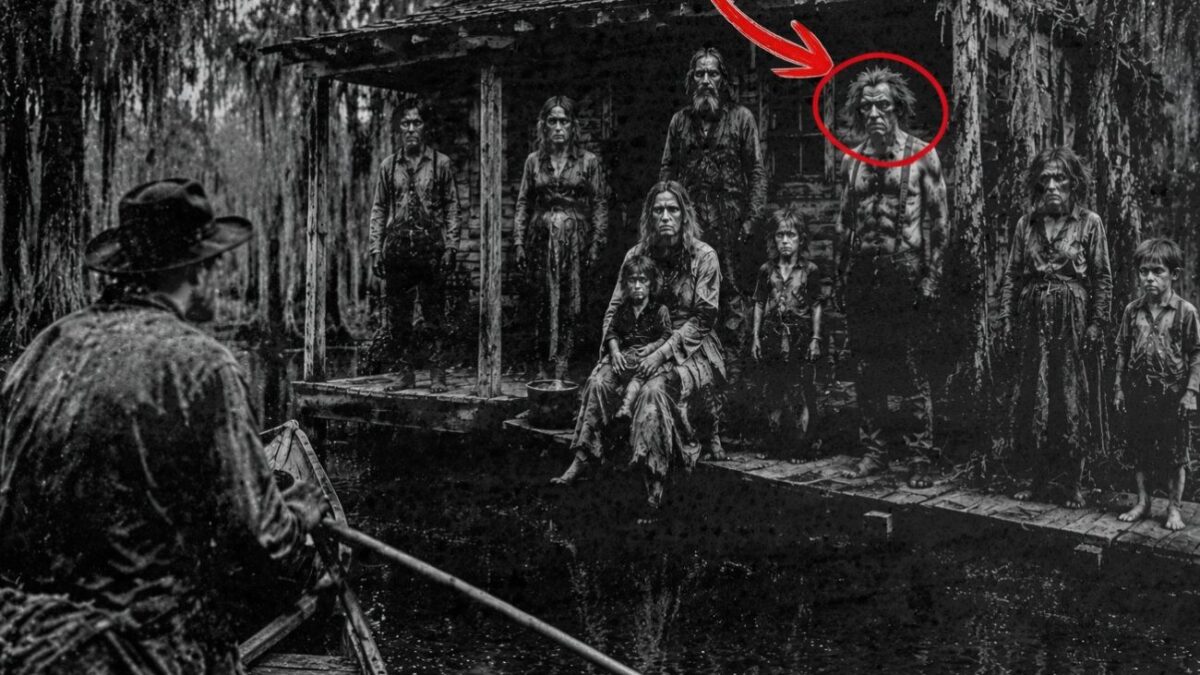
Unlike every other dwelling in the basin, it was not built on stilts. It sat directly on a hummock of raised earth—an island of packed mud ringed by tupelo trees planted in a rough circle to conceal it. The cabin was an ancient patchwork of cypress planks of various vintages, with a roof of shingles and moss, and a smoke hole at the ridge leaking thin, greasy smoke. Around the base of the structure on the packed mud were bones—not scattered food scraps, but deliberately arranged bones set into shallow trenches around the perimeter. He saw the long bones of deer, smaller bones of raccoons, and, closer to the door, a set of ribs that were the wrong size and curvature to belong to any ordinary local animal.
The chanting came from inside, layered at slightly different pitches so it sounded less like a chorus and more like a swarm. But the most terrifying sight was the open doorway. Watching him from the interior darkness was a face. Emil had seen alligator attacks and wounded panthers, but this face was wrong. The features were there, but the proportions, the socket placement, and the expression—or absolute lack thereof—were unnatural. It was the blankness of a thing that had never learned what human expressions were for. The face did not blink or move.
Griping his paddle, Emil turned his pirogue around as quietly as possible and paddled for three hours through unfamiliar water until he reached the safety of a known bayou near Grand Coteau. When he pushed open the door of the general store, the women were humming that same song about the door that is not a door. Emil began to cry, and the shopkeeper sat him down with a cup of chicory coffee, asking quietly what he had seen.
What Emil told the shopkeeper that night, and later repeated to the parish priest and Sheriff Antoine Thibodaux, formed the beginning of an official record that no longer exists in public archives. The fragments that survived came from documents sent to New Orleans before the sealing order or kept in private family hands.
According to surviving parish register fragments, the Budro family on the hummock descended from a man named Alcide Budro, baptized in St. Martinville in 1798. He married Elodie Landry in 1821, after which Alcide vanished from the parish record for forty-six years. He did not baptize children or attend mass, yet tax rolls showed he periodically paid small assessments in cash or furs, with his address laconically listed by the clerk as prairie perdu.
The silence broke in August 1867 with a letter from Father Théodule Léger to the bishop in New Orleans. The priest described a three-day visit to the deep basin settlement at Alcide’s invitation, where he said mass and baptized fourteen individuals ranging in age from three to twenty-two. None had ever received sacraments before or spoke a recognized language, though they mimicked the baptismal words. Alcide, then sixty-nine, presented himself as the father of all fourteen. Father Léger noted with quiet horror that a substantial proportion of these children had been born to mothers who were themselves Alcide’s daughters. The priest intended to return to instruct them, but died of a sudden fever less than three months later. His replacement was strictly forbidden by the bishop from ever traveling into the deep basin, leaving the family untouched for another twenty-five years.
In the decades following Father Léger’s letter, Terrebone Falls Parish experienced a statistically unusual number of disappearances—averaging one per year. When Sheriff Thibodaux later plotted these twenty-five disappearances on a map in chronological order, they formed a tight spiral pointing straight to the hummock in the prairie perdu.
When authorities finally raided the cabin after Emil Fontineau’s discovery, they uncovered chilling proof. Inside, they found seventeen personal effects belonging to missing parishioners: a hunting knife carved with staghorn and initials belonging to a missing trapper named Sylvan Cormier; a rosary belonging to Marceline Duceay, who vanished in 1874; a tortoise-shell hair comb; children’s shoes; and, in a wooden box beneath a bed, a collection of thirty-one human teeth, each wrapped in a square of antique New Orleans morning fabric.
Sylvan Cormier’s mother, handed her son’s knife in the sheriff’s office, turned it over slowly before whispering that she had known for ten years her son was dead, but had only just learned he had been eaten—using a local patois word carrying deep, dark connotations of consuming someone to absorb their qualities.
The authorities found ninety-four-year-old Alcide Budro still alive, sitting by the hearth, surrounded by his silent, feral kin. The back room of the cabin was ordered sealed immediately by the sheriff, then burned to the ground along with the structure itself. The surviving members of the family were quietly dispersed under armed guard to distant asylums, and the parish clerk was ordered to pull every file relating to the prairie perdu. By the summer of 1893, all official mention of the Budro family had vanished from the state archives, leaving behind only whispers in the dark corners of the basin and a haunting melody about a door that is not a door.

