Why U.S. Marines Were Ordered NEVER to Pick Up a Japanese Sword
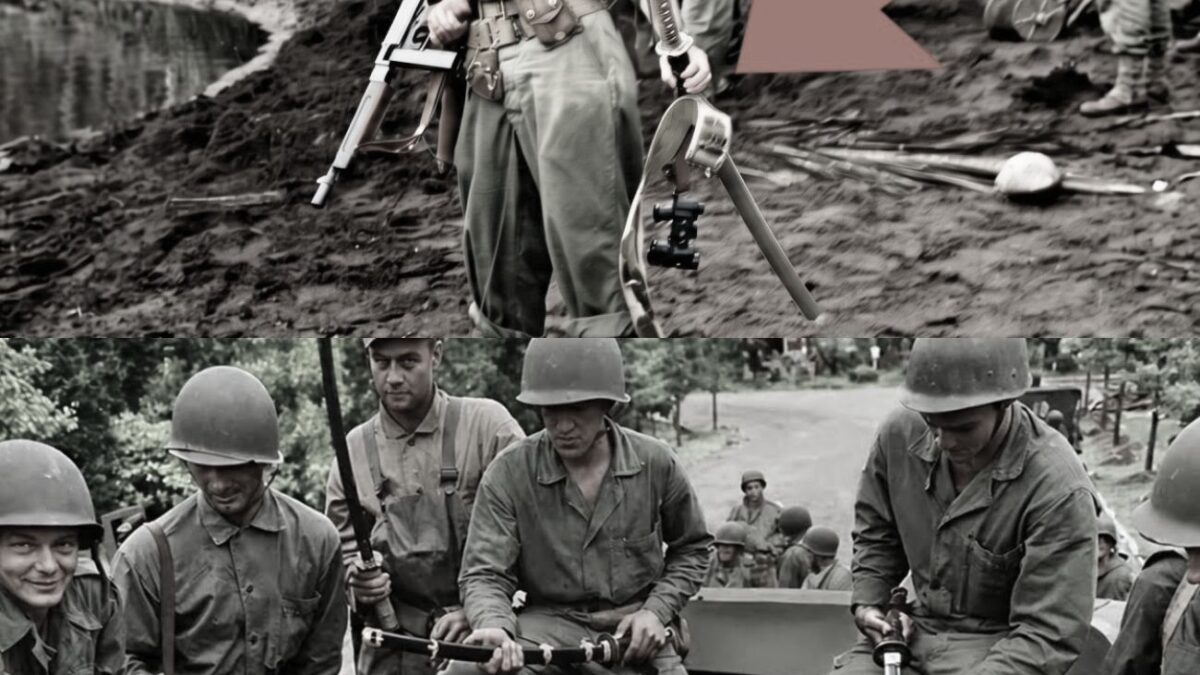
The silence that followed a failed banzai charge was never an empty quiet, but a thick, suffocating weight that settled deep into the damp earth. Across the torn ridge of a nameless Pacific atoll, the smoke of mortar fire lingered like gray grease against the jagged roots of shredded palm trees. In the middle of that ruined ground lay a Japanese officer, sprawled face down in the volcanic ash, his tunic blackened by powder burns and stiffened by dried blood.
Beside his outstretched hand rested the single object that every infantryman on the line coveted far more than a clean pair of dry socks or a stack of unopened mail from home. The scabbard was wrapped in dull olive leather, fitted with gilded bronze mounts that caught the first sharp rays of the tropical morning sun. It was an officer’s gunto, the ultimate prize of the island war, gleaming like untouched treasure among the twisted wreckage of men and spent brass.
A young private huddled behind a shattered coconut log caught sight of the brass fittings and stopped breathing for several long seconds. He did not pause to scan the dark treeline, nor did he look toward the squad leader who was currently crouched twenty paces back, frantically waving his arm to signal a hold. The kid scrambled out of the slit trench on his belly, scrambled across the hot shale, reached out his dirty hand, and watched the ground beneath his chest violently erupt into flame.
What nobody told that boy, and what nobody standing fifty yards back behind the coral berm could possibly have seen, was that the fallen officer was never the ambush. The dead man was nothing more than an inert frame of bone and cloth, abandoned to the flies and the rising heat. The sword lying beside his cold fingers was the true weapon, crafted to butcher the living long after the heartbeat of its owner had stopped.
This is the grim history of how the most sought-after souvenir of the Pacific Theater became one of its quietest and most efficient killers. It explains why seasoned combat commanders eventually began threatening their own men with court-martial simply for bending down to pick a relic up out of the coral. The obsession did not begin in the bloody final months of Okinawa, but rather in the green hell of Guadalcanal during the desperate autumn of 1942.
When the first waves of the First Marine Division scrambled ashore on that malaria-choked island, the vast American military machine developed a bizarre second appetite. They were not merely fighting to secure an airstrip or hold a perimeter against starving enemy regiments; they were hunting for artifacts to pack into canvas seabags. The hunger for keepsakes took root immediately, spreading like an epidemic through every foxhole and staging area along the perimeter.
Around the middle of October that year, an intelligence officer interrogated a downed Japanese pilot who allegedly delivered an observation that stung precisely because it was accurate. The prisoner looked at his interrogator and noted that his own countrymen fought fanatically for their divine Emperor, while the Germans across the Atlantic bled for Adolf Hitler. The Americans, however, seemed to throw themselves into the line of fire largely to collect curiosities and belt buckles.
Years later, the combat historian William Manchester recalled that identical front-line aphorism circulating in a slightly cleaner and far more biting form among the veterans. The Japanese died for the Emperor, the British endured for empire and glory, but the American farm boys crossed the wide ocean exclusively to hunt for souvenirs. It was funny enough to draw a dry chuckle around a smoldering smudge pot, but it masked an ugly and escalating reality.
That compulsive thirst for tangible proof of victory was already claiming young lives on the very first major ground battlefield of the island-hopping campaign. On the night of August 21, 1942, Colonel Kiyonao Ichiki hurled roughly nine hundred veteran soldiers of the 28th Infantry Regiment straight into the dug-in Marine lines along the sandspit of the Ilu River. By dawn, Ichiki’s entire assault force had been virtually wiped out, their bodies stacked three deep along the bloody sandbar.
A young mortarman named Robert Leckie stood in the morning haze and watched the souvenir hunters move immediately into the carpet of corpses like eager scavengers. He noted in his classic memoir that the men picked their way delicately through the severed limbs and shattered equipment, hesitant yet completely unable to restrain their impulses. Even then, an instinctive dread hung over the dead, a primitive realization that a fallen enemy might still have one last lethal secret tucked inside his uniform.
To understand why an eighteen-year-old soldier would risk his life on a pile of maggot-ridden corpses, one must first comprehend the mesmerizing allure of the prize itself. At the absolute top of the hierarchy of battlefield plunder sat the curved steel blade, an object that almost every Western soldier fundamentally misunderstood. They invariably called them samurai swords, imagining ancient feudal workshops and legendary warrior clans while dragging them through the jungle mud.
The vast majority of those weapons were not ancestral heirlooms at all, but mass-produced military items designated by the Imperial Japanese armed forces as gunto. The most ubiquitous pattern encountered across the battlefields was the Type 98 Shin Gunto, an army officer’s weapon adopted in 1938 to replace earlier, French-inspired cavalry hilts. It featured a traditional hilt wrap over ray skin, fitted to a machine-stamped blade designed to withstand the brutal mechanical wear of modern industrial warfare.
There was also the earlier Type 94, which carried two suspension mounts on its metal scabbard, and the widely despised Type 95, issued directly to non-commissioned officers. The Type 95 was an industrial product through and through, featuring a cast brass or aluminum hilt painted to mimic cloth, paired with a serial number stamped right into the steel. Meanwhile, Imperial Navy landing forces carried the Kai Gunto, distinguished by its blackened stingray scabbard and polished fittings suited for salt air.
Yet within that massive sea of standard-issue ordinance lay the rare, terrifying reason why every infantryman continued to roll the dice on every scabbard he saw. While more than ninety percent of wartime blades were simple spring steel forged rapidly in the industrial foundries of Seki, a small fraction were genuine antiques. Modern estimates confirm that only about six percent of military-mounted blades were forged using traditional folded steel, quenched in clay and polished by hand.
Wealthy officers and members of ancient military lineages had simply taken their centuries-old family heirlooms out of domestic mounts and bolted them into regulation brass fixtures. A battered scabbard pulled from the mud might contain a worthless piece of machine steel stamped in 1941, or a priceless masterwork forged during the Kamakura period. An American rifleman squinting through the gunsmoke had no way of telling the difference without prying the blade free, and that uncertainty drove men mad.
Ranked immediately below the sword was the officer’s personal sidearm, most notably the Type 14 Nambu automatic pistol chambered in the bottle-necked eight-millimeter cartridge. Because of its distinctive raked grip and tapered barrel, American troops immediately nicknamed it the Japanese Luger, treating it with an almost mythical reverence despite its notorious mechanical flaws. The gun was prone to weak striker springs, catastrophic misfires, and possessed a magazine that was nearly impossible to drop with one hand.
Roughly four hundred thousand Type 14s were manufactured, though thousands disappeared beneath the waves or were deliberately pulverized with sledgehammers by their owners before capture. The Japanese viewed their small arms as personal property bestowed by the Emperor himself, meaning that surrendering a weapon brought unforgivable shame upon their living relatives. Many chose to expend their last cartridge through their own palate rather than allow an Allied soldier to pocket the imperial crest stamped into the receiver.
Even worse was the smaller, clumsier Type 94 pistol, an eight-millimeter abomination featuring an exposed sear bar running flush along the exterior of the frame. If an eager soldier snagged the weapon from an officer’s holster and accidentally bumped that exposed bar against a branch or a canteen, it fired instantly. American front-line units quickly dubbed it the suicide gun, yet men continued to trade bags of dry rations and cartons of cigarettes just to possess one.
Below the weapons came the deeply personal artifacts stripped from the interior pockets of tunics, items that could be easily wrapped in oilcloth and sent home. The most famous was the Hinomaru Yosegaki, the national good luck flag made of white silk, covered in radiating signatures and prayers from friends and kin. Mothers, fathers, and local dignitaries would gather to brush blessings of martial fortune around the red sun disk before the recruit departed for foreign shores.
Alongside the flag rested the Senninbari, or thousand-stitch belt, a length of white cloth adorned with a thousand individual knots sewn by a thousand different women. Each knot was accompanied by a whispered prayer, transformed by traditional folk belief into an amulet capable of deflecting high-velocity lead and shrapnel from the wearer. These intimate items were lightweight, slipped easily into an overseas mail pouch, and quickly became the most widely circulated souvenirs of the entire Pacific conflict.
The commercial mania for these tokens grew so insatiable that ordinary supply chains across the Pacific Theater rapidly morphed to satisfy the demands of the troops. In rear-echelon repair depots, Australian engineers began manufacturing counterfeit samurai swords out of scrap vehicle springs, aging the bronze fittings with battery acid to sell to Americans. On Guadalcanal, Marines were caught painting counterfeit rising sun banners onto bedsheets, carefully copying the intricate Japanese characters off empty tins of canned mackerel.
The Japanese high command was neither blind nor ignorant to this desperate American appetite for martial keepsakes, and they moved swiftly to weaponize it. But here, the historical record must be stripped bare of the cinematic exaggerations that have accumulated around the subject across the decades of popular post-war lore. The common Hollywood image depicts a pristine sword tied to an invisible tripwire, hooked directly to the spoon of an American fragmentation grenade.
While that cinematic trap certainly occurred in scattered instances, military intelligence reports preserved in the National Archives reveal a reality that was far more insidious. An officer rigging a blade rarely bothered with delicate, tension-sensitive wire that could be easily spotted by a cautious man probing the ground with a bayonet. The Japanese had realized that the greatest vulnerability was not the act of picking the sword up, but the reckless approach toward it.
In December of 1944, the War Department’s official Intelligence Bulletin published a field report from an American cavalryman operating in the dense scrub of the Admiralty Islands. His description was short, brutal, and unadorned: the enemy was deliberately using ornate swords and silk flags as visible bait to lure unsuspecting infantrymen into minefields. The technique required no intricate linkage to the weapon itself; it relied entirely on human greed and a simple pressure plate buried inches away.
The engineers would lay an officer’s scabbard out in the open, usually across a fallen trunk or nestled cleanly into a patch of undisturbed river sand. They would then conceal a wooden Type 3 or a magnetic Type 99 mine directly in the single natural footstep a man would take to reach down. The hunter never died because he disturbed the hilt; he died because his right boot dropped six inches short of his prize, triggering four pounds of picric acid.
To comprehend why a professional Imperial Army officer would permit his own family blade to be utilized as bait, one must look directly into bushido. During the aggressive militarization of the early Showa period, the Tokyo government deliberately resurrected the feudal cult of the warrior class to unify the ranks. The officer’s blade was no longer viewed merely as an edged tool of war, but as the literal, breathing repository of the warrior’s immortal spirit.
In the romantic, fatalistic philosophy that drove the officer corps, the blade was an unbroken physical bridge connecting the warrior to his ancestors and his divine sovereign. To allow that sacred object to be roughly hauled off by an enemy soldier, only to be hawked for whiskey or traded for canned peaches, was desecration. It was an intolerable spiritual violation that stripped the dead man of his final measure of honor on the battlefield of his ancestors.
Transforming that holy relic into an instrument of absolute slaughter carried an austere, unyielding logic that aligned perfectly with the brutal realities of the island fighting. If the degenerate Western enemy possessed an uncontrollable lust for the soul of the fallen, then that very greed should serve as his tombstone. The sword would perform its sacred duty one last time, sacrificing its physical sheath to ensure the destruction of the barbarian who dared touch it.
This cruel psychology fit seamlessly into the broader, desperate defensive doctrine that took hold across the empire as the tide of war turned inexorably after 1943. Facing overwhelming industrial superiority, Japanese combat engineers turned booby-trapping into an art form, converting everyday terrain into subterranean chambers of continuous slaughter. They wired natural limestone caves, fortified civilian burial vaults, and even the rotting flesh of their own fallen comrades to ensure that every advance cost blood.
The clearest and most chilling official account of the trophy ruse emerged from the battered limestone cliffs of Saipan during the ferocious fighting of July 1944. A senior Marine intelligence officer submitted a field memorandum describing the exact trap that was regularly dismantling front-line infantry squads in the island’s northern pocket. Japanese riflemen would take shelter within the deep shadows of natural caves, then push a polished sword or rifle out onto the bright apron.
The glistening metal caught the eye of passing riflemen from fifty yards away, dangling like silver bait in front of men who had fought weeks without sleep. The moment an eager private broke formation and hurried forward with his hands extended, a hidden marksman nestled thirty feet back in the dark fired. The officer’s subsequent summation in the intelligence report was chillingly direct: the trick worked reliably, producing dozens of entirely unnecessary American casualties among the assault waves.
The explosives that supplied the lethal force beneath these trophies were the standard munitions found in every Imperial infantry battalion’s forward supply depot. The serrated Type 97 fragmentation grenade, the dual-purpose Type 91, and the round Type 99 kiska grenade were all readily modified for subterranean use. An engineer had only to pull the brass safety pin, wedge the grenade into a hollow bamboo tube, and place the trophy lightly over the exposed striker.
When standard factory munitions began to run dry under the relentless naval blockades, the defending garrisons displayed an astonishing, terrifying capacity for battlefield improvisation. Along the oily beaches of Tarakan, Australian troops discovered an unexploded five-inch Dutch naval shell buried nose-up in the sand, masked beneath an officer’s ceremonial cap. The trophy did not need an intricate trigger mechanism; it merely required a tired soldier whose common sense had been burned away by exhaustion.
By the time the meat grinder reached the jagged coral peaks of Peleliu and the red clay ridges of Okinawa, the booby trap had become atmospheric. Eugene Sledge, a mortarman serving in King Company, Third Battalion, Fifth Marines, captured this creeping dread with unflinching clarity in his classic memoir, With the Old Breed. He documented the obsessive trophy hunting with a clinical, horrified honesty, noting how the constant scavenge for relics warped the humanity of his companions.
Sledge described the predatory savagery that uniquely infected the ground war in the Pacific, an environment where men stripped corpses with cold, mechanical indifference. On Okinawa, every ancient limestone burial tomb encountered by the infantry had to be treated as a potential detonation chamber packed with high explosives. Corporal Joseph Pizamenti of the 96th Infantry Division recounted discovering an immaculate lacquer box resting in a tomb entrance, an obvious snare that turned his stomach cold.
Faced with this steady drain of experienced combat personnel, modern observers might reasonably assume that high command intervened by executing instant courts-martial for looting. The reality of how the military hierarchy attempted to manage the trophy crisis was far more complex, frustrated, and ultimately revealing of front-line realities. Commanders could not simply line up their exhausted, malaria-ridden assault troops for military trials while the lines were still actively fluid and breaking.
Instead, division and corps headquarters unleashed a continuous blizzard of stern warnings, restricted orders, and immediate administrative crackdowns that carried genuine weight. They invoked the 80th Article of War, which expressly governed the capture and improper disposal of abandoned enemy property, threatening offenders with hard labor. They placed entire captured supply complexes and cave networks strictly off-limits, posting armed military police to turn back souvenir hunters at the point of bayonets.
Yet beneath the concern for booby traps lay an equally urgent military priority that had nothing to do with saving young infantrymen from hidden mines. Every time an overeager private snatched a sword from a fallen officer, he invariably ripped away the leather map case and order book resting underneath. Thousands of critical operational maps, cipher tables, and handwritten command directives were lost forever to combat intelligence because they were stuffed into seabags as personal souvenirs.
There was also a far darker and more shameful dimension to this disciplinary campaign, one that forced American high command to look inward with profound disgust. The hunting of battlefield trophies did not stop with inanimate pieces of forged steel, silk flags, or brass-mounted leather holsters and canvas belts. It is well documented by historians on both sides that some American soldiers engaged in the grotesque mutilation of Japanese remains, prying out gold teeth and collecting bones.
The practice grew frequent enough that in September of 1942, Admiral Chester W. Nimitz was forced to issue a scathing directive to all Pacific forces. He stated unequivocally that the desecration of enemy remains was a dishonorable violation of the laws of naval warfare that would be punished with maximum severity. The following year, General George C. Marshall dispatched a severe radio warning to General Douglas MacArthur regarding mounting reports of horrific battlefield conduct.
By January of 1944, the Joint Chiefs of Staff had drafted their own formal policy explicitly prohibiting the taking of body parts under threat of court-martial. Historians have long debated the exact scope of these actions, recognizing that while the vast majority of soldiers abhorred the practice, a visible minority indulged. The orders were officially published because the rot was undeniable, reflecting the total, horrifying dehumanization that characterized the Pacific conflict from its earliest days.
Yet there was one final, deeply unglamorous reason why senior medical officers begged field commanders to keep their men away from the sprawling enemy dead. That reason was the swift, rampant spread of lethal tropical disease fueled by the rapid putrefaction of organic matter in equatorial humidity. In temperatures regularly exceeding one hundred degrees, human flesh decayed with terrifying velocity, transforming battlefields into seething cesspools of flies, maggots, and dysentery within hours.
Eugene Sledge documented repeatedly how the pervasive stench of rotting flesh clung to the uniforms, hair, and very souls of the men who lived forward. Crawling across a carpet of decomposing soldiers to inspect a sword belt was an open invitation to acquire violent fevers, ringworm, and debilitating gastrointestinal infections. A soldier incapacitated by bacillary dysentery was just as useless to a company commander as a soldier whose foot had been shattered by a pressure mine.
When one examines the complete historical canvas, the prohibition against souvenir hunting was never rooted in a single, neat tactical calculation or chivalric consideration. It was an accumulation of brutal realities: the pressure plate in the dirt, the sniper waiting in the darkness, the catastrophic loss of vital intelligence. It was the frantic effort to halt psychological barbarism among their own ranks, combined with the desperate necessity of keeping troops free from disease.
Over the course of the war, the Imperial Japanese armed forces manufactured and distributed well over one million military swords to their officers and sergeants. Hundreds of thousands of those curved steel weapons ultimately made their way across the sea, carefully stowed inside the duffel bags of returning American servicemen. The overwhelming majority were taken completely without incident, pulled from massive surrender depots, coastal warehouses, or off the bodies of men who held no traps.
The booby-trapped trophy was a mathematically minor element within the enormous, industrial machinery of Japanese defensive warfare, but its psychological terror was absolute. Every single infantryman who reached down through the tall kunai grass to grasp an exposed hilt was placing his life on an agonizing gamble. He was betting that the cold steel in front of him was an innocent piece of abandoned equipment, rather than an intricately disguised instrument of death.
That gamble brings us back to the sword resting silently in the ash, a blade that outlived the violent era of its creation by generations. Most of those captured weapons never returned across the ocean; they spent fifty, sixty, or seventy years hidden deep within American attics and cedar closets. They rested silently in cardboard boxes, wedged behind dust-covered uniforms that old men could never bear to look at, much less discuss with their children.
Along with the swords went thousands of the silk good luck flags, their crimson centerpieces and faded black ink signatures preserved in permanent darkness. Contemporary estimates suggest that more than fifty thousand of these family heirlooms still sit forgotten in American basements, with another two hundred thousand scattered across the globe. They represent a haunting, unresolved legacy of a total war that consumed an entire generation of young men on both sides of the sea.
In recent years, a small, dedicated non-profit organization based in Astoria, Oregon, known as the Obon Society, began a quiet and extraordinary mission. Its volunteers began examining the delicate brushstrokes on those captured flags, utilizing family registries and town archives to trace the artifacts back to their ancestral homes. Working patiently across continents, they have succeeded in returning hundreds of personal flags and artifacts directly to the surviving descendants of the fallen.
Against the staggering total of more than one million Japanese servicemen whose remains were never recovered from the islands, that number seems impossibly small. Yet to an elderly woman in an isolated mountain village receiving the final physical trace of her long-lost brother, the gesture is everything. It transforms a trophy of conquest back into an intimate human tragedy, closing a wound that had remained raw and open for more than eighty years.
The sword was once believed to be the living soul of the imperial soldier who strapped it to his leather belt before stepping onto the transports. That fervent, unyielding conviction was precisely what made it the most coveted prize on the battlefield, the ultimate symbol of victory over a stubborn foe. It was also the exact same mystical belief that allowed it to be transformed into bait, waiting in the mud to claim one final life.
Now, eight decades after the last artillery round echoed off the coral ridges, those lethal souvenirs are finally embarking on their long, quiet journeys home. They are no longer traveling as glorious spoils of war tucked inside an infantryman’s seabag, nor as grim instruments of sudden, subterranean violence in the dark. They are returning simply as a dead boy’s forgotten possession, the long-delayed homecoming of a father, an uncle, or a brother who never left the dirt.

