Why U.S. Marines Were Ordered NEVER to Help the “Guy with his Hands Up”
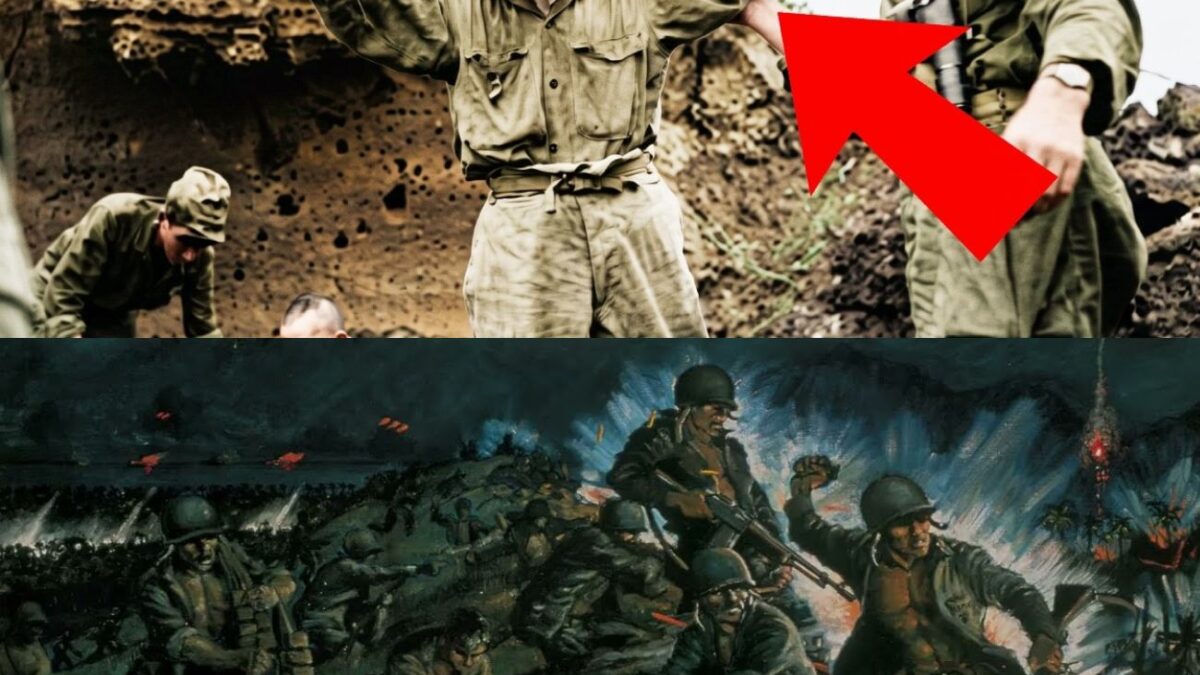
On the twelfth day of August 1942, Lieutenant Colonel Frank Goettge stepped from the ramp of a Higgins boat into the dark surf of Guadalcanal.
Behind him came twenty-four handpicked Marines, moving through the warm, black water toward an unfamiliar shoreline near the mouth of the Matanikau River.
They were embarking on what was meant to be a mission of mercy, diplomacy, and intelligence gathering, lured by words that felt like a quiet blessing.
Earlier that day, a captured Japanese naval warrant officer had broken down during interrogation, his resolve softened by generous rations of medicinal alcohol.
He told his captors that a sizable contingent of Imperial troops west of the American perimeter was starving, abandoned, and thoroughly broken in spirit.
They wanted only to lay down their rifles and yield to honorable captivity, having even hoisted a white flag visible along the dense, tangled tree line.
Goettge served as the chief intelligence officer for the First Marine Division, a seasoned officer who desperately wanted to believe the enemy was human.
He refused to leave this critical opportunity to chance, assembling a team of specialists to ensure the delicate operation went smoothly from the start.
His patrol included a regimental surgeon to tend the sick, a fluent Japanese language interpreter, and a protective detachment of veteran combat scouts.
Under the shroud of midnight, the wooden boat ground its hull against the coarse sandbars just west of Point Cruz, completely isolated from friendly lines.
The silence of the jungle was thick, heavy with the stench of rotting vegetation and the ceaseless, deafening rhythm of nocturnal insects.
Before the men could even clear the damp surf, the surrounding jungle exploded into an overwhelming sheet of coordinated, interlocking machine-gun fire.
Lieutenant Colonel Goettge fell in the very first second of the ambush, struck in the head by a heavy burst before his boots found dry ground.
There was no defeated garrison waiting to be saved, no demoralized cadre seeking food, and no honest desire for honorable surrender.
The white cloth fluttering between the palms had been calculated bait, an intentional trap designed to exploit the Western assumption of battlefield decency.
Twenty-two of the twenty-five men were cut down where they stood, trapped helplessly in the open between the foaming sea and the hidden guns.
Platoon Sergeant Frank Few crouched low behind a shelf of coral, watching in paralyzed horror as the final moments of his comrades unfolded.
Japanese soldiers surged out from the brush with fixed bayonets, methodically shooting the fallen and brutally mutilating every corpse they could find.
Few managed to kill an charging enemy soldier with his sidearm before spinning on his heel and diving into the churning black water of the sound.
He swam four agonizing miles through the pitch-black, shark-infested current, guided only by the distant, rhythmic flashes of American artillery.
He was one of only three survivors who made it back alive, and the mutilated remains of Goettge and his men were never recovered.
Nine days later, the terrible lesson of Point Cruz was carved irrevocably into the bone and sinew of the First Marine Division.
Along the sandspit where the sluggish waters of the Ilu River—mistakenly called Alligator Creek—met the sea, Colonel Kiyonao Ichiki struck.
He threw nine hundred and sixteen elite infantrymen of the 28th Infantry Regiment straight into the fortified wire of the American perimeter.
The Japanese assault was a magnificent and suicidal display of raw bravado, charging directly into the crosshairs of dug-in water-cooled machine guns.
Private Johnny Rivers fired until a bullet struck him between the eyes, leaving his weapon smoking in the sand as his loaders scrambled to take his place.
Corporal Lee Diamond immediately slid behind the spade grips, shouting over the din, while Private Al Schmid fed belts until an exploding grenade blinded him.
Schmid kept his hands on the trigger, blind and bleeding, taking vocal commands from his wounded comrades to rake the sandspit with lead.
By late afternoon the following day, the battle was officially over, and more than eight hundred Japanese soldiers lay sprawled across the torn sand.
The sun rose hot and sickening over the beach, turning the quiet estuary into a vast open-air slaughterhouse covered in buzzing swarms of black flies.
Then, without warning, the slaughter began a second time, shattering whatever fragile peace had settled over the blood-soaked sandbars of Guadalcanal.
Marine riflemen and navy medical corpsmen walked among the mounds of fallen enemy soldiers, looking for wounded men who might still be saved.
Suddenly, a Japanese soldier who appeared dead sat upright, his eyes wild, and leveled a hidden pistol directly at the approaching stretcher team.
Another wounded soldier, his abdomen ripped open by shrapnel, calmly pulled the safety pin from a Type 97 grenade concealed beneath his hip.
A Japanese sergeant lunged at three inspecting officers, including Lieutenant Colonel William Creswell, attempting to fire his sidearm before being shot dead.
Men who had miraculously survived the night assault were maimed or killed by enemies they had mistakenly assumed were harmless corpses.
The Marines learned immediately that the fallen could not be approached, touched, or pitied without risking an instantaneous and violent death.
Rifles barked continuously across the beach as Marines pumped rounds into every motionless body, ensuring no man retained the strength to strike back.
A profound, irreversible shift settled over the battlefield, transforming a standard war of nations into a mutual struggle of absolute extermination.
In the quiet shade of a canvas tent, Major General Alexander Vandegrift sat down to pen a grim letter to Marine Corps Commandant Thomas Holcomb.
The words he wrote beneath the dim light of a lantern would fundamentally reshape the psychology of American infantrymen for the next three years.
He wrote that these people simply refused to surrender, biding their time until men came up to examine them before detonating concealed grenades.
He concluded his dispatch with a chillingly practical sentence that soon hardened into unwritten combat doctrine across every Pacific landing zone.
“You can readily see the answer to this,” Vandegrift wrote, leaving no ambiguity about how his men would handle such encounters in the field.
The answer was brutally simple, entirely merciless, and necessitated the total destruction of every enemy soldier found on the field of combat.
That dark reality had not been born on the beaches of Guadalcanal; its foundational laws had been codified months before the Americans ever landed.
On the eighth of January 1941, War Minister Hideki Tojo had issued Army Order Number One, introducing a pocket manual known as the Senjinkun.
Every imperial conscript received the booklet, carrying it over his heart inside his uniform blouse as an absolute ethical compass for modern warfare.
Its most famous passage was an uncompromising demand that left no room for defeat, compromise, or the preservation of human life.
“Do not live to endure the shame of imprisonment,” the manual instructed, equating military captivity with an eternal and unforgivable moral stain.
“By dying, you will avoid leaving behind the crime of a stain on your honor,” the text commanded, establishing death as the only righteous outcome.
A soldier who allowed himself to be captured did not merely fail his regiment; he was formally erased from the social fabric of his home.
His name was struck from the official family registers in his home village, his parents were publicly disgraced, and he became an unspeakable non-entity.
To surrender was to abandon civilization itself, casting oneself out of the imperial family and betraying the sacred lineage of the Emperor.
The moral mandate was reinforced by concrete revisions to the operational regulations governing the Imperial Japanese Army in combat zones.
In 1940, field service modifications quietly eliminated the traditional Geneva Convention protections historically afforded to severely wounded soldiers.
The revised manual established an absolute institutional rule: no imperial soldier, under any circumstance, was ever to fall into foreign hands alive.
In practical execution, this meant field surgeons routinely administered lethal injections or distributed poisons to men too badly injured to withdraw.
Officers handed out fragmentation grenades to soldiers whose legs had been shattered by artillery, expecting them to utilize the weapons on themselves.
Once a broken man grasped a live explosive, waiting for the approaching boots of enemy soldiers to pull the pin was an instinctive tactical leap.
It was an act actively encouraged by commanders who understood that dying in an explosion of mutual slaughter redeemed a fallen soldier’s honor.
The Japanese referred to this sacrificial ideal as gyokusai, a poetic phrase translating to “shattered jewel,” framing total annihilation as glorious art.
A military unit was not destroyed by superior enemy tactics; it was preserved forever in a state of pristine, unyielding spiritual purity.
This was never the desperate improvisation of terrified conscripts cornered in muddy foxholes, but rather a deliberate and institutionalized doctrine.
By the time the Second Marine Division hit the coral beaches of Betio Island at Tarawa Atoll in November 1943, the doctrine was perfected.
Four thousand five hundred imperial troops, including elite Special Naval Landing Force units, waited within heavily fortified, bombproof coral-and-log bunkers.
The bloody assault lasted seventy-six grueling hours, turning the tiny island into a concentrated nightmare of smoke, high explosives, and burning flesh.
More than a thousand American Marines were killed in the surf and on the sand, while over twenty-three hundred were grievously wounded.
When the firing finally died down across the leveled atoll, only seventeen Japanese military personnel out of the entire garrison surrendered alive.
Seventeen men out of forty-five hundred; the rest died in their emplacements, in shattered communication trenches, or in midnight banzai charges.
Among the dead were dozens of men who had carefully feigned mortal injury, waiting patiently until stretcher teams knelt beside their limp bodies.
They held their breath, their fingers tightly hooked into the split rings of concealed explosives, trading their final seconds for an American life.
Tarawa proved to every front-line commander that the bloody tragedy of the Goettge patrol had not been an isolated misunderstanding of intentions.
The fake surrender was a formalized defensive weapon, an asymmetric tactic meant to inflict maximum emotional and physical trauma on the enemy.
Because the imperial soldier regarded surrender as an unforgivable cowardice, he viewed Western adherence to the rules of war as childish weakness.
The deadly philosophy escalated in scale and ferocity seven months later during the invasion of Saipan in the Mariana Islands chain.
On the seventh of July 1944, Lieutenant General Yoshitsugu Saito realized his positions were entirely compromised and ordered a final, massive counterattack.
Four thousand three hundred and eleven imperial soldiers formed up in the darkness, armed with rifles, bayonets, and grenades lashed to bamboo poles.
They threw themselves against the positions held by the 105th Infantry Regiment, creating a chaotic wall of screaming men and exploding ordnance.
Yet the violent horror of the banzai charge was utterly eclipsed by the catastrophic events that unfolded at the northern cliffs of Marpi Point.
There, the imperial military command turned its apocalyptic philosophy directly against the terrified civilian population trapped along the rocky coast.
Japanese civilian propaganda had consistently told the islanders that American soldiers were subhuman barbarians who would rape, torture, and eat them.
General Saito’s headquarters had broadcasted direct orders to the trapped civilian populace, declaring it their duty to die rather than be captured.
Marines stood at the jagged edge of the rocky cliffs, yelling through megaphones, begging the families gathered below to turn back from the drop.
Through binoculars, American troops watched mothers methodically throw their infants into the violent surf before leaping into the churning sea themselves.
A Time magazine correspondent on the scene recorded a scene that permanently scarred the memories of every battle-hardened veteran who witnessed it.
A group of approximately one hundred civilians bowed respectfully toward the watching Marines, stripped off their garments, and ritually bathed in the sea.
They dressed themselves in immaculate clean clothes, spread a large imperial flag across a flat rock, and began pulling grenade pins together.
Imperial snipers concealed in the surrounding brush fired accurately into the backs of any civilian who hesitated before taking the fatal plunge.
Between eight hundred and one thousand Japanese civilians died along the rocks of Marpi Point, their broken bodies floating in the foam.
Among the limestone caves below the cliffs, the familiar pattern of suicidal deception played out with renewed and terrifying regularity.
Japanese soldiers threw their weapons to the ground, raised their arms, and waited for American squads to close the distance before detonating themselves.
Even civilian women were recruited into the slaughter, their natural appearance of vulnerability turned into an effective, cold-blooded ambush tactic.
In one documented incident, two young women walked slowly out of a dark cave completely naked, beckoning enticingly to an American combat patrol.
The patrol consisted of combat veterans who had already seen too many comrades killed by feigned weakness and duplicitous white flags of truce.
They did not advance; instead, they brought their rifles up and opened fire, dropping both women onto the jagged limestone rocks below.
When the scouts cautiously inspected the fallen bodies, they discovered fragmentation grenades strapped tightly beneath each woman’s armpits.
The war had stripped away every lingering vestige of normal human sympathy, replacing it with an instinct for immediate, lethal preemptive action.
Every white rag was assumed to be an ambush, every outstretched hand was treated as a trigger, and every corpse was regarded as explosive.
Far to the south, during the brutal September heat of 1944, a twenty-year-old mortarman from Mobile, Alabama, waded ashore onto Peleliu.
His name was Eugene Bondurant Sledge, a sensitive young man serving with King Company, Third Battalion, Fifth Marines, in a living hell.
The company landed with two hundred and thirty-five men; when they were finally pulled off the line, only eighty-five remained unwounded.
Sledge carried a small pocket New Testament through the carnage, scribbling raw, honest observations into the margins between the printed verses of Scripture.
His written recollections would eventually form one of the most uncompromising, historically significant accounts of enlisted infantry combat ever published.
He described how every limestone cave they assaulted was covered by interlocking heavy machine-gun fire from deeply fortified, mutually supporting positions.
The Japanese fought like cornered demons, systematically targeting stretcher bearers, medical corpsmen, and the wounded crying out in shell holes.
The hatred that blossomed between the two armies was an ancient, consuming fire, devoid of professional respect or basic human empathy.
In his memoirs, Sledge penned the haunting passage that defined the terrible moral reality of combat operations across the Pacific theater.
“We never took prisoners,” Sledge wrote with unvarnished candor, describing the routine reality of island fighting after years of persistent deception.
“Even when some few tried to give up, they often tried to throw a grenade at us,” he explained, recounting the universal suspicion.
“After taking a position, we routinely shot both the dead and wounded enemy troops in the head to make sure they were dead.”
Sledge explicitly rejected the convenient modern theory that this systematic brutality was solely the product of American racial prejudice.
“Some writers blame it on racism,” he noted decades later, reflecting upon the horrors he had witnessed as an impressionable young mortarman.
“I don’t believe that; the code of Bushido by which the Japanese fought fostered brutality, forcing us to respond with equal savagery.”
Yet the widespread practice of collecting battlefield trophies told an undeniable, chilling story of deep dehumanization on both sides of the line.
Marines and soldiers routinely pried gold teeth from the mouths of dead and dying enemies, collected severed ears, and boiled enemy skulls.
A photograph published in Life magazine in May 1944 showed a young woman in Arizona posing beside an imperial skull sent by her naval boyfriend.
The Army Judge Advocate General officially condemned these grotesque practices as blatant, severe violations of the 1929 Geneva Convention.
Yet the fury of the combatants was fueled daily by the knowledge that their enemies recognized no conventions or treaties of any kind.
On Peleliu, eleven thousand imperial soldiers held out within the coral caves of Umurbrogol Mountain, fighting until the garrison ceased to exist.
Across the entire campaign, only two hundred and two prisoners were secured by American forces from the shattered limestone ridges and caves.
Of those two hundred and two captives, only nineteen were actual Japanese soldiers; the remaining one hundred and eighty-three were Korean laborers.
Nineteen combatants out of eleven thousand men yielded alive, confirming that the imperial army preferred total physical extinction to legitimate military capture.
If the fighting on Peleliu demonstrated the total breakdown of battlefield mercy, the struggle for Iwo Jima carried the horror even further.
In February 1945, Lieutenant General Tadamichi Kuribayashi transformed the black volcanic ash of the island into an subterranean fortress of death.
He strictly forbade banzai charges, knowing they squandered human lives without inflicting meaningful strategic delay on the advancing American forces.
Instead, Kuribayashi ordered his men to construct eleven miles of deep, interconnected tunnels, commanding every soldier to kill ten Americans before dying.
His troops fought as ghosts, emerging from concealed subterranean apertures, delivering lethal sniper fire, and slipping back beneath the pumice earth unnoticed.
Most ruthlessly of all, the defenders turned their linguistic skills into an insidious, devastating psychological weapon against front-line medical personnel.
Imperial soldiers concealed in the rocks learned to scream “Corpsman!” in perfect, desperate English, mimicking the agonized cries of wounded American Marines.
When young navy corpsmen rushed into the open carrying aid bags to treat what they believed was a fallen comrade, snipers opened fire.
The very men whose sole moral duty was to alleviate suffering and preserve human life became the highest-priority targets on the battlefield.
In response, Navy corpsmen stripped the brassards with the red cross from their sleeves, tossing the internationally recognized symbols into the dirt.
They scraped the white-and-red insignias off their steel helmets, recognizing that the markings served only as precise aiming points for enemy snipers.
Beside their bandages, sulfa powder, and morphine syrettes, corpsmen began carrying heavy M1911 semi-automatic pistols and M1 carbines into every combat action.
The medical personnel fought back with extraordinary heroism, forced to become relentless combatants simply to protect the patients under their immediate care.
Pharmacist’s Mate First Class John Harlan Willis was dressing a Marine’s shrapnel wounds in an exposed shell crater when grenades began raining down.
Willis dropped his medical kit, caught the first smoking grenade, and hurled it back toward the enemy positions before it could detonate.
He caught and threw back eight consecutive grenades, keeping his patient shielded beneath his own body as the dirt exploded around them.
The ninth grenade exploded in his hand, killing him instantly and earning him a posthumous Medal of Honor for his selfless sacrifice.
Nearby, Private Jacklyn Lucas, who had lied about his age to enlist at fourteen, was trapped in a trench when two grenades landed.
The seventeen-year-old private threw himself directly over both explosives, absorbing the full force of the blast into his chest and torso.
Miraculously, Lucas survived the massive blast, his body shredded by two hundred and fifty pieces of jagged shrapnel, living to tell the tale.
Of the roughly twenty-one thousand Japanese defenders stationed on Iwo Jima, only two hundred and sixteen men survived the assault as prisoners.
Nearly every one of those captured survivors was unconscious from blast concussions, grievously wounded, or physically incapable of detonating their concealed weapons.
Navy Corpsman John Bradley, who had helped raise the iconic flag atop Mount Suribachi, remained profoundly silent about the battle for fifty years.
He never spoke of the heroics that earned him fame, telling his son James only a single, horrifying story about his friend Ralph Ignatowski.
Bradley had been pinned down in the rocks when a Marine fell screaming nearby, prompting the corpsman to scramble away to provide aid.
When he returned to his original fighting hole, his close friend Ignatowski—known affectionately to the platoon as “Iggy”—had completely vanished from sight.
Days later, Marines discovered Ignatowski’s mutilated body inside an abandoned subterranean bunker, his fingernails pulled out, his tongue excised, his body violated.
Bradley never recounted the incident again, locking the horrific memory away in the deepest, most shadowed recesses of his private consciousness.
The American response to this unrelenting brutality was both institutionalized through formal technical doctrine and violently executed through informal practice.
Informally, from Guadalcanal onward, the standing operational procedure among frontline infantry squads was simple: shoot or bayonet every body after securing positions.
By the time the fleet reached Peleliu and Okinawa, the practice of putting security rounds into the heads of fallen soldiers was universal.
Officially, the War Department published Technical Manual TM-E 30-480, a massive intelligence handbook detailing the psychology of the Japanese soldier.
The manual explicitly warned troops that imperial forces possessed an absolute determination to fight to the death or commit suicide rather than yield.
Simultaneously, senior American commanders attempted everything within their material power to incentivize the taking of live prisoners for strategic intelligence.
One Marine division offered a full case of cold beer or a bottle of whiskey to any squad that brought in a prisoner alive.
In the Southwest Pacific, General Douglas MacArthur’s command escalated the reward, offering frontline soldiers three full days of leave and ice cream.
Yet even the most lavish bribes could not convince a veteran rifleman to trust an enemy soldier who suddenly dropped his hands in surrender.
Not after the betrayal of the Goettge patrol, not after the bloody waters of Tarawa, and not after the butchery of Peleliu and Iwo Jima.
Every instinct for survival screamed that an enemy soldier who laid down his weapon was simply preparing to detonate a concealed grenade.
By the spring of 1945, the war had reached Okinawa, the final stepping stone before the long-dreaded invasion of the Japanese home islands.
Here, on an island populated by hundreds of thousands of native civilians, the cycle of mutual slaughter threatened to reach its ultimate peak.
Yet, amidst the unimaginable carnage of the Shuri Line, a profound and unexpected transformation began to take root within the combat theater.
A formal psychological warfare program, quietly authorized a year earlier, had begun systematically retraining frontline soldiers on the intelligence value of prisoners.
Intelligence officers desperately needed live captives to decipher defensive maps, locate underground command complexes, and assess civilian morale for the coming invasion.
Yet the greatest breakthrough achieved on Okinawa was not the result of military threats, but rather a brilliant piece of psychological engineering.
The Psychological Warfare Branch, operating under the guidance of Brigadier General Bonner Fellers, identified a fatal linguistic flaw in previous surrender appeals.
The traditional Japanese terms for surrender—kōsan and kōfuku—carried an ancient cultural stigma of absolute dishonor, moral failure, and personal humiliation.
An imperial soldier would gladly slit his own throat or pull a grenade pin before reading a military leaflet that demanded his surrender.
Recognizing this critical cultural barrier, the psychological warfare specialists constructed an entirely new semantic phrase: “I cease resistance.”
Leaflets dropped over enemy positions explicitly avoided the shameful terminology of defeat, framing the act as a rational, honorable military suspension of combat.
The leaflets provided meticulous, highly specific instructions designed to eliminate every possible opportunity for lethal misunderstanding during the act of capitulation.
Soldiers were commanded to discard their helmets and weapons, strip completely to the waist, and mount the American leaflet onto a long stick.
Every individual requirement had been scientifically engineered by military minds to neutralize the tactics that had terrorized American troops for years.
A man stripped naked to the waist cannot hide a fragmentation grenade beneath his armpits or within the folds of his tunic.
A man holding a long stick above his head with both hands cannot quietly pull a safety pin or reach for a concealed pistol.
The clear, unambiguous procedure solved the precise physical dilemma that had made the Pacific war’s surrenders a deadly gamble for three years.
It provided front-line American riflemen with a visible, reliable guarantee that an approaching enemy soldier was entirely incapable of launching an ambush.
The system did not work for everyone, nor did it magically erase the deep-seated indoctrination that ruled the Imperial Japanese Army.
Diehards inside the labyrinthine limestone caves of southern Okinawa continued to shoot stretcher parties and execute any comrade who spoke of yielding.
Civilians who had been systematically issued two grenades by the military police still used them underground, killing their children with the first explosive.
Private First Class John Quinn Jr. and Private John Hartman of the 29th Marines were ambushed and killed inside a cave near Itoman.
They fell on the twenty-ninth of June 1945, victims of one of the final concealed cave ambushes of the bitter island campaign.
Their forgotten remains lay undisturbed in the subterranean dark for nearly eight decades until a dedicated Japanese nonprofit organization excavated them in 2022.
Yet, despite the persistent violence, the psychological breakthrough achieved results that would have been entirely unthinkable on the beaches of Tarawa.
Over eleven thousand two hundred and fifty Japanese prisoners were successfully taken alive during the brutal, ninety-day struggle for Okinawa.
The capture rate skyrocketed from under one percent of the defending garrison to approximately eleven percent by the time the island was secured.
For the first time in three long, terrible years of island combat, an honorable, survivable pathway out of the war had been successfully forged.
Enough imperial soldiers chose to walk that precarious line to prove to history that the relentless cycle of mutual slaughter could be broken.
The men who survived the Pacific campaign carried the psychological scars of that unyielding savagery with them for the rest of their days.
Eugene Sledge returned home to Mobile, Alabama, eventually earning a doctorate in biology and teaching for decades at the University of Montevallo.
Yet the man who had survived the horrors of Peleliu and Okinawa found that he could never again hunt game birds without weeping.
Decades after the war, at the urgent insistence of his wife, he finally wrote “With the Old Breed,” confronting the ghosts that haunted him.
William Manchester, a combat sergeant who had been severely wounded on Okinawa, found himself plagued by violent nightmares twenty-three years after the war.
To purge the lingering madness from his soul, he traveled back across the Pacific, walking the quiet, overgrown battlegrounds of his lost youth.
John Bradley, the flag raiser, ran a quiet funeral home in Wisconsin, refusing interviews and shielding his children from the terrible things he had seen.
He kept the memory of Ralph Ignatowski’s mutilated body locked within his heart until his death in 1994, taking the full story to the grave.
These American soldiers had not entered the Pacific theater as hardened killers or sadists bent on the total annihilation of their fellow men.
They were ordinary young men, raised in small towns, taught to respect the rules of war, and trained to preserve the lives of the fallen.
Then they had been cast into an apocalyptic environment where every wounded enemy was an explosive and every white flag was an ambush.
They had adapted to the terrifying demands of total war, matching the merciless fanaticism of their adversaries with an absolute, uncompromising lethality.
Yet, even after years of continuous betrayal, the capacity for restraint and human decency managed to flicker back to life on the final battlefield.
On the twenty-fifth of July 1945, an anonymous Marine Corps photographer snapped an extraordinary, quiet photograph on the torn hillsides of Okinawa.
The image shows an American Marine standing entirely exposed in the sunlight, his right hand held high, firmly signaling his squad to hold fire.
A few yards ahead of his rifle barrel, a battered, terrified Japanese soldier crawls slowly out from a cave opening, his empty hands raised.
The official military caption noted that while surrenders had once constituted less than one percent of total casualties, the rate had reached eleven percent.
That single photograph was taken exactly six days before an atomic weapon detonated over the city of Hiroshima, ending the Pacific War forever.
It captures a solitary American soldier making a conscious, terrifying choice to extend trust after three long years of calculated, relentless betrayal.
He stood in the open, defying the painful lessons of the Goettge ambush, the horrors of Alligator Creek, and the bloody sands of Tarawa.
He ignored the lingering ghosts of Peleliu and Iwo Jima, choosing to see a human being rather than an inevitable, concealed explosion of shrapnel.
In that perilous moment, lowering his weapon and demanding his comrades hold their fire was the most dangerous act a Marine could perform.

