Why Killer Whales Are Terrified of Walruses.
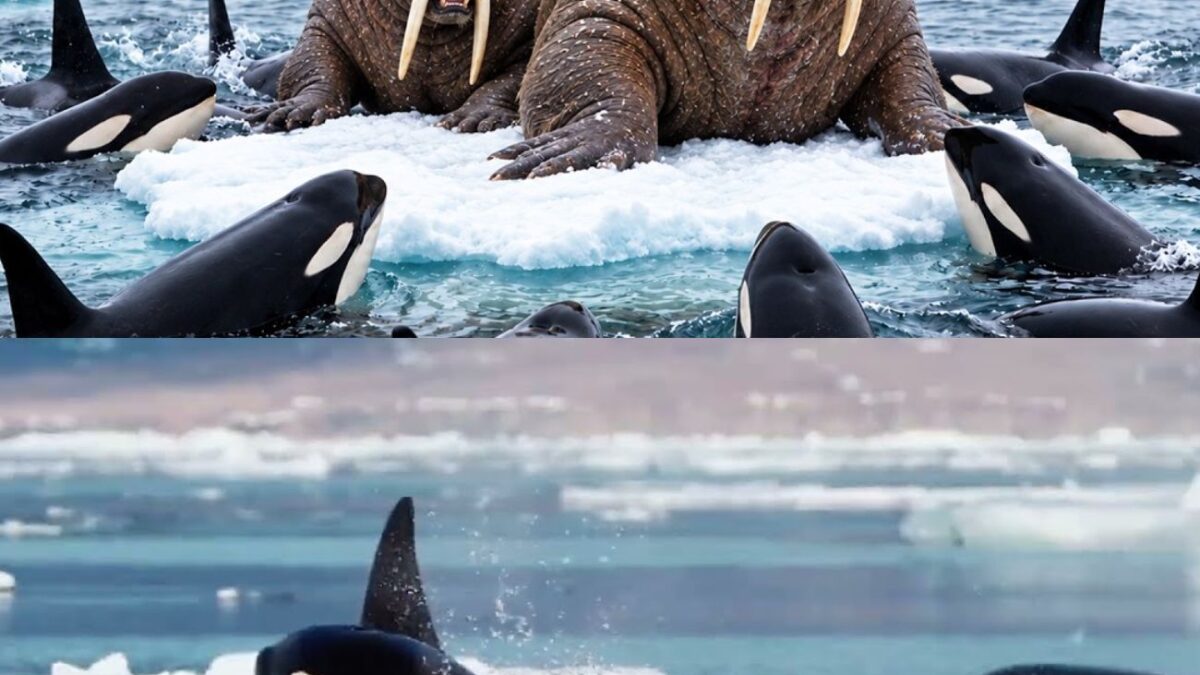
On the eighteenth of August in 2008, an extraordinary event unfolded in the shallow coastal waters off a remote spit of land along the Chukotka coast of far eastern Russia. A resident pod of killer whales, consisting of seven mature adults and two dependent calves, encountered a solitary walrus swimming approximately three kilometers away from a massive haul-out site where thousands of other herd members were resting on shore. What Russian field biologists managed to document over the ensuing ninety minutes represents one of the only detailed, systematically recorded accounts of an active, sustained predatory confrontation between these two massive marine mammals anywhere in modern scientific literature.
The engagement was characterized by an astonishing degree of relentless violence, tactical complexity, and sheer energetic persistence. Over an intense seventeen-minute window during the encounter, the pod launched fifty-five coordinated, high-speed strikes against the lone pinniped, averaging roughly seven full-force assaults per whale. The prolonged siege escalated to such a desperate intensity that, at one dramatic point, two of the apex predators surged so fiercely into the coastal shallows that they briefly beached their massive bodies on the gravel spit.
When that grueling encounter was formally cataloged in a comprehensive global scientific review of killer whale predatory behavior, the ultimate outcome was officially recorded as entirely unknown. Nine apex predators had executed fifty-five violent assaults across an hour and a half of turbulent water, yet science could not determine who had prevailed. This unresolved entry is not merely an isolated oversight in a single research paper, but rather represents virtually the entirety of humanity’s documented observations regarding orcas actively hunting walruses on this planet.
Meanwhile, across other expanses of the northern hemisphere, killer whales routinely demonstrate their unmatched mastery as the undisputed sovereign hunters of the ocean. In just one localized corridor of the eastern Canadian Arctic, marine biologists estimate that seasonal pods systematically slaughter and consume well over a thousand narwhals during a single summer season. Every year, populations of beluga whales are methodically pursued, corralled into fatal bottlenecks, and devoured, while even massive bowhead whales, weighing upwards of sixty tons, are overwhelmed and drowned through collective mammalian intelligence.
The enduring mystery that confronts marine ecologists and wildlife observers centers on why this dramatic hunting disparity exists in the first place. Why does the undisputed supreme predator of the global seas relentlessly devastate narwhals, belugas, and giant baleen whales, while almost entirely ignoring a slow, blubbery animal floating right beside them on the drifting pack ice? For decades, popular folklore and amateur nature documentaries have promoted the cinematic myth that killer whales live in utter terror of the walrus.
The prevailing explanation asserts that the walrus carries twin ivory tusks capable of skewering an approaching dolphin or whale, and that orcas consistently flee from such lethal weaponry. As with many widespread natural history myths, this interpretation contains a minute grain of mechanical truth, yet almost entirely obscures the far more complex reality beneath the surface. The genuine answer to this profound biological riddle is not rooted in primal fear, nor is it strictly an explanation about the anatomy of the walrus itself.
The dynamic currently unfolding across the polar expanse is the direct consequence of a massive environmental transformation that has been gaining momentum for roughly eighty years. This shifting environmental reality fundamentally recalculates the strategic value of every predatory encounter and redefines what this ancient arctic match-up means for the future. To understand the intricate truth of these two ocean giants, we must first rigorously dismantle the pervasive cultural idea that killer whales are terrified of entering walrus territory.
When scientists examine the actual observational data gathered across the northern oceans, the popular concept of cetacean panic utterly dissolves. Between 2007 and 2010, an extensive interdisciplinary research initiative conducted one hundred and five in-depth interviews with experienced Indigenous hunters spanning eleven distinct coastal communities across eastern Nunavut. These generational experts were asked to provide meticulous, firsthand inventories detailing the precise mammalian species that transient and resident killer whales actually target when they patrol local bays and straits.
The ecological hierarchy provided by the hunters was remarkably consistent across every settlement, identifying ringed and bearded seals as the most common prey, closely followed by narwhals, beluga whales, and bowhead whales. The walrus did not merely occupy a subordinate position near the bottom of this extensive predatory ledger; it was entirely absent from the tally. The research paper concluded with unvarnished empirical clarity: killer whales inhabiting the eastern Canadian Arctic do not feed upon walruses under any normal operational circumstances.
This finding was subsequently corroborated by a historical database comprising four hundred and fifty documented killer whale sightings across the Canadian Arctic spanning the years 1850 through 2008. Within this century and a half of archived marine observations, researchers cataloged dozens of confirmed kills involving seals, belugas, narwhals, and bowheads, yet found not a single confirmed walrus predation event. Genuine animal fear always leaves unmistakable biological fingerprints across a landscape, manifesting as aborted pursuits, defensive trauma, and conspicuous avoidance behaviors.
What the empirical data presents instead is an ecological disconnect that is far stranger and fundamentally simpler than conventional narratives suggest. Throughout the vast majority of the circumpolar Arctic, these two colossal creatures do not actively avoid one another out of mutual terror; rather, they have historically barely existed within the same operational arena. Almost every reliably documented account of killer whales attempting to hunt walruses originates from a remarkably narrow geographical corridor: the shallow shelf environments of the Bering and Chukchi Seas, the Chukotka coastline, and western Alaska.
Within the entire global body of marine mammalogy literature, there exist only about three primary scientific records detailing killer whales actively engaging walruses. Everywhere else across the sprawling marine Arctic, the interaction occurs so infrequently that it has failed to leave any tangible scientific record whatsoever. However, the absence of frequent predatory clashes does not imply that the walrus is an easy meal or an innocuous target for an enterprising pod of orcas.
The adult Pacific walrus is an emphatically formidable creature, and the specific biological reasons behind its extraordinary defensive capabilities deserve rigorous, clear-eyed examination. Virtually every dramatic assumption popularized by casual nature programming regarding the anatomy, behavior, and physical weapons of this colossal pinniped is fundamentally incorrect. To properly assess this animal as an engineering challenge for an apex predator, one must begin with its sheer, overwhelming biomechanical specifications.
A fully grown, mature male Pacific walrus can easily exceed a total body mass of two thousand kilograms, or roughly forty-four hundred pounds, while reaching nearly four meters in length. This represents a massive, heavily muscled bull that readily outweighs an average full-sized family automobile resting on the ice. Covering this immense bulk is a nearly impenetrable external hide that measures between two and four centimeters in thickness across the majority of the torso.
Around the vulnerable neck, shoulders, and chest of a prime breeding bull, this fibrous hide thickens into an extraordinary, cornified shield reaching up to ten centimeters in depth. Immediately beneath this leathery external armor lies an uninterrupted layer of dense, fibrous adipose blubber that routinely reaches depths of up to fifteen centimeters. Consequently, any aquatic predator attempting to bite into a healthy walrus must first chew through an entire hand’s depth of vulcanized leather before penetrating another hand’s depth of solid grease before ever reaching vital tissue.
Beyond this staggering defensive bulwark sit the iconic tusks, elongated canine teeth composed of solid dentine that can extend up to a full meter in length and weigh five kilograms apiece. It is precisely at this juncture that nearly every commercial wildlife documentary misleads its audience by claiming walruses use these massive tusks to actively excavate clams from the ocean floor. If walruses utilized their tusks as benthic spades to dig into abrasive gravel, forensic examinations would inevitably reveal pronounced wear facets and deep gouges along the anterior tips and edges.
Rigorous microscopic and morphological analyses of walrus ivory have conclusively demonstrated that the abrasion patterns on their tusks are entirely smooth, resulting from passive contact as they drag through bottom sediment. In biological reality, a foraging walrus locates its hidden invertebrate prey using a dense sensory brush of up to seven hundred mystacial vibrissae, or facial whiskers, which are as tactilely sensitive as human fingertips. Once it pinpoints a buried clam, the animal excavates it not by gouging with its teeth, but by rhythmically sweeping its front flippers and blasting high-pressure hydraulic jets of water from its mouth.
If these formidable ivory spikes are entirely unsuited for subterranean foraging, their true evolutionary purpose boils down to two explicit functional mandates. The primary utility is mechanical locomotion across ice surfaces, serving as biological climbing picks that allow these immense animals to haul their ponderous bodies out of freezing water onto slippery floes. This specialized climbing adaptation is so central to their lifestyle that their scientific generic name, Odobenus, translates literally from classical Greek as the tooth-walker.
The secondary function of the tusks, which carries far greater evolutionary significance than locomotion, is to serve as brutal, decisive combat equipment deployed against conspecific rivals. These massive weapons were not shaped by selective pressure exerted by ancestral marine predators seeking to cull the herd from the deep. Instead, they were sculpted over millions of years of ferocious, intra-species competition, evolved explicitly for one massive walrus to batter, slash, and puncture another massive walrus of identical weight and armor.
Male walruses routinely engage in grueling territorial clashes to establish social dominance, secure reproductive access, and defend prime space along crowded coastal haul-outs. This evolutionary reality means that the walrus never evolved its formidable defensive shields or its ivory spears in response to killer whales at all. The species is heavily armored against itself, possessing a natural weapon system engineered specifically to punch clean through the toughened hide of a two-ton bull.
A biomechanical weapon system that has evolved over millennia to penetrate the near-impenetrable armor of a rival walrus will effortlessly tear through the soft tissues of any other living creature. Fortunately, the biological sciences possess extraordinary, direct observational evidence demonstrating the lethal efficacy of these weapons, and that evidence does not come from whales. Instead, this definitive testament to the walrus’s defensive prowess comes from long-term terrestrial research focusing on the undisputed king of the Arctic ice: the polar bear.
Between 1990 and 1992, the renowned Russian biologist Nikita Ovsyanikov stationed himself at Cape Blossom on Wrangel Island to conduct uninterrupted behavioral studies of polar bears. Rather than compiling second-hand hunting folklore, Ovsyanikov recorded meticulous, direct observations of twenty-five distinct, separate predatory attempts by polar bears attacking walruses on land. Out of those twenty-five high-stakes engagements, only two hunts achieved success, representing a dismal overall predatory success rate of just eight percent.
Furthermore, both of the successful kills involved highly vulnerable, immature calves that were systematically isolated from the protective perimeter of the main adult herd. To make the statistical reality even starker, both of those rare kills were orchestrated by the very same exceptionally experienced, mature female bear operating with extraordinary opportunistic precision. Across the entire multi-year study period on Wrangel Island, not a single healthy, mature adult walrus was successfully brought down or killed by a polar bear.
Ovsyanikov’s scientific conclusion was definitive: under standard environmental conditions, a solitary polar bear simply lacks the anatomical leverage and physical force required to kill an adult walrus on shore. Even when a massive male polar bear launched an aggressive assault against an adult walrus that was visibly emaciated and weakened, the walrus successfully repelled the carnivore and escaped. The bears routinely paid a devastating physical price for their hunting attempts, suffering catastrophic lacerations from desperate retaliatory strikes delivered by their intended prey.
During the observed confrontations, three bears sustained massive puncture wounds that bled profusely across the snow, while five other bears exhibited severe, festering facial injuries. These trauma patterns were heavily concentrated directly across the sensitive muzzles and forepaws of the bears, illustrating precisely what occurs when a carnivore presents its face to the front end of a walrus. The sheer difficulty of tackling this prey item has even spawned a long-standing body of Indigenous Inuit and Greenlandic accounts describing bears employing novel, unconventional strategies.
For more than two centuries, native hunters have described polar bears actively picking up heavy rocks or massive chunks of sea ice to bash resting walruses across the skull. Contemporary arctic researchers have taken these persistent ethnographic accounts seriously enough to publish peer-reviewed papers evaluating potential mammalian tool use, though whether it constitutes true learned cognition remains debated. The most illuminating aspect of this enduring lore is the underlying behavioral motive: the standard predatory playbook simply does not work against the physical architecture of a walrus.
The undisputed apex terrestrial predator on planet Earth boasts a dismal eight percent hunting efficiency against this animal and routinely ends up with its skull violently punctured for its trouble. Yet the formidable physical defense of the individual walrus is only the baseline obstacle that any potential predator must confront when approaching a herd. The second, and arguably far more dangerous, component of the walrus’s survival strategy lies in its deeply ingrained social instincts and communal defensive mechanics.
When a typical herd of arctic ringed or harp seals detects an approaching apex predator, the individual animals immediately panic, scatter in random trajectories, and attempt to flee. This dispersal behavior represents the ideal tactical scenario for a coordinated pack of killer whales, because a scattering population instantly generates isolated, disoriented individuals that can be picked off one by one. Walruses, possessed of an ancient collective intelligence forged across harsh millennia, execute the absolute polar opposite behavioral response when threatened by an approaching carnivore.
Rather than fleeing and breaking cohesion, an imperiled walrus herd immediately draws closer, locking massive shoulders together to form a nearly impenetrable, solid wall of living flesh. The vulnerable calves and younger yearlings are systematically shuffled into the absolute geometric center of the assemblage, protected entirely by the bodies of the mature bulls and cows. The mature adults then rotate outward toward the perimeter, lowering their heads to point hundreds of heavy ivory tusks outward into the surf like a medieval bristling phalanx of pikes.
What an approaching pod of killer whales encounters in the water is not an assortment of panicking individual targets, but a unified, four-hundred-ton fortress bristling with bone-shattering spears. The physical reality is inescapable: the adult walrus is genuinely, extraordinarily dangerous, and possesses defensive capabilities that demand respect from any animal sharing its marine environment. However, this undeniable physical prowess has given rise to an accompanying viral claim that circulates relentlessly across modern digital media, demanding direct, rigorous scientific scrutiny.
This popular internet assertion claims that dead killer whales frequently wash ashore along circumpolar coastlines bearing paired puncture wounds that precisely match the biological inter-tusk spacing of a walrus. Dedicated marine forensic researchers have systematically combed global stranding archives, cetacean necropsy records, and the broader body of orca predatory literature to locate the empirical source of this claim. There is not a single recorded stranding report, not one published veterinary autopsy, and zero photographic evidence anywhere in global scientific literature documenting an orca mortally wounded by a walrus.
The dramatic claim is an entirely fabricated modern myth that has attained the illusion of fact through continuous, unverified repetition across unvetted digital forums. What makes this persistent falsehood particularly fascinating to wildlife pathologists is that the specific forensic trauma described is entirely real; it has merely been erroneously attributed to the wrong marine mammal. Paired puncture wounds exhibiting identical spacing and deep tissue cavitation are thoroughly documented, well-recognized injury patterns frequently evaluated by veterinary pathologists who study arctic fauna.
Pathologists routinely observe and document these specific puncture profiles across the skulls, paws, and ribs of injured polar bears recovered near coastal haul-outs. They also document them across the broken remains of walruses themselves, where animals are repeatedly trampled, gored, and crushed by their own brethren during catastrophic herd stampedes. Yet within the global historical catalog of killer whale necropsies, that signature biological injury pattern has never once been identified on a stranded orca.
This brings the inquiry back to the central ecological question, and to an environmental reality that remains almost entirely unappreciated by the general public. Killer whales are not ancient, endemic evolutionary residents of the frozen high Arctic; from an evolutionary standpoint, they are opportunistic, newly arriving migrants. In 2009, Canadian marine biologists John Higdon and Steven Ferguson conducted a landmark study, assembling every reliable sighting record of killer whales across the Canadian Arctic dating back to 1900.
The very first verified visual report of a killer whale penetrating deep into the waters of Hudson Bay was recorded remarkably recently, occurring in the 1940s. Following that initial mid-century baseline, the annual frequency of documented killer whale sightings across northern latitudes did not merely climb at a modest, gradual pace; it exploded exponentially. Today, far from being rare biological anomalies, dynamic pods of killer whales are visually reported, acoustically tracked, and photographically cataloged entering Hudson Bay during every single summer season.
When the researchers statistically plotted these documented cetacean incursions against comprehensive satellite measurements of regional sea ice concentrations, the resulting correlation was undeniably stark. As the total spatial extent and seasonal duration of high-latitude pack ice plummeted, the seasonal presence of migratory killer whales scaled upward with mathematical precision, leaving no room for coincidence. The researchers identified the precise geographical chokepoint governing this historical mammalian exclusion: the narrow, treacherous corridor of Hudson Strait, which serves as the aquatic gateway into the bay.
Historically, this critical maritime passage remained completely choked with grinding sheets of heavy multi-year pack ice throughout the vast majority of the calendar year. The unyielding environmental barrier that successfully barred killer whales from ruling the high Arctic for thousands of years was never the frigid temperature of the polar water; it was the ice itself. A killer whale is a warm-blooded, obligate air-breathing mammal that must surface every few minutes beneath what amounts to an impenetrable, shifting roof of solid ice.
Within a dense, dynamic matrix of heavy pack ice, the primary existential hazard confronting an apex cetacean is not freezing to death or starving from a scarcity of prey. The ever-present, terrifying threat is surging upward toward the ocean surface to replenish oxygen reserves, only to slam into a rigid ceiling without encountering a single open lead. Marine ecologists formally classify killer whales as distinctly pagophobic, a technical behavioral term meaning that they actively avoid, fear, and retreat from substantial ice concentrations whenever possible.
A ubiquitous explanation circulating through popular literature claims that this pronounced aversion is driven strictly by the extreme vertical height of the adult male’s dorsal fin. According to this narrative, an adult male orca’s dorsal fin stands so tall—often reaching up to six feet—that it physically cannot maneuver through narrow fractures in the ice pack. While this towering anatomical feature undoubtedly represents an awkward liability in confined spaces, systematic reviews of arctic entrapment events do not cite dorsal fin impediment as the primary fatal mechanism.
The primary hazard cataloged across the historical scientific literature is far simpler, more universal, and far more brutal: killer whales simply run out of air and drown. One comprehensive scientific review systematically cataloged seventeen separate killer whale ice entrapment events occurring between 1840 and 2013, involving groups ranging from solitary individuals to pods exceeding twenty animals. The vast majority of these documented historical entrapments ultimately concluded with the agonizing, collective asphyxiation of every single whale trapped within the shifting pack.
In January of 2013, an international wildlife crisis erupted when approximately twelve killer whales were discovered desperately crowding around a single, rapidly shrinking breathing hole off Inukjuak in eastern Hudson Bay. The open water of the vast bay had flash-frozen over a rapid forty-eight-hour period following a sudden plunge in regional temperatures, entirely sealing the animals beneath an expansive sheet of ice. Eyewitnesses and arriving scientific observers described the whales exhibiting rapid, severely stressed hyperventilation patterns as they fought over the meager open water, escaping only when an offshore wind shifted the ice pack.
More recently, in February of 2024, an identical drama played out when roughly ten killer whales were photographed trapped tightly within drifting pack ice off Hokkaido’s Shiretoko Peninsula. The animals survived solely because shifting ocean currents miraculously fractured the floes, granting them a temporary corridor of open water after an entire day of near-certain doom. This unyielding frozen ceiling is the ancient ecological barrier that kept the high Arctic largely insulated from killer whale predation throughout the entirety of modern mammalian history.
For countless millennia, endemic arctic species evolved their life histories, reproductive cycles, and defensive adaptations entirely around the reliable seasonal protection provided by this impenetrable frozen shield. Now, as global temperatures climb and polar regions warm at more than double the global rate, that ancient evolutionary shield is rapidly disintegrating into open water. Hydroacoustic listening arrays deployed across the southern Chukchi Sea have recorded the unmistakable calls of hunting killer whales every single year since 2009, with acoustic detections steadily escalating.
In several recent monitoring years, these advanced acoustic arrays recorded killer whale vocalizations continuously from the early thaw of June straight through the late freeze of November. Across the eastern Canadian Arctic, systematic photographic identification programs have enabled researchers to estimate a growing seasonal population of approximately one hundred and sixty individual killer whales. Bioenergetic modeling indicates that this single migratory population alone is projected to consume well over a thousand endemic narwhals during their extended summer residence in these newly accessible waters.
Concurrently, along the gravel beaches and barrier islands of the Chukchi and Beaufort Seas, massive bowhead whale carcasses have begun washing ashore bearing distinct trauma inflicted by killer whales. In the year 2019 alone, out of eleven bowhead whale carcasses systematically recovered and autopsied along the northern Alaskan coast, seven exhibited extensive damage directly attributable to killer whale attacks. These forensic realities demonstrate that the popular internet narrative surrounding the relationship between orcas and northern mammals was framed entirely backward from the very beginning.
This is not the dramatic tale of a cowardly predator that arrived in a new land only to be thoroughly intimidated and repelled by an armored walrus. This is the sobering ecological reality of an apex predator that has recently conquered a massive, rapidly thawing ocean that was previously locked behind a wall of ice. Once this geographical and climatological context is fully understood, the broader scientific question ceases to focus exclusively on the walrus, and expands to encompass every endemic creature in the ecosystem.
The native species that inhabited these frigid waters for thousands of years in relative isolation have been forced to respond to this sudden invasion with frantic, desperate adjustments. The peer-reviewed behavioral research documenting how these long-isolated endemic arctic mammals react to the presence of killer whales is both ecologically profound and genuinely unsettling. Consider the immediate behavioral collapse observed in narwhals, the iconic unicorns of the sea that have historically flourished amidst the deep, ice-covered channels of the Canadian archipelago.
In an exhaustive telemetry study conducted within Admiralty Inlet in Nunavut, researchers simultaneously affixed high-resolution satellite tags to both native narwhals and newly arriving killer whales. Under standard baseline conditions, narwhals are deep-water pelagic foragers that spend the vast majority of their lives hunting Greenland halibut offshore at depths ranging between four and ten kilometers. The very instant killer whales entered the mouth of the inlet, the tagged narwhals completely abandoned their offshore feeding grounds, fleeing into shallow coastal waters within five hundred meters of the beach.
The narwhals pressed their bodies so tightly against the rocky shoreline that their bellies scraped the bottom sediment, remaining paralyzed in that defensive stance for the duration of the whales’ presence. This dramatic disruption was not merely a transient burst of instinctive panic; it was a sustained, debilitating cessation of all normal foraging that persisted for days on end. When asked by science journalists to summarize the sheer psychological and physical toll observed during the tracking initiative, one of the lead researchers stated simply that the narwhals were utterly terrified.
A virtually identical behavioral catastrophe unfolds among populations of beluga whales when transient killer whale pods sweep into the shallow estuaries and river deltas of the North. On the fourth of August in 2012, near the mouth of the Seal River in southwestern Hudson Bay, a pod of ten to twelve killer whales cornered a group of tagged belugas. For ninety minutes, the panicked white whales jammed their bodies together into less than two meters of water, violently thrashing and porpoising along the edge of a dangerous tidal flat.
The belugas deliberately chose the imminent danger of beaching themselves rather than remaining in deeper channels where the larger, heavier killer whales possessed the hydro-acoustic maneuvering advantage. Baseline telemetry data gathered in the four days prior to this violent attack demonstrated that the belugas had maintained an average daily foraging range of roughly nine kilometers. In the forty-eight hours following the encounter, the traumatized belugas were tracked fleeing more than twenty-three kilometers away into shallow coastal sanctuaries where killer whales could not follow.
Even the massive bowhead whale, an ancient creature weighing up to sixty tons and boasting a blubber layer half a meter thick, exhibits profound behavioral disruption. In an extensive multi-year study conducted within the Gulf of Boothia, satellite-tagged bowheads that normally rested peacefully in open water shifted their distribution the instant killer whales entered the region. The bowheads immediately retreated deep into dense, ninety-percent pack ice and pressed themselves flush against the shoreline, actively fleeing killer whales that were still over a hundred kilometers away.
The behavioral biologists authoring that landmark study coined a powerful, evocative term to describe the profound psychological regime shift transforming this northern sea: landscapes of fear. This is what the empirical data reveals: an entire oceanic biome quietly and frantically rearranging its spatial distribution to avoid a predator that historically could not enter. When we step back and evaluate this rapidly changing ecosystem as an interconnected whole, the question of who is terrified of whom resolves with absolute empirical finality.
The narwhals are terrified, completely altering where they feed and driving themselves into shallow gravel beds to avoid being torn apart. The belugas are terrified, fundamentally reorganizing their migration routes and abandoning rich estuarine feeding grounds for barren coastal shallows where they risk stranding on the tide. The sixty-ton bowhead whales are undeniably terrified, fleeing their ancestral open-water habitats to squeeze their massive bodies into dense, fractured pack ice at the mere acoustic detection of distant orcas.
The walrus, by complete contrast, has changed absolutely nothing about its daily routine, its spatial distribution, or its collective behavioral responses to the arrival of the killer whales. This is the profound biological truth that is infinitely more compelling than any manufactured internet myth regarding dueling aquatic gladiators. The walrus is not an invincible mythical titan that actively stalks killer whales, nor does it serve as an antagonistic nemesis that sends black-and-white pods fleeing across the sea.
The walrus is simply the one large mammal in the Arctic that did not have to alter its lifestyle, because its evolutionary armor was fully completed millions of years before. Its ten-centimeter hide was evolved to endure the bitter crushing pressure of arctic ice and the biting teeth of sub-zero coastal winds. Its massive ivory tusks were sculpted across an evolutionary forge to puncture the hides of rival two-ton bulls fighting for reproductive supremacy on the rocky points.
Its dense, communal defensive phalanx was perfected across hundreds of thousands of years to ward off the opportunistic stalking of hungry polar bears on the shores. The walrus never evolved a single biological feature as a specific, calculated countermeasure designed to defend against the hunting tactics of killer whales. It simply happened to possess the most over-engineered suite of defensive adaptations in the entire marine realm, developed entirely for completely unrelated survival challenges.
When an intelligent, highly coordinated killer whale pod surveys an arctic coastline evaluating potential food resources, it executes the precise bioenergetic calculus that governs every wild carnivore. In the harsh reality of the open ocean, there are no veterinary clinics, no antibiotics, and no second chances following a severe combat injury sustained during a hunt. A single broken jaw from a retaliatory thrash, a ruptured eye, or a deep abdominal laceration from a meter-long tusk inevitably leads to catastrophic systemic infection and death.
To an apex predator operating on razor-thin metabolic margins, a successful hunt that results in a severe, debilitating wound is ultimately indistinguishable from a fatal biological defeat. Faced with the choice between attacking a bristling, two-ton fortress armed with bone-shattering ivory, or hunting a fragile, soft-skinned narwhal possessing no defensive armor whatsoever, the choice is obvious. The killer whale pod simply adjusts its course, maneuvers silently through the coastal channels, and leaves the walrus herd resting unmolested on its gravel spit.
Yet here is the tragic, profound irony that ultimately unravels the walrus’s magnificent, multi-million-year evolutionary triumph over its harsh environment. The extraordinary physical armor that successfully deters the most lethal apex predator on planet Earth is aimed entirely at the wrong threat, and always has been. Walruses are obligate benthic feeders that subsist almost entirely upon marine invertebrates, specifically bivalve clams, snails, and marine worms excavated from the seafloor.
Because they are mammals that must surface to breathe, they can conduct this intensive benthic foraging only within shallow continental shelf environments, typically at depths between ten and one hundred meters. To survive, walruses do not merely require generic ice; they require stable, thick sea ice resting directly above the shallow continental shelf to serve as a mobile resting platform. This floating ice platform allows nursing females to rest, care for their fragile calves, and dive repeatedly to the rich bivalve beds below without expending precious energy swimming.
When rapid climate warming forces the southern edge of the summer sea ice to melt completely away from the shallow shelf, the ice retreats northward over the deep Arctic Basin. Once the pack ice floats over the abyss of the central polar basin, where water depths plummet to thousands of meters, it becomes entirely useless to a bottom-feeding mammal. A walrus cannot dive thousands of meters to the deep ocean floor to forage for clams; its anatomical operating limit leaves it hopelessly stranded from its ancestral food supply.
Deprived of their essential floating ice rafts over the shallow feeding shelves, hundreds of thousands of walruses are forced to abandon the open sea and swim exhausted to shore. They arrive on solid land in staggering, desperate concentrations that completely defy conventional imagination, cramming themselves onto narrow coastal beaches in horrifying numbers. In 2015, an estimated thirty-five thousand walruses hauled out on a single narrow strip of gravel beach near the native village of Point Lay, Alaska.
Two years later, in 2017, that single coastal aggregation swelled to an astonishing forty thousand animals packed shoulder-to-shoulder on the very same narrow, rocky spit. When tens of thousands of skittish animals weighing up to two tons each are compressed onto a tiny strip of land, the greatest threat to their survival becomes each other. A sudden unnatural noise, the distant drone of an approaching airplane, or the mere silhouette of a wandering polar bear on a nearby bluff will instantly trigger a catastrophic herd stampede.
The resulting scene is sheer, chaotic horror, as forty thousand panic-stricken animals surge blindly toward the perceived safety of the ocean, crushing everything beneath their immense bulk. In 1978, on the Punuk Islands and St. Lawrence Island, biologists recovered approximately twelve hundred mangled walrus carcasses following a series of massive herd panics. Subsequent post-mortem forensic examinations confirmed that the overwhelming cause of death across the dead was massive internal trauma and violent, catastrophic torsion of the cervical vertebrae.
These majestic animals were not slaughtered by hunting killer whales or ambushing polar bears; they were crushed, trampled, and broken by their own panicked brethren. At Icy Cape, Alaska, in 2009, over one hundred and thirty walrus carcasses were found strewn along the coast following a mass panic, the vast majority being young calves. In the autumn of 2007, along the rocky margins of the Chukchi Sea, wildlife observers documented the grim aftermath of more than twenty-six hundred walruses crushed to death in stampedes.
To maintain intellectual honesty, one must acknowledge that catastrophic stampede mortality is not a completely novel biological phenomenon invented solely by modern climate change. The devastating Punuk Islands disaster of 1978 occurred decades before modern sea ice retreat reached its current acute levels, remaining one of the largest mortality events ever recorded. Furthermore, legal subsistence hunting by coastal Indigenous communities historically removes significant numbers of walruses annually, contributing to ongoing scientific debates regarding the strategic management of vulnerable Pacific stocks.
Nevertheless, the long-term ecological trajectory confronting this magnificent arctic species remains completely undisputed among the global marine biology and climatology communities. Less summer sea ice floating over the shallow continental shelf forces vastly more animals to crowd onto vastly fewer coastal beaches for far longer periods of time. When an entire species is forced into extreme physical compression along narrow terrestrial strips, the herd inevitably becomes its own most lethal, indiscriminate predator.
Their leathery hide stops the shearing teeth of sharks; their towering ivory tusks easily fend off the desperate claws of hungry polar bears. Yet all of that magnificent evolutionary architecture combined is entirely powerless against the simple, quiet reality of a missing slab of floating summer ice. The bureaucratic legal framework surrounding the conservation status of this colossal animal reflects the genuine scientific and political uncertainty surrounding its long-term viability.
The Pacific walrus is currently classified as vulnerable on the international Red List of Threatened Species, while the Atlantic subspecies is cataloged as near threatened. In 2017, federal wildlife regulators in the United States controversially determined that the Pacific walrus did not warrant full protection under the Endangered Species Act. That contentious decision was justified in part by arguing that the species had successfully demonstrated behavioral resilience by simply hauling out on land when sea ice vanished.
In 2021, an American federal appeals court struck down that administrative reasoning, declaring the government’s justification scientifically insufficient and ordering a comprehensive re-evaluation of the species’ survival outlook. It remains a deeply troubling ecological reality when a species’ primary documented adaptation to catastrophic habitat loss is congregating onto overcrowded beaches where thousands of its own offspring are crushed. This is where the grand evolutionary narrative of this extraordinary marine mammal ultimately lands as we gaze out across the rapidly transforming polar landscape.
Over millions of years of rigorous natural selection, the walrus accidentally assembled the only biological body in the Arctic that a killer whale must hesitate to attack. Ten centimeters of near-impenetrable leather, fifteen centimeters of dense insulating blubber, a full meter of combat-tested ivory, and a social instinct that turns a herd into a fortress. It stands as the single most magnificent, over-engineered biological defense system operating within the icy waters of the high northern latitudes.
Yet that legendary suit of biological armor was never oriented toward the existential threat that is currently restructuring the entire circumpolar marine ecosystem. Killer whales are not terrified of walruses; killer whales are opportunistic conquerors stepping boldly into a thawing polar kingdom that was previously barred by ice. Every endemic creature inhabiting that fragile northern ocean is currently scrambling to survive the arrival of the apex predator that now rules their ancestral home.
The narwhals have abandoned their deep offshore feeding canyons, the belugas have retreated into the perilous shallows, and the bowheads flee across hundreds of miles of open water. The walrus does not have to alter its daily behavior to evade the hunting pods of killer whales, because its ancient armor renders it far too costly to hunt. The walrus has to move solely because the very ice that sustains its way of life is dissolving beneath its flippers, and there is nowhere left to go.
Fifty-five violent strikes across seventeen frantic minutes in the cold surf of Chukotka, and humanity’s finest scientific observers still cannot tell us who walked away with the victory. That single, ambiguous historical record represents virtually the entirety of our collective scientific knowledge regarding how these two titans clash in the wild. As the great northern ice sheets continue their silent, relentless retreat into history, that enduring biological ambiguity should probably worry us far more than it does.

