Why God charged the rich and the poor exactly the same price (The secret ransom)
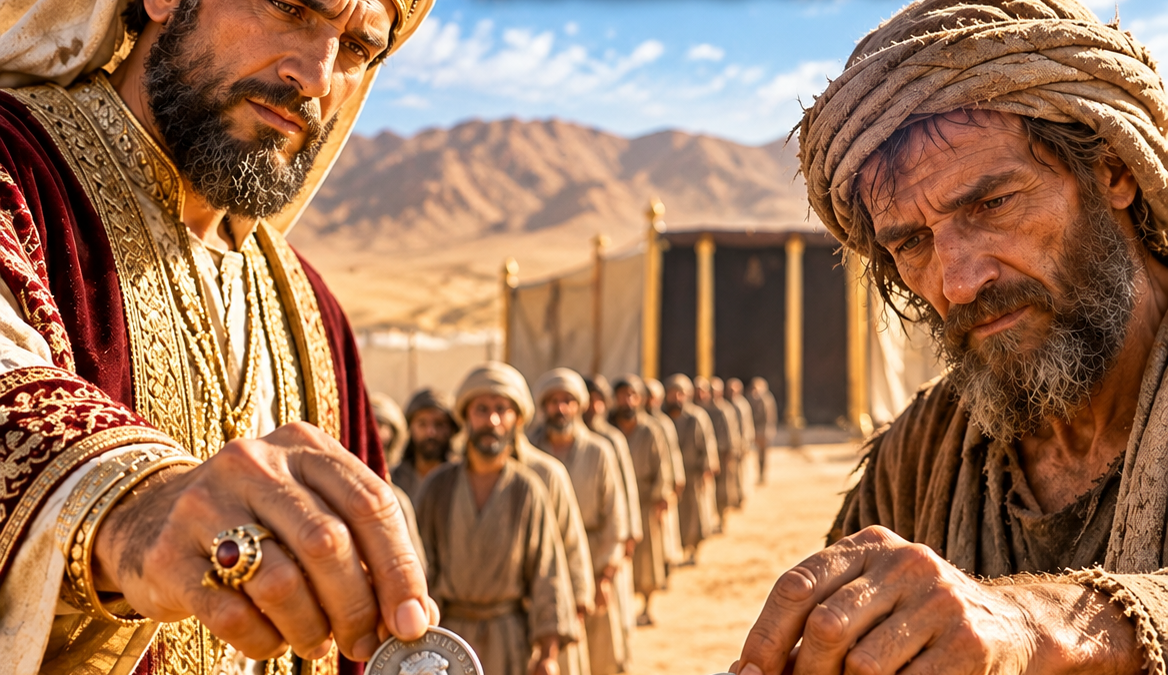
At some point, in the middle of the most detailed building instructions in the entire Bible, God stops describing the furniture and starts charging money for something you would never expect him to put a price on. It is not gold for the ark, nor cloth for the tent, nor any of the oil, the bronze, or the acacia wood that he has been listing elbow to elbow for chapters. And then, without warning, he changes the subject completely and asks his people to hand over money, a very specific amount of money.
And when you read what that money is really for, it should make your skin crawl, because he doesn’t call it a donation, he doesn’t call it a gift, or an offering, or even a tax, he calls it a ransom. A ransom for your life, a price paid so that a soul is not lost. And this is the amount. It’s not a round number, it’s not a cycle, it’s not 10, nor whatever you can give. Exactly half a cycle, half. Not one more coin, not one less coin. And then he says something that turns a small, strange instruction into one of the most radical, though silent, phrases in the Old Testament. Neither the rich will increase, nor the poor will decrease in the middle cycle.
The billionaire and the beggar approach the same table and put in exactly the same coin. Whatever this money buys, it costs exactly the same for every living soul. And at the end a warning, so that there is no death among them when you have counted them, so that there is no death. Read it a few times and the questions start piling up faster than you can answer them. Why a rescue? What did these people do that their own lives had to be bought again? Why would God, of all people, need to be paid to let them live? Why exactly half a coin when he could have said any number in the world? And what does all this have to do with being told? Why would staying still and being registered in a census be so dangerous as to require a rescue to survive and a plague as punishment if done wrong?
What almost no one who passes by this line stops to notice is that this is not God asking for support, it is God charging his people for their own lives and charging each one exactly the same price, as if a soul, any soul, were a fixed and known amount with a price tag already hung on it, and that price was the same whether the soul was that of a king or a slave. Here we go. And I need to tell you right now so you know it’s worth staying, that this little half-coin turns out to be one of the most connected objects in the entire Bible. Almost everything goes back and touches her. Because in this story there is a king who skipped exactly this rescue, counted his people without it and buried 70,000 people in three days, just as Exodus had said would happen.
In this story there is a stone, a real one, the size of your fingertip, taken from the earth beneath Jerusalem just a few years ago, with the exact word of this half-coin engraved in letters older than the alphabet you are reading. In this story there is a floor, the floor on which the very presence of God stood and was melted down to the last gram with this collected ransom silver. In this story there is a coin still dripping from the mouth of a live fish in the Sea of Galilee. There’s a price to pay in this story: 30 pieces of this same silver that will chill your blood when you see what he bought. And folded within this single half-cycle, waiting silently for 100 years, is a ransom that this coin could never truly pay, a real ransom. An amazing one. And it turns out the whole purpose of the coin was to make you wait for it. And underneath it all, running through it from beginning to end, is the reason why this was never a video about old money.
Because the moment God says that the rich give no more and the poor give no less, He has told you something about yourself. He told you that your soul has a price, a real, fixed, non-negotiable price. And that the person you secretly envy, the one who has the life you’d like to have, their soul costs exactly the same as yours, down to the last penny, and that neither of you, no matter what you have in your account, can truly pay for it. This is the story of the half cycle. Why half? Why a rescue? Why a plague? And why does the answer end up pointing directly at you? These are six verses that most people have skimmed a thousand times on their way to something they assumed was more interesting, and it is one of the most amazing things hidden in plain sight in the entire book. Let’s begin.
To truly appreciate how strange this commandment is, you have to see where it is located, and the location is the strangest thing of all. Return to Mount Sinai. Israel has left Egypt, has walked through a sea that rose up on both sides and has arrived at the foot of a mountain that burns with fire on its summit. And God has begun to give them something that no other nation on earth had. He will come down and live with them, not to visit them, but to live in the middle of the camp. So he gives Moses the plans for a building, a tent, but a tent like none that has ever existed, made to be the only place on the planet where heaven and earth touch. And the level of detail is almost overwhelming. Chapter after chapter, God describes it down to the last loop and the last clasp, the ark of the covenant and its exact measurements, the table for bread with its cups and plates.
The gold candlestick wrought from a single piece with its almond blossoms and its arms. How many curtains are there? The color of the thread, the bronze altar, the atrium, the priestly garments, the breastplate, the 12 stones and the names engraved on them. The golden altar of incense reads like the most sacred plan in history, because that’s exactly what it is. And then, right there, tucked between the golden altar, where the incense was burned, and the bronze basin where the priests washed, in the midst of all that gold, that cloth and that holy furnishings, God stops describing objects and gives a law about people, about counting them and about the price of keeping them alive. This is what it says. When you take the number of the children of Israel according to the census of them, each one shall give to the LORD the ransom for his life when you count them, so that there will be no plague among them when you have counted them. This will give to everyone who is counted half a cycle, according to the cycle of the sanctuary.
The cycle is 20 years. Half a cycle will be the offering to Jehovah. Everyone who is counted from 20 years old and above shall give an offering to the Lord. Neither will the rich increase nor the poor decrease from half a shekel when you give the offering to the Lord to make atonement for yourselves. And you shall take from the children of Israel the atonement money, and you shall give it for the service of the tabernacle of meeting, and it shall be a memorial to the children of Israel. before the Lord to make atonement for yourselves. Go slowly, because every sentence there carries a lot of weight. The rescue of his person. The word is not a gift, it is not a tribute, it is a ransom. The price you pay to recover something, to free a captive, to prevent a life from being lost, to prevent death among them. The commandment comes with a threat included. If you omit it, if you do it wrong, something deadly awaits you on the other side.
Half a cycle, according to the sanctuary cycle. Not the common market cycle, but the holy pattern, the one kept in the sanctuary itself of 20 jas, an exact and official weight. This needs to be measured correctly. Neither will the rich increase, nor will the poor decrease. A perfect and deliberate equality. The amount does not depend on income; it is fixed to the soul to make atonement for your persons. That word atonement is the word for what happens on the holiest day of the year, when blood is taken to the holiest place. And here it appears attached to a coin. And it shall be a memorial before the LORD. This money is not just spent, is remembered, it represents something before God forever. Each of those phrases is a door and behind each door is a part of the answer. But none of them open until you understand the one thing on which the entire commandment is secretly built, which makes everything else make sense.
You have to understand why for these people the simple fact of being counted was a matter of life or death. For us, a census is boring. A form, someone knocking on the door with a spreadsheet, a number on a spreadsheet somewhere, is the least dangerous thing a government does. So when God says a census needs a ransom or a plague is coming, our instinct is to assume that it’s symbolic, a quaint detail from antiquity and move on. That instinct is wrong, and if you don’t see it, you miss everything. Because in the world of the Bible, to tell something was to claim it. Counting was what an owner did with his property. You counted your sheep because they were yours. You counted your coins because they were yours. To count something was to lay my hand on it and say, “This belongs to me and I’ve already taken its measure.” And that’s exactly the problem, because Israel did not belong to Israel. Israel belonged to God.
He had said it in no uncertain terms: “You will be my special treasure above all peoples, for all the earth is mine.” So when a leader decided on his own to count the people, to run his own hand over the nation and take its measure like a man counting his flock, he was doing something enormous, even if it seemed small. He was treating what belonged to God as if it were his own. And beneath that lies a second, even more disturbing layer. To be counted is to be singled out. In a crowd you are anonymous, one face among thousands, hidden. But the moment the census reaches you, they pull you out of the crowd and make you stand alone to be assessed. Your name, your number, you specifically on the list. And according to the logic of this book, being evaluated individually before a holy God, leaving the safety of the crowd and being examined one by one, is not a safe thing. It’s about being exposed. It’s about provoking a verdict.
In this world, counting heads is a moment when each head is lifted alone into the light. So think about what a census was on a spiritual level. It was the entire nation, one by one, emerging from the crowd to be individually counted before the God to whom they belonged, just as their leader dared to treat them as if they were his own. It is a place full of exposed, singled-out souls, each one giving an account for itself. And in the presence of perfect holiness, to be exposed in this way is dangerous. That’s why the rescue is so brilliant and so merciful. Because look what he does. The very instant each person is counted, the exact moment they are exposed, they hand over a ransom, a cover, a price that says, “I know I am singled out and judged here before God, and I know I cannot survive this on my own. So here is the price of my life paid to go through the count alive.” The half cycle is what allows a soul to be counted and not be mortally wounded. Turn a deadly moment into a safe one.
The census doesn’t kill them because the rescue comes with it. And notice another mercy hidden there. The money does not go to the king who is counting, it goes to the sanctuary, to the service of the tent where God lives. So the same act that could have been a leader claiming the people as his own, is completely reversed. Each coin silently declares the truth once again. These people are not yours, they belong to God. Here is the paid proof in your home, one soul at a time. So the half-cycle was never a fee, it was a way to save them. A small silver salvation repeated throughout a nation so that being counted would not cost them their lives. Now, if all this still sounds like theory to you, like something a preacher says that may or may not be true, I understand. So let me show you what happened the only time in Israel’s history that a king took the census and forgot about the ransom. Because it’s not just theory, there are dead people.
Let’s fast forward about 400 years from Sinai. Israel is no longer a wandering camp of tents, it is a kingdom at the height of its power, ruled by its greatest king, David, the shepherd boy who killed the giant, the poet who wrote the psalms, the man whom the Bible calls a man after God’s own heart. And near the end of his reign, David does something that at first glance seems completely normal. decides to tell his people. He gives the order to Joab, the commander of his army. Go now through all the tribes of Israel, from Dan to Beersheba, and take a census of the people, that I may know the number of the people, count the men of war, and measure the nation. And something strange happens. Joab, a tough man, a soldier not known for having a sensitive conscience, resists. He doesn’t want to do it. Why, my Lord, do this which will bring sin upon Israel? Even Joab feels that something is wrong here, that there is something dangerous about the king passing his hand over the nation and counting it as if it were his own.
But David prevails and Joab goes out and for almost a year he travels throughout the land counting the people and brings back the number, hundreds and hundreds of thousands of men who drew swords. A powerful army, a large and accountable nation, just what would make a king proud. And notice what’s missing from the whole story. There is not a word about a ransom, no half-cycles, no money taken to the sanctuary, no coverage paid at the time of the count. David tells the people how a man tells his own possessions. And the atonement money that Exodus had commanded, the price that was to accompany each head counted so that there would be no slaughter, is simply not. And here is the detail that Exodus sowed 400 years earlier and then silently left waiting. Exodus clearly stated that a ransom should be collected when they were counted, so that there would be no death among them when they were counted. David counts them, there is no rescue and death breaks out among them. It is immediate and devastating.
A plague sweeps through Israel and 70,000 people die in 3 days. 70,000. Let that number weigh exactly what it weighs. No 70. 70,000 human beings from Dan to Beersheba, killed in 72 hours during the reign of the best king Israel ever had. In a plague that Exodus had described centuries before, like what happens when you count the people without covering them. Now I want to be honest with you because this channel thrives on being honest and there’s a nuance worth mentioning. The book of Samuel, when telling this story, does not stop to explain in full that the king did not collect the half cycles and that is why they died. He doesn’t write us a footnote. What it gives us is the form of the matter, a census done the wrong way, no rescue mentioned anywhere. And then exactly the plague that Exodus had linked to a census without ransom. The connection between the two, the reason why readers for 2000 years have put these passages side by side and seen the half-cycle right in the gap, is not an invention.
It is Exodus itself that told us what a census without coverage costs. David paid the bill, the warning came true, and then comes the part that will run under the rest of this video. So hold on tight. As the plague advances toward Jerusalem, David looks up and sees the angel of the Lord with a drawn sword in his hand stretched out against the city. And at that moment a prophet came to David and said, “What should you do? Go up and build an altar to the Lord on the threshing floor of Araunah the Jebusite.” So David went, bought the threshing floor, refused to offer God something that cost him nothing, and paid the full price for the land in silver. He built an altar there, offered a sacrifice, and the plague stopped. And that was that high ground where the sword stopped and the people stopped dying, bought at full price to end a plague that came from a census without redemption. It becomes a generation later the exact place where Solomon built the temple, Mount Moriah, the house of God, the place where for the next 1,000 years atonement would be made for the whole nation, the place where the half-cycles would one day arrive.
Do you see what just happened? The story of the redemption that was omitted ends up founding the very building that the ransom, collected as it should be, was going to sustain. The plague and the temple spring from the same soil. And it’s not the last time in this story that silver, an era, a price paid in full, and the end of death are going to appear intertwined. Remember that form; it’s going to return. So we already know why a ransom and why a plague, but we still haven’t touched on the strangest word of the original commandment, the one hidden in the title. Not a cycle, not two, half. Why on earth half a coin? If you wanted to charge people for their lives, half a cycle is a very odd amount to choose. A whole cycle would be cleaner, would be easier to divide, to weigh, and to count. Half a cycle means someone has to think in halves, in splitting the standard weight in half.
God, who is dictating every measure of the sanctuary with total precision, deliberately chooses the fraction, the incomplete number, the piece that is missing its other part, and does so intentionally. So the question is not small: why would the price of a soul be precisely one half? Readers have pondered this for centuries, and the answers they have found do not compete with each other but rather add up, each one truer than the last. The first answer is the simplest. One half says something about you. It says that a single Israelite alone is not complete. You are not a complete thing on your own. You were never made to be a single, independent, self-sufficient unit before God. You are one half, and the other half is your neighbor, the person who places their coin on the table next to you. The half-cycle silently unites you with all the others who paid it. No one can make up the full weight. Only two are needed. Halves to form a whole, meaning that the ransom itself is a picture of a united people where no one is complete in isolation and everyone is needed to complete the sum.
The rich man’s half is worthless without the poor man’s half beside it. The offering is only complete when the whole nation brings it. You cannot be redeemed as an isolated atom. You are redeemed as half of something larger. The second answer goes deeper. The half says, “This is not the real price.” It cannot be. Think about it. If God had wanted to say how much a human soul is truly worth, no amount of silver would come close, and he knows it. So he doesn’t even try. He doesn’t put the price at 1,000 shekels, or 10,000, or a fortune fit for a king, as if with enough silver you could finally cover a lifetime. He deliberately sets it low, almost ridiculously low, one half. About two days’ wages for a laborer. An amount that obviously, and even absurdly, is not what a soul is worth, so that no one could look at the coin in their hand and think, “There it is, that’s what I’m worth, paid in full.”
The message is small. The half cycle is not a purchase, is a sign, a memorial, something that takes the place of another thing. God saying, “I’m not selling you your life at market price because there is no fair market price. I’m asking you for a fragment, a sign, a reminder, and the real price is something else entirely, something that isn’t silver at all.” And that’s where the third answer comes in, the one that goes all the way to the end of this video. A whole cycle would be fully paid, debt settled, account closed. But half a cycle, by its very nature, is a debt that remains open. It is a receipt for a payment that is not finished. Each year, when a man put in his half, the coin itself told him, “The rest is still owed. This isn’t the full price; something more is yet to come. The half-cycle is a fraction that leans forward, that points beyond itself, that waits. From the first day it was sent out, it was always only half of a ransom, and the other half was never going to be more silver.
People entered the sanctuary for 100 years, put in their half, and assumed they were done. They weren’t. They held in their hands half a price that waited silently and patiently throughout the entire Old Testament for its other half to arrive. But before we understand what that other half turned out to be, we have to look at the word God chose for this money. Because the word itself reveals the secret. At its root, it’s the same word as the holiest object in the entire sanctuary. This is where a little bit of Hebrew changes everything, and you don’t need to be able to read it to follow him. When God commands the half-cycle, the word He uses for the ransom is the Hebrew word coffer. And coffer comes from a three-consonant root that scholars spell kp. And that root KPR is one of the most important words in the entire Bible because it is the word for atonement, to make coffer. The verbal form capfar means at its base to cover, to cover something completely, to smear it, to seal it, like when you cover the hull of a ship with pitch so that water doesn’t get in.
In fact, the first time a form of this word appears in the Bible, God tells Noah about the ark, “You shall caulk it inside and out with pitch.” It is to say, to make it capped, to make it watertight against the flood. So the underlying idea of atonement in the Hebrew mind is to cover. When your sin is atoned for, it is covered, sealed, watertight, so that the judgment that should come cannot reach you. That’s what KPR does. Now look at where this root goes, because it goes to all the places that matter. The Day of Atonement, the holiest day of the Israelite year, the one day the high priest enters the innermost chamber and brings blood into God’s presence, is called Yom Kippur. And Kippur is this word. It’s the Day of Covering, the day the nation’s sin is covered for another year. And the object at the very center of that day on which the blood is actually sprinkled is the lid that sits on top of the ark of the covenant. In our Bibles, in English, it’s given the beautiful name of propitiatory, but its Hebrew name is caporet.
And caporet is again this same word; it’s the covering, the place of covering, the lid where the blood is placed so that the broken law inside the ark, the stone tablets that Israel could not keep, is covered and the people are not consumed. So follow the thread. The stage where atonement is made is the kapotreet. The day of atonement is Yom Kippur, and the coin that redeems a soul in the census is the coffer. The mercy seat, the Day of Atonement, and the half-shelf are the same word. They are all coverings. They are all what is put between an exposed and guilty life and a holy God so that that life is not destroyed. Which means the half-shelf isn’t just money that happens to be religious; it is atonement in the form of a coin. It belongs to the same family as the blood on the mercy seat. When a man put his half-shelf in the census, he was doing with silver something similar to what the high priest did with blood on the holiest day of the year. He was buying a covering for an exposed soul.
And that’s exactly what makes it all hurt, because a coin can’t truly cover a soul. Silver isn’t blood. A heavy metal cycle on a scale can represent atonement, it can point to atonement. It can be called atonement money, but it cannot be the covering a soul needs. Just as a receipt is not the same as payment. The half-cycle is atonement in the form of money. And atonement in the form of money is a promise, not a payment. It is a covering that keeps whispering. The real covering is coming. The real covering is coming, and it will not be made from me. Now, I have said many things about this coin, that it was a ransom, that it was atonement, that it was a half-cycle of the actual sanctuary, weighed and measured, 20 jas, an exact official weight. And I want to prove to you that this is not just words in a book, because a few years ago someone put their hand in the earth beneath Jerusalem and pulled the half-cycle out of the ground.
I told you that the sanctuary cycle was an exact weight, 20 jas, an official standard considered holy, so that when if someone said half a shekel, everyone would know exactly how much silver it meant. And in the First Temple period, the time of David, Solomon, and the kings, there were no coins yet. Coins hadn’t been invented yet. So when a man brought his half shekel to the temple, he wasn’t bringing a minted coin; he was bringing a small piece of silver, and it had to be weighed. It was placed on one side of a scale, and on the other side, to check it, a stone was placed—a weight, a small stone carefully carved to weigh exactly half a shekel. And the Bible even gives that half-shekel weight its own name. In the book of Exodus, when it tallies the silver from the census, the Hebrew text says that the people gave a bekah per head. Bekah is the specific word for a half-shekel weight. A bekah is half a shekel. That’s the object you would put on the scale to measure a man’s ransom.
Now, this is what happened in the year is 2018. Beneath Jerusalem’s Old City and around the foundations of the Temple Mount, archaeologists have long been working on something called a sieving project. When soil is removed from the ancient areas near the Western Wall, instead of dumping it, it is taken to a site, washed, and sieved grain by grain, searching for the tiny things that shovels miss. And in soil that came from the foundations of the Western Wall, at the foot of an ancient structure called Robinson’s Arch, right against the base of the Temple Mount, a sieving person found something about the size of a fingertip: a tiny, dome-shaped stone, inscribed with ancient Hebrew letters—letters from the First Temple period, older than the square script of a modern Hebrew Bible. There was a single word: beca. They had found a half-cycle weight, the exact object described in Exodus, carved to weigh half a cycle of the sanctuary, so that pilgrims coming to the Temple could put their silver on the scales and know that its ransom had the right weight.
In the First Temple period, the days of the kings, found in the very soil of the Temple Mount with the word of the half-cycle engraved on its face. The half-cycle of Exodus 30, which we have called symbol, memorial, and coin-shaped promise, turns out to be a small gray stone that you can see behind glass in Jerusalem. And there is one more detail about this particular stone that makes archaeologists smile because it is so human. The inscription is written in reverse, in mirror image. The letters go from left to right instead of right to left, as Hebrew should. And each letter is flipped, facing the wrong way. And the archaeologist who studied it discovered why the artisans who carved these weights were the same ones who carved seals, personal stamps. And a seal has to be engraved in reverse, in mirror image, so that when you press it into wet clay, it comes out the right way. This weight maker, so accustomed to carving everything backward for the seals, he simply kept the habit and engraved the word “becaed” backward out of pure muscle memory.
A tiny human error from antiquity frozen in stone for 3,000 years. Think for a second about what this object is. For most of history, a skeptic could say the half-cycle was a nice little legend, a bit of religious accounting in an ancient text. And then a stone the size of a fingertip comes out of the ground at the foot of the very Temple Mount where the ransom was paid, with the exact biblical word engraved on it, with the exact biblical weight, and the legend has substance. This channel doesn’t need to embellish anything; it just needs to go slowly enough to notice that the half-cycle isn’t just in your Bible—it’s in the ground. But knowing the weight of the coin only sharpens the real question. All those little half-cycles brought in by an entire nation added up to a mountain of silver. And the Bible tells us down to the gram exactly where that silver went and where it went is going. It will forever change the way you imagine God’s presence. Go to the end of the book of Exodus, to the section on accounts, where the Bible does something it rarely does.
It stops telling a story and starts keeping the books. It adds up all the materials used in the tabernacle, one by one, like a receipt. And tucked into that receipt is one of the most beautiful pieces of information in the entire Old Testament. There it is in simple arithmetic, waiting for someone to actually do the math. Here’s what it says: “And the silver from those who were registered in the congregation was 100 talents and 1,775 shekels, according to the sanctuary shekel, half a shekel per person according to the sanctuary shekel. All those who passed through the census, 20 years old and above, numbered 603,550.” Now do the math with me, because here the math is the miracle. 603,550 men, each giving half a shekel. Half of that number is 301,775 shekels of silver. And one talent, the large unit, equals 3,000 shekels, so 100 talents is 300,000 shekels. Add the remaining 1,775, and you get 301,775. The numbers add up exactly to the last shekel.
Half of each man, of the more than 600,000, precisely adds up to the 100 talents and the 1,775 shekels reported in the text. This isn’t a story that throws around large numbers lightly; it’s an account book that balances. But the most valuable thing isn’t that the arithmetic works; it’s what they did with the silver. Because the lines that follow tell you exactly what all that census silver was melted down into. And it’s not what you would imagine. It’s not the ark, it’s not the gold objects. Those were gold. The ransom silver, the half-shekels collected from the entire nation. It was used for a specific thing, the bases, the supports, the foundation blocks. The tabernacle wasn’t a solid building; it was a framework of tall wooden boards set upright, forming the walls of the holy tent. And each of those boards didn’t simply rest on the sand; each one was set in a heavy silver support, a cast bracket to hold the base of the board and keep the whole structure upright.
And the text is precise. There were also 100 talents of silver to cast the bases of the sanctuary and the bases of the veil into 100 basins, 100 talents at a talent per base. The foundation upon which the entire sanctuary stood, the supports that held up each wall of the tent where God dwelt, was made from the ransom money, from the half-shekels, from the silver gathered, weighed, and redeemed from every soul counted in Israel. And with what was left over, the amount that wasn’t enough for another complete foundation, this happened. And from the 1,775 shekels, He made the He covered the capitals of the columns and bound them. Not a single coin was wasted. Half of every man found a place in the structure. None of it was decoration. Everything bore weight. Now feel the weight of that. The presence of God descended and filled that tent. The glory rested upon it with such force that Moses could not even enter it.
And beneath it all, supporting every wall, bearing the entire weight of God’s dwelling place, was a foundation made with the ransom price of the people. The half-cycles were not spent on ornaments; they became the ground upon which the holy place rested. Every Israelite could look at the sanctuary and know, “My ransom is down there, my half is in the foundation.” The place where God lives is supported in part by the price of my life. And there’s one more detail to note before we leave this. Inside the tabernacle was a curtain, the veil, the heavy woven barrier that separated the holy place from the most holy place, the innermost room where the ark and the mercy seat were located, where the presence of God was most intense. The room where a man could enter only once a year and only with blood. And that veil didn’t hang from nothing, it hung from four columns. And those four pillars were on four silver vessels, which carry the ransom money.
The last barrier between humanity and the direct presence of God was held up on supports cast at the price of human lives. Don’t forget that veil. Don’t forget what it was built on and what it kept people away from. Because that curtain hanging over the ransom money has something more to do in this story, far away from here, and it’s going to be torn. But before all that, there is something else buried in these same books that you have to see, because the half cycle was not the only silver price that God put on a human life. There was a second one, and placing it next to the first one reveals everything. Return to the night when it all began for Israel. The last night in Egypt, the tenth plague, death stalking the land, taking the firstborn son from every house. And the only thing that stopped her at the door of an Israelite was blood. The blood of a lamb sacrificed at sunset, smeared on the door frame, so that when death came to that house, it would see the blood and pass by.
Every firstborn of Israel who survived that night lived because a lamb died in his place and its blood stood between him and the destroyer. And God doesn’t let it pass. He claims them almost immediately. Consecrate to me every firstborn, he says, every firstborn of Israel is his. And it says, exactly, why? Because everything is mine, firstborn. From the day that I killed all the firstborn in the land of Egypt, I sanctified to myself all the firstborn in Israel. In other words, the firstborn of Israel now belong to God by right of the blood that purchased them. Death had a right over them. A lamb paid the price, and that’s why they are no longer simply their parents’ children. They are God’s, bought, the Lord’s property, delivered from death. This creates a problem, and it’s the same problem we already know. If your firstborn son belongs to God, how can he continue to live a normal life in your home? As your son has to be bought again, redeemed, rescued from the service he owes and returned to you.
And God puts a price on it, and that price should sound familiar to you. Five silver cycles, according to the cycle of the sanctuary. The same holy pattern of 20 years per cycle as the census half cycle. A fixed weight of silver paid for each life to redeem a life that belonged to God. Jewish families still do this today in a ceremony called the redemption of the Son, in which five pieces of silver are given for a firstborn son, just as the book of Numbers says. So now you have two silver ransoms touring Israel, side by side. Half a cycle for each soul counted, five cycles for each firstborn son. Different quantities, one single idea, repeated so you can’t miss it. Your life is not yours, it belongs to God. And a life that belongs to God must be rescued in order to be free. But the story of the firstborn has one more layer, and it is the layer that reaches to the cross. Because God does something with the firstborn that He does nowhere else.
Instead of taking every firstborn son from every family to serve him, he takes an entire tribe, the Levites, and sets them apart to serve him instead of the firstborn. Listen to how he says it. Behold, I have taken the Levites of from among the children of Israel instead of all the firstborn, the first born among the children of Israel. The Levites will be mine, one group in place of another, a substitution, the whole tribe of Levi, set apart and placed in the exact place where all the firstborn had to be, so that the firstborn themselves could be free. And here it gets precise and a little impressive, because God really counts it to see if the substitution fits. Count the Levites and count the firstborn of Israel. And it almost fits. There are 22,000 Levites and there are 22,273 firstborn sons, which means there are 273 more firstborn than Levites to take their place. 273 children without a substitute. The tribe of Levi covers all the firstborn except for those last 273.
There simply aren’t enough substitutes for everyone. So what about the 273 who don’t have anyone to take their place? They are redeemed with silver, five cycles each and the book does the calculation for you out loud and it’s exact. 273 times 5 cycles each is 1365 cycles of silver, collected and delivered to Aaron and the priests as a ransom for those whom the substitutes could not cover. Now stop and look at what has just come to light here, because it is almost the entire gospel hidden in a census. For a life that belongs to God, there are exactly two ways to become free. Either a substitute takes their place or a price is paid. And when the substitutes ran out, when there was no one left to step in, money had to be spent to cover the difference. Replacement or rescue, someone in your place or a price. That is the mechanism that operates beneath the entire system of sacrifices. It is the mechanism that operates below the half cycle.
And hold on to him with both hands, because the day is approaching at the very end of this story when the substitute and the rescue cease to be two different things and turn out to be a single person who takes your place. And pay your price at the same time with a currency that is not silver. And notice one last thing, in silence, because it resolves the question we opened at the beginning. When Moses counted Israel in the book of Numbers, with all this in place, the ransom paid, the firstborn counted, the covering in hand, no one died. The census was secure. Only David, centuries later, laid his hand upon the nation and counted it as his own, without the covering and buried 70,000 people for that same act. Two completely different outcomes and the only thing that separated a safe census from a deadly one, the only piece that changed was the rescue. So the rescue was never a technicality, was the difference between life and death.
And the Bible proves it twice, once with the 70,000 who died without him and another time with an entire nation that was counted without danger with him. But all this silver still belonged to a world that did not yet have coins, weighed in bits against a stone. That world was about to change and the half cycle was about to do something that no one in that desert could have imagined. This is what one would expect. A commandment given once in the wilderness for a single census, to finance a single tent, should have expired by the time the tent was built. The tabernacle received its silver vessels. Job completed. The half-cycle could have quietly faded into history. That wasn’t the case. On the contrary, it became one of the most enduring institutions in Jewish life. He survived the tabernacle, he survived the first temple, he survived the Babylonian exile, and he returned. It was still being collected every year in the days of Jesus 1000 years after Sinai.
The half cycle simply refused to disappear. You can see him survive exile with your own eyes. When the Jewish people returned from Babylon and rebuilt without money and with difficulties under Nehemiah, they made a written commitment and it was recorded. We also imposed upon ourselves, by law, the duty to contribute each year with one-third of a cycle for the work of the house of our God. A third at first, because they were poor and money was scarce, but the principle was exactly the old one, a fixed contribution per person for the upkeep of the house of God assumed by the whole community. And over time, when things stabilized, returned to the old amount, half. And what he ended up doing is stranger than you would expect from a temple donation. It wasn’t a dish that was politely passed around a room. It became a complete institution with its own set of laws, its own season in the calendar, and its own system for collecting silver, and it reached far beyond the borders of Israel.
By the time of the Second Temple, the great temple that Herod expanded into one of the wonders of the ancient world, the half-century had become an annual tax paid by every Jewish man over the age of 20 throughout the world, wherever Jews lived, and it financed the daily running of the temple, the morning and evening sacrifices offered each day on behalf of the entire nation. The community’s atonement was partly paid for with these half-coins that came from all over. There is an entire tractate of the Mishnah, the great collection of Jewish law called Shekalim, meaning cycles, devoted solely to the rules of this tax. When was it due? Before a certain time in the month of Adar, at the end of winter, how it was collected in special temple chests with trumpet-shaped openings, wide at the bottom and narrow at the top, so that no one could reach in and steal. It was a serious, organized, national system, and it all came directly from those six verses of Exodus.
But collecting a fixed weight of silver from Jews all over the ancient world created a very practical problem, and that problem is going to open a door straight to the Gospels. Because the temple did not accept just any currency. The rules required that the tax be paid in a specific and reliable currency, famous for having the purest and most consistent silver in the region, called the Tiro cycle. The problem was that this mandatory currency came from a pagan city and bore the image of a pagan god on its face. And so, in a profound irony that the gospels would take up and turn into a whip of ropes, the holiest tax in the world, the ransom for a Jewish soul, had to be paid with a coin that bore the engraved head of a foreign deity. This meant that pilgrims, who came from all over, needed a place to exchange their ordinary money for the sacred currency. And that need, that change is the reason why there were money changers sitting at their tables in the temple courtyards.
And if all of this has seemed valuable to you, if going slowly and really reading these six verses has shown you something you had passed over 100 times, take a second and subscribe, because that’s what this channel is all about. We take the parts of the Bible that everyone treats as mere decoration and stand still in front of them until they open up. There’s much more to open. Now take a step back and look at the strange, long shape of what we have traveled. A ransom in the desert became a base under a tent, then a tax in a temple, then money changers at a table, and went to that world, to a temple funded by a soul ransom paid with a pagan coin, into which a carpenter from Galilee entered. And one afternoon, on the shore of a lake, someone asked in front of his own disciples if he paid the half cycle. And what he did about it is one of the strangest, most discreet, and most amazing miracles in the entire New Testament.
It happens in the Gospel of Matthew, in a town called Capernaum, on the northern shore of the Sea of Galilee, and it ends almost before you know it. If you blink, you’d think it was a minor anecdote about paying a bill. It’s quite the opposite. The temple tax collectors approach Peter and the tax they collect has a precise name. Matthew calls it the two drachmas, the didragma. And that’s not a random number. Two drachmas was the standard Greek equivalent of exactly half a cycle. This is the Exodus 30 census ransom, now converted into a well-known annual coin. And the collectors are making their rounds. They arrive to Pedro and ask him a direct question. Your teacher does not pay the two drachmas. And Peter, loyal, quick, wanting his teacher to look good, says yes, of course yes. But when Peter enters the house, before he can even mention it, Jesus speaks first and what he says gives a completely new meaning to everything.
What do you think, Simon? The kings of the earth, from whom do they collect tributes or taxes? From their children or from strangers? And Pedro answers the obvious question about strangers. Kings do not tax their own children. The son of a king does not pay to enter his father’s house. And Jesus says to him, “Then the children are exempt. Feel the magnitude of what he just stated. This tax funds the house of God. It is the ransom paid to the God to whom this temple belongs. And Jesus just said, without raising his voice, that the son of that God does not owe this tax, because the king’s son is not charged admission to his father’s house. He’s not talking about taxes. He’s saying to Peter, who is he? The temple is my Father’s house. I am the Son. I am free. And then he does something that should leave you speechless. He doesn’t cling to that freedom. He pays anyway, not because he owes it, but for a reason he states aloud, so as not to offend them, so as not to be a stumbling block.
The only person in history who truly does not owe the ransom chooses to pay it out of kindness so as not to cause anyone to stumble. And the way he pays it is the miracle. Go to the sea and cast your line, and the first whatever fish you catch, take it. And when you open its mouth, you will find a stater. Take it and give it to him for me and for yourself. Read carefully about the coin, because the detail is exact. The coin in the fishmonger’s mouth and a stater is a four-drachma coin. It is the tithe cycle, the very coin of the temple. And four drachmas are exactly two payments of the tax of two drachmas, one coin, enough for exactly two people, for me and for you, says Jesus, the son who owes nothing and the fisherman who cannot pay, covered by a single coin taken from the sea, from the mouth of a live fish.
Look at all that fits into that single act. The Son of God, who according to his own logic does not owe the ransom, because the temple is his father’s house, chooses to pay it anyway. He pays it not only for himself, but for another man, a man who could not get the coin on his own and gets the ransom with a word from the depths of a fish’s mouth. Silver called forth from the sea. He doesn’t reach into a purse, he doesn’t borrow. He raises the exact ransom to the last coin, from the water to the mouth of the first fish that comes up. The one who owns everything provides the price for the one who has nothing, and he does it silently, on the shore of a lake, as a favor, so that no one will even be offended. If you want to see in miniature everything this video is building, it’s right there. A son free from the ransom who pays it anyway, who pays it for someone who can’t, who provides it himself from a source no one else could reach.
That’s a rehearsal, a small, soft, almost hidden rehearsal of something huge that was going to be on a grand scale on a mountain outside the city, not long after, because everything we’ve seen so far, the half that was never the whole, the coin that could only be a memorial, the atonement in the form of money that kept whispering that the real covering was coming. All of that was waiting for a ransom that silver could never truly pay. It’s time to see what that ransom was. This is the phrase that the entire Old Testament has been silently leaning on, and almost no one connects it to this coin. It’s in Psalms 49, and it says, “The only thing the half-cycle deep down always knew about itself.” None of them will be able in any way to redeem the brother or give to God his ransom, because the redemption of his life is of great price and will never be achieved. In other words, you can amass all the money in the world, every talent, every cycle, and every heavy scholarship, and still you couldn’t rescue a single human life from death.
The price is too high, is out of reach. No amount of metal will ever arrive. The redemption of his life is of great price and will never be achieved. Now put that psalm next to the half cycle and the coin finally makes perfect sense. Of course, the amount was deliberately, almost ridiculously small. Of course, the rich couldn’t pay more and the poor couldn’t pay less, because all of this was never a real payment. I couldn’t do it. No amount could do it. If God had allowed the rich man to pay more, it would have led him to believe that a soul is something that can be bought with enough money, and it is not. The identical, small, fixed half was God’s way of saying aloud, “For 100 years, this is not the price of your soul. Nothing you can carry is the price of your soul. This is a memorial, something that takes the place, a coin that is put in the gap, points forward, and says, ‘Someone else is going to have to pay this because you never could.'”
The half-cycle was an unpaid bill laid on the table year after year after year, a receipt for a debt that remained open, and the whole nation kept paying the deposit, the down payment, the money-shaped cover, while the actual balance remained there uncollected, waiting. And then the New Testament opens its mouth and uses a word again and again. And the word is ransom. Jesus says it of himself in the clearest sentence he ever uttered about why he came. The Son of Man did not come to be served, but to serve, and to give his life as a ransom for many. Ransom. The word is litron, the price paid to set free a captive. The same idea that underlies the half-cycle. He’s saying, “I am the payment.” His whole life pointed to that. Not silver, a life given for many. Paul puts it the same way, who gave himself as a ransom for all, a ransom for all. And then, in case anyone still thinks the payment could be metal, Peter, the same Peter who once pulled a coin from a fish to pay the half-cycle, writes the sentence that closes the circle forever: “For we know that it was not with perishable things such as silver or gold that you were redeemed from the empty way of life handed down to you from your ancestors.
It was not with perishable things such as silver or gold that you were redeemed from it, but with the precious blood of Christ, a lamb without blemish or defect.” There’s the other half of the ransom. All along, the half-cycle was half a price, leaning forward, pointing beyond itself, a covering that couldn’t truly cover, a payment that was never the payment, a debt that remained open. And the balance, the part no amount of silver could cover, the part Psalm 49 said was simply beyond human reach, was finally paid. Not with metal, but with blood. The half-cycle was the deposit, the cross was the settlement. The coin was atonement in the form of money, and it kept whispering that the real covering was coming and that it wouldn’t be made of silver. And it was right. The real covering was made of blood. This is the secret ransom hidden inside the coin. Not hidden because it was a trick, but hidden like a seed hides a tree. For 1,000 years, an entire nation approached a table, put down half a price, and was told they had paid.
And each of them actually held in their hand a promissory note signed in silver, waiting to be fulfilled with blood. The rich and the poor put down the same coin because their souls were worth the same. And their souls were worth the same because the real price was never their money. It was a life, a single life, given as a ransom for many. The half-cycle was always, from the first day in the desert, a shadow of the coin-shaped cross. But the story of silver isn’t over because it has a darker side. If the ransom for a soul could be paid in blood, then someone at some point was going to try to put a price on that soul in silver. And they did. And the number they chose will turn your stomach. Everything we’ve followed has been silver well used, silver as ransom, silver as covering, silver as a foundation under the presence of God. But the Bible knows that the same metal can be used in reverse, that the same thing that redeems a life can also be used to put a price on it and to sell it.
And it also tells that story on purpose with silver deliberately echoing it. Centuries before Jesus, the prophet Zechariah depicts a strange and bitter scene. God, speaking through him, plays the role of a shepherd who cares for the people and then asks them to name his wages, to put a value on them, and they weigh him out: 30 pieces of silver. And God’s response is full of contempt. Throw it to the treasury. What a lovely price they valued me at. So I took the 30 pieces of silver and threw them into the treasury of the house of the Lord. 30 pieces of silver. And this is why that exact number is a wound, because the law had already fixed it back in Exodus, in the same book as the half-cycle. If an ox gores a male or female servant, its owner shall pay 30 shekels of silver. 30 shekels was the price of a slave, the compensation for human property gored in a field. That is the number that Zechariah’s people weigh as the value of God among them, the price of a slave.
As if the shepherd of Israel were worth exactly what you would pay for a dead servant. And now watch it actually happen. In the Gospels, one of Jesus’ own disciples, Judas, goes to the chief priests, the men who ran the temple, the men whose entire system was financed with half-cycles, with ransom money. And he asks them a question that should never be asked. What will you give me, and I will give it to you? And they count out the money to him. Matthew records the amount with cold precision. And they allocated him 30 pieces of silver, the price of a slave, the number of Zechariah. They pay with the ransom metal, the silver to buy the betrayal of the one who was about to become the true ransom. And then the silver goes back home because when Judas sees what he has done, he is devastated and takes the 30 pieces of silver back to the temple and throws them into the sanctuary, exactly as Zechariah did, exactly as the prophecy said. And the chief priests, with that handful of silver in their hands, suddenly become very scrupulous.
It is not lawful to put it into the treasury of offerings because it is the price of blood money can’t go into the sacred fund. Think about what fund they’re talking about. The temple treasury, the very treasury where the half-cycles of the ransom went, the fund that existed to make atonement for the nation. They’re not going to let the price of Jesus’ blood be mixed with the people’s ransom silver. And so, with the blood money they can’t use, they buy a field, the potter’s field, for the burial of foreigners. And ever since, people have called that field the Field of Blood. Put it all together, and the deliberate horror is complete. Silver was the ransom that covered a soul. Silver built the foundation under the dwelling place of God. Silver was atonement in the form of money. And now silver, 30 pieces, the price of a slave named by a prophet centuries before, is the sum the religious leaders pay to deliver the true ransom to death.
The metal of redemption becomes the metal of the betrayal. The ransom money buys the ransom murder, and the blood price is thrown back into the very temple that the half-cycles built, too impure to stand beside it, and it becomes a graveyard. The half-cycle said that a soul is worth more than you can pay. The 30 pieces said that a soul, the highest of all, could be sold for the price of a slave. Those two piles of silver are the whole story of what human beings do with the value of a life. And the two are purposely in the same book, which means it’s time to stop talking about coins in the past tense and turn everything around so that it faces the one direction it was always pointing—toward you. This channel has a custom, and it’s time to fulfill it here because this coin has been seeking you out from the very beginning. Every now and then, a passage from the Bible ceases to be a window through which you look at something far away and it becomes a mirror in front of which you find yourself standing.
The half-cycle is one of those and the face that appears on it is yours. Because look at what that coin really said every year to every person who put it on the table. It said, “Your soul has a price. A vague and poetic value, a real, fixed, heavy price, an amount that God himself established and said, ‘The price is the same for you as for anyone.’ The richest man in the place contributed the same half as the poorest. Because before God the value of a soul does not depend on your bank account, your talent, your music, your reputation, or how impressive your life looks from the outside. The person whose life you secretly wish you had and you cost exactly the same at that table, down to the last coin. And she said one more thing, the most difficult one, and she said it being deliberately, almost offensively small. He said, “You can’t pay this. Whatever the true price of your soul is, it’s not what you’re holding in your hand.
The coin was small on purpose, so you could never look at it and feel at ease, so you would never look at your own payment and think, ‘Okay, I’m covered, I’m even with God, I’ve got it sorted.’ The half-cycle was designed to leave you restless, to keep the account open, to make you carry year after year the silent certainty that a ransom was owed for your life, that you were exposed, singled out, and evaluated before a holy God, and that the little coin you carried was a memorial of a debt, not its payment. That coin was a mirror, and what it showed you was a soul that has been counted and therefore has to give an account, that cannot pay its own ransom and is waiting, whether it knows it or not, for someone else to cover it. And this is the part the mirror isn’t comfortable, so I’m going to say it plainly, because comfort isn’t the purpose of this scene. You and I spend our lives doing the exact opposite of what the coin taught.
We spend our lives trying to prove we’re worth more than the person next to us, trying to earn a bigger half, trying to be the most impressive, the most successful, the one who’s right, the most admired, the one most worth keeping. We’re always trying to raise the price of our own souls before God and everyone else, to become the exception, the one whose worth is self-evident, the one who doesn’t need to be rescued like ordinary people. And the half-cycle comes up against all of that. Silently, it puts the same small coin down for you as for the beggar and says, “No, price, same debt, same incapacity, same need. You are no exception. You are one half, like everyone else, waiting for your other half. And you can’t buy your way out with any life, no matter how impressive it is, no one can. That was the whole purpose of the rich man not paying more.
So the mirror asks you the one question it was always asking, not what this coin meant to ancient Israel, but how much your soul is worth and who’s going to pay for it, because you have a price. The currency insists on that, and you can’t afford it. The currency also insists on that. And there is exactly one place in the whole of history where the price that no silver could reach was truly paid at last. And you didn’t pay for it. And it wasn’t paid for with metal. It was paid in blood on a mountain by the only person who did not owe it, in favor of people who could never pay it. The half-cycle took 100 years to make you wait for that. The mirror is just the coin seen from the other side, asking you if you already know that the wait is over. You came into this video with six verses that you had skimmed 100 times. A bit of old-fashioned accounting amidst a furniture list, a half-cycle, some census data, and then on to the good parts.
You come out with something much bigger. And before I finish, I want to put everything in one place, because when you see it all together it’s almost hard to believe that it all fit on a single small coin. And I want to say what this channel always says out loud, because everything depends on it. We didn’t invent a single piece of this. We didn’t add a single word to the book, nor did we twist a single verse to make it fit. The ransom, the plague, the exact half, the equality between rich and poor, it’s all there in Exodus 30 for anyone who wants to read it. The 70,000 who died in a census without ransom are in Second Samuel and in Chronicles. And there is also the era where death stopped, which later became the temple mount. The fact that the word cofer has the same root as the propitiatory and the day of atonement is in the Hebrew itself, in any dictionary you want to open.
Beca is in Exodus 38 and is also in the land beneath Jerusalem, in a museum with the word engraved backwards on a stone the size of your fingertip. May the silver from the census add up to the last cycle the 100 bases on which the tabernacle stood. It’s arithmetic you can do yourself on the back of an envelope. That the mid-cycle tax be converted into an annual tax. It is in Nehemiah and in the Mishnah. The coin in the fish’s mouth is in Matthew and the stater is really worth exactly 2 half cycles. The 30 pieces are actually the price of a slave in Exodus, appointed by Zechariah, paid to Judas, thrown back into the temple and turned into a field. And the ransom paid, not with gold or silver, but with blood, is written with those same words by Peter. Each piece is already in your own Bible and in museums around the world, stored in six verses that most people have walked right past their entire lives on their way to something they thought was more exciting.
That’s the whole promise of this channel, not to add anything to the book, just go slowly and really read it. And when you go slow, this is what the half cycle turns out to be, not accounting. The gospel in the form of currency 100 years earlier, is a ransom because your life had to be bought back. It is atonement because your exposed soul had to be covered. It’s exactly half, because it was never the full price and always leaned towards the remainder. It’s the same for rich and poor, because a soul is a soul and money was never the true means of payment. A memorial, a debt that was deliberately kept open, an unpaid bill on the table of an entire nation for 1000 years, until the balance that no metal could reach was finally paid in blood by a son who did not owe it. That’s why the coin changes everything, because it means that long before the cross, God had already drawn an image of the cross, given it to every person in Israel, and told them to carry it in their hand.
He told them that his soul had a price. He told them they couldn’t afford it. He told them that the real price was coming and that it wouldn’t be money. And then, when he arrived, he was a lamb without blemish. The payment was his own blood, and the bill that had been open since the desert was finally sealed, paid in full. And remember the way I asked you to store it when the plague stopped. In the era of David, silver, land purchased at full price, and the end of death were intertwined in the very place where one day the temple would stand. That intertwining returns here at the very end. More silver, 30 pieces, buy a field. Once again, the full price is being paid for, this time with blood instead of metal. And on a hill just outside the city, death stops again. Not for the three days of a plague, but forever.
So let me leave you where we started with the strangeness of the quantity, because that’s where the circle closes. We begin with a God who stops in the middle of a plane and demands a ransom from his people for their own lives and chooses half of all possible amounts. Not a whole, a half. And I told you that half was the strangest word in the commandment. Now you know why. The half cycle was never meant to be the full price. It was one half of a rescue and spent 15 centuries waiting for its other half to arrive. And when the other half arrived, it wasn’t another coin, it was a cross. The money was always only half. The blood was the rest. But look at the one thing we went through and never opened. There in the tabernacle was a curtain, the veil before the most holy place, the last barrier between a human being and the direct presence of God.
And I told you to remember what it was hanging from. It hung from four columns, and those columns stood on four silver vessels, cast with the ransom money, with the half-cycles, with the price of the people. For 100 years, that veil hung there over its silver ransom foundation, keeping everyone out of the holiest room, letting in only one man one day a year and only with blood. And at the hour when the true ransom was finally paid, when the blood that no silver could match was truly shed, the Gospels say, “The veil of the temple was torn in two from top to bottom.” That veil, the one that rested on the ransom money, and the way to the Holy of Holies, was opened forever. What that torn curtain truly opened, what it means that the way to God’s presence has been wide open ever since, and why it took blood and not silver to tear it, is the subject of the next investigation.
If you want to cross the veil that the ransom finally opened, subscribe, because that’s exactly where we’re going. The coin is on the table, the debt is paid, the Lamb has been sacrificed, and the curtain that hung all those years on the silver of a ransom has just been torn from top to bottom. See you in the next investigation.

