Why do Jews and Muslims not eat pork, while Christians do?
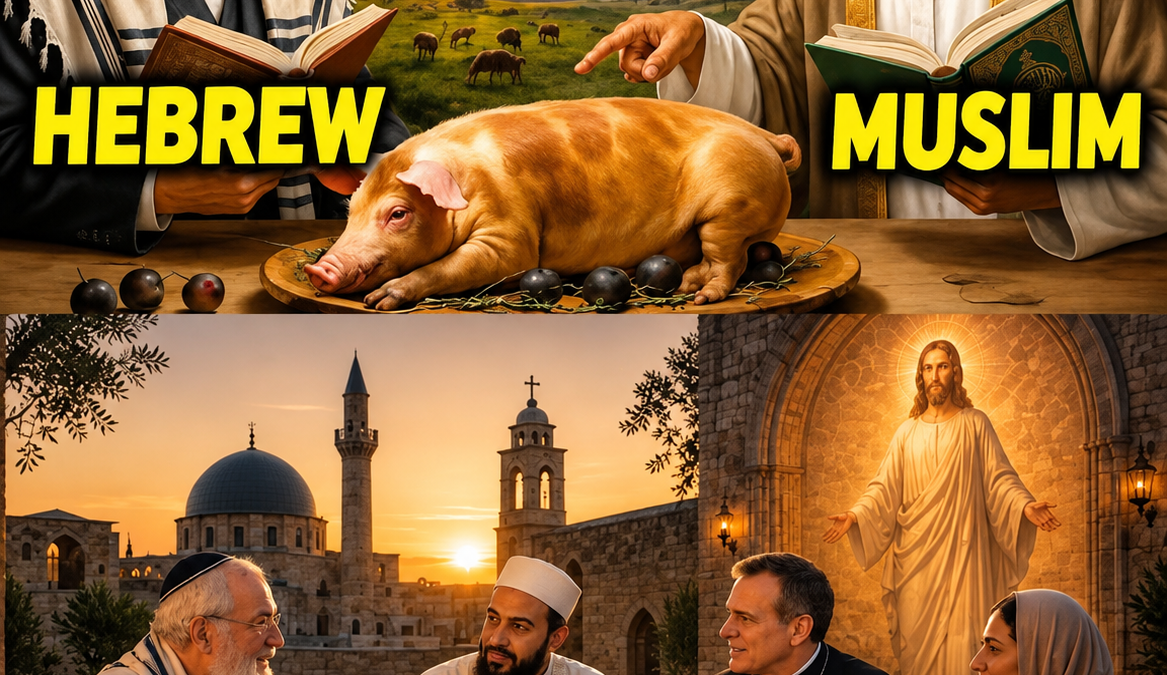
Across three global religions and billions of faithful souls, one creature stands at the center of ancient history. The pig remains an enduring emblem of theology, communal boundary, and divine instruction. Judaism strictly avoids pork, Islam strictly bans it, while Christianity consumes it without guilt.
This division touches something far deeper than mere dietary preference or table customs. It speaks directly to sacred identity, eternal covenants, divine holiness, and spiritual salvation. Three great traditions worship the God of Abraham, yet arrive at opposite conclusions about one single animal.
To understand this enduring mystery, we must step back into deep antiquity. We journey before the founding of modern nations, before churches or mosques dotted landscapes. In those formative days, the Creator began forging a covenant people from the descendants of Abraham, Isaac, and Jacob.
As these wanderers were shaped into a holy community, God delivered precise statutes. A core pillar of this guidance concerned dietary codes, detailed extensively in Leviticus and Deuteronomy. The text explicitly declares that the swine divides the hoof yet chews not the cud, rendering it unclean.
To contemporary observers reading these decrees millennia later, such commands can seem puzzling. Why would the Sovereign Architect of all creation concern Himself with the meat placed upon dinner plates? The ultimate answer begins with the sacred principle of divine holiness and separation.
Before the children of Israel could step foot into the land promised to their forebears, they received a sacred calling. In Exodus, God announced that they were destined to become a kingdom of priests and a holy nation. In the sacred Hebrew tongue, the word for holy is Kadosh, signifying complete separation and distinct consecration.
Surrounding Canaanite tribes, Egyptians, and Mesopotamian empires engaged in violent pagan rites. They worshipped pantheons of idols, practiced sorcery, sacrificed infants, and consumed foods declared abominable. Divine food laws formed an impenetrable cultural and spiritual border wall separating Israel from these corrupting practices.
Every daily meal became an embodied exercise in spiritual dedication and loyalty. What an Israelite chose to place on the table visibly declared whose sovereignty governed their home. It demonstrated absolute submission to the covenant, proving devotion through unquestioned obedience.
In the ancient Near East, dining was never considered a private, secular action. Feasting was deeply interwoven with local cultic rites, where animals were routinely consecrated to pagan deities. Swine were heavily involved in these chthonic offerings, fertility cults, and impure temple ceremonies.
By commanding His chosen people to reject pork, God erected a sacred protective perimeter. This border safeguarded their souls and rituals from idolatrous entanglements and defiled altars. To dine differently was to live differently, declaring uncompromising public devotion to Yahweh alone.
Through endless generations of triumph, exile, and persecution, Jewish communities upheld this statute. Refusing the swine became a heroic badge of honor and fidelity to the Sinai covenant. Countless faithful chose martyrdom during Hellenistic and Roman oppression rather than taste forbidden meat.
A secondary dimension of divine wisdom involves ancestral health and environmental conditions. In the searing climate of the ancient Near Eastern deserts, scavenging animals posed lethal medical hazards. Swine consumed detritus, decaying refuse, and offal, frequently hosting aggressive, debilitating parasites.
Without refrigeration or modern sanitation, raw pork spoilt rapidly and spread trichinosis. Divine law effectively provided preventive physical protection alongside comprehensive spiritual sanctuary. Even today, anthropologists recognize that these biblical instructions preserved lives in unforgiving wilderness conditions.
Abstaining from pork transformed everyday nutrition into an intimate, recurring creed. Every meal proclaimed: “I belong to the Lord, I walk apart, and my life is consecrated.” This dietary boundary forged an unbreakable spiritual brotherhood that survived empires and diasporas.
For the Jewish believer, these ordinances were never arbitrary burdens or minor lifestyle choices. Observing them meant walking in the light of divine commandments and safeguarding sacred identity. Violating them meant crossing into forbidden spiritual territory and compromising sacred covenant purity.
Thus, the pig became an enduring monument to absolute obedience and communal preservation. Even today, after more than three millennia, this identity remains steadfast in Jewish homes. Yet the story takes a fascinating turn when we examine the sacred traditions of Islam.
Emerging in the Arabian Peninsula roughly two millennia after Moses, Islam encountered established traditions. Both Jewish and Christian communities were actively practicing their respective faiths throughout the region. When the Quran was revealed through the Prophet Muhammad, it confirmed many core moral and spiritual statutes.
The Quran mentions the absolute prohibition of swine explicitly across multiple foundational surahs. Surah Al-Baqarah and Surah Al-Ma’idah declare carrion, blood, and the flesh of swine strictly forbidden. In Islamic jurisprudence, this ruling is not treated as a passing suggestion, but as an absolute divine ban.
Unlike the Sinai covenant, which formed an ethnic and spiritual constitution specifically for Israel, Islam views its laws as universal. Divine dietary restrictions revealed in the Quran are commanded for all humanity across every era. To comprehend why Islam prohibits pork so unconditionally, we must examine its central theological pillars.
The primary foundation rests upon pure submission to the sovereign authority of Allah. Indeed, the very word Islam translates fundamentally as submission and surrender to divine will. Obeying divine decrees without requiring exhaustive empirical justifications represents the pinnacle of worship.
When the Quran announces that pork is forbidden, the faithful believer responds: “We hear and we obey.” Refraining from pork becomes a continuous, humble act of worship and spiritual discipline. It aligns the believer’s daily routine with the universal order commanded by the Creator.
The second core reason involves ritual and spiritual purity, known as the concept of Tahara. Islamic theology classifies the swine as rijs and najis, denoting inherent ritual impurity and spiritual uncleanness. Tahara is an all-encompassing system governing prayer, bodily cleanliness, devotional focus, and personal nourishment.
Consuming an animal considered inherently impure directly compromises the spiritual state required for communion with God. The physical body and the immortal soul are viewed as intimately and profoundly connected. Nourishing the temple of the body with impure elements inevitably clouds the heart and taints prayer.
The third pillar is the profound continuity running through all previous prophetic revelations. Muslim theology teaches that Islam confirms and completes the pristine revelations granted to past messengers. The Tawrat of Musa, the Zabur of Dawud, and the Injeel of Isa are recognized as heavenly messages.
Because the Mosaic Torah expressly forbade pork, Islam maintains this standard as unbroken divine continuity. It honors the ancient lineage of monotheistic prophets who uniformly rejected the impure swine. For Muslims, maintaining this boundary affirms solidarity with the long chain of righteous prophets.
The fourth dimension of this commandment is the active testing of inner personal discipline. Certain divine laws serve specifically to examine human resolve, restraint, and sincere devotion. Even when mortal minds cannot perceive every cosmic reason, obedience proves true spiritual mastery over base appetites.
The fifth aspect echoes ancestral health wisdom, which scholars throughout Islamic history have consistently noted. Swine harbor dangerous parasites, and their flesh degrades rapidly in hot desert environments. Islamic jurisprudence prioritizes the preservation of life and bodily health as essential duties before God.
Just as the rejection of pork marked Jewish identity, it equally defines the global Muslim Ummah. For over fourteen centuries, across more than fifty nations, this commandment has stood entirely unshaken. From Mecca to Cairo, Istanbul to Jakarta, millions observe this divine restriction with unified devotion.
Eating pork in Islam is never dismissed as a trivial slip or an innocent culinary adventure. It represents a direct breach of sacred boundary lines, defying the explicit text of the Quran. Both Judaism and Islam therefore walk in shared dedication, rejecting the swine out of devotion to God.
Yet when we cross the threshold into Christian theology, an astonishing divergence appears. Why do Christians, who honor and revere the Old Testament scriptures, eat pork without spiritual guilt? To understand this transformation, we must study Jesus Christ, His ministry, and the dawn of the New Covenant.
A foundational truth often overlooked by modern readers is that Jesus was born into a Jewish family. He lived under the Mosaic Law, attended synagogue, and observed the dietary commandments meticulously throughout His life. Jesus never ate pork during His earthly journey, nor did His original band of twelve Jewish disciples.
In the Gospel of Matthew, Jesus proclaimed that He came not to abolish the Law, but to fulfill it. Fulfilling the divine law does not mean casting it aside as worthless or flawed. It means bringing its prophetic types, shadows, and ceremonial purposes to their ultimate cosmic climax.
The tension surfaces prominently in the seventh chapter of the Gospel of Mark. Pharisees and scribes gathered to challenge Jesus because His disciples ate with hands that were ceremonially unwashed. This conflict had nothing to do with modern germ theory or practical dining hygiene.
The dispute centered upon man-made scribal traditions and ritualistic purification rituals added to Moses’ words. Jesus responded with a revolutionary theological declaration that shook the religious establishment of His day. He asserted that nothing entering a person from the outside can defile them spiritually before God.
Instead, Jesus declared that genuine spiritual defilement originates entirely from within the human heart. From the inner person emerge evil thoughts, sexual immorality, theft, murder, adultery, greed, malice, and pride. Mark includes a profound editorial observation: “In saying this, Jesus declared all foods clean.”
This pivotal moment shifted humanity’s focus from exterior ritual washings to interior spiritual condition. True holiness before God was never a question of digestive biology or culinary regulations. Sin is an issue of spiritual rebellion, birthed in the hidden chambers of the soul.
The Pharisees maintained that holiness was maintained through avoiding physical contamination and rigid external rites. Jesus overturned this paradigm, teaching that physical food enters the stomach and passes into the sewer. It cannot touch, alter, or corrupt the immortal spiritual nature of a human being.
Jesus was laying the groundwork for the New Covenant, prophesied long ago by Jeremiah. This promised an era when God’s law would be written directly upon human hearts by the Holy Spirit. The external ceremonial boundary markers of national Israel were preparing to give way to something far greater.
During His earthly ministry, Jesus did not command His Jewish disciples to start consuming pork immediately. He did not encourage reckless disregard for the Mosaic code while the old dispensation stood. Instead, He planted the living seed of a reality realized through His crucifixion and resurrection.
Christ’s sacrificial death tore the temple veil in two, dissolving ceremonial barriers forever. The Holy Spirit was poured out to purify human souls from the inside out. True righteousness was unveiled not as dietary abstinence, but as divine redemption received through living faith.
The profound seeds planted in the Gospels bloomed into full realization in the tenth chapter of Acts. This passage records one of the most critical turning points in all of human spiritual history. It permanently redefined holiness, birthed the universal Church, and opened salvation to all nations on Earth.
The instrument chosen for this revelation was the Apostle Peter, a devoted Jewish fisherman. While praying upon a rooftop in the coastal city of Joppa around midday, Peter grew deeply hungry. While awaiting a meal, he fell into an ecstatic spiritual trance and witnessed heaven opened wide.
A great sheet descended toward him, bound at its four corners like a magnificent sail. The four corners mirrored the four winds and cardinal directions of the global human family. Within that sheet crawled every variety of four-footed animal, reptile, and bird known to the world.
Creatures classified as clean and unclean under the Levitical code lay jumbled together without distinction. Suddenly, a heavenly voice commanded: “Rise, Peter; kill and eat.” Shocked to his core, the faithful apostle recoiled, declaring he had never eaten anything common or unclean.
Even years after Christ’s ascension, Peter had scrupulously maintained the ancestral dietary statutes. He could not fathom violating the ancient holiness codes delivered on Mount Sinai. Then the voice spoke a second time with divine authority: “What God has cleansed, you must not call common.”
This dramatic exchange repeated three times, echoing the three times Peter had once denied his Master. Three times heaven affirmed that God was dismantling the ancient divisions that kept humanity fractured. At first glance, this heavenly vision might appear merely to be an authorization of new culinary choices.
Yet sacred Scripture leaves no ambiguity regarding the true, profound meaning of this miraculous encounter. Peter himself decoded the vision upon entering the home of Cornelius, a Roman military officer. He proclaimed: “God has shown me that I should not call any person common or unclean.”
The primary intent was never an advertisement for eating pork, but the radical inclusion of the Gentiles. For fifteen centuries, a wall of separation had stood between Jewish communities and the broader nations. Dietary laws, circumcision, and temple rituals had functioned as fences guarding Israel’s unique covenant sanctuary.
With this divine revelation, the Creator smashed that ancient wall of cultural and ceremonial separation. Salvation was no longer confined within the borders of one nation or one ancestral lineage. Gentiles were invited into full fellowship as equal children in the royal household of God.
Three profound theological truths shine brightly through the lens of Peter’s rooftop vision. First, it signaled the fulfillment and retirement of the Mosaic ceremonial and ritual legislation. The dietary rules, washings, and festival calendars were prophetic shadows pointing forward to Jesus Christ.
When Christ, the radiant substance, arrived, the preparatory shadows naturally receded into the past. Second, it heralded the miraculous birth of an international, multi-ethnic, and multi-lingual kingdom. The Church would never be bound by dietary traditions, but by transformative faith in the risen Savior.
Third, it extinguished the ancient spiritual hostility separating diverse human families. As the Apostle Paul later explained, Christ broke down the dividing wall of hostility through His flesh. He created in Himself one new humanity out of former enemies, reconciling both groups unto God.
Though the vision’s deepest heart concerned the dignity of human souls, its dietary implications were absolute. If Gentile believers were cleansed by the Spirit, the ceremonial food taboos lost their theological purpose. The Church stepped into an expansive kingdom where all peoples sat together at one Eucharistic table.
No theologian clarified this newfound spiritual liberty with greater brilliance than the Apostle Paul. Paul had lived as an elite Pharisee, educated at the feet of the celebrated master Gamaliel. He understood the intricate legal requirements of Jewish food traditions better than any contemporary scholar.
Paul had defended those ancestral boundaries with violent zeal before his dramatic conversion on the Damascus road. Yet encountering the risen Christ completely dismantled his reliance on legalistic perfection. He came to perceive that external dietary regulations were merely temporary guardians leading humanity to the Messiah.
Writing to the believers in Rome, Paul made an astonishing theological statement. He wrote: “I know and am persuaded in the Lord Jesus that nothing is unclean in itself.” For an orthodox Pharisee, this was an astonishing theological paradigm shift.
Paul asserted that no food possessed innate moral filth or inherent demonic corruption. Food had carried ceremonial significance temporarily to define Israel’s unique earthly pilgrimage. Under the reign of grace, food resumed its original character as innocent material creation.
In his letter to Timothy, Paul grounded this truth in the glorious dawn of Genesis. He wrote that everything created by God is good, and nothing is to be rejected if received with thanksgiving. God had looked upon His original handiwork and declared it very good before human codes existed.
In Paul’s theology, food possesses neither intrinsic moral virtue nor intrinsic spiritual depravity. Eating certain meats cannot make a believer holier, nor does abstaining from them earn divine merit. Salvation rests entirely upon the finished work of Jesus Christ on the cross of Calvary.
Holiness is not forged by rejecting bacon or clinging tightly to outward ceremonial ordinances. It is birthed through the supernatural regeneration of the Holy Spirit living within the surrendered soul. Paul vehemently warned the early churches against slipping back into the suffocating trap of religious legalism.
In Colossians, he warned: “Let no one pass judgment on you in questions of food and drink.” The eternal kingdom of God is not eating and drinking, but righteousness, peace, and joy in the Holy Spirit. The Mosaic law served a vital purpose by exposing human sin and pointing to the coming Redeemer.
Once Christ fulfilled that law through His life, death, and resurrection, the ceremonial framework reached its destination. Believers are now sanctified through the living presence of Christ, not by the contents of their stomach. Yet Paul never allowed this glorious Christian freedom to mutate into selfish, destructive arrogance.
He offered a tender and sobering pastoral warning to the church in Rome regarding weaker consciences. He urged believers not to destroy the spiritual work of God for the sake of mere earthly food. A Christian possesses freedom to eat, but equally possesses freedom to abstain out of self-sacrificing love.
Spiritual liberty must always be shepherded and restrained by the higher law of divine love. Freedom divorced from love degenerates into callous spiritual arrogance and reckless indifference toward others. Love without freedom suffocates in legalism, but freedom expressed through tender love reflects the genuine heart of Jesus.
In the primitive Church, Jewish believers who abstained from pork lived alongside Gentile believers who ate freely. This clash of cultures carried enormous potential to tear fledgling local assemblies completely apart. Paul taught that both choices were acceptable before the Lord, provided they were practiced with thanksgiving.
One believer eats to the glory of God, giving thanks for the bounty provided by heaven. Another abstains to the glory of God, dedicating their disciplined appetite in solemn worship. Neither believer possessed the moral right to despise, condemn, or sit in judgment over their brother.
This magnificent teaching altered human fellowship forever, establishing unity rooted in Christ alone. The Church became a family united not by shared cultural menus, but by a shared divine Redeemer. Food fills the belly for a few short hours, but it cannot purify the immortal human spirit.
What you consume will never save your soul, nor will it cast you into eternal damnation. Your earthly diet does not establish your worth, your character, or your status before the Creator. Your true, unshakeable identity is rooted in Christ, whose blood washes the soul whiter than snow.
When we survey this grand panoramic narrative, we witness an extraordinary and illuminating reality. Three world religions, tracing their spiritual roots back to the patriarch Abraham, disagree about one creature. This divergence persists because each faith operates under a distinct covenant and understanding of divine holiness.
In Judaism, avoiding pork represents an enduring commitment to the Sinai covenant. The prohibition stands as an eternal witness that Israel is called to be a distinct, consecrated nation. Refusing the swine connects modern Jewish believers to Moses, ancient ancestors, and an unbroken line of faithfulness.
In Islam, abstaining from pork is an absolute mandate revealed directly within the Quran. It applies globally, reinforcing personal self-mastery, bodily cleanliness, and wholehearted submission to Allah. It stands as an essential badge of devotion shared by hundreds of millions of faithful worshippers worldwide.
In Christianity, the consumption of pork illustrates the profound liberty inaugurated by the New Covenant. Christians believe Jesus fulfilled the symbolic shadows of the law, inaugurating true righteousness from within. Purity is no longer regulated by external culinary boundaries, but by the indwelling Holy Spirit.
The three great Abrahamic traditions honor God through three distinct theological paradigms. Judaism seeks holiness through observance of the sacred Torah revealed to Moses. Islam seeks purity through complete surrender to the divine commands revealed in the Holy Quran.
Christianity seeks holiness through the grace, sacrifice, and spiritual transformation found in Jesus Christ. Each path honors the Sovereign Creator, yet envisions the journey toward spiritual purity through different sacred lenses. Recognizing these distinct perspectives allows us to appreciate the depth, history, and convictions of each faith.
As followers of Christ, our central focus shifts permanently away from culinary disputes or ritual regulations. What truly matters is the posture of your heart, your personal faith, and your walk with God. Spiritual life does not depend on what you avoid, but on the Savior to whom you belong.
As Paul memorably wrote to Corinth: “Whatever you eat or drink, do all to the glory of God.” The foundational question of faith is never: “What kind of meat is permitted upon my dinner table?” The real question is: “Does my daily life bring honor, glory, and reverence to my Creator?”
Are our bodies, our thoughts, our words, and our hidden motives dedicated to honoring Him? For some believers, honoring God means practicing sacred fasting, simplicity, and physical discipline. For others, it means enjoying creation with gladness, gratitude, and unrestricted Christian freedom.
Whatever path your personal conscience chooses, ensure your life radiates the love and majesty of God. The Lord does not inspect your kitchen cabinets; He gazes directly into the depths of your heart. We are called not to walk in fearful bondage to external rules, but in radiant love.
May that divine love govern our steps, humble our speech, and inspire our service to humanity. Whatever you place upon your table, receive it with genuine gratitude, deep humility, and joy. Honor the Savior who gave His life, resting your eternal confidence in His unfailing grace alone.

