Why Did They Try to STONE JESUS When He Said “I AM” Before ABRAHAM?
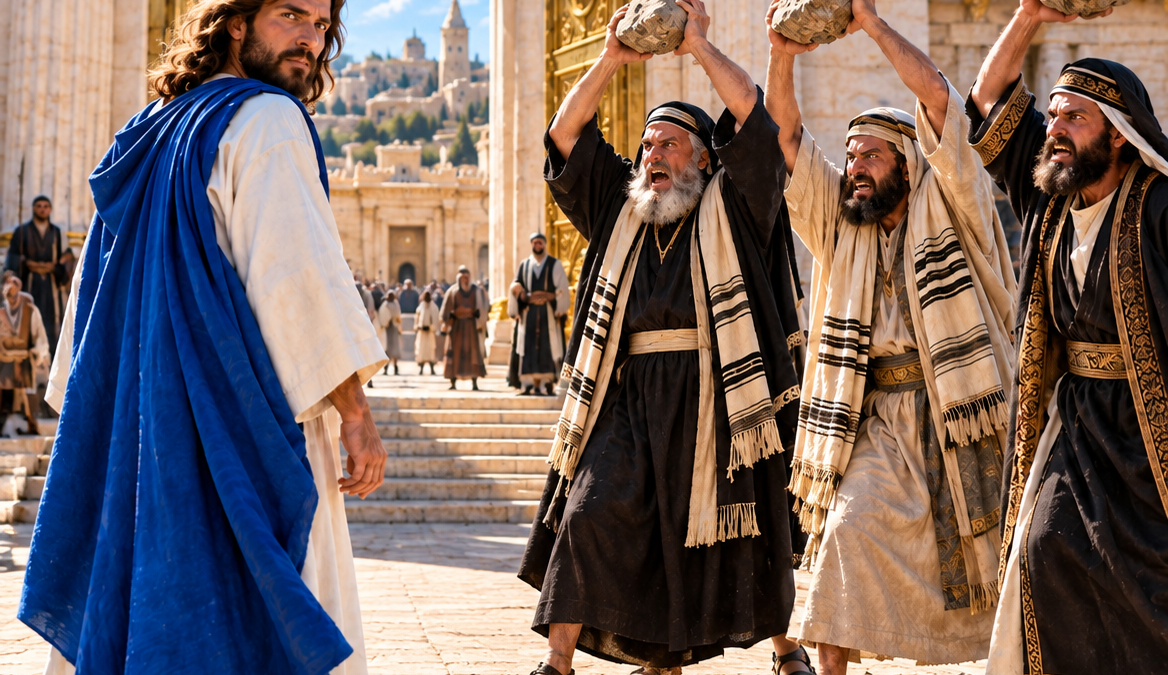
Jesus finished a sentence with two words. People bent down to pick up stones. Today you are going to see exactly what they heard and why they reacted so quickly.
It was not in a dark alley. It was not a nighttime ambush. It was inside the temple in Jerusalem in broad daylight in the most heavily watched place in the city.
And what triggered it was not a blow, not an insult, not a threat. It was a sentence that in Greek has five words ending with two. I am.
That reaction is one of the most uncomfortable pieces of evidence that exists about who Jesus claimed to be because the witnesses we have from that afternoon were not his followers. They were people who wanted him to be wrong.
One quick thing. If you just landed here, do not leave a like. Watch it. And if it gives you something, then yes. If not, you owe me nothing.
If you are already part of the family, leave it in trust. That tells the algorithm to carry this to more homes and stay because there is a detail that ruins the easy explanation.
The easy explanation says he said the name of God and the name of God was untouchable. So the law commanded killing him. It sounds tidy.
The problem is that according to the very law they themselves followed, what Jesus had just said would not technically qualify for a death penalty. Not in a court.
There is an ancient Jewish treatise that defines blasphemy with such precision that what happened that day would not even have made it to trial.
And worse still for that explanation, one chapter later in that same gospel, a blind beggar says those exact two words in full view on a public street and absolutely nothing happens.
So let us do this in order. First you will see the phrase in the language in which it was spoken with the two verbs that make it impossible to translate without losing something.
Then we will hold that afternoon up against the written law step by step and you will discover that not a single one of those steps was followed.
Then I will put before you the best objection that exists against all of this with the grammar in hand and no tricks.
And at the end you will see where the echo those people recognized actually came from not where almost everyone looks for it. I will give you one preview.
The answer is not in Exodus. It is in a prophet writing from exile describing the gods of another empire being carried on the backs of animals. Let us go to the courtyard.
The scene is in the Gospel of John chapter 8. And to understand why it ends with stones in people’s hands, you have to see it complete because it did not begin there.
Nobody picks up a stone all at once. The temperature of that conversation rose step by step and every step is written. Look at where we are standing because the text is surprisingly precise about it.
Jerusalem is full. It is the feast of tabernacles. One of the three feasts when the city multiplied with pilgrims and John says so from chapter 7.
During those days the temple esplanade was a mix of market, open air school and moving crowd. Teachers taught there seated surrounded by people coming and going and John gives you the exact corner. Chapter 8 verse 20.
These words Jesus spoke in the treasury teaching in the temple. The treasury was the area where contributions to the sanctuary were received.
That is not a secluded courtyard but a thoroughfare with an audience with money moving and with guards nearby. And that same verse 20 ends with a phrase I want you to put in your pocket.
It will come back at the end of the video and it will explain something important. It says, “And no one arrested him because his hour had not yet come.” Hold on to that.
His hour had not yet come and you need to know what they had been arguing about because the fight over Abraham did not come from nowhere.
A few verses before in verse 31, Jesus had said something apparently gentle. If you abide in my word, you are truly my disciples and you will know the truth and the truth will set you free.
It is one of the most quoted phrases in the world. It is on the walls of universities and on the seals of entire institutions.
But look at what it provoked right there live. Verse 33. They answered him, “We are offspring of Abraham and have never been enslaved to anyone. How is it that you say you will become free?”
Stop at that answer because it is extraordinary. We have never been enslaved to anyone.
They are saying this as descendants of the people who were slaves in Egypt who have an entire annual feast dedicated to remembering precisely that.
They are saying it as heirs of those who were deported to Babylon. And they are saying it in that very moment while the city is under Roman occupation.
In the northwest corner of that same esplanade, Herod had built a fortress called the Antonia.
And Josephus records that from its tallest tower, one could survey the entire temple precinct with the eye.
There were Roman soldiers looking down while they said that phrase. We were never slaves to anyone under a foreign banner.
Notice what they bring forward to sustain that impossible claim. Lineage we are from Abraham. As if the surname canceled history and geography alike.
That is where the argument that will end in stones is born. They put Abraham on the table as a shield. And over the following verses, Jesus is going to keep pushing that shield until it breaks in their hands.
Now we start. It begins with an insult. John 8:48. They say to his face, “Are we not right in saying that you are a Samaritan and have a demon?”
Stop at that for a moment because translations soften it without meaning to. Calling him a Samaritan was not calling him a foreigner.
It was calling him a religious half breed, someone of mixed blood and contaminated worship, someone who has no right to talk about Abraham.
And the second part was worse. You have a demon did not mean you are crazy. It meant what comes out of your mouth does not come from God. It comes from somewhere else. They are telling him his source is dirty.
And he answers without raising his tone. His response is right there. I do not have a demon, but I honor my father and you dishonor me.
Here it is worth clarifying something because the text is going to use a word that today is read incorrectly.
John writes the Jews to refer to this group arguing with him in the temple courtyard. He is not speaking of an entire people. Jesus was Jewish. His disciples were Jewish. The crowd that followed him was Jewish.
Those who listened to him that afternoon were also Jewish. What you are watching is an internal argument within one family about who the man speaking really is.
When in this video I say those who argued with him, I mean exactly that group in the courtyard and no one else.
The scene continues. A few lines later Jesus says, “Truly, truly I say to you, if anyone keeps my word, he will never see death.” And something breaks there.
Because up to that point, the argument had been about authority, about origin, about who has the right to teach. But something else has just appeared. Death has just appeared.
Notice how that sentence opens truly, truly. In Greek, it is amen. Amen. The doubled form only appears in the Gospel of John and it functions as a seal.
It is the way of saying what comes now is not an opinion, not a side comment. It is a declaration. Every time you hear it in John, something large is about to fall.
And now they shout, “Now we know you have a demon. Abraham died as did the prophets. And you say, ‘If anyone keeps my word, he will never taste death.'”
Listen to the argument. Because it is a good one. It is not a foolish argument.
They are saying, “The most important man in our history is dead. The prophets are dead. Everyone who ever spoke on behalf of God ended up under the ground. And you come to offer what none of them could even offer or attain.”
Verse 53. And this is the question that opens the door to everything that follows. Are you greater than our father Abraham who died? They asked the question.
Hold on to that detail because it matters at the end. Nobody put the subject in their mouths. They brought the comparison with Abraham themselves.
And Jesus could have dodged. He could have said, “You are misunderstanding me. That is not what I meant.” Instead, he does something different.
He answers, “Your father Abraham rejoiced that he would see my day. He saw it and was glad.”
Think about what just happened. They asked whether he was greater than Abraham. And his answer was neither yes nor no. His answer was, “Abraham was waiting for me.”
Abraham saw my day and rejoiced. He has just placed Abraham on the side of those who wait and himself on the side of what is awaited.
And it was not an idea out of nowhere. In that world, tradition circulated that Abraham had been shown the future. And the textual anchor was in the scripture itself.
Genesis 15, the night of the covenant. Abraham falls into a deep sleep and receives what had not yet occurred. Centuries of history fast forwarded in a vision.
They knew that scene. What they were not expecting was for someone to use it this way.
The response he receives is mockery. And it is the last thing before the phrase verse 57, you are not yet 50 years old and have you seen Abraham?
That number is probably not a biographical fact. They are not calculating his exact age. 50 was a mark of full maturity in that world.
In numbers 4, the service of the Levites in the sanctuary ran from 30 to 50 years old. And that is where the duty ended.
By saying you have not even reached 50, they are saying you have not even finished your tour of duty, young man. It is the veteran’s contempt for the young.
And then he answers. John 8 verse 58. Truly, truly I say to you before Abraham was, I am. There is the seal again. Amen. Amen. What comes is a declaration.
I want you to look at the sentence up close because the entire reaction in the courtyard fits inside two verbs. In Greek, it sounds like this.
Prin Abraham ganesti ego ami five words the first three say before Abraham came to exist. The last two say I am.
The verb Jesus uses for Abraham is ginomay in the form janesti. It does not mean to be. It means to come to be to begin to exist to start to be there.
It is the verb of things that at some point were not and afterward were. Abraham had a day one. There was a moment when Abraham began.
The verb Jesus uses for himself is different. Amy present tense I am. And that is the peculiarity no translation can fully hide because it is in the grammar itself.
The sentence mixes two tenses that should not coexist. It opens looking backward at a point in the past and ends in the present. Before that man began to exist. I am.
Think of it as a timeline. Jesus marks a point on that line. Here Abraham begins and then says he is not at any point on the line. He is holding the line up.
Now look at what he did not say because in a court that weighs as much as what he did say, he did not say I was.
The Greek had that form available and it is what one would expect before Abraham existed. I already was. It would have been an enormous claim and perfectly expressable.
He did not say I was made before. He did not say I existed first. He did not say I was born before him. He chose the present.
And the present placed against a starting point in the past does something no other tense does. It erases the starting point.
A being who already is before another begins to be is a being who did not begin. Subscribe what is coming explains the stones.
I want to show you something about this gospel that once you see it, you cannot stop seeing.
John uses those two words, ego Amy, in two distinct ways. And confusing them is the most common mistake when speaking about this topic.
The first way is the famous one. Jesus says, “I am,” and then adds something. I am the bread of life. In chapter 6, I am the light of the world.
In chapter 8, just a few verses before the scene we are looking at, I am the good shepherd. In chapter 10, I am the resurrection and the life in chapter 11. I am the way, the truth, and the life in chapter 14.
Those are the ones that get preached, the ones embroidered on pictures, the ones everyone can quote. And they are enormous statements. But they have something after them. There is a compliment. I am what?
The second way is much harder to see because in English it conceals itself. It is when Jesus says, “I am” and adds nothing.
The sentence hangs there without a compliment, grammatically incomplete, and those are the ones that provoke reactions.
Chapter 8 24. Unless you believe that I am, you will die in your sins. No compliment.
Many translations feel compelled to fill it in with something because it sounds odd standing alone and add he who I say I am or the one I am. In Greek there is nothing. It is bare.
Chapter 8 28. When you have lifted up the son of man then you will know that I am. Again with no compliment.
Chapter 13 19. At the last supper. I am telling you this now before it takes place that when it does take place you may believe that I am same and the one from our courtyard verse 58 is of this second kind the bare form.
Hold on to that distinction because it is the hinge of the entire video. An I am with a compliment is a powerful metaphor.
An I am without a compliment is something entirely different. And in a little while you will understand why.
And that group of people did not need it explained to them. Nobody in the courtyard asked for clarification. Nobody asked, “What do you mean?”
The reaction came in the very next verse immediately physical. And the following line says, “So they picked up stones to throw at him.”
Here is where the explanation usually stops and draws the conclusion. He said the name of God. So they wanted to kill him. End.
But stay with me because if you stop there, you miss the best part and the best part is a problem. That problem takes the shape of written law and it is in the book of Leviticus.
Leviticus 24 preserves the only case of blasphemy narrated in the law of Moses with names, with a process, and with a sentence.
And the interesting thing is not the punishment. It is the procedure. The scene is the camp in the wilderness.
A man, the son of an Israelite mother and an Egyptian father gets into a fight with someone else inside the camp. In the middle of the fight, the text says he blasphemed the name and cursed.
What happens next is what matters. And look at what the text says. They put him in custody until the will of the Lord should be clear to them.
Read it again. They locked him up. They did not kill him.
There was a man who had just cursed the name in front of witnesses in the heat of anger in the middle of a fight. And the entire community stopped and waited. They waited for a response. Nobody picked up a stone that day.
And when the sentence comes, it comes with a detailed procedure. Two lines further. Bring out of the camp the one who cursed, and let all who heard him lay their hands on his head, and let all the congregation stone him.
Count what that verse requires. It requires a place outside the camp, not where the act occurred.
It requires witnesses and not anonymous ones because those who heard him have to identify themselves publicly by laying their hands on the head of the accused.
And it requires the community gathered and in agreement, not an outraged group. Custody, waiting, named witnesses, designated place, community convened.
Now go back to the temple courtyard. How many of those steps do you see in John 8:59? None.
Nobody placed him in custody. Nobody waited for a response. Nobody called witnesses or asked them to identify themselves.
Nobody took him out of anywhere because they were in the most sacred place they had. And that is precisely where they raised the stones.
There was no community convened. There were hands going down to the ground.
About those stones, incidentally, the text does not say where they came from.
Popular tradition imagines a courtyard full of rubble, and there is a reason to imagine it. The temple was still under construction.
In John 2:20, his own interlocutors say it had been under construction for 46 years, and Josephus in the Jewish antiquities records that the work was not completed until the 60s of the first century.
In other words, there was construction, but from that to claiming they grabbed building material is a step the text does not take, and I am not going to take it for you.
What you can affirm is this, and it is what changes the entire video. That was not a tribunal. It was a reflex.
And I want you to hold on to the difference because it is the key to everything that follows. A sentence is thought through.
A tribunal deliberates, consults, takes its time, weighs the evidence, and can be contaminated by interests. A reflex cannot.
A reflex is what the body does before the head has time to put together the argument.
When a group of people hears a phrase and bends down to look for a stone without consulting anyone, those people are not executing a law. They are reacting to something they understood at once.
And here is the uncomfortable part. What makes this scene one of the hardest to sidestep in the entire discussion about who Jesus was? Those people did not want it to be true.
Think about it carefully. If an enthusiastic follower tells you his teacher claimed to be divine, you can suspect the enthusiasm. That is natural.
But here there are no followers. Here there are adversaries. Here there are people who had spent the entire conversation trying to prove that man was wrong, that his origin was dirty, that he was too young to speak that way.
And those are the ones who react as if they had just heard someone claim for himself what belongs to God alone.
In any investigation, the testimony that carries most weight is not the friends. It is the adversaries who without meaning to confirms what he was trying to deny.
And that is exactly what you have in John 8:59. The oldest interpretation that exists of that phrase given by hostile eyewitnesses with their hands full.
And I want you to see what this is useful for outside the video because this is not a collectible piece of information.
Sooner or later, someone is going to tell you that the divinity of Jesus was invented three centuries later at a council by vote out of political convenience.
It is one of the most repeated objections there is and it usually comes with a tone of revelation.
When they tell you that there is no need to argue about councils, just ask one thing.
Why then did some of his adversaries in his own lifetime inside the sacred precinct bend down to pick up stones after hearing him talk about himself?
Because that reaction is dated long before any council and it was not written by a devotee describing his teacher.
It was provoked by people who were trying to discredit him and who reacted that way precisely because they understood what he was claiming for himself.
A friend can exaggerate out of affection. An adversary does not exaggerate in his favor when the result exposes him. If this changed the scene for you, tell me in the comments.
Now then, if the reflex was that clear, we should be able to point to the rule they believed he had broken. And that is where the case gets genuinely complicated.
The law says in Leviticus 24:16, “Whoever blasphemes the name of the Lord shall surely be put to death.” It seems closed, but look at the object of the sentence.
It does not say whoever speaks ill of God. It says the name. The offense is tied to something very specific.
And here I need to introduce a source with its warning stated upfront. There is a document called the Mishna. It is the first major written compilation of Jewish oral law.
And in its tractate on the court Sanhedrin, there is a line that goes straight to our problem. Sanhedrin 75. The blasphemer is not liable unless he pronounces the name.
The warning and I put it in the air so you cannot claim it from me later. The Mishna was put into writing around the year 200 of our era. More than a century after that afternoon.
It is not the minutes of any trial. It is not the code that was in force in the temple courtyard.
And there is academic discussion about how much of what it preserves reflects actual first century practice.
What it is, and this is why it is valuable, is the best window we have for understanding how that world thought legally about this exact offense. And what that window shows is surprising.
The definition not only requires that the accused pronounce the name, it requires more. Rabbi Yahoshua Ben Cchure describes the trial procedure there.
During all the sessions, the witnesses testified using a substitute name so as not to repeat the offense in the courtroom.
The substitute was Yose, which in Hebrew has four letters, the same as the name.
Only at the end, in order to pass sentence, was the room cleared, and the lead witness asked to say exactly what he had heard.
And when he said it, the judges stood up and tore their garments. That tear was never to be sewn back, measure the level of requirement, they had to reproduce the complete curse with the name inside for the case to hold.
The Jewish scholar Louis Jacobs noted that the definition is so narrow, it makes the offense nearly impossible to commit in practice.
And you may be wondering why anyone would make a rule so impossible to fulfill. The answer is in the Old Testament itself and it is chilling.
First Kings chapter 21. A man named Naboth has a vineyard that King Ahab wants and cannot purchase.
Queen Jezebel solves the problem with a method that requires no armies. The plan is written, “Bring two worthless men and have them bring a charge against him, saying, you have cursed God and the king. Then take him out and stone him to death.”
And it worked completely. They took him outside the city and stoned him with stones, and he died.
As soon as Jezebel heard it, she told the king, and the king rose and went down to take possession of the vineyard.
There you have the complete portrait. The accusation of blasphemy was the perfect weapon to kill someone with the appearance of legality.
You needed no material evidence. There was no body of the crime, no stolen object, no wound to show.
All you needed was two witnesses willing to say they had heard it.
That is why the definition kept getting narrower over time. Not to protect the blasphemer, to protect the innocent man from two neighbors who wanted his vineyard.
Hold on to that detail too because it will reappear in the final stretch of the video. In a blasphemy case, everything depended on the witnesses agreeing.
Now apply that rule to what happened. Did Jesus pronounce the name that afternoon? No.
There is not a single version of John 8:58 in any manuscript in any language in which Jesus pronounces the name. He did not say the tetragrammaton. He said nothing resembling it. He said two perfectly ordinary Greek words.
And I want you to see just how ordinary they were because this is what makes the matter fascinating. Turn the page. John 9.
A man born blind is healed and the neighbors gather to argue about whether it is really him or someone like him. Verse 9. Some said it is he. Others said no. But he is like him.
He kept saying I am. I am in Greek ego amy the same two words a beggar in the street one chapter later says exactly the same thing Jesus said in the temple and absolutely nothing happens.
Nobody starts nobody looks at the ground for a stone the neighbors keep arguing because in Greek egoy was the most common expression in the world.
It was what you said when someone knocked on your door and asked who is there it is me. There was nothing sacred about it.
And there you have the complete problem with the two pieces laid side by side. On one side, words anyone used to identify themselves.
On the other, a group of people who upon hearing them bent down to pick up stones inside the temple, skipping every step of their own law.
So it was not the letter of the code and it was not the expression itself because the expression was used even by a neighborhood beggar. It was something else.
It was something they heard inside those two words that a reader today does not hear. And a reader today does not hear it because they are missing what those people had lodged in their ears since childhood.
Did that question stick? Subscribe. Before showing you what it was, I have to be honest with you and put before you the most serious objection that exists against everything I just said because there are intelligent people with Greek grammar in hand who argue that nothing of the sort happened here.
And their argument is not foolish. Imagine the scene. You are at home, phone in hand, and a 3 minute video comes up.
The person speaking looks calm, has an open Bible and knows Greek and they say this.
You read before Abraham was I am and you think you are reading a declaration of divinity. You are not. You are reading a strange translation.
What Jesus said in plain English is before Abraham existed I already existed. I have been. That means he is older than Abraham nothing more. And being older is not the same as being divine.
And you sit there staring at the screen with nothing to say. Let us take that objection seriously because it deserves it. And because if I hid it from you, this video would be worth nothing.
In Greek, there is a real rule. When a verb is in the present but is accompanied by an expression of past time, that present is translated into our languages as a perfect. The action began earlier and continues now.
And the best examples do not come from any textbook. They come from the Gospel of John itself.
John 14:9 Jesus says to Philip, “Have I been with you so long?” In Greek that have been is a pure present. But no translation puts Philip, “So long I am with you.” Because in English it sounds broken. They all put have been.
John 15:27. You also will bear witness because you have been with me from the beginning. Again, in Greek, present, in English, perfect.
In other words, the rule exists. It works. And it works inside this very gospel in the mouth of the same person.
Anyone who tells you that the reading I have been is a dishonest invention of some sect is lying to you or has not read enough.
More than that and here I am going to be even harder on myself.
The grammarian Kenneth Mackay in his syntax of the Greek verb in the New Testament published in 1994 not only acknowledges that reading, he prefers it.
He translates the verse as I have been in existence since before Abraham was born.
And two years later in an article in the Expository Times, he adds a sentence I want you to hear because it comes from the opposing side.
It says, “To claim to have been in existence for that length of time is in itself an astounding statement, more than enough to provoke the violent reaction of the crowd.”
Hold on to that sentence because it comes from the opposing side and already gives us half the answer. But let us press the objection because it has a crack and it is exactly where nobody looks.
Go back to the two good examples, the ones from John 14 and John 15. In both there is an expression of duration. So long from the beginning.
These are phrases that measure a stretch from then to now. That is precisely the condition the rule requires in order to work. Now look at John 8:58. Where is the stretch? There is none.
It does not say for so long. It does not say from the beginning. What there is is a clause with the word prin before followed by a verb that marks a beginning before Abraham came to exist.
And that is not a stretch. It is a frontier. The difference looks like fine grammar, but it is enormous. A stretch measures since when. A frontier says what was on the other side.
When you say I have been with you for so long, you are measuring. When you say before that thing began, I am, you are not measuring anything. You are planting yourself outside the point where the time of created things begins.
And there is still something that the grammatical objection cannot resolve and which in my view leaves it without a leg to stand on.
Suppose they are right. Suppose Jesus only said, “I already existed from before.”
That would explain the sense of the sentence, but it does not explain the courtyard.
It does not explain why those people who had spent half the conversation arguing with rational arguments suddenly stopped arguing.
It does not explain why they skipped the custody, the witnesses and the congregation.
And above all, it does not explain why the beggar of John 9, who said the exact same two words, was left completely alone.
A theory about what the sentence meant in the abstract is worthless if it does not explain what the sentence concretely provoked.
And there is a third problem which I find decisive. Do you remember the distinction I asked you to hold between the I am with a compliment and the bear I am?
Try applying the alternative translation to the other two and see what happens.
Chapter 8 verse 24. Unless you believe that I have been, you will die in your sins. It means nothing. If you do not believe that I what the sentence is left lame.
Chapter 13 verse 19. I am telling you this now so that when it takes place you may believe that I have been just as broken.
The reading I have been works in one sentence the courtyard one precisely because there is a reference to the past to grab onto.
In the other two there is nothing to grab onto and the translation collapses on its own and it is not honest to treat the same formula repeated by the same author in the same gospel as a grammatical idiom in one case and non-existent in the others.
You have to explain it whole or you have explained nothing.
To explain it whole, you have to leave grammar behind and ask a different question. Not what those words said, but where they had been heard before.
And the answer will take you to another country, another century, and some pages written while watching the gods of Babylon being carried away on carts.
Babylon. The scene these chapters of Isaiah describe is that of exile with Israel defeated and far from home.
I am reconstructing what the text itself lays before us. So take this as a recreation and not a photograph.
It is a procession day. The gods of the city come out of their temples and travel the streets and they come out carried. They are loaded onto carts, tied down, transported on the backs of animals that grow tired.
Isaiah 46 describes it with a cruelty that still impresses. Bell bows down. Nebo stoops. Their idols are on beasts and livestock.
In the crowd there are Jews. They are there because they lost. They lost the land, the city, the temple. And now they watch the gods of the victors parading by.
And the question burning inside them is not theological. It is personal. Where is ours?
And at that moment to those defeated people God begins to speak and he chooses a very particular way of naming himself.
In Hebrew it is two words ani hu literally I he and they appear precisely where the comparison with idols is hottest.
Isaiah 41:4 Who has performed and done this? Calling the generations from the beginning, I the Lord, the first and with the last. I am he, that I am he at the end is ani hu.
Isaiah 43:10. You are my witnesses, declares the Lord, and my servant whom I have chosen, that you may know and believe me and understand that I am he. Before me no god was formed, nor shall there be any after me. Again, ani hu.
And in chapter 46:4, even to your old age I am he, and to gray hairs I will carry you. Ani hu again.
And look at the contrast. The other gods are carried on beasts. And this one says he is the one who carries. Ani hu is not a name in the sense of a label. It is a signature. It is the way God identifies himself.
In contrast to what is not God, and that signature does not begin with Isaiah, it is much older.
Go to the end of Deuteronomy to the song Moses pronounces before dying. Chapter 32:39. See now that I, even I am he, and there is no God beside me. I kill and I make alive.
In Hebrew that says ani ani hu repeated I, I am he. It is the same signature placed in God’s mouth in one of the oldest texts in the entire Hebrew Bible and in the same context in the face of the claim of other gods.
This is not an amateur reading. The researcher Katherine Williams devoted an entire academic study to tracing ani hu and her work follows the trail exactly there from the song of Moses to the poetry of exile in Isaiah and from there to the targums and later Jewish literature.
It is a formula with its own history and with a fixed function to express that God is exclusive.
Hold on to that detail because it has an irony inside it. The people in the courtyard were arguing with Jesus about who their father was and what Moses and Abraham represented.
And the formula he used at the end came among other places from the last words sung by Moses. If you felt that irony, leave a like.
Now comes the piece that connects the two worlds. Centuries before Jesus, Jewish scholars were translating those scriptures into Greek for communities that no longer read Hebrew easily.
They started with the law of Moses and continued with the prophets over generations.
That translation is called the Septuagint, and it was the Bible read aloud in much of the first century world.
And how did they translate ani hu into Greek? Ego amy. The same two words Jesus said in the courtyard in Isaiah 41:4, in Isaiah 43:10, in Isaiah 46:4.
The signature with which God distinguishes himself from idols put into Greek sounds exactly like the phrase a man pronounced in the temple of Jerusalem.
But there is one case where the resemblance ceases to be resemblance. Compare these two phrases.
Isaiah 43:10 in Greek. So that you may know and believe me and understand that I am.
John 13:19 when Jesus speaks with his disciples at the last supper. I am telling you this now before it takes place that when it does take place you may believe that I am.
Strip away the connecting words and you are left with the same structure in the same language with the same ending so that you may believe that I am.
Now apply this to the courtyard and everything fits. Those people did not react to a strange word. They reacted to a familiar cadence.
They had heard that formula read aloud since childhood in the synagogue and always in the same place in God’s mouth speaking of himself to make clear that he was not like the idols.
And suddenly that sound came from the mouth of a man from Nazareth who was arguing with them about Abraham.
That is why the beggar of John 9 can say ego amy without anything happening and Jesus cannot.
The beggar said, “It is me.” In response to, “Who are you?”
Jesus placed those two words at the end of a frontier of time in the same position and with the same function as Isaiah. One identified himself, the other signed himself.
That is where the grammatical objection loses its footing. Because even if you conceded that I have been is a defensible translation, you would still have three things to explain.
Why the echo is exact, why it is in the same language in which that audience read the Old Testament, and why the reaction was immediate and physical in one case and non-existent in the other.
Now, notice a detail in the Hebrew, and you will see that Isaiah had already built the same sentence Jesus used.
Isaiah 43:13. The translation you have at home very likely says, “Even from eternity, I am he.” or before the day was I am he.
But the Hebrew does not say I was. The Hebrew says ani hu. I am he. It is the same architecture as John 8:58. First a frontier of time before day existed and then an affirmation in the present.
Isaiah placed God before the first day. Jesus placed himself before the first patriarch.
And modern translations do to Isaiah exactly what Jesus refused to do with himself. Soften the present and convert it to past. Because in our language it sounds odd. He did not soften it.
And that is why the problem is on the floor in the form of stones.
And here I have to make a precision because the usual explanation of this scene is not the one I just gave you.
The usual explanation is that Jesus was quoting Exodus 3:14, the burning bush, where God tells Moses, “I am who I am.”
The underlying connection exists and is real. But it is worth looking at the Greek text before saying it is the exact same phrase because it is not.
In the Septuagint, Exodus 3 verse 14 reads, “Ego amy ho on, I am the one who is.”
And when God tells Moses what name to pass on to the people, the name he is entrusted to transmit is not the first two words. It is the last one. Ho on the one who is.
So the bridge through Exodus exists, but it is long and it passes through a word Jesus did not use.
The bridge through Isaiah is short. It is direct and it uses the exact two words.
That is the one that explains the courtyard reflex because it is the one that audience had in their ears.
And from here on the phrase stops being an isolated episode. It becomes something that pursues Jesus to the end.
Go back to verse 59 because we did not finish reading it. So they picked up stones to throw at him. But Jesus hid himself and went out of the temple.
He hid himself and went out. That is the first time. The second is two chapters later and John marks it with a word that changes everything.
Chapter 10 verse 31. The Jews picked up stones again to stone him again. A second time.
John is telling you that this was not an isolated outburst from a bad afternoon. It is a pattern.
This man says things and people’s hands start to feel heavy and this second time something happens that did not happen the first. They say the reason out loud.
Verse 33. It is not for a good work that we are going to stone you but for blasphemy because you being a man make yourself God.
And this time the gospel also gives you the setting. Verse 22. It was the feast of dedication at Jerusalem.
It was winter and Jesus was walking in the temple in the colonnade of Solomon, a covered gallery on the eastern edge of the esplanade, the place where one took shelter from the cold and the wind. They surrounded him there.
There you have it, written in every letter from their own mouths.
In John 8, the narrator keeps silent about the why and leaves you looking at the hands. In John 10, the interlocutors themselves declare it.
And the accusation is not that he broke the Sabbath or taught wrongly or pretended to be a prophet. The accusation is that a man is putting himself in God’s place.
And pay attention to what he does with that accusation because it is not what you would expect. He did not deny it. He could have said, “You misunderstood me. That is not what I said.”
Instead, verse 34, he throws back a question with a text in hand. Is it not written in your law, I said you are gods?
He is quoting Psalm 82. Their God addresses the judges of Israel, men charged with administering justice, and calls them gods because they exercise an authority that is not theirs, but delegated.
And the same psalm disarms them two verses later by reminding them that they will die like any man.
The argument of Jesus moves from lesser to greater.
If scripture called certain human judges gods because they received a borrowed word, then the question is sent back to them.
Verse 36. Do you say of him whom the father consecrated and sent into the world, you are blaspheming because I said I am the son of God.
Stop at what just happened. They accused him of making himself God. And his response was not to lower the claim one step.
It was to contest the category of the accusation without withdrawing a single word.
And in the very next verse 39, the text says again they sought to arrest him, but he escaped from their hands. Second time and second time he walks out.
Write me one word in the comments. Remained.
The third appears in chapter 11 and it is even more revealing because it does not come from the adversaries. It comes from his own people.
Lazarus has died. Jesus announces he is going to Judea and the disciples answer him.
Verse 8, Rabbi, the Jews were just now seeking to stone you. And are you going there again?
Hear the fear in that phrase. For the disciples, going to Judea had already become going toward the stones. The danger had become routine.
And now I want to place two pieces beside you that together form one of the strangest pictures in the entire gospel.
First piece, three times they tried to kill him without a process.
Second piece. When they finally bring him arrested before the Roman governor, they themselves say in John 18:31, “It is not lawful for us to put anyone to death.”
Read it slowly. The same people who had raised stones that afternoon declare before the authority that they have no right to execute anyone.
And there is no contradiction if you understand what you were watching from the beginning.
The stones of chapter 8 were never a legal procedure. They were exactly what we said, a reflex. And a reflex does not ask Rome for permission.
One more scene remains before the end. And it is the one that turns everything around Gethsemane at night.
A detachment arrives with lanterns and weapons to arrest him. John 18:4 Jesus goes out to them and asks whom they are seeking.
They answer, “Jesus of Nazareth.” And he says, “I am.” And the text continues, “When he said to them, ‘I am he,’ they drew back and fell to the ground.”
Now, honesty upfront, because this verse is used a great deal and used badly. The text does not explain why they fell.
It does not say it was invisible power. Does not say it was fear. Does not say it was the weight of the name. John describes the effect and is silent about the cause.
And those same two words there can simply mean it is me because it is the direct answer to a question.
Anyone who tells you the text asserts more than that is adding something that is not there.
But look at what you can assert because it is in the sequence. An armed group arrives at night to find him. He does not wait to be found. He goes out to them. He says two words. The entire group draws back and ends up on the ground.
And in that instant, the way out is clear. It was dark. They were fallen.
In chapter 8, he disappeared into the crowd. In chapter 10, he escaped from their hands again. In chapter 11, the disciples assumed that going there meant dying. He had his third way out served to him.
And this time, he stayed. And he still says, “If you seek me, let these men go.” He stays and negotiates for his own.
This is where the video stops being about an argument in a courtyard because the question is no longer whether he said what he said.
The hostile witnesses answered that with stones in their hands.
The question now is why someone who could have left decided to stay.
And for that we have to go to the last time he said those words in a real trial with real witnesses and with a sentence that was carried out.
Mark 14 before dawn. This time there is a real tribunal. There is a high priest. There is a council assembled. There are witnesses convened.
And there is a problem for the prosecution. The witnesses do not agree. Verse 56. Many bore false witness against him, but their testimony did not agree.
That detail is worth its weight in gold because it shows the case was stalled. Without matching testimonies, there was no case. They knew it.
So the high priest does the only thing left to him. He stands up in the middle and asks directly.
Verse 61, are you the Christ, the son of the blessed?
And Jesus answers, verse 62, I am, and you will see the son of man seated at the right hand of power and coming with the clouds of heaven.
Here I have to be precise with you because it is easy to slip and I am not going to slip in the final stretch that I am does not function the same way as the one in the courtyard.
In John 8, the phrase stood alone, hanging from a frontier of time with nothing to complete it. Here it is the direct answer to a closed question. Are you the Christ? Yes, I am.
And in fact, Matthew telling the same scene records the answer with different words. You have said so.
What breaks the room open is not those two words. It is what comes after.
Because Jesus did not stop at the yes. He continued and in continuing he joined two texts that everyone in that room knew by heart.
Seated at the right hand comes from Psalm 110. The psalm of the king who sits beside God and coming with the clouds of heaven comes from Daniel 7.
It is the vision where someone with the appearance of a man arrives in the clouds up to the throne, receives eternal dominion, and all people serve him.
Clouds in that literature is not meteorology. It is God’s vehicle and he is not saying he saw it. He is saying they are going to see it and they will see it there.
And then the high priest tore his garments and said, “What further witnesses do we need? You have heard his blasphemy.”
Tore his garments. Do you remember the Sanhedrin tractate we read a while back with its date warning already stated?
It described exactly that gesture. The judges would stand up and tear their garments upon hearing the offense.
What that afternoon was a reflex without procedure, here is the complete procedure, including the ritual gesture.
And now place the two scenes side by side because this is the point we have been building towards since the first minute.
In the courtyard, there was no custody, no identified witnesses, no congregation, no sentence, and he walked out.
In the trial, there was all of that. And verse 64, they all condemned him as deserving death.
The difference is not that the accusation was stronger the second time. It was the same accusation.
The difference is that the first time he left and the second time he stayed.
Think about everything he had done before. He hid himself and left the temple. He escaped from their hands again. His own disciples assumed that returning to Judea meant returning to the stones.
And in the garden, with an armed detachment on the ground and the way clear in full darkness, he had the exit served to him and did not take it.
Do you remember the phrase I asked you to put in your pocket at the beginning?
The one from chapter 8 verse 20, just a few lines from the stones. And no one arrested him because his hour had not yet come.
It is not a stray phrase. It is a thread John weaves throughout the entire gospel.
Chapter 7 verse 30. At that same feast, they sought to arrest him. But no one laid a hand on him because his hour had not yet come.
And when the last supper finally arrives, chapter 13:1, the same narrator changes the tense. When Jesus knew that his hour had come, that thread tells you the escapes were not luck.
It was not that he ran faster or hid better in the crowd. John is telling you every time that there was a calendar, every previous time he left because the moment had not come. This time it had.
And that changes the meaning of the courtyard phrase.
Because if someone claims for himself the signature of God and then flees every time he can, the story ends as an anecdote about a man who talked too much.
But if someone claims that signature leaves three times because the time had not come and the fourth time stays knowing what comes next, then the courtyard phrase was not a boast.
It was an identity and an identity holds even when it is no longer convenient.
Now, let me take you to the point where this stops being ancient history.
There is a phrase in that same chapter 8 that tends to get skipped and it is the only one in the entire argument that is not directed at the people in the courtyard.
It is directed at the one who reads verse 24. Unless you believe that I am, you will die in your sins.
Look at the construction because it is the same as always. In Greek, there is no compliment there either.
It does not say unless you believe that I am the Messiah or that I am the teacher.
It says again those two words alone and that turns the entire investigation into a personal question.
An exile in Babylon heard ani hu while watching the gods of his conquerors being carried past on beasts, and that signature was all that was left to him when he no longer had land or temple.
Centuries later, a group of people heard those same two words in the temple courtyard from the mouth of a man they were insulting, and they understood at once what they meant. They bent down to look for stones.
And today, the phrase stands as it did then, without a compliment, waiting for someone to complete it with their own answer.
The Gospel of John says what it was all written for. Chapter 20:31.
These are written so that you may believe that Jesus is the Christ, the son of God, and that by believing you may have life in his name.
That is the position from which this channel reads the scene and I state it without ambiguity.
The man in the courtyard was not exaggerating. He was telling the truth about who he was.
Those who were there understood it perfectly. That is why they picked up the stones.
The only question that remains open is what you do with that.
There is a video on the screen right now that takes this one step deeper. Open it.

