Why Did MOSES Appear With JESUS If the Bible Says No One Can Return?
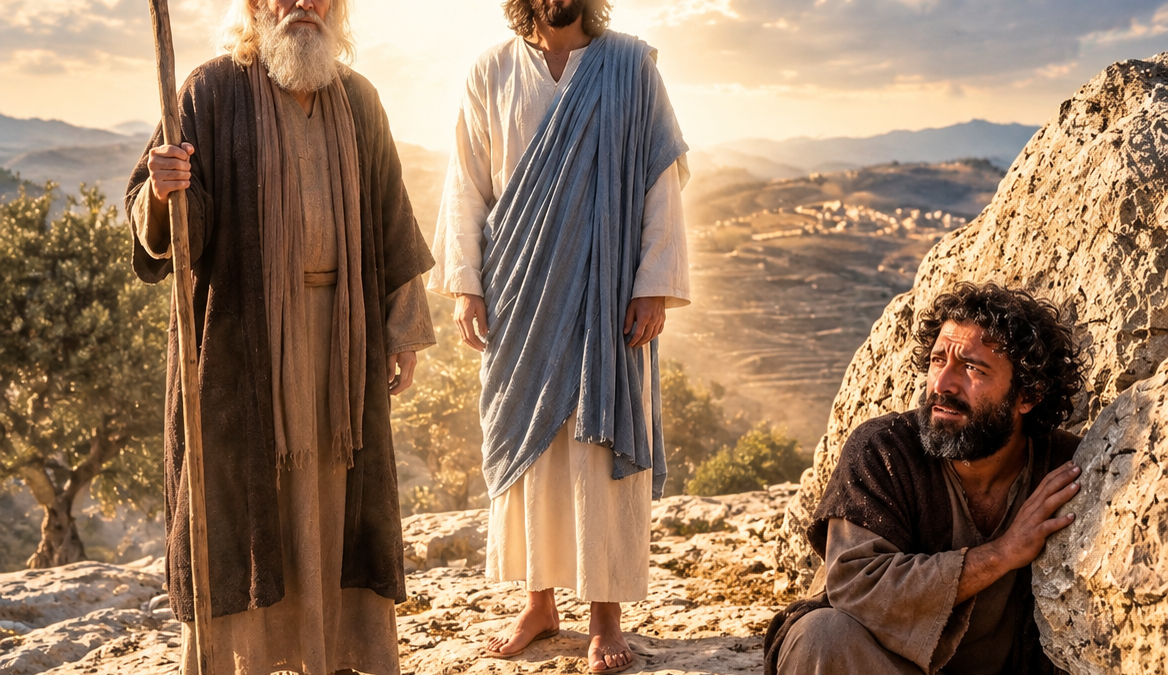
Moses died and his burial place was left unknown. Centuries later, three disciples saw him standing alongside Jesus. Today, we are going to examine four explanations proposed for this apparent tension and distinguish what the text asserts from what remains interpretation. Deuteronomy 34 buries him, while Matthew 17 puts him speaking. Some answers collide with the account itself. Another finds support in a statement Jesus made about the dead and the resurrection, though it also fails to explain every detail of the scene.
Let us start with the burial because that is where almost all the weight of the question lies. Deuteronomy 34:5 states that Moses the servant of the Lord died there in the land of Moab according to the word of the Lord. He died without detour and without ornament. He did not fade away, he was not transported, and he did not disappear in a cloud of light. He died in Moab on the wrong side of the Jordan. Verse 6 adds the unusual detail that God buried him in the valley in the land of Moab opposite Beth Peor, but no one knows the place of his burial to this day.
The Hebrew text uses the singular subject for the burial, which traditional readings understand to be God. Some translations prefer an impersonal form, indicating he was buried. The text does not identify anyone who may have been present, nor does it describe the act of burial itself. What it does establish firmly is that the location of the tomb was never known. Despite this hidden grave, the people observed thirty days of mourning immediately afterward.
This treatment is highly unusual within the biblical accounts of the patriarchs. Abraham buys a plot to bury Sarah with a fully explained negotiation. Jacob asks to be brought to the cave of his fathers, and Joseph requests that his remains not stay in Egypt. Joshua later records the fulfillment of Joseph’s request. In those narratives, the place of burial forms part of the memory and continuity of the family. Yet for one of the central figures of the Old Testament, the text declares that no one knows the place of his burial.
Verse 7 closes the picture with a detail that usually passes quickly. Moses was one hundred and twenty years old when he died, yet his eye was undimmed and his vigor had not abated. The account highlights that his eyesight and strength had not been spent. It does not give a medical cause of death, but instead presents Moses as still physically capable at the very end of his life. Verse 8 records thirty days of weeping on the plains of Moab as a national period of mourning for a man whose grave had no known location.
There is also a scene before the burial worth looking at closely because the same chapter tells it with purposeful detail. Deuteronomy 34 begins with a man climbing from the plains of Moab to Mount Nebo, to the top of Pisgah overlooking Jericho, at one hundred and twenty years old. The account mentions no companions during the ascent. At the top, God shows him the land in a sweeping panorama from Gilead as far as Dan, the territory of Naphtali, Ephraim, Manasseh, Judah, the Negev, and the valley of Jericho.
Then comes the phrase that cuts deeply: you have seen it with your eyes, but you shall not go over there. This is the man who dies in the very next verse. He is not an elderly man surrendered in a bed surrounded by children, but a man standing on a summit looking at something he would never set foot on. And why would he never set foot on it? Numbers 20 tells the episode of the rock at Meribah, where God commands Moses to speak to the rock, but Moses strikes it twice instead.
The divine explanation emphasizes that Moses and Aaron did not trust in God or uphold his holiness before the people. In Deuteronomy 3, Moses recalls that he pleaded to be allowed to cross, but God told him not to press the matter any further. This gives added weight to what comes next. The last image the Bible gives of Moses while alive is that of a man who was told no. A striking contrast exists within Moses’s own story in Exodus.
Exodus 13:19 describes the night of the departure from Egypt. With an entire people moving and a thousand urgent matters pressing, the text pauses to record a particular burden: Moses took the bones of Joseph with him. Joseph had made his people swear to this generations earlier. Moses made sure that Joseph’s remains left Egypt, and they were later buried at Shechem, as Joshua 24:32 confirms.
History created a profound contrast between these two men. The man who made sure Joseph’s remains reached their destination ended up without a burial site of known location. A later rabbinic discussion preserved in Sotah 13 places the conversation about the transfer of Joseph’s remains in close proximity to the death of Moses. While Joseph’s text records the transfer and the place of burial, the narrative effect for Moses is the exact opposite, leaving his location completely unknown.
The chapter closes with praise that no other person receives in the Torah. Verse 10 states that there has not arisen a prophet since in Israel like Moses, whom the Lord knew face to face. This is the man we are talking about. The account grants him singular greatness while simultaneously leaving his burial place without a known location. Holding that image, we jump more than a thousand years in a single sentence to Matthew 17:3, which notes that Moses and Elijah appeared talking with Jesus.
Mark 9:4 tells the same story while reversing the order of the names, and Luke, the most detailed of the three, places it in chapter 9, verses 30 and 31. Luke records that two men appeared in glory and spoke of the departure Jesus was about to accomplish at Jerusalem. All three synoptic gospels place Moses in the scene and present him talking with Jesus. The gospels do not leave the identity of the figures as a riddle, but they do not explain the exact nature of their presence on that mountain.
Clearing away the half of the scene belonging to Elijah helps simplify the question. Second Kings 2:11 narrates that Elijah was taken up in a whirlwind and records no death. This is why Moses’s presence raises a fundamentally different question, given that it is explicitly stated that he died, was buried where no one knows, and then appeared standing and speaking to three named witnesses.
A methodological warning is necessary at this stage. The Bible does not explain how Moses arrived at that mountain. None of the three accounts includes a line describing the mechanism or offering a narrator’s comment. The scene simply occurs and the text moves on. Everything that follows consists of answers built around that silence, some born inside the Bible and others outside it. The tension between the recorded death and the later appearance acts as a gateway into these various explanations.
The first door is opened not by a commentator, but by Jesus himself in Matthew 17:9. As they descend from the mountain, Jesus instructs them to tell no one the vision until the Son of Man is raised from the dead. Matthew chose the Greek word horama, a term designating a vision or perceived manifestation. The word affirms that something was shown, but by itself, it does not determine whether the figures were physically present or whether they formed part of a visionary experience.
A quick look at the book of Acts reveals the same pattern. In Acts 9, Ananias sees the Lord in a vision. In Acts 10, Cornelius clearly sees an angel entering where he is, and Peter sees the sheet descending from heaven. In Acts 16, Paul sees the Macedonian man at night. These visions are presented as revelations from God that produce concrete consequences, yet none of them claims that the content of what was seen was standing there in flesh and blood.
If Matthew called what happened on the mountain a horama, it is possible to understand the scene as a revelation shown to the disciples without requiring the affirmation that Moses’s buried body was transported there. However, the word also does not demonstrate that everything was purely symbolic. When the disciples descend, there is no indication of physical contact with Moses or Elijah, and when the scene ends, Luke writes that Jesus was found alone. These details are compatible with a visionary experience, though they are not enough to completely resolve its nature.
Complicating this reading, Luke 9:32 states that Peter and those with him were heavy with sleep, but when they became fully awake, they saw his glory and the two men standing with him. Luke distinguishes what occurred from an ordinary dream by noting they saw the scene while fully awake. Second Peter 1:16–18 supports this side by presenting the episode as eyewitness testimony, affirming that they were eyewitnesses of his majesty and heard the voice on the holy mountain.
Examining the vocabulary across accounts shows that Matthew alone uses the word vision, while Mark and Luke employ different phrasing. Furthermore, none of the three gospels names the mountain, referring to it only as a high mountain. Ancient Christian tradition favored Mount Tabor, while many modern scholars prefer Mount Hermon, but we ultimately do not know for certain. Ultimately, the first door leaves us with an open question, as a vision can communicate truth through real or symbolic figures without fully clarifying Moses’s physical condition.
The second door appears in later rabbinic traditions. These Jewish documents, written after the New Testament, show how ancient readers wrestled with the same text, even though they do not decide what historically happened. Rabbis noticed that the word there in Deuteronomy 34:5 (“Moses died there”) also appears in Exodus 34:28 describing Moses standing in the presence of God for forty days. This led to bold claims in Sifre Deuteronomy and the Babylonian Talmud in Sotah 13b that Moses did not die, but stands and serves above.
This tradition also produced legends about imperial authorities attempting to find Moses’s tomb near Beth Peor, only to find the location continually slipping out of their hands. However, this second door ultimately closes because it directly contradicts Deuteronomy 34:5 and 34:6, which explicitly state that he died and was buried. Accepting this tradition would require erasing verses from the very text it attempts to defend. Yet it illustrates a common pattern where later tradition rushes to fill a void left by the biblical text.
The third door is located inside the Bible, though it points outward in Jude verse 9. Jude writes that when the archangel Michael contending with the devil was disputing about the body of Moses, he did not presume to pronounce a blasphemous judgment, but said, “The Lord rebuke you”. This single line affirms a dispute between Michael and the devil over the body of Moses, but it does not report the outcome, suggesting Jude expected his readers to recognize an existing tradition.
Ancient Christian writers connected this episode with an extra-biblical Jewish writing known as the Assumption of Moses. While the surviving manuscripts of that writing are incomplete and do not explicitly contain the dispute scene, the association relies on ancient testimonies. Additionally, Jude references other external literature, much like Paul quoted Greek poets, which is a method of citing a known piece of data rather than endorsing an entire document. Jude affirms the dispute without narrating its origin or outcome, using it primarily to contrast Michael’s conduct with the arrogance of false teachers.
Recent academic research by Ryan Stokes in 2017 suggests the dispute between Michael and the devil was not about the corpse itself, but about the bodily ascent of Moses into the presence of God. In this view, the accuser argues that a body of human flesh is not worthy of God’s presence. While this remains one researcher’s proposal rather than a dogma, it offers a fascinating framework. Nevertheless, this third door leaves unanswered questions and creates theological hurdles, such as reconciling it with 1 Corinthians 15 calling Christ the firstfruits and Hebrews 11 stating that the faithful did not receive the promise apart from us.
Before moving forward, we must address two major verses that skeptics use to challenge this entire discussion. The first is John 3:13, where Jesus states that no one has ascended into heaven except he who descended from heaven. Read as an absolute declaration about human transit, this would rule out Moses and Elijah being above. The second is Hebrews 9:27, which states it is appointed for man to die once, and after that comes judgment. A third objection comes from Ecclesiastes 9:5 and Job 7:9–10, which state that the dead know nothing and do not return from Sheol.
Addressing John 3:13 requires looking at the context, where Jesus is discussing his unique authority to speak about heavenly things rather than compiling a catalog of every individual God might have received. For Hebrews 9:27, the answer is that Moses died once, exactly as Deuteronomy 34 reports, and the transfiguration does not require a second death or a return to ordinary earthly life. Passages like Job and Ecclesiastes describe life “under the sun” from the perspective of this world where the dead are absent from daily human labor, but they do not negate God’s overarching power over life and death.
Jesus provides clarity in Luke 20:38 by declaring that for God all are alive. When answering the Sadducees regarding the resurrection, Jesus points to the burning bush passage in Exodus 3, where God identifies himself as the God of Abraham, Isaac, and Jacob centuries after their deaths. If God continues presenting himself in the present tense as the God of three buried men, those men are not mere absences to him. This affirmation grounds the future hope of the resurrection without describing every detail of the intermediate state.
Examining the legal prohibitions in Deuteronomy 18:10–11 and Leviticus 19:31 regarding consulting the dead reveals an important distinction. The law prohibits human initiative—seeking out, consulting, or going to a specialist to get answers from the other side. It regulates human behavior rather than limiting divine possibility. On the mountain, no one summons Moses or Elijah; the disciples went up simply to pray, making the transfiguration an act of divine revelation rather than prohibited necromancy.
First-century historian Flavius Josephus also recounts the end of Moses in his Jewish Antiquities, describing a cloud covering him as he disappeared into a valley while maintaining that Moses recorded his own death to prevent people from claiming he went off to the deity. Yet neither Josephus’s account nor the absence of an identified tomb serves as definitive archaeological proof of an ascension. Furthermore, if escaping death were the primary criterion for appearing on the mountain, Enoch—who was taken up so he would not see death—does not appear, suggesting that Moses and Elijah represent the law and the prophets standing alongside Jesus.
Bringing these insights down to a practical level, people grieving loved ones often wonder if the dead can hear them or if they can communicate with them. The biblical text offers both comfort and a warning. The comfort is that for God all are alive, anchoring our hope in His eternal relationship with His own. The warning from Deuteronomy 18 is not to seek out the dead or resort to intermediaries. Our hope is anchored in God rather than in unauthorized communication lines.
The human reaction on the mountain highlights the overwhelming nature of the divine encounter. Mark 9:6 notes that Peter did not know what to say because they were terrified, and Matthew describes the disciples falling facedown. Jesus then comes and touches them, telling them to rise and have no fear. This physical touch is the only physical contact recorded in the entire scene, returning the focus squarely to Jesus, who had just announced his upcoming suffering, death, and resurrection.
Reviewing what the text asserts versus what it leaves silent provides an honest boundary. The text asserts that Moses died, was buried in an unknown location, and appeared centuries later on a mountain talking with Jesus before eyewitnesses. It remains completely silent on the mechanism of his appearance, his exact bodily condition, and what happened after the vision concluded. Anyone claiming to know these hidden details is relying on speculation outside the biblical text.
The climax of the event occurs when a voice from the cloud speaks. The voice says nothing about Moses or Elijah, directing its focus entirely onto Jesus with the command: “This is my beloved Son; listen to him”. When the cloud withdraws, Moses and Elijah have exited the frame, leaving only Jesus. The disciples descend the mountain in silence, keeping what they had seen to themselves until the appointed time after the resurrection.
Thus, the honest limit of the answer remains clear: Moses died and was buried, the gospels affirm his appearance alongside Jesus, and the Bible leaves the mechanical details unexpressed. The true center of the scene is not Moses, but the divine command to listen to Jesus.

