Why did God command Israel to circle Jericho 7 times? (The hidden pattern)
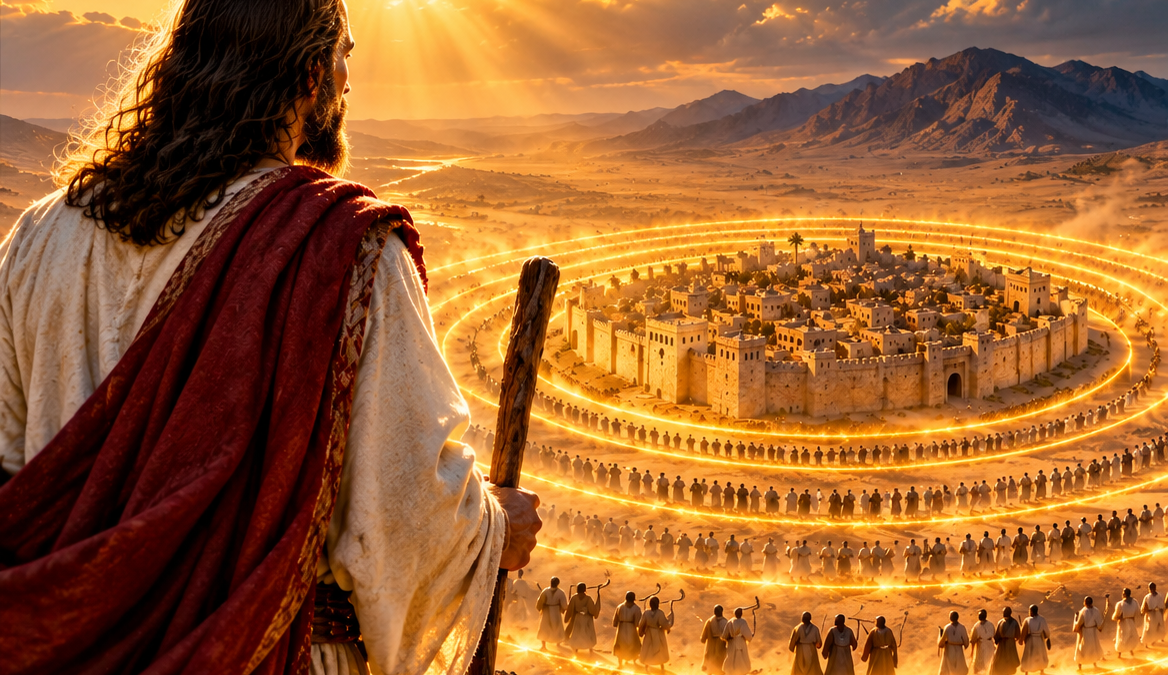
Imagine the ancient city of Jericho completely sealed off, its massive fortifications barring any entry, while a group of people who had never experienced a traditional military siege stood outside. Divine promises had already designated this stronghold, and alternative methods could have easily dismantled it instantly. However, a profoundly unconventional strategy was instituted instead. A procession was commanded to encircle the perimeter once daily for six days. Leading this movement were priests carrying sacred instruments, while the entire assembly maintained complete silence. On the final day, this circuit was to be repeated seven times, culminating in a unified sound that would cause the formidable barriers to collapse.
This sequence often gets categorized simply as a traditional Sunday school lesson, frequently reduced to a modern motivational phrase about personal conviction. Yet, the recurring digits embedded within the narrative serve as a deliberate linguistic and structural marker. Tracing this numerical pattern reveals a profound connection stretching from the opening passages of scripture to the ultimate visions at the end of the text. Exploring the significance behind the repeating structure, the quiet days, and the specific instruments utilized unveils deeper layers of meaning that completely reframe the historical event.
An entire nation had gathered on the dusty plains near the Jordan River, gazing across at the destination promised to them. Reaching this point required navigating physical impossibilities, beginning with the swollen spring waters of the river itself. The preceding generation had spent decades wandering through arid lands, with every adult from that era passing away before reaching the destination. Now, their descendants faced a swift and dangerous current that threatened any attempt at crossing with families and livestock.
The obstacle vanished when the leaders carrying the covenant symbol stepped to the edge of the water, causing the upstream flow to pile up and dry the riverbed completely. This miraculous crossing mirrored the historical event at the Red Sea, demonstrating that the path opened not through human strength, but around the divine presence moving ahead of them. Once across, they immediately engaged in actions that defied conventional military wisdom. They erected a twelve-stone memorial, every fighting-age male underwent ritual covenant circumcision, and they celebrated a public Passover while in plain view of hostile defenders.
Immediately following these events, the daily provision of manna ceased, marking the official end of the wilderness era and the beginning of their permanent inheritance. Across the plain stood Jericho, a heavily fortified and ancient settlement guarding the entry routes to the mountainous interior. The inhabitants had barred their gates tightly, gripped by terror because news of previous historical miracles had preceded the advancing population. Fear had paralyzed the city, echoing the sentiments of Rahab, an individual living within those very walls who recognized the reality of the incoming force.
With the army weakened and a sealed fortress standing before them, instructions were given that went far beyond typical military tactics. The command declared victory as a completed reality before a single physical action was taken. The subsequent marching instructions involved a precise structural design centered around specific numbers. Armed forces circled the settlement once daily for six days, accompanied by priests carrying horns and the sacred ark. Complete silence was strictly enforced among the marching masses, creating an intense psychological pressure for the defenders watching from the ramparts.
On the final day, the routine shifted drastically as the procession circled the perimeter seven times. At the conclusion of the final lap, a long blast was sounded, and the people raised a unified sound of acclamation. The architectural blueprint of the entire event relied heavily on the number seven, moving from days to rounds and instruments. This specific numeral was not chosen by chance; in the ancient linguistic context, it carried deep ties to notions of completion, finished labor, and sacred oaths or covenants. Every rotation around the settlement echoed the language of a promise sealed and finalized.
The timing of the collapse on the final day highlighted a profound paradox. Although functioning as a period associated with rest and cessation of labor, the seventh day witnessed the most intense physical activity. This design deliberately stripped the people of any illusion that their own efforts or military prowess had achieved the victory. The outcome was a demonstration that triumph belonged to a finished divine plan rather than human accomplishment, separating true faith from modern interpretations of self-reliance.
Furthermore, the instruments carried by the priests introduced another significant layer of symbolism. The rams’ horns used in the procession were associated with the concept of the jubilee, a radical economic and social reset outlined in ancient law. Occurring after multiple cycles of seven years, this special period involved the cancellation of debts, the liberation of servants, and the return of ancestral property to its original owners, all announced through the sound of a ram’s horn. Ringing these instruments outside the first city of the promised land framed the event not merely as a violent military conquest, but as a long-awaited homecoming and a reclaiming of a lost heritage.
Despite the profound theological framing, the historical account does not shy away from the severe reality of the city’s destruction. The settlement was subjected to a total dedication, meaning material wealth was consecrated to the treasury while the inhabitants faced judgment. Yet, right in the middle of this severe event, a remarkable act of preservation unfolded. Rahab, an outsider living along the wall who had previously sheltered spies and recognized the true power governing the universe, was spared. Protected by a visible scarlet thread tied to her window, she and her household survived the collapse, echoing the imagery of deliverance seen during the Passover. Her lineage ultimately integrated into the community, eventually finding a place in the genealogy of future historical figures and leaders.
Examining the physical site of ancient Jericho reveals a complex history filled with archaeological excavation, debate, and shifting scholarly conclusions regarding exact chronologies. While researchers over the decades have arrived at differing dates for the destruction of the city’s fortifications, physical findings consistently align with specific details mentioned in the text. Excavators uncovered evidence of collapsed mud-brick walls forming a debris ramp, extensive layers of intense fire, and storage jars left completely full of grain. The presence of unlooted food supplies strongly indicated a rapid fall rather than a prolonged starvation siege, matching the narrative timeline where spoils were consecrated rather than plundered.
The narrative extends beyond the immediate conquest through a specific prophetic warning pronounced against anyone who might attempt to rebuild the settlement in the future. Centuries later, this warning found fulfillment during a period of historical monarchy, demonstrating that the event functioned as a far-reaching pattern rather than an isolated occurrence. This overarching pattern culminates in the final visions of scripture, where a series of seven angelic trumpets sound against the proud systems of the world, leading to the ultimate establishment of an eternal kingdom. The initial events at the ancient settlement served as a miniature preview of a universal coronation.
The leader who guided the population into the region bore a name carrying profound significance, translating conceptually to deliverance and salvation. This linguistic connection pointed forward to a future figure who would lead humanity toward an ultimate inheritance and dismantle the final barriers standing against divine purpose. Ultimately, the meticulous structure observed during the conquest was designed to demonstrate that major obstacles are overcome not through human strength, but through trust in a completed plan brought to fruition at the appointed time.

