When Her Husband Went to War — What Happened to a Medieval Woman Left Behind?
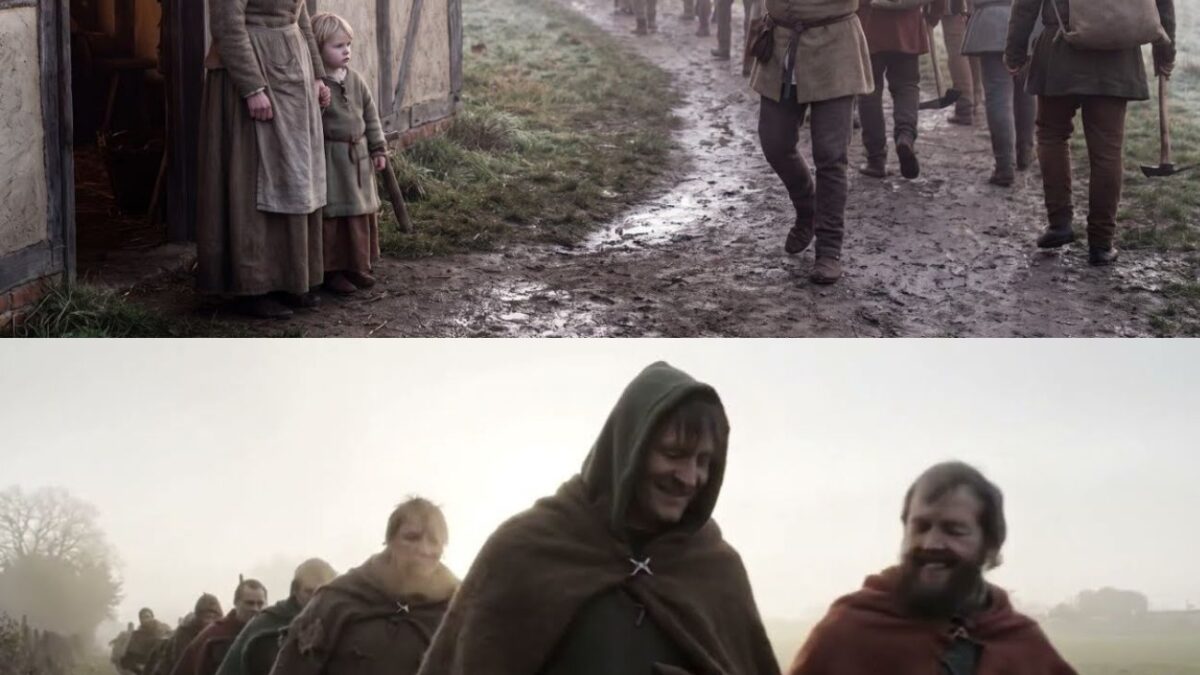
The knife is the last thing he touches before he leaves. Not her, and not the child sleeping softly by the hearth. It sits resting on the oak shelf, dark-handled and familiar.
It is the blade he uses for every honest task, skinning a winter hare, paring hooves, cutting tangled hemp cord. He leaves it behind on the planed wood without a word. That quiet omission is how she knows he truly believes he is coming home.
Outside across the ditch, cold autumn mist hangs thick above the stubble fields, clinging to damp wool and freezing the breath. A manor bailiff reads names aloud from a sheet of stiff parchment, his harsh voice cracking. Forty able-bodied men are summoned from this single hundred alone.
Her husband’s name falls somewhere in the middle of the muster call. He did not choose this cold morning, nor did anyone else in the parish. Yet, and this distinction matters, he is not being dragged away in heavy iron chains.
No man-at-arms prods his shoulder with an ash-hafted spear. Instead, he walks forward to meet a gathering knot of laborers and yeomen. Some of them mutter quietly, while one young carter actually laughs into the gray damp.
For a poor tenant in this long century, marching to war means terrible fear, but it also means hard silver wages. It promises sixpence a day for an archer, more ready coin than a whole year behind an ox plow. The chance of plunder glints behind every whispered promise of campaign pay.
She does not know what kind of man he will become once he lands on the soil of France. She cannot picture him holding a steel weapon against strangers, far beyond the reach of her watching eyes. She knows only that the heavy timber door is about to swing shut against the frost.
Every chore, every payment, and every dispute the household must endure tomorrow has suddenly fallen upon her shoulders alone. Here is the quiet truth that chroniclers never thought to record in their rolls. Her danger did not begin on some distant battlefield across the narrow sea.
The peril began that very evening at her own hearthstone. It started when she first tried to complete an act that only her husband had ever been trusted to do. She discovered, with sudden clarity, that she was not permitted to simply step into his place.
What that act was, and what it cost her to work around it, is the real history buried beneath the romantic legends of war. If you follow her steps, you will understand something fundamental about medieval marriage that older histories overlooked. The muster that summoned him was not an act of random local tyranny.
It was an official commission of array, empowered by royal letters patent issued directly in the name of the king. Country gentry and knights rode out to muster the stoutest men of the shire for prolonged continental service. By this year, with King Edward’s campaigns dragging into endless decades, many recruits were no longer simple conscripts.
Men bound themselves under written indentures, betting their bones against the hope of returning with pockets lined with silver groats. That harsh reality complicates the picture of rustic innocence. Her husband was not merely an unlucky victim of the list; he was gambling on the crown’s need.
By the second week of his absence, the heavy earth demanded the plow, and there was no man left to walk the furrow. She bore the strain herself, bartering away precious bushels of grain from the coming harvest to secure her cousin’s labor. A neighbor lent his second ox to double the team so the shallow blade could bite the clay.
It was awkward, exhausting work, and every neighborly kindness carried an exact and unforgiving price. Yet the furrow was turned, the seed rye was scattered, and the tenant holding held together against the season. Then, before the mud on her skirts had dried, the bailiff came knocking for the Michaelmas rent.
This is the quiet crossroads where her domestic life fractured. She held the silver pennies wrapped tightly in a linen rag, saved from the summer wool sale. What she lacked was legal standing in the presence of the manor court.
When she stepped forward to clear the account, she found that her voice carried no weight before the steward’s bench. Under English common law, a married woman possessed no independent legal personhood while her husband drew breath. The doctrine was coverture, the ancient legal fiction that husband and wife were merged into a single body.
That single body belonged entirely to the man who had just taken ship for Gascony. Her husband had carried the household’s only recognized signature away in his pocket, leaving her powerless on paper. She could not sign an acquittance, sue a debtor, or bind herself to an enforceable agreement without his name.
Yet custom in the English countryside was far more adaptable than the cold maxims written down in the royal law books. In towns and manors across the realm, practicality forced communities to build working detours around the doctrine. A married woman trading on her own account could sometimes be recognized as a femme sole, answering for her debts.
Manor court rolls from Norfolk to the Welsh Marches record hundreds of wives appearing on ordinary court days. They paid fines, answered for land holdings, and settled claims on behalf of men serving across the sea. Village business would have collapsed into paralysis if every tenant wife had been rendered totally mute.
So she took the path that generations of country women had worn smooth through stubborn daily necessity. She presented the silver pennies not as her own payment, but explicitly as his wife acting under his authority. The manor steward dipped his quill, weighed the silver, and scribbled her entry into the sheepskin roll.
Coverture remained an unyielding wall in the royal courts, but in the manor barn it was bent by economic reality. She had slipped through this first legal gate, yet other barriers loomed immediately behind it. Rent was merely the first burden levied against the hearth.
In the very years when the king gathered bodies for his war, his officers gathered everything else that was not nailed down. Royal purveyors arrived with wooden tally sticks, claiming grain, timber, draft horses, and carts for the army. They promised fair payment from the exchequer, but payment arrived late, depreciated, or never materialized at all.
The shires that sent their sons were systematically stripped of the oats and barley needed to feed the war horses. On top of purveyance came the parliamentary subsidies, the harsh fifteenths and tenths levied directly on movable goods. It mattered not at all to the tax collectors whether the cottage had already lost its primary breadwinner.
A peasant household was forced to do the heavy labor of two people while paying for the campaign from both ends. By the turn of the year, her store of dried peas was depleted, and she had borrowed two marks to stay afloat. That quiet debt hung over her head like an unsheathed blade, waiting to strike in ways she could not foresee.
What kept her roof intact during that bitter first winter was neither the majesty of common law nor the mercy of the king. It was the simple, fragile matter of whether a neighbor chose to answer when she rapped against their door. Consider two peasant women living within sight of the same parish spire, both whose men marched out that autumn.
The first woman had been born in the village, surrounded by two brothers and an uncle whose fields bordered her own. When her plow team faltered, her kin helped her finish the strip, and the parish priest spoke for her at the manor house. When she stood at a neighbor’s gate with an empty wooden bowl, hands reached out to fill it with meal.
The second woman had married into the parish from a settlement five miles distant across the river marshes. Her kin were strangers here, too poor and too far away to sacrifice their own scarce labor for an outsider’s strip. When she knocked against closed shutters, the latches remained dropped against the cold wind.
By her second winter, that stranger-wife was boiling old mutton bones until they splintered into gray broth. Both women were identical before the eyes of the law, but communal belonging decided who starved and who survived. An isolated cottage without an adult male presence could not remain invisible to greedy eyes for long.
To certain men in the village, an undefended holding looked less like an unfortunate home and more like an opportunity. This vulnerability is documented with astonishing clarity in the private correspondence of the period. The Paston letters, preserved by a rising family of Norfolk gentry, lay bare the naked opportunism of medieval land hunger.
In that archive, Margaret Paston found her fortified manor house at Gresham besieged by an armed retinue of sixty men. Her husband John was away in London attending legal matters, leaving her to hold the timber gates alone. She wrote frantic letters begging not for domestic comforts, but for heavy crossbows, winding gear, poleaxes, and lead shot.
Margaret called herself the household’s captainess, walking the ramparts while balancing domestic accounts and purchasing almonds. Yet even with stone walls, loyal servants, and wealth, Margaret was eventually dragged out into the road by force. A peasant woman possessing neither stone walls nor wealthy kin could muster no such defense against encroachment.
She had no fortress to defend; she simply had a modest strip of land that stronger neighbors wanted to fold into their own. That very danger manifested itself three fields over from her own boundary before the spring barley was sown. A tenant from the neighboring hamlet began spreading rumors through the alehouse that her husband had perished at sea.
He argued openly to the manor bailiff that her strip was effectively abandoned and that his bullocks ought to graze it. No captain had sent a letter, and no official roll had confirmed a death upon the coast of Normandy. Yet an unchecked rumor, repeated often enough before the manor steward, possessed the destructive force of a legal eviction.
She did not wait for the bailiff to seize the earth from beneath her children’s feet. On the next court Tuesday, she walked into the manor hall and stood before the crowded room of tenants. She answered for the strip with clear words, paying the entry fee to maintain the tenancy in her absent husband’s name.
The steward had already watched half a dozen women make identical pleas, and he allowed her name upon the roll. The neighbor’s grasping claim fell away not because the court was just, but because she stood firmly in the doorway. That was the unheralded siege fought by peasant women across the shires, won not with iron poleaxes, but with presence.
Yet survival on the land brought her no closer to knowing the fate of the man who had left the knife on the shelf. That was the central agony that dictated every passing month of her life: what if he simply never returned? For a belted knight or an esquire, capture on campaign meant the structured negotiation of ransom and exchange.
A wealthy captive was worth far more alive than dead, carefully preserved until his kinsmen mortgaged lands to redeem him. For a common foot archer levied from an English village, no market of chivalric mercy ever existed. His war was one of bloody water, unburied corpses, and foul dysentery sweeping through damp tents faster than arrows.
Campaign records reveal that camp sickness slaughtered four times as many soldiers as French cavalry ever rode down. If he survived the flux, he faced the risk of being left stranded in a port town without wages to pay his passage. Or he might vanish into the smoke of a burned hamlet, lost to memory with no survivor left to speak his name.
Three distinct fates waited for a soldier’s wife, and the third was far worse than the certainty of a grave. In the first, he might walk back through the gorse bushes, bruised and hollow-eyed, holding his pay in his belt. In the second, a limping comrade might stop by her gate to tell her where he had helped dig the trench.
That second outcome was a bitter grief, but it carried the cold mercy of finality, allowing the parish to reckon with her loss. The third fate was complete silence, stretching through the summer harvest, through the deep snow, into another barren year. The knife remained on the shelf, growing dusty, while she listened for the latch until she hated the sound of the wind.
That third state stranded a woman in a legal and social wasteland that the language of the courts could scarcely define. Without proof of death, she was forbidden from stepping into the legal protections granted to a widow. She could not claim her common law dower, the vital life interest in one third of her husband’s former lands.
Dower was reserved solely for those whose widowhood was proven before God and the king’s officers. At the same time, she could not take another husband to plow the soil, for remarriage under such conditions was adultery. She remained trapped between two social definitions, frozen in place while the unpaid taxes and loans accumulated interest.
Women across England spent decades petitioning manor courts and diocesan chancellors for release from this legal purgatory. They brought forward travelers, begging friars, and returning soldiers, searching for any scrap of spoken testimony to break the seal. They pleaded for the church to declare them either wives or widows, so that their daily labor might find an honest name.
Meanwhile, the debts she had contracted to keep her hearth burning did not vanish into the silence that swallowed her man. Under the customs of the realm, those obligations had attached to the head of the household when she acted for him. If he returned home empty-handed, he returned to face a ledger that had grown heavier in his absence.
The crown was notoriously delinquent in paying its levies, leaving thousands of veteran archers to petition the exchequer for arrears. When a husband returned with empty scabbards and no silver, two separate debts met upon the cottage floor. The money she had borrowed to preserve his children met the unpaid wages the king had withheld from his hands.
Many households emerged from the continental wars far poorer than when the commission of array first rode down the lane. Even when the door creaked open and the missing man stepped over the threshold alive, the tale found no easy peace. He did not return as the young laborer who had set down his rabbit knife in the cold morning mist.
He came home hardened, his knuckles thickened by weapon grips, his sleep ruined by memories of burning French barns. What he found was not a submissive, waiting dependent, but a woman who had run an estate without his permission. She had decided which rye to sow, which beast to slaughter, which neighbor to pay, and which to threaten with law.
A woman who has governed a household through two years of famine does not easily bend her neck back to common subservience. The court rolls of the fourteenth century are peppered with domestic disputes that flared up after the muster rolls disbanded. Husbands sued to undo contracts made by their wives, while wives fought bitterly to protect the arrangements they had forged.
The war had not truly ended when the transport ships dropped anchor in the southern ports of the realm. It had merely migrated inland, shifting its battleground from the muddy plains of France to the timber threshold of the home. We know the inner thoughts of the noble Paston family because their literate heirs preserved their letters in cedar chests.
For the archer’s wife, who could neither write nor read the bailiff’s tally stick, no parchment preserves her private voice. Her presence survives only in the broken margins where the machinery of law was forced to write her down. A three-penny fine for brewing ale without an assize, a disputed boundary marker, an entry granting poor relief to an abandoned hearth.
Yet the absence of her letters is no evidence that she walked through those bitter years as a passive, helpless shadow. It proves only that the scribes of the medieval world saw no glory in the quiet heroism of keeping a hearth alive. Her survival was secured long before the commission of array shouted her husband’s name into the autumn fog.
It was decided years earlier by the strength of her kin, the goodwill of her neighbors, and her courage before the court. Her life hung on whether she possessed the wit to claim the space the law had tried to deny her. Go back to the shelf beside the cold chimney, where the iron knife still rests upon the dry wood.
She left it sitting there on that first morning when the fog was thick, refusing to hide it away in a drawer. She could not guess that the test of her life would have nothing to do with swords or the banners of knights. Her war was fought quietly over plowshares, bushels of rye, and the stubborn right to answer for her own door.
If no man ever rode back to say where her husband fell, how long was she expected to remain his shadow? How many seasons must a woman stare at an empty knife before the world allows her to take up the blade herself?

