Undercover Billionaire Orders Steak At His Own Restaurant—Then Waitress Slips A Note That Froze Him
The mid-afternoon sun hung low over the bustling avenue, casting long, fractured shadows through the pristine, leaded-glass facade of Augustine’s. Polished brass fixtures caught the light, and from beyond the heavy mahogany doors came the muted clatter of fine china and the murmur of discreet conversation.
A man stepped into the marble vestibule, the crisp outdoor air rushing in behind him like an uninvited guest. His jacket was faded denim, frayed along the cuffs and carrying the accumulated dust of long city walks, while his scuffed boots spoke of miles traveled on cracked pavement. His hair was windblown, his collar crooked, and his presence stood out against the deep burgundy carpets like an ink blot on freshly pressed linen.
The young host standing behind the brass podium immediately stiffened, his fingers hovering over the leather-bound reservation book as his eyes darted from the man’s boots to his unshaven jaw. The automatic greeting died on the young man’s lips, replaced by an uneasy tightness around his mouth that signaled an immediate retreat into corporate politeness.
“I’d like a table, please,” the man said softly, his voice gravelly from the cold breeze outside. “Somewhere by the window if you have one open.”
“Sir, I… we’re quite full this afternoon,” the host stammered, deliberately sliding a sheet of parchment over the half-empty dining chart. “I’m really not sure we can accommodate walk-ins at this hour.”
“I can pay,” the man replied calmly, reaching toward his pocket before letting his hand rest easily at his side. “I’d just like to sit down, look outside, and have a meal. What’s the holdup?”
Before the flustered host could fabricate an excuse about private parties or kitchen closures, a tall figure in a razor-sharp charcoal suit stepped out from behind the mahogany partition. His hair was impeccably pomaded, every movement calculated to project effortless superiority, his lapel pin catching the chandelier glow.
“This gentleman would like a table, Mr. Shaw,” the host explained quickly, his tone bordering on apologetic as he deferred upward. “I told him we’re full, but he insists…”
Daniel Shaw did not bother looking the guest in the eye; instead, his gaze dragged slowly from the dirt along the man’s hem up to his bare, weathered neck. A faint, contemptuous sneer touched the corner of the manager’s mouth as he made a brisk calculation of the room’s sightlines.
“We have tables,” Shaw said dismissively, checking his gold wristwatch with an exaggerated flourish. “That’s not the issue.”
Shaw leaned in closer to the podium, his voice dropping into a cutting whisper that barely bothered to mask its disdain. “Seat him in the back corner away from the windows, by the service hallway. And get somebody disposable on the table, Carter. Naomi’s station is empty, and she’s not doing anything useful anyway.”
The host nodded rapidly, picking up a single menu and turning on his heel without offering a customary welcoming word. The man in the worn denim jacket was led past spacious banquet rounds adorned with fresh calla lilies and sunlit booths where well-dressed patrons sipped pale chardonnay.
They traveled deeper into the restaurant, past the swinging doors of the kitchen where the smell of roasting garlic grew sharper, arriving at Table 9. It was a tiny two-top wedged into an alcove where the dining room carpet gave way to scuffed service linoleum, completely obscured from the street.
The host dropped the heavy, embossed leather menu onto the bare wood and walked away without pulling out the chair. The customer sat down quietly, smoothing his worn sleeves over the dark mahogany surface, completely unbothered by the dim isolation of the corner.
Within moments, a server appeared from the kitchen corridor carrying a clean water glass and an open, genuine warmth that seemed entirely out of place in Shaw’s regimented dining room. Her uniform apron was immaculately pressed, though the fabric around the pockets showed the threadbare wear of endless twelve-hour shifts.
“Good afternoon. Welcome to Augustine’s,” she said, setting down a linen napkin and placing the glass before him with practiced, steady grace. “My name is Naomi, and I’ll be taking care of you today.”
The man looked up, his deep-set eyes softening as he took in her tired, honest expression. “Thank you, Naomi. I appreciate that.”
“Can I start you with something to drink,” she offered, resting her notepad against her forearm, “or would you like to hear about what’s fresh today?”
The guest folded his hands together over the table, tilting his head slightly. “Tell me what’s good. I trust your judgment.”
Naomi smiled, a sudden spark of genuine enthusiasm cutting through the fatigue etched around her eyes. She loved food, and she loved the craft of hospitality, regardless of who sat across from her.
“Well, our soup today is a roasted tomato bisque that I’d put up against my grandmother’s,” she said with quiet pride. “And that’s not something I say lightly around here. The halibut is beautiful, caught fresh yesterday and served with braised leeks.”
She paused, glancing toward the kitchen before leaning down just a fraction. “And if you’re in the mood for something with weight, the dry-aged ribeye is the best thing on this menu. Chef does it with a rosemary butter that’ll make you close your eyes.”
The customer listened intently, nodding slowly as the descriptions rolled effortlessly off her tongue. “The ribeye. That’s the one.”
“Good choice,” Naomi affirmed, her pen poised over her pad. “How do you like it cooked?”
“Medium rare,” he replied without hesitation.
“You want the soup to start or just the steak?” she asked, already writing down the specifications in neat, flowing cursive.
“Let’s do both,” the man said, leaning back into the wooden chair. “And the bread if you’ve got it.”
“Soup, warm bread, and the ribeye medium rare,” Naomi recited with crisp efficiency. “I’ll get this in for you right away.”
She began to turn toward the kitchen, but the man raised an open hand, his tone reflective and curious. “You didn’t blink.”
Naomi halted, turning back with an eyebrow slightly raised in gentle confusion. “I’m sorry?”
“When I ordered the most expensive thing on the menu, you didn’t blink,” he pointed out, watching her carefully. “Most people would have looked at me like I didn’t know what numbers meant.”
Naomi let out a short, quiet breath, her posture softening with profound simplicity. “You sat down at a table in a restaurant and ordered a meal.”
The guest held her gaze, waiting for the caveat that usually followed. “Mhm?”
“That’s what tables are for,” she said, offering a small, reassuring nod before turning gracefully toward the back hallway.
Inside the kitchen, the roar of the exhaust hoods drowned out the gentle classical music playing in the front of house. Naomi moved swiftly to the bread station, slicing a warm loaf of sourdough and ladling the velvety tomato bisque into a wide, shallow porcelain bowl.
When she returned to Table 9, she set the items down with deliberate care, angling the bread basket so the steam drifted upward toward him. “Roasted tomato bisque and the bread fresh out of the oven. Your ribeye will be about ten more minutes.”
The man inhaled deeply, the rich scent of basil, garlic, and caramelized cream filling the dim alcove. “Can I ask you something?”
“Of course,” she answered, pausing with her tray held securely under her left arm.
“It’s been a while since I’ve sat down somewhere like this,” the man confessed, clearing his throat lightly as he looked around at the vaulted ceiling and intricate molding. “A real restaurant, a real meal. Is this place as good as it looks?”
“I wouldn’t work here if it wasn’t,” Naomi said honestly, her voice dropping into a confidential register. “The kitchen is serious about what goes out, and I’m serious about making sure the people at my tables are taken care of. You ordered well. I think you’ll be glad you came in.”
“I’m already glad,” he answered, picking up the heavy silver soup spoon.
“Wait till you try the steak,” she said with a bright smile, tapping the edge of her order pad before slipping back through the service door into the kitchen.
Behind the stainless-steel pass, the atmosphere was thick with grease, shouting, and high tension. Daniel Shaw stood over the expo station, his tailored cuffs turned back precisely two inches as he examined a tray of prepared proteins resting beside the grill line.
The lead line cook was reaching for a freshly cut bone-in ribeye from the main reach-in cooler when Shaw’s hand shot out, slapping the counter loudly to halt him. Shaw pointed a manicured finger toward a dull, graying cut of meat resting on a plastic utility tray near the corner of the prep table.
“Use this one for the ribeye on table 9,” Shaw ordered, his voice flat and commanding.
The cook froze, pulling his tongs back and looking at the cut with immediate alarm. “Mr. Shaw, that tray got flagged this morning. The seal tore during yesterday’s delivery, and it’s been sitting out too long. It was supposed to go in the discard bin. I can pull a fresh one right now.”
“I didn’t ask you to pull a fresh one,” Shaw snapped, his voice sharpening into an icy hiss that carried across the line. “I told you to use this one.”
“Sir, that cut smells sour,” the cook protested, shaking his head slightly. “I’m not putting that on the fire.”
“The man at table 9 doesn’t know the difference between a forty-dollar cut and a gas station sandwich,” Shaw sneered, leaning over the heat lamps. “Sear it hard, load the butter, and plate it. He won’t taste a thing.”
“Sir, if somebody gets sick…” the cook began, but Shaw cut him off with a violent flick of his wrist.
“Nobody is getting sick because nobody is going to know,” Shaw dictated coldly. “Season it heavy. Plate it pretty. Are we clear?”
The cook swallowed hard, looking down at the greasy cutting board before reaching reluctantly for the flagged steak with his tongs. Neither man noticed Naomi standing behind the cold appetizer station, her knuckles white against the metal shelf as she absorbed every word.
Her breath hitched in her throat, a cold wave of sickness washing over her stomach as she watched the cook toss the gray meat onto the screaming-hot iron grill. Black smoke billowed instantly, masked by heavy shakes of seasoned salt and charred rosemary.
Shaw dusted off his hands, adjusted his lapels, and pushed through the double swinging doors back toward the dining room without a backward glance. Naomi stood paralyzed for a second, her mind racing through the consequences of what she had just witnessed.
She thought of the man in the corner, holding his spoon with quiet dignity, praising the bread, looking around the grand room like a child seeing a cathedral for the first time. She knew what food poisoning from rancid beef could do, especially to someone who might not have access to medical care.
When the cook slammed the plated ribeye under the pass light, the dish looked exquisite, smothered in aromatic herb butter that bubbled violently over the dark crust. Naomi didn’t hesitate; she grabbed the warm plate, tucked her order pad firmly into her apron pocket, and stepped out into the dining room.
She walked purposefully across the dining room floor, her steps steady even as her heart hammered against her ribs like a trapped bird. Arriving at Table 9, she set the heavy porcelain plate down before the customer, but she didn’t offer the usual cheerful presentation.
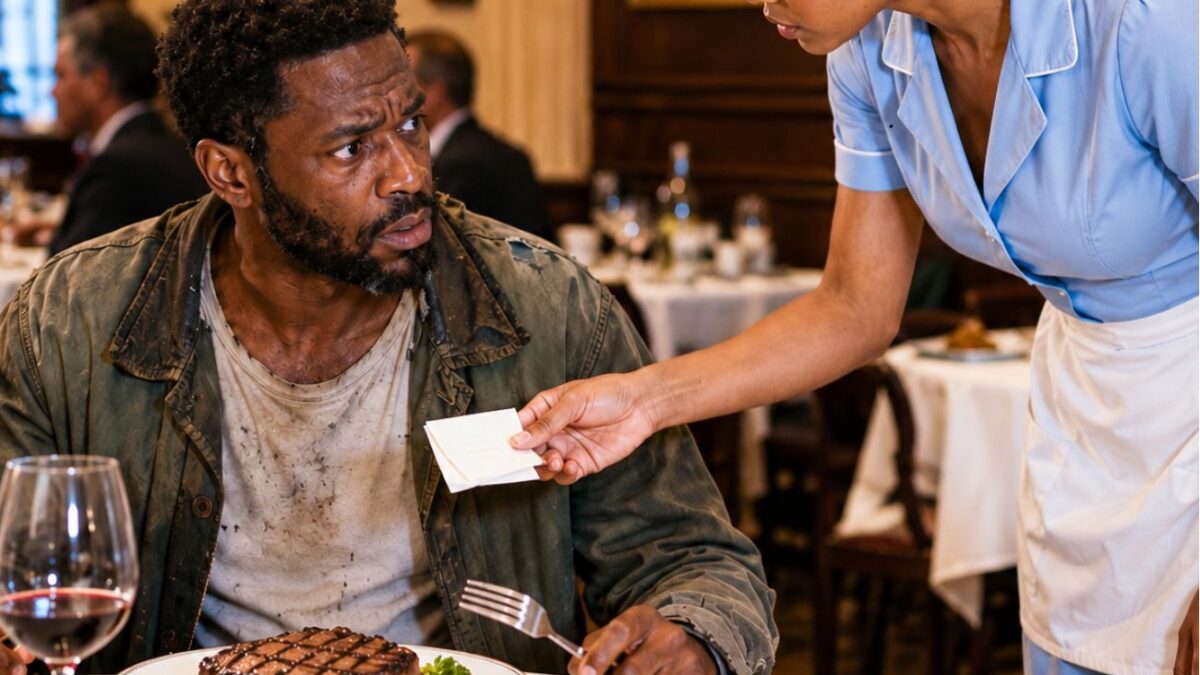
Instead, she leaned down, pretending to arrange the silverware, her shoulder shielding him from the view of the dining room cameras and the distant host stand. Underneath the napkin, her fingers brushed a slip of paper onto the wooden surface, scribbled with urgent handwriting.
“Do not eat this,” she whispered, her voice barely an audible breath against his ear, trembling with suppressed terror. “The meat is not safe. Please just go. I’m sorry.”
The man looked up sharply, his eyes widening in surprise as he caught the desperate urgency in her pale face. Before he could speak, she pulled back, smoothed her apron with trembling hands, and practically fled toward the server station.
Ten minutes later, Daniel Shaw strolled casually down the back corridor, holding a leather billfold and looking down into the alcove of Table 9. His eyes landed on the plate, where the expensive cut of ribeye sat completely untouched, the butter cooling into a congealed pool of fat around the blackened crust.
The chair was empty, the customer gone, leaving behind only an untouched plate and an unsettled bill. Shaw’s face darkened instantly into a mask of pure, concentrated fury as he rounded the corner and marched straight toward the server station where Naomi was polishing water glasses.
“The steak on nine hasn’t been touched,” Shaw hissed, grabbing the edge of the stainless-steel prep counter so hard his knuckles turned white. “Not a single bite. What did you say to him?”
Naomi did not flinch, though her breath was shallow as she set a clean tumbler down onto the drying mat. “I didn’t say anything. He just wasn’t hungry.”
“Wasn’t hungry?” Shaw spat, stepping closer until he towered over her, his breath smelling faintly of peppermint and black coffee. “A man who hasn’t had a real meal in God knows how long orders a forty-dollar steak and then isn’t hungry?”
“I don’t know what to tell you, Mr. Shaw,” Naomi said quietly, keeping her chin up. “Some people change their mind.”
“People don’t change their mind about a ribeye they begged to order,” Shaw roared, his voice drawing nervous glances from the pantry cooks nearby. “You were writing something when you brought that bread out.”
Before Naomi could step back, Shaw’s hand darted forward, snatching the small green guest-check pad directly from the pocket of her apron. He flipped past the blank tickets, holding the top page at an angle beneath the harsh fluorescent lights, examining the deep, indented pencil impressions left behind on the cardboard backing.
The faint grooves clearly spelled out the desperate message she had pressed into the paper only moments before: DO NOT EAT THIS. MEAT SPOILED.
“You went behind my back,” Shaw said, his voice dropping into a terrifying, guttural register as he ripped the notepad in two. “You sabotaged a plate that I personally approved. You conspired with a vagrant to make this restaurant look like a joke.”
“That meat was spoiled!” Naomi cried out, her voice finally breaking its quiet restraint as she faced him directly. “You knew it was spoiled. You told the kitchen to serve it anyway because you thought he didn’t matter!”
“You’re done,” Shaw snarled, pointing a shaking finger directly at the exit door. “You are fired. Effective right now.”
The small service area fell completely silent, the line cooks freezing in place, eyes locked on the floor.
“Take your things out of that locker and leave this building,” Shaw continued, his eyes bulging with malice. “And I promise you, I will make sure every restaurant manager in this city knows your name and knows exactly what kind of employee you are.”
Shaw turned sharply and stormed down the hall toward his administrative office, letting the heavy door slam shut behind him with an echoing boom. Naomi stood alone for several long seconds, the cold reality of what had just happened settling into her chest like lead.
She walked slowly down the narrow hallway to the employee break area, unbuttoning her apron with numb, clumsy fingers. She shoved her belongings into a frayed canvas tote bag, her hands shaking so violently she could barely turn the combination lock on her locker.
As she pushed through the rear service exit into the damp, shadowed alleyway, a figure stepped out from the shelter of the brick wall. It was the man from Table 9, his collar pulled up against the biting wind, his eyes grave and watchful.
“You shouldn’t be back here,” Naomi whispered, wiping a sudden tear from the corner of her eye with the back of her sleeve. “Staff only.”
“I know,” he said softly, taking a step toward her. “I’m sorry. I just… I had to tell you something.”
“If you’re here to say thank you, please don’t,” she said, her voice cracking under the crushing weight of panic. “I just lost my job. I’m not in the mood to feel noble about it.”
“What you did was right,” the man said, his tone entirely free of pity, filled instead with deep, resonant conviction.
Naomi let out a bitter, humorless laugh that ended in a ragged sob. “Right doesn’t pay rent.”
The man looked at her intently, his expression unreadable in the dim alley light. “Why did you do it? You could have set that plate down and walked away. Nobody would have known.”
“I would have known,” she shot back instantly, her voice rising with raw honesty.
“That’s not an answer most people would give,” he countered gently.
“I’m behind on rent,” Naomi said, the words spilling out of her as if a dam had burst inside her chest. “Two months. I eat one meal a day, and it’s whatever comes back from the tables before the bus tubs get dumped in the back. This job was the only thing keeping a roof over my head. And I am not exaggerating. I mean the only thing.”
The man took this in, his jaw tightening as he looked at her worn canvas shoes. “And you gave it up for a stranger.”
“I couldn’t let somebody get poisoned and then go home and sleep,” Naomi said, shaking her head firmly as she pulled her bag tight against her shoulder. “I can’t be that person. I won’t be. Not for a paycheck, not for rent, not for anything.”
“This isn’t over,” the man stated quietly, the authority in his tone so stark that it caught her off guard.
“I appreciate your concern, but it is over,” Naomi replied, looking down at the wet asphalt. “He fired me, and he’ll make good on that promise about my name. I’ve worked in enough restaurants to know how that goes. Blacklisted means blacklisted.”
“I’m asking you to wait,” he urged, stepping directly into her path with a look of steady determination. “Don’t walk away from this yet. Can you do that?”
“Wait for what?” she asked, exasperation finally breaking through her shock. “With all due respect, what exactly are you going to do? You can barely take care of yourself.”
The man paused, a faint, rueful smile touching his lips for just a fraction of a second. “Maybe. But I’m asking anyway. Please.”
“I don’t even know your name,” she said, exhausted.
“You will soon,” he replied firmly. “Just please wait. Come back tomorrow at noon.”
Naomi looked at him for a long, quiet moment, seeing something beneath the dirt and the frayed jacket that defied explanation—a stillness that belonged to someone who didn’t run from storms. “Fine, I’ll wait. But I’m not sure what I’m waiting for.”
She turned and hurried down the alley toward the subway entrance, her footsteps echoing against the damp brick walls. The man watched her disappear around the corner before turning back toward the service door of Augustine’s.
He pushed the metal door open, stepping past the grease traps and the dishwashing station without pausing to ask permission. He walked down the corridor with long, purposeful strides, bypassing the kitchen entirely and heading straight for the frosted glass door marked General Manager.
Inside the office, Daniel Shaw was sitting behind a massive walnut desk, laughing into a telephone receiver while reviewing the afternoon receipts. When the door opened without a knock, Shaw looked up, his face instantly contorting in pure disbelief and disgust.
“Kitchen’s the other way, and the exit is behind you,” Shaw said, slamming the receiver down into its cradle with a sharp click.
The man walked in and closed the heavy door behind him, leaning his back against the wood and folding his arms across his chest. “I want to talk to you about what just happened. You fired a waitress for warning a customer about bad food.”
“I fired a waitress for insubordination, which is none of your business,” Shaw replied, leaning forward on his elbows with bared teeth. “You have about ten seconds to walk out of this office before I pick up this phone and call the police.”
“She was trying to protect someone,” the man said evenly, unmoving.
“Let me explain something to you,” Shaw said, rising slowly from his chair to emphasize his expensive height and tailored presence. “Since clearly nobody in your life has done you that courtesy: you do not belong here.”
The manager circled the desk, sneering as he gestured broadly toward the mahogany walls and the oil paintings hanging in the room. “You walked in off the street looking like the last stop before a shelter. And my staff had the grace to seat you anyway.”
“I let you sit in my dining room,” Shaw continued, his voice dripping with condescension. “I let you order food you probably couldn’t afford. And instead of being grateful, you’re standing in my office telling me how to run my restaurant.”
The man tilted his head, catching Shaw’s eye with chilling calm. “Your restaurant?”
“Yes, my restaurant!” Shaw barked, striking his desk with an open palm. “I run this building. Every plate, every server, every table falls under me.”
Shaw stepped within inches of the man’s face, his eyes blazing. “And people like you—people who wander in thinking the world owes them a seat they haven’t earned—you should be thanking me for not having you removed the second you walked in.”
“Is that what you think happened?” the man asked softly, his tone dangerously steady. “Someone who didn’t earn their seat?”
“What I think is that you’re trespassing in a staff area, and I’ve been more patient than you deserve,” Shaw hissed, turning back toward the landline on his desk. “Get out now before I stop being patient.”
The man did not argue; he simply looked at Daniel Shaw with a cold, measuring gaze that made the manager’s hand hesitate above the telephone keypad. Then, turning on his heel, the man opened the office door and walked out into the afternoon chill.
An hour later, an old black town car pulled into the driveway of an elegant, ivy-covered brownstone in the city’s historic district. The man stepped out of the vehicle and walked up the broad stone steps, pushing through the heavy oak double doors without knocking.
In the sunlit parlor, an elderly woman with silver hair swept into an immaculate chignon sat near the bay window, drinking Earl Grey from a porcelain cup. She lowered her teacup slowly, taking in his scuffed work boots, the grease-stained denim jacket, and the dust clinging to his hair.
“Boy, you look absolutely ridiculous,” she said, her voice rich with age, amusement, and unconditional authority.
The man collapsed into a deep velvet armchair opposite her, letting out a long, weary sigh. “You can tell?”
“I pushed you into this world,” Lorraine Townsend replied, setting her cup onto the saucer with an elegant clink. “You think a little dirt and some wrinkled clothes are going to fool me? I could pick your jawline out of a police lineup in the dark.”
The man smiled faintly, rubbing his tired face with both hands. “It worked on everybody else.”
“That’s because everybody else doesn’t love you,” Lorraine said, leaning forward, her sharp gaze cutting through his exhaustion. “Now tell me what happened. Because you wouldn’t come here dressed like a scarecrow unless something crawled under your skin.”
Eric Townsend leaned his head back against the upholstery, looking up at the high decorative plasterwork of his family home. “I went into Augustine’s today undercover. I wanted to see how the staff treats somebody who walks in looking like he’s got nothing.”
“And?” his mother prompted, her expression darkening with protective instinct.
“The manager, Daniel Shaw, treated me like garbage,” Eric said, his voice flat with lingering outrage. “Told the host to seat me in the back like I was something to hide. Called me a charity case in front of the staff.”
Lorraine’s eyes narrowed into hard slits. “Go on.”
“He had the kitchen serve me spoiled meat, Mom,” Eric said, looking directly at her. “On purpose. Pulled it from a tray that had already been flagged for the dumpster. He wanted me sick, embarrassed, or gone. Probably all three.”
Lorraine drew in a sharp, quiet breath, her fingers tightening around the armrest of her chair. “Lord.”
“But there was a waitress, Naomi,” Eric continued, his tone shifting from anger to deep reverence. “She heard what he told the kitchen, and Mom, she slipped me a warning. Whispered it right at the table, wrote me a note under the napkin, told me the meat wasn’t safe, told me to leave.”
Lorraine watched her son’s animated face closely. “What happened to her?”
“He fired her,” Eric said, his hands clenching into tight fists against his jeans. “Found the notepad in her apron, saw the impression of what she wrote, and fired her on the spot. Told her she’d never work in this city again.”
Lorraine leaned back slowly, her gaze drifting toward the oil portrait of her late husband hanging above the marble fireplace. “And this woman, Naomi… what’s her situation?”
“She’s broke,” Eric answered, the weight of the alleyway conversation still heavy in his throat. “Two months behind on rent. She eats whatever scraps come off the tables. That job was everything holding her together, and she gave it up to protect me. A man she thought was homeless. A man who couldn’t do a single thing for her.”
Lorraine turned her head, looking at the portrait of the patriarch whose values had laid the bedrock of their lives. “Your father used to say something. You remember?”
Eric nodded quietly, his voice barely above a whisper. “He said a lot of things.”
“He said the only test of character that counts is how you treat someone who can’t do anything for you,” Lorraine recited, her voice trembling slightly with fierce conviction. “That woman passed a test most people never even get asked to take. And she did it with everything on the line.”
“I know,” Eric murmured.
“So, what are you going to do about it?” Lorraine demanded, her eyes flashing with the resolute fire that had helped build their family empire.
Eric stood up, his weariness replaced by cold, deliberate focus. “I need to find out how deep this goes first. If Daniel’s been doing this to one customer, he’s been doing it longer than today. I need the records—purchasing, safety logs, invoices, vendor kickbacks.”
Lorraine nodded briskly in agreement. “That’s the smart part. Now, here’s the part that matters: don’t you make that girl wait, Eric.”
She pointed a stern finger at him, her voice brooking no compromise. “She put herself on the line for you. You owe her the truth, and you owe it to her quick. She’s sitting somewhere right now thinking she threw her life away for nothing. Don’t you let her believe that one day longer than she has to.”
“I won’t,” Eric promised, leaning down to kiss her wrinkled cheek.
“Good,” Lorraine said, settling back into her chair with a sharp sniff. “Now go home and take a shower. You smell like a bus station.”
“Yes, ma’am,” Eric said with a quiet chuckle, turning toward the foyer.
The following morning was spent in a flurry of high-level activity at the Townsend corporate offices. Accountants, legal counsel, and forensic auditors dug through eleven months of encrypted operational files, matching Augustine’s incoming supply manifests against distributor invoices.
By eleven o’clock, the paper trail was undeniably clear: Daniel Shaw had systematically diverted thousands of dollars a month into an off-book account while substituting low-grade, near-expiration meats and produce into the daily kitchen inventory.
At precisely eleven forty-five, Eric stepped out of a private car in front of Augustine’s, wearing a tailored navy suit, crisp Egyptian cotton shirt, and polished oxfords. At his side, dressed in an elegant ivory silk coat, Lorraine Townsend walked with the effortless poise of someone who owned the ground beneath her feet.
They stepped through the heavy glass doors into the main dining room, where the lunchtime bustle was just beginning to take shape. The same young host from the previous afternoon stood behind the brass podium, his eyes widening in immediate, fawning deference as he saw the luxurious cut of their clothing.
“Good afternoon, sir, ma’am,” the host said smoothly, bowing slightly over his leather ledger. “Welcome to Augustine’s. Table for two?”
“Thank you,” Eric said, his voice deep and measured. “Actually, I called ahead earlier. There’s a woman named Naomi Carter meeting me here. When she arrives, would you send her to the dining room?”
“Of course, sir,” the host replied eagerly, already picking up two gold-embossed menus. “Can I get you anything while you wait?”
“Just some water for the corner table,” Eric replied, gesturing toward the back alcove. “My mother will take a seat there for now.”
Lorraine walked past the host with an amused glance, making her way toward Table 9, while Daniel Shaw emerged briskly from the kitchen corridor, smoothing his tie and flashing his best executive smile.
“Good afternoon, sir. Welcome,” Shaw said, offering an outstretched hand with practiced warmth. “I’m Daniel Shaw, general manager. I don’t believe we’ve met. Are you joining us for the first time?”
Eric ignored the outstretched hand, letting his cool, penetrating gaze lock onto Shaw’s eyes. “We haven’t met. Not formally. My name is Eric Townsend. I own this restaurant.”
Shaw’s outstretched hand froze in midair, his professional smile instantly locking into a rigid, terrified grimace. The color drained from his face with sickening speed, his fingers curling inward as he dropped his arm to his side.
“Mr. Townsend,” Shaw breathed, his voice suddenly jumping an octave as sweat broke out across his forehead. “Of course. I… it’s an honor, sir. We had no idea you were coming in today. I would have had everything prepared.”
Shaw took a nervous step backward, glancing around the room as if searching for an escape route. “Please, anything you need—the best table, the chef’s tasting menu, our private reserve…”
“That’s kind. Thank you,” Eric replied coldly, cutting him off mid-sentence. “Actually, I’d like to address the full staff this afternoon. Everyone who’s on shift—front of house, kitchen, dishwashers, everyone. Can you bring them into the dining room?”
Shaw blinked rapidly, his throat bobbing as he swallowed hard. “Of course. Absolutely. Is everything all right? Anything I should know about beforehand?”
“Just the staff,” Eric said, his voice leaving no room for debate. “That’s all I need.”
“Give me five minutes,” Shaw stammered, turning awkwardly and rushing toward the back swinging doors.
Eric turned toward the back corner where his mother sat watching the scene with quiet amusement. He walked over to her table and leaned down, a faint smile touching his lips. “He didn’t recognize me.”
Lorraine took a sip of her water, shaking her head gently. “He never saw you in the first place. That’s the whole problem.”
Before Eric could answer, the front brass doors pushed open, and Naomi Carter walked into the restaurant. She was dressed in her best civilian clothes—a simple, neatly pressed black sweater and dark trousers—her eyes darting around the luxurious room with deep apprehension.
“Excuse me,” she said nervously to the host, clutching her purse against her ribs. “I got a call saying I should come back to Augustine’s today. Someone said there was something I needed to see, but I don’t…”
She stopped dead in her tracks as Eric stepped away from the alcove and approached her across the Persian rug. Her eyes traveled from his polished leather shoes, up the sharp lines of his bespoke suit, to his clean-shaven, familiar jawline.
“Wait,” she breathed, her mouth dropping open in utter disbelief. “I know you.”
“You do,” Eric said gently, stopping a respectful few feet away from her.
“You’re… you were at my table yesterday,” Naomi stammered, her mind struggling to reconcile the transformation before her. “You were the man who…”
“Stay, please,” Eric said warmly, gesturing toward the center of the main dining room. “You’re going to want to be here for this.”
At that moment, the kitchen doors swung wide, and the entire afternoon staff filed out onto the hardwood floor of the main dining room. Cooks in white aprons, prep staff, dishwashers with wet rubber sleeves, and nervous servers stood in an uneasy cluster near the service station, with Daniel Shaw standing rigidly at the front.
“Everyone on shift is here, Mr. Townsend,” Shaw announced, his voice tight and trembling with suppressed panic.
“Good. Let’s begin,” Eric said, stepping to the center of the room, commanding the attention of every eye with natural authority. “Thank you all for taking a few minutes. I know you have service to prep for, so I’ll be direct.”
Eric turned his gaze directly upon the general manager, his voice dropping into a tone of absolute, unforgiving clarity. “Daniel, yesterday afternoon, a guest was served a dry-aged ribeye at Table 9. Do you remember that ticket?”
Shaw shifted uncomfortably on his polished heels, attempting a weak, dismissive shrug. “Mr. Townsend, I handle dozens of tickets every shift. I couldn’t tell you what went out on any particular…”
“Let me help your memory,” Eric interrupted, stepping closer until Shaw was forced to look up at him. “The guest was a man who came in alone, poorly dressed, seated in the back corner because you told the host he was, and I’m quoting, ‘somebody’s charity case.'”
A collective, horrified murmur rippled through the gathered line cooks and servers, several of them exchanging wide-eyed glances.
“He ordered the most expensive item on the menu, and it bothered you,” Eric continued, his voice ringing through the vaulted room. “So, you went to the kitchen and told a line cook to pull a cut of steak from a tray that had been flagged as spoiled that morning.”
Shaw’s face went from pale to an ashen, sickly gray, his breathing turning shallow and rapid. “Mr. Townsend, please…”
“You told him to sear it hard, season it heavy, and plate it pretty,” Eric said, reciting the words like a judge reading a death warrant. “Because, in your words, ‘the man wouldn’t know the difference between a forty-dollar cut and a gas station sandwich.'”
“I don’t know where you’re getting this!” Shaw blurted out, holding his hands up defensively. “That is… that’s simply not what happened! I would never…”
“I know it happened, Daniel,” Eric said, his voice dropping to a terrifying, quiet pitch that silenced the room. “Because I was the man sitting at that table.”
A collective gasp echoed across the staff, followed by absolute, pin-drop silence. Naomi stood near the archway, her hands covering her mouth, her eyes wide with overwhelming realization.
“After your waitress was fired for protecting me,” Eric pressed on, pulling a thick leather folder from under his arm and tossing it onto a nearby table with a loud slap, “I pulled Augustine’s purchasing records. Every invoice, every safety log, every vendor receipt.”
Shaw stared at the folder as if it were a coiled serpent, his knees visibly shaking beneath his tailored trousers.
“For the last eleven months, you’ve been skirting food safety protocols,” Eric declared, his eyes flashing with disgust. “Ordering full-price inventory, swapping in substandard product, and pocketing the difference. It’s all documented. Every dollar, every date.”
“Mr. Townsend… Eric, I can explain,” Shaw pleaded, his voice breaking into a pathetic whine. “The margins have been tight, and I was trying to keep the numbers where…”
“You endangered people’s health to line your pockets!” Eric roared, the fury finally breaking through his composed facade. “You served rotten meat to a customer because you decided he didn’t matter!”
Eric pointed across the room toward Naomi, whose eyes were filled with tears of shock. “And when the one person in this building who had the courage to stop it tried to protect him, you fired her and threatened to destroy her name.”
“She went behind my back!” Shaw protested desperately, looking around at the staff for support, finding only cold, contemptuous stares. “She undermined…”
“She did her job,” Eric said firmly, closing the distance between them. “You’re done. Your employment is terminated. Effective right now.”
Shaw opened his mouth to speak, but Eric cut him off with unyielding finality. “I’ve already contacted the health department and my legal team. You’ll want to speak with an attorney. Immediately.”
“You can’t just…” Shaw started, his voice choking on panic.
“It’s time for you to go, Daniel,” Eric said coldly, gesturing toward the street doors. “Right now.”
Without another word, Daniel Shaw turned, his head hanging low, and practically ran through the brass doors, disappearing out onto the crowded avenue in utter disgrace. A low, nervous breath swept through the remaining staff, the air suddenly lighter, as if a long-standing poison had finally been expunged from the building.
Eric turned toward the back of the room, his expression softening instantly as his eyes found Naomi standing near the pillar. “Naomi.”
She stepped forward, her voice trembling and barely audible above the quiet hum of the dining room. “You own this restaurant.”
“I built it twelve years ago,” Eric said with a warm, humble smile. “Augustine’s is named after my father.”
Naomi let out a bewildered, breathy laugh, shaking her head in complete disbelief. “I slipped a note to the owner. I whispered to the owner of the restaurant that his own food wasn’t safe.”
“You didn’t know who I was,” Eric said, stepping closer to her, his voice full of genuine respect. “That’s exactly the point. You thought I was a man with nothing. No name, no power, nobody coming to help me. And you helped me anyway.”
The entire staff watched in reverent silence as Eric continued, the words carrying the full weight of his father’s legacy. “You risked everything you had—and you had almost nothing—and you did it for a stranger who couldn’t give you a single thing in return.”
Eric paused, letting the silence settle over the room before making his offer clear to everyone present. “I need a new general manager. Someone who understands what this restaurant is supposed to be. Someone who believes that every person who walks through that door deserves to be treated with dignity, no matter what they look like.”
He extended his right hand toward her, an open invitation to a completely different life. “I’m offering you the job.”
Naomi stared at his outstretched hand, tears spilling freely down her cheeks as she shook her head in panic. “I’m just a waitress. I don’t know the first thing about running a restaurant.”
“You’re the only person in this building who protected a stranger when it cost you everything,” Eric said, his voice steady and unwavering. “That’s not just anything. That’s everything.”
“I will teach you every single thing you need to know,” he promised gently. “The inventory, the scheduling, the vendors, the ledgers. But the thing that matters most—the thing I can’t teach anyone—you already have.”
Naomi looked from Eric to the staff, who were all watching her with quiet, encouraging smiles, and then to Lorraine Townsend, who offered an approving, regal nod from Table 9. “You’re serious?”
“I have never been more serious about anything,” Eric answered with absolute certainty.
Naomi took a deep, shuddering breath, reached out her trembling hand, and placed it firmly into his grasp. “Then yes. I’ll do it. I don’t know how, but I’ll do it.”
A sudden burst of applause erupted from the line cooks and servers, breaking the tension of the room and filling Augustine’s with a warmth it hadn’t felt in years. Eric smiled, squeezing her hand, knowing that the foundation of his father’s dream was finally in safe hands.
The weeks that followed were a trial by fire, filled with late-night inventory counts, dense spreadsheet tutorials, and intensive vendor negotiations. Eric stayed by her side through every step, showing her how to spot bloated freight costs, how to inspect fresh deliveries at the dock, and how to command a kitchen pass during a sold-out Saturday night rush.
There were moments of sheer terror, like the second Tuesday when an entire shipment of sea bass arrived warm and Naomi had to reject it personally, standing her ground against a furious truck driver twice her size. When she finally sent the truck away and called a local sustainable supplier to replace the stock within two hours, Eric had stood at the back of the walk-in cooler, nodding with quiet pride.
Four weeks later, the dinner rush was in full swing, the dining room alive with the hum of laughter, clinking crystal, and rich aromas. Naomi stood at the host podium, wearing a sharp, tailored black blazer that fit her perfectly, holding an electronic tablet with steady, confident fingers.
Suddenly, a young runner rushed over to her station, looking completely overwhelmed as he clutched an order ticket. “Table four sent back the halibut. I don’t know if I should tell the kitchen or go talk to the guest first.”
Eric, who had been observing from the corner bar, stepped up quietly behind her, offering a calm, reassuring presence. “Hey. Breathe. You’re doing fine.”
Naomi took a measured breath, her initial panic subsiding as she tapped into the deep reservoir of hospitality that had always been inside her. “Ask them what was wrong,” she instructed the runner with clear authority. “Listen to them, then bring the plate to the kitchen yourself and tell the chef exactly what the guest said.”
Eric smiled, nodding in complete agreement. “You’re not delivering bad news. You’re solving a problem.”
Naomi looked up at him, a spark of complete mastery shining in her eyes. “That’s the whole job.”
An hour later, as the dinner service began to wind down and the room settled into a warm, contented glow, Eric and his mother sat together at a spacious, central table adorned with fresh white roses. The heavy oak doors swung open, and Naomi approached their table carrying a silver tray bearing three glasses of vintage champagne and a platter of house-made pastries.
“We didn’t order that,” Eric said with a soft laugh, looking up at her with admiration.
“I know you didn’t,” Naomi said, setting the flutes down with graceful, practiced precision before taking a seat beside them. “Today is my one-month anniversary as general manager of Augustine’s. The first month of my new beginning.”
She looked at Eric, then turned her gaze toward the elderly matriarch whose steady guidance had anchored the entire transition. “And I wanted to spend part of it with the two people who made it happen.”
Lorraine Townsend reached across the white tablecloth, placing her soft, ringed hand over Naomi’s fingers with profound tenderness. “Sweetheart, you made it happen.”
Eric nodded in quiet agreement, lifting his champagne glass toward the center of the table. “All we did was open a door.”
“You’re the one who walked through it,” Lorraine added firmly, her voice thick with maternal pride.
Naomi shook her head, her smile brimming with deep gratitude. “You raised a man who sat in a chair and let a stranger tell him he deserved a good table. That didn’t come from nowhere, Miss Lorraine.”
Lorraine let out a soft, delighted chuckle, her eyes twinkling in the chandelier light. “Well, his father gets half the credit. But I’ll take it.”
Eric took a sip of his champagne, leaning back in his chair and looking around the glowing room, which was filled with diners from every walk of life, all being served with identical, immaculate care. “How does it feel, Naomi?”
Naomi looked out over the floor, watching a young busser patiently pull out a chair for an elderly couple near the front windows, while a line cook through the pass smiled as he plated a fresh steak.
“It feels like every table in this room belongs to someone who walked in hoping they’d be seen,” Naomi said softly, her voice steady and resolute. “And it’s my job to make sure they are.”
Lorraine leaned back, lifting her own glass high with an expression of complete satisfaction. “That’s exactly right.”
Eric raised his glass to meet theirs, the crystal chiming clearly in the warm air of the dining room. “Well, would you look at this? The table is finally full.”

