Three Mountain Men Ordered a Virgin Mail Order Bride —The Eldest Had Loved Her for Four Silent Years
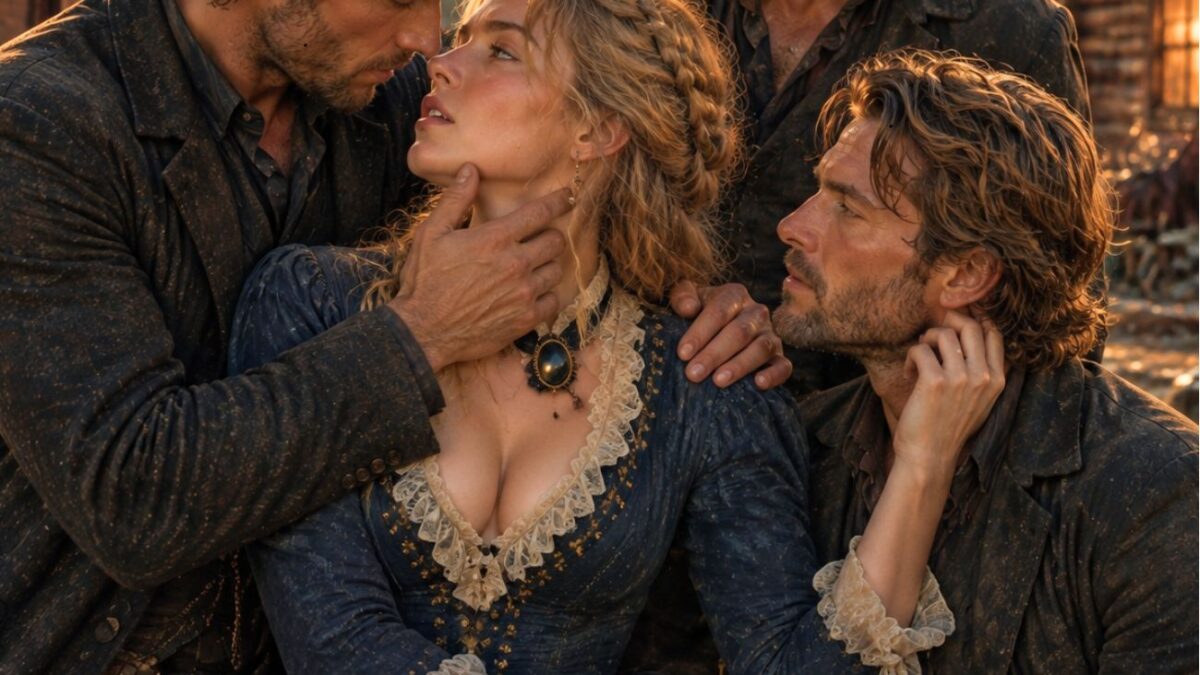
Eleanor Whitmore stepped off that stagecoach in Montana Territory expecting to meet one man. Instead, three stood waiting. Three tall men with the same amber eyes watching her the way men watch something they have waited a very long time for. The letter in her coat had mentioned only one. But the shelf built to her hand, the tin of tea already waiting on the high shelf, and the locked door at the end of the hall would tell her slowly that the letter hadn’t lied. It just hadn’t told her everything all at once. This is the story of Eleanor Whitmore and of the mountain that had been waiting for her for ten long years.
The wind came down off Silver Carriage the way it always came in late October that year. Carrying the first true cold of the season and a warning nobody in Coal Creek wanted to hear. It moved through the tall pines and the stripped aspens and the frost-hardened ruts of the old wagon road, and it carried the sound of hooves striking frozen ground long before the stagecoach itself appeared at the bend. Eleanor Whitmore heard that wind before she saw anything else. She had been asleep against the worn leather wall of the coach.
Her traveling shawl pulled up around her throat. Her gloved hands folded in her lap the way her mother had taught her to fold them when she was a very small girl in Boston a lifetime and two thousand miles ago. The cold had worked its way through the floorboards and into her boots and up through her bones and she had stopped feeling her feet somewhere past Helena. The coach lurched. Her eyes opened. Through the small grimy window she saw the first light of a pale autumn morning catching on the tops of the mountains and she saw the trees and she saw nothing at all that looked like a town.
She had been told Coal Creek was the end of the line. She had not been told that the end of the line looked like the end of the world. The driver called something down from his bench. His voice muffled by scarf and wind and Eleanor pressed her face closer to the glass. She was twenty-three years old. She was unmarried. She was carrying one leather traveling trunk, one carpet bag, and one folded letter tucked inside the lining of her coat where no pickpocket between Boston and Montana territory could have found it. The letter was the only thing in the world that had told her where she was going.
And now as the coach slowed and the trees broke open into a small clearing where a weathered wooden cabin stood with smoke rising from its stone chimney, she understood that the letter had not told her everything. Three men stood in front of that cabin, three not one. Three tall men broad as barn doors, bearded still as the trees behind them, watching the coach come to rest with the calm unhurried patience of men who had waited a long time for something and were now waiting a little longer. Eleanor felt her heart pick up behind the cameo brooch at her throat.
She felt her gloved hands tighten in her lap. She felt every rehearsed sentence she had practiced for the last two thousand miles slide out of her mind like water through cupped palms, leaving her with nothing to say and no one else to say it to. The coach door opened. Cold air rushed in. The driver, a white-bearded man who had introduced himself three days earlier as Augustus Merriwether and then had hardly spoken a word since, extended a hand that was not quite steady. “Miss Whitmore,” he said, “you’re home.” She stepped down onto the hard frozen ground on legs that did not feel like her own.
The wind took her shawl and pushed it sideways. She steadied herself against the coach wheel with one gloved hand and looked up and the three men looked back at her. They had the same face. That was the first thing she understood before anything else, before any word was spoken. Three men separated perhaps by a handful of years, had the same strong jawline, the same high brow, the same straight nose with the faintest bump that suggested an old break, and above all, the same eyes. Amber eyes. Whiskey-colored eyes. The color of creek water in autumn when the sun catches it through cedar leaves.
Three pairs of those eyes all fixed on her at once, and not one of them smiling. The tallest of them, the one who stood a half step forward of the others removed his hat. “Miss Whitmore,” he said. His voice was low and slow and carried no hurry in it. “I’m Caleb Hawthorne. These are my brothers. Jonah.” The second man nodded. “And Silas.” The third, the youngest, touched the brim of his own hat and gave her the smallest possible smile. A smile so brief she almost missed it. And in that flicker she saw the first kindness she had seen in three days.
“Yes?” Eleanor said. Her voice came out thinner than she meant it to. She cleared her throat and tried again. “Yes, I am Miss Whitmore.” She reached one gloved hand into the inner lining of her coat and drew out the folded letter. She held it up not quite accusingly, not quite apologetically. “The letter,” she said, “mentioned one man.” Caleb Hawthorne looked at the letter. His amber eyes moved to her face and held there. “The letter didn’t lie to you, ma’am,” he said. “It just didn’t tell you everything all at once. A person can only take in so much at one time.”
Behind him Jonah shifted his weight. It was a small movement, but Eleanor saw it, and she understood that Jonah was not sure he wanted her there. She understood it in the same way she had understood her uncle’s gaze back in Boston, the way a woman understands a thing before she has any words for what she has understood. The youngest one, Silas, stepped forward. “Ma’am,” he said, “may I carry your trunk?” She nodded. She could not remember how to answer out loud. He walked past her to the back of the coach and lifted her trunk as though it weighed nothing.
And something in the easy way he did it, the unhurried strength of it, made her want very suddenly to sit down on the frozen ground and cry. She did not cry. She had not cried since the funeral, and she was not going to begin now. Not here, not in front of three strangers who looked the same and the mountains behind them, and the wind that was going to be her wind from this day forward. She turned to Augustus Merriwether. “Thank you, sir,” she said, “for bringing me this far.” The old driver looked at her for a long moment. His pale eyes were roomy and kind, and Eleanor understood that he wanted to tell her something and did not know if it was his place.
Finally, he leaned down from his bench. “Miss Whitmore,” he said, “the Hawthorne boys, they don’t take to strangers. They haven’t taken no one into that cabin in ten years, not since their mama was laid in the ground up on Silver Ridge.” Eleanor felt something cold settle in her chest that had nothing to do with the wind. “Ten years,” she repeated. “Ten years this past spring.” The old man’s eyes flicked past her to the three men waiting in front of the cabin, then came back to her face. “I don’t know what that letter of yours said, but you’re the first woman to stand on that ground since the day we buried Miss Adelaide.
You remember that if things go hard. You remember they chose to open that door.” He touched the brim of his hat, clucked to his tired team, and turned the coach in a wide arc on the frozen clearing. Eleanor stood watching him go until the last sound of his harness disappeared into the pines. And then there was only the wind and the three men behind her and the long unanswered question of what she had agreed to when she had written her careful, polite letter back in Boston eight months ago. She turned around. Caleb Hawthorne was waiting. “Come inside, Miss Whitmore,” he said, “the cold will take you quicker than you know.”
She went. Eleanor Whitmore had been born in Boston, Massachusetts, in the spring of 1860, the only surviving child of the Reverend Nathaniel Whitmore and his wife Cordelia. Her father had been a Methodist minister of the old school, plainspoken, honest, short on ceremony, long on kindness. Her mother had been a school teacher before she married a quiet woman who played the piano on Sunday evenings and read aloud from Dickens and Longfellow, while her daughter sat on the rug with her knees pulled up to her chin. Cordelia Whitmore died of typhoid fever in the summer of 1868. Eleanor had been eight years old.
She remembered her mother’s hand cold at the end, and she remembered her father bowing his head at the graveside and saying not to her exactly, but to the air and to God that a good woman passing early was the hardest thing a preacher ever had to preach on because there were no easy answers for it and no easy answers would be given. After her mother’s death, Eleanor and her father had lived in a small parsonage in Beacon Hill. He had raised her alone. He had taught her to read and to write and to think and he had never once in fourteen years spoken an unkind word to her.
And when she thought of him now, she thought of the warm smell of pipe tobacco and old books and the sound of his boots on the wooden stairs coming up to say goodnight. The Reverend Nathaniel Whitmore died of consumption in the winter of 1882. Eleanor was twenty-two years old. She sat beside him through the last three weeks and when it was finally over, she sat beside him for another hour because she did not know what else to do. The parsonage belonged to the church. Within a month she was out of it. Her mother’s only sister, Harriet Ashcroft, took her in. Harriet was married to a man named Percival Ashcroft, a thin, sharp-featured banker with ambitions that exceeded his talents, who had never liked the Reverend Whitmore, and who had always believed privately that his sister-in-law’s daughter thought too well of herself.
The Ashcroft house on Louisburg Square was large and cold and full of clocks that ticked at different rates so that no room was ever quite in time with any other. Harriet treated Eleanor as one treats a distant cousin who has overstayed her welcome. Percival treated her differently. Eleanor understood it the first week. It was not anything he said. It was the way he looked at her on the stairs when no one else was home. It was the way he stood one step too close to her in the hallway. It was way his hand brushed hers once, twice in the reaching for a book or a teacup, and the way he did not apologize for it.
She began locking her bedroom door at night. She began teaching piano lessons in the homes of respectable families four days a week so that she would not be in the house when he was, so that she could save a small amount of money each month towards some other future she could not yet see. In March of 1883, she saw the advertisement. It was on the back page of the Matrimonial Times, which she would never in her life have purchased for herself, but which happened to be lying folded on a bench at the streetcar stop, waiting for her in the way that certain things in life are waiting for us before we know they are.
“Montana Territory,” the advertisement said. “Three brothers seek one honorable woman for the eldest. Mountain homestead, fair terms. Must be literate, patient, and strong of spirit. Write to Caleb Hawthorne, Coal Creek, Montana.” She read it twice. She tore it out of the paper. She folded it into the small pocket at her waist and walked home in the rain with her heart beating like a young bird against the cage of her ribs. She wrote her letter that night by candlelight at the small writing desk in her room with the door locked. She wrote it plainly the way her father had taught her to write.
She said who she was and where she had come from. She said she was educated and she was not afraid of work. She said she could cook and sew and read and play the piano, and she said she did not expect love from a marriage of arrangement, but that she would offer loyalty and effort. And she said if these terms were acceptable, she would come. The reply arrived six weeks later. It was written in block letters, careful, an almost too neat the handwriting of a man who had taught himself to write well alone without much schooling because he had been the kind of man who believed a letter should be worthy of the person who read it.
Miss Whitmore, the letter said, “I cannot promise you love right away, but I can promise you will never be cold, never be hungry, and never be alone again. We are three brothers, myself and Jonah and Silas. You would marry me, but the three of us would be your family if you chose to let us. There is time to decide. The journey is long. I have sent funds to cover your passage under separate cover. Sincerely, Caleb Hawthorne.” Eleanor read the letter a hundred times. She read it on the streetcar. She read it in the kitchen when Harriet was at market. She read it at night by candlelight with her door locked.
She did not know yet that the line about the funds had cost Caleb Hawthorne far more than money. She did not know yet what it had taken for him to persuade her aunt and uncle to release her at all. She would not know for many weeks, but she knew this. Something in the way the letter was written, something in the straightness of the lines and the absence of flourish, and the plain sober promise of warmth and food and company, struck her the way her father’s sermons had struck her when she was a child. Here, she thought, is a man who means what he says.
Here is a man who does not waste his words. Here is a man who, whatever else he is, is not Percival Ashcroft. She wrote back. She said yes. The journey took fourteen days. Train from Boston to Chicago. Train from Chicago to Omaha. Train from Omaha to Cheyenne. Stagecoach from Cheyenne to Helena. Stagecoach from Helena with Augustus Merriwether on the bench and a leather trunk strapped to the back up the long climbing road into the Bitterroot foothills and at last to the small trading post called Cold Creek, where the railroad ended and the mountain road began. She had slept perhaps ten hours in fourteen days.
She had eaten perhaps twelve meals. She had not spoken more than twenty words to any human being since Chicago. And now she stood on the threshold of a cabin made of pine logs hewn square and shingled with clay. And Caleb Hawthorne was holding the heavy oak door open for her. And the warmth and the smell of wood smoke and cured meat and something baking slowly in a cast-iron stove reached out of that open door and wrapped around her like an arm she had not known she needed. She stepped inside and she stopped. She had prepared herself for a bachelor’s cabin.
She had prepared herself for the rough neglect that three men living alone for a decade might have settled into. She had prepared herself to roll up her sleeves and begin cleaning on the very first day because that was the kind of woman she had decided she would be. What she saw instead stopped her where she stood. The floor was swept. Not merely swept in the hasty way of a man making ready for a visitor, but swept and kept the soft worn sheen of pine boards that had been tended for years. The walls were not bare. They were paneled with matched planks, the grain running true, and they had been recently whitewashed.
She could see the pale color of them catching the morning light from the east-facing window. The east-facing window. Her eyes went to it the way the needle of a compass goes to north without thought, without permission. It was a tall, narrow window set in the eastern wall letting the low gold autumn light fall in a clean slanted column onto the pine boards. And beside that window fixed to the wall at a height that was not a man’s height, at a height that was exactly the height at which a seated woman might reach out her hand without rising, there was a small wooden shelf, a narrow shelf, carved along its upper edge with small grooves at careful intervals, the sort of grooves a woodworker makes when he is shaping a rack for spools of thread.
Eleanor stood very still. She was aware of Caleb Hawthorne watching her from the doorway. She was aware of Jonah, who had come inside behind her, and was now setting her carpet bag down on a wooden bench by the hearth. She was aware of Silas whistling something low and cheerful under his breath as he carried her trunk across the room and set it gently by the base of the staircase. She was aware of all these things, but she could not take her eyes off the shelf. She told herself it was nothing. She told herself a tidy man might build tidy storage for any number of household purposes.
She told herself that the spacing of the grooves, the smoothness of the wood, the way the morning light fell on it in a clean unbroken column, meant nothing at all. She told herself, and she did not believe herself, and she said nothing aloud. She turned instead to the rest of the room. A stone hearth wide and deep with a fire burning low and steady, the kind of fire a man builds who intends for it to last. An oak table with four chairs, plain, smooth, the surface marked by use but clean. Kitchen shelves stocked with flour and salt and dried beans and smoked venison and sacks of coffee beans and one, just one, tin canister stood set alone on the highest shelf.
She did not ask about the canister yet. “Your room, Miss Whitmore, is up the stairs,” Caleb said behind her. “The one on the right. Silas has taken your trunk.” She turned. She nodded. She tried to find her voice. “Thank you,” she said. “It is a fine house.” “It was built to last,” he said simply. He did not smile. He did not look away from her, either. “You must be tired. There is hot water on the stove. Supper will be an hour yet. Rest if you like.” She went up the stairs. The room on the right was small and plain and ready.
A narrow bed neatly made up with a heavy wool blanket and a quilt pieced in blues and creams, a washstand with a white porcelain basin and a clean folded towel, a small writing desk under the window, a cedar chest at the foot of the bed. Eleanor sat down on the edge of the bed with her hands folded in her lap and looked around the room and understood with a slow, clear quietness that had nothing to do with the long journey or the cold or the strangeness of the men downstairs that this room had not been recently prepared for her arrival. It had been ready for a very long time.
The bed had the soft set of a mattress that had been made up and left so for months, perhaps years. The towel had the faintly starched stiffness of linen folded and stored rather than linen shaken out that morning. The quilt was pieced in the colors a man might guess a woman would like, not the colors a woman had chosen for herself. She rose. She walked to the washstand. She looked at her own face in the small square mirror above the basin and she saw a pale, tired young woman with honey blonde hair coming loose from its pins and eyes that were trying very hard not to show what they were beginning to understand.
She turned away from the mirror. She went back downstairs for supper. Supper that night was venison stew with dumplings and bread that Silas had baked himself that morning and coffee strong enough to stand a spoon in. The four of them sat at the oak table and Eleanor sat at the place that had been set for her, which was the place at Caleb’s right hand. She ate slowly. She had not realized how hungry she was until the first spoonful. The brothers did not speak much. Silas offered her the bread and complimented the stew as though he had not made half of it himself.
Jonah did not look at her. Caleb spoke twice. Once to ask if the stew was to her liking. Once to say that Reverend Ambrose Thornberry would come up from Coal Creek on Christmas Eve to perform the ceremony if she was still willing when the day came and that until then she would have the upstairs room in her own time and her own choices. “And if I am not willing when the day comes?” Eleanor asked quietly. The room went still. Caleb set down his spoon. He looked at her with those amber eyes that gave nothing away and also somehow gave everything.
“Then I will pay your passage back to Boston or anywhere else you choose,” he said. “And you will go with our goodwill and without debt. That is a promise, Miss Whitmore. A man keeps his word. A Hawthorne does, too.” She nodded. She could not quite speak. After supper, Silas cleared the dishes. Jonah went out to the barn to check on the stock before full dark. Caleb banked the fire and then without looking at her said only, “Sleep well, Miss Whitmore. The mountain is loud at night. Don’t let it trouble you.” She climbed the stairs.
She undressed by the light of a single candle. She put on the plain nightdress she had folded at the top of her trunk. She climbed under the wool blanket and the blue and cream quilt and she lay on her back and listened. He was right. The mountain was loud. The wind came off the ridge and struck the eastern side of the cabin in long slow gusts that made the timbers creak. Somewhere far off a wolf called once and another answered. An owl passed over the roof on silent wings and then was gone. She thought of Boston.
She thought of Louisburg Square and the clocks that never kept the same time. She thought of her uncle’s gaze on the stairs. And she thought with a strange quiet certainty that the wolves and the wind on the mountain frightened her less. She turned her head on the pillow and looked at the moonlight coming in through the small window, and she closed her eyes. Somewhere in the hours before dawn, she woke briefly and heard voices downstairs. Not an argument, not even a proper conversation. Just a low rumble of Caleb’s voice and the sharper answering voice of Jonah, too quiet to make out any words.
And then silence, and then the soft scrape of a chair, and then footsteps climbing the stairs. The footsteps stopped outside her door. They stood there for one long moment. Long enough that Eleanor in her bed held her breath. Then they moved on. Down the hall into another room. A door closed softly. She exhaled. She did not sleep again for a long time. In the morning, there was frost on the inside of the window glass, and the smell of coffee came up the stairs. And when she came down, dressed and with her hair pinned as neatly as she could manage, she found the kitchen empty and the kettle hot, and one tin canister sat on the table beside her plate.
She picked it up. She turned it in her hands. It was a small tin of green tea, fine loose leaf. The label said it had been shipped from a merchant in San Francisco. She had drunk green tea every morning of her life since she was sixteen years old. It had been her mother’s habit before her, and her mother’s mother’s before that. She had never spoken of it to anyone in Boston outside the parsonage. She had certainly never written of it in any letter to a man she had never met in Montana Territory. She stood in the warm kitchen holding the tin, and she felt the morning light coming in through the east-facing window, and she felt, for the first time since she had left Boston, that she was standing at the edge of something she did not yet understand.
The back door opened. Caleb Hawthorne came in from the yard, stamping snow off his boots, the cold of the morning riding in on his coat. He saw her. He saw the tin in her hands. He did not explain himself. “You look like a green tea sort of a woman, Miss Whitmore,” he said, and he went to hang up his coat. She sat down at the table. She poured the hot water. She watched the steam rise in the slanted gold column of morning light from the east-facing window. And she thought very quietly that in thirty-six hours in this house, she had seen three things that did not belong to coincidence. A shelf, a room, a tin of tea.
She did not know yet what it meant. She only knew that a man did not order green tea from San Francisco on the chance that a stranger might one day prefer it. She drank her tea slowly. She thought of her father. She thought of what he would have said sitting across from her at their small parsonage table if she had told him where she was and what she had done. She thought he would have said, “Trust what you see and trust what you feel, and go carefully, daughter, but go.” That afternoon, Caleb came to find her where she sat by the east window with her mending in her lap. The light was very good there.
The shelf was exactly the right height. He stood for a moment in the doorway without speaking, the way he seemed to do everything as though measuring the air before he entered it. “Miss Whitmore,” he said at last, “if you’ll walk with me a little, I’d like to show you the place.” She set down her mending. She rose. She took her shawl from the peg by the door. They walked out through the dooryard past the wood pile stacked head high and as neat as a stone wall, past the smokehouse and the chicken coop, and the wide low barn where a bay mare watched them with dark curious eyes. He showed her the springhouse where the water came down cold and clear out of the mountain even in the hardest winter.
He showed her the pen where the sheep would winter. He showed her the small forge where Jonah did his iron work. The hammer hung ready on its hook, the anvil dark with use. He showed her the separate log workshop where Silas did his carpentry and through the open door she saw a half-finished cradle of dark walnut standing on the workbench, the rockers fitted and shaped but not yet joined. She did not ask about the cradle. She could not. They walked on. The trail climbed. They came up out of the dooryard up through a stand of tall ponderosa pines and the ground opened onto a small meadow on the shoulder of the mountain where the last autumn grass stood silver gray against the frost.
At the far edge of the meadow under the spreading arms of a single great ponderosa pine, there was a grave. A simple granite marker, a small iron fence around it painted black. Winter flowers dried now laid on the stone. Caleb stopped. He took off his hat. “My mother,” he said. Eleanor stood beside him. She did not speak. “Her name was Adelaide Hawthorne,” he said quietly. “She came out from Tennessee with my father in sixty-seven. She bore us three boys on this mountain. She buried a fourth, a little girl in seventy-one. She died of the lung fever in the spring of 1873. I was twenty-three years old. Jonah was twenty. Silas was seventeen.”
The wind moved through the meadow grass. “Our father went to Colorado to look for gold in seventy. He went on,” his voice not quite even. “He did not come back. For a long time we did not know if he was alive or dead. By the time my mother fell ill, there was no telegraph that could have reached him even if we had known where to send one.” He was silent for a long moment. “I promised her something the night before she died,” he said. “I promised her I would keep the mountain. I promised her I would keep the boys. I would not let this place fall, and I would not let us scatter. I gave her that promise, Miss Whitmore, and I have kept it for ten years.”
He turned his head and looked at her. The amber eyes were very clear. “I wanted you to see her first,” he said, “before anything else. Because this ground is where I stood when I made every decision I have made for ten years, and it is the ground I stood on when I decided to write to you.” Eleanor felt the tears come up behind her eyes, and she did not let them fall because she did not think he wanted her to weep over his mother, and because she did not yet know whether she had earned the right. She said only very quietly, “Thank you, Mr. Hawthorne, for bringing me here first.”
He nodded. He put his hat back on. They walked down together. That night after supper, after Silas had cleared the dishes and Jonah had gone again to the barn, Caleb set a second cup on the table and poured coffee for her without being asked. She took it in both hands. The warmth of it traveled up her wrists. He sat down across from her. The fire burned low behind him. His face was half in shadow. “Miss Whitmore,” he said, “you have until tomorrow morning to decide.” She looked at him over the rim of the cup. “Decide what?” “Whether to stay,” he said.
“I will not hold you to anything you agreed to in Boston. You came a long way in the dark. You should be allowed to see where you are in daylight before you give your word. If you want to go back, Augustus Merriwether will be through Coal Creek on Thursday. I will drive you down in the wagon myself at first light and see you safely aboard. You will not owe me anything, not one penny, not one word of apology. You came in good faith, and if you leave, you leave in good faith.” She set the cup down. “And if I stay?” she asked.
“Then tomorrow morning you stay as a guest of this house until Christmas Eve,” he said. “You sleep in the upstairs room. I sleep in the front room by the fire. My brothers keep to their own cabins. Reverend Thornberry comes up on Christmas Eve and marries us if you are still willing that morning. From that day forward, you are mistress of this house and my wife and I will spend every day of my life trying to deserve that.” She looked at him. She thought about Boston. She thought about Percival Ashcroft on the stairs. She thought about the tin of tea and the shelf by the window and the quilt that had been pieced in colors a man had guessed a woman might like.
She thought about Adelaide Hawthorne lying under the pine on the mountain and about three brothers who had built a house for ten years around a silence shaped like a woman who was not there. She was afraid. She would not have denied it to herself, but she was not afraid of him. She said, “I will sleep on it, Mr. Hawthorne, as you have asked. You will have my answer in the morning.” He nodded once. He rose. He did not touch her. He wished her good night in the same low, unhurried voice he had used every time he had spoken to her, and he went to bank the fire.
She climbed the stairs. She lay awake a long time. The wind from the ridge moved against the eastern wall of the cabin, and she listened to it, and she thought about two thousand miles. And she thought about a man who had stood by his mother’s grave and told her the shape of a ten-year promise. And she thought about the fact that she had ridden that stagecoach in the first place not to be saved, but to save herself. Toward dawn she heard the footsteps again coming up the stairs, slow, heavy with care, not heavy with weight, stopping at her door. This time they did not move on immediately.
They waited. And in the soft blue hour before the sun touched the east window, Eleanor Whitmore understood with no particular drama and no sudden revelation, only a slow sure clarity, like water settling in a cup, that she was not going to get back on that stagecoach. She was going to stay. She did not yet know what it would cost her. She did not yet know about the cedar chest behind the locked door at the end of the hall. She did not yet know about the letters written over four long years to a woman whose name he had not known. She did not yet know about the man named Rutherford Callaway who would ride up the mountain road in a black coat in three weeks of time with papers in his hand.
She did not yet know about the storm that would nearly take Caleb Hawthorne from her before she had told him or told herself what he had already become. She only knew this. She had come to the end of the road she could see. And at the end of that road there was a door. And behind that door there was a room made ready and a shelf built to her hand and a tin of tea set out by her plate and three men with the same amber eyes watching her with the quiet watchfulness of men who had waited a very long time for something they were not sure would ever come. In the morning she would go downstairs.
She would pour her tea from the tin on the high shelf. She would sit at the oak table. And when Caleb Hawthorne came in from the barn with the cold of the morning on his coat, she would set down her cup and look him in the eye. And she would tell him in the plain honest voice her father had taught her to use for the most important things that she was staying. She would tell him that she did not yet love him because that would have been a lie. And her father had raised her not to lie, but she would tell him that she intended to try.
And outside the east-facing window, the first true snow of the winter of 1883 began to fall on Silver Ridge soft and slow and steady, the way it fell on that mountain every year the way it had fallen on the grave under the ponderosa pine for ten long winters. The way it would fall now on the roof of the cabin where Eleanor Whitmore lay awake in the blue hour and waited for the morning to come and tell her the rest of her life. She did not yet know what she had walked into. She only knew she had walked into something. And for the first time in a very long time, she was not running away from anywhere.
She was at last walking toward. She came down the stairs in the gray first light of the morning with her decision already made. And she found Caleb Hawthorne at the kitchen table not eating, not drinking, only sitting with his hands folded around an empty cup. And his amber eyes fixed on the east-facing window as though he had been sitting there a long time waiting for the sky to answer a question. He rose when he saw her. “Miss Whitmore.” “Mr. Hawthorne.” She stopped at the foot of the stairs with one hand resting on the newel post and she drew a breath and she spoke the way her father had taught her to speak.
“I have slept on it as you asked. And I would like to stay.” Something moved behind his eyes. It was gone before she could name it, but she saw it pass and she understood that for one small moment she had seen the shape of what ten years of waiting look like on a man’s face when the waiting is finally over. He nodded once. “Thank you,” he said, and then very quietly, “thank you, Miss Whitmore.” That was all. He poured her tea. She sat down at the table and wrapped her hands around the warm cup and understood with no particular ceremony that her old life was behind her now and her new life had begun while neither of them were quite looking.
Before the first frost melted off the porch boards that morning, they had settled the terms of it between them plain and honest, the way two practical people settle a thing they both intend to keep. Eleanor would take the upstairs room until Christmas Eve. Caleb would keep his bedroll in the front room by the hearth. Jonah and Silas would remain in their own small cabins behind the main house, each fifty paces off, near enough for help, far enough for privacy. Reverend Ambrose Thornberry would come up from Coal Creek on Christmas Eve to say the words if she was still willing when the day came and she had told him she would be.
Then before the tea had cooled in her cup, she asked him for her own terms. “I would like to know about your brothers, Mr. Hawthorne,” she said. “I would like to know about your family. If we are to be married in eight weeks, I do not want to be walking into shadows. Whatever there is to know, I want to be told.” He was quiet a long moment. “There is a great deal to know,” he said at last. “Some of it I can tell you today. Some of it will take longer because some of it I have not said aloud in ten years, and I do not yet know how to find the words. But I will tell you, that I can promise.”
“You said you had a sister.” “Lilly Adelaide. She was born in the spring of seventy. She lived eleven months. She is buried beside our mother under the pine.” “I am sorry.” “So am I, Miss Whitmore. Every spring when the ground softens, I am sorry again.” She looked down at her cup. She did not know what to say to that, so she said nothing, which she had learned from her father was sometimes the most honest answer a person could give. After a moment, she looked up. “And your father?” “My father,” Caleb said slowly, “is a question I cannot answer for you. He went west in the summer of 1870. He was chasing gold in the Colorado diggings. He wrote three letters in two years and then nothing.
I have not laid eyes on him in thirteen years. I do not know if he is living or dead. I stopped waiting to know.” She heard the flat, careful weight in his voice and she did not press him. “All right,” she said. “And Jonah, he does not care for me being here.” A shadow of something that was almost a smile touched the corner of Caleb’s mouth. “Jonah,” he said, “does not care for anyone being here. He has not cared for anyone being here since he was seventeen years old. Do not take it personally, Miss Whitmore. It is the highest form of consistency he can offer. And Silas? Silas cares for everyone being here. He is the reason there is still bread on this table and music in the evenings. He will love you by Thursday.”
“And you, Mr. Hawthorne?” The words came out before she meant to speak them. She heard herself and felt the heat come up into her face and she could not call the question back. But Caleb did not look away and he did not flinch. “I will tell you,” he said, “in my own time if that is acceptable.” “It is.” “Good.” He rose. He set his cup on the sideboard. He took his hat from the peg by the door. “Come outside, Miss Whitmore,” he said. “I would like to show you the place by daylight. There are things that are easier to understand on your feet than at a table.”
She followed him out into the cold, bright morning. The tour of Silver Ridge took the better part of four hours and Eleanor would remember it for the rest of her life, not because of any single thing Caleb Hawthorne said, but because of the slow, accumulating weight of what she saw. She saw a homestead that had been built by a man who did not intend to leave. The main cabin had been raised by Caleb’s father in the summer of 1867. Two rooms and a loft, and it had been doubled in size by Caleb himself in the long years since. A second story, a proper kitchen with a cast-iron stove shipped up from Helena on three wagons in the spring of seventy-seven.
A root cellar cut deep into the hillside behind the house, stone-walled, floored with slate, cold even in high summer, stocked now with potatoes and turnips and cabbages and smoked hams and glass jars of preserves that Silas had put up from the last of the summer’s gardens. She walked into that cellar with him and smelled the cold earth and the salt of the cured meat and saw by the light of the lantern he carried a kind of careful abundance she had not seen since her childhood in the parsonage kitchen in Boston. “You will not be hungry this winter, Miss Whitmore,” Caleb said, lifting the lantern. “That I can promise you.”
“I believe you, Mr. Hawthorne.” She saw the barn. She saw the twelve horses in their stalls, each one known by name, each one stepping to the front of its box to have its nose rubbed as Caleb passed. A bay mare named Juno, a tall chestnut gelding named Cassius, a rough, shaggy little mountain pony named Biscuit, who Caleb said, without quite smiling, had been Silas’s since he was fifteen and would probably outlive them all. She saw the herd of forty white-faced Hereford cattle grazing on the last of the autumn pasture in the south meadow. She saw the flock of sheep, small but sturdy, and the low sheep shed where they would winter, and the old black and tan dog named Ranger, who followed at Caleb’s heel without being called and who looked at Eleanor once steadily with gray-brown eyes and then decided, apparently, that she would do.
She saw Jonah’s forge. It stood apart from the main house, a low stone wall building with a tall stone chimney. Smoke was rising from it as they came up, and the steady ring of a hammer on hot iron came out through the half-open door. Caleb stopped on the threshold and did not go in. “He doesn’t like me in there when he is working,” he said simply. “It is his. I respect that.” Inside, Eleanor saw Jonah at the anvil, stripped to his shirt sleeves. Despite the cold, the forge fire orange on the side of his face. He was shaping what looked like a length of horseshoe stock, and he was working with a concentration so complete that he did not see her in the doorway.
She watched him a moment. She watched the weight of the hammer come down clean and true on the yellow-hot iron, and she watched the muscle shift in his forearm, and she understood with a small, surprising clarity that Jonah Hawthorne was a man who had found the one thing in the world that quieted whatever it was that moved in him when the rest of the world was too loud. He glanced up. He saw her. He did not smile. He did not scowl, either. He gave her one short nod and bent again to his work. She thought that was possibly the most generous greeting she would receive from him for some weeks yet, and she was not displeased by it.
She saw Silas’s carpentry shop. It was smaller than the forge, and it smelled of fresh-cut pine and linseed oil, and the faint sweet warmth of wood shavings and a stove. Silas was there when they came up, stripped to his vest, planing a long board on a trestle with smooth, even strokes that sent the shavings curling away in pale ribbons. When he saw Eleanor in the doorway, he set the plane down at once, wiped his hands on a rag, and gave her the first real smile she had seen on a Hawthorne face since she had arrived. “Miss Whitmore,” he said, “you came.” “I did.” “Good,” he said, “good. Come in. Come in where it’s warm.”
She stepped inside. She saw what he was working on. A kitchen dresser, handsome and deep, four drawers and two cupboards, the wood planed to a softness like fine cloth. But she also saw at the far end of the shop, set against the wall under a clean sheet of muslin, the half-finished walnut cradle she had glimpsed the day before. She did not look at it long. She was not ready to. Silas, who noticed everything in the soft unspoken way that seemed to be his particular gift, did not mention it. He walked her through the shop instead. He showed her the tools, each one hung in its place on pegs he had shaped to fit.
He showed her a small carved wooden box on his bench, not yet finished, its lid inlaid with a simple pattern of interlocking pine boughs. “For my sister-in-law,” he said, and then paused and then added quietly, “if she will have it one day.” “It is not finished yet.” Eleanor did not trust her voice. She touched the carved lid lightly with one gloved fingertip, and she said, “It is very fine work, Mr. Hawthorne.” “Silas,” he said, “please. We’ll save Mr. Hawthorne for my brother. He wears it better.” She smiled. She could not help it. And she thought even as the smile came that Caleb had been right about one thing, she was going to love Silas by Thursday.
The days that followed settled into a shape. Eleanor rose before the sun each morning as she had done in Boston, and she came downstairs to find the fire already built up and the kettle already warm because Caleb had been up before her every single morning without exception. She did not know when he slept. She suspected he did not sleep very long. She made the tea. She made the breakfast. Silas would come in from the cabin with fresh eggs that the hens had laid, and Jonah would come in from the barn smelling of hay and horse, and the four of them would eat together at the oak table in the gray dawn light, and they would not speak much.
And she began to understand slowly that the silence in this house was not empty. It was full. It was the silence of people who had lived together long enough not to need their words wasted. After breakfast, the work of the day began. Caleb taught her to read the weather off the ridge. He showed her how to tell a hard freeze from a soft one by the way the smoke rose off the chimney at first light. He showed her where to look on the high peaks for the first band of cloud that meant a storm was moving down out of Canada. And he told her how long she would have once she saw it to bring in the wash and close up the chicken coop and get whoever was out on the trail back to the house.
“On this mountain, Miss Whitmore,” he said, standing with her in the dooryard one morning, with the wind lifting her shawl, “the weather is a person. You do not ignore a person who can kill you. You watch her, and you learn her moods, and you respect her, and mostly she will respect you back. And when she does not, then you are inside with the door barred and the fire high, and you wait her out. Nobody wins an argument with this mountain. You only survive it.” He taught her to handle his long rifle, although she did not tell him not yet that her father had taught her the small rifle when she was fourteen years old in a rented cabin on a lake in New Hampshire one summer before her father’s lungs had begun to fail.
She let Caleb show her the long gun as though it were the first she had ever held, and she let him adjust her stance with his hand light at her elbow. And when she fired her first shot and dropped the tin can off the fence post at fifty paces, she saw him go very still behind her. “Miss Whitmore?” “Yes, Mr. Hawthorne.” “You have done this before.” “A little.” “A little, she says.” He took the rifle back gently. He was almost not quite smiling. “Remind me in future to ask the whole question before I begin teaching a lesson.” “Yes, Mr. Hawthorne.”
Silas laughed out loud from the porch where he had been watching. And even Jonah coming up from the barn with a bucket in each hand stopped to look. And Eleanor saw him shake his head once and go on and she thought there was maybe the smallest ghost of something almost amused on his face. She taught herself, too. She learned to carry water from the spring house in the cold before sunrise without spilling it. She learned to keep the fire banked so that the coals were still red at dawn. She learned the weight of the heavy cast iron pots on the stove. And the way Silas’s bread dough felt when it had risen enough.
And she learned the smell of smoked venison cut fresh from the smokehouse rail. And she learned the small muscular jolt of splitting kindling with a short-handled hatchet by the back door. Her palms blistered the first week and went raw the second. And on the third morning of the second week, Silas without a word, set a small tin of balm beside her plate at breakfast. “Bear grease and peppermint,” he said when she looked up. “My mother used to make it. The recipe was in the kitchen book. I found it.” She could not speak. She put the tin in her apron pocket and she used it that night and the blistering stopped.
It was in the second week on an evening that a small autumn storm blew in off the ridge that she first saw all three of the Hawthorne brothers in the same room after dark. And saw what they became when they were alone together and had forgotten almost to be careful. Supper was done. The storm was a low wet snow, not hard but steady, and the wind was pressing at the eastern wall of the cabin in long slow breaths. Jonah had come in and shaken the snow off his coat at the door and sat down by the fire with a piece of leather harness across his knees and his awl in his hand.
Silas had finished clearing the dishes and he had gone to the corner of the front room and taken up from its place on a small shelf a harmonica in a worn tin case. He looked at Eleanor. “Do you sing, Miss Whitmore, a little? Caleb says you played the piano back east.” “I did.” Silas glanced at his older brother who was at the table with a ledger open and Caleb did not look up, but Eleanor saw the corner of his mouth move in something that was not quite a smile and was not quite not one. “Play for the lady, Silas,” Caleb said quietly without raising his eyes from the ledger. “She has not heard you yet.”
Silas put the harmonica to his lips. He played Shenandoah. He played it the way a man plays a song he has loved since he was a boy, slow and clear, and the small battered harmonica made a sound far larger than itself in the low ceiling room. Eleanor sat very still by the east window with her mending in her lap and the firelight moved on the walls and the snow came down past the glass in slow steady feathers. And she did not mean to sing, but when he came to the second verse she was already singing it under her breath. And then when he played the third verse a little softer, she was singing it aloud.
“Oh, Shenandoah, I long to hear you. Away you rolling river. Oh, Shenandoah, I long to hear you. Away I’m bound away across the wide Missouri.” When the last note died, she lowered her eyes and felt the heat come up into her face and the room was very quiet. And then Silas said so softly she almost missed it. “Well.” And Jonah who had not once met her eyes since she had come off that stagecoach lifted his head from the harness in his lap. He looked at her. He did not smile. But he said in a low gruff voice that she did not at first recognize because it was the longest sentence he had yet spoken to her.
“Our mother used to sing that one. She had a voice like that. High and clear. I had forgotten.” He bent back to his harness. Eleanor did not trust herself to speak. She bent again to her mending. And Caleb at the table closed the ledger quietly and did not open it again. That was the first week Eleanor understood that she was not only being invited to live in the Hawthorne house, she was being invited to fill a silence that had been shaped very carefully for ten years around the place where a woman had used to stand. It was in the third week that she found the tea.
She had been up since before first light and the kitchen was hers alone. The fire was built. The kettle was warm. She went to the high shelf for the tin of green tea that had stood there since her first morning and she reached it down and she saw behind it pushed to the back of the shelf and half hidden by a crockery jar of salt a second tin. She took it down. It was identical to the first. Same merchants mark from San Francisco. Same weight. Same fine green tea. Unopened. She turned it in her hands in the gray light of the kitchen and she understood as clearly as she had ever understood anything that Caleb Hawthorne had not bought one tin of green tea on the chance that she might prefer it.
He had bought two and set them ready months before she had ever written her first letter. She set the second tin back on the shelf behind the first. She did not speak of it to him at breakfast. She did not speak of it to him at supper. She did not speak of it to him for two more weeks. She carried the knowledge of it the way a woman carries a small stone in her pocket that she takes out sometimes when she is alone and turns over in her hand. She had begun without meaning to to pay closer attention. And because she had begun to pay closer attention, she began to see.
She saw the wood pile. It was stacked head high along the north wall of the cabin, the way any frontier wood pile is stacked, but the end nearest the kitchen door was stacked differently. The split logs there were shorter. The top of the stack came no higher than her shoulder. It was stacked, she realized one morning, as she reached for a piece without stretching at exactly her height. Not at Caleb’s, who was a head taller, not at Jonah’s or Silas’s, hers. She saw the chair by the east window. It had a short footrest set before it low to the ground.
She had taken it for granted the first week. She understood in the third week that a man of Caleb’s height would not need such a footrest, and that Silas and Jonah never used that chair. It had been placed there with its small, low footrest for a woman of about five feet and three inches in height who would need to rest her feet on something other than the floor. She saw the hook by the back door set lower than the others. The kind of hook a woman would hang a shawl on. No man’s coat would fit it comfortably. She did not say anything. She watched.
And on the nineteenth day of her life at Silver Ridge, she walked into the small pantry off the kitchen looking for a clean cloth to wrap the morning bread, and she found folded on the top shelf a stack of cotton aprons that had never been worn. Six of them, pressed and folded, waiting. She closed the pantry door and leaned her back against it for a moment. With her hand pressed flat over her heart, she did not speak of it at breakfast. It was that same afternoon coming back from the spring house with a bucket of cold water that she slipped on the frozen boards of the porch step and went down.
She did not fall all the way. A hand caught her at the elbow, steady as iron, and did not let go until she had her footing again. Caleb. He had come up the path from the barn without her hearing him. He was still holding her elbow. His other hand was on her waist. The cold of his glove was coming through the sleeve of her dress. His face was very close to hers, and his amber eyes were for the first time since she had come, not carefully neutral, but open looking at her the way a man looks at the one thing he has been most afraid of breaking. They stood like that in the cold for one long moment.
He let go of her elbow. He let go of her waist. He stepped back. “Careful, Miss Whitmore,” he said. His voice was not quite level. “Those boards ice up.” “Yes,” she said, “thank you.” He picked up the bucket. He carried it into the house for her. He did not look back at her as he went. She stood on the porch with her hand over her elbow where his hand had been, and she understood that something had changed between them, and that neither of them had spoken of it, and neither of them yet knew how. It was three days after that that Jonah cut his hand.
It was a small wound by the measure of working men, a gash at the base of his thumb from a slipped blade he had been testing, but it bled freely and it needed binding, and Eleanor found him in the forge with his left hand wrapped in a rag going slowly red. “Sit down,” she said. “It’s nothing, ma’am.” “Sit down, Mr. Hawthorne, please.” He looked at her. He sat. She cleaned the wound with whiskey from the small bottle he kept on the forge sill. He did not flinch. She bound it with the clean linen from the strip she had cut in the kitchen and brought out with her, and she tied it with a small neat knot her father had taught her when she was seven years old and had bound her first cut knee.
Jonah watched her work. He did not speak until she was nearly done. Then he said low, “Miss Whitmore.” “Yes, Mr. Hawthorne.” “I owe you an apology.” She did not look up from the binding. “For what, Mr. Hawthorne?” “For the first week and the second. I was not welcoming.” “You were not,” she said. “But I did not expect to be welcomed by all three of you on the first day. I am a stranger. Strangers earn their welcome. My father taught me that.” He was quiet. “My brother has waited a long time for you,” he said at last.
The words came out of him as though they had cost him something to say. “I know he has,” she answered softly. “He does not know how to say it. Neither do I. Silas is the one of us who knows how to say things. Caleb and I, we were not built for words.” “You are saying it now, Mr. Hawthorne.” “I am trying.” She tied off the last turn of the linen and set his hand down gently on his knee. “There,” she said, “keep it dry for two days. Change the binding tomorrow morning. I will bring you fresh linen.” He flexed the hand carefully. He looked at her.
“Thank you, Miss Whitmore,” he said. And then so quietly she almost did not hear it, “My mother used to bind it the same way. With the same knot.” Eleanor rose. She gathered her things. She did not look at him because she did not want either of them to have to bear her seeing his face in that moment. She said only from the doorway, “I am glad, Mr. Hawthorne.” And she walked back to the house in the cold blue dusk. That night she did not bolt her bedroom door. She had bolted it every night for the better part of a year in Boston.
She had bolted it every night for nineteen nights at Silver Ridge, not because she feared the Hawthornes, but because the habit of a bolted door is not easily unlearned. That night she climbed the stairs and she undressed by candlelight and she lay down under the blue and cream quilt and she listened for a long time to the small sounds of the house settling around her, Caleb banking the fire downstairs, Ranger the old dog circling three times and lying down by the hearth, the wind off the ridge. She did not bolt the door. She did not know quite what she meant by it. She thought he might understand.
In the morning coming down, she met him at the foot of the stairs. He was carrying an armload of split kindling in from the back porch. He looked up at her and he stopped. He did not say anything, but she saw in the quiet amber eyes that he had noticed. He nodded to her very slightly and went on into the kitchen. She stood a moment on the bottom step with her hand on the newel post and her heart beating in a way she had not felt it beat since she was sixteen years old. Then she went to make the tea. The fourth week she first saw the door at the end of the hall.
She had passed it, of course. She had passed it every day. A narrow door at the end of the short upstairs corridor just past her own room, set flush to the wall, painted the same pale cream as the paneling, so that it almost disappeared. She had thought the first week that it was a storage closet. She had not thought about it at all in the second and third weeks because there were a great many other things to think about. But on a still gray afternoon in the fourth week, coming up the stairs with an armful of folded linen, she paused at the end of the hall and put her hand on the knob absently, the way a person tests the handle of a drawer in an unfamiliar kitchen.
The door was locked. She let go of the knob at once. She felt the heat rise into her face. She had no business trying doors in a house that was not yet hers. But she turned with the linen still in her arms, and she looked back at that narrow painted door, and she thought, “Every other door in this house opened. The pantry, the root cellar, the barn, the smokehouse, the forge, Silas’s shop, Jonah’s cabin, her own upstairs room, Caleb’s mother’s kitchen dresser, which had not been disturbed since the spring of ’73, but which any hand could open without ceremony.”
This door alone was locked, and the keyhole she saw now was not dusty. It was clean. It had been opened and closed and opened and closed many times. Recently. She went into her room. She set the linen down on the foot of her bed. She sat on the edge of the bed with her hands folded in her lap, and she thought about the shelf built to her hand, about the wood pile stacked to her height, about the footrest, about the pressed, folded aprons in the pantry, about the second tin of tea, about the low hook by the back door, about ten years, about a man who had waited ten years and had written a letter to a woman he had never met, promising her warmth and food and company, and who had kept every one of those promises from the hour she stepped off the stagecoach.
She thought about the key. Caleb wore something on a leather cord around his neck. She had seen it once when he had been splitting wood with his shirt collar open in the cold, a small thing, a dark shape against his chest. She had not known what it was. She knew now that it was a key. She rose from the bed. She went to the window. The light was beginning to fail on Silver Ridge. The snow in the yard was blue in the dusk. She saw Caleb come out of the barn with Ranger at his heel, and she saw him stop and look up at the house, and she could not see his eyes from here, but she knew where they were looking.
He was looking at her window. He lifted one gloved hand. A small, quiet gesture, not a wave only, an acknowledgement the way a man tips his hat to a woman he means to keep. She lifted her hand to the cold glass in answer. And she understood, standing there with her palm flat against the window pane in the dying light, that there was a room at the end of the hall that held the shape of whatever it was he had not yet been able to say to her, and that the time was coming and coming soon when he would find the words or she would find the courage to ask, but not tonight. Tonight she would go downstairs.
She would sit at the oak table. Silas would play the harmonica. Jonah would work his harness leather by the fire. Caleb would close his ledger and pour her a second cup of coffee without being asked. And the wind would come down off Silver Ridge and the snow would fall, and she would go to sleep in a room with an unbolted door in a house where six-folded aprons had been waiting on a pantry shelf for her for longer than she had known she was coming. She went down the stairs. He was waiting for her at the bottom. He did not speak.
He only stepped aside to let her pass, and as she went by him, he said so quietly she barely caught it. “Miss Whitmore, thank you for staying.” She paused. She did not turn. “Mr. Hawthorne,” she said to the air in front of her. “I think you might begin to call me Ella.” He was silent a long moment behind her. Then he said in the same low unhurried voice he used for every important thing. “Ella then, and I am Caleb.” “Yes,” she said, “I know.” She went into the kitchen to set the table, and somewhere above them at the end of the upstairs hall, the narrow painted door stood locked in the dusk, keeping the last large unspoken thing between them for a few more days, waiting for its turn, waiting for the hour when the waiting would end and the telling would begin.
Outside the first real winter storm of the year began to build itself against the shoulder of the mountain slow and sure, and neither of them knew yet that before the storm was done, a man named Rutherford Callaway would ride up the mountain road with papers in a black leather case, and everything they had built between them in twenty-nine quiet days would be put to its first hard test. But that was tomorrow. Tonight there was supper on the stove and a harmonica in Silas’s pocket, and Jonah by the fire, and Caleb at the head of the table, and a woman named Ella Whitmore who had come a long way to find a house she had not known was hers, standing in the warm kitchen at Silver Ridge, with her hand on the back of the chair, looking at the three amber-eyed men who had been waiting for her for most of their lives, and understanding for the first time in her own life what it felt like to be exactly where she was supposed to be.
The storm that had been building itself against the shoulder of the mountain the night before broke sometime in the hours before dawn, and when Ella came down the stairs in the gray first light, she found the world outside the east-facing window changed. Six inches of fresh clean snow lay across the dooryard. The pines were bent under the weight of it. The sky above the ridge was the color of old iron. Caleb was already at the table. He had a cup of coffee in one hand and his long rifle broken open across his knees running a clean patch through the barrel.
And when she came into the kitchen, he looked up and did not say good morning. He said very quietly, “Ella.” She stopped in the doorway. “Riders coming up the south road,” he said. “Three of them. Jonah saw them from the ridge trail an hour ago. They will be here within the hour.” “Who?” “I do not know yet. But I know men do not ride up that road on the first morning after a storm for any reason I am likely to welcome.” He set the rifle down across the table and rose and went to the peg by the back door for his coat.
Ella did not move. She stood in the doorway with her hands wrapped in her apron and she watched him and she felt the small cold of something she had not felt in the week since her first morning in the house begin to settle behind her ribs. “Ella,” he said turning. “Yes.” “Whatever they say, whatever they want, you stay behind me. You say nothing. You hear me?” “I hear you.” “Good.” He went out. She stood a long moment in the empty kitchen and then she set the kettle forward on the stove and she began steadily to set out cups for four because whatever was coming a person still drank coffee in the morning and her father had taught her that the ordinary work of the hours was the rail a person held on to when the hours were not ordinary.
They rode in three-quarters of an hour later. Three men on three good horses well mounted for the ridge country. The lead horse a tall black with a white star on the forehead and a silver tip bridle that caught the gray morning light in a way that did not belong on any honest working ranch. The man on the black was of middle height, thin at the shoulders, a long black wool coat buttoned to the throat, a dark gray Stetson gloves of fine thin leather that had never split a cord of wood in their life. His face was narrow and close-shaved, and his eyes, when he turned them on, Ella standing in the cabin doorway with her shawl around her shoulders, were the pale washed-out blue of river ice.
The second rider was shorter, heavier, a black bag on a strap across his shoulder, the look of a town lawyer two days past his last shave. The third was a thin young man with a surveyor’s chain coiled at his saddlebow. The lead rider touched two fingers to the brim of his hat. “Mr. Caleb Hawthorne.” “I am.” “My name is Rutherford Callaway, president of the Coal Creek Bank and Trust. This is Mr. Horace Grant, attorney at law of Helena, and this is Mr. Pike of the Territorial Land Office. We have ridden up this morning on a matter that touches all three of our offices, and I would take it as a kindness if you would invite us down out of the weather for the conversation.”
Caleb did not move. Jonah had come up silently from the direction of the forge and was standing at Caleb’s right shoulder now with his arms folded across his chest. Silas was on the porch of his cabin, far enough away to be out of easy talk, but near enough that Ella saw the long barrel of his rifle resting loose and easy in the crook of his arm. Caleb said, “You may step down, Mr. Callaway. Your men may water the horses at the trough. We will speak in the kitchen. My wife-to-be is inside.” The pale blue eyes moved past him to the doorway where Ella stood.
They lingered. “Your wife-to-be,” Rutherford Callaway repeated softly. “How fortunate.” He swung down out of the saddle. They sat in the kitchen, four men and one woman. Ella had poured the coffee without being asked and had placed the cups before each man with a small quiet competence her father had taught her at parish funerals, which were the occasions at which he had said a person’s manners were most tested and most needed. She did not sit. She stood at the far end of the table behind Caleb’s chair, and she watched. Rutherford Callaway opened the black leather case Horace Grant set before him.
He took out three papers. He laid them on the table one at a time slowly as though each one were a card in a hand of poker he intended to win. “Mr. Hawthorne,” he said, “in the summer of 1868 your father, Mr. Josiah Hawthorne, signed a note of indebtedness at the First Bank of Helena in the amount of $1,850 secured against the whole of the Silver Ridge parcel, 320 acres as surveyed and recorded. The note came due in the spring of ’70. Your father was by then, as I understand it, in the Colorado territory. The note was not called in at the time because the original holder, a Mr. Ellis Brandt, was an old and trusting man who was fond of your father and believed the payment would be made. Mr. Brandt has been dead eleven years.”
He paused. He took a slow sip of the coffee Ella had poured him and did not thank her for it. “The paper,” he said, “passed through his estate into the hands of his daughter, who could not be troubled with mountain paper, and she sold it on at a discount to the Territorial Land Consolidation Company of Cheyenne, which held it for a number of years. Last spring the consolidation company released a parcel of its Montana holdings at auction. I bid. I won. I now hold the note in full.” He turned the first paper so that Caleb could read it. “The principal is $1,850,” he said.
“The interest compounded annually at eight percent for thirteen years brings the total owed as of this morning to $2,493 and 12 cents. I will round it for the sake of a simpler number to $2,500. You have sixty days to pay. If you cannot pay within sixty days, the parcel reverts to the holder of the note. That would be myself.” He smiled. It was a small, thin smile that did not reach the pale blue eyes. “I regret to be the bearer of it, Mr. Hawthorne. I truly do. But paper is paper. A man’s father’s debts do not die with the man.” Caleb had not moved through any of this.
He sat very still with his hands folded on the table in front of him and his amber eyes fixed on Rutherford Callaway’s face and Ella behind him saw the small, tight line come into his jaw and saw the tendons rise along the back of his right hand. And she knew as clearly as if he had spoken the words aloud that he was holding himself still with everything he had. When he answered, his voice was level. “My father paid that note, Mr. Callaway.” “I have no record of that, Mr. Hawthorne.” “There is no record because the man my father paid it to died before he could file the release. But my father paid it. He rode down to Helena in the summer of ’70 to pay it before he went west. I was there when he left. I know what he carried in his saddlebag.”
“A son’s memory,” Rutherford Callaway said gently, “is a charming thing, but it is not a legal instrument. Absent a recorded release, the note stands. Sixty days, Mr. Hawthorne.” Caleb did not answer. Rutherford Callaway closed the leather case. He rose. He settled his coat. And as he rose, his eyes went past Caleb to the end of the table and he looked at Ella with the long, considering look of a man appraising a piece of goods at a county fair. “Miss Whitmore,” he said. Ella went cold. He looked at her, then offered a small private smile as though they shared a confidence.
“Your uncle, Mr. Percival Ashcroft of Boston, sends his compliments. He asked after your health in his last letter. He was concerned, he said. He was concerned you had fallen among rough company.” The kitchen was very quiet. Caleb rose slowly from his chair. He did not speak, but Ella saw the shift of his shoulders and saw Jonah behind him take one small half step forward, and she said quickly, before either of them could speak, “Mr. Callaway, please thank my uncle for his concern. Please tell him I am in excellent health and in the best company I have ever known. Please tell him I do not expect to write to him or to receive any further correspondence from him for the foreseeable future.”
Rutherford Callaway inclined his head. “Of course, Miss Whitmore.” “That will be all, gentlemen,” Caleb said quietly. They left. Ella stood at the window and watched the three horses go down the snow road until the last of them was lost behind the pines, and she felt Caleb come up behind her, and she felt him stop at her shoulder without touching her, and she said without turning, “He knows my uncle.” “Yes.” “That is not a coincidence.” “No.” “He has been looking for me, so he has been looking for a way to get to this mountain, Ella. You and I are the same road to him. Your uncle was part of it. I do not yet know how, but he is.”
She turned at last and looked up at him. “Caleb?” “Yes.” “What is in the room at the end of the hall?” He did not answer for a long moment. He looked at her, and she saw the slow weight of ten years of silence move behind his amber eyes, and he said, “Come with me.” He led her up the stairs. At the narrow painted door at the end of the hall, he stopped. He reached under his collar and drew out the leather cord, and he lifted it over his head, and he held in his open palm the small dark iron key she had known for a week now was there. He fitted it into the lock. He turned it. He opened the door.
The room behind it was not large. It was the smallest room in the house she saw at once, a narrow chamber with a single east-facing window and a sloped ceiling following the line of the roof, the kind of room a woman might have kept as a sewing room or a quiet room in a larger house. The walls had been painted the same pale cream as the hall. The floor had been swept. A small iron bed frame stood against one wall stripped to its mattress covered neatly with a clean white sheet. A rocking chair stood by the window, and in the center of the room beneath the window stood a cedar chest.
It was long and low, the color of dark honey. The wood polished to a soft sheen by years of careful hands. A brass plate was set into the lid. The plate was engraved with three letters, A. M. H. “Adelaide Mary Hawthorne,” Caleb said quietly behind her. “My mother. The chest was her mother’s. It came out from Tennessee with her in sixty-seven. It has been in this room since the day she died.” Ella did not trust her voice. She stepped forward. She knelt in front of the chest. She did not open it. She waited. Caleb came and knelt beside her.
He did not touch the chest. He said, “When my mother was dying in the last week, she could not speak for long at a time, but there were things she wanted said. She told me one afternoon that she was sorry she would not live to meet the woman I would one day marry. She said she wished she could have written her a letter. She said she wished she could have told her some of the things a mother tells a daughter on the day a daughter comes into the house.” He paused. The amber eyes were not on Ella. They were on the brass plate on the lid of the chest.
“I was twenty-three years old, Ella. I had no woman to marry. I had no prospect of one. I had 320 acres and two grown boys to raise and a mother to bury. But I told her yes. I told her I would write down what she wanted to say. I told her I would keep it safe in the cedar chest and that when the day came, I would give it to the woman who came.” “Caleb, she dictated three days later. I kept my promise. I wrote down what she said. I put the pages in the chest. I closed the lid. I left the chest in this room. I did not open it again for six years.”
He drew a slow breath. “In the spring of seventy-nine, I was twenty-nine years old and I had not spoken fifty words to a woman not kin to me since my mother was buried. Jonah had begun to take his morning hard. Silas had begun to take it harder. I understood that spring that if something in this house did not change, the three of us were going to die on this mountain one by one without ever again knowing what it was to have a woman’s voice in the kitchen or a woman’s laugh in the yard. I understood that spring that I had to do something, but I did not know what.”
He looked at her then. “So I did the only thing I knew how to do,” he said. “I began to write.” He rose. He crossed the room. He came back with a small iron ring from which hung another smaller key and he knelt again before the chest. He turned the key in the lock. He lifted the lid. Ella drew in one slow breath. The chest was not half full, but it was not empty. At the bottom lay a folded square of ivory linen yellowed a little with the years. Beneath the linen she could see the edge of old paper. That would be Adelaide Hawthorne’s letter to the woman who would come.
Above the linen stacked in careful rows tied in bundles of a dozen each with plain twine were letters. Fifty of them. Perhaps more. Each was addressed in the same careful block print Ella knew now as well as her own handwriting. “To the woman who will come.” “I wrote the first one in June of seventy-nine,” Caleb said quietly. “I did not know your name. I did not know your face. I did not know whether you existed anywhere on the earth. I wrote it because I could not hold what I was feeling any longer and writing it down was the only thing I had ever learned to do with a thing I could not carry. I sealed it. I put it in the chest. I closed the lid. I did not mean to write another.”
He took up the topmost bundle. He turned it in his hand. “I wrote the next one in July. And then in August. And then one each month for four years through every winter and every spring and every harvest until the night I put down the pen and said aloud to the empty kitchen that if the woman did not come I was going to have to go and find her myself. I wrote the advertisement the next morning. I walked it down to Coal Creek that afternoon. I sent it east with the Tuesday mail. You answered it in March. You came in October. You are kneeling in front of me now and every one of these letters was written to you Ella Hawthorne before I knew you were you.”
She put her hand over her mouth. She could not speak. He took the topmost letter off the topmost bundle and held it out to her in his open palm. “Read this one,” he said. “I wrote it on the sixth of June, 1879. It is the first one, Ella. After that, you may read the rest in your own time or none of them at all. They are yours to do with as you choose.” She took the letter in both her hands. She unfolded it. “To the woman who will come, I do not know your name. I do not know your face. I do not even know if you are alive yet on this earth. But I am writing to you tonight because I have finally understood that this house was built for a woman and that the woman my brothers and I have lost is not coming back and the only woman who can walk through that door again is you, whoever you are.
I will not ask you to love me. I know I am asking a great deal already. I will ask you only to let us keep you, to let us feed you and shelter you and stand between you and the cold. That is what we know how to do. That is what we are good at. If you come, you will not be hungry. You will not be cold. You will not be alone. I promise you these three things. And I promise you if you come that I will spend the rest of my days trying to deserve the fact that you did. Caleb.”
Ella could not see the page. Her tears had filled her eyes and were moving down her face without her permission. And she did not try to stop them because she understood that this was the proper answer to the letter and that no other answer would do. She pressed the paper to her chest and she bent forward over the cedar chest with her shoulders shaking in silence. And she felt Caleb’s hand come down very lightly between her shoulder blades and rest there. He did not speak. He did not move her. He simply held his hand there until her shoulders stopped shaking and then he took the hand away.
“I did not plan for you to know,” he said quietly. “I intended to give you the letters on our wedding night when you were already my wife and you could not be frightened by them. But Callaway came up that road this morning and I cannot leave you in this house without knowing what you are in the middle of. You deserve the whole truth. So you have it.” She wiped her face with the back of her wrist. She sat back on her heels. She looked at him. “Why me, Caleb?” she said. “Because you answered the letter and because when I read your letter back, I knew. I do not know how I knew, but I read the first three lines in your hand and I put the paper down on the kitchen table and I said to Silas who was standing at the stove, I said, ‘Silas, she is coming.’
I did not say a woman is coming. I said she is coming because I already knew which one of the letters in the chest was going to be for you.” “Which one?” He reached into the chest. He drew out a single letter from near the bottom of the pile, one that had been set apart from the others, bound by itself in a separate ribbon of dark green silk. He held it out to her. “This one,” he said, “I wrote it in the spring of eighty-one. I wrote it on the morning I finished the shelf by the east window. I put it aside from the others. I told myself the day the woman comes and sits down in that chair to mend, I will give her this one first. But you sat down in that chair your second morning and I could not. I did not have the courage yet.”
He put the letter into her hands. She did not open it. She looked at it lying there across her open palms, a single sheet folded three times and bound with a green ribbon the color of spring on the mountain. She looked up at him. “May I read it tonight, Caleb? In my own room, alone?” “Yes.” “Thank you.” She closed the lid of the cedar chest gently. She carried the green ribbon letter out of the room in both her hands as a woman carries something that will not survive a careless step and she walked past Caleb without looking at him again because she could not. And she went down the hall to her own room and she closed the door.
She sat down on the edge of the bed. She untied the green ribbon. She read, “To the woman who will come, it has been almost two years since I first began these letters and I have not stopped and I do not think I will stop until the day I hear a wagon on the south road and know without being told that it is you. I built a shelf today by the east window. I built it at the height a woman of ordinary stature could reach from a sitting chair without lifting her shoulder. I built it of pine and I sanded it smooth and I carved small grooves along the upper edge for spools of thread. And when I had finished it, I stepped back and looked at it in the morning light and I understood that I have been building this house for you for two years without admitting it to myself.
There is a hook I put up by the back door that is shorter than the others. There is a footrest under the chair by the east window that no man in this house needs. There are six cotton aprons folded in the pantry that I ordered from the catalog in eighty because I could not make myself not order them. There is a tin of green tea on the high shelf that I do not drink and my brothers do not drink but that someone one day will. I do not know what you look like. I do not know the color of your hair or your voice when you sing. I know only that my hands have been making a place for you for two years and I cannot make them stop.
If you are reading this, then one day the wagon came and I was right and you are here and I am writing to you in the past from a morning when I had only my faith that you existed to keep me at the work. Thank you, woman who will come. Thank you for existing. Thank you for being what I was building for. Caleb.”
Ella sat on the edge of the bed with the letter in her hands in the gray winter light, and she did not weep this time. She had wept enough. She folded the letter carefully. She tied the green ribbon around it again. She placed it on the small writing desk under the window. She rose. She washed her face at the basin. She smoothed her hair back with her hands. She settled the cameo brooch at her throat. She went down the stairs. He was in the front room by the fire. Jonah was there with him, and Silas had come up from his cabin, and the three of them were standing around the hearth talking low and urgently about Rutherford Callaway and the sixty days and the money.
They stopped when she came in. She walked across the room, and she stopped in front of Caleb, and she said in a voice she did not try to keep level because there was no point anymore in pretending what was between them was only practical. “You are going to fight this man, Callaway, the three of you, and I am going to fight him with you. Because whatever I was when I got off that stagecoach, I am not that anymore. I am a Hawthorne woman now, or I will be at Christmas Eve, and a Hawthorne woman does not stand behind her husband while a thief takes the mountain his mother is buried on.”
Nobody spoke, she went on. “My father left me one thing besides the clothes I came in. He left me his Bible. It is upstairs in my trunk. I have not opened it since I packed it in Boston. But I remembered while I was reading your letters that he once wrote something in the back of that Bible about a trip he made to Montana territory in 1872. He was a visiting minister. He spent three weeks in Helena preaching at a camp revival. He wrote afterward that he had witnessed there a sworn statement from a dying man about a matter of land fraud, and that he had signed the statement as a witness, and that he had not been able to bring the matter to trial before the man who had made the statement passed.
I have not looked at those pages since I was a girl, but I remember the name my father wrote in the Bible. He wrote that the man who had sworn the statement was named Ellis Brant. And he wrote that the man being accused in the statement was named Rutherford Callaway.” The fire popped in the hearth. Caleb’s amber eyes went very still. Jonah spoke first. “Ellis Brant,” he said slowly, “the man who held the original note.” “Yes,” Ella said. “Who died eleven years ago.” “Yes.” “Whose sworn statement,” Silas said quietly, “would cast a very large shadow on the paper Mr. Rutherford Callaway carried up that road this morning.” “Yes.”
Caleb did not speak. He was looking at Ella the way a man looks at a door that has opened unexpectedly into a room he had long ago given up hoping to enter. “Caleb,” she said. “Yes.” “I did not know when I came up the stairs with you this morning that I had brought something with me from Boston that mattered. I thought I had only brought myself. I was wrong. I brought my father’s Bible. And my father’s Bible, God willing, may be the thing that holds this mountain.” “Ella.” “Yes.” “Go get the Bible.”
She went. She brought it down in both her hands, a heavy old calfskin volume, the corners soft with use, the gilt faded from the spine. She set it on the table by the fire and she opened it to the back where her father had kept his working notes. And there, in his plain clean hand, written on the last blank leaf and dated the fourteenth of September 1872, was the full text of a sworn statement made by one Ellis Brant before the Reverend Nathaniel Whitmore and witnessed by the Reverend Nathaniel Whitmore on that day in the presence of Mr. Brant’s housekeeper describing in plain factual language how one Rutherford Callaway, then the cashier of the First Bank of Helena, had forged three separate notes of indebtedness against Montana landholders between the years of 1868 and 1871 and had caused those forged notes to be sold on through intermediaries in Cheyenne to obscure his authorship with the intention of one day recovering the land himself.
The first of the three forged notes named in the statement was against the Silver Ridge parcel of Mr. Josiah Hawthorne. The amount was $1,850. The original of Mr. Hawthorne’s payment, the statement said, was held by Mr. Brant in his personal safe marked receipt in full dated summer of seventy. The fire burned, the wind pressed at the eastern wall of the cabin. Jonah let out a slow low breath that was half a word and half nothing at all. Caleb put one hand flat on the open page of the Bible. He looked up at Ella.
“Ella,” he said, “tomorrow morning at first light I am riding down to Coal Creek. I am taking this Bible with me. I am putting it into the hand of Marshal Cyrus Bradley who knew my father and who has owed this family a favor for twenty years. If the weather holds, I will be back by dusk on the following day. If it does not hold, I will be back as soon as I can ride back. I am asking you before I go to do one thing for me.” “Anything.” “Stand with me tonight.” The room went still. “I do not mean at Christmas Eve,” he said.
“That day is coming and Reverend Thornberry will come up this mountain and read the true words over us then and nothing I say tonight replaces what he will say. But the license is not yet filed and tomorrow I am riding a road in winter weather with a man’s paper in my saddlebag that could make a widow of you before you have rightly been a wife. I am asking you tonight before God and my brothers to stand with me in this front room and pledge yourself to me and let me pledge myself back to you so that if anything goes wrong on that road tomorrow there is no question in any court or any ledger or any man’s mind including Rutherford Callaway’s about who you are to me and whose mountain this is.”
She looked at him. She did not even have to think. “Yes, Caleb,” she said. “Yes.” They were pledged that night in the front room of the cabin on Silver Ridge as men and women had sometimes pledged themselves on the frontier long before any minister could reach them binding enough in the sight of God and the people present to hold until the paper and the preacher caught up. Silas built up the fire. Jonah brought Adelaide Hawthorne’s small worn Bible down from the upstairs mantle and laid it open on the table beside Ella’s father’s Bible. Ella put on the pale gray Sunday dress she had worn on the last journey out of Boston with her mother’s small cameo brooch at her throat.
Caleb stood in a clean white shirt with his amber eyes very clear and he took her right hand in both of his and he said the old words a plain man says when there is no preacher in the room and the weather is closing and the morning is uncertain. He said before God, “And these two witnesses I pledge myself to you Ella Whitmore this night and every night until Reverend Thornberry comes at Christmas to say the true words over us. I will keep you in sickness and in health. I will keep you as long as I live. Whatever happens on that road tomorrow you have my name and my mountain and my word.”
And she said the same words back to him quiet and sure without hesitation in the voice of a woman who had already decided. There were no rings. Caleb took the small iron key from around his neck, the key to the cedar chest upstairs, and he lifted the leather cord over his head and put it around hers. And he said, “Until I have a better one for you, keep this.” Silas played Shenandoah on the harmonica, very slow and very soft. Jonah, who did not cry, stood with his back to the room and looked out the dark window for a long moment before he turned around.
Outside the snow began to fall again, slow and steady, and Ella Whitmore, who would be Ella Hawthorne by Christmas Eve and was already bound to him now in every way that mattered, tonight stood beside the man she had pledged herself to with her father’s Bible closed on the table beside her and a cedar chest full of four years of letters upstairs and a ride down the mountain waiting for Caleb at dawn, and she understood with a calm that surprised her more than any fear could have that whatever came tomorrow, she had walked into the shape of her own life tonight, and that she would not walk out of it again for anything the world could send.
Caleb raised her hand to his lips and pressed a single kiss to her knuckles light as breath. Then he let her go. “Sleep, Ella,” he said quietly. “I ride at first light. There is still a great deal of country between us and the morning.” She climbed the stairs. She did not bolt the door. She lay down in the blue and cream quilt, and she listened for a long time to the small sounds of the house settling around her. And she thought of a man riding down a mountain in the snow at dawn with her father’s Bible in his saddlebag and his mother’s promise on his shoulders and the whole of a ten-year silence finally broken, and she closed her eyes.
Outside the storm kept falling on Silver Ridge, and somewhere down in the dark below the cabin on the long snow road that wound toward Coal Creek, a man named Rutherford Callaway was sitting at a table in a warm room with a glass of good whiskey at his elbow, not yet knowing that the small woman in the pale gray dress he had looked at that morning had carried up into the mountains the one piece of paper on earth he could not buy and could not burn and could not explain away. Tomorrow the weather would turn. Tomorrow Caleb Hawthorne would ride. Tomorrow everything that had been held so carefully for ten long winters would be put at last to the test.
But tonight there was firelight in the front room and a harmonica in Silas’s pocket and Jonah standing guard at the window and a small iron key warm now against the throat of a woman who had pledged herself to the mountain and the man and the silence and the letters in the mountain above them all kept its long patient watch. She did not sleep much that night. She lay in the blue and cream quilt with the small iron key warm at the hollow of her throat and she listened to the wind off Silver Ridge and to the small familiar sounds of a house where three men were awake each in his own way each keeping his own kind of watch.
Somewhere toward three in the morning she heard Caleb come up the stairs. He did not stop at her door this time. He went on to the end of the hall and she heard the soft turn of a key in a lock and she knew he had gone into the small room where the cedar chest stood to look at it one more time before he rode the way a man will look at the thing he means to come back to so that he will remember it on the road and will not let himself fail. She slept finally for perhaps an hour. When she woke it was to the sound of horses in the dooryard and to the gray-blue of the hour before dawn and to the understanding deep and immediate that the man she had pledged herself to the night before was about to leave.
She came down the stairs with her shawl pulled tight around her shoulders. They were in the kitchen, Caleb at the table pulling on a second pair of wool socks over the first. Jonah by the stove tightening the buckles on a heavy saddlebag. Silas at the sideboard wrapping something in a square of oiled linen smoked venison and bread and a flask of good whiskey against the cold. Caleb looked up when she came in. “Ella.” “Caleb.” She crossed to the table. She did not touch him. She stood beside him with her hands folded at her waist and she watched him finish with the socks and pull on his heavy winter boots and tie the laces with hands that did not hurry and did not tremble.
“How long?” she asked. “Two days if the road holds. Three if the weather turns. Not more than three. I will not be away longer than three.” “And if you are?” He stopped. He looked at her. “Then Jonah will come for me,” he said quietly. “Jonah will know where to go. Marshal Bradley’s office first. If I am not there the telegraph office. If I am not there the back room of the Coal Creek Mercantile where Elias Winter keeps a bed for travelers who get caught in weather. I will not be anywhere else. And Jonah will find me.”
Jonah at the stove did not look up. He only nodded once. “All right,” Ella said. She turned to the sideboard. She took a small cloth from a drawer. She wrapped two thick slices of the bread Silas had baked the day before and she added a wedge of yellow cheese and she folded the cloth carefully and tied it with a strip of linen. She brought it to Caleb and set it in his hand without a word. He looked at the small bundle and then at her and something moved in his face that she had not seen there before and would not quite have known how to name.
“Thank you, Ella,” he said. “Bring yourself back, Caleb.” “I mean to.” “That is not the same thing as a promise.” He held her eyes for one long breath. “I promise you Ella Whitmore Hawthorne that I will bring myself back to this cabin. Alive or the world will have to answer to me for the fact that I did not.” “All right,” she said, “now go.” He went. She stood in the doorway with her shawl clutched at her throat and she watched him swing up onto the tall chestnut gelding Cassius with her father’s Bible wrapped in two layers of oiled canvas inside the saddlebag and the heavy winter coat buttoned to his chin and his wide-brimmed hat pulled low against the wind.
She watched Jonah hand him the long rifle. She watched Silas tighten the cinch strap one last time the way a younger brother checks the work of an older brother he is not yet willing to lose. She watched Caleb turn in the saddle and look back at the cabin and at her in the doorway and she saw him touch two fingers to the brim of his hat. Then he rode. Down the long snow road Cassius picking his careful way through the fresh six inches of powder, Ranger the old black and tan dog trotting at the horse’s heels because nobody had told him not to.
The pines closed behind them. The last sound was the small muffled drum of hooves on packed snow. Then that too was gone. Ella stood in the doorway a long time after she could no longer hear him. The wind off the ridge pressed her shawl against her back. The sky above the mountains was the pale color of milk at the bottom of a bowl, a sky that had not yet decided whether it meant to hold or to break. Silas came up behind her. He did not touch her. He said very quietly, “He’ll make Coal Creek by nightfall, Ella. He could ride that road in his sleep. He has ridden it in his sleep.” “I know.” “You had best come inside. Standing in that door won’t speed him any.”
She turned. She went inside. The kitchen was warm and the fire was built up and the kettle was on and Jonah was already at the east window where Caleb had been at the table the morning before his arms folded across his chest, his amber eyes fixed on the south road with the quiet unblinking watchfulness of a man who would sit there until his brother came home. She made the tea. If you are listening tonight, settle in with me because what comes next is the test of everything. The hard part of a long love story is never the beginning. The beginning is easy. A letter, a stagecoach, a first look.
The hard part is the first time the world tries to take away from you what you have only just begun to hold. And what the Hawthornes and Ella Whitmore were about to learn in the weeks to come was that some loves are not finished the day you pledge yourselves. Some loves only begin truly on the day the winter comes down and tries to break you and finds you still standing in the morning. If this story is reaching you, hit that like button so it reaches someone else. Tell me in the comments, what kind of weather are you listening through tonight? What kind of cold are you keeping out?
I read every one of them, every single word. Now come back with me to the kitchen at Silver Ridge where a woman named Ella, who was now also Ella Hawthorne in every way that mattered except the paper, was about to begin the longest two days of her life. The first day held. Caleb rode into Coal Creek just before full dark by Jonah’s reckoning of the road and he would have been at Marshal Cyrus Bradley’s office by supper. The weather stayed clear through the daylight, a cold bright sky, the snow firm under foot, the sort of day a man on a good horse could make time on if he pushed a little.
Ella cooked. It was what she knew how to do with her hands when the rest of her could not be still. She baked two loaves of bread and a great pot of bean soup for the evening, and she mended a pair of Silas’s work trousers that had torn at the knee, and she sat by the east window in the afternoon with her sewing in her lap and watched the South Road until the light failed, and then she closed the shutters and turned up the lamp. They ate at the oak table, three of them for the first time since she had come. Caleb’s chair stood empty at the head.
Nobody moved it. Nobody said a fourth place. The chair was a kind of promise between them, the promise that he would sit in it again. After supper, Silas took his harmonica from the mantelpiece shelf and played for a while, but he did not play Shenandoah. He played Amazing Grace instead, very slow, the way a man plays a hymn when he wants to say a thing that he does not have words for. Jonah sat by the fire with a piece of harness across his knees and his awl in his hand, and he did not work at the leather. He only held it. And Ella sat in the chair by the east window with her hands folded in her lap, and she listened, and she waited, and at last she rose and banked the fire and climbed the stairs and lay down in her cold bed without undressing, because she did not want to be more than thirty seconds away from her coat and her boots if a horse came up the road in the dark.
No horse came. The first day had held. Morning would be the second. The second day broke clear at first, but Jonah was at the east window by the time she came down, and his face was set in a way she had not seen it set before. “Jonah.” “What is it?” He pointed without speaking. Ella followed his finger. High up on the north peaks above the line of the Bitterroot, there was a band of cloud that had not been there yesterday’s dusk. It was a low, flat, gray cloud, long and level, the color of the underside of a slate shingle. It was not moving fast, but it was moving down.
“That,” Jonah said, “is the weather coming out of Canada. Caleb told you what that means.” “How long?” “Twelve hours, maybe fourteen. If it hits us by dark tonight, it’ll hit him on the road this afternoon if he is coming home.” “Will he come home?” Jonah was quiet a long moment. “He will try. That is who he is. He will have done his business with Bradley by now, and he will be on the horse before noon. He knows the weather as well as I do. He will know what is coming. He will try to beat it.” “And if he cannot?”
Jonah did not answer. He did not have to. The cloud kept coming down. By midday, the light had changed. The sky above Silver Ridge had gone from pale milk to the color of tarnished pewter, and the wind off the ridge had shifted, and the small, sharp, dry snow that came ahead of a real storm was already ticking against the east-facing window. Silas came up from his cabin with an armload of wood and his coat caked white at the shoulders. “It’s going to be a hard one,” he said. “I have never seen the barometer fall that fast.”
“What do we do?” Ella asked. “Jonah and I,” Silas said, “we will bring the stock in. The cattle into the south meadow pen where the windbreak holds. The horses into the barn. The sheep are already in. That will take us three hours. In the meantime, Ella, we need you to do something else.” “Name it.” “Watch the south road. Do not leave the window. If he comes, he may not come easy. He may come off the horse at the tree line. He may come in and not know where he is. You watch, and if you see anything, anything at all, you fire the long rifle from the porch one shot straight up. I will hear it at the south meadow. Jonah will hear it at the barn. We will come.”
“I will watch.” “Ella.” “Yes, Silas.” His voice was not quite steady. “He will come. Caleb always comes. Ten years I have waited on that man to come home off a mountain in a bad winter and he has never failed to come. You hear me?” “I hear you.” He went. The storm came in at two in the afternoon. It did not build the way smaller storms build. It arrived. One moment the sky was the color of tarnished pewter and the next moment the world outside the east-facing window was white, a pure, unbroken white that pressed itself against the glass and smothered the dooryard and swallowed the barn and the forge and the smokehouse and the henhouse and the south road, all of it gone as though somebody had pulled a muslin sheet across the whole of Silver Ridge.
The wind came with it, a wind that did not gust, a wind that pressed steady and hard against the eastern wall of the cabin, making the timbers groan in a way Ella had not heard them groan before. The chimney smoke, when she went to look, was not rising at all. It was being driven down flat and sideways against the roof and forced away through whatever cracks it could find. She did not leave the east window. She kept the long rifle by her chair. She kept the porch door unbarred so she could throw it open and fire without fumbling. She kept the kettle hot on the stove. She kept the fire high in the hearth.
She kept her hands busy with mending. She could not see clearly because her eyes were on the road or on where the road had been because there was no road anymore. There was only white. Jonah came in twice. Once for hot coffee, his eyelashes crusted with ice. Once to tell her the horses were in and the cattle were bedded down in the windbreak and Silas was bringing the last of the sheep into the shed. The second time he came in, he stood at the east window with her for a long moment and he did not speak and she did not speak and they looked together at the white that had eaten the world.
“Four in the afternoon,” Jonah said at last. “I expect he does.” “Yes.” “He is four hours overdue by the road we would choose. Which does not mean he is overdue by the road he is on. He may have gone south around the ridge to stay out of the wind. He may have holed up at the winter place if he could not ride.” “Do you believe he holed up?” Jonah was quiet. The truth was in the silence. “No,” he said at last. “I do not believe he holed up. My brother would die before he let you sit one night in this kitchen wondering whether he was alive. I know that about him. So do you.”
“Yes.” “I am going out.” “Jonah.” “Not far, to the first turn of the south road where it drops below the first ridge. If he is within two miles of this cabin, I will find him there or nowhere. Silas will stay with you.” “Jonah.” “Ella, do not ask me not to.” She did not ask him not to. He went. He was back in thirty minutes. He came in with his coat frozen stiff and the beard around his mouth white with ice and his eyes wild in a way she had not seen them and he said in a voice that was flat with the effort of holding it so flat.
“Nothing. No horse, no tracks, no sign. The wind has wiped the road clean. I could not see my own footprints going back. I nearly lost the house. Silas had to stand on the porch and fire the rifle twice before I could find my way.” “Where is he, Jonah?” “I do not know.” She did not weep. She did not sit down. She did not speak. She stood at the east window with both her hands flat against the cold glass and she looked out into the white. And she understood with a clarity that was so cold and quiet, it was almost calm, that the man she had pledged herself to not thirty-six hours before might already be gone.
And she understood also in the same quiet calm that if he was gone, she would not go back to Boston. She would stay on this mountain. She would help Jonah and Silas work it. She would sit by this east window for the rest of her life and mend by the small carved shelf he had built for her and she would teach his brother’s children to read and she would be buried one day next to him under the pine where his mother lay. She understood that she had already chosen all of this. She had chosen it when she had said yes the night before in the front room. She had chosen it truly weeks before that when she had sat down in the chair by the east window on her second morning and had understood that the chair had been built for her.
She turned from the window. She went to the stove. She poured three cups of coffee. She set one in front of Jonah at the table. She set one in front of Silas who had just come in from the porch with snow in his hair. She set the third at Caleb’s empty place at the head of the table and she said in the voice her father had taught her to use for the hardest thing, “We will wait. We will wait as long as we have to. We do not give up on him tonight.” Silas put his face in his hands. Jonah put a hand briefly on her shoulder the first time he had ever touched her. Then they sat.
They sat for another hour. The storm did not ease. The wind did not drop. The white against the east window did not thin. And in the slow deepening of that hour with the coffee going cold in three cups and the fourth cup untouched at the head of the table, Ella Hawthorne learned a thing about love that she had not yet learned in all her twenty-three years on Earth. She learned that love is not only the bright beginning. Love is also this, this sitting, this waiting, this keeping of the hot cup at the empty place, this refusing with all of one’s heart to begin grieving one minute before grief has been proven necessary.
The dog barked. Ranger, the old black and tan, who had gone out with Caleb two days before and had not been seen since. His bark came from the porch, not far, not faint, a short, sharp, urgent bark. She had heard him give only once before the first week she had been there, when he had treed a raccoon behind the smokehouse and had been triumphant about it. Silas was already at the door. Jonah was a step behind him. Ella was a step behind Jonah. The door came open and the cold came in like a blow, and Ranger was on the porch crusted with ice, his coat matted white, his sides heaving, and behind him fifteen feet down the path to the barn on hands and knees in the snow was Caleb.
He was trying to stand. He could not. Cassius the tall chestnut gelding behind him lame on the near foreleg, head blowing hard. The saddlebag with the Bible in it was still on the saddle. Caleb had come the last mile on foot leading the horse. Ranger had gone ahead. Silas was off the porch before the door had finished opening. Jonah was two strides behind. Ella stood in the doorway for one frozen heartbeat, and then she was moving, too, into the snow in her house shoes, no coat, no shawl across the dooryard to where they had reached him and were getting him up between them, one under each arm.
His face was the color of wax. The beard at his jaw was stiff with frost. His lips were cracked and blue. His eyes, when they found her face over Silas’s shoulder, were the amber she knew but barely underneath a glaze of exhaustion so deep she could see the bottom of it. “Ella,” he said. It was not a word. It was a breath with her name inside it. “You came back,” she said. “You kept your word.” “Man keeps his word,” he whispered. “A Hawthorne does, too.” Then his knees went. Silas and Jonah caught him and carried him.
Ella ran ahead to open the door. They brought him into the front room past the hearth and Silas swept the ledger and the mending off the long bench by the fire with one sweep of his arm and they laid him down on the bench and began without a word between them the practice frontier work of bringing a frozen man back from the edge. Off with the coat, which was frozen stiff as oiled canvas. Off with the shirt, cut away with Jonah’s blade because the buttons were ice. Off with the boots and the two pairs of wool socks, the second pair wet through, the feet beneath them white as bone and without feeling.
Blankets. The blue and cream quilt off Ella’s bed brought down in Silas’s arms. The heavy wool blanket off Caleb’s own bedroll. A third quilt that had belonged to Adelaide out of a chest in the front room. Jonah heated water, not hot only warm because hot would kill a frostbitten man faster than the cold. Silas rubbed Caleb’s hands between his own, slowly, steadily, the way their mother had taught them. Ella held a cup of warm broth to his lips and got three slow sips into him before he turned his head away. “Ella,” Caleb said. His eyes were closed now. “The Bible.” “It’s safe, Caleb.” “Bradley has it.”
“Marshal Bradley has it. Has its copy made, sworn statement on file, Callaway, warrant.” His voice trailed. “Rest, Caleb.” “Ella?” “Yes.” “Come closer.” She knelt by the bench. She took his hand in both of hers. It was cold as a river stone. She held it against her heart through the front of her dress. And she felt against her sternum the slow faint return of warmth into the fingers that had held the reins of a horse for eighteen hours through a storm that should have killed him. “I got scared once,” Caleb said, his eyes still closed. “On the road about two hours out the wind turned. I could not see. Cassius knew the road. I did not. I let the horse choose. And for about an hour I thought maybe I had chosen wrong for you. Making a widow of you before I had even rightly been your husband. I thought I cannot do that to her. So I told Cassius, I said, ‘Old boy, take us home. Take us home to Ella.’ And he did.”
He opened his eyes. He looked at her. “He did, Ella. Good horse.” “Good horse,” she said. Her voice did not quite hold. “Good man, good brother, good husband. Sleep now.” He slept. He slept for eleven hours. The storm broke sometime after midnight. The wind dropped first and then the snow thinned and by first light the sky above Silver Ridge was the clean washed blue of the morning after a hard storm. The kind of sky that looks too gentle to have anything to do with what has just passed. Ella had not slept. She had sat on the floor by the bench the whole night with Caleb’s hand in hers under the quilt and she had watched the color come back into his face hour by slow hour.
Silas had slept in the chair by the fire. Jonah had slept on the kitchen floor with his back against the pantry door and the long rifle across his knees because somebody had to hear the road. At dawn Caleb opened his eyes. They were clear. He looked at her. “How long?” “Eleven hours. The storm has passed.” “Cassius?” “Silas has been out to the barn. Cassius is standing, lame still, but standing. The foreleg is strained, not broken. He will mend.” “Ranger?” “By the fire. He has not moved from your boots since we brought you in.”
“My girl,” he said softly, almost to himself, looking at her. She did not answer. She did not need to. She only pressed his hand against her heart once more, and then laid it gently back on the quilt, and went to the stove to warm the broth. He ate a little at first, then more. By noon, he was sitting up on the bench with his back against the wall, and a bowl of soup between his hands. And by evening, he was on his feet, slowly. And by the morning of the following day, he had shaved and put on clean clothes, and had walked with Jonah at one elbow, and Silas at the other, out to the barn, to stand beside Cassius at the stall door, and rub the tall chestnut’s nose, and tell him quietly that he was the finest horse on the mountain.
The feet would take longer. Two toes on his left foot had gone black with frost. The country doctor from Coal Creek, sent for by Marshal Bradley’s orders, came up the mountain three days after the storm broke. A small, bird-like man named Dr. Ellicott. And he shook his head over the toes, and he said what had to be said. The two toes would not come back. They would have to come off. He could do it clean at the joint in the kitchen with Caleb on the table, and Ella and Silas and Jonah holding his shoulders and his legs and his good foot. It would hurt more than any man ought to be asked to bear. But the alternative was sepsis, and the alternative to sepsis was death.
Caleb lay on the oak table. He looked up at Ella. “I am not going to die of two toes, girl.” “No, you are not.” “This is going to be hard to watch.” “I am not going to watch. I am going to hold your hand. And I am not going to let go.” “All right.” She did not let go. Dr. Ellicott was quick and clean, and the job was done in less than three minutes, and Caleb did not cry out, but his hand in Ella’s hand crushed her bones together in a way she would remember for the rest of her life. And when it was over, his face was white, and he was shaking, and she was shaking, too.
And Silas and Jonah carried him back to the bench by the fire, and Dr. Ellicott bound the foot with fresh linen, and pronounced in his dry, bird-like voice that Mr. Hawthorne would walk with a small limp from this day forward. And that Mr. Hawthorne was, all things considered, the luckiest man in Montana territory. And good evening to the assembled company, he would be driving himself back down to Coal Creek before the next weather came in. He went. Ella sat with Caleb that night by the fire. He was exhausted. He was drugged with the little brown bottle Dr. Ellicott had left.
His amber eyes kept half closing, and his hand in hers kept loosening and then tightening again as he fought to stay awake with her. “Ella,” he said around midnight, his voice a thick, slow whisper. “Yes.” “I saw my mother.” “When?” “On the road, the second hour, when the wind turned.” “I saw her standing in the pines. I saw her as plain as I see you now. She did not speak. She only looked at me.” “And then she pointed down the road.” “The way home.” “And you went.” “I went.” “Good.” “Ella.” “Yes.” “I think she wanted me to bring you back to her. I think that is what she wanted all those years ago. Not just the mountain, not just the boys. She wanted one more thing. She wanted me to bring her a daughter. And I did. I did, Ella. I brought her a daughter.”
His hand loosened in hers. He slept. She sat with him another hour, then she laid his hand on his chest and rose stiffly and climbed the stairs. And she walked down the hall past her own door. And she opened the narrow painted door at the end of the hall. And she went in and she knelt by the cedar chest in the blue nightlight from the east-facing window. And she rested her forehead against the brass plate that said AMH. “Thank you, Adelaide Hawthorne,” she said very quietly into the dark. “Thank you for waiting for me. I will try to be worthy.”
She went back down. He slept until morning. When he woke, he asked first for her, and she was there. And he asked second for his boots. And Jonah laughed out loud for the first time since Ella had known him, and said, “Brother, the boots do not fit yet. We will build you new boots. You have earned new boots.” The dark moment came three days later. The mountain had quieted. Caleb was moving around the cabin with a cane Silas had turned for him overnight. A clean oak staff with a brass tip, the sort of cane a man uses for a season, and then keeps on a peg by the door afterward out of affection.
He was mending well. The house had begun cautiously to believe he would mend entirely. Ella had been helping Silas reorganize the pantry. There had not been time to do it properly since she had come. Flour and meal and sugar were in one place. Canning jars in another. The old catalog orders that had come up the mountain over the years, receipts and shipping slips, had been stuffed into a small wooden box at the back of a top shelf. And had not been looked at by anyone she gathered in some years. Silas had set the box on the pantry floor and had asked her in passing if she would mind sorting what was worth keeping from what was worth burning.
She had taken the box to the kitchen table. She had begun to sort. It was a tedious, happy, small task, the kind of work that steadied her hands. She made two piles, keep and burn. An invoice for the cast-iron stove from 1877, keep. A notice from the Helena post office about a parcel, burn. A yellowed receipt for twelve cotton aprons from a Chicago mail-order house dated 1880, and she set that one very gently to the side, not in either pile, because she did not yet know what to do with it. It was the receipt for her aprons, the six that had been waiting in the pantry when she came.
She kept sorting, and at the bottom of the box, folded once with a corner a little foxed by mice, was a letter. It was not in Caleb’s hand. It was in a woman’s hand, a sharp, angular, impatient hand, the kind of hand that wrote bills of lading and dunning notices. And the paper, when she smoothed it flat, bore at the top the embossed letterhead of the Ashcroft household at Louisburg Square, Boston. “Mr. Caleb Hawthorne,” the letter said, “Sir, we are in receipt of your correspondence of the twenty-second of June last regarding our niece Eleanor Whitmore, and we write to acknowledge your offer and to set our terms in the matter.
Let it be plainly stated that Eleanor has, since the death of her father, been maintained at considerable expense to this household, an expense which her temperament and her situation as an unmarried woman of twenty-two years has done little to justify. Mr. Ashcroft and I have long considered that her circumstances would be best served by a respectable marriage in this city, and we had, in fact secured for her such a prospect in the person of Mr. Edgar Thrall, a widower of some standing who expressed himself willing to take her. Your correspondence presents us with an alternative. Before we consent to release the girl to your charge, however, certain expenses associated with her maintenance and with the inconvenience of her removal must be satisfied.
We propose, sir, the sum of $500 to be remitted by bank draft to Mr. Ashcroft’s office prior to her departure, in consideration of which we will cease all further claim upon the girl and will not henceforth correspond with her in any fashion whatsoever. This sum we consider a fair reflection of the cost she has represented to this household and of the advantageous match we will be foregoing on her behalf. We await your draft. Until it is in our hands, the girl stays here. Yours in business, Mrs. Harriet Ashcroft.”
Ella read it once. She read it twice. She sat very still at the oak table with the letter flat under her hand and she did not breathe for a long moment and the kitchen seemed very bright and very far away. $500. He had bought her. She did not know she had risen from the table. She did not know she had gone up the stairs. She found herself standing in her own bedroom with the letter clutched in her hand and the door closed behind her and she sat down on the edge of the blue and cream quilt and she read the letter a third time. A widower. A Mr. Edgar Thrall.
They had been going to marry her to a widower. The money was a release. $500 to sever her from the Ashcroft house. Caleb had paid it. That was the line in his first letter that she had never understood. “I have sent funds to cover your passage under separate cover.” The funds had not been for the stagecoach. The funds had been for her aunt and uncle. Her own kin had extracted a price. And he had paid it without ever telling her. She did not weep. She was past weeping. What she felt she understood slowly was not hurt exactly. It was not betrayal exactly.
It was something colder and stranger and more complicated. It was the understanding that the life she had stepped into in the last six weeks, the life of the shelf and the pledged words in the front room had been purchased. That she had been delivered like the cast iron stove and the six cotton aprons and the green tea from San Francisco by mail order and cash draft. That she was in some hard true sense one more thing a man had ordered for his empty cabin and had paid the shipping on. She sat on the bed for a long time. The light in the east window moved across the floor.
Somewhere downstairs she heard Caleb’s cane on the pine boards, the slow careful tap of a man relearning his gait. At last she rose. She smoothed the front of her dress. She pinned the small cameo brooch of her mother’s at her throat. She went down the stairs with the letter folded in her apron pocket. He was in the front room by the fire alone. Jonah and Silas both gone out to the barn. He looked up when she came in. “Ella.” “Caleb.” She crossed the room. She took the letter from her apron. She unfolded it. She laid it on the small table by his chair where he could see it.
He looked at the letterhead. His face did not change, but the amber eyes went very still in the way she had learned to read. “Where did you find it?” “In the bottom of this pantry box. Silas asked me to sort the old papers. I did not know it was there.” “No, Ella. I know you did not.” He did not reach for the letter. He only looked at it lying on the table between them, and he drew a long, slow breath. “Ella, I need you to sit down.” “I will stand, thank you.” “Please.” She sat, not because he asked, because her knees had begun finally to shake.
He folded his hands on the knob of the cane. He did not look at her. “I got your aunt’s first letter at the Cold Creek Post Office on the ninth of July. She had written it the week after she received my first letter to you, which she had opened and read. She had not shown it to you. She had written to me instead. She said she had a prospect in Boston for you, a widower, she said. She said the widower was willing. She said if I wanted you, I had to pay for the privilege of taking you away from a better match. $500.” “$500.” “And you paid it.” “And I paid it.”
The fire popped. He was silent a long moment. “Ella, I want you to understand two things. The first is that I am sorry I did not tell you. I meant to tell you. I meant to tell you on our wedding night after Reverend Thornberry, when you were already my wife, because I did not want the first winter between us to be the winter in which you learned that your own kin had put a price on your head. I thought there was no hurry. I thought I could pick my moment. I was wrong. You should have been told from the first, and I did not tell you, and that is on me, and I am sorry.”
She waited. “The second thing,” he said, and here his voice went quiet in a way it had not gone even the night of the cedar chest, “is that I need you to understand what that $500 was not. It was not payment for you. There is no sum in the currency of this world that would have been payment for you. A man does not buy a woman. I have never in my life believed that he could, and I never will. What that $500 was, Ella, was a ransom. Your aunt and your uncle were holding you. They were going to marry you off to a widower you had not chosen in a city you wanted to leave because you were a burden in their house and because they had found a man who would take you off their hands for less than $500.
I had a choice. I could refuse to pay and leave you there or I could pay and bring you here. I paid. To my dying day I will not apologize for paying but I will apologize for the rest of my life for not telling you.” She did not speak for a long time. She looked at the fire. She looked at her hands in her lap. “Where did you get the money, Caleb?” “I sold a horse.” “Which horse?” He did not answer. “Caleb, which horse?” “A black stallion, a four-year-old. I had raised him from a colt. He was the finest saddle horse I have ever put a leg over in my life. I took him down to Helena in August and I sold him to a cattleman out of Billings for $520.”
“Twenty over.” “I bought a tin of green tea in Helena with the twenty. The tin on the high shelf.” She put her face in her hands. She sat that way for a long time. He did not reach for her. He did not try to comfort her. He waited the way he had waited once for fifty-ferenz months of Tuesdays with no letter because he had understood somewhere along the way that the right thing was often the thing you had to be willing to wait through. When she looked up, her face was wet but her voice was level. “The horse had a name.” “Yes.” “Tell me.”
“Redeemer. My mother named him. The spring he was foaled was a spring she knew she was dying. She named him Redeemer because she said somebody on this mountain was going to have to go and buy somebody back one day and she hoped Redeemer would be the horse to do it.” “She was right. He was. He did.” Ella rose from the chair. She crossed the two feet of floor between them. She knelt on the pine boards beside his chair, both hands on the arm of it, her face close to his. Her voice was low. “Caleb Hawthorne.” “Yes, Ella.” “You listen to me. I am not angry with you. I was for about twenty minutes this afternoon. I am not anymore. I have had time to read that letter three times and to think and I have understood what it is and what it is not and I have understood what you did and what it cost you.
You sold the best horse on this mountain to get me off Lewisburg Square. You did not tell me because you did not want me to have to carry the weight of what my own blood thought I was worth. You were wrong not to tell me. You were right about everything else.” “And Caleb.” “Yes.” “If you ever again for any reason in any matter that touches the two of us decide to spare me a hard truth because you do not want me to have to bear it, I will walk down that mountain myself in my house shoes and bear it on the porch of the Cold Creek post office and everybody in Montana territory will hear about it. Do you understand me?” “I understand you, Ella.” “Good. Now, help me up. My knees are not as young as they were twenty minutes ago.”
He stood leaning on the cane. He put his free hand under her elbow. He lifted her to her feet. And when she was standing before him close enough that she could see the fine lines at the corners of his amber eyes, close enough that she could feel his breath on her forehead, he said very low, “Thank you, Ella.” “For what?” “For not running.” “I ran once. I do not intend to again. Not from anything. Not from anyone. Not from you, Caleb Hawthorne. You are the last thing on God’s earth I would run from.”
He raised her hand to his lips. He pressed it there for a long moment. Then he said almost inaudibly against her knuckles, “My girl.” She closed her eyes. She did not trust herself to answer. They stayed that way a while. Christmas Eve came three weeks after. The toe stumps had healed. The limp was small. The cane stood on its peg by the back door and was used now only for the longer walks down to the springhouse or out to the south meadow to check the cattle. Caleb had put on ten pounds he had not realized he had lost. He had shaved his beard back to a short close one that Ella liked better because she could see his face.
He had on the second Sunday of December asked her if she would stand with him again on Christmas Eve for the true ceremony this time with Reverend Ambrose Thornberry in attendance and had apologized for having to ask twice. She had said yes. She said it quickly. She said it so there was no pause in it at all. He had smiled then, a small rare smile, the amber eyes very clear, and he had said, “I will try to deserve it.” “Caleb,” she had said, “you have been deserving it for ten years. All you have to do now is stand still long enough for the Reverend to finish.”
The morning of Christmas Eve broke cold and still and clean. There had been fresh snow three days before and the mountain had that white polished look, the pines heavy, the sky a bright washed blue, the sun a low sharp gold on the east face of Silver Ridge. Reverend Ambrose Thornberry came up the road on a shaggy gray pony at ten in the morning, a thin stooped man of sixty-five years with a white beard cut square and a coat turning rusty at the elbows and a small leather pouch of books slung over his shoulder. “Miss Whitmore?” “Reverend Thornberry?” “Mr. Hawthorne tells me you have come a long way for this morning.”
“I have, sir.” “Most folks would think two thousand miles a great deal.” “Most folks, sir, have not been to Silver Ridge.” He laughed. It was a good laugh, dry and appreciative, the laugh of a man who had married frontier couples for forty years and had seen most of what there was to see. He set his books on the kitchen table. He asked for coffee. He got it. They did not hold the ceremony in the kitchen. Caleb had decided this and Ella had agreed and Jonah and Silas had spent the morning clearing the path up to the meadow under the pine where their mother lay.
They shoveled the snow back. They brushed the granite marker clean. They cleared a small space before the headstone and laid down a saddle blanket. They set Adelaide Hawthorne’s old family Bible on a low plank supported by two stones and beside it they set Nathaniel Whitmore’s Bible back at last from Marshal Bradley’s evidence box in Helena, the sworn statement still pressed between its pages. Silas carried up Ella’s sewing chair from the east window of the cabin and set it by the grave for the reverend to sit on while he made his preparations. By 11:30 they were ready.
Ella came out of the cabin in her mother’s blue wool walking dress, the one she had worn on her first Sunday out of Boston and had kept folded carefully at the bottom of her trunk for a morning she had not yet been able to imagine. She wore her mother’s cameo brooch at her throat. She wore on a leather cord the small iron key to the cedar chest. Her honey blonde hair was pinned in a low knot at the nape of her neck with two small white ribbons Silas had tied for her at the kitchen mirror because his hands were steadier than hers that morning. Jonah walked her up the path. He had shaved.
He wore a clean white shirt under his winter coat. He did not speak on the walk up, but halfway he stopped and turned to her and said low, “Ella.” “Yes, Jonah.” “I was wrong about you the first week. I told Caleb you would leave by Thursday. I told him no woman was going to stand this country. I was wrong. I want you to hear me say so.” “Thank you, Jonah, and I want you to hear me say something else. When my brother rode down this mountain with your father’s Bible in his saddlebag, I did not think he was going to come back. I thought I was going to lose him. And when I thought that, I thought at least Ella will not be alone. At least we will take care of her. At least this house will not be empty again. That is what I thought, Ella. You were already ours before the paper. I want you to know that.”
She could not answer. She squeezed his arm once hard. He nodded. They went on. They came up out of the trees into the meadow under the pine, and Caleb was there with Silas beside him, and Reverend Thornberry beyond them at the foot of the grave with his book open. Caleb was in a new black coat and a clean white shirt, and his amber eyes, when he saw her come up out of the trees with Jonah at her elbow, did something she would remember for the rest of her life. They filled, not with tears exactly, with a light, as though the low winter sun on the east face of Silver Ridge had reached inside his face and found, finally after thirty-three years, the place it had always meant to reach.
She walked to him. Jonah put her hand into Caleb’s hand. He said, “Jonah.” She stepped back. Reverend Thornberry began. He began with Adelaide Hawthorne. That had been Caleb’s only request. He said, “This morning we stand on ground made holy by a woman who bore three sons on this mountain, and who was laid to rest under this pine ten years ago next spring. She did not live to see this day, but she waited for it. And all those who wait, the scripture says, shall not be put to shame.” He read Ruth. “Whither thou goest, I will go. And where thou lodgest, I will lodge. Thy people shall be my people, and thy God my God.”
The old words, the right words, the words Caleb and Ella had asked for. He asked them their vows. They gave them. Caleb went first. “I Caleb Hawthorne take thee Ella Whitmore to be my wedded wife to have and to hold from this day forward for better, for worse, for richer, for poorer, in sickness and in health, to love and to cherish till death us do part according to God’s holy ordinance. And thereto, I plight thee my troth.” Ella answered the same words, the same voice her father had used when he had married couples in the little parsonage in Beacon Hill.
A clear, clean voice that carried across the meadow and up into the boughs of the pine. Caleb took a ring from the small inner pocket of his coat, a plain gold band, heavier than she expected, when he slid it onto her finger, warm already from his body. It fit. “I had this made for my mother,” he said quietly. “She never got to put it on. She told me on her last night, ‘Give it to the woman who comes.’ So, here is the woman who came.” Reverend Thornberry pronounced them man and wife in the sight of God and the company present. “Let no man put asunder.”
Caleb bent. He kissed her once softly on the mouth in the bright winter air under the pine with his mother’s headstone at his shoulder, and his two brothers a step behind him, and Ranger, the old dog, sitting on his haunches ten feet off in the snow. “My wife,” he said. “My husband.” Silas, somewhere behind them, was crying. Jonah was crying, too, although he would deny it later and did. Reverend Thornberry closed his book. The wind moved once gently through the pine above them and a small handful of snow fell off a high bough and drifted down past them to the meadow. And Ella understood without needing to be told that it was Adelaide Hawthorne saying yes.
They walked down together. They ate together, the four of them at the oak table and Reverend Thornberry at the head, on a goose Silas had shot the week before, and bread and preserves and a cake Ella had made that morning with the last of the dried apples. There was a bottle of wine. There were three toasts. Silas gave one. Jonah gave one, short and gruff and from the heart, and he got through it. Reverend Thornberry gave the third. He said to Mr. and Mrs. Caleb Hawthorne and to the woman waiting under the pine and to the mountain that brought them all together, “May the Lord’s face shine upon this house for a hundred years.”
They drank. That night, when the reverend had been put in the guest bed in the front room with three quilts and a hot brick at his feet, and when the fire had been banked, and when Jonah and Silas had gone to their own cabins through the cold, clear, starry night, Caleb took Ella’s hand at the foot of the stairs. “Mrs. Hawthorne.” “Mr. Hawthorne.” “Come on upstairs.” They went up together. Past her old door, which was her door no more, to the larger room at the other end of the hall that Caleb had been quietly preparing with Silas’s help for the last three weeks.
A wider bed, a new quilt in the colors a woman had actually chosen for herself this time. A small desk under the east-facing window because she had said she would like one. A fresh tin of green tea the third on the bedside table because he could not help himself. He closed the door. Outside the first Christmas morning of 1883 began to rise over the pines of Silver Ridge, slow and cold and perfect. The fire in the hearth downstairs burned low and steady. Ranger, the old dog, circled three times on the rug and lay down.
Somewhere in the barn, Cassius, the chestnut gelding, stamped once in his stall and was still. The wind, for once, did not come. The mountain above them all kept its long, patient watch, and the house settled in around them as a good house will settle around good people and held. The spring came slowly as it always came on Silver Ridge. The thaw took its time that year. The road to Coal Creek did not open until the first week of April, but by the middle of April, the south meadow had begun to green, and by the end of May, Ella had a small garden going under the kitchen window, tomatoes and beans and turnips in a row of herbs, and by June, she was sitting by the east window in the late afternoons with her sewing in her lap, and her hand resting quietly over the small, warm place under the blue of her apron where the first of the Hawthorne children had begun, without any of them quite realizing it yet, to make himself known.
She knew first. She kept it to herself for two weeks to be certain, and then she told Caleb in the evening at the kitchen table over a cup of tea from the third tin. He did not speak for a long moment. He set his hands flat on the oak table. He looked at her with the amber eyes very clear. Then he rose. He crossed the kitchen. He knelt in front of her chair. He put his hands on her knees. “Ella.” “Yes, Caleb.” “Thank you.” “For what?” “For everything you are doing, for everything you are about to do, for everything we are both about to be.”
She put her hand on top of his. She said, “You are welcome, husband.” They named the boy Ezra Nathaniel Hawthorne. He was born in late January 1884, small and red and furious, and Silas, who had attended his mother’s birthing of Lily in seventy, delivered him in the kitchen with Ella’s small, pale hand crushing his. And Jonah paced the front room with his rifle across his shoulder because his own brother had told him to make himself useful somewhere. And Caleb sat by his wife’s shoulder and did not move and did not speak and only wiped the sweat off her forehead with a clean, damp cloth every few minutes for seven hours.
When the baby was put in his hands, Caleb Hawthorne, who had not wept at his mother’s funeral nor at the burial of his little sister nor at any of the ten hard winters after, wept silently and steadily for ten minutes. Ella watched him from the bed. She did not say anything. There was nothing to say. Ezra was christened under the pine in the spring of ’84 by Reverend Ambrose Thornberry. Adelaide Hawthorne had a grandson. Three years later, in the winter of ’87, their daughter was born. They named her Adelaide Cordelia Hawthorne after her grandmothers, and they called her Addie.
And she had her father’s amber eyes. In 1890, Jonah married a young widow named Prudence Whitcomb, who had come west from Indiana with her parents and had lost her first husband to a mining accident in the Bitterroot in ’88. She was quiet and steady and had a dry wit that matched Jonah’s. And the two of them set up their household in Jonah’s old cabin, which he expanded by two rooms that spring with Silas’s help. Prudence brought two small stepchildren into the Hawthorne family, a boy of six and a girl of four. And the boy attached himself so completely to Uncle Silas within a month that the question of whose child he was became for all practical purposes decided.
In 1891, Ella bore her third and last child, a boy they named Wyatt Josiah Hawthorne. The Josiah was a surprise. Caleb had made the request quietly. Ella had agreed. She had understood that some names are kept not because the man who owned them deserves it, but because the man who carries it next will redeem it. In 1893, Caleb’s father came home. Josiah Hawthorne came up the South Road on foot in the first week of August, a thin, bent, white-haired old man of seventy-two years and with a small canvas bag over his shoulder and an old revolver in his belt and a look in his eyes of a man who had spent twenty-three years not knowing whether he would ever again stand on this ground.
He stopped at the edge of the dooryard. He did not come closer. He stood there in the sun with his hat in his hand. Caleb saw him first from the porch. He set down the hammer he had been using on a loose porch board. He walked across the dooryard slowly, the small limp showing in his stride. He stopped four feet from his father. The two men looked at each other for a long moment. “Son,” Josiah said. “Father.” “I know I have no right.” “No, you do not.” “I have come anyway.”
Caleb was silent a long time. “Come in,” he said at last. “Ella will want to meet you. The children do not know who you are. I will introduce you as their grandfather. You will not tell them where you have been. You will stay until the road closes in November. Then we will see.” “Son, that is the arrangement.” “Father. Take it or take yourself back down the road.” Josiah took it. He lived with them through that autumn quiet and thin and hollow-eyed. And he was a good grandfather to Ezra and Addie and Wyatt in the few months he had.
He taught Ezra to whittle. He sat in the chair by the east window in the afternoons when Ella was resting. He went up under the pine three times a week and stood at his wife’s grave for an hour at a time and he did not speak of it when he came down and nobody asked. He died in his sleep on a Tuesday morning in late October of 1893 before the road had closed. Silas made the coffin. They buried him beside Adelaide and beside Lily under the pine. Reverend Thornberry came up to read the words. Caleb standing at the graveside with his wife’s hand in his looked down at the fresh turned earth and said quietly not to anyone in particular, “He came home. In the end, he came home.”
Silas married Josephine Ainsworth, the new school teacher at Coal Creek in the spring of 1895. They had three children of their own in the quick succession of people who have waited longer than they meant to. They built a proper house a quarter mile down the ridge from the main cabin and Silas put a woodworking shop behind it that became over the next fifteen years the finest joinery between Helena and Missoula. Furniture that had been made in that shop would be in the houses of Silver Ridge for four generations.
The years stacked themselves as years do. Ezra grew tall and grave and quiet, the image of his father and at eighteen he went down to the state college in Bozeman and came back four years later as an agricultural engineer. And in 1908, he took over the running of the ranch with his father’s blessing and his father’s relief. Addie grew tall and sharp-tongued and beautiful with her father’s amber eyes. And in 1906, she married a young doctor named Elias Granger who had opened a practice in Helena and she went to live with him there and they had four children of their own and Ella visited every spring for six weeks without fail until the year she could not.
Wyatt stayed on the mountain. He married the Ainsworth cousin of his aunt Josephine, a dark-eyed quiet girl named Hannah, and they took over Jonah’s old cabin when Jonah and Prudence moved into the main house to help care for the parents. Jonah’s heart gave out in the winter of 1921. He was sixty-eight. He had never been sick a day in his life. And then one Tuesday morning at breakfast, he set down his coffee cup and said to Prudence across the table, “Pru, something is wrong.” And he was gone before sundown. Prudence did not long outlive him. She followed in the spring.
The Hawthornes buried them together side by side a little way down the slope from Adelaide and Lily and Josiah. Silas played Shenandoah on the harmonica at the graveside and broke down halfway through and could not finish. Caleb, leaning harder on his cane now that he was seventy-one years old, put his hand on his youngest brother’s shoulder and did not move it until Silas had stopped shaking. The summer of 1923 was very fine on Silver Ridge. The snow had held late into May and the runoff in the creeks was high and the pastures had come in green and thick.
And by July, there were more wildflowers in the south meadow than anyone could remember. There were seven grandchildren now. Ezra had three, two boys and a girl. Addie’s four visited every August for a month. Wyatt’s youngest was only five. They ran in a small loud pack through the meadow below the main house in the long afternoons. And Ella, who was sixty-three years old and whose honey blonde hair had silvered at the temples, but not at the crown, sat on the long porch Caleb had added to the east side of the cabin in 1919, and she watched them and she held her husband’s hand.
Caleb was seventy-three, his beard was white. His eyes, the amber still, were deeper set now, and the small limp had settled into his gait so completely that it no longer looked like a limp, but only like the particular way he walked. He still worked, not hard, not the way he had worked at thirty, but he rode out with Ezra most mornings to look over the herd, and he split kindling for the kitchen stove every afternoon because he would not let Wyatt do it for him. And he still, every morning without exception, was up before Ella to build a fire and put the kettle on for her tea, a fresh tin.
He had been ordering them from San Francisco for forty years without a single interruption, and he did not intend to stop. They sat on the porch one evening in late August. The sun was dropping behind the high peaks. The grandchildren had been called in for supper. The sky above Silver Ridge was going through the slow gold pink of a mountain summer evening. Ella had a shawl around her shoulders because the nights came cool now. Caleb had his cane beside his chair. “Caleb.” “Yes, wife.” “Do you remember that morning?” “Which morning?” “The morning I came off the stagecoach.”
He smiled. It was not the small rare smile of the early days. It had become over forty years a whole other thing, a settled thing, a thing she saw several times a day. “Every minute of it,” he said. “Every minute of every one of those first thirty-six hours, I could take you back through them breath by breath if you wanted me to.” “Do you remember what I said standing in the doorway?” “You said the letter had mentioned one man.” “And do you remember what you said?” “I said the letter hadn’t lied. It just hadn’t told you everything all at once.” “Mhm.”
She was quiet a long moment looking out at the meadow. “Caleb.” “Yes.” “You still haven’t.” “Still haven’t what?” “Told me everything all at once. Forty years. Every day I still find out something new you had been quietly doing the whole time. The tins of tea, the boots you had resoled in Helena the winter of ’91 because mine were wet through and you hadn’t said. The year you paid off the mortgage on Ezra’s land in Bozeman and never told him. This porch you built without telling me the summer I was in Helena with Addie.”
“A man is entitled to a few secrets, Ella.” “A man is entitled to nothing of the sort. You are a scoundrel and a sneak and forty years late on your own full disclosure, Caleb Hawthorne, and I love you with every bone in my body and I always will.” He turned his head. He looked at her a long look. The amber eyes very clear in the sunset light. “I wrote one more letter,” he said. “When?” “Last night while you were asleep. I did not mean to. I had come downstairs for water and I saw the cedar chest in the front room which has been standing open now for thirty-sept years and I thought just one more. And I wrote it. It is on the top of the pile.”
“Caleb Hawthorne.” “Mrs. Hawthorne.” “Go get it.” He got up carefully leaning on the cane. He went inside. She heard a slow steady step on the pine boards of the front room. The small sound of the cedar chest lid. He came back. He put the letter in her lap. One folded sheet. His hand had not changed in forty years. Still the careful block print. Still the handwriting of a man who believed the letter should be worthy of the woman who read it. She opened it. She came. After all of it she came and she stayed. “Caleb.”
She folded it. She held it against her heart. She did not speak for a long time. The sun dropped behind the Bitterroot. The first star came out over the ridge low and bright the way the evening star always came out over Silver Ridge in August. The way it had come out over the cabin on the night Ella Whitmore had climbed the stairs to an unbolted door the way it had come out on every one of the 14,600 nights she had spent as Ella Hawthorne since. She took her husband’s hand. He lifted it to his lips. He pressed a kiss to her knuckles light as breath the way he had done the night she had pledged herself to him in a front room with a harmonica playing and a storm closing in.
“My girl,” he said very softly. “My Caleb.” Somewhere inside the cabin Wyatt was laughing at something one of Ezra’s boys had said. A plate rang against the table. Silas’s oldest visiting from the joinery down the ridge was asking if the apple pie was ready. Ranger the fourth a direct descendant of the original black and tan circled three times on the porch boards and lay down at Caleb’s feet. The pines on the east side of the cabin moved once gently in a breath of evening wind that had come down off the ridge the way it always came carrying the first faint cool of the night ahead and the small clean smell of pine resin and snow still up on the high peaks even in August.
Ella Hawthorne closed her eyes. She did not open them for a while. She let the porch in the evening and the forty years and the seven grandchildren and the husband beside her settle around her the way a good life will settle around a person who has earned it. She had stepped off that stagecoach forty years ago into a world she had not been able to see the edges of. She had walked into a cabin she had not known was hers. She had sat in a chair built to her hand and had found a tin of tea set out by her plate and had wed by candlelight in an upstairs bedroom, a letter written to her two years before she had known the man who wrote it existed.
She had been afraid. She had not been afraid of him. She had stayed. And the rest of her life, she understood, had been the slow sure proof that sometimes the letter does not lie. It only takes a while to tell you everything all at once. She opened her eyes. She looked at her husband. “Caleb?” “Yes, wife.” “Come inside. Supper is ready. Wyatt’s boys will eat everything if we leave them to it.” He laughed softly. He stood. He offered her his arm. She took it. They went inside together.

