This Humpback Whale’s Strange Rule Stopped 115 Orca Attacks
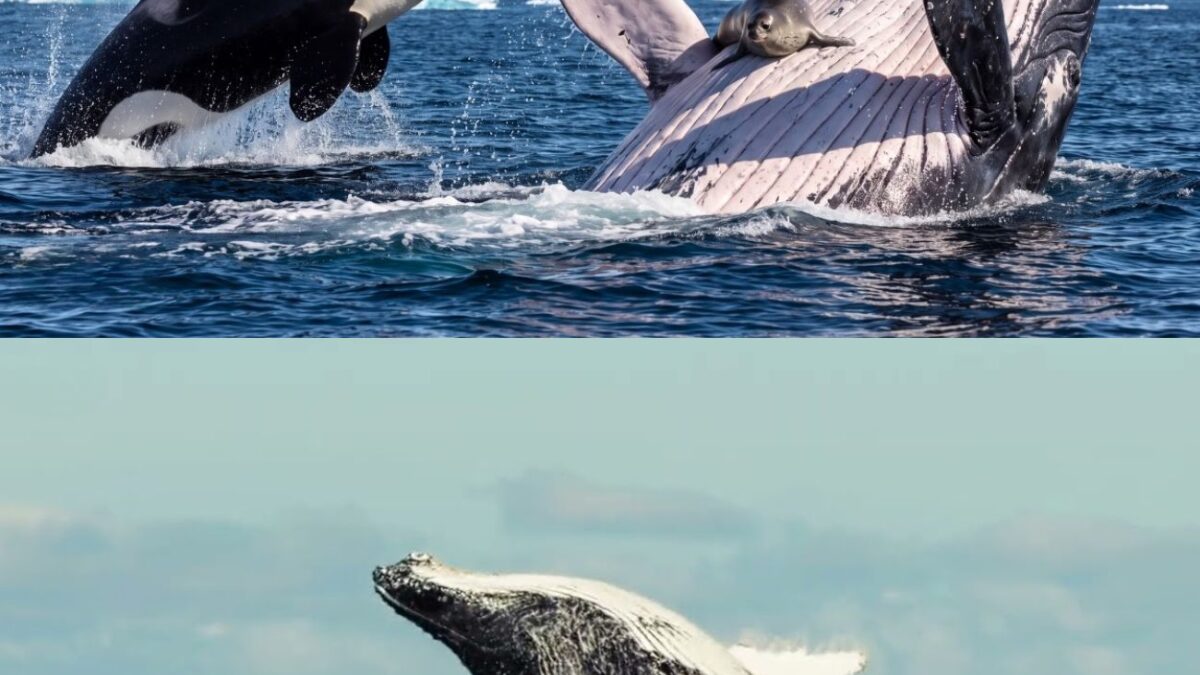
There is a behavior in the animal kingdom that on paper should simply not exist. An enormous, physically dominant animal, possessing almost nothing to fear in its own environment, will sometimes swim toward danger to interrupt a lethal attack on a completely different species. Not its own calf, not a relative, and not even another member of its own kind, but a stranger from an entirely different branch of the evolutionary tree that it will likely never encounter again.
The animal capable of displaying this startling phenomenon across our modern oceans is the humpback whale. Over the past several decades, field researchers have quietly documented this happening again and again in regions on opposite sides of the planet. To understand why this matters so deeply to evolutionary biology, it helps to first understand what a humpback whale actually is when viewed within its broader wild context.
They are truly massive mammals, frequently reaching fifty feet in length and forty tons in body mass. These cetaceans are among the most far-ranging creatures on Earth, completing annual migrations that trace paths between cold, food-rich polar waters and warm tropical breeding grounds. A round trip across these shifting oceanic corridors can easily exceed ten thousand miles within the span of a single exhausting calendar year.
Beyond their staggering physical proportions, humpback whales are, by almost any available measure, remarkably intelligent and socially complex beings. Their famous underwater songs, sung primarily by solitary males across vast territories, can last twenty minutes or longer and shift gradually over years. Marine scientists often compare the spread of these acoustic motifs to human cultural trends rather than static, unyielding instinctive animal calls.
Deep within their intricate neurological structures, humpback whale brains contain specialized units known as spindle neurons. In human beings and a small handful of other highly social mammals, these specialized cells are closely associated with empathy, rapid emotional processing, and social intuition. Yet for most of the twentieth century, conventional cetacean research focused strictly upon population counts, migratory tracks, and physical feeding ecology.
Questions regarding emotional capacity or complex moral motivations in wild animals were treated with intense academic skepticism and caution. Projecting human-like intentions onto a wild creature without rigorous empirical proof has long been regarded as one of the easiest ways to produce thoroughly bad science. Biologists were strictly trained to describe precisely what an animal did with neutral language, never speculating about what it might have felt compelled to do.
That institutional skepticism is precisely what makes the global pattern documented around humpbacks so difficult for modern science to casually dismiss. These animals are already celebrated as brilliant, collaborative hunters capable of astonishing acts of marine coordination. In specific northern feeding grounds, stable groups of humpbacks gather to blow intricate spiral columns of bubbles beneath schooling fish.
This rising wall of shimmering air forms a circular barrier that traps thousands of herring near the choppy surface. Acting in near-perfect acoustic synchronization, the whales suddenly lunge upward through the vortex together, huge mouths expanding across the foam. It is an advanced feeding technique that requires implicit trust, acute spatial awareness, and constant communication among non-related individuals.
For a very long time, bubble-net feeding stood as the clearest observable proof of deliberate teamwork within baleen whales. That kind of wild cooperation was always straightforward to contextualize within the boundaries of standard evolutionary theory. A coordinated hunting party catches vastly more schooling prey, meaning every individual participating in the maneuver gains an immediate energetic return.
Nobody gives up their share of food, nobody risks their life for a stranger, and everyone eats their fill. What marine observers eventually documented in the freezing expanses off Antarctica, however, refused to fit into that tidy economic equation. The initial breakthrough into public awareness is credited to marine ecologist Robert Pitman, who spent decades studying marine mammals in the Southern Ocean.
During an Antarctic research expedition conducted in 2009, Pitman and his scientific crew witnessed two distinct encounters within one week. In both instances, massive humpback whales appeared to deliberately interfere with an active, coordinated killer whale hunt. The target pursued by the apex predators was not a vulnerable humpback calf, but an isolated, panic-stricken Weddell seal.
In one encounter that has become widely cited across peer-reviewed behavioral literature, a solitary humpback was observed positioning itself beneath the seal. The giant whale deliberately rolled onto its back, lifting the exhausted seal entirely out of the water upon its broad chest. Each time the frantic seal started slipping back into the churning sea, the whale gently adjusted its massive pectoral flipper to keep it secure.
Pitman acknowledged openly that neither he nor his colleagues possessed an existing biological framework that could explain what was occurring before them. Decades of formal literature detailing baleen whale behavior had simply not prepared them to witness a giant acting as an oceanic raft for a seal. Yet the true scientific shock was not merely that such a bizarre confrontation had taken place on a single afternoon in polar waters.
What transformed the encounter into a historic scientific inquiry was what occurred after Pitman began asking colleagues if they had seen similar things. He sent quiet inquiries to researchers, naturalists, and commercial whale-watching guides operating in diverse waters around the globe. Answers soon arrived from ocean basin after ocean basin, revealing a dense and unrecognized history of identical multi-species interventions.
Reports described humpbacks rushing to disrupt killer whale hunts targeting California sea lions along the rugged coastline of Alaska. Other records showed them shielding terrified harbor seals, gray whale mothers, and even a pair of colossal ocean sunfish. The sunfish is an odd, primitive creature bearing no anatomical, behavioral, or acoustic resemblance to any species of cetacean.
By the time Pitman and his team collated these scattered field notes, they had assembled a definitive catalog of one hundred and fifteen encounters. These documented events stretched across more than six decades of neglected observations, recorded by different people with no knowledge of one another. Crucially, in nearly ninety percent of the analyzed cases where prey identity was verified, the targeted victim was not a humpback.
Part of the reason this staggering pattern remained hidden for so long is simply the logistical difficulty of observing open-ocean ecology. A predatory assault by an orca pod can erupt and conclude within minutes in remote waters thousands of miles from the nearest port. For an intervention to be recorded, a qualified scientific observer must be present with clear visibility at the exact second violence breaks out.
The witness must also possess the insight to document the interaction systematically rather than passing it off as a curious one-time anomaly. For over half a century, individual mariners likely viewed these frantic encounters as bizarre sea stories never meant for formal publication. It was only when biologists began synthesizing logs across multiple institutions and languages that the undeniable global scale of the phenomenon surfaced.
The pattern demonstrated its most dramatic and costly manifestations in severe situations where the intended prey had already perished. During one thoroughly documented confrontation off Monterey Bay in 2012, a pod of transient orcas successfully separated and killed a gray whale calf. The calf died early in the assault, yet adult humpbacks continued to arrive at the bloody scene for hours after the hunt was over.
Eventually, more than a dozen humpbacks converged upon the coordinates, forming a protective perimeter over the sunken remains. Eyewitness accounts described individual humpbacks stationing their bodies beside the carcass, violently lashing their tails whenever an orca approached to feed. They sustained this dangerous defensive perimeter long after any physical hope of saving the young gray whale had entirely vanished.
Faced with such extraordinary field evidence, science must ask what evolutionary mechanism drives a massive animal to behave this way. The baseline hypothesis favored by Robert Pitman is rooted in evolutionary ecology, presenting a mechanical explanation for the behavior. Pitman does not claim that humpback whales feel empathetic pity in the exact manner a human being conceptualizes moral charity.
Instead, his hypothesis highlights the ecological reality that mammal-eating killer whales represent the single greatest natural threat to humpback calves. A fully grown humpback adult has virtually nothing to fear from an orca pod in ordinary conditions. Its immense bulk, thick blubber, and formidable tail flukes make it far too dangerous for an orca pod to casually engage.
Furthermore, a humpback wields sixteen-foot pectoral flippers, the longest limbs of any living cetacean species on Earth today. These massive appendages are lined along their leading edges with hard, jagged colonies of calcified barnacles that act like heavy blades. When swung through the water with thousands of pounds of muscular leverage, these flippers can break the bones of an apex predator.
A young humpback calf, however, is delicate, inexperienced, and entirely dependent upon adult protection during its earliest months in open water. These vulnerable nursery weeks overlap directly with the seasonal hunting circuits of wide-ranging, mammal-hunting transient killer whale pods. Pitman suggests that somewhere in their deep history, humpbacks developed an aggressive, hardwired behavioral rule that bypasses nuanced assessment.
Upon hearing the unmistakable acoustic signatures of an active killer whale hunt in the vicinity, the adult humpback simply charges toward the sound. The biological cost of investigating the predatory noise is comparatively low for a formidable, fully grown adult whale moving through familiar waters. If the animal under attack happens to be its own calf or a relative, that immediate, aggressive intervention could save its genetic lineage.
Over millions of years, this reflexive behavior would persist because, on evolutionary balance, the reproductive payoff of saving offspring outweighs the wasted energy. Even if most of the time the animal being saved is a seal, sea lion, or stranger, the hardwired response remains intact. Biologists have given this mechanical explanation the formal title of inadvertent altruism, a phrase designed to capture a very specific dynamic.
Under this premise, the whale does not make a moral assessment of the terrified seal struggling for breath upon its chest. Yet to the human observer standing on a research vessel, the action is functionally indistinguishable from conscious, selfless intervention. And certainly to the shivering seal kept out of the orca’s jaws, the distinction between instinct and empathy makes no practical difference.
A significant contingent of evolutionary biologists remains hesitant to reduce the entire global catalog of interventions to a blind, reflexive instinct. Two traditional paradigms of behavioral ecology are frequently brought forward to explain how these perilous interventions might make evolutionary sense. The first theoretical framework is kin selection, the idea that helping other members of your species indirectly perpetuates your shared genes.
Under kin selection, protecting a humpback calf that belongs to an unrelated mother still supports the collective survival of the regional breeding population. The second framework is reciprocal altruism, the concept that taking a risk for another individual today creates a social expectation of future help. This hypothetical assistance acts as a long-term social insurance policy that plays out across decades of an individual whale’s long life.
Yet both kin selection and reciprocal altruism immediately unravel when applied to the multi-species interventions documented by modern science. A rescued Weddell seal in the Southern Ocean will never return the favor by defending an adult humpback against a hunting pod. A pair of sunfish swimming in the North Pacific possesses neither the physical capacity nor the cognitive wiring to reciprocate protective assistance.
The genuine, honest consensus held by field scientists today is that the true internal motivation of the humpback remains completely unresolved. What can no longer be contested is that the behavior is real, highly repeatable, and documented across every major ocean on the planet. The biological data cannot be dismissed as romantic anthropomorphism when it fills hundreds of pages of peer-reviewed marine science journals.
It is worth recognizing that these diverse biological theories are not mutually exclusive when examined through the lens of long evolutionary spans. It is entirely plausible that inadvertent altruism explains how the broad behavioral impulse initially emerged within ancient cetacean populations. At the same time, kin selection and learned social culture may explain why the habit persisted across different ocean basins and generations.
Untangling the psychological mechanics at play would require continuous observation that technology cannot yet provide for wide-ranging marine creatures. Studying a forty-ton animal that dives into black ocean depths for hours at a time remains one of the hardest tasks in biology. Scientists must piece together fleeting surfaces, acoustic hydrophone recordings, and satellite tags to glimpse moments that transpire across vast oceanic wildernesses.
Humpbacks are not the only cetaceans known to disrupt predatory behavior, though they represent the most extensively documented and organized example. Historical records contain credible accounts of dolphins forming defensive circles around distressed human swimmers to fend off stalking white sharks. Other species of baleen whales have occasionally been seen swimming toward predatory activity that had nothing to do with their immediate social unit.
What sets the humpback apart is the deliberate, repeatable, and confrontational scale at which these interventions systematically occur across modern seas. This is not an isolated piece of folklore passed down through centuries of whalers sitting on wooden sailing vessels. This is an internationally corroborated, mathematically analyzed collection of scientific fieldwork representing dozens of institutions, marine biologists, and photographic databases.
The uncertainty surrounding why humpbacks do this represents one of the most exciting, challenging frontiers in modern evolutionary biology. For the historical majority of behavioral science, true altruism toward an unrelated species was considered an intellectual capacity unique to humans. The foundational belief was that caring for a stranger with zero expectation of practical return required an abstract moral compass.
The staggering records compiled around humpbacks do not necessarily prove that whales share our human moral frameworks or spiritual convictions. What they demonstrate is that nature produces behaviors that mirror what our species would instantly identify as deliberate acts of courage. The observable facts challenge our neat, reductionist assumptions about the psychological boundaries separating humanity from the non-human animal world.
Furthermore, field records demonstrate clearly that these multi-species protective efforts do not always conclude in cinematic, triumphant rescue operations. Antarctic research teams have recorded numerous instances where humpbacks arrived at the coordinates of a hunt only after the prey had been dismembered. In these grim scenarios, the whales still charged into the bloody foam, bellowing low-frequency acoustic blasts through the water at the orcas.
A marine biologist documenting one such encounter observed that the humpbacks exhibited all the energetic hallmarks of an aggressive disruption. They swung their tails, formed defensive lines, and remained agitated for hours despite the complete absence of a living victim to protect. These failed or late arrivals are, from a research perspective, just as scientifically illuminating as the successful interventions with living seals.
A predator-deterrent strategy that only triggered when an immediate personal benefit was guaranteed would be trivial to categorize under basic self-interest. An animal that consistently charges directly into danger after the target is already dead demonstrates a commitment to a behavioral impulse. It points toward an imperative that defies simple cost-benefit balance sheets and exposes the limits of our neat mathematical survival models.
It is equally essential to state that the killer whales participating in these violent interactions are not malicious villains in this marine drama. Orcas are themselves extraordinary, intelligent, and socially complex predators that possess distinct cultures, communication dialects, and specialized ancestral traditions. The vast majority of killer whale populations around the world never hunt warm-blooded marine mammals, feeding exclusively upon specific species of fish.
The specific mammal-hunting populations that provoke this defensive response from humpbacks represent a distinct, highly specialized evolutionary lifestyle. These transient, mammal-eating orcas act under the same relentless survival pressures that guide every other living creature struggling to feed its family. This is not a simplified fairy tale of virtuous gentle giants fighting off cruel, cold-blooded monsters of the oceanic deep.
Rather, it is the dramatic collision of two distinct evolutionary pathways and intellectual cultures unfolding across the unforgiving, open water. One culture relies upon coordinated pack-hunting tactics to track down intelligent, warm-blooded mammals in coastal coves and polar ice flows. The other culture relies upon massive physical presence, acoustic resonance, and a stubborn refusal to let apex predators hunt without resistance.
Scientists who study orca populations over multi-decade intervals have noted that fish-eating and mammal-eating ecotypes rarely interact with each other. They share the same broad geographic waters yet do not interbreed, communicate, or emulate each other’s distinct hunting lifestyles. Humpbacks appear entirely aware of these cultural divisions, ignoring fish-eating pods completely while reacting violently to the subtle clicks of mammal-hunters.
When an actual physical battle erupts between a humpback and a mammal-hunting orca pod, the confrontation is brutally violent and exhausting. Biologists have recorded humpbacks ramming their multi-ton bodies directly into attacking orcas, stunning the smaller predators with raw kinetic mass. A single sweeping blow from a humpback’s tail fluke carries sufficient hydraulic energy to kill an orca outright if struck cleanly.
The edges of their massive pectoral fins, encrusted with sharp, jagged barnacles, turn into defensive shields and heavy blunt weapons. These slashing appendages transform the humpback into a fortress of muscle and bone that few predator pods can safely penetrate. Yet despite their defensive advantages, engaging a coordinated group of intelligent killer whales carries authentic, life-threatening danger for the humpback.
A hungry orca pod is lightning-fast, exceptionally coordinated, and capable of working in concert to exhaust and drown much larger opponents. A humpback that chooses to swim into the center of an active hunt is intentionally putting its own physical survival at risk. These are not casual, dispassionate gestures; they are grueling physical trials that often leave the intervening whales scarred, bleeding, and utterly depleted.
What makes this entire behavioral pattern utterly impossible to ignore is the immense geographic distribution of the accumulated field reports. These accounts do not come from a single eccentric family group of whales occupying an isolated bay in the Pacific Northwest. They are logged by independent oceanographers in the icy fjords of Norway, across coastal California, throughout Antarctic icefields, and around Australia.
If this phenomenon were simply the quirky habit of one unusually aggressive individual whale, it would be treated as an anomaly. Instead, we are confronted with more than a hundred formal, verified records describing the exact same dynamic across multiple decades. Every time an analysis is completed, the data confirms that humpbacks globally share a fundamental behavioral imperative to confront hunting orcas.
When human beings observe this incredible oceanic phenomenon, there is an overwhelming, natural urge to assign the word heroism to the act. And in our limited, poetic human vocabulary, that word may be the closest conceptual match we possess to capture the reality. Whether the action originates as a genetic survival mechanism or something resembling interspecies empathy, the real-world outcome remains completely identical.
A massive, sentient creature with nothing obvious to gain risks its own physical safety to place itself between a predator and prey. As researchers continue to monitor the oceans with satellite systems and hydrophones, new reports of these encounters continue to arrive. Right now, in some remote, slate-gray stretch of the Pacific, it is entirely possible that this exact oceanic drama is unfolding again.
Somewhere miles offshore, an adult humpback whale has detected the frantic underwater acoustic signature of a killer whale hunting run. It cannot know across the dark miles whether the animal fighting for air is a humpback calf or an exhausted harbor seal. It cannot calculate the odds of a successful rescue, nor can it anticipate any tangible reward for the immense calories it will burn.
Yet, without hesitation, the massive animal turns its forty-ton body away from its migratory destination and swims straight toward the violence. It cuts through the cold swells, flippers sweeping forward, propelled by an ancient impulse written deep into its immense, mysterious nervous system. It chooses to show up, insert its body into the crossfire, and hold the line for an animal it will never meet again.
This persistent, majestic mystery is why marine biologists find themselves drawn back to the study of these oceanic leviathans year after year. Unusual behaviors occur throughout nature, but very few challenge the core philosophy of animal behavior science quite like this one. It forces us to reconsider the narrow evolutionary theories that have long maintained that self-interest is the sole architect of the wild.
The great humpback whales of the world may never explain to human researchers why they swim into the teeth of danger for strangers. Perhaps it is an evolutionary glitch, a marvelous accident of natural selection that preserved an overly broad defensive instinct across evolutionary time. Or perhaps there are dimensions of social consciousness, cross-species awareness, and oceanic intelligence that human science has barely begun to grasp.
Regardless of which scientific explanation ultimately proves correct, the empirical truth remains written across the salt water of our planet. Every documented rescue, every seal lifted on a barnacled pectoral fin, and every tail struck against the tide makes the pattern undeniable. In the cold, indifferent wild of the global ocean, these ancient giants continue to challenge our understanding of what nature can be.

