This 19-Year-Old Got Separated — and Accidentally Liberated an Entire Village
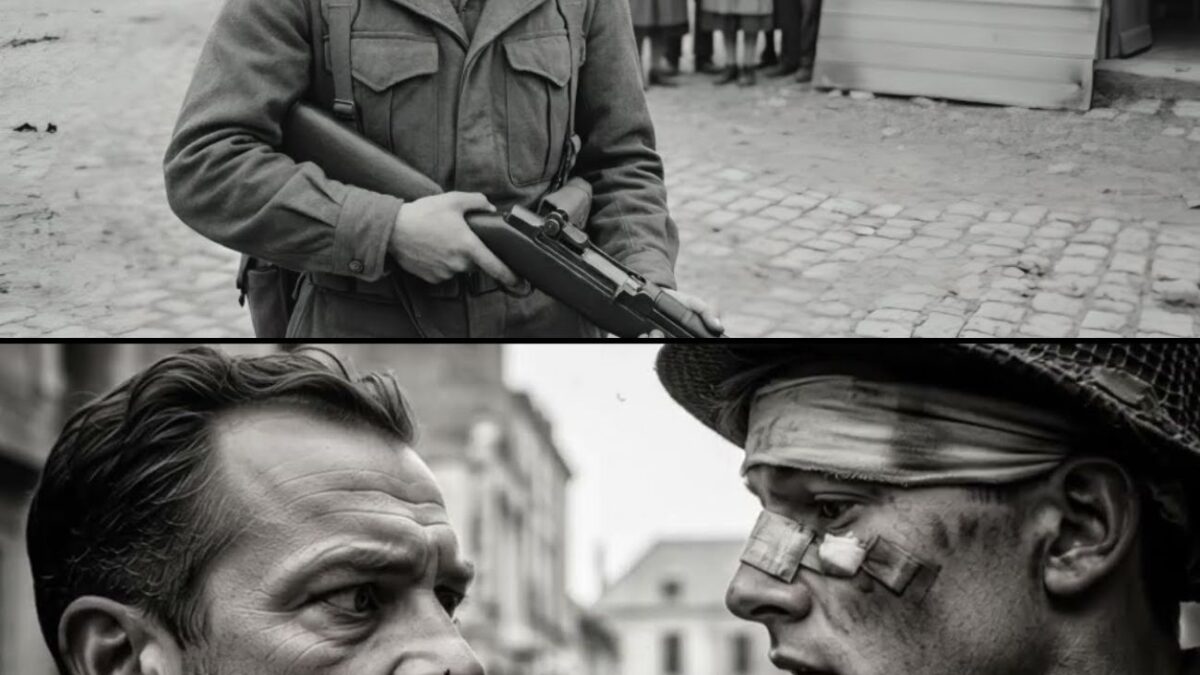
The night of April 13, 1945, hung heavy over the ancient city of Zwolle in the northeast of the occupied Netherlands. Behind shuttered wooden windows and drawn blackout curtains, fifty thousand Dutch men, women, and children huddled inside their dark homes. For nearly five agonizing years, they had lived under the iron fist of Nazi tyranny, enduring hunger, deportations, and absolute terror.
Beyond the dark perimeter of the canal-ringed city, the damp Dutch night was punctuated by the low rumble of Allied diesel engines and moving steel. Canadian artillery crews from the 3rd Canadian Infantry Division worked methodically in the cold mist, sliding brass shells into breeches and double-checking coordinates. Their orders were clear and standard: at the first light of dawn, they were to obliterate the historic urban center with high-explosive ordnance.
Artillery doctrine treated civilian structures as secondary concerns whenever entrenched German resistance stood in the direct path of advancing ground troops. Reducing Zwolle to smoking rubble would safeguard the lives of Canadian infantrymen who would otherwise have to fight room to room. The catastrophic loss of innocent civilian lives was viewed by high command as deeply regrettable, yet entirely unavoidable in total war.
Two men crouching in a muddy drainage ditch just outside the Allied lines saw things with profound clarity. Private Léo Major reached up with gloved fingers to adjust the rough black eye patch resting firmly over his empty left socket. He ran a practiced hand along the stamped steel receiver of his 9mm Sten submachine gun, listening to the soft click of the bolt.
Beside him in the damp grass crouched his closest companion, Corporal Willie Arsenault, equally silent and alert as he checked his extra magazines. The pair belonged to the scout platoon of Le Régiment de la Chaudière, an aggressive and battle-hardened French-Canadian unit. Their official orders called for an ordinary, cautious reconnaissance probe to identify enemy concentrations and slip back before the dawn bombardment.
Major was only twenty-three years old, yet his face was lined with the hardened, ageless exhaustion of a man who had seen too much slaughter. Back in Montreal, before the globe tore itself apart, he had earned his meager living fitting pipes and sweating in industrial basements. He possessed no formal officer schooling, no family lineage of decorated generals, and zero reverence for paper-pushing command staff.
He was simply a proud, defiant young man from Quebec who had enlisted in 1940 to prove to his harsh father that he was worth something. By the spring of 1945, he had already paid a terrible personal toll in blood, bone, and flesh across Western Europe. He had lost his left eye during a savage close-quarters ambush just days after storming the beaches of Normandy on D-Day.
A dying SS soldier had managed to pull the pin on a phosphorus grenade, showering Major’s face with burning chemical fire that consumed his eye. Medical officers had ordered him evacuated home to Canada, expecting him to accept an honorable discharge and a lifelong disability pension. Major had sneered at their papers, famously telling them that he only needed his right eye to line up the sights of a rifle.
What the Allied commanders did not suspect was that Major and Arsenault had already discarded their official instructions before even setting foot across the fields. They had forged an audacious, completely unauthorized pact in the darkness of their cold staging trench. They were not going to simply count machine gun bunkers and quietly scurry away to watch the city burn at dawn.
They intended to enter the maze of Zwolle’s medieval streets and liberate the entire occupied population of fifty thousand people by themselves. The logic guiding Major was simple, fierce, and entirely devoid of the cold mathematics that governed high-level operational maps. He had marched through Caen, Falaise, and countless ruined French hamlets where Allied shells had left nothing behind except shredded limbs and pulverized stone.
He had heard the wailing of mothers digging through brick dust to find crushed children, and he had smelled the sickly sweet stench of ruins. He was determined that this Dutch sanctuary would not suffer the same fate, not while he still possessed breath, blood, and a loaded gun. If he could break the German garrison from within, the Canadian guns would have nothing left to target when morning broke.
At exactly 23:00 hours, the two Canadian scouts slipped over the embankment and crossed into the silent, treacherous expanse of no man’s land. They moved like shadows across the flat, damp terrain, staying low along irrigation ditches and avoiding open meadows where flares could catch them. A local Dutch farmer named Hendrik van Gerner met them at a designated hedgerow, whispering vital intelligence about German checkpoints near the railway tracks.
Major absorbed the details quickly, committing the layout of canals, stone bridges, and railway culverts to his photographic memory. What Major could not possibly know was that in less than two hours, his closest friend would be lying dead in the gravel. He did not know that he was destined to spend the rest of the cold night entirely alone, fighting a phantom war against hundreds of soldiers.
Nor could he fathom that by the time the sun touched the Dutch church steeples, he would achieve what generals would deem mathematically impossible. This was the opening hour of a legendary night when a wounded French-Canadian tradesman took on an occupying army with sheer will. To grasp the enormity of what happened that night in Zwolle, one must understand the terrible gauntlet Major had already survived.
By April 1945, the Allied liberation of the Netherlands had transformed into a grinding, muddy slog against an enemy fighting for survival. The German Wehrmacht was crumbling on every front, yet its rearguard units clung fiercely to every canal, ditch, and urban street corner. Every brick bridge was rigged with explosives, every attic housed snipers, and every open plaza was calibrated as a fatal kill zone.
Major’s regiment, Le Régiment de la Chaudière, had been locked in this meat grinder since wading ashore at Juno Beach on the morning of June 6, 1944. On that terrifying first morning in Normandy, while machine-gun fire ripped through the surf, Major had sprinted forward completely alone. He had single-handedly assaulted a German Hanomag halftrack, killing the machine-gun crew and capturing the vehicle before it could butcher his company.
Inside the captured halftrack, Canadian officers discovered cipher books, communications gear, and operational codes that saved hundreds of Allied lives along the beachhead. Yet mere days later, while conducting a solo recon patrol through the dense hedgerows of Normandy, Major ran straight into four elite SS infantrymen. He killed all four in a blinding flash of reflexive shooting, but the final soldier detonated a phosphorus grenade as he fell.
The blinding explosion seared through Major’s flesh, melting the optic nerve of his left eye and burning half of his face down to raw tissue. When surgeons in the field hospital told him that his war was finished, Major laughed in their faces, demanding a simple eye patch. He told anyone who would listen that he looked like a pirate now, and a sniper only required one good eye to kill fascists anyway.
He rejoined the scout platoon and marched directly into the nightmare of the Scheldt estuary in October 1944 to clear the approaches to Antwerp. It was during that brutal campaign in the frozen mud that Major pulled off another feat that defied standard military credibility. Acting completely on his own initiative, he had stalked an entire German garrison near a flooded dyke, using the driving rain as cover.
He captured a German patrol leader, used him at gunpoint to bluff an entire garrison, and marched ninety-three captured enemy soldiers back to Canadian lines. British commanders were so stunned by the prisoner haul that they recommended Major for the Distinguished Conduct Medal, the second-highest honor in the Commonwealth. Major flatly refused to accept the medal, bitterly declaring that General Bernard Montgomery was an incompetent butcher who had no right awarding medals.
His refusal scandalized the brass, but among the rank-and-file soldiers who crawled through the mud, Léo Major became a living legend. Then, in February 1945, in the shattered German border town of Kleve, Major’s charmed life appeared to finally run out. He was helping a military chaplain retrieve the bodies of fallen soldiers from a destroyed tank when their Universal Carrier struck a heavy anti-tank mine.
The violent blast blew the chaplain and the driver to pieces, launching Major thirty feet into the air before slamming him onto jagged rubble. He fractured multiple vertebrae, shattered ribs, and broke both ankles, leaving him lying in the dirt unable to move or breathe. Field doctors who examined his battered frame declared his military service concluded, preparing paperwork to ship him back across the Atlantic forever.
Major lay in his hospital cot, grit his teeth, and refused the transfer order, declaring that the war was not done and neither was he. He spent the next month in a makeshift rehabilitation unit, secretly walking through agony, relying on morphine injections and absolute obstinacy to heal. By April 13, 1945, when his regiment reached the outskirts of Zwolle, Major was back with his scout platoon, though still wrapped in bandages.
His back flared with agonizing pain whenever he turned his torso, and he walked with a slight, stiff limp that he tried desperately to conceal. Any sane officer looking at his medical chart would have placed him on light administrative duty miles behind the forward operational lines. Yet when the company commander asked for two volunteers to slip into the heavily fortified city of Zwolle, Major stepped forward without hesitation.
Corporal Willie Arsenault stepped forward right behind him, clapping his friend on the shoulder with a grin that signaled they were in it together. The intelligence brief laid before them was grim: Zwolle was a vital strategic transportation hub choked with defensive trenches and artillery emplacements. An estimated German garrison of several hundred seasoned troops held the perimeter, prepared to turn every residential cellar into a machine-gun bunker.
Urban combat in a city of fifty thousand terrified civilians would have meant massive house-to-house battles, burning neighborhoods, and endless civilian casualties. The Allied operational plan was to treat Zwolle not as a community to be preserved, but as a fortified enemy redoubt to be systematically erased. The dawn bombardment scheduled for April 14 was intended to drop twelve hundred heavy high-explosive artillery rounds directly into the city streets.
The recon mission assigned to Major and Arsenault was merely a targeting exercise: identify German strongpoints, radio coordinates, and pull out before the barrage. But as the two scouts crossed the darkened dikes leading toward the outer canal, they carried no radio for calling in the guns. They carried two Sten submachine guns, a canvas sack packed with high-explosive grenades, extra magazines, and an unshakeable determination to save the city.
Léo Major had never lived an easy life, and the rugged hardness that now kept him moving was forged long before he put on a uniform. Born in Massachusetts in 1921 to French-Canadian parents, his family had returned to Montreal while he was still an infant in arms. He was raised in the hardscrabble, unforgiving working-class tenements of Montreal during the darkest years of the Great Depression.
His father was an austere, emotionally distant man whose expectations were impossible to meet and whose approval was never once given. By the age of fourteen, unable to endure his father’s harsh demeanor any longer, Major packed his few belongings and moved in with an aunt. He worked brutal hours in industrial plants, learning the pipe-fitting trade, developing massive grip strength and an intuitive understanding of mechanical systems.
When he walked into the recruiting depot in 1940, the enlistment officer asked him why a skilled tradesman wanted to volunteer for infantry service. Major looked the recruiter in the eye and said bluntly that he wanted to prove to his father that he was a man worth honoring. The army initially saw him as just another French-speaking kid from Quebec, uneducated in military science and lacking deference to authority.
During field exercises in New Brunswick, seasoned instructors quickly realized that Private Major possessed instinctive combat attributes that could never be taught. He possessed an uncanny sense of terrain, moving through dense brush without snapping twigs, and remaining completely motionless for hours in freezing rain. He gravitated immediately toward the scout platoon, where independent judgment was prized above blind obedience to the drill book.
After losing his eye in Normandy, his physical presence took on a fearsome, almost ghostly aura among both his comrades and the enemy. Soldiers began whispering about the “one-eyed ghost,” a specter who slipped past enemy sentries, struck with terrifying precision, and vanished into darkness. German field reports from the winter of 1944 frequently mentioned an unseen Canadian sniper who operated alone, never retreating and never missing.
Major was insubordinate, fiercely independent, and openly disdainful of officers who sat in warm tents while enlisted men bled for trivial objectives. He repeatedly turned down promotions to sergeant because he knew rank would shackle him to paperwork and rob him of operational freedom. Yet his men would have followed him directly into the mouth of hell, knowing that Major never risked another man’s life needlessly.
By midnight on April 14, 1945, this battle-worn soldier stood poised on the threshold of the historic Dutch city he intended to liberate. The ancient Sassenpoort gateway, with its massive brick towers, loomed against the cloudy night sky like a medieval sentinel in the gloom. Major and Arsenault moved quietly through the narrow stone entrance, their rubber-soled boots making almost no sound on the wet cobblestones.
The streets were dead, suffocated by an unnatural silence that only an occupied city under military curfew could produce. Somewhere ahead in the labyrinth of narrow alleys, the Wehrmacht had dug in their forward pickets, listening for any sign of Allied advance. The two Canadians kept to the deep shadows beneath overhanging brick eaves, weapons cocked, scanning second-story windows for sniper positions.
Then, without warning, the stillness of the street was shattered by the deafening chatter of an MG42 machine gun firing from an embankment. The muzzle flash illuminated the rain-slick stones in strobe-like bursts, the high-velocity rounds ricocheting violently off the brick walls with metallic screams. Arsenault had made a slight sound, catching the attention of a nervous German gunner who opened fire blindly into the alley.
A burst of heavy fire caught Corporal Willie Arsenault squarely in the chest, lifting him off his feet and dropping him onto the cobblestones. Major watched his best friend collapse, blood pooling instantly on the stones, dead before his body even settled into the dirt. A terrible, cold fury ignited behind Major’s single good eye, consuming any lingering trace of caution or regard for his own safety.
Screaming a primal battle cry, Major charged directly toward the muzzle flash of the German machine-gun position through the open street. He fired his Sten gun from the hip, emptying a magazine into the nest, killing two German gunners where they crouched. A third soldier scrambled into the back of an idling staff car, which screeched away into the darkness, tires smoking on the wet bricks.
Major stood alone in the ringing silence over the bodies of the enemy, his breathing ragged, the barrel of his weapon smoking in the cold. He knelt beside Arsenault’s body, feeling for a pulse that was not there, gently closing his fallen comrade’s unseeing eyes. Standard doctrine demanded that he fall back immediately, report the death of his partner, and let the artillery wipe out the city at dawn.
That was the safe decision, the military decision, the choice that would spare him from facing an entire garrison alone in the dark. Major refused to leave his friend’s sacrifice to become just another forgotten footnote to an artillery barrage that would incinerate fifty thousand Dutch civilians. He stood up, adjusted the sling of his submachine gun, checked the pins on his canvas grenade sack, and made his silent vow.
Willie Arsenault had died trying to preserve this historic city, and Major would finish what they had started or die on these cobblestones. But he could no longer fight a conventional war; he had no radio, no squad, and no way to hold fixed defensive positions. If he was going to defeat an entire garrison alone, he had to become an entire army, creating an illusion of overwhelming force.
He slipped deeper into the dark city center, moving rapidly from alleyway to alleyway, his remaining eye scanning every window and doorway. The adrenaline pumping through his veins drowned out the throbbing pain in his shattered spine and numbed his frozen, broken ankles. He caught sight of a German staff vehicle parked outside a grand brick townhouse that appeared to serve as an officers’ field quarters.
A tired German driver stood beside the running board, smoking a cigarette, his uniform collar turned up against the cold April wind. Major emerged from the black shadows like a wraith, planting the cold muzzle of his Sten gun against the man’s temple before he could react. In sharp, whispered German, Major ordered the petrified soldier to get behind the steering wheel and prepare to drive through the streets.
Major climbed into the open back seat, weapon leveled, and instructed the terrified driver to tie a white handkerchief to the radio antenna. They began moving slowly through the deserted thoroughfares of Zwolle, cruising past shuttered townhomes, dark canals, and abandoned tram tracks. Whenever Major spotted an active enemy bunker, a barracks window, or a guarded intersection, he went on the attack with devastating fury.
He hurled high-explosive grenades through ground-floor windows, sprayed bursts of 9mm ammunition down empty hallways, and shouted fictitious French commands into the night. The sound of rapid fire and concussive blasts reverberated through the narrow stone corridors, echoing off medieval walls to sound like multiple platoons. Before the enemy could organize a counterattack, Major ordered the driver to accelerate, disappearing into another district before the dust had settled.
He would strike in the northern sector near the canal, then appear ten minutes later near the central marketplace, throwing more grenades and firing bursts. To the German garrison commanders listening to the frantic reports coming in over field telephones, the situation appeared utterly catastrophic and out of control. Canadian commandos were reported to be breaching the perimeter at six different locations simultaneously, supported by automatic weapons and heavy explosives.
The sight of a staff car flying a white flag moving through the chaos convinced panicked sentries that an Allied infiltration unit was already operating behind them. German officers attempted to establish a coherent defensive perimeter, but every report contradicted the last, describing attacks occurring across the entire city. In reality, the entire Allied assault was one furious, half-blind French-Canadian pipe fitter armed with a sack of grenades and iron resolve.
By 01:00 hours, Major had been running his one-man guerrilla war through the dark, twisting streets of Zwolle for over an hour. Sweat mixed with rain ran down his scarred face, stinging his empty eye socket, yet he never paused to catch his breath. He navigated toward the Potgietersingel canal, where intelligence indicated the regional Gestapo headquarters was located in an imposing administrative building.
When Major reached the complex, flames were already licking out of the second-story windows, thick black smoke billowing into the night sky. The panic had spread so deeply that the secret police were frantically destroying their files, burning torture records before the Canadians arrived. Major helped accelerate their panic, firing several bursts into the ground-floor entry and lobbing another grenade through the front door for good measure.
Shortly after 01:30, while navigating an alley near the Grote Markt, Major found himself staring down the barrels of four Sten submachine guns. But these men were not dressed in field-grey Wehrmacht tunics; they wore civilian coats, wool caps, and orange armbands pinned to their sleeves. He had stumbled directly into the forward patrol of the local Dutch underground, led by a local resistance commander named Frits Kuipers.
Kuipers and his fighters had spent the last two hours listening to the gunfire and explosions, completely baffled by the tactical situation. Kuipers later recalled his utter disbelief upon encountering the lone soldier, soaked in mud, grease, and blood, calmly demanding to know German troop concentrations. The resistance leaders initially assumed Major was insane or had lost his mind from combat fatigue, unable to comprehend that he was alone.
Major quickly silenced their doubts with his sharp, commanding tone, laying out his plan and demanding practical intelligence on the garrison’s movements. Kuipers explained that the primary German force was concentrating near the eastern perimeter of Zwolle, preparing for what they believed was an evacuation. The German commander had concluded that the city was already surrounded by superior Canadian forces and that their supply lines were severed.
Major’s single eye narrowed as he processed this vital operational intelligence, realizing that the enemy garrison was already balanced on a psychological knife-edge. The Wehrmacht was not interested in dying in the ruins of Zwolle for Adolf Hitler’s lost war; they only wanted to escape eastward toward Germany. If he could ratchet the psychological pressure just a little higher, the garrison would break and run without offering any further resistance.
Major instructed Kuipers to keep his resistance fighters out of direct firefights, knowing that their light hunting rifles would be outmatched by German machine guns. Instead, he ordered the underground to spread through the neighborhoods, knock on doors, and instruct every Dutch civilian to remain hidden in their cellars. The underground was also to observe German vehicle movements, report troop withdrawals, and set up observation posts along every major street intersection.
For the next three hours, Léo Major transformed himself into a living nightmare for the retreating, terrified German soldiers across the city. His morphine had long since burned out of his bloodstream, leaving his back in screaming agony and his vision swimming with exhaustion. His uniform was torn, his hands were scraped and bloody from loading magazines, and his throat was hoarse from screaming combat orders in French.
Yet he pushed forward on broken ankles through sheer, unbreakable stubbornness, refusing to collapse until the mission was finished. He struck German checkpoints from the rear, hurling smoke grenades and fragmentation explosives, firing short bursts from his Sten gun before vanishing into shadows. He ambushed a German staff car near the canal bridge, disabling the engine with a well-placed burst and sending the occupants fleeing on foot.
Every explosion convinced the Wehrmacht officers that Canadian armored reconnaissance elements had penetrated the inner defensive ring of the city. By 03:30 hours, the German commander made the fateful operational decision to abandon the city of Zwolle entirely to the Canadians. Orders were shouted through the eastern barracks, and vehicles were hastily loaded with surviving officers, heavy weapons, and retreating staff.
Soldiers abandoned heavy machine guns, field radios, and stockpiles of ammunition in their rush to reach the eastern road to Germany. The orderly withdrawal rapidly devolved into a disorganized, panicked rout as men abandoned their posts and fled eastward through the morning mist. By 04:00 hours, the last German transport truck rumbled over the eastern bridge, leaving the city of Zwolle utterly silent once more.
Against every principle of modern warfare and every law of tactical probability, a single soldier had brought an occupying garrison to total collapse. Léo Major walked through the deserted center of the liberated city, his empty Sten gun slung over his shoulder, swaying from sheer physical exhaustion. He met Kuipers and the stunned members of the Dutch resistance on the steps of the town hall, his mission finally complete.
Civilian windows began to unlatch, and cautious faces appeared in second-story frames, staring down at the solitary, battle-scarred Canadian in disbelief. Word spread like wildfire through the alleys: the Germans were gone, the city was untouched, and freedom had arrived on the back of one man. But Major had one final, heartbreaking duty to perform before he could allow himself to rest or celebrate with the people.
He took a civilian truck provided by the resistance and drove back through the quiet streets to where Corporal Willie Arsenault lay. With gentle reverence, Major lifted his fallen friend’s body into the back of the vehicle, covering him with a wool blanket. He had to reach the Canadian lines before dawn broke, before the artillery crews unleashed their planned hell upon the people of Zwolle.
At 06:00 hours, as the first grey light of April 14 crept over the eastern horizon, Major’s vehicle approached the Canadian lines. Centries, nervous and primed for an expected German counterattack, nearly opened fire on the approaching vehicle flying a white cloth from its antenna. Furious at the thought of being shot by his own men after surviving the night, Major scrambled onto the hood, shouting in colorful French.
The vehicle screeched to a halt in front of the forward headquarters tent, where artillery officers stood with chronometers in their hands. The massive guns were loaded, the targeting angles locked, and gunners were waiting only for the final green light to open fire. Major marched into the command tent, caked in mud, blood, and brick dust, his eye patch crooked, his uniform reeking of cordite.
He looked his commanding officer directly in the eye and delivered his blunt, historic report: the Germans were gone, and the barrage must be cancelled. His commander stared back in utter shock, sputtering that such a report was completely impossible, demanding to know where the recon patrol was. Major looked at the floor, his voice dropping into cold grief as he stated that Willie was dead, and he had liberated Zwolle alone.
The command bunker exploded into chaotic shouting as officers accused him of lying, suffering from combat psychosis, or deserting under enemy fire. One staff officer demanded that Major be immediately arrested and court-martialed for abandoning his assigned recon mission to conduct an unauthorized offensive operation. But the regimental commander, Lieutenant-Colonel Paul Mathieu, looked closely at the exhausted, wounded private standing rigidly before him and called for calm.
Mathieu ordered a patrol of armored scout cars to immediately advance on Zwolle and verify the unbelievable claims made by Private Major. If Major was wrong and the Germans were waiting in ambush, he would spend the rest of his life in a military prison. But if he was telling the truth, he had just accomplished the most remarkable single-handed feat in the entire history of the Canadian Army.
The Canadian scout cars cautiously approached the ancient outskirts of Zwolle, their machine guns trained on every treeline, expecting an immediate barrage. Instead of anti-tank fire and German mortar rounds, the patrol was met by thousands of Dutch citizens pouring into the streets. Flags that had been hidden under floorboards for five years fluttered from every balcony, and church bells rang out across the countryside.
Crying mothers lifted their children into the air, crowds threw spring tulips at the Canadian vehicles, and resistance fighters paraded captured equipment. The historic brick city was completely intact: not a single home had been flattened, not a single civilian had been killed by artillery. Fifty thousand human beings were alive and free because a pipe fitter from Montreal had refused to let their city be destroyed.
When the Canadian patrol radioed the report back to headquarters, confirming that Zwolle was entirely liberated, the command tent fell dead silent. The formal validation of Major’s impossible night came over the following weeks as military intelligence officers conducted exhaustive debriefings across Zwolle. They interviewed resistance leaders, examined the abandoned German bunkers, and cross-referenced the timeline of explosions and firefights recorded during the night.
The physical evidence was undeniable: over the course of five frantic hours, Major had executed an asymmetric campaign that broke an entire garrison. The German force, estimated between two hundred and four hundred soldiers, had completely abandoned a vital strategic node without the Allies firing a single artillery shell. Lieutenant-Colonel Mathieu walked through the intact city streets in profound awe, marveling at the sheer audacity of what his wounded private had accomplished.
Mathieu faced a difficult command dilemma: technically, Major had broken military discipline, ignored orders, and conducted an unauthorized operation. But punishing a man who had single-handedly liberated an entire city and saved thousands of lives was an utter political and moral impossibility. Mathieu tossed the proposed court-martial papers into the trash and officially recommended Private Léo Major for the Distinguished Conduct Medal.
The official citation for his award, signed on May 20, 1945, recorded the unbelievable facts for future generations of military historians. It described how Major, undaunted by the death of his partner, had fought alone through the city, establishing contacts and forcing the enemy’s withdrawal. It noted his burning of the Gestapo headquarters, his mastery of tactical movement, and his retrieval of his fallen friend’s body under fire.
This time, because the medal was not being presented by General Montgomery, Major accepted the honor in memory of Corporal Willie Arsenault. When German prisoners of war were later interrogated by Canadian intelligence officers, many flatly refused to believe that Zwolle had been taken by one man. One captured Wehrmacht officer insisted that the garrison had been attacked by at least a full battalion of elite Canadian commando troops supported by armor.
For the citizens of Zwolle, April 14, 1945, was burned into their collective memory as the day an angel with an eye patch delivered their salvation. Hendrik van Gerner, the farmer who had guided the scouts before Arsenault’s death, wept openly when he learned what Major had accomplished alone. Jan de Vries, who was fourteen years old when he walked out into the streets that morning, never forgot the sight of the liberator.
He recalled seeing a lone Canadian soldier wearing a pirate-like patch over his eye, leaning against a vehicle, smiling through grease and exhaustion. The soldier had looked at the gathering crowd of Dutch civilians and said in quiet French, “Vous êtes libres”—you are free. That simple sentence marked the end of half a decade of Nazi terror, starvation, and fear for fifty thousand innocent human souls.
The strategic consequences of Zwolle’s bloodless liberation echoed across the entire Western front during the final weeks of the European war. Because the city was captured intact, its bridges, railway hubs, and communication lines remained operational for the advancing Canadian 1st Army. Canadian divisions surged northward without delay, bypassing demolished roadblocks and driving deep into the remaining pockets of German occupation across Holland.
The already demoralized German forces in the Netherlands realized that their defensive lines were collapsing from within as well as from without. Less than three weeks after the liberation of Zwolle, on May 5, 1945, all German forces in the Netherlands surrendered unconditionally to the Allies. The military cost of liberating Zwolle was one Canadian hero killed in action, while civilian casualties stood at absolute, miraculous zero.
Had the dawn artillery barrage taken place as planned, twelve hundred high-explosive shells would have pulverized forty to sixty percent of the city. An estimated one thousand Dutch civilians would have been killed in their beds or crushed beneath the collapsing masonry of their historic homes. All of that catastrophic slaughter was averted because a young working-class tradesman from Montreal placed human lives above military procedure.
When the war in Europe concluded in May 1945, Léo Major laid down his weapons and returned across the Atlantic to Montreal. He did not seek out parades, he refused political appearances, and he returned quietly to his old trade as a master pipe fitter. In 1951, he married the love of his life, Pauline De Croiselle, and together they built a peaceful, loving home with four children.
He rarely spoke about the war, preferring to leave the horrors of the battlefield buried deep within his memories of youth. When neighbors or curious strangers asked about his eye patch or his scarred face, he politely changed the subject and talked about his work. But Léo Major’s extraordinary warrior spirit was not quite finished with history, nor was his unique courage done serving his country.
In 1950, when the Korean War erupted and Canada answered the United Nations call to resist communist aggression, Major volunteered for service once again. He enlisted in the Royal 22e Régiment—the famous “Vandoos”—and was immediately placed in charge of an elite scout and sniper platoon. In November 1951, at a critical defensive position known as Hill 355 or “Little Gibraltar,” Major would once again accomplish the impossible.
When Chinese forces overran Allied positions, Major led a handpicked force of eighteen scouts on a daring counterattack, recapturing the hill. For three brutal days, Major and his eighteen men held off relentless assaults from an estimated fourteen thousand Chinese soldiers in freezing weather. Outnumbered nearly a thousand to one, Major refused every order to retreat, calling in artillery strikes so close that they exploded right outside his trench.
For his unbelievable heroism on Hill 355, Léo Major was awarded a Bar to his Distinguished Conduct Medal, cementing his place in history. He became the only Canadian soldier, and one of only three men in the entire British Commonwealth, to win the DCM in two separate wars. After returning home from Korea, Major retired from the military permanently, spending the remainder of his life as a quiet, hardworking family man.
Whenever journalists managed to track him down and called him a hero, Major rejected the label with the same humility he had shown in 1945. He would tell them that he was just a soldier who did his job, and the real heroes were men like Willie Arsenault who never came home. But the grateful people of Zwolle never allowed the memory of what the one-eyed Canadian had done for their city to fade away.
Every year on April 14, the citizens of Zwolle gathered in their ancient town square to celebrate their liberation from Nazi occupation. In 2005, on the sixtieth anniversary of that miraculous night, an eighty-four-year-old Léo Major returned to Zwolle as an honored guest of the city. As he walked through the cobblestone streets, elderly citizens who remembered that terrifying April night in 1945 wept and threw their arms around him.
They brought their children and grandchildren forward to shake his hand, telling the young ones that they only existed because this man had spared their city. The city named him an honorary citizen, and a major thoroughfare was permanently christened Leo Majorlaan in his honor for all time. Major, visibly moved yet characteristically modest, told the gathering crowd to remember Willie Arsenault, the boy who died outside their gate so they could live.
Léo Major passed away peacefully on October 12, 2008, at the age of eighty-seven, leaving behind his devoted wife, four children, and five grandchildren. He was laid to rest with full military honors at the National Field of Honor in Pointe-Claire, Quebec, surrounded by the comrades he loved. In 2020, Canada Post issued a national stamp featuring his portrait and his iconic eye patch, forever honoring the legendary “One-Eyed Ghost.”
Today, military academies around the globe study Major’s night in Zwolle as a masterclass in psychological warfare and independent small-unit initiative. Yet the real lesson of Léo Major’s life is not found in tactical manuals or military textbooks on urban warfare doctrine. The real lesson is that an ordinary human being, armed with unbreakable moral conviction, can stand against impossible odds and change history forever.
Léo Major had set out into the cold European war as an unappreciated boy from Montreal, desperate to prove his worth to a distant father. His father may have never spoken the words of pride that the young pipe fitter so deeply yearned to hear in his youth. But fifty thousand citizens of Zwolle spoke those words for him, their children’s voices echoing his name across generations that will never forget his courage.

