This 18-Year-Old Was Loading His First Shell—And Accidentally Turned the Gun Into a Machine Cannon
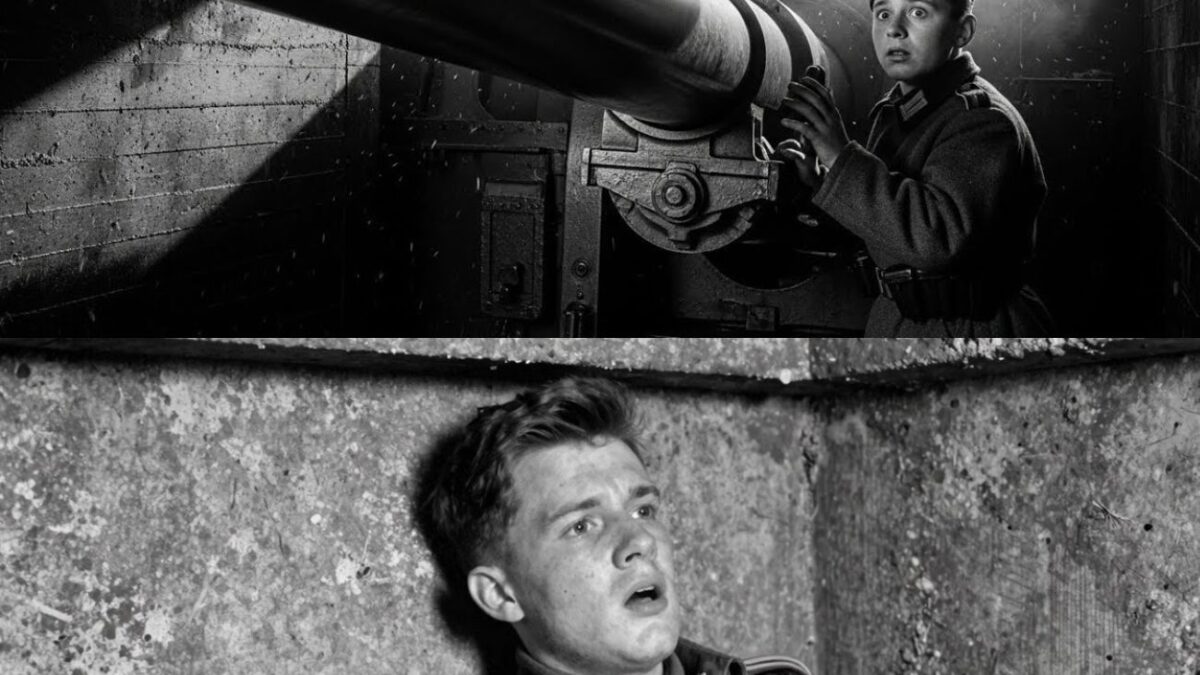
The gray expanse of the Baltic Sea churned with violent, unforgiving waves under the heavy, low-hanging clouds of late autumn. Along the jagged, windswept coastline, the concrete monolith of Battery Lindemann stood crouched against the relentless wind like an armored beast overlooking the vital maritime arteries of the Danish Straits. Inside the reinforced cavern of Casemate Number One, the damp, chilled air smelled heavily of industrial grease, cold stone, and unspent propellant, an environment far removed from any human warmth.
Standing beside the colossal breech mechanism of the primary gun was Obergefreiter Hans Müller, an eighteen-year-old soldier whose fresh uniform still carried the faint scent of the central supply depot. His hands, clad in rough woolen gloves, trembled almost imperceptibly against the cold steel of the railings as he stared up at the sheer, overwhelming mass of the artillery piece before him. Only forty-eight hours had passed since the rattling military transport had deposited him at this isolated, cliff-side outpost, far from everything he had ever known.
Before him stretched a barrel nearly fifteen meters long, its immense snout protruding through the thick embrasure to point toward the horizon like an iron pillar aimed at the throat of the sky. The Krupp-built barrel alone weighed tens of tons, an astounding feat of metallurgy and precision design engineered to shatter capital warships before they could even sight the coastal bluffs. The bunker walls, cast from three meters of solid, reinforced concrete, were built to survive direct hits from the heaviest bombs and naval shells the Allied fleets could muster.
Hans drew in a sharp breath of the freezing draft that drifted through the embrasure, feeling the icy bite settle deep in his chest. Back home in the tranquil Bavarian village of Oberammergau, mornings had been defined by the comforting, rhythmic rasp of his father’s wood rasps and the sweet, resinous aroma of seasoned alpine pine. His family had dedicated generations to crafting delicate religious statues, where a deviation of a single millimeter was an aesthetic flaw to be patiently smoothed away with fine sandpaper.
Here on the front lines of coastal defense, precision carried a far more lethal weight, measured not in artistic beauty but in thousands of foot-pounds of chamber pressure and high-explosive yield. He gently touched the small pocket of his tunic, reassuring himself that the tiny wooden crucifix his father had whittled for him on the eve of his departure was still resting securely against his ribs. It was a tangible link to a gentle past, contrasting sharply with the bleak, utilitarian architecture of the subterranean bunker complex that now claimed his daily life.
His journey to this fortress had been a harrowing, eye-opening odyssey through a homeland unraveling beneath the catastrophic weight of total war. The military train had ground to a halt outside the scorched, skeletal remains of Hamburg, where miles of bombed-out neighborhoods stood as charred chimneys and hollow brick facades against a blood-red dusk. That grim sight had extinguished the naive, boyish romanticism of warfare he had carried since basic enlistment, replacing it with a grim, lingering knot of anxiety and duty.
Yet, despite his youthful insecurities, the instructors at the Jüterbog artillery school had noted his remarkable aptitude for mechanical systems, a natural intuition inherited from years of assisting in his family’s workshop. While other recruits struggled to grasp the complex mathematics of trajectory calculations and propellant burn rates, Hans had visualized the intricate clockwork of the breeches and hydraulic accumulators with effortless, natural clarity. It was precisely that technical aptitude which had prompted his high-tier assignment to this crucial strategic site.
The battery itself was an expansive underground city carved straight out of the coastal rock, possessing independent diesel power generators, vast subterranean magazine vaults, and air-filtration chambers designed to counter toxic gas attacks. It was conceived as an unsinkable dreadnought set in solid stone, fully capable of sustaining independent fire missions for weeks even if completely isolated and encircled by invading forces. Over two hundred enlisted men and seasoned officers lived within this maze of tunnels, their daily routines dictated by the blaring sirens and harsh iron whistles of artillery readiness.
At five-thirty that morning, the heavy, measured footsteps of Feldwebel Krueger had echoed sharply down the damp concrete passageway, shattering the uneasy sleep of the barracks. Krueger was an unyielding veteran of the grueling campaigns in Poland and the frozen reaches of the Eastern Front, whose severe limp from a mortar fragment near Smolensk was a constant reminder of survival against terrible odds. His scarred face and gravelly voice commanded absolute, unquestioned obedience, yet beneath his weathered exterior lay a genuine desire to keep his young crewmen alive through strict, unwavering discipline.
“Up, Müller, boots on and grease your fingers,” the old sergeant had barked into the doorway, not unkindly, but with the firm urgency born of years under enemy fire. “Zimmermann is already running diagnostics on the primary elevator, and the Straits will not defend themselves while you linger in your blankets.” Hans had vaulted out of his cot immediately, rapidly fastening his woolen uniform and lacing his combat boots with fingers still stiff from the pervasive, deep-seated chill of the underground chambers.
Breakfast in the communal mess had been brief and solemn, consisting of a meager slab of coarse rye bread, a smear of turnip paste, and a tin cup of bitter ersatz coffee brewed from roasted barley. Around the zinc tables, older gunners spoke in hushed tones about Allied reconnaissance aircraft spotted high over the Kattegat the preceding evening, their vapor trails cutting white scars across the freezing blue dawn. Every man within the installation understood that the quiet along the Danish Straits was an illusion, one that could be shattered at any moment by naval guns.
When Hans entered the cavernous firing chamber, Obergefreiter Claus Zimmermann was already busy inspecting the massive hydraulic lines that snaked along the base of the gun carriage. At twenty-six, Zimmermann was widely considered the most proficient gun captain in the battery, having spent three intensive years calibrating, maintaining, and firing every type of coastal ordnance in the regional inventory. His father had been a senior precision toolmaker in the industrial heart of Berlin, granting Claus an almost supernatural instinct for mechanical diagnosis and fine adjustments.
“Good morning, Hans,” Zimmermann said without looking up, his voice calm and melodic beneath the hum of the nearby auxiliary hydraulic pump. “The Baltic is bitter today, but our steel doesn’t care about the weather. Today, you take the primary rammer controls and learn how to feed this monster properly, because if an Allied destroyer group appears tomorrow, hesitation is our death sentence.” Hans stepped onto the grated steel platform, nodding earnestly as his heart hammered against his ribs like a trapped bird.
The weapon towering before them was an engineering masterpiece, its gigantic Krupp breech block ground to tolerances so fine that the three-ton block of forged alloy swung shut with the smooth whisper of a bank safe. The entire system relied on a network of pressurized oil lines, electrical solenoids, and heavy mechanical linkages that worked in harmony to lift, align, ram, and seal high-explosive ordnance into the rifled throat of the chamber. A single mistake in sequence, a misplaced lever or misaligned guide, could crush a man’s limbs or trigger an catastrophic in-bore detonation.
“Listen to me carefully, Hans,” Zimmermann instructed, wiping a smudge of dark graphite grease from his cheek with the back of his forearm. “A standard armor-piercing projectile weighs over a thousand kilograms, and the main powder charge adds another three hundred kilograms of volatile nitrocellulose propellant. You must never rush the rammer cycle, keep your eyes on the guide rails, verify that the soft copper driving bands do not catch on the entry lands, and ensure the electrical fuse seat makes clean contact with the firing pin block.”
Hans nodded repeatedly, swallowing the dryness in his throat as he gripped the twin brass levers of the auxiliary loading console. During his accelerated training courses at Jüterbog, he had practiced on modest 15-centimeter naval guns, which were massive in their own right but pale toys compared to this gargantuan engine of destruction. Here, the artillery shells stood taller than his shoulder, smooth cylinders of painted steel whose sleek contours contained enough high explosive to pulverize an armored bridge into airborne splinters.
The first shell of the morning drill had already been lifted from the lower handling room by the chain hoist and now sat secured upon the steel loading tray. The harsh, unshielded electric bulbs overhead cast stark, pale reflections across its polished surface, revealing the dull, reddish-gold sheen of the wide copper driving bands encircling its tapered base. As Hans leaned closer to inspect the weapon, his gaze caught something unusual stamped into the gray lacquer near the fuse base—a series of non-standard numerical sequences and a tiny, etched red triangle.
“Claus, look at these inspection stamps,” Hans whispered, pointing an outstretched finger toward the peculiar markings, which differed significantly from the regular ammunition diagrams he had committed to memory. “The factory code reads Kummerdorf, not the usual Kassel munitions depot, and the fuse housing carries an extended secondary contact ring.” Zimmermann leaned in, squinting slightly under the glare of the work light, his experienced brow furrowing into deep, skeptical creases as he studied the unfamiliar metallic collars around the base.
“That’s peculiar,” Zimmermann muttered quietly, tracing the unfamiliar serial engravings with a gloved thumb. “It must be one of the pre-series test projectiles transferred from the experimental testing grounds when transport logistics became strained last month, likely intended for passive dimensional checks. No matter, the propellant casing is standard, and we are only running a mechanical dry-cycle test to ensure the breech carrier seats flush against the chamber walls.”
With that casual dismissal, the fate of the battery was irrevocably set in motion. Zimmermann took two steps back to the primary observer’s position, leaving Hans alone at the hydraulic control station with his hands trembling slightly on the cool brass handles. “All right, Hans, initiate the sequence,” Zimmermann ordered, his voice echoing cleanly off the curved ceiling of the casemate. “Engage the primary rammer slowly, maintain steady pressure, and ensure the projectile seats completely against the start of the rifling lands.”
Hans took a slow, deep breath, centered his balance upon the vibrating deck plates, and nudged the main hydraulic lever forward into the first detent. The pump responded with an immediate, deep-throated whine as high-pressure fluid surged through the armored hoses, pushing the heavy piston arm outward from its housing. The thousand-kilogram shell began to slide forward along the greased bronze guide tray, its heavy nose entering the darkness of the chamber with a rhythmic, low-frequency scrape that reverberated through the gun platform.
Everything proceeded normally until the shell approached the final six inches of its travel, where the copper driving bands were supposed to engage the steel rifling. Suddenly, Hans felt an unnatural resistance push back through the hydraulic linkage, a shudder that vibrated through the console as the shell halted prematurely, lodged at an improper angle against the chamber lip. Panic flickered behind the young soldier’s eyes; he feared that stopping now would cause Zimmermann to judge him incompetent, an embarrassing failure on his very first operational drill.
Desperate to force the stubborn shell home without displaying weakness, Hans made a fateful, split-second decision that defied all his training protocols. Instead of disengaging the hydraulic feed to inspect the obstruction, he leaned his full body weight into the booster valve, dumping the entire reserve of the pneumatic accumulator into the ramming cylinder. The hydraulic piston surged forward with monstrous, unregulated violence, slamming the heavy steel projectile into the weapon’s breech with an ear-splitting, metallic crash that rang out like a church bell struck by a hammer.
The brutal impact seated the shell violently into the rifling, but the excessive, uncalibrated force crushed the experimental fuse housing against the chamber wall. The impact crushed a delicate internal quartz crystal and distorted the modified contact ring, designed solely for laboratory high-frequency testing, forcing it into direct contact with the gun’s secondary electrical firing rail. Deep inside the mechanical core of the weapon, a series of rapid, miniature electrical sparks bridged the damaged circuitry, bypassing the manual firing interlocks entirely.
A bizarre, unnatural sound began to emanate from the depths of the sealed breech mechanism—a frantic, high-pitched metallic clicking that sounded like an oversized mechanical clock running wild. “What did you do?” Zimmermann shouted, his calm demeanor instantly evaporating as his face drained of all color. “Disengage the main valve! Pull the rammer back this instant!” Hans threw himself against the release levers, hauling them backward with all the strength in his young muscles, but the control handles remained locked solid, frozen by internal system pressure.
“It won’t budge! The hydraulic circuit is jammed!” Hans cried out, his voice cracking with terror as the strange clicking noise transformed into a vicious, unbroken electrical whine. The experimental fuse, trapped in an impossible feedback loop with the bunker’s continuous high-voltage generator, had sent an uninterrupted ignition command to the primer pocket. Before either man could reach the master breaker panel, the primary charge detonated with a catastrophic, earth-shaking roar that tore the breath straight from their lungs.
The shockwave within the casemate was immense; a hurricane of scorching air, pulverized concrete dust, and acrid nitrocellulose smoke erupted through the blast seals, throwing both men violently to the iron decking. Through the gun port, the colossal steel projectile was hurled out over the Danish Straits at three times the speed of sound, leaving behind an enormous cone of white fire that scorched the winter snow off the outside rocks. Hans lay sprawled on his stomach, his ears screaming with a deafening, white-hot ringing that obliterated all natural sound.
In normal operations, reloading such a massive weapon required several minutes of strenuous labor by an entire crew of synchronized gunners utilizing overhead cranes and electric hoists. But the impossible had occurred: the catastrophic distortion of the experimental fuse and the shattered pneumatic valve had created a continuous, self-cycling feed malfunction. The automated chain hoist, triggered by an erroneous electrical impulse from the shorted panel, slammed a second shell into the glowing chamber, followed instantly by the automated rammer and an uncapped propellant charge.
With a bone-jarring mechanical slam, the breech slammed shut under pure pneumatic momentum, and the weapon discharged again, scarcely three seconds after the first shot. The entire bunker structure groaned in protest, the massive steel carriage rocking violently on its hardened foundation ring as tons of recoil force slammed into the hydraulic buffers. Hans pulled himself up by the console railing, watching in sheer, paralyzed disbelief as the machine transformed itself into an autonomous, monstrous engine of unending devastation.
Boom. The third shell tore into the gray sky before the smoke of the second had even cleared the embrasure, sending another massive shockwave rippling through the concrete floor. The concussion felt like repeated hammer blows against Hans’s ribcage, rattling his teeth in their sockets and making his nose bleed from the violent barometric swings. Dust rained down from the ceiling like a heavy snowfall, coating the men in a pale, chalky layer as the gun operated with relentless, machine-like indifference.
Outside the casemate, along the barren cliffs of the Danish Straits, the ocean surface erupted in towering, apocalyptic columns of pulverized white water that reached hundreds of feet into the freezing air. The shells were impacting in a tight, devastating cluster nearly fifty kilometers out to sea, their arrival preceded by a shrieking roar that could be heard across entire archipelagos. The immense kinetic energy of each thousand-kilogram projectile displaced thousands of tons of sea water, creating artificial tidal waves that rolled violently across the shipping channels.
Zimmermann, his face bleeding from a deep gash near his temple where he had struck the console corner, crawled desperately along the shuddering floor plates toward the wall. “The power!” he screamed, his voice completely lost beneath the rhythmic, earth-shattering thunder of the gun, though his frantic gestures toward the main switchboard were unmistakable. “Cut the main breakers! Cut the generators before the chamber ruptures!” Hans understood the command through instinct alone, scrambling on hands and knees through the blinding cloud of smoke and burning oil.
The weapon fired a fourth time, then a fifth, settling into an impossible, terrifying rhythm that defied every fundamental law of heavy artillery doctrine ever written. The massive barrel, never engineered to withstand sustained rapid fire, began to radiate intense, shimmering heat waves that distorted the view of the snowy horizon outside. The green protective paint on the exterior of the sleeve was already blistering, peeling away in charred flakes as the steel beneath turned a dull, ominous cherry red under the friction.
Down the long access corridor, the heavy blast doors burst open, and Hauptmann Weber came charging into the chamber, accompanied by Feldwebel Krueger and three panicked ammunition handlers. The battery commander stopped dead in his tracks, his eyes wide with absolute disbelief as he witnessed the single gun firing like an automated anti-aircraft cannon. “What in God’s name have you done?” Weber yelled, holding his steel helmet against his head as the blast waves nearly knocked him off his feet with each subsequent detonation.
“It’s an automated feedback loop, Herr Hauptmann!” Zimmermann screamed back, his mouth inches from the officer’s ear as he pointed at the smoking, vibrating electrical junction box. “An experimental test shell has fused the ignition circuits with the continuous feed relays! The ammunition hoist is pulling directly from the primary lower conveyor without any interlock stops!” The mechanical monster paid no heed to the chain of command, discharging its ninth round into the churning sea with an unbroken, deafening violence.
Hans reached the master junction panel, his fingers clawing at the heavy iron levers that controlled the three-phase electrical input from the bunker’s underground diesel plant. The steel housing of the panel was vibrating so violently that his grip slipped twice, the rough edges of the latches tearing open the skin across his knuckles. Looking over his shoulder, he saw the ammunition elevator ascend once more, bringing another massive projectile from the subterranean depths to be hurled into the roiling, devastated waters of the Straits.
Through the bunker’s armored periscope, the scene across the Kattegat was one of utter, terrifying chaos as forty-foot walls of displaced water crashed against the distant shoals. Far on the horizon, several small Danish fishing cutters, caught unaware in their traditional winter netting zones, were pitching violently in the sudden tempest of falling water and massive geysers. The shockwaves traveling through the dense sea floor were registering on seismographs across southern Sweden, leaving regional observers baffled by the apparent arrival of an entire naval armada.
“We have to throw the main busbar!” Krueger roared, throwing his massive weight alongside Hans as they both fought the jammed iron handle of the master cut-off. “If the barrel sleeve overheats past six hundred degrees, the next charge will cook off before the breech can lock, and this whole fortress will be blown into the clouds!” The thought of thirty tons of high explosives detonating inside the sealed chamber gave them a desperate, superhuman surge of adrenaline.
With a joint, agonized heave, Hans and the veteran sergeant threw their combined weight against the master lever, wrenching the heavy copper contacts apart with a brilliant flash of blue sparks. The deafening hum of the primary hydraulic pumps ceased instantly, and the automated chain hoists ground to an abrupt, screeching halt halfway up their vertical tracks. Inside the breech, the tenth shell remained firmly seated, its propellant charge unignited as the electrical current died within the smoking, melted coils of the damaged fuse.
The silence that collapsed upon the casemate was sudden, heavy, and unnatural, broken only by the loud hissing of oil vaporizing against the red-hot steel of the barrel. Hans fell backward onto the iron floor plates, his chest heaving as he gasped for air in the thick, sulfurous haze that filled the ruined firing bay. His ears rang with an agonizing, shrill whine that drowned out the world, and every muscle in his body shook violently from the sheer physical shock of the concussive battering.
Feldwebel Krueger leaned against the concrete wall, clutching his injured leg, his face pale beneath the heavy soot and sweat that covered his lined features. Hauptmann Weber stood frozen in the center of the room, his eyes fixed upon the glowing barrel, which ticked loudly as the metal struggled to contract in the bitter winter wind. Outside, thick snowflakes drifted through the shattered embrasure, landing on the searing steel and vanishing in tiny, instantaneous puffs of white steam that drifted toward the roof.
“Report… casualties,” Weber finally managed to utter, his voice weak and raspy as he lowered his hands from his ears and stepped over a pile of scorched cartridge casings. Zimmermann pulled himself up from behind the loading console, shaking his head slowly to clear the dizzying haze that threatened to drop him to his knees. “No direct injuries, Herr Hauptmann,” he coughed out, “but the gun is completely out of action, the barrel is ruined, and the electrical conduits are melted through to the deck.”
Hans remained on the cold floor, staring down at his blistered, soot-blackened hands, the gravity of what had just transpired beginning to weigh down upon his soul. In the span of less than ten minutes, his single clumsy over-correction at the hydraulic valve had unleashed more destructive energy than the battery had expended in six months of defensive patrols. He looked up at the officers with eyes filled with dread, fully expecting to be arrested, court-martialed, and placed before a firing squad for criminal negligence against the state.
Yet, as the smoke gradually cleared through the emergency exhaust grates, the expression on Hauptmann Weber’s face shifted from pure horror to a strange, bewildered fascination. He approached the smoking breech mechanism, examining the melted copper rings of the experimental fuse with the cold, calculating eye of a career artilleryman. “Ten rounds,” the captain whispered in disbelief, checking the sweep-second hand of his service watch with trembling fingers. “Ten rounds of heavy naval caliber fired in less than four minutes… it should be mechanically impossible.”
Within two hours, the casemate was swarming with senior officers, ordnance engineers, and technical investigators dispatched in high-speed staff cars from the regional headquarters in Copenhagen. The incident had sent shockwaves through the entire German coastal command, who initially believed that the battery had been engaged in a pitched battle against an Allied invasion fleet. When the true nature of the firing became clear, the initial anger of the high command quickly transformed into intense, scientific curiosity about the strange phenomenon.
Engineers from the Krupp development bureau spent days examining every inch of Casemate Number One, meticulously measuring the distorted tolerances of the hydraulic valves and documenting the melted wiring. They discovered that the experimental shell, inadvertently mixed into the bunker’s standard reserve, had carried an advanced multi-stage electrical trigger designed for static testing of anti-aircraft proximity bursts. The violent impact from Hans’s heavy-handed ramming had altered the delicate internal contacts, creating an accidental feedback cycle with the bunker’s main generator.
Hans was interrogated for hours by tight-lipped investigators in the command bunker, his testimony recorded down to the exact angle at which he had held the brass levers. He sat on a hard wooden stool under a bare electric bulb, answering every technical inquiry with absolute, unvarnished honesty, concealing nothing of his initial error. To his immense surprise, there was no court-martial, no sentence of treason, and no transfer to a penal battalion awaiting him at the conclusion of the grueling technical debriefings.
The high command had realized that the young recruit from Oberammergau had stumbled upon a radical, hitherto unimaginable tactical possibility: the concept of continuous-feed, automated heavy artillery. In the desperate, final months of the war, when the German war machine was grasping at any technological miracle to turn the tide, Hans’s terrifying accident was viewed by some planners as an accidental stroke of engineering genius. Specialized teams were immediately formed at the firing ranges of Hillersleben to determine if this rapid-fire phenomenon could be stabilized and reproduced safely.
However, the laws of physics and metallurgy were absolute and could not be circumvented by sheer military ambition or desperate tactical necessity. Subsequent engineering reports concluded that the enormous thermal stresses of such rapid firing completely destroyed the barrel rifling within twenty rounds, rendering the weapon wildly inaccurate at extended ranges. The barrel at Battery Lindemann had warped so severely during those four minutes that its long-range effectiveness was reduced by more than thirty percent, requiring a complete, impossible replacement of the eighty-ton steel tube.
Yet, the technical fascination of the incident brought no comfort to Hans Müller as the cold winter weeks dragged on along the bleak Danish coast. Several days after the firing, a somber intelligence bulletin crossed the desk of the battery commander, detailing the civilian aftermath of the mysterious barrage in the Kattegat. The sudden, violent displacement of water from the falling shells had capsized two Danish fishing boats working peacefully in the gray morning swells, claiming the lives of seven innocent fishermen who drowned in the freezing sea.
The news hit Hans with the force of an artillery shell, shattering whatever lingering pride he might have felt regarding his survival of the dangerous mechanical ordeal. In the quiet, dark hours within the subterranean barracks, while the other men slept, he would stare up at the sweating concrete ceiling, tortured by the terrible knowledge of what his error had wrought. He had never aimed to kill anyone; he was merely a frightened, inexperienced boy who had pulled a lever too hard in a dark room full of cold iron.
He took the small wooden crucifix carved by his father from his pocket, turning it over and over in his scarred fingers until the wood grew warm against his skin. His father had taught him that the hands of a craftsman were meant to shape, to create, to bring peace and reverence into the world through patient, quiet labor. Instead, those same hands had unleashed a monstrous, uncontrolled fury that had extinguished innocent lives miles away across the water, lives that would never return to their quiet coastal homes.
In January of 1945, Hans was quietly transferred away from Battery Lindemann, reassigned to a small, unremarkable rail-mounted artillery unit positioned deep within the interior of northern Germany. The high command wished to shield the young soldier from the prying questions of other coastal units, while his officers sought to spare him the suffocating guilt that haunted the damp corridors of Casemate Number One. He spent the remaining months of the conflict performing routine maintenance on locomotive engines, far away from the massive coastal monsters that dominated the sea.
When the war finally ground to its catastrophic, inevitable conclusion that spring, the detailed technical files on the Lindemann incident fell into the hands of British and American intelligence teams sweeping through the military archives. Allied ballistics experts were thoroughly astonished by the German reports, studying the diagrams of the accidental feedback loop with great interest during the early dawn of the Cold War. The concept of automated, rapid-fire heavy ordnance would eventually find its way into postwar naval designs, influencing the development of the automated rapid-fire guns that equipped modern destroyers.
Hans Müller returned home to the serene, undamaged valleys of Oberammergau in the late summer of 1945, walking the final miles along the winding mountain path with his pack slung over one shoulder. The village appeared completely unchanged by the madness that had consumed the rest of the continent, the church bells ringing out their familiar, tranquil melodies against the towering peaks. His father welcomed him back into the woodworking shop without asking about the war, understanding with quiet wisdom that some experiences were too heavy for speech.
Hans picked up his carving tools once more, dedicating his remaining years to shaping delicate, peaceful forms from blocks of soft, fragrant linden and alpine pine. He never spoke to his neighbors about his time on the Baltic coast, nor did he ever recount the morning he turned a fortress gun into a terrifying, automated engine of destruction. Whenever the church bells tolled across the valley, his mind would drift back to the icy winds of the Danish Straits, whispering a silent prayer for the seven souls lost beneath the gray waves.

