They Shot Down His B-24 — So He Killed Their Pilot With a Pistol While Falling
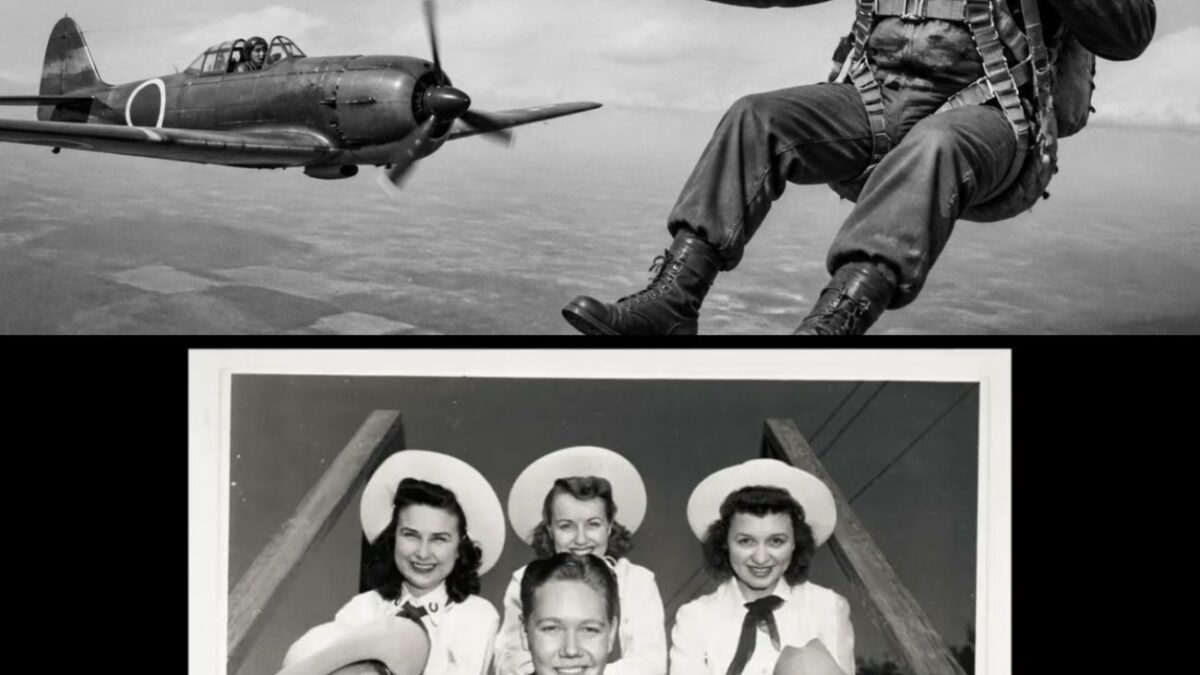
March 31, 1943, at precisely 10:47 in the morning, high above the dense and unbroken jungle of Central Burma. Eight thousand feet in the sky, Second Lieutenant Owen Baggett allowed his head to roll forward against his chest. He let his body go entirely limp in his canvas harness, willing his limbs to hang slack as he played dead.
Warm blood trickled steadily down the length of his left arm, soaking deep into the olive drab wool of his flight suit. A high-caliber bullet had already torn into his flesh during the frantic seconds of their catastrophic descent from the clouds. Far beneath his dangling combat boots, the disintegrating remains of his B-24 Liberator were tumbling toward the unforgiving canopy.
The heavy four-engine bomber was shedding great sheets of torn aluminum and trailing plumes of black smoke across the sky. Circling him in a lazy, predatory arc was an enemy fighter plane, stalking its drifting targets without any hint of hurry. The Japanese pilot had already systematically strafed two of Baggett’s crewmates, cutting them to ribbons in their silk chutes.
Owen Baggett was just twenty-two years old, an ocean away from everything and everyone he had ever known or loved. He had been flying active combat sorties for less than a year, serving primarily as a quiet, unassuming co-pilot. He was a gentle young man from Texas who, until this morning, had never fired a single weapon in mortal combat.
By every established law of aerial warfare, ballistics, and physical survival, he had perhaps sixty seconds left on earth. Yet he possessed one critical advantage that the approaching enemy pilot could not possibly detect from inside the cockpit. His right hand remained pressed entirely flat against his outer thigh, shielding a heavy, cold piece of blued steel.
Curled tightly within his aching fingers was the textured walnut grip of a standard-issue military Colt .45 semi-automatic pistol. What Baggett was about to attempt in the next four fleeting seconds had never been officially matched in military history. It was an instinctive, desperate act born of sheer survival that defied all conventional logic and every conceivable expectation.
Yet the most astonishing facet of the entire ordeal was not merely the sheer audacity of what transpired next. It was the reality that when Baggett later attempted to explain what happened, almost nobody in authority believed him. Neither his fellow surviving airmen, nor the military establishment, nor the cynical intelligence officers who filed away his debriefing.
For more than five decades, the United States military wrestled silently with whether their officer was an authentic hero. They simply could not determine if he had authored a miraculous feat of survival or spun a brilliant piece of fiction. His life was destined to be defined by four echoing gunshots fired into the deafening rush of the open wind.
Owen John Baggett had entered the world in 1920 in Graham, a sleepy rural community in North Central Texas. It was a quiet realm defined by an endless, towering blue sky and flat horizons stretching endlessly into the shimmering distance. It was the distinct variety of frontier town where a young boy learned how to handle a rifle before learning to drive.
Yet Owen was never an aggressive youth by nature, displaying an innate artistic sensitivity rather than an appetite for violence. He was a dedicated musician who spent countless hours practicing his craft and immersing himself in the discipline of music. While attending Hardin-Simmons University in Abilene, his magnetic presence earned him the role of drum major for their Cowboy Band.
Years later, when those who had shared his youth were informed of what took place over Burma, they were astounded. “Not Owen,” his former classmates and neighbors murmured in absolute disbelief, shaking their heads at the wild, unbelievable reports. “Owen was the kind one. Owen was the gentleman who smiled, played music, and led the band across the field.”
Then history intervened violently on the quiet morning of December 7, 1941, when bombs rained down on Pearl Harbor. The peaceful world evaporated overnight, and the drum major walked straight into an Army recruiting station to answer the call. Like millions of other young American men of his generation, he stepped forward eagerly and volunteered to defend his country.
The rapidly expanding United States Army Air Forces desperately needed intelligent young aviators possessing steady hands and calm nerves. Baggett quickly proved to have the exact blend of physical coordination, spatial awareness, and cool temperament the military sought. He was promptly sent to flight schools throughout the dusty airfields of California and the blazing heat of Arizona.
There, instructors taught him to master heavy, multi-engine aircraft, wrestling enormous machines through turbulent thermal drafts and crosswinds. He studied celestial navigation, blind instrument flight, aircraft mechanics, and the demanding aerodynamics of sustained multi-engine flight. He proudly pinned on his silver wings in the summer of 1942, ready to serve as a newly minted officer.
By early 1943, Lieutenant Baggett was assigned as a co-pilot aboard a massive Consolidated B-24 Liberator long-range bomber. Orders soon arrived dispatching his newly formed bombardment group to what was undeniably the most isolated theater of the war. History would endlessly chronicle the massive Eighth Air Force daylight bombing raids striking industrial complexes across wartime Nazi Germany.
Generations of scholars would write exhaustively about the dramatic amphibious landings of Normandy and the brutal Pacific island campaigns. Almost nobody in the mainstream consciousness remembered the men who flew, fought, bled, and died over the mountains of Burma. Yet the aircrews stationed in that forgotten corner flew combat missions that were every bit as lethal and psychologically demanding.
They operated with a mere fraction of the resources, outdated spare parts, miserable rations, and virtually zero fighter escort protection. The men of the 7th Bombardment Group flew their punishing sorties directly out of crude, austere bases in Eastern India. Every mission was an endurance trial, crossing vast expanses of impenetrable jungle that offered no visual landmarks and zero mercy.
If an aircraft suffered engine failure or sustained battle damage out there, the crew plummeted into disease-ridden mountain swamps. The terrain below was controlled entirely by Imperial Japanese forces who routinely tortured, abused, and summarily executed captured aviators. Yet this overlooked campaign possessed a strategic objective so critically important that thousands of Allied lives were staked upon it.
On the eastern side of those treacherous, soaring mountain ranges lay the vast, beleaguered territory of Nationalist China. China had been locked in a savage, grinding war of resistance against Imperial Japan for years before Pearl Harbor occurred. Cut off from sea lanes and overland highways, China was utterly dependent on American weaponry, fuel, medicine, and critical supplies.
The only remaining umbilical cord keeping China in the war was an aerial supply bridge crossing the highest peaks on earth. Aviators across the globe knew this terrifying transport corridor by a simple, legendary moniker that inspired cold dread: the Hump. C-46 and C-47 transport planes flew it day and night through monstrous mountain updrafts, severe icing conditions, and zero visibility.
It was widely recognized as the deadliest logistical route in the entire global conflict, claiming hundreds of aircraft and crews. So many transports broke apart and vanished into the rocky crags that the wreckage formed a gleaming, horrifying visual guide. Crews flying the treacherous passes grimly dubbed the glinting trail of twisted aluminum below them the Aluminum Trail.
The heavy bombers of the 7th Bomb Group were deployed specifically to ensure that this fragile aerial lifeline remained open. Their primary objective was to relentlessly smash enemy airfields, supply depots, bridges, and rail lines throughout occupied Burma. Every single bomb released over Burmese soil was ultimately aimed at preventing Japan from choking off the supply of China.
The environmental conditions on the ground were almost as destructive to the Allied squadrons as the enemy’s anti-aircraft batteries. The relentless tropical heat sapped men’s strength, while monsoon downpours quickly transformed primitive dirt runways into deep quagmires of mud. Malaria, dysentery, and strange tropical fevers incapacitated almost as many brave young men as Japanese shrapnel and high-explosive shells.
By the time the conflict drew to a close, nearly one-third of the 7th Bomb Group would be casualties. They were either killed in action, listed as missing in the endless jungle canopy, or held in brutal captivity. Owen Baggett flew squarely into that meat grinder for eight grueling months, somehow repeatedly managing to cheat the grim reaper.
Yet even the most charmed run of military luck possesses an expiration date, and Baggett’s was running out fast. The B-24 Liberator was an undeniable technological titan of its era, powered by four massive Pratt & Whitney radial engines. Boasting a massive 110-foot wingspan, it bristled with ten .50-caliber Browning machine guns protruding from hydraulic turrets and waist windows.
It could carry four tons of high-explosive ordnance across two thousand miles of hostile sky to strike its assigned target. When operated correctly, it was fully capable of bringing its ten-man crew back through intense anti-aircraft fire and bad weather. Yet beneath its rugged, slab-sided aluminum exterior, the massive heavy bomber concealed one fatal, catastrophic vulnerability that terrified crews.
The Liberator’s enormous fuel cells, housing thousands of gallons of volatile, high-octane aviation fuel, were not entirely self-sealing. The critical tanks were positioned directly inside the thin, narrow Davis wing structure, vulnerable to any incoming penetrating projectile. A single incendiary round striking the exposed wing structure at the right trajectory could instantly turn the craft into a fireball.
Every pilot, navigator, and aerial gunner who strapped into the giant machine was acutely aware of that terrifying structural reality. Yet day after day, they pushed the heavy throttles forward, lifted off into the humid sky, and flew anyway. On the clear, sweltering morning of March 31, 1943, Lieutenant Baggett climbed into the right seat of his assigned Liberator.
He was flying as co-pilot alongside First Lieutenant Lloyd Jensen, a skilled, steady aircraft commander trusted by the entire crew. Their tactical objective for the morning was a crucial railroad bridge located at Pyinmana, deep inside occupied central Burma. It was an essential logistical bottleneck that Allied High Command desperately needed severed to halt enemy reinforcements and equipment movements.
The bridge was heavily defended by rings of well-concealed anti-aircraft batteries calibrated to fill the sky with lethal shrapnel. Furthermore, two major Japanese fighter bases were located within minutes of the target, housing interceptors ready to scramble at notice. Due to the extreme distances involved, no Allied fighter escorts possessed the fuel capacity to accompany the bombers that day.
The American Liberators were scheduled to fly deep into hostile territory entirely alone, relying solely upon their own defensive fire. A strike package of twelve B-24s lifted off from their Indian base, formed into a defensive combat box, and turned east. For hours, they droned steadily over endless miles of hostile jungle canopy, watching the green terrain roll beneath their wings.
Before the formation could establish its bomb run over the Pyinmana bridge, the enemy fighter controllers detected their high-altitude approach. The Japanese interceptors struck with terrifying tactical efficiency, diving directly out of the blinding glare of the tropical sun. They were Nakajima Ki-43 Hayabusa single-engine fighters, known throughout the Allied military forces by the reporting code name Oscar.
The Oscar was an exceptionally light, maneuverable aircraft, weighing less than a tenth of the massive bombers it was stalking. It could climb at an astonishing rate of three thousand feet per minute, carrying two rapid-firing heavy machine guns. At the controls were hardened veteran pilots of the Imperial Army’s 64th Sentai, men who had been downing planes for years.
Thirteen of these nimble fighters plunged violently into the American bomber formation from high above, screaming in at blistering speed. They held a speed advantage of more than a hundred miles per hour over the heavily laden, lumbering B-24 Liberators. The American bombers were tough, fortified, and bristling with defensive guns, but against such overwhelming maneuverability, it was not enough.
The enemy attack unfolded in coordinated, sweeping waves that systematically tore the defensive integrity of the formation to pieces. The Oscars dove out of the sun, fired devastating bursts into wings and cockpits, and broke away before gunners tracked. They looped gracefully back through the thin air, utilizing their superior climbing speed to set up fresh firing passes immediately.
Across the American formation, heavy Liberators began to shudder, lose structural integrity, and die violent deaths in the sky. One bomber took multiple direct 20mm cannon hits through its flight deck, pitching abruptly forward into an unrecoverable vertical dive. Another caught fire along its port wing, turning into an uncontrollable torch before beginning a slow, agonizing death spin downward.
The lead aircraft, carrying the group commander himself, was raked thoroughly by explosive rounds from its plexiglass nose to tail. Within minutes of the initial contact, what had been an orderly, tight formation degenerated into an aerial slaughterhouse of attrition. Colonel Conrad Necrason, leading the entire raid from the forward bomber, sustained grievous wounds early in the engagement as shells struck.
The heavy cannon rounds shattered the cockpit framework, spraying jagged metal shrapnel and cutting the colonel down at the controls. His co-pilot instinctively seized the controls with both hands, struggling desperately to hold the damaged, smoking aircraft in level flight. There was no place to hide in the sky, no protective cloud deck to slip into, and no friendly escorts coming.
The surviving bombers could only pull their formation tighter, maintain constant defensive fields of fire, and pray for survival. Yet the defensive perimeter simply could not hold against the relentless, highly disciplined diving passes of the seasoned Japanese interceptors. Inside the shuddering bombers, young American gunners fought desperately for their lives, their twin .50-caliber machine guns hammering continuously.
Spent brass casings cascaded out of hot receivers, piling up inches deep around the heavy fleece boots of the gunners. The interior of the planes filled with the choking stench of burned cordite, electrical insulation, and overheated hydraulic fluid. Occasionally, a diving Oscar took a lethal burst of heavy American gunfire, bursting into flames or shedding structural parts entirely.
Yet for every enemy fighter that was successfully deterred or destroyed, two more swept in violently from an unexpected angle. Then, with the suddenness of a lightning strike, the terrible mechanical lottery of combat selected Baggett and Jensen’s aircraft. A blistering burst of enemy cannon and machine-gun fire stitched directly across the fuselage, puncturing the thin aluminum skin.
Heavy, high-explosive rounds punched directly through the delicate wing structure and ruptured the volatile, unprotected fuel cells within. The Liberator immediately shuddered as pressurized, high-octane gasoline began atomizing into the turbulent air and instantly ignited into sheets. Fire is the single greatest nightmare of any aviator because, thousands of feet in the air, fire does not negotiate.
The interior heat escalated rapidly to unbearable levels, causing high-pressure oxygen bottles to rupture with concussive force, feeding the inferno. The internal communication wiring melted almost instantly, rendering the aircraft intercom system dead and silencing all voice communication between crew. Realizing that the crew’s lives hung by a thread, Baggett twisted violently in his seat, urgently gesturing toward the hatch.
His hands cut through the thickening smoke, desperately signaling the universal command: “Get out! Bail out of the airplane right now!” One brave gunner grabbed two handheld fire extinguishers, stepping out onto the narrow metal catwalk suspended over the bomb bay. He sprayed the chemical retardant directly into the heart of the roaring blaze, battling the flames with absolute raw courage.
His desperate efforts were utterly futile against thousands of gallons of burning aviation fuel, and the inferno continued to spread uncontrollably. The heavy metal airframe was groaning under immense structural stress, literally melting and coming apart in midair around them. At 10:45 a.m., Lieutenant Jensen made the agonizing decision that every bomber commander feared most, shouting the final order: “Abandon ship!”
Evacuating a dying, spiraling four-engine aircraft eight thousand feet above the earth is an experience of pure, unadulterated terror. The wounded Liberator had slipped into a violent corkscrew, pinning the crew against the walls with heavy, disorienting centrifugal forces. A hurricane-force slipstream tore furiously through the open emergency hatches, screaming with deafening intensity and pulling the air out.
Every primal human survival instinct screams at a man to stay inside the machine and grip something solid and familiar. Instead, survival demands that you overcome your deepest evolutionary terrors and fling yourself willingly into miles of empty sky. Owen Baggett did not hesitate for a second, diving headfirst out through the open emergency hatch into the frigid slipstream.
He plummeted rapidly through the turbulent, rushing air, tumbling end over end as the earth and sky spun violently together. Clearing the aircraft’s empennage, he reached down, gripped his parachute D-ring firmly, and yanked the emergency cord with force. The pilot chute deployed instantly, catching the air and dragging the main white silk canopy from its packed canvas container.
The heavy nylon harness snapped violently taut against his torso and groin with enough raw kinetic force to steal his breath. The sudden deceleration shook his entire frame, and just as abruptly, the deafening roaring wind faded into absolute, eerie quiet. By 10:46 a.m., several other white canopies were blossoming across the sky around him, drifting slowly toward the green jungle below.
His surviving crewmates were spilling out of the dying bomber, their silk canopies offering a fleeting glimmer of profound hope. For a few miraculous seconds, it seemed entirely possible that the majority of the crew might actually survive the mission intact. Then, slicing through the thin mountain air, came a sharp, high-pitched mechanical sound that froze Baggett’s blood in his veins.
It was the distinctive, rising mechanical shriek of high-rpm radial aircraft engines diving under full throttle directly toward the chutes. The Ki-43 fighters of the 64th Sentai had completed their destruction of the bomber formation and were aggressively turning back around. This time, their guns were not leveled at engines or fuel tanks; their sights were locked on the helpless men descending.
There are formal international conventions governing civilized warfare, and then there is the brutal, unforgiving reality of actual frontline combat. Allied intelligence officers had already gathered harrowing accounts of enemy fighter pilots systematically strafing descending airmen suspended beneath their parachutes. The strategic doctrine was ruthlessly simple: a downed bomber could be replaced by American factories, but trained flight crews were irreplaceable.
Baggett watched in absolute horror as the fast-moving fighters flashed repeatedly through the cluster of drifting silk parachutes, guns blazing. Heavy machine-gun rounds tore mercilessly through the thin white canopies and the unprotected human bodies suspended limply beneath them. Two of the eight men who had successfully escaped the burning bomber were cut down and killed before reaching the earth.
Suddenly, a violent burst of gunfire erupted around Baggett, and a heavy projectile punched clean through his upper left arm. The kinetic impact spun him violently in his harness, and warm, dark blood immediately soaked into his thick canvas sleeve. In eight months of flying brutal combat missions, he had witnessed terrible destruction, but nothing matched the horror of this moment.
There is no tactical defense against an approaching fighter when you are suspended under a parachute high above the earth. There is no physical cover behind which to hide, no engine power to dive away, and no defensive weapon to aim. A man simply hangs there, suspended like a tragic, helpless target silhouetted sharply against the vast blue canvas of the heavens.
Baggett had perhaps two seconds to formulate a plan before the diving interceptor swung around to finish the job. He could simply hang there passively, closing his eyes in terror and hoping the enemy pilot missed his target again. Or he could attempt the only desperate gamble left to an unarmed man suspended eight thousand feet in the open air.
He reached down to the heavy leather holster strapped securely to his hip and gripped the weapon issued to every officer. Baggett made a fateful calculation, allowing his head to fall limply against his chest as his entire body slumped slack. His arms dangled lifelessly, swaying naturally with the motion of the shroud lines to mimic the appearance of a fresh corpse.
He committed himself utterly to selling the visual illusion that the previous strafing pass had already snuffed out his life. Yet beneath that performance of death, his right hand slipped into his unbuttoned holster, closing firmly around his Colt .45. The Colt Model 1911 semi-automatic pistol was standard issue for aircrews, firing a heavy, blunt .45-caliber ACP lead slug.
Carrying seven rounds in the magazine and one chambered, it was designed specifically as a short-range weapon for ground defense. It was engineered to stop an enemy soldier at close range during an unexpected, chaotic encounter in the bush. Nobody in the history of aerial warfare had ever contemplated using such a handgun to destroy a fast-moving combat aircraft.
Yet Baggett slipped his thumb over the safety catch, keeping the heavy pistol concealed flat against his outer right leg. He hung suspended, breathing shallowly through parted lips, his heart hammering against his ribs as he listened to the engine. The desperate ruse worked precisely as Baggett had hoped when one of the Oscars detached from the formation and banked toward him.
The Japanese pilot was flying with deliberate curiosity, intending to verify whether the limp American hanging from the harness was dead. The Ki-43 banked into a wide, sweeping turn, lining up directly on the motionless, bloodstained figure suspended in the sky. Then the Japanese aviator committed the critical tactical error that would forever alter his fate and seal his sudden death.
Instead of keeping his airspeed high and maintaining a safe standoff distance, he hauled back on the stick to reduce speed. He pulled his nimble fighter into a precarious, nose-high attitude, hovering right on the edge of an aerodynamic stall. His engine sputtered under the strain, propeller blades biting into the thin air as he struggled to maintain altitude.
He was determined to get an intimate, close-up look at the American airman whom he firmly believed to be deceased. The Oscar drifted closer and closer, floating through twenty feet, then closing to an astonishing fifteen feet from Baggett’s harness. The enemy fighter was suspended almost stationary in the sky, its engine groaning while the pilot leaned outward to look down.
To secure an unobstructed view of the supposedly dead man, the Japanese pilot had slid his clear cockpit canopy back. His head and shoulders were fully exposed to the outside air, his flight helmet and goggles clearly visible just yards away. He was staring with cold, detached fascination at the motionless, blood-soaked body of a young man he believed was gone.
In that frozen split-second of time, Owen Baggett snapped his head upward, raising the heavy Colt .45 in both hands. The Japanese pilot’s eyes widened behind his flight goggles in sudden, absolute terror as realization struck his mind like lightning. The dead American was not dead at all; he was alive, focused, and pointing a heavy handgun straight at his face.
There was no time to react, no time to slide the canopy forward, and no time to shove the throttle into emergency. Before the stunned aviator could move a muscle, Baggett took firm sight picture and squeezed the heavy military trigger. The weapon bucked violently in his grip: Bang! Bang! Bang! Bang! Four rapid-fire rounds erupted from the muzzle in two seconds.
The sharp, flat cracks of the heavy pistol were instantly swallowed by the deafening slipstream and the roar of the radial engine. For half a heartbeat, the fighter hung motionless in the sky, suspended in that terrifying, precarious state of near aerodynamic stall. Then, suddenly, the pilot went limp, his body slumping forward against the controls as the heavy engine pitch changed violently.
The steady mechanical roar broke apart into an erratic, choking stutter as the nose of the lightweight fighter dipped downward. The Oscar fell off violently on its left wingtip, completely losing its lift before entering an uncontrolled, violent downward spin. It dropped like a stone through the empty sky, tumbling uncontrollably toward the dense, sprawling jungle eight thousand feet below.
Baggett hung suspended in his parachute harness, his left arm throbbing with pain, staring downward in absolute disbelief at the sight. Down and down the enemy aircraft tumbled, spinning wildly over itself until the green carpet of the jungle swallowed it. A distant, muffled explosion resonated through the hills below, sending up a thin, vanishing pillar of pale gray smoke.
Then, profound silence returned to the open Burmese sky, broken only by the whistling wind and the creaking of his harness. Just seconds earlier, there had been a screaming fighter, an exposed enemy pilot, and the violent eruption of point-blank gunfire. Now, there was nothing around him but the vast expanse of blue heavens and the slow, rhythmic turning of the earth.
There was no floating wreckage he could observe, no wingman nearby to witness what had occurred, and no definitive proof. He did not cheer or experience any surge of exultation; he simply hung there, stunned by the sheer unreality of the event. He was still suspended four thousand feet in the air, bleeding profusely from his arm, drifting into territory controlled by the enemy.
The ground was rushing up to meet him rapidly, and survival instincts demanded his immediate, undivided attention for the landing. Had he genuinely accomplished the impossible, or had the delicate, nose-high fighter merely stalled out on its own accord? In that chaotic, adrenaline-fueled moment, Owen Baggett had no way of knowing the definitive answer to that profound question.
That lingering uncertainty would dog his footsteps and haunt his memories for the remainder of his long and remarkable life. At 10:53 a.m., Baggett crashed violently through the branches of the jungle canopy, landing in a flooded, muddy rice paddy. Eighteen inches of stagnant water and thick silt broke his rapid fall, collapsing the muddy parachute canopy around his shoulders.
The surviving Japanese fighters had already reformed and departed the area, leaving the quiet valley shrouded in humid, suffocating silence. Baggett struggled desperately against the tangled shroud lines, finally slicing his harness free and crawling out onto a dirt dike. Within minutes of splashing down into the mud, he realized that he was far from alone in the silent clearing.
A detachment of local Burmese militia allied with the Japanese occupation emerged quietly from the dense foliage with rifles raised. Wounded, exhausted, covered in mud, and entirely surrounded by armed men, Baggett understood that further armed resistance was completely impossible. He slowly raised his mud-stained hands into the air, surrendering his empty Colt .45 as the militia seized him roughly.
They bound his wrists securely behind his back with coarse hemp rope, marching him eastward along an overgrown jungle foot trail. Ten minutes later, two more captured Americans were shoved into the grim, quiet procession under the heavy watch of guards. They were Lieutenant Lloyd Jensen and the courageous sergeant who had battled the catastrophic blaze inside the burning bomb bay.
Of the ten brave young men who had taken flight from India that morning, only three remained alive on earth. The other seven members of their crew had died in the air, either consumed by fire or cut down by strafing. The three survivors were marched relentlessly through hostile countryside, passing through occupied villages where hostile villagers watched them pass in silence.
Every single step was an endurance trial; Baggett’s wounded left arm had swelled dramatically, throbbing with intense, burning heat. The bullet wound had become contaminated with the stagnant muck and bacteria of the rice paddy, threatening a lethal systemic infection. With every mile they trudged along the jungle trail, the Americans waited for the inevitable summary execution that frequently befell prisoners.
Downed Allied airmen captured in the Southeast Asian theater were frequently executed on the spot without trial or formal documentation. Their bodies were simply discarded in shallow jungle graves, their fates recorded as missing in action by distant headquarters in Washington. Yet these particular guards possessed explicit orders from Japanese intelligence: the surviving bomber officers were to be kept alive for interrogation.
The three battered Americans were formally transferred to regular Imperial Japanese Army units, beginning an agonizing ordeal of captivity. For Owen Baggett, the war transformed overnight from a high-speed technological battle in the sky into a grinding war of survival. The prisoners were transported southward toward Rangoon under heavy guard, packed into primitive trucks and subjected to harsh treatment throughout.
The formal interrogations commenced immediately upon their arrival at a fortified Japanese garrison building in the center of the city. Japanese intelligence officers demanded detailed information: flight formations, radar frequencies, base locations, and Allied strategic bombing plans for Southeast Asia. Baggett adhered strictly to the military code of conduct, repeating only his name, his rank, and his serial number.
His interrogators struck him repeatedly with fists, rifle butts, and bamboo sticks, demanding that he cooperate with their questioning. Each time he was knocked to the floor, Baggett pulled himself up and calmly repeated his three standard answers. Then, unexpectedly, the brutal interrogation shifted into an entirely different and surreal encounter that left Baggett deeply shaken and confused.
He was abruptly marched out of the dark holding cells and escorted directly before a high-ranking Japanese general officer. This austere commander oversaw all prisoner-of-war camps and detention facilities throughout the Burmese and Malayan operational theaters. This was a hardened, ruthless imperial officer who would, after the war, be tried, convicted, and executed for horrific war crimes.
Yet as this senior Japanese commander looked upon the battered, blood-stained young American co-pilot, there was no contempt present. Instead, he treated Baggett with an aura of cold, formal respect that baffled the exhausted and wounded American lieutenant. Within the traditional warrior culture of the Japanese military, few things commanded greater reverence than undeniable, extraordinary martial courage.
Word had already spread rapidly throughout Japanese command channels concerning the bizarre aerial duel that occurred over the skies of Pyinmana. The commander believed the incredible story: an American airman had engaged an attacking fighter with a simple handgun and won. In a stunning gesture, the general formally offered Baggett an ornate traditional blade, inviting him to choose the path of suicide.
The Japanese officer genuinely appeared to believe that he was extending the highest possible military honor to a worthy combatant. Baggett politely but firmly declined the offer; he was a Texas farm boy with every intention of surviving the war. Yet the deeper implications of that surreal meeting were absolutely unmistakable to the wounded American officer standing before the commander.
The enemy hierarchy actually believed the story was true; they fully accepted that an American had shot down their fighter. The very military establishment that possessed every conceivable reason to dismiss the claim as impossible propaganda treated it as established fact. Yet for Owen Baggett, that strange moment of recognition was rapidly replaced by thirty months of sheer, unadulterated human misery.
Baggett was transported south via an unmarked merchant vessel and locked away inside a notorious Japanese prisoner camp near Singapore. The conditions inside the camp were monstrous: starvation rations consisting of meager portions of rotting rice, forced labor, and disease. Dysentery, malaria, and tropical ulcers ravaged the emaciated bodies of the Allied prisoners, claiming dozens of innocent lives each week.
The strong, athletic young officer who had weighed 180 pounds on the morning of the mission steadily deteriorated over the months. His body withered until he weighed barely ninety pounds—a skeletal, hollow-eyed ghost of the robust man who had left Texas. Yet even while shivering with malaria on a damp wooden cot, that single, unresolved question continued to burn in his mind.
Had those four desperate pistol shots genuinely found their mark, or had the nimble Japanese fighter simply crashed by tragic coincidence? Then, in the cold, rain-soaked winter of 1943, potential confirmation of the miraculous shoot-down walked straight through the camp gates. A new group of American prisoners arrived, including Colonel Harry Melton, the highly respected commander of the 311th Fighter Group.
Melton had been shot down over Burma while leading his squadron of P-51 Mustangs on an aggressive sweep against Japanese airfields. During his initial debriefing by other Allied prisoners in the barracks, Colonel Melton revealed a piece of astonishing, classified information. While undergoing intense interrogation by a senior Japanese intelligence officer in Burma, Melton had listened to an incredible, unsolicited story.
The Japanese officer had described the downing of an American B-24 bomber over Pyinmana many months earlier during the spring. He recounted how an American crewman had fired upon an approaching fighter while suspended helplessly beneath the silk canopy of his parachute. Then the interrogator provided the vital, definitive detail that instantly confirmed Baggett’s wildest hopes and resolved his long-standing internal doubts.
When Japanese recovery teams finally located the wreckage of the crashed Ki-43 fighter, the pilot’s body was found nearby. He had been thrown clear of the cockpit upon impact, lying broken in the underbrush some two hundred yards from the crash. The military surgeon examining the corpse discovered that the pilot had not died from the catastrophic trauma of the crash landing.
He had been killed instantly by a single, large-caliber bullet that had penetrated his skull while he was still airborne. The heavy .45-caliber slug had ended his life while he leaned from the cockpit, long before the plane struck the jungle. The recovery team’s forensic conclusion was absolute: no Allied bombers or escort fighters were anywhere near the aircraft when it plummeted.
No heavy anti-aircraft shrapnel was responsible; the man had been killed by a handgun fired by someone looking into his eyes. There had been only one individual in the sky positioned at such intimate range: a wounded American airman descending in a parachute. This was the absolute, undeniable proof Owen Baggett had yearned for: an enemy forensic report confirming his impossible shot had succeeded.
Colonel Melton listened to Baggett’s stunned confirmation with awe, promising that upon their eventual liberation, he would rectify the military record. Melton pledged that he would personally draft and submit a formal intelligence report to the United States Army Air Forces headquarters. The American military, Melton insisted, needed to formally acknowledge and decorate one of its own for an unprecedented feat of arms.
Tragically, Colonel Harry Melton was never given the opportunity to file that official report or bear witness for his comrade. In December 1943, the Japanese military loaded Melton and hundreds of other Allied prisoners into the squalid holds of an unmarked freighter. These notorious vessels, universally referred to by surviving prisoners as “Hell Ships,” were floating chambers of unspeakable human suffering.
Packed into unventilated cargo holds like livestock in equatorial heat, men died by the dozens from suffocation, dehydration, and madness. Because the Japanese imperial military refused to mark these vessels with white crosses indicating prisoners of war, tragedy was inevitable. Allied submarines patrolling the shipping lanes of the South China Sea routinely attacked the unmarked freighters, believing they carried enemy troops.
Colonel Melton’s transport ship was intercepted by the American submarine USS Sealion, which sent two torpedoes crashing into the hull. The unmarked vessel broke apart and sank rapidly, plunging hundreds of trapped Allied prisoners of war into the dark, churning ocean. Japanese escort destroyers circled the floating wreckage, mercilessly machine-gunning the surviving prisoners who were struggling desperately in the water.
Only a single British officer survived the horrific massacre by concealing himself beneath the floating corpses of his fellow prisoners. With the tragic sinking of that ship, the only high-ranking officer who carried official confirmation of Baggett’s combat victory perished. The hard physical proof, recorded in Japanese military ledgers and confirmed by Melton’s testimony, vanished into the depths of the sea.
All that remained was a secondhand memory of an interrogation, carried in the mind of an emaciated, sick prisoner of war. By the early months of 1945, the crushing weight of Allied industrial and military might was closing around the Japanese empire. From within the confines of his Singapore prison camp, Baggett watched formations of Boeing B-29 Superfortresses appear in the skies.
Searchlights crisscrossed the tropical night, and the concussive detonations of heavy bombs shook the earth beneath the prisoners’ bare feet. Nazi Germany collapsed and surrendered in May, followed by the catastrophic atomic strikes on Hiroshima and Nagasaki in August. One morning, without a word of explanation or formal surrender, the Japanese guards simply abandoned their posts and melted into the jungle.
The emaciated prisoners, terrified that the sudden evacuation was an elaborate trap designed to slaughter them, waited cautiously behind the wire. When relief finally materialized, it arrived directly from the sky in a dramatic display of precision and sudden mercy. A team of American Office of Strategic Services operatives parachuted directly into the camp perimeter to secure the emaciated survivors.
What the rescue operatives discovered inside the compound were living skeletons—men preserved purely by stubborn willpower and the hope of home. Owen Baggett was among those fragile survivors, his skeletal frame weighing barely half of what it had on that fateful morning. He could barely stand on his feet without support, but his mind was clear, his spirit unbroken, and he was alive.
In late September 1945, after more than nine hundred days of brutal captivity, Baggett was carried aboard a Douglas C-47. He lifted off from the runway, watching the prison camp disappear beneath the wings as he began the journey home. He should have returned to the United States hailed as an absolute legend of combat aviation, a hero beyond compare.
Instead, when Owen Baggett landed on American soil, he returned home as a confusing, highly dubious bureaucratic question mark. During his formal military debriefings with Army Air Forces intelligence officers, Baggett calmly and honestly recounted the events over Pyinmana. The debriefing officers listened to his incredible story with polite, professional skepticism, their expressions betraying their deep, unspoken doubts.
They had listened to hundreds of combat accounts from returning personnel, knowing that trauma and time could distort human memory significantly. Baggett possessed no gun-camera film to corroborate his claim, for he had not been sitting inside an operational aircraft cockpit. There was no physical wreckage to examine, for the Japanese fighter had impacted miles deep inside remote, impenetrable enemy territory.
His surviving crewmates had been tumbling through the clouds at different altitudes and could not visually confirm the bullet’s impact. Colonel Melton, the sole American officer who had heard the enemy’s internal forensic confirmation, rested on the floor of the Pacific. Unable to verify the account through existing official channels, the intelligence officers transcribed Baggett’s statement without comment and filed it away.
No formal follow-up investigation was ever launched, and no intelligence team was dispatched to comb through captured enemy unit diaries. The most extraordinary, unprecedented individual combat action in the history of aerial warfare was quietly locked inside a metal cabinet. Under standard military regulations, what Baggett had accomplished should have resulted in a nomination for the nation’s highest combat decorations.
Yet he received no prestigious medal for the shoot-down, no formal commendation ceremony, and no headlines in the national newspapers. Officially, as far as the vast administrative apparatus of the United States military was concerned, the encounter had never occurred. Herein lies the true, enduring measure of Owen Baggett’s character: he never once complained, grew bitter, or protested the omission.
He never hired a publicist, never wrote an sensationalized memoir to profit from the incident, and never embarked on lecture tours. He never demanded that the Air Force award him medals or grant him public recognition for what he had done. Instead, like so many quiet, unassuming veterans of his legendary generation, Owen Baggett simply put his uniform on and went to work.
He chose to remain in military service as the Army Air Forces separated into the United States Air Force in 1947. He flew demanding logistical missions during the perilous Berlin Airlift, helping feed thousands of civilians trapped behind the Soviet blockade. He served honorably during the Korean War, handling complex organizational and flying duties with steady, quiet, and unquestioned professionalism.
He rose steadily through the officer ranks purely on the strength of his competence, leadership, and unwavering personal integrity. After nearly thirty years of continuous, faithful service to his nation, he retired with the rank of full Colonel. Over the decades, fellow officers who learned of his years as a prisoner of war would occasionally ask about his shoot-down.
Baggett would recount the incredible story in a calm, matter-of-fact tone, watching the inevitable polite disbelief cloud the listener’s eyes. The narrative was simply too sensational, too cinematic, and too absurd to fit within the rigid framework of conventional warfare. Real combat, experienced pilots believed, did not operate like a Hollywood movie script; pistols did not bring down modern fighter planes.
Baggett, lacking the definitive documents to prove his words, never argued with his peers or attempted to persuade the skeptics. There was something deeply noble, dignified, and profoundly moving about his absolute refusal to engage in petty defensive arguments. A lesser man would have allowed the widespread skepticism to poison his spirit, turning inward toward corrosive resentment and anger.
Baggett simply kept flying, kept serving his country, kept his head down, and faithfully executed his duty every single day. He knew precisely what had transpired in that small patch of Burmese sky on that bright morning in March 1943. He did not require an official citation, a polished brass medal, or a bureaucratic committee to validate the truth of his life.
For fifty-three long years, that quiet, unresolved ambiguity defined the central, dramatic legend of Owen Baggett’s wartime service. He had executed one of the most stunning individual feats in the history of aviation, yet received only polite smiles. He bore that skepticism with the same quiet grace and dignity with which he had endured the wounds, the disease, and captivity.
He simply allowed the truth to rest quietly, confident that historical reality possessed a peculiar, unstoppable resilience of its own. The incredible story stubbornly refused to fade away, continuing to circulate through the ranks of the Air Force for decades. It was whispered in officers’ clubs, flight briefing rooms, and mess halls across the globe, treated as a half-legendary tall tale.
Pilots would grin over drinks and tell the story of the crazy Texan who supposedly shot down a Zero with a .45. The listeners would laugh, raise their glasses, and shake their heads in amusement, convinced the tale was pure, unadulterated folklore. None of those laughing young aviators realized that they were chuckling at an absolute, verified historical truth born of blood and steel.
Then, after decades of silence, the historical record finally caught up with the quiet colonel in the summer of 1996. More than fifty years after those four shots rang out over the jungle, Air Force Magazine published a definitive historical investigation. Written as part of the publication’s prestigious “Valor” series, the extensive article meticulously dismantled the skepticism surrounding Baggett’s claim.
The author thoroughly re-examined wartime combat logs, weather reports, and previously unexamined Japanese defense records from the 64th Sentai. The forensic historical evidence lined up with astonishing, undeniable precision, leaving no room for alternative explanations or rational doubt. First, comprehensive records confirmed that no Allied fighter aircraft were operating anywhere within two hundred miles of Pyinmana that morning.
Therefore, no other Allied aircraft could have possibly shot down the Nakajima Ki-43 that crashed in the valley below. Second, aerodynamic analysis confirmed that the Oscar’s remarkably low stall speed permitted an experienced pilot to hover at near-zero velocity. Third, terminal ballistics proved that a heavy .45 ACP slug fired at fifteen feet possessed lethal energy to penetrate an open cockpit.
Fourth, hung in a precarious, nose-high stall, the death of the pilot would immediately induce an unrecoverable aerodynamic spin to the ground. Finally, Colonel Melton’s account of the Japanese interrogation was confirmed through independent prisoner accounts recorded in other wartime debriefings. The evidence was overwhelming, leading the journal to conclude definitively that Owen Baggett had accomplished precisely what he had always stated.
After more than half a century of polite disbelief and bureaucratic indifference, Owen Baggett stood completely vindicated by the historical record. It had not been a military decoration board that cleared his name, but a determined military historian holding dusty archival records. The impossible event that had seemed too wild, too dramatic, and too extraordinary to be true had been genuine all along.
Owen Baggett was seventy-six years old when the long-delayed tidal wave of official public recognition and gratitude finally arrived. A new generation of military historians, aviation enthusiasts, and young service members reached out, eager to hear his incredible story. They traveled to his home, seeking to shake the hand of the legendary Texan who had faced death and conquered the impossible.
Through all the sudden media attention, interviews, and public acclaim, Baggett remained the same modest, quiet gentleman he had always been. To him, it remained four desperate shots, a falling fighter plane, and a profound, lifelong gratitude that he had survived. On July 27, 2006, Colonel Owen John Baggett passed away peacefully at his home in Texas at the age of eighty-five.
His extensive military obituary noted his long, distinguished Air Force career, his decorations, and his heroic endurance as a prisoner. Yet it closed with the singular, permanent tribute that history, after decades of hesitation, had finally inscribed beside his name. Owen Baggett remains universally recognized as the only human being to shoot down an enemy fighter with a handgun from a parachute.
Consider for a moment the astronomical, almost infinitesimal margin of circumstance required for such an event to occur in human history. An enemy combat fighter had to abandon all tactical doctrine, pull within feet of a descending target, and bleed off its speed. Its pilot had to slide back his canopy in mid-flight, exposing himself directly to the elements and an opponent’s desperate gaze.
And a severely wounded young man, dangling helplessly beneath a scrap of silk, had to maintain cold, calculating presence of mind. He had to master his terror, draw a sidearm, and fire four lethal, perfectly placed rounds into a four-second window of opportunity. The statistical odds against such an alignment of factors were astronomical, yet in the crucible of war, the impossible occurred.
Any ordinary human being suspended in that harness would have squeezed their eyes shut, prayed silently, and waited to die. Owen Baggett, the gentle drum major from a quiet Texas town, chose instead to reach for his weapon and fight back. Tens of thousands of brave young American aviators flew into combat carrying that very same Colt .45 pistol on their hips.
Only one man in the entire history of modern warfare ever used that weapon to strike down an enemy aircraft from the heavens. His extraordinary legacy stands as a timeless, enduring reminder that the most unbelievable stories are often the most profoundly true. And the quietest, most unassuming men among us are frequently the ones who accomplished the impossible without ever demanding a thing in return.

