They Mocked him not knowing he is the Richest man in Town
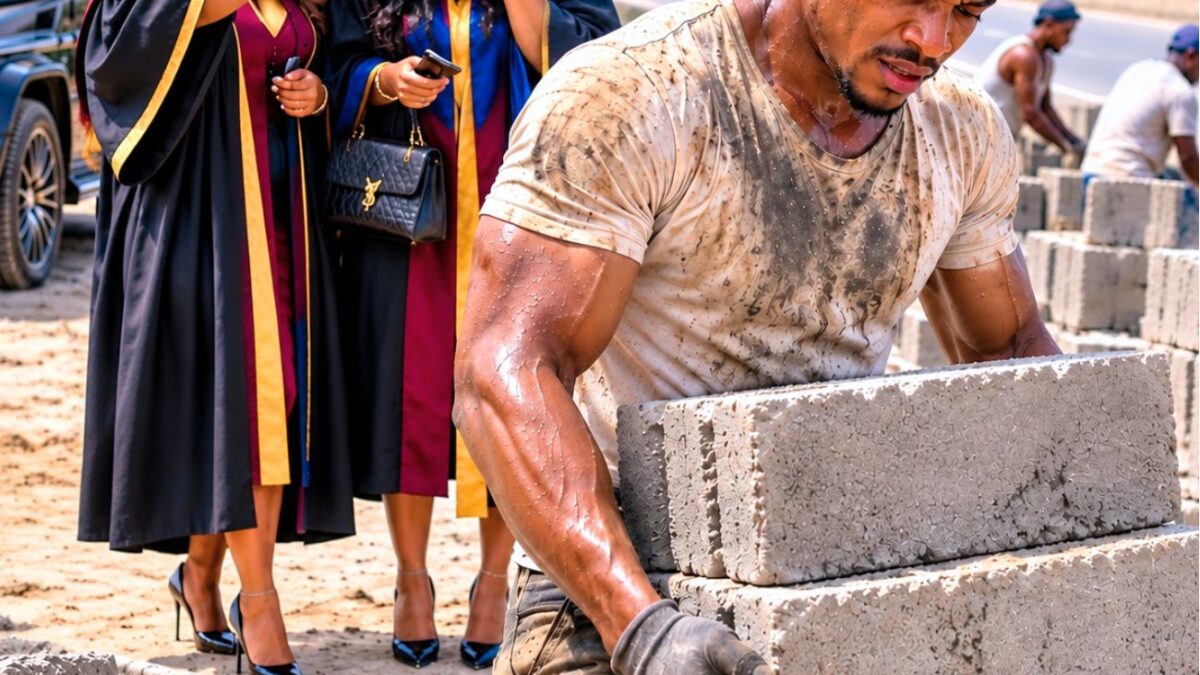
The university courtyard was alive with the vibrant rustle of black academic gowns, the bright flash of cameras, and the relentless hum of celebratory brass bands. Families gathered in joyful clusters beneath the sprawling shade of the ancient neem trees, pinning fresh corsages to crisp lapels and showering the young scholars with praises. In the center of that moving sea of pride stood Ikenna, his heavy polyester gown clinging uncomfortably to his thin frame under the harsh, unyielding tropical sun.
He held his rolled leather-bound degree tightly against his chest, his calloused knuckles turning pale from the pressure, feeling the textured paper within like a sacred shield he had earned through blood and sweat. Beside him stood his mother, Mama Nkechi, her faded Ankara wax print ironed with painstaking precision, her worn leather sandals dusted by the dry university clay. Her deep, dark eyes were shining with tears she had swallowed for four long years, watching the boy she raised alone reach the finish line of his youth.
“Congratulations, my brother,” a former classmate named Emeka yelled out cheerfully above the brass horns, clapping Ikenna hard on his stiff shoulder before pulling him into a brotherly embrace. “You finally conquered it! Department of Geology! You survived the hardest faculty on this entire campus, my man, through all the field trips and sleepless nights!”
Ikenna managed a modest, weary smile, though his eyes drifted constantly past the laughing crowds, searching every passing face with an anxious, desperate longing. “There were many times I wanted to drop out, Emeka,” he admitted softly, his voice trembling slightly beneath the heavy roar of the festive campus. “I swear there were mornings I thought my spirit would break before the semester finished.”
“Yet you never surrendered,” Mama Nkechi interjected firmly, stepping closer and gently resting her coarse, hardworking palm against her son’s shoulder. “I only wish your late father were alive to stand here beside us under this bright sun to see what his seed has become.”
Ikenna nodded absently, his gaze cutting sharply through the colorful crowd again, tracking the perimeter of the manicured lawn near the administrative gates. “Who are you looking for, my son?” Mama asked gently, noticing how his tall body remained tense and poised on the balls of his feet.
“Chidimma,” he whispered, swallowing the dry lump that had lodged in his throat since morning. “She promised she would be here before the chancellor took the podium.”
Just then, the crowd parted near the faculty steps, and Ikenna caught sight of her walking slowly toward them across the open lawn. She wore an expensive, tailored peach gown that accentuates her delicate frame, but beside her walked Daniel, a well-known local contractor whose polished leather shoes and gold wristwatch gleamed brightly. Ikenna stepped forward instinctively, offering an eager, relieved smile, but Chidimma’s expression remained flat and cold, devoid of the warmth he had cherished for five long years.
“Chidimma,” Ikenna said, extending a hand that hung awkwardly between them in the humid air. “You made it. But what is going on here?”
She folded her arms neatly, glancing briefly at the mud-splattered hem of his rented graduation trousers before looking into his eyes. “Why shouldn’t I be here, Ikenna?”
“Today was supposed to be our happy day,” he replied, his heart hammering against his ribs like a trapped bird. “The day we worked for.”
“It is a happy day for some people, I suppose,” she countered, her voice devoid of any festive affection. “For those whose journeys are actually going somewhere.”
A heavy silence descended between the three of them, suffocating despite the nearby music and the roaring cheers of other celebrating families. “What does that mean, Chidimma?” Ikenna asked, the joyous noise of the campus suddenly fading into a dull, terrifying buzz.
“We need to talk,” she said, nodding toward a secluded concrete bench beneath an old bougainvillea bush. “About us.”
“Yes,” Ikenna answered, following her while Daniel leaned against a shiny black SUV parked along the curb, watching them with calm amusement. “We have been together for almost five years, Chidimma. We promised each other we would celebrate this day together as one.”
“I know how long it has been,” she replied smoothly, turning to face him as the pink bougainvillea petals drifted silently around them. “And that is precisely why I am talking to you like this right now.”
“Why?” Ikenna asked, his voice shaking with confusion. “Because five years is a long time to keep waiting for a promise, Ikenna.”
“Waiting for what, exactly?” he pressed, his palms beginning to sweat against the rough grain of his degree certificate. “Haven’t I done what was required?”
“Waiting for you to become something,” she stated bluntly, looking directly at him without a single flinch of hesitation. “Waiting for your life to move.”
“Become something?” Ikenna repeated, the words striking him like a series of physical blows to his chest. “I just crossed the stage!”
“Do not misunderstand me, please,” she sighed, adjusting the strap of her designer handbag with practiced nonchalance. “I am only looking at reality.”
“Then explain it to me clearly,” he demanded, his vision blurring slightly as his fingers gripped the rolled parchment tighter. “Explain what you mean.”
“Look at you, Ikenna,” she said, gesturing vaguely at his faded shoes and the cheap cotton shirt beneath his gown. “You have just graduated today, yes. But what happens tomorrow morning?”
“I will find a job,” he answered automatically, the standard hope of every youth rising to his dry lips. “I will build my career.”
“You have been singing that identical song for two whole years,” she scoffed softly, shaking her head with thinly veiled pity. “Two solid years of promises.”
“Because I was still in school!” he argued, his chest heaving with mounting indignation. “I had to finish my coursework first!”
“And now you have finished,” she said, her voice dropping into an icy, practical tone. “And what do you truly have to show for it?”
“I have my degree,” he replied, raising the leather folder between them like a shield. “A first-class training in geology.”
“A piece of paper does not automatically give you a future in this country,” she replied, her words dripping with cold realism. “You cannot eat a certificate.”
“You knew I was not a wealthy man when you started dating me,” Ikenna said, feeling a bitter sting in his eyes. “You knew my background.”
“You are entirely correct,” she replied without shame. “I was young and naive, and I believed love alone could feed a growing household.”
“You knew my mother was struggling to sell vegetables just to keep kerosene in our lantern and pay my tuition fees,” he persisted, his voice cracking.
“Yes, I knew,” she answered, casting an indifferent glance back toward Daniel, who was calmly checking his gold wristwatch by the car. “I knew everything.”
“And because our fortunes have not transformed overnight, you are walking away from me today?” he whispered, devastated. “On this very ground?”
“I am simply tired, Ikenna,” she sighed, looking past his shoulder at the happy crowds. “I am tired of struggling and waiting with you.”
“Is this the true reason?” Ikenna asked, gesturing toward the well-dressed man leaning against the luxurious vehicle. “Is it because of him?”
“Daniel has a stable life,” she answered calmly, without dropping her gaze. “He has built a solid foundation while others are still dreaming.”
“So,” Ikenna murmured, his pride crumbling into dust beneath his worn shoes. “He owns a registered company, and I have absolutely nothing.”
“I did not say you have nothing,” she countered, adjusting her dress. “Those are your words, not mine.”
“You do not have to speak them aloud,” Ikenna said, his jaw tightening as anger fought against the overwhelming grief rising in his throat. “Your actions scream it.”
“And honestly, I have changed too over these years,” she added, her voice hardening as if to convince herself of her righteous choice. “People outgrow people.”
“What has changed in you, Chidimma?” he pleaded, desperate to find a glimmer of the woman who used to pray with him over cold bowls of garri.
“I no longer desire the kind of man I used to want,” she said coldly. “I want someone who already looks successful. Someone who doesn’t look like he has been engaged in a lifetime war against poverty.”
Ikenna felt as though the wind had been violently knocked from his lungs. “So now you are deeply ashamed of how I look?”
“I am only being honest with you,” she replied, stepping back. “You asked me for the plain truth, didn’t you?”
“On my graduation day?” he shouted, oblivious to the few curious onlookers who turned to stare. “You chose this exact morning to be honest?”
“You asked me to speak from my heart,” she said defensively. “I am doing you a favor by not wasting any more of your precious time.”
“After five long years of loyalty, you couldn’t even wait until tomorrow morning to break me?” Ikenna whispered, his voice trembling with sheer agony.
Chidimma stood her ground, her face a mask of resolute stone. “There is never a perfect time to break someone’s heart, Ikenna.”
“And to make matters worse, you brought him here to witness it,” Ikenna said, gesturing toward Daniel, who had begun walking slowly toward them across the grass.
“I did not come here to disrespect you or cause a scene, young man,” Daniel interjected smoothly, arriving with his hands buried casually in his tailored pockets.
“Then why are you standing here on my campus?” Ikenna demanded, stepping between Daniel and the memory of the life he thought he was building.
“Because Chidimma specifically asked me to drive her here,” Daniel replied with a smug, easy smile that did not reach his calculating eyes. “She needed a ride.”
“So this whole humiliation was meticulously planned,” Ikenna said, turning his broken gaze back to the woman he had loved without reservation. “You orchestrated this spectacle.”
“I did not want to continue living a lie,” Chidimma answered, stepping instinctively closer to Daniel’s side and resting her fingers lightly on his forearm.
“You brought another man to humiliate me on the very day my mother sacrificed her last wrapper to celebrate,” Ikenna choked out, tears finally spilling.
“You purposely waited for the single morning I was supposed to hold my head high to tell me that I am utterly worthless,” he said, turning away.
“Worthless for what?” she called after him defensively. “I only said you cannot provide the life I need right now!”
“Because you have finally secured the kind of man with deep pockets that you always secretly craved,” Ikenna said, stopping to look back one last time.
“Yes,” Chidimma declared without hesitation, lifting her chin proudly. “I have found security, and I will not apologize for choosing comfort over endless struggle.”
“Are you truly certain about this choice?” Ikenna asked quietly, the heavy reality settling like lead in the pit of his stomach.
“I have never been more certain of anything in my entire life,” she replied, turning her back on him to walk toward Daniel’s gleaming car.
Mama Nkechi, who had watched the painful exchange from a respectful distance under the tree, hurried over and took her son’s trembling arm in hers. “What happened, my child?” she asked softly, though the sorrow in her eyes revealed that her mother’s intuition had already understood the bitter tragedy.
“Nothing, Mama,” Ikenna whispered, wiping his damp cheek with the rough sleeve of his academic gown. “Let us just leave this place immediately.”
“Ikenna,” Mama pleaded, pulling him toward her chest as his broad shoulders began to shake with silent, suffocating sobs. “Please, do not weep.”
“Please, Mama,” Ikenna begged, his voice muffled against her worn cotton wrapper. “Today was not supposed to end with me crying like a disgraced child.”
“Listen to me, Ikenna,” Mama said firmly, gripping his face between her rough, loving hands. “Do not let what happened today destroy the man you are inside.”
“You have a great and glorious future ahead of you,” she continued, her voice rising with the steady authority of a mother who had survived storms.
“Chidimma touched me where it hurts the most, Mama,” he wept openly now, letting the certificate droop toward the dirt. “Maybe she was right about me.”
“Maybe I am just an ordinary poor boy who will spend his entire life chasing shadows,” he added, his self-worth shattered beneath Daniel’s expensive leather shoes.
“My son, listen to your mother!” Mama scolded gently, shaking him lightly until his tear-filled eyes met her unwavering gaze. “You must not allow her to win.”
“You must never permit her shallow actions to defeat your eternal soul,” Mama insisted. “After all, she is certainly not the only woman walking this earth.”
“She told me I have no money, Mama,” Ikenna choked out, the cruel words ringing in his ears like church bells at a funeral.
“She told me I am worthless and that I do not fit her grand vision of a man, after five whole years of pouring my soul into her hands.”
“You possess something that all the crisp banknotes in Daniel’s leather wallet can never purchase,” Mama replied softly, wiping his wet face with her handkerchief.
“What do I have, Mama?” Ikenna asked bitterly, looking down at his frayed trouser cuffs. “Empty hands and an empty stomach?”
“You have youth, you have integrity, and you have time,” she answered with conviction. “Your story has only just begun to be written by God.”
The dusty public bus rattled noisily along the pitted expressway, carrying them away from the vibrant university town toward the modest fringes of the city suburbs. Ikenna sat pressed against the scratched window pane, his graduation cap resting awkwardly on his lap, watching the blurred green trees speed past in silence. Mama Nkechi held his cold, motionless hand between both of hers, humming a low, ancient hymn that had comforted generations of weary travelers before them.
“We are almost home, Mama,” Ikenna murmured as the bus slowed near the familiar junction of cracked red earth and bustling roadside fruit stalls.
“I know, my son,” she replied, reaching into her small coin purse. “And regardless of what transpired on that lawn, I remain overwhelmingly proud of you.”
Ikenna stepped down into the dust and paid the conductor, who handed him his small change with an offhand nod of congratulation. “Here is the fare, brother,” Ikenna said quietly, handing over the worn notes before turning to help his aging mother descend the steep metal steps.
“Congratulations to you, young scholar,” the bus driver called out through his open window, spotting the black academic gown draped over Ikenna’s arm.
“Thank you, sir,” Ikenna replied hollowly, unable to summon a genuine smile for a stranger when his own soul felt thoroughly emptied of light.
“Let us go inside the house, Mama,” he said, guiding her down the narrow, familiar pathway that wound between small cinderblock homes toward their two-room apartment.
The small living room was cool and dim, smelling faintly of dried bay leaves, paraffin oil, and the lingering dampness of the rainy season’s mud bricks. A single wooden table stood near the window, flanked by two plastic chairs and a modest bookshelf crammed with heavy, dog-eared geological textbooks. Ikenna dropped his gown onto the sofa, set his prized certificate down upon the bare table, and collapsed into the nearest chair like a felled mahogany tree.
“Ikenna, you have not swallowed a single morsel of food since morning,” Mama observed, untying her headscarf and setting it on the sideboard.
“I am not hungry, Mama,” he muttered, resting his forehead against the cool wooden surface of the table, his eyes burning with exhaustion.
“You recited that exact same excuse inside the car on our way home,” she noted gently, moving into the tiny curtained kitchen corner to light the stove.
“I have lost all appetite for food, Mama,” he confessed, staring blankly at the rough plaster wall where his late father’s faded photograph hung.
“Your eyes are bloodshot and swollen, my child,” Mama said, returning with a cup of cool water from the clay pot in the corner.
“You are punishing your own body, Ikenna. I watched you walk from that university gate to the bus stop like a condemned laborer carrying stones.”
“There is a vast difference between being physically tired and allowing your spirit to be broken by another human being,” she continued, standing over him.
“You sacrificed your youth for that degree for four painful years,” Mama reminded him, her voice ringing with the fierce passion of a protective elder.
“You spent freezing nights reading by kerosene flames while your wealthier classmates were out drinking at the town clubs or sleeping soundly in beds.”
“There were days when your stomach grumbled with hunger, yet you walked five miles to the lecture halls without uttering a single complaint to me.”
“Today was meant to be the glorious morning when you held that certificate up to the heavens and declared to yourself, ‘I have overcome.'”
Ikenna lifted his heavy head, his eyes dark with unshed grief. “I truly believed it would be that way, Mama. I really thought so.”
“Then what changed inside you?” she asked gently, pulling up the second plastic chair to sit directly opposite him at the modest wooden table.
“You were there, Mama,” he whispered, his throat tightening again. “You witnessed everything that unfolded beneath those trees with your own eyes.”
“I saw Chidimma arrive accompanied by that arrogant man in his fine vehicle,” Mama acknowledged calmly, her expression tightening slightly with suppressed anger.
“I saw the cold way she looked at you,” she added. “And I observed how her mouth moved, but I could not hear their words.”
“Perhaps it is far better that your ears were spared the poison they poured upon me,” Ikenna muttered, tracing the gold lettering on his folder.
“What could they possibly have said that was sharp enough to cut down a strong boy like you?” Mama asked, leaning forward with genuine concern.
“Some words are not meant to enter a mother’s heart concerning her child,” Ikenna replied, shaking his head slowly as the bitter memory resurfaced.
“Did she stand before strangers and insult your bloodline, Ikenna?” Mama demanded, a spark of maternal fury finally breaking through her calm demeanor.
“She looked me in the eyes and said she was utterly tired of waiting for my life to begin,” he answered, each syllable heavy with humiliation.
“And what response did you offer her in that terrible moment?” Mama asked, watching his face closely in the dim light of the afternoon.
“I asked her why she lacked the decency to wait until tomorrow to cast me aside,” Ikenna whispered, his voice cracking beneath the weight of shame.
“And how did she justify her cruelty?” Mama inquired, her hands folding tightly together over the faded floral fabric of her lap.
“She claimed there was no ideal moment to break another person’s heart,” Ikenna answered, letting out a sharp, joyless laugh that echoed off the walls.
“In a harsh way, that is true,” Mama noted softly. “I am not defending her wicked timing, but cowards always rush to strike when fear grips them.”
“She did not merely state her truth, Mama; she deliberately crushed my dignity into the dirt,” Ikenna said, his fists clenching until his knuckles popped.
“Tell me the rest of it,” Mama urged gently. “Purge the bile from your chest so it does not rot your spirit from within.”
“She told me she no longer had any use for a man who looked as though he had spent his whole existence wrestling with poverty.”
Mama went completely still, her breath catching in her throat for a brief second before her eyes softened into profound, boundless sorrow. “She spoke those wicked words directly to your face, my son? In the presence of that other man?”
“Yes, Mama,” Ikenna breathed, staring down at his empty palms. “With Daniel standing right beside her, smiling like a king at a public execution.”
“And you remained standing there like a statue?” Mama asked, her eyebrows drawing together in a mixture of pain and quiet reproof.
“What else was I supposed to do, Mama?” he asked helplessly. “Engage in a disgraceful fistfight on the graduation lawn of a federal university?”
“No,” Mama answered firmly. “You were supposed to turn around and walk away with your head high before she saw the moisture in your eyes.”
“I loved her, Mama,” Ikenna cried out softly, the raw confession filling the small room with an overwhelming weight of genuine heartbreak.
“That is the crucial part that none of you understand,” he continued, leaning forward and resting his elbows on his knees in deep despair.
“I know she made her calculation,” he admitted. “I know she desires a comfortable home, and I know I cannot force anyone to walk this road.”
“But I gave five whole years of my loyalty and trust to that woman,” he said, his voice breaking into ragged, uncontrollable gasps of pain.
“Whenever our cupboards were bare and I had to skip meals to buy drafting paper, I endured it because I thought she was my future.”
“When I was turned down for student internships, she would sit with me on this very porch and whisper that God was preparing our breakthrough.”
“When I could not afford to buy her meat pies or soft drinks, she would swear that simple love was more than enough for her.”
“Perhaps she only spoke those sweet platitudes because Daniel had not yet pulled up to her bus stop in a shiny car,” Mama remarked.
“Listen to your mother very carefully,” Mama commanded, reaching out and gripping both of his trembling wrists with remarkable, weathered strength.
“Do not ever permit another fragile human being’s poor decision to become the final definition of who you are going to be in this life.”
“It is very easy for you to offer these philosophical words tonight, Mama,” Ikenna replied, shaking his head with bitter resignation.
“Of course it is easy for me to speak them,” Mama countered without missing a beat, her gaze fierce and unwavering in the fading dusk.
“Because I have walked this difficult earth far longer than you have, Ikenna. I have watched wealthy merchants fall into ruin and rise again.”
“I have seen promising marriages collapse into bitter hatred, and yet the victims woke up, swept their compounds, and discovered new joy.”
“I buried your sweet father in the damp village soil twenty years ago, and I still found the courage to kindle a cooking fire the next morning.”
“Yet you sit here in your youth, convinced that your existence has ended simply because one woman decided she preferred someone else’s car.”
“It is not just about Chidimma, Mama,” Ikenna muttered, pulling his hands back to rub his tired face. “I feel as though I have utterly failed.”
“Failed at what, exactly?” Mama challenged, her voice rising with sharp, loving impatience. “What standard have you failed to achieve today?”
“At becoming the successful man that everyone expected me to be by now,” he confessed, staring out the window at the gathering shadows of evening.
“And who is this mighty ‘everyone’ that governs your peace of mind?” Mama asked, narrowing her eyes. “Give me their names, Ikenna.”
“You, Mama,” he whispered, looking at her with guilt. “My professors, my former coursemates, Chidimma, and most of all, the boy I used to be.”
“Then let me teach you an essential truth that your university textbooks completely neglected to mention,” Mama said, tapping her finger on the table.
“You have spent your entire day measuring the length of your young life using somebody else’s broken and crooked measuring ruler.”
“You look at Daniel because he possesses an imported car and crisp banknotes, and you immediately conclude that heaven has forgotten your name.”
“You observe your former classmates who found banking jobs through their influential uncles, and you tell yourself that you are hopelessly left behind.”
“Life does not travel along a paved, identical highway at the exact same speed for every traveler, my son,” she said, her voice softening.
“What if no company ever hires me, Mama?” Ikenna asked, voicing the terrifying nightmare that had haunted his sleep for months. “What if I fail?”
“Then you will use your two strong hands and that bright brain to create something of your own,” Mama declared without an ounce of hesitation.
“With what capital, Mama?” he demanded, spreading his arms wide to indicate the bare, modest room around them. “With what secret wealth?”
“You are an educated graduate of the earth sciences,” Mama replied with pride. “You understand what lies beneath the surface of this world.”
“Mama, a printed certificate does not magically sprout currency notes,” Ikenna replied, collapsing back into his plastic chair with an exhausted sigh.
“And sitting here weeping like an abandoned widow over Chidimma will certainly not fill our cooking pot either,” Mama retorted sharply, standing up.
“You really have no sympathy for my broken heart tonight, Mama,” Ikenna murmured, though a tiny flicker of his usual wit returned to his voice.
“I possess abundant sympathy for you, Ikenna,” she said, resting a warm hand upon the crown of his head. “More than you will ever know.”
“But I also possess a grown son who is beginning to wallow in the poison of self-pity, and I refuse to stand by and watch it consume him.”
“I truly believed that earning this degree would instantly transform our circumstances,” Ikenna said, looking once more at the leather folder on the wood.
“It still holds that power, my son,” Mama answered, heading back into the small kitchen where the aroma of boiling peppers began to drift.
“How, Mama?” he called after her, his voice small against the growing darkness outside. “Tell me how it will change anything tomorrow.”
“I do not possess the blueprint of heaven,” Mama called back over the sizzle of the pan. “And that is the grand beauty of tomorrow morning.”
“No man knows what unexpected grace the dawn will carry across the threshold,” she added. “Now wash your face and prepare to eat.”
“I am still not hungry, Mama,” Ikenna repeated out of stubborn habit, resting his chin on his chest as the shadows deepened in the room.
“Then you will sit right there and endure your hunger in peace,” Mama replied cheerfully from behind the curtain. “Because I am cooking regardless.”
Ikenna turned his eyes toward the old photograph of his father on the wall, whispering into the quiet room, “If you were standing here, what would you say?”
Later that evening, after a plate of spicy beans had been forced upon him, Ikenna sat on the narrow front veranda beneath a dim yellow bulb. His old mobile phone buzzed against the concrete ledge, vibrating with a notification that made his wounded heart leap against his ribs with sudden, desperate hope. He snatched the device, his thumb trembling as he unlocked the glowing screen, only to find a brief, sterile text message from Chidimma’s number.
“I know today was very difficult,” the brief message read, cold and distant. “I hope one day you will mature enough to understand why I made this choice.”
Ikenna stared at the glowing pixels until his vision blurred, remembering the nights they had shared roasted corn on this very step, laughing at silly campus rumors. With a slow, deliberate movement, his thumb hovered over the options menu before pressing the delete key, wiping the message and her contact into oblivion. “Ikenna, your bathwater is ready,” Mama’s gentle voice called from within the house, grounding him back in the simple, ongoing reality of their shared survival.
The following morning brought the harsh, unvarnished routine of the post-graduate struggle, stripping away the festive illusions of convocation day with brutal efficiency. Ikenna spent his meager savings at the local cybercafé, printing dozens of neat copies of his curriculum vitae, his hands smelling of warm toner and cheap paper. He ironed his single white long-sleeved shirt until the seams were razor sharp, polished his scuffed black shoes with candle wax, and set out into the city.
By afternoon, he returned home with his shoulders drooping, his collar stained with city exhaust and sweat, finding Mama sorting dried bitterleaf on the veranda. “Another firm turned you away?” she asked without looking up from her wooden tray, her practiced hands moving rhythmically among the brittle green leaves.
“Yes, Mama,” Ikenna sighed, collapsing onto the top concrete step and unbuttoning his damp collar to catch the faint afternoon breeze. “Another closed door.”
“What excuse did they offer this time, my son?” Mama inquired, setting aside a small pile of unwanted stems into a plastic basin.
“They informed me that they are strictly seeking candidates who already possess two full years of verifiable post-graduation experience,” he explained bitterly.
“Experience?” Mama exclaimed, pausing her work to look at him in genuine disbelief. “How can a fresh graduate possess two years of professional work?”
“That is the identical question I posed to the human resources officer,” Ikenna replied, shaking his head at the sheer absurdity of the corporate maze.
“And how did that officer answer your reasonable inquiry?” Mama asked, wiping a speck of dust from her brow with the back of her forearm.
“He stated that thousands of unemployed graduates are roaming the streets for the exact same entry-level post,” Ikenna murmured, his voice laced with defeat.
“He told me plainly that when twenty men are fighting over a single bone, the master throws it to the dog with the sharpest teeth.”
“You labored tirelessly for that degree, Ikenna,” Mama said softly, her eyes filling with a mixture of righteous anger and deep maternal sympathy.
“I know how many nights you studied while the city slept,” she added. “You did not waste your youth in drunkenness or idle gambling.”
“Mama, academic merit is entirely irrelevant out here,” Ikenna said, leaning his head back against the warm brick pillar of the small veranda.
“Then what is the true obstacle?” she asked, setting her tray down on the floor between them to give him her complete, undivided attention.
“The real tragedy is that nobody in this city is willing to grant a young man his very first opportunity to demonstrate his worth,” he whispered.
“Go inside and take a bath, then eat the yam porridge on the stove,” Mama commanded gently, patting his knee with her work-roughened palm.
“I have no stomach for food today, Mama,” he muttered, closing his eyes against the persistent headache throbbing behind his temples.
“You must nourish your flesh, Ikenna,” she insisted firmly. “A starving soldier cannot win the prolonged campaign that lies ahead of him.”
His mobile phone suddenly rang with a sharp, high-pitched chime, jolting him from his melancholy and causing his mother to lean forward with sudden anticipation. Ikenna fumbled with the device, his heart leaping into his throat as he recognized the landline prefix of a major engineering firm he had visited last week. “Good afternoon, sir,” he answered quickly, his voice instinctively adopting the crisp, formal tone of an eager, desperate applicant seeking grace.
“Yes, sir… I understand completely,” he said after a long, agonizing pause during which only the tinny squawk of the receiver was audible.
“Thank you very much for considering my application, sir. I appreciate the courtesy of your phone call,” he concluded, lowering the phone slowly to his lap.
Mama leaned forward, her eyes wide with unasked questions that hung heavily in the warm afternoon air between them. “What news did they deliver?”
“They have offered the junior geologist position to a relative of the managing director,” Ikenna reported quietly, staring down at his dusty shoes.
“Do not let your heart fail you,” Mama said softly, picking up her tray of leaves once more. “Perhaps the next interview will bear good fruit.”
“Mama, how many ‘next interviews’ are left before our money runs dry?” he cried out, his frustration finally shattering his calm composure.
“I was convinced that graduating with honors would alter the trajectory of our suffering,” he added, burying his face in his hands with a groan.
“It will bear fruit in due season, my son,” she replied steadily, her faith refusing to waver even when his own was completely exhausted.
“When, Mama?” he asked, lifting his head to reveal eyes red with suppressed tears. “Tell me an exact month or year so I can endure!”
“I do not possess that knowledge, Ikenna,” she confessed with gentle honesty. “Only the Almighty holds the calendar of our ultimate deliverance.”
“But you must never allow the bitter taste of temporary disappointment to convince your soul that your journey has reached its final destination,” she warned.
The following Tuesday found Ikenna seated in the waiting lobby of a mid-sized civil engineering consultancy in the commercial heart of the bustling metropolis. The air conditioning hummed frigidly overhead, chilling the sweat that had soaked through his formal shirt during his two-hour trek across the city bridges. A stern-faced secretary with braided hair clicked loudly on her mechanical keyboard, occasionally glancing up at the four nervous young men seated against the wall.
“Mr. Ikenna Okoye?” she finally called out, her voice cutting through the sterile silence of the corporate reception area like a sharp knife.
“Yes, ma’am,” Ikenna answered instantly, rising to his feet and smoothing the wrinkles from his trousers before grasping his leather document folder firmly.
“The panel is ready to see you now in boardroom two,” she instructed, pointing a polished acrylic fingernail toward a frosted glass door down the hallway.
Ikenna took a deep, steadying breath, whispered a silent prayer for his mother’s sake, and pushed open the heavy wooden door into the interview chamber. Three evaluators sat behind a gleaming mahogany table: two older gentlemen in dark suits and a severe-looking woman with silver-rimmed spectacles resting on her nose. “Good afternoon, esteemed panel,” Ikenna greeted them respectfully, bowing his head slightly as he approached the solitary leather chair facing their long desk.
“Good afternoon, Mr. Okoye,” the woman replied, gesturing toward the empty seat. “Please make yourself comfortable and present your academic credentials to the clerk.”
Ikenna handed over his pristine file, sitting with his back straight and his hands clasped neatly on his lap, willing his pulse to slow down. “I see here that you graduated with top honors in Geology from the Federal University,” she noted, scanning his transcript with an experienced, analytical gaze.
“That is correct, ma’am,” Ikenna replied politely, feeling a sudden surge of cautious pride warm his chest. “I dedicated four focused years to the discipline.”
“An exceptionally brilliant academic record, Mr. Okoye,” the older man seated in the center remarked, looking over the rim of his reading glasses.
“Thank you very much, sir,” Ikenna responded, leaning forward slightly with eager, professional intensity. “I have always taken my academic investigations seriously.”
“However, I notice an immediate and glaring deficiency in your profile,” the woman interjected, her red pen tapping rhythmically against the pristine white paper.
Ikenna felt his brief optimism wither instantly under her cold gaze. “What deficiency might that be, ma’am?” he asked, though he already anticipated the blow.
“You possess absolutely zero practical industry experience within an active engineering firm,” she stated flatly, leaning back against her plush leather executive chair.
“I completed my degree requirements only a month ago, ma’am,” Ikenna explained earnestly, his voice pleading for basic human understanding and fair logic.
“I understand your circumstance perfectly, young man,” she replied without a hint of warmth. “Yet our firm requires someone who operates without constant oversight.”
“Sir, ma’am, if you grant me this singular opportunity, I will master your operational software within two weeks,” Ikenna promised with fierce, desperate resolve.
“I have no doubt regarding your intellectual capacity, Mr. Okoye,” the central director conceded, closing the folder with a decisive, dull thud.
“Nevertheless, our current commercial contracts demand an operative who has already spent several years navigating the complex logistics of actual field drilling sites.”
“Sir, permit me to ask a genuine question,” Ikenna said, his desperation momentarily shattering his carefully cultivated professional composure in the cold room.
“How is an ambitious young graduate ever supposed to acquire practical industry experience if every single corporate door remains slammed shut in his face?”
The director sighed softly, a fleeting glint of genuine sympathy softening his tired eyes before the hardened armor of corporate realism returned completely. “I comprehend your profound frustration, son,” he admitted quietly. “It is an unfortunate reality of the current economic climate in our developing nation.”
“I am not begging for unearned charity or unmerited favor, sir,” Ikenna pressed on, leaning forward with his heart bared before the stone-faced panel.
“I am merely requesting a modest platform to demonstrate my diligence and loyalty to your organization,” he pleaded, his voice thick with raw emotion.
“We shall retain your curriculum vitae within our active database, Mr. Okoye,” the woman concluded sterilely, signaling the end of the brief interview.
“If a suitable entry-level trainee opening materializes in the upcoming financial quarter, our administrative department will reach out to your telephone number.”
Ikenna knew the hidden, bitter translation of that polished corporate phrase; it was the polite death sentence every unemployed graduate received before being forgotten. “Thank you for your valuable time, ma’am, gentlemen,” he whispered, standing up with trembling knees and gathering his leather folder from the polished table.
He walked out through the chilled glass doors into the blinding, oppressive heat of the mid-afternoon sun, feeling completely drained of hope and human worth. His stomach growled loudly, reminding him that he had spent his lunch money on the public bus fare to reach this sterile execution chamber. He paused beside the busy highway, watching executive cars speed past through the swirling exhaust fumes, realizing that his degree could not even purchase a loaf of bread.
Two days later, the reality of empty food tins in their modest kitchen drove Ikenna far beyond the polished corridors of the commercial business district. He stood in the swirling, gritty gray dust of a sprawling commercial block-molding factory located along the industrial bypass at the edge of the sprawling city. Hundreds of heavy, wet concrete building blocks lay curing in long, neat rows under the merciless glare of the blazing midday sun.
A burly, shirtless foreman with a measuring tape slung across his broad, scarred shoulders glared at Ikenna’s slender frame with evident skepticism. “You claim you are capable of enduring heavy manual labor, young man?” the foreman barked, spitting a stream of red kola nut juice into the dust.
“Yes, sir, I am strong and ready to work immediately,” Ikenna replied, having folded his trousers up to his shins and stripped to a singlet.
“Have you ever operated a mechanical press or hauled wet cinderblocks across a production yard before today?” the foreman demanded, crossing his massive arms.
“No, sir, but I am an exceptionally fast learner and I do not shy away from arduous physical toil,” Ikenna answered with quiet, unyielding determination.
“Very well, you will commence your shift by carrying freshly cured nine-inch blocks from the drying beds to the loading bay,” the man instructed gruffly.
“What is the wage structure for this manual task, sir?” Ikenna inquired, preparing his mind for whatever meager compensation was customary in such yards.
“Each standard block you successfully transport and stack without cracking will earn you exactly thirteen naira,” the foreman replied, turning away to inspect a mixer.
“Your total earnings at dusk will depend entirely upon the strength of your spine and how many hundreds of blocks your two hands can move.”
Ikenna swallowed the bitter bile of pride rising in his throat, approached the towering rows of gray concrete, and hoisted the first rough block. The coarse aggregate bit viciously into the soft, uncalloused skin of his palms, the sharp sand scraping against his flesh like coarse sandpaper. By his fiftieth block, his lower back was screaming with sharp, fiery pain, and thick rivers of sweat were stinging his salt-encrusted eyes.
“Hey, new fellow!” an older laborer called out, pausing with his wheelbarrow to observe Ikenna’s trembling forearms and careful, unsteady gait across the dusty yard.
“You possess the smooth skin and delicate speech of a university scholar,” the laborer noted, wiping his brow with a greasy rag and grinning broadly.
“I completed my university degree only last month,” Ikenna answered between ragged breaths, refusing to drop the heavy burden resting against his aching chest.
“What field of study did you waste four precious years pursuing in those fancy lecture halls?” the man asked with genuine, unmocking curiosity.
“Geology,” Ikenna gasped out, setting the heavy block down onto the growing wooden pallet with a dull, resonant thud that sent dust flying.
“Geology!” the laborer laughed heartily, shaking his head at the strange ironies of modern life in their struggling country. “And here you are moving blocks!”
“An honest job is an honest job, brother,” Ikenna replied, straightening his agonizingly stiff spine and wiping his dripping brow with his dusty forearm.
“You speak the absolute truth, young scholar,” the man conceded respectfully, turning back to his wheelbarrow. “Hunger does not recognize the Latin printed upon a diploma.”
As the afternoon sun reached its fiercest peak, a young woman carrying a covered plastic basket entered the dusty yard to sell cold water and snacks. It was Adaeze, a former university acquaintance who lived two streets away from Ikenna’s family home and operated a modest tailoring shop near the market. She froze in her tracks, her eyes widening in sheer astonishment as she recognized the tall, soot-stained young man lifting another heavy cinderblock nearby.
“Ikenna?” she called out softly, setting her basket down upon an empty wooden pallet and walking toward him through the swirling gray concrete dust.
Ikenna turned sharply, his face instantly burning with an intense, suffocating wave of embarrassment that made him want to dissolve into the dry earth. “Adaeze,” he murmured, his voice cracked with dry thirst as he carefully set down the wet block he was holding before his knees buckled.
“What on earth are you doing in this industrial yard?” she asked, her voice filled with profound shock rather than cruel, mocking amusement.
“I am engaged in productive labor, Adaeze,” he answered defensively, wiping his hands against his dusty trousers in an attempt to look composed.
“You are carrying heavy construction blocks under this blazing sun?” she whispered, stepping closer to observe his blistered, bleeding palms with deep distress.
“It is legitimate physical work,” he stated firmly, though he could not prevent his exhausted hands from trembling visibly before her searching, honest gaze.
“Your hands are shaking violently, Ikenna,” she observed gently, reaching into her pocket to pull out a small bottle of cool, clean water.
“I am perfectly fine,” he lied unconvincingly, turning his head away. “I am simply adjusting to the physical demands of this new operational environment.”
“You do not look fine in the slightest,” she said, uncapping the bottle and pressing it firmly into his raw, dusty fingers with quiet insistence.
“I hope you are not feeling deeply ashamed because my eyes happened to discover you laboring here,” she added softly, her tone entirely devoid of mockery.
“I am profoundly ashamed, Adaeze,” he confessed in a broken whisper, looking down at the red, raw skin peeling from his swollen palms.
“After all the complex geological theorems I mastered and the honors I achieved, this gritty yard is where my life has ultimately landed.”
“There is absolutely nothing shameful about engaging in honest labor to preserve your dignity, Ikenna,” she scolded gently, touching his dusty arm with genuine warmth.
“However, I must confess that seeing a brilliant scholar like you hauling cinderblocks is an unexpected and deeply striking sight for my eyes today.”
“Every corporate office I approach tells me I lack two years of practical experience,” he explained bitterly, taking a desperate swallow of the cool water.
“They promise to telephone me after reviewing my academic files, but the silence from their end is as cold as a fresh grave, Adaeze.”
“So what alternative remained for me?” he asked, his voice thick with suppressed anguish. “Should I sit idle at home and watch Mama starve to death?”
“No,” she replied firmly, her brown eyes shining with steady, quiet admiration. “You did what a responsible, courageous man was required to do today.”
“Drink the rest of that water,” she commanded gently, handing him a clean cotton handkerchief from her pocket to wipe the cement dust from his face.
“Thank you, Adaeze,” he murmured, feeling a strange, unfamiliar warmth touch his battered spirit beneath the brutal heat of the open industrial sky.
“You do not owe me or any other human soul an elaborate explanation for your survival,” she said, looking straight into his tired, bloodshot eyes.
“If carrying these heavy cinderblocks is the cross you must bear today to purchase your bread, then lift them with pride and unwavering focus.”
“Just promise me that you will never allow this dusty yard to convince your soul that this is where your story reaches its final conclusion.”
Ikenna looked at her, truly seeing the gentle strength and quiet grace that lived in her modest countenance for the very first time in years. “Why do you still retain faith in my potential, Adaeze?” he asked softly. “When even the woman I loved for five years called me worthless?”
“Because you are fundamentally the same honorable, hardworking Ikenna I have observed for years,” she answered without hesitation, gathering her basket from the pallet.
“A temporary change in your financial circumstance does not diminish the quality of the gold residing within your character,” she added with a smile.
“Promise me you will telephone my small shop when you return safely to your mother’s compound tonight,” she said, turning toward the yard exit.
“I will call you, Adaeze,” he promised, watching her walk away through the swirling dust with a newfound, resilient lightness settling in his aching chest.
Across the sprawling city, in an air-conditioned boutique cafe overlooking the affluent Victoria district, Chidimma sat across from Daniel at a glass-topped table. She wore an imported silk blouse and gold earrings that swayed delicately with every turn of her head, sipping an iced fruit beverage through a straw. Yet her gaze was distant, wandering out the floor-to-ceiling windows toward the busy avenue below, her brow furrowed in quiet, restless contemplation.
“You have been unusually quiet and distracted since our driver picked you up this morning,” Daniel observed, cutting into his pastry with casual elegance.
“I am merely reflecting on a few random things,” she answered softly, resting her chin upon her manicured hand and stirring her drink slowly.
“Reflecting upon what specific matter, my dear?” Daniel inquired, his sharp, possessive eyes narrowing slightly across the pristine linen tablecloth between them.
“I happened to cross paths with Ikenna earlier today,” she revealed, her voice dropping to a cautious murmur that barely carried over the soft jazz music.
“Indeed?” Daniel responded with an amused, superior chuckle. “And in what illustrious establishment did you stumble upon your former university scholar?”
“At the commercial block-molding factory along the industrial bypass,” she confessed, her fingers tightening slightly around the chilled glass of her tumbler.
“What could a supposed intellectual possibly be doing in a filthy, chaotic place like that?” Daniel scoffed, dabbing his mouth with a linen napkin.
“He was actively hauling wet cinderblocks on his shoulders,” she stated flatly, a flicker of uncomfortable guilt piercing through her polished, modern exterior.
“I was under the distinct impression that the young fellow graduated with impressive honors in Geology,” Daniel mocked, shaking his head with dismissive pity.
“He did graduate with distinction,” she confirmed quietly. “He spent four years buried in textbooks, dreaming of working for the major multinational oil corporations.”
“Then why in heaven’s name is he reducing himself to manual day labor among common illiterates?” Daniel asked, his tone dripping with condescending superiority.
“Because the corporate market is entirely frozen, Daniel,” she answered with a sigh. “Nobody is willing to employ a fresh graduate without connections or capital.”
“That is genuinely unfortunate for him, I suppose,” Daniel remarked without an ounce of real empathy, adjusting the gold links on his tailored cuffs.
“Perhaps my decision to sever our ties on convocation day was the absolute right choice after all,” she murmured, almost trying to convince herself.
“Are you still allowing your thoughts to dwell upon that destitute boy, Chidimma?” Daniel questioned sharply, his casual demeanor instantly vanishing into cold possessiveness.
“No, of course not,” she lied quickly, straightening her posture and offering him an artificial, practiced smile that did not reach her eyes.
“You are entirely certain of your heart?” he pressed, reaching across the table to cover her delicate hand with his heavy, gold-ringed fingers.
“I simply experienced a momentary wave of human pity for his terrible plight,” she explained softly, looking down at their joined hands with detachment.
“You have absolutely no reason to harbor guilt now that you reside under my protection in a secure and prosperous environment,” Daniel asserted firmly.
“I do not feel guilty,” she insisted, pulling her hand back under the guise of smoothing her expensive silk blouse over her lap.
“You made the mature, sensible calculation that was best suited for your long-term comfort,” Daniel continued, leaning forward to reinforce his undeniable dominance.
“There is no cosmic law stating that two childhood sweethearts must inevitably drag each other down into the bottomless pit of generational poverty.”
“Perhaps you are right,” she whispered, her gaze drifting back out toward the sun-drenched street where common laborers walked beneath the scorching heat.
“You desired financial stability and luxury,” Daniel reminded her with an arrogant grin. “And I possess the substantial resources to supply all your desires.”
“Listen to me attentively, Chidimma,” he commanded softly, his voice carrying the smooth, dangerous authority of an experienced man accustomed to buying compliance.
“I hold a deeper affection for your beauty than any penniless graduate ever could. That boy, whatever his name is, lost you purely to poverty.”
“I am a wealthy man with thriving enterprises under my direct command,” Daniel declared proudly, gesturing grandly to emphasize his obvious material advantages.
“That concrete reality is what truly matters in this modern world, so cease casting your foolish glances backward into the dust of your past.”
“Daniel, I assure you that I am no longer contemplating his existence,” she surrendered, offering another polished, submissive smile across the table.
“After all, you have provided every luxurious comfort I ever requested since the day we stepped away from that university lawn together,” she added.
“Excellent,” Daniel approved, his smug expression returning in full force as he signaled the waiter for their lavish afternoon luncheon bill.
“A magnificent, refined woman of your caliber has no business associating with a struggling man whose tomorrow remains completely shrouded in terrifying darkness.”
“How much more a fresh, unemployed graduate roaming this unforgiving country without a dime to his name,” he concluded with a loud, triumphant laugh.
The next afternoon, the dry wind blew harsh clouds of cement dust across the block factory yard, coating Ikenna’s eyelashes and hair with gray powder. His muscles had adapted slightly to the grueling rhythm of the physical labor, though the deep blisters on his palms had burst and reformed into raw, hardened calluses. As he hoisted two heavy six-inch blocks against his chest, the low, powerful rumble of an approaching luxury vehicle drew the tired eyes of every laborer.
A pristine black Mercedes G-Wagon rolled smoothly into the unpaved yard, its dark tinted windows and chrome accents contrasting sharply with the gritty industrial squalor. The driver’s door opened, and Daniel stepped out into the dust, wearing an impeccably tailored navy suit and dark Italian designer sunglasses. From the passenger side emerged Chidimma, dressed in a dazzling yellow sundress that billowed lightly in the wind, a matching umbrella shielding her fair complexion.
“Good afternoon, site manager!” Daniel called out authoritatively, waving his hand to summon the yard foreman who was supervising the mixing machinery nearby.
The foreman hurried over, wiping his dirty hands on his trousers and bowing slightly before the obviously wealthy patron. “Good afternoon, honorable chief! Welcome to our yard!”
“Daniel, look over there,” Chidimma suddenly whispered, a sharp, nervous giggle escaping her lips as she tapped her partner’s arm and pointed across the drying beds.
“I genuinely cannot believe my own eyes,” she added, her voice carrying clearly across the quieted yard as the nearby laborers paused their wheelbarrows.
Daniel turned his gaze toward the far corner of the yard, his lips curling into an amused, mocking sneer. “Well, well, well… isn’t that our great scholar, Ikenna?”
Ikenna froze in his tracks, the two heavy concrete blocks resting against his bare, sweat-drenched chest like two massive millstones threatening to crush his remaining pride. He slowly lowered the blocks onto the nearest wooden pallet, stood up straight, and met their staring eyes with an expression as cold and unyielding as stone. “Chidimma,” he said simply, his voice low and steady despite the furious tempest of humiliation and anger raging violently within his battered ribcage.
“So this is the prestigious professional career you embarked upon after four rigorous years in university halls?” she asked, stepping forward with deliberate theatrical pity.
“Leave the young man alone to earn his thirteen naira, Chidimma,” Daniel interjected with a loud, cruel chuckle that echoed across the dusty yard.
“I warned you explicitly on our graduation day that you needed to be realistic about your future,” she continued, ignoring Daniel’s performative restraint completely.
“You had absolutely no justification to travel to my place of employment simply to mock my labor,” Ikenna responded, clenching his bruised fists at his sides.
“Why shouldn’t I speak?” she challenged loudly, ensuring every laborer within fifty paces could hear her sharp, cutting condemnation of his poverty.
“Because back in school, you were perpetually giving grand speeches about your revolutionary geological research and how you would transform the entire energy sector!”
“Is this the magnificent industrial empire you were building in your head?” she mocked, waving her hand at the dusty piles of curing cinderblocks.
“I am earning an honest livelihood with the strength of my own two hands,” Ikenna answered through gritted teeth, holding her disdainful gaze without flinching.
“You spent your youth mastering advanced science only to perform the identical task that an illiterate street urchin does for peanuts!” she scoffed.
“At least I am actively toiling rather than selling my dignity and virtue for the comfort of another man’s vehicle,” he fired back, his patience snapping.
“That exact arrogant, stubborn mindset is precisely why I walked out of your life without looking back!” she retorted, her voice rising in shrill defense.
“I required a mature partner who already had a solid financial footing, not an idealistic dreamer who thinks prayers alone can pay rent!”
“You could have delivered that message privately without orchestrating a public spectacle to humiliate me before my family,” Ikenna said, his eyes burning.
“I spoke plainly to you on convocation day because you stubbornly refused to confront the brutal economic reality of our society!” she argued defensively.
“You disgraced me intentionally before my aging mother and my coursemates,” he replied, taking a slow step toward her through the swirling gray dust.
“Because you were living in a childish fantasy, Ikenna!” she yelled back, crossing her arms and leaning her back against the sleek door of Daniel’s vehicle.
“I truly hope you discover every single luxury and comfort you sold your soul to obtain,” Ikenna whispered, his voice trembling with deep, ancient sorrow.
“I have already secured everything I ever desired,” she declared proudly, stepping closer to Daniel and grasping his muscular, suited arm with dramatic flair.
“I possess absolute security with Daniel standing faithfully by my side. Can you not observe the exquisite fabric of his suit? Look at this imported machine!”
“Men may claim equality in the sight of God through their religious scriptures,” she proclaimed with arrogant finality, “but men are only truly equal where wealth speaks!”
Ikenna felt a profound, sudden stillness descend upon his soul, the sheer absurdity of her cruelty stripping away the last lingering remnants of his former affection. “Chidimma, cease heaping unnecessary salt upon an open wound,” he said quietly, his voice devoid of all anger, leaving only hollow, exhausted pity.
“You have made your calculated choice. You have obtained the gold and the chariot you worshipped. I beg you now, permit me to labor in peace.”
“Tell me, my dear philosopher,” Daniel interjected smoothly, leaning casually against his shiny hood with a mocking grin, “is there truly any peace for a destitute man?”
“Daniel, that is quite enough,” Chidimma murmured, suddenly looking unsettled by the cold, unblinking dignity radiating from Ikenna’s soot-covered face in the harsh sun.
“We have two thousand cured blocks to purchase for my new duplex in the estates,” Daniel announced loudly to the foreman, tossing his car keys in his palm.
“Ensure my truck drivers select only the finest quality blocks, not the cracked, brittle rubbish molded by clumsy, bitter academic hands,” he added with a wink.
Ikenna did not utter another word; he turned his back on them completely, reached down to hoist another heavy cinderblock, and walked steadily toward the loading bay. As the roar of the powerful Mercedes engine tore through the dusty air, signaling their departure, Ikenna continued his rhythmic, agonizing stride across the yard. Every step sent a jolt of fire through his spine, but his mind had retreated into an impenetrable fortress of quiet, absolute determination to survive this darkness.
That evening, Ikenna trudged back into his mother’s small compound, his clothes stiff with dried sweat and gray concrete dust, his head hanging low with exhaustion. Mama was sitting on a low wooden stool by the doorway, peeling cassava roots into an enamel basin, but she halted her knife the moment he appeared. She observed the rigid set of his jaw and the strange, haunting silence that enveloped his tall frame like an invisible, suffocating cloak of mourning.
“What terrible trial confronted you in the city today, Ikenna?” she asked gently, setting down her half-peeled root and wiping her hands on her apron.
“Nothing of significance occurred, Mama,” he muttered, sinking down onto the hard concrete step of the veranda and resting his elbows upon his knees.
“Do not attempt to deceive the woman who carried you for nine long months in her womb,” Mama chided softly, rising and walking over to stand beside him.
“I recognize that dark, stormy countenance. You look like a man who has just walked through an enemy ambush without a shield. Tell your mother everything.”
“Chidimma visited the block factory this afternoon,” he confessed, staring blankly at the hard-packed red earth between his worn, dust-caked work boots.
Mama stood entirely motionless for a long moment, her breath steady and calm despite the sudden tightening of the lines around her weathered mouth. “What purpose brought her to that gritty industrial yard?” she asked quietly. “Did she come alone, or did that arrogant contractor accompany her?”
“They arrived together in his luxurious black vehicle to inspect building materials for his new estate mansion,” Ikenna answered, his voice devoid of tears.
“She stood before the entire assembly of day laborers and inquired whether hauling heavy blocks was the grand purpose for which I attended the university.”
“And what response did you offer to her wicked taunts?” Mama inquired, her eyes narrowing with a deep, protective fury that burned like hot coals.
“I opened my mouth to retaliate with venom, Mama,” he admitted, looking up at her with raw vulnerability. “I wanted to tear her dignity into shreds.”
“Why did you withhold your sharp tongue, my child?” she asked, placing a comforting, heavy hand upon his dust-streaked shoulder to anchor him.
“Because I realized in that very instant that she arrived with the deliberate intention of provoking me into an undignified, violent rage before that crowd.”
“She desperately wanted me to act like an unhinged, uncivilized beast so she could justify her betrayal to her own conscience and to that wealthy man.”
Mama nodded slowly, a profound, solemn smile of maternal respect softening her stern features. “You demonstrated true royal blood today, Ikenna.”
“You are not an absolute failure simply because a shallow, impatient woman refused to maintain faith in your character,” she declared with fierce authority.
“Mama, take an honest look at my wretched condition!” he cried out softly, holding up his raw, calloused palms for her inspection under the evening bulb.
“I earned an honors degree in the complex science of the earth! I have distributed my credentials to every corporate establishment in this metropolitan territory!”
“Not a single enterprise is willing to grant me an entry desk! I spend my daylight hours hauling masonry for thirteen naira per stone like an illiterate convict!”
“That is merely your current circumstance for today, my son,” she replied calmly, pulling up a plastic stool to sit directly beside his weary form.
“How much longer will this agonizing ‘today’ endure, Mama?” he asked, his voice cracking with the agonizing weight of his ongoing, seemingly endless humiliation.
“I do not possess the divine calendar of heaven, Ikenna,” she whispered, leaning in close so her breath stirred the dust on his hair. “Yet I know one certainty.”
“What truth do you possess, Mama?” he asked, searching her ancient, wrinkled face for a solitary sliver of enduring, reliable hope in his world.
“Your ultimate destiny is vastly grander and more magnificent than the miserable, shallow way blind human beings perceive your worth this evening,” she promised.
“Do not ever permit the bitter sting of temporary poverty to deceive your mind into despising the honorable man God fashioned you to become,” she insisted.
“And when the sun rises over this city tomorrow morning,” she added, her eyes flashing with unshakable conviction, “what will your response be?”
Ikenna took a deep, shuddering breath, looked down at his bleeding palms, and felt a sudden, steely resolve harden within the deepest chambers of his chest. “Tomorrow morning at the crack of dawn, Mama,” he answered with a steady, quiet voice, “I will return to the yard and move those blocks.”
“That is my father’s true son speaking,” Mama said, tapping his chest with her knuckle. “Surrender is an inheritance we do not pass down in this family.”
Weeks bled into months, each day marked by the unrelenting cycle of blistering manual labor, cold baths from a plastic bucket, and silent night studies. Between his exhausting shifts at the block yard, Ikenna continued to purchase cheap mobile internet bundles, submitting academic abstracts to obscure international geological journals. He also attended every sporadic entry-level interview he could find, enduring the identical corporate dismissals with an increasingly hardened, impenetrable armor of stoic patience.
“Your academic credentials are fundamentally pristine, Mr. Okoye,” an exploration director remarked during an interview at an offshore surveying consultancy three months later.
“Thank you very much, sir,” Ikenna responded calmly, sitting in his faded white shirt that had been washed and ironed until the fabric was paper-thin.
“Your grades in mineralogy and petrology are quite frankly among the most remarkable I have witnessed from your university in a decade,” the man noted.
“I dedicated my entire academic youth to understanding the precise structural compositions of our regional soil layers, sir,” Ikenna answered with quiet competence.
“Yet the undeniable reality remains that you possess zero practical industry tenure within a commercial drilling operation,” the director sighed, tapping his pen.
“Sir, I completed extensive academic field mapping throughout the rocky terrains of the northern escarpment during my undergraduate thesis,” Ikenna countered respectfully.
“Academic field mapping is merely a theoretical simulation, Mr. Okoye,” the director dismissed, shaking his head. “We require someone seasoned in commercial drilling logistics.”
“Then grant me the privilege to acquire that practical seasoning under your leadership, sir,” Ikenna urged, his voice steady, devoid of the old, frantic desperation.
“I am entirely unacquainted with the concept of fear when it comes to grueling physical toil; I currently haul hundreds of concrete blocks every single day.”
“We can observe your physical fortitude from your robust frame, young man,” the director acknowledged with a faint, respectful smile that carried no practical offer.
“Nevertheless, our operational board has already reached a unanimous determination to shortlist candidates who already boast five years of verified field tenure.”
“I comprehend your corporate position perfectly, sir,” Ikenna answered gracefully, standing up and retrieving his folder without a trace of visible defeat on his face.
“I express my sincere gratitude for your gracious time and consideration,” he added, executing a crisp, respectful bow before departing the executive office.
Outside the corporate tower, his phone vibrated in his pocket. It was Adaeze, whose daily phone calls had become the solitary, luminous lighthouse in his storm. “How did the exploration consultancy interview conclude, Ikenna?” she asked, her gentle voice immediately cutting through the oppressive, noisy roar of the city traffic.
“They dismissed my application with the standard corporate script, Adaeze,” he answered, leaning against the warm concrete pillar of a pedestrian bridge.
“The identical lamentation regarding lack of practical field tenure was recited once more,” he added, letting out a dry, untroubled chuckle into the receiver.
“Are you returning to your mother’s compound, or will you report to the industrial block factory for the afternoon shift?” she inquired with genuine concern.
“I am proceeding straight to the factory, Adaeze,” he answered, stepping into the flow of pedestrian traffic toward the bus terminal with renewed purpose.
“You sound remarkably identical to my mother whenever you inquire about my daily movements,” he teased gently, feeling a genuine smile touch his lips.
“Somebody has to maintain a vigilant watch over your stubborn spirit, Ikenna,” she laughed warmly, her affection radiating clearly across the wireless connection.
“Thank you, Adaeze,” he said, his tone softening into profound sincerity. “Thank you for perpetually reminding my weary heart that I am not an abandoned ruin.”
When he arrived at the block factory, the yard was engulfed in chaotic activity; three massive commercial flatbed trucks were idling near the central pallets. “You reported exceptionally early for your afternoon shift, Ikenna!” the burly foreman shouted across the roar of the diesel engines, waving him over urgently.
“I am fully prepared for duty, sir,” Ikenna replied, quickly stripping off his formal shirt and carefully folding it into his weathered canvas rucksack.
“A massive commercial contract has just been signed with Chief Daniel’s property development consortium,” the foreman explained, pointing toward the towering stacks.
“They require an immediate delivery of two thousand nine-inch blocks to the hillside residential development site before dusk falls across the city.”
Ikenna paused for a fraction of a second, the name striking a familiar, dull chime of memory, but his hands moved automatically to secure his gloves. “I will load the flatbeds immediately, sir,” he answered without hesitation, stepping onto the wooden loading ramp with steady, disciplined footwork.
Later that evening, after earning an extra three thousand naira for the grueling loading shift, Ikenna chose to walk the long, dusty route home. The industrial road wound past the rocky, unpaved outskirts of the city where new infrastructure cuts had recently blasted through an ancient hillside ridge. Giant yellow excavators sat abandoned along the unfinished bypass, their steel treads resting in deep trenches of fractured granite and exposed red sedimentary earth.
Ikenna walked with his canvas bag slung over his shoulder, his geological instincts unconsciously scanning the newly blasted rock faces illuminated by the setting sun. Suddenly, a strange, unnatural glint of light reflecting from a freshly excavated drainage ditch beside the road caught the peripheral vision of his trained eyes. He halted his stride, frowning slightly as he stared into the shadow of the trench where a newly broken boulder lay split open by dynamite.
He stepped down into the shallow ditch, his work boots sinking into the loose gravel, and knelt beside the fractured, unusual stone formation. It was a heavy, dense rock fragment, roughly the size of an ostrich egg, its weathered gray exterior concealing a crystalline interior that shimmered strangely. The fractured surface revealed dense, hexagonal crystal structures interwoven with deep, metallic purplish-black veins that absorbed the dying sunlight with an oily, iridescent sheen.
Ikenna pulled a small magnifying hand lens from his canvas rucksack—a beloved scientific instrument he had carried every day since his first year of university. He held the lens against his right eye, leaning close to the specimen, his breath catching in his dry throat as the structural details magnified. The crystal habits were entirely inconsistent with common regional quartz, basalt, or ironstone; they exhibited the rare, distinct signatures of high-grade tantalite and columbite.
His heart began to hammer against his ribs with a sudden, violent intensity that completely eclipsed the exhaustion in his aching, overworked limbs. He pulled a steel pocketknife from his bag and performed a quick scratch test across the dark, metallic vein; the blade barely left a mark. He struck the edge of the stone with the steel casing of his pocketknife, observing the fracture pattern and the peculiar, faint radioactive luminescence.
“This is fundamentally impossible,” he whispered aloud to the empty, wind-swept ditch, his hands trembling as he hoisted the remarkably dense, heavy specimen.
He scrambled out of the trench, his eyes darting frantically along the length of the newly blasted road cut that stretched for nearly two miles. The identical, dark-veined geological stratum ran continuously along the entire exposed bedrock ridge like a massive, hidden subterranean highway waiting for discovery. “Tantalite… lithium pegmatites… rare earth deposits,” he breathed, the advanced technical textbooks he had memorized flooding his racing mind with blinding, undeniable clarity.
He quickly wrapped the heavy stone fragment in his cotton work rag, buried it deep within his canvas rucksack, and fastened the brass buckles securely. He climbed back up to the road, his heart racing like a runaway locomotive, and walked toward his mother’s compound with rapid, energized strides. The crushing fatigue of hauling concrete blocks had evaporated entirely, replaced by the blazing, incandescent fire of a scientist who had stumbled upon an empire.
When he pushed open the wooden door of their modest home, Mama was seated at the table, carefully counting her daily market earnings from a tin. She glanced up, noticing immediately the intense, wild luminescence dancing in her son’s dark eyes—a fierce, radiant energy she had not witnessed in months. “Ikenna, you are nearly forty minutes late this evening,” she observed, her hands pausing over her small stacks of crumpled paper banknotes.
“I apologize, Mama,” he said breathlessly, locking the deadbolt behind him and placing his heavy canvas rucksack onto the bare wooden table with care.
“You have been standing there staring at that battered bag as if an angel were hiding inside the canvas,” Mama remarked, tilting her head with curiosity.
“I discovered something extraordinary on my trek home along the newly blasted industrial bypass, Mama,” he confessed, unbuckling the straps with trembling fingers.
“What manner of strange object did you carry into this house?” she inquired, leaning forward in her chair to inspect his mysterious, dusty package.
“It appears to be merely an unusual stone, Mama,” he replied, unwrapping the coarse cotton rag to reveal the dense, dark, crystalline specimen beneath.
Mama blinked at the rough, glittering rock resting upon her polished table, then looked up into her son’s intense, solemn face with gentle bewilderment. “Ikenna, my dear child, we possess millions of ordinary stones scattered across our compound soil outside. Why carry another into the house?”
“I am fully aware of our outside gravel, Mama,” he answered with a soft, excited laugh, leaning over the table and illuminating the rock with a flashlight.
“Yet this particular geological specimen is fundamentally different from anything that has ever been officially documented in this geographical province,” he explained.
“It looks remarkably like an ordinary piece of blackened granite to my uneducated eyes,” she noted, reaching out a hesitant finger to touch the cool mineral.
“Then why are your eyes fixed upon it as if it owes you a vast fortune of gold?” she asked, her mother’s intuition detecting the deep undercurrents.
“I do not possess absolute laboratory verification yet, Mama,” he whispered, running his thumb over the dense, metallic purplish-black veins that shimmered in the light.
“Yet every single petrological principle I mastered over four rigorous years at the university is telling me that this stone is an extraordinarily valuable industrial mineral.”
“Perhaps you should extinguish that lamp, swallow your cold soup, and seek proper rest, my child,” Mama suggested gently, concerned for his mental exhaustion.
“I will eat and sleep shortly, Mama,” he promised, though his eyes never wavered from the magnificent, crystalline structures locked within the heavy stone.
“Do not permit whatever complex theories are racing through your brilliant brain to torment your sleep through the night,” she cautioned, rising from her chair.
“I will rest peacefully, Mama,” he murmured, his fingers gently tracing the hexagonal facets of the rock as she retired behind the curtain of her room.
Left alone in the dim living room, Ikenna retrieved his heavy, dog-eared geological reference volumes from the modest bookshelf, spreading them across the table. For four uninterrupted hours, beneath the harsh glare of the bare electric bulb, he cross-referenced specific gravity calculations, mineral hardness tables, and known tectonic fault maps. Every mathematical calculation and comparative chemical diagram confirmed his wild hypothesis: the newly blasted ridge sat directly atop a massive, unmapped pegmatite deposit.
The following morning, Ikenna bypassed the block factory entirely, withdrawing his meager savings to secure an urgent laboratory appointment at the Regional Mining Institute. He carried the carefully wrapped specimen in his canvas bag, his heart pounding in his throat as he navigated the sterile, chemical-scented hallways. An elderly, white-haired analytical chemist named Dr. Alabi adjusted his heavy spectacles, peer-reviewing Ikenna’s handwritten specific gravity notes before conducting an X-ray fluorescence scan.
“Where on earth did you extract this geological core sample, young man?” Dr. Alabi inquired two hours later, emerging from the testing chamber with an expression of pure, unadulterated scientific shock.
“Is the elemental assay favorable, sir?” Ikenna asked cautiously, holding his breath as the older scientist set down the printed spectral analysis sheets.
“Favorable is a grossly inadequate term, Mr. Okoye,” the senior chemist declared, tapping the spectral graph with an unsteady, deeply excited finger.
“This specimen exhibits an extraordinarily high concentration of tantalum oxide, columbite, and grade-one spodumene lithium, with virtually zero hazardous radioactive impurities.”
“In simple, commercial language, young man, you are holding a high-purity industrial sample of what global technology markets classify as strategic critical minerals.”
“Are you entirely certain of this spectral readout, Dr. Alabi?” Ikenna whispered, the room suddenly spinning with the glorious, terrifying weight of reality.
“I have supervised this metallurgical laboratory for thirty-four years, son,” the old scientist chuckled softly, looking at Ikenna with profound, respectful admiration.
“Whoever holds the legally registered exploration and extraction license for the subterranean ridge where this rock originated effectively commands a multi-million-dollar fortune.”
Ikenna walked out of the institute with the certified assay documentation sealed tightly inside his leather folder, his mind remarkably clear, calculating, and calm. He did not rush to boast, nor did he seek out the bustling market squares to proclaim his sudden, staggering elevation above his former tormentors. Instead, he boarded a commercial bus to Adaeze’s modest tailoring shop near the central district, seeking the solitary soul whose faith had never wavered.
Adaeze was seated behind her manual sewing machine, her foot pumping the iron pedal rhythmically as she guided a vibrant blue fabric beneath the needle. She looked up, halting the wheel with her palm as Ikenna stepped across her threshold, noticing immediately the profound, quiet transformation in his posture. He stood tall, his broad shoulders squared, a serene, unshakable authority radiating from his dark eyes that took her breath away.
“You have been conspicuously absent from the industrial block factory this morning, Ikenna,” she observed softly, stepping out from behind her wooden work table.
“Have I truly been missed by the foreman and his heavy cinderblocks?” he asked with a gentle, enigmatic smile, setting his canvas rucksack down.
“You are perpetually exhausted, yet today you look entirely different,” she said, stepping closer and searching his face with her sharp, perceptive eyes.
“You possess an astonishing ability to perceive the deepest shifts within my spirit, Adaeze,” he confessed, pulling two wooden stools together near the window.
“Somebody has to maintain a constant, loving vigilance over your life, Ikenna,” she answered softly, sitting down opposite him. “Now tell me what has occurred.”
“I have made an unprecedented geological discovery,” he revealed quietly, unzipping his bag to present the dense, crystalline rock and the sealed laboratory assay.
“What is the significance of this dark stone?” she inquired, leaning close to inspect the certified spectral charts stamped with the government seal.
“It is high-grade tantalite and lithium pegmatite, Adaeze,” he explained in a reverent whisper, his eyes shining with the brilliant light of justified sacrifice.
“The newly blasted bypass along the western hillside ridge cuts directly through an undocumented mother lode of the world’s most sought-after critical technology minerals.”
“Ikenna,” she gasped, her hands flying to her mouth as the staggering economic implications of his calm explanation sank into her sharp, practical mind.
“This is not a theoretical academic exercise, Adaeze,” he continued, leaning forward and covering her trembling hands with his calloused, hardworking palms.
“This certified laboratory assay represents the total, irrevocable transformation of my family’s destiny and the beginning of the geological enterprise I was born to lead.”
“Have you revealed this staggering discovery to any other living person in the city?” she asked urgently, her eyes wide with sudden, protective apprehension.
“No,” he answered without hesitation, holding her gaze with steady, unwavering devotion. “I brought this truth solely to you, because you believed in my gold when I was dust.”
“Then you must exercise extreme, uncompromising caution, Ikenna,” she warned, tightening her grip on his fingers with fierce, protective loyalty.
“You have endured too much bitter humiliation and suffering for opportunistic predators to swoop in and rob your hard-earned harvest at the eleventh hour.”
“I am proceeding directly to the Federal Ministry of Mines and Solid Minerals to file the formal, legal coordinates under my registered consultancy,” he assured her.
“Keep this secret locked beneath your tongue until the legal exploration titles are signed, stamped, and delivered into your hands,” she insisted firmly.
“The walls of this commercial city possess sharp ears, and wealthy contractors like Daniel would not hesitate to deploy their influence to seize your ridge.”
“Let them try, Adaeze,” Ikenna answered, a confident, fearless smile gracing his handsome face for the first time in years. “The earth belongs to those who understand her.”
Three months later, the dry harmattan wind swept through the capital city as an official federal gazette published the comprehensive mining concession awards for the region. The newly established Okoye Geological & Mining Resources Consortium was formally granted exclusive twenty-five-year exploration and extraction rights across the sprawling western hills. International clean-energy conglomerates and multinational technology firms descended upon the small, elegant corporate office Ikenna had leased in the city’s premier business district.
On a bright Tuesday morning, a high-level coordination summit was convened in the executive boardroom of the State Ministry of Infrastructure and Urban Development. Daniel sat at the end of the long conference table, sweating profusely within his tailored suit, flanked by his anxious legal team and junior project directors. His property development firm was facing catastrophic legal penalties and immediate bankruptcy for executing unauthorized excavation and dynamite blasting across federal geological reserves.
“I assure the honorable commissioner that my firm was entirely unaware that the western hillside bypass encroached upon a high-value critical mineral concession,” Daniel stammered, his usual arrogant swagger completely obliterated by impending financial ruin.
“Your commercial ignorance does not grant you immunity from federal environmental statutes, Chief Daniel,” the stern commissioner replied from the head of the table.
“You have conducted illegal quarrying upon an internationally classified tantalite pegmatite reserve that commands extraordinary strategic significance for our national treasury.”
“We are prepared to negotiate an immediate, massive out-of-court settlement with the concession owner,” Daniel pleaded frantically, wiping his wet brow with a silk handkerchief.
“The distinguished concession owner and managing director of the consortium is arriving this morning to determine whether to pursue full criminal charges against your firm,” the commissioner stated, checking his watch as the double mahogany boardroom doors swung open.
A collective, respectful hush fell across the entire assembly of lawyers, civil engineers, and corporate executives as the head of the consortium entered the room. Ikenna walked in with calm, regal authority, dressed in an impeccably tailored three-piece charcoal Italian suit that accentuated his tall, powerful, athletic frame. His skin was clear and radiant, his dark hair neatly groomed, his eyes shining with the tranquil, absolute confidence of a man who had conquered the furnace of adversity.
Behind him walked his chief executive consultant and personal advisor, Adaeze, radiating elegance in a brilliant emerald green dress, carrying their leather portfolios. Daniel’s jaw dropped in absolute, paralyzing horror, his face turning an ashen gray as he gripped the edge of the mahogany table to steady his trembling knees. He stared at the commanding young executive before him, desperately attempting to reconcile this magnificent titan of industry with the destitute boy who had moved his concrete blocks for thirteen naira.
“Good morning, honorable commissioner, esteemed board members,” Ikenna greeted the room, his rich, baritone voice filling the expansive chamber with commanding elegance.
“Welcome, Director Okoye,” the commissioner smiled warmly, rising from his executive seat to shake Ikenna’s hand with genuine, deferential professional respect.
“We have reviewed your consortium’s master extraction blueprint, and the federal government is thoroughly eager to expedite your joint venture with our international clean-energy partners.”
“Our technical teams are fully mobilized, commissioner,” Ikenna replied smoothly, taking his seat at the center of the table while Adaeze opened their legal files.
Ikenna slowly turned his gaze across the long table, letting his cool, steady, unblinking eyes settle upon the petrified, sweating figure of Daniel. The contractor shrank back into his plush leather seat, utterly unable to meet the piercing, tranquil gaze of the man he had publicly humiliated and mocked in the dust. “Chief Daniel,” Ikenna addressed him softly, his tone completely devoid of petty spite, carrying only the terrifying weight of absolute, unassailable power.
“Mr… Director Okoye,” Daniel stammered, his voice cracking with sheer, pathetic terror as his legal team looked at him with profound embarrassment.
“I have meticulously examined the forensic engineering reports concerning your firm’s unauthorized dynamite detonations along our licensed geological ridge,” Ikenna stated calmly.
“You blasted through forty meters of high-purity lithium-bearing pegmatites, treating irreplaceable strategic critical minerals as if they were worthless quarry gravel for your private residential driveways.”
“It was an honest, catastrophic technical oversight by our subcontracted survey team, Director Okoye!” Daniel begged, extending trembling hands across the polished wood.
“We are prepared to surrender our entire fleet of heavy transport machinery, our commercial flatbed trucks, and pay whatever financial restitution your board demands!”
Ikenna leaned back in his executive chair, steepled his fingers, and regarded the terrified, broken contractor with calm, profound, philosophical detachment. “A man who possesses substantial wealth without foundational character or scientific understanding is merely an illiterate barbarian waving borrowed banknotes in the dark, Chief Daniel.”
“You made a point of reminding me in the dust of that factory that men are only truly equal where wealth speaks,” Ikenna continued in a measured whisper.
“Yet you failed to comprehend that true, enduring wealth is not measured by the imported brand of an automobile or the temporary arrogance of a bank balance.”
“Real wealth is the divine wisdom to perceive the boundless treasures concealed beneath the earth, and the honorable integrity to build a legacy that outlasts flesh.”
“I will not pursue criminal prosecution that would see you locked behind prison bars, Chief Daniel,” Ikenna announced calmly, closing the file before him.
“However, your firm will fully execute the complete civil reclamation of the western ridge under the strict, unpaid supervision of my junior geological interns.”
“You will personally supply two hundred thousand high-density cured cinderblocks to construct the new free vocational school our consortium is founding in the city suburbs.”
“Thank you, Director Okoye! God bless your generous soul, sir!” Daniel gasped out, utterly disgraced and financially subjugated, bowing repeatedly before the board.
That evening, a lavish international reception was held in the grand ballroom of the city’s most prestigious five-star hotel to celebrate the consortium’s launch. Crystal chandeliers cast warm, glittering light across the assembly of foreign ambassadors, cabinet ministers, university professors, and distinguished corporate titans. At the center of the room, Mama Nkechi sat in a plush velvet armchair like an African queen, dressed in luxurious hand-woven lace, smiling serenely as dignitaries paid their respects.
Near the grand entrance of the ballroom, standing behind the decorative brass velvet ropes among the curious public onlookers, stood Chidimma. She wore an outdated cocktail dress, her hair unkempt, her face pale and drawn with the terrifying, bitter realization of her monumental, historic life miscalculation. She watched with a shattered, bleeding heart as Ikenna moved effortlessly through the elite crowd, conversing fluently in technical English with foreign energy delegates.
Beside Ikenna stood Adaeze, her beauty breathtaking, her demeanor gracious and composed as she laughed warmly at a remark made by the Minister of Petroleum. Chidimma gathered her remaining courage, stepped past the hesitant security guards, and approached the perimeter of the executive lounge where Ikenna stood. “Ikenna,” she called out, her voice trembling, cracked with a desperate, suffocating mixture of profound remorse, humiliation, and ancient longing.
Ikenna turned slowly, holding a glass of sparkling water, his expression polite, serene, and entirely unmoved as his eyes rested upon her face. “Good evening, Chidimma,” he greeted her gently, with the identical cool courtesy he would extend to a complete stranger who had wandered into the hall.
“Ikenna, please… I need only two minutes to speak with you privately,” she pleaded, tears welling in her eyes, threatening to spill down her cheeks.
“I was blind, Ikenna… Daniel deceived my heart with his rented luxury… I never truly ceased believing in your magnificent mind and your destiny,” she whispered desperately.
Adaeze looked at her with gentle, silent pity, then stepped back gracefully to attend to Mama Nkechi, granting Ikenna absolute freedom to answer his past. Ikenna looked at Chidimma, seeing not the cruel woman who had crushed his youthful soul, but a tragic, hollow ghost whose shallow measuring ruler had destroyed her own life. “There is nothing left between us to discuss, Chidimma,” he replied softly, his voice firm, tranquil, and as final as the setting of the sun.
“You informed me on our graduation day that there is never a perfect time to break someone’s heart,” he reminded her without a trace of malice.
“And you were entirely correct. Yet you also taught me an invaluable, eternal lesson that no prestigious university lecture could ever impart to my mind.”
“You revealed to me that a person who abandons you in the dry season of your labor has absolutely no legitimate place at the harvest banquet of your elevation.”
“Ikenna, please… do not abandon me to this empty life,” she wept, reaching out a trembling hand toward the fine fabric of his tailored sleeve.
Ikenna stepped back smoothly, placing his glass upon a passing silver tray, his posture radiating unshakeable dignity and absolute, liberating closure. “I bear no hatred or bitterness toward your soul, Chidimma. I genuinely hope you find the peace and true understanding that money alone can never purchase.”
“Excuse me now; my mother and the woman who loved me in the dust are waiting for me at the head of the banquet table,” he concluded gently.
He turned his back on her completely, walking away across the polished marble floor toward the glowing center of the grand ballroom where his loved ones sat. Mama Nkechi looked up as her son approached, her ancient eyes shining with triumphant, boundless love as she took his strong, calloused hand in hers. Adaeze smiled warmly beside them, her hand resting naturally against his arm, the trio standing together in unbreakable harmony beneath the brilliant chandeliers.
Outside, beneath the vast, star-strewn African night sky, the cool harmattan wind swept softly through the leaves of the ancient trees along the avenue. Far beyond the glowing city lights, the grand western hills rested quietly in the dark, their deep subterranean treasures cradled securely in the loving hands of the faithful son who had refused to die in the dust. Ikenna looked up through the glass dome of the ballroom toward the heavens, knowing in his peaceful heart that the glorious morning of his life had finally arrived.

