They Laughed at His “Scrap Metal Fork” — Until It Saved 4,000 Lives in Normandy Hedgerows
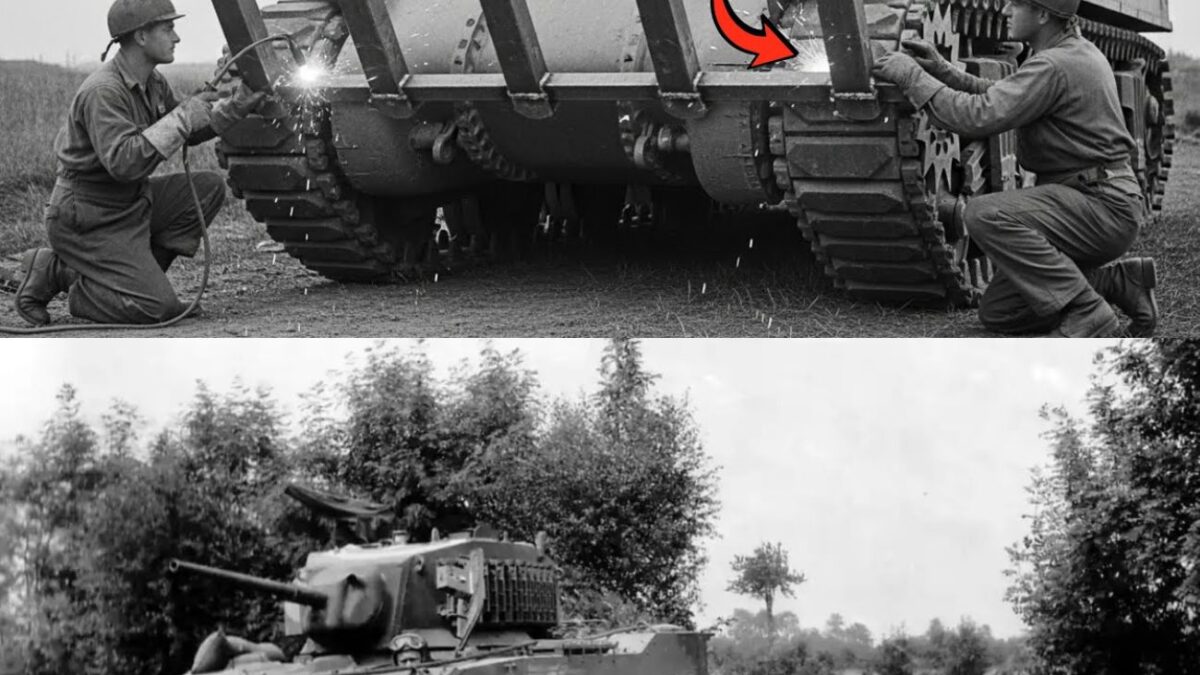
June 16th, 1944, at 08:15 hours, near Saint-Lô, Normandy, France, the morning fog hung heavy over the suffocating pastureland. The hedgerow rose twelve feet high, an immovable wall of compacted earth, tangled roots, and centuries of relentless wild growth. Sergeant Curtis Culin pressed his back against the cold armor plate of his Sherman tank, listening to the rhythmic snap of German Mausers.
From the unseen blind of the earthen barrier, MG 42 machine guns tore across the sunken pasture with terrible precision. In his dirt-caked hands, Culin gripped an assembly that would have appeared entirely absurd to any formal military engineer: four jagged steel prongs, roughly cut and tack-welded together in the crude shape of a heavy agricultural pitchfork.
The metal was salvaged from German beach obstacles—the formidable Czech hedgehogs that had failed to stop the Allied tide ten days earlier. Its edges were uneven, the torch burns were jagged, and the entire assembly resembled something cobbled together by a farmer to hoist hay. Through the green labyrinth, Culin caught the strained, desperate voices of his tank commander and the company officers.
Another Sherman sat disabled thirty yards to his left, tracks thrown and its terrified crew pinned down beneath blistering crossfire. The hedgerow directly ahead had turned into an impenetrable bastion where every traditional attempt to advance ended in butchery. Engineers attempting to blow passages with satchel charges and bangalores had been cut down before reaching the embankment.
For ten agonizing days, the American advance had been bleeding into the pastoral soil of the Norman countryside. Tanks that had survived the catastrophic artillery fire of Omaha Beach now sat helpless in enclosed pastures like cattle in an abattoir. Whenever a Sherman attempted to crawl over an earthen bank, its nose pointed skyward, completely blinding the driver and gunner.
That agonizing climb exposed the paper-thin underside belly armor directly to concealed German panzerfaust squads lying in wait. A single shaped charge would pierce the vulnerable belly plate, incinerating the fuel tanks and turning the crew compartment into an inferno. Infantrymen advancing without armored fire support were systematically butchered in the narrow sunken wagon lanes.
The arithmetic of death throughout the Norman bocage was horrifyingly direct, unyielding, and utterly predictable. Every single hedgerow breached cost an average of six American infantrymen and stripped precious momentum from the invasion front. There were over three thousand separate, heavily fortified hedgerows standing between the Normandy beaches and the crossroads at Saint-Lô.
At the current rate of attritional slaughter, the entire Allied campaign would collapse long before the armies ever reached open terrain. Culin looked down at the scrap-metal prongs, then at the towering hedgerow, and finally back at the improvised welding torch nearby. Within minutes, he intended to fix this crude scrap directly onto the lower hull of his tank and attempt what doctrine deemed impossible.
He planned to drive headlong into the ancient Norman embankment at combat speed, slicing through centuries of subterranean timber. If his concept worked, he would slice open the stalled Western Front and preserve thousands of young American lives from the meat grinder. If it failed, he would become just another charred statistic in the preliminary maneuvers of Operation Cobra, the breakout that had stalled.
The journey to this decisive test had begun eleven days prior, amidst the terrifying chaos of the initial landings. On June 6th, 1944, during the opening hours of D-Day, the world had focused solely on surviving the murderous fire of Omaha Beach. Sergeant Curtis Culin, a twenty-eight-year-old former New York City cab driver from Cranford, New Jersey, had enlisted in 1942.
Assigned to the 102nd Cavalry Reconnaissance Squadron of the 2nd Armored Division, he learned mechanics and tank driving at Fort Benning. His background in civilian life offered no formal technical prestige or prestigious military pedigree. He held no degree in engineering, had never drafted mechanical blueprints, and possessed little patience for textbook orthodoxy.
What Culin carried across the Atlantic was a sharp, street-level practicality honed by years of navigating congested Manhattan traffic. He possessed that rare, invaluable combat instinct: the capacity to look at an intractable deadlock and ask, “Why not try something else?” The initial landing at Omaha Beach had cost more than two thousand American casualties within the first bloody morning hours.
Culin’s unit rolled ashore during the chaotic logistics of D+1, tasked with thrusting inland to support the pinned-down infantry. Their operational orders were neat, confident, and utterly detached from the reality waiting beyond the coastal bluff. “Advance rapidly through the countryside, secure key road junctions, and shield the foot soldiers as they clear defensive positions.”
Nobody in high command had adequately accounted for the ancient, living architecture of the Norman bocage. These hedgerows were not simple garden hedges, but colossal agrarian ramparts constructed painstakingly over thousands of years. Norman farmers had piled stone, clay, and heavy loam into defensive dikes up to fifteen feet high to divide ancestral fields.
Generations of oak, ash, hawthorn, and blackthorn had woven dense roots throughout the mounds, creating natural reinforced concrete. From reconnaissance aircraft, Normandy resembled a patchwork quilt of lush, rolling meadows and picturesque apple orchards. From the eye-level perspective of a terrified rifleman, it was a terrifying labyrinth of sunken trenches and fortified kill-sacks.
The German Wehrmacht, having occupied the French countryside for four years, recognized the terrain’s lethal defensive value instantly. They transformed every earthen bank into a fortress, every ditch into an ambush trench, and every opening into a calibrated kill-zone. Machine guns were positioned to lay down interlocking grazing fire barely six inches above the churned mud.
Concealed anti-tank teams took up firing positions exactly where American tanks were forced to expose their fragile underbellies. Artillery and mortar crews had pre-sighted every gate, country road, and natural depression with mathematically brutal accuracy. American armored columns, organized and trained for sweeping maneuvers across wide-open plains, found themselves completely paralyzed.
Armored superiority meant nothing when thirty-ton vehicles were funneled into narrow lanes where they could neither turn nor maneuver. Air supremacy was rendered useless because dense tree canopies concealed enemy gun pits from roving fighter-bombers. Artillery support was paralyzed because forward observers could rarely see beyond the tangled branches of the immediate embankment.
Initial efforts to conquer the hedgerow maze relied strictly on standard, doctrinal combat engineering tactics. Engineers would crawl forward under suppressive fire to bury bundles of TNT, blowing a narrow gap in the dirt mound. Tanks would then attempt to rumble through the resulting breach, accompanied by squads of infantry scrambling behind for cover.
The German defenders simply waited for the explosive blast, brought their machine guns to bear, and massacred whatever emerged. American field officers tried every desperate permutation: sustained preliminary artillery barrages, smoke screens, and night assaults. Every tactical variation yielded the same catastrophic results: catastrophic casualties, negligible ground gained, and total tactical exhaustion.
By June 10th, the Allied offensive had devolved into a bloody, grinding crawl measured in agonizing yards rather than intended miles. Company casualty rosters swelled to unsustainable levels as morale plummeted among the veteran units and replacements alike. Sergeant Culin watched his own unit lose tank after tank to the exact same predictable, fatal tactical sequence.
A Sherman would attempt to claw its way over the crest of an earthen wall, its tracks slipping wildly in the damp loam. The front hull would rise toward the gray sky, turning its exposed belly plate straight into the sights of a hidden anti-tank team. A violent detonation would shake the earth, leaving another burning steel hull full of screaming men in the middle of a lane.
After watching yet another Sherman burn, Culin walked back to his company commander, Captain James DeBlanc, determined to speak. “Captain, why in hell do we keep climbing over these damned mounds? Why can’t we just drive straight through them?” DeBlanc, grey-faced with sleepless fatigue, gave the standard reply: “The banks are six feet thick and packed solid with roots.”
“Those root systems have been growing undisturbed since the Middle Ages. You hit that earth, and you just get stuck.” “Has anyone actually tried hitting one straight on at full speed?” Culin asked, leaning into the command vehicle. “Tried what? Ramming an ancient wall? You’d snap the drive sprockets, peel off the tracks, and leave the tank a sitting duck.”
Culin did not back down. “What if we weld teeth to the front? Heavy steel blades to cut the roots before they snag the chassis.” “And where do we get specialized cutting steel in the middle of combat? We can’t wait weeks for shipments from supply depots in England.” Culin turned and pointed back toward the north, toward the shoreline where the salt air still mingled with smoke.
“The beaches, sir. The Germans left thousands of tons of high-grade steel sitting right out on the tide line.” “Those hedgehogs and welded rails they put down to tear open landing craft—that stuff is just rusting in the surf.” DeBlanc rubbed his eyes, listening to the relentless thud of German mortar rounds landing two fields away in the tree line.
The beaches were indeed packed with thousands of twisted iron obstacles that had failed to hold back the initial Allied assault. “You honestly believe you can take that scrap, weld it onto a tank nose, and chop an ancient hedgerow down?” “I don’t know for certain, Captain. But it can’t possibly go worse than watching our boys burn alive every morning.”
DeBlanc made a field decision that would radically alter the tactical geometry of the Normandy campaign. “You have twenty-four hours, Sergeant. Take what men you need, get down to the beaches, find a torch, and build a test model.” “If that contraption works, I will personally push it to the battalion commander and put it on every tank we have left.”
Culin set out immediately for the shoreline, taking along Private John DePasso and Corporal William McDonald from his crew. They picked their way through the debris of the landing zones, scouring the wet sands for the highest-grade structural steel available. The best pieces were heavy angle irons and railroad rails that the Germans had driven deep into the sand to impale incoming landing craft.
These girders had been manufactured from dense, high-tensile carbon steel, ideally suited to endure immense structural pressure and shear forces. Using cutting torches salvaged from a mobile maintenance shop, the small team began slicing through the German beach obstacles. They hauled the jagged steel segments back to their maintenance bivouac aboard an open six-by-six supply truck.
That evening, Culin sat beneath an olive-drab tarp, sketching out rough mechanical schematics on the cardboard back of a K-ration carton. His design was unadorned and purely functional: four heavy, forward-projecting tines welded securely across a thick mounting beam. This reinforced mounting plate would be attached securely to the lower differential housing on the Sherman’s forward hull.
The tines had to be long enough to bite deep into the embankment, yet short enough not to restrict the main seventy-five-millimeter gun. They had to be balanced so the vehicle would not become dangerously nose-heavy when maneuvering across soft, mud-soaked pastures. Most importantly, the assembly had to be simple enough for an ordinary maintenance crew to fabricate with basic field equipment.
Throughout the night, under the sputtering blue hiss of oxyacetylene torches, the trio measured, hammered, and welded the prototype together. Sparks cascaded across the damp grass as they bent the glowing metal into sharp, forward-raking teeth with heavy sledgehammers. The finished device looked bizarre—a jagged, menacing iron comb that gave the rounded American tank the appearance of an angry mechanical boar.
When Captain DeBlanc inspected the contraption at first light, he circled the tank twice, shaking his head in sheer disbelief. “That unholy thing looks like a giant medieval pitchfork. You really expect this junk to cut through centuries-old trees?” “We’ll find out in about five minutes, sir,” Culin replied, wiping grease and sweat from his forehead with a sleeve.
At 06:00 hours on June 12th, they pulled the experimental tank up to a massive, untouched hedgerow behind the frontline positions. The test obstacle was an absolute monster: twelve feet high, seven feet thick at the base, and held by ancient hawthorn and oak roots. Lieutenant Colonel James Bates, commander of the 743rd Tank Battalion, arrived to observe the trial with obvious professional skepticism.
Culin climbed through the driver’s hatch, slammed the heavy hatch shut, and pulled his goggles tight over his eyes. DeBlanc raised his hand and signaled the advance: “Full throttle! Don’t let up for a second! Drive clean through the belly of it!” The Continental radial engine roared to life, churning up clouds of gray exhaust as the tank lurched forward into gear.
The Sherman accelerated across the open pasture, its crude iron tusks skimming just above the grass at twenty miles per hour. Spectators held their breath, fully expecting the tank to smash into the earthen rampart and grind its transmission to scrap. The impact was an earthquake of raw sound—metal screaming against compacted rock, shattering timber, and collapsing earth.
Inside the hull, Culin was slammed against the metal steering levers as thirty tons of charging armor met the ancient Norman barrier. For half a heartbeat, the machine seemed to hesitate, its rubber-chevron tracks biting fiercely into the turf as the engine wailed. Then, with a deafening crack that echoed across the field, the ancient root network gave way under the focused cutting points.
The four steel teeth dug deep into the core of the embankment, shearing through thick roots like heavy industrial axes. Instead of riding up the bank and exposing its soft belly, the Sherman stayed completely flat, its weight driving the blades forward. The upward sweep of the tines forced tons of dirt and shattered roots up and over the front hull, preventing a stall.
Ten seconds after the initial collision, the snout of the Sherman burst triumphantly through the far side of the hedgerow. Five seconds later, the entire vehicle rolled into the adjacent orchard amidst a roaring shower of shattered branches, dirt, and stone. Curtis Culin had carved a clean, ten-foot-wide assault breach directly through an obstacle that had paralyzed entire divisions for days.
The tank sat idling quietly among the apple trees, its improvised steel tines slightly scarred but completely structurally sound. Lieutenant Colonel Bates ran forward, his eyes wide as he inspected the freshly excavated passage cut through the living wall. The breach was level, clear of major debris, and wide enough for infantry and following vehicles to pour through instantly without slowing.
Bates spun around to face Captain DeBlanc, shouting over the rumble of the engine: “How fast can we manufacture these for the battalion?” “If we round up every welding rig and requisition every piece of beach iron within five miles, maybe forty-eight hours, sir.” “You have twenty-four,” Bates ordered flatly. “I want this gear mounted on every Sherman in this command before sunset tomorrow.”
“I am notifying General Bradley’s staff at First Army immediately. This isn’t just an experiment anymore; it’s our way out of this hell.” The news of Culin’s crude hedgerow cutter swept through the frontline divisions like an electric current through dry wire. By June 13th, the rear staging areas resembled an enormous, open-air blacksmith shop running twenty-four hours a day under blackout canopies.
Soldiers immediately christened the modified tanks “Rhinos,” referencing the lethal steel horns protruding menacingly from their noses. Others simply referred to them with deep affection and profane relief as “Culin Cutters” or “Hedgerow Chippers.” The underlying mechanics of the device were a masterclass in straightforward, unpretentious, practical physics under battlefield conditions.
Instead of dissipating the tank’s kinetic energy across the broad, curved face of the lower bow, the tines concentrated that force. The impact force was focused into narrow points of extreme pressure, shearing through structural root systems instead of compressing them. Simultaneously, the lower tines lifted the dirt upward, transferring the soil’s weight and clearing a level path for the tracks.
Its greatest operational advantage was its sheer, unadorned simplicity: it required no precision manufacturing or imported spare parts. Any three mechanics with a basic welding kit and a pile of scrap beach obstacles could assemble a complete cutter in three hours. The beaches still held thousands of tons of Czech hedgehogs and twisted rails, turning the enemy’s beach defenses against their own inland positions.
By June 15th, over five hundred Sherman tanks throughout First Army had been equipped with Culin’s improvised steel cutters. The sudden appearance of these modified fighting vehicles fundamentally transformed the operational realities of the Normandy campaign overnight. The catastrophic vulnerability that had paralyzed American armored doctrine during the first ten days of the invasion was broken.
Before the introduction of the cutter, breaching an obstacle required careful, multi-branch choreography between combat engineers, artillery, and infantry. The entire clumsy process took anywhere from fifteen to forty minutes per hedgerow, exposing ground troops to pre-aimed defensive fire. Now, a single Rhino tank could punch an assault gap through an ancient embankment in less than fifteen seconds flat.
That incredible speed obliterated the foundational tactics of the German defense, which relied on bottling up attackers in predictable choke-points. Anti-tank teams waiting patiently to ambush vehicles as they crawled over the mounds found themselves suddenly overrun from unexpected directions. The Rhinos did not wait for existing gaps or narrow road lanes; they tore straight through the solid walls of green.
On June 18th, during preliminary assaults leading toward Saint-Lô, the 2nd Armored Division unleashed its new Rhino tanks en masse. Units that had previously measured daily advances in bloody yards surged forward three full miles through the dense bocage in one morning. More importantly, the casualty rosters reflected an astonishing, immediate plummet that stunned the field surgeons at the rear hospitals.
Infantry casualties dropped by approximately sixty percent in sectors where Rhino tanks led the tactical advance through the hedgerows. Armored vehicle losses plummeted by more than seventy percent as crews remained level, protected, and fully capable of returning fire. A piece of scrap metal salvaged from the tide was saving hundreds of American soldiers from gruesome deaths every single day.
General Omar Bradley, commanding the U.S. First Army, received initial field reports regarding the device with profound personal astonishment. He had spent weeks agonizing over the butcher’s bill in the bocage, watching his grand strategic plans disintegrate into static trench-style slaughter. After witnessing an in-person field demonstration outside Isigny, Bradley bypassed standard ordnance procurement bureaucracy entirely.
He ordered that every available medium tank, tank destroyer, and heavy recovery vehicle receive a Culin cutter with absolute priority. Depots in England were ordered to strip additional structural steel from coastal defenses and fly it across the Channel in transport aircraft. Field maintenance units worked through rain and artillery fire, turning hundreds of tons of German steel into offensive breach weapons.
The German response to the sudden appearance of the Rhino tanks revealed their total operational shock and tactical dislocation. A captured intelligence dispatch from the German 352nd Infantry Division, dated June 22nd, described the terrifying collapse of their line: “Enemy armored vehicles are penetrating our fortified hedgerows with incomprehensible velocity, ignoring all established terrain limitations.”
“Our defensive positions, designed to exploit the natural barriers of the bocage, are being outflanked and crushed from within seconds.” “The enemy appears to employ an unknown heavy cutting device that severs roots and earth instantaneously. Tactical redeployment is imperative.” Another captured field letter from an anti-tank gunner serving in the elite Panzer Lehr Division was far more visceral:
“The Americans have somehow conquered the bocage. The sunken banks we turned into impregnable strongpoints have become death traps for our infantry.” “We cannot hold them in the choke-points anymore. Their tanks emerge straight through the living walls like ghosts and crush our pits.” When an enemy is forced to fundamentally overhaul their entire defensive doctrine within forty-eight hours, the battlefield has shifted permanently.
The tactical implications extended far beyond simply punching holes through dirt banks to allow movement from field to field. With Rhino-equipped tanks, the U.S. Army could finally execute the fluid combined-arms operations they had practiced for years. Tanks blew through walls to deliver devastating point-blank cannon and machine-gun fire, clearing trenches while infantry poured through behind them.
Mortar teams and artillery spotters could keep pace with the vanguard, maintaining pressure and denying the enemy time to reorganize. The fundamental premise of the German defensive plan in the West was that the Norman terrain would buy time for reinforcements. Curtis Culin’s unpretentious scrap-metal pitchfork completely shattered that premise, collapsing the timetable the German High Command relied upon.
The story of how the cutter was adopted reveals an essential, defining truth regarding the nature of the American war effort. Curtis Culin was not a decorated general, a West Point theorist, or a university-trained structural engineer from an elite laboratory. He was a working-class cab driver from the paved streets of New Jersey who possessed common sense and an eye for mechanics.
The American military structure in 1944, for all its bureaucratic faults and growing pains, preserved an essential pragmatic flexibility. Captain DeBlanc could have easily dismissed the suggestion as insubordinate nonsense from an enlisted man who should know his place. Lieutenant Colonel Bates could have buried the concept under standard army regulations, demanding formal testing approvals from back home.
General Bradley could have insisted that any official hull modification pass through the Ordnance Department in Washington, D.C. Instead, at every link in the chain of command, battle-tested officers looked at the reality of combat and asked: “Does it work?” When the answer came back as an undeniable yes, institutional arrogance evaporated, clearing the path for immediate frontline deployment.
This adaptive pragmatism contrasted sharply with the rigid, centralized command culture that increasingly stifled the German Wehrmacht. German engineering was often brilliant, producing formidable weapon systems like the Panther tank and advanced optical targeting equipment. Yet their military hierarchy prioritized top-down control, rigid adherence to doctrine, and an obsessive reliance on centralized design bureaus.
The idea that a lowly field sergeant could revolutionize armor tactics using scrap metal would have struggled within the German staff system. Even if a German non-commissioned officer had built such a device, it would have faced months of bureaucratic trials and political scrutiny. The American army took Culin’s idea from a muddy field sketch to army-wide combat deployment in less than fourteen days.
By the time Operation Cobra launched on July 25th, over three out of every five Shermans carried Culin’s steel teeth. The psychological impact on the frontline troops was just as profound as the cold physical mathematics of the casualty reduction. For weeks after the beachhead landings, American soldiers had felt trapped within a verdant tomb that favored the hidden defender.
A palpable dread had settled over the infantry, who watched their friends butchered at every blind corner and sunken hedgerow lane. The sight of the Rhino tanks tearing through those ancient walls restored the offensive spirit of the entire Allied force. The bocage was no longer an insurmountable natural barrier; it was merely an obstacle to be smashed, cleared, and left behind.
A weathered pocket diary recovered from an infantryman in the 29th Division captures this dramatic psychological turning point: June 10th: “The hedgerows are eating us alive. We can’t see fifty feet. Every field costs twenty men. It feels like we’ll never get out.” June 26th: “Our tanks have big steel tusks on their noses now. They rip right through the banks like paper. We are running them down.”
When the massive carpet-bombing of Operation Cobra blasted a corridor through the German lines west of Saint-Lô, the armor surged. Without the Culin cutters, the armored divisions would have been funneled straight into pre-sighted German kill-zones along the highways. With the cutters, the 2nd and 3rd Armored Divisions burst through the hedgerows in parallel assault columns, outflanking the enemy.
They drove over sixty miles during the first week of the breakout, liberating town after town and unhinging the German defensive line. Military historians studying the European theater consistently identify Culin’s field innovation as a critical turning point of the Normandy campaign. Major General James Gavin of the 82nd Airborne Division wrote that without the hedgerow cutter, the Allied advance would have stalled indefinitely.
He noted that the political and human cost of grinding through the bocage into the autumn would have been utterly catastrophic for the Allies. The cold, undeniable casualty statistics stand as the ultimate monument to the impact of Culin’s scrap-metal invention. Between D-Day and June 15th, before the cutter’s widespread adoption, First Army suffered roughly fifteen thousand casualties advancing just two miles inland.
Between June 20th and July 31st, after the Rhino tanks entered combat, forces took eighteen thousand casualties while conquering sixty miles. The device did not make war gentle or bloodless, but it broke the deadly bottleneck that had threatened the entire liberation of Europe. Conservative estimates calculated by military analysts conclude that the Culin cutter saved at least four thousand American lives in Normandy.
Yet, despite the monumental scale of his contribution, Sergeant Curtis Culin never received widespread public fame or personal wealth. In official battle reports, the device was typically referred to by dry titles like “Hedgerow Breaching Device, Type One.” Culin’s name was mentioned in local unit dispatches, but largely vanished from higher-level press releases and historical summaries.
This anonymity was partly due to the frantic pace of the war, where frontline innovations were quickly absorbed into the standard machinery. It was also because dozens of maintenance crews immediately developed their own subtle variations of Culin’s basic four-prong layout. Some crews used six teeth, some used angled blades, and some reinforced the mounting plates with recovered railroad track steel.
In the thunderous rush toward Paris and the German border, tracking down the humble sergeant who started it all seemed unimportant. For his part, Curtis Culin never sought out glory, financial compensation, or personal recognition for what he had constructed. Whenever journalists or fellow soldiers asked him about his invention in later years, he invariably dismissed his role with quiet humility.
“We had a problem that was killing our boys, and nobody had a fix for it, so I tried something different. That’s all.” “A lot of guys were thinking the exact same thing; I just happened to find the steel and the welding rig first.” “The real credit belongs to Captain DeBlanc and the officers who had the guts to let us try something crazy.”
Culin survived the brutal combat of the European theater without sustaining serious injury, rolling with his unit through Belgium and into Germany. He was awarded the Legion of Merit and a Bronze Star, though his citations spoke broadly of meritorious service rather than the cutter. When the guns fell silent in 1945, Culin returned home to Cranford, New Jersey, quietly picking up his life where he had left it.
He went back to work, driving his taxi through the busy streets of the New York metropolitan area to provide for his family. He married, raised three children, joined his local veterans’ organization, and lived an unassuming, remarkably quiet civilian existence. He never boasted of his service, never displayed his medals, and rarely spoke about the war unless someone pressed him with direct questions.
In a rare 1958 newspaper interview, an aging Culin was asked if he felt proud when he thought about the lives his device had preserved. He looked down at his rough, working hands, fell silent for a long moment, and offered a deeply moving, quiet response: “I don’t think much about the lives that were saved. I think about the boys who died before we figured out how to cut the dirt.”
“If I had been a little smarter and thought of that steel fork a week earlier, a lot of good men would have made it home.” Curtis Culin died in March of 1963 at the age of forty-seven, his heart giving out after years of hard, honest work. His modest obituary in the Cranford Chronicle spoke warmly of his work as a driver, his devotion to family, and his local community ties.
His world-altering invention—the humble hedge cutter that cracked the German line in France—was not even mentioned in the text. Decades later, the National World War II Museum in New Orleans recovered an original Culin cutter from a hedgerow outside Saint-Lô. It now rests on display behind glass, its jagged, hand-welded steel tines preserved as a testament to working-class battlefield ingenuity.
The museum placard reads: “Invented by Sergeant Curtis G. Culin of the 2nd Armored Division, this device transformed the Battle of Normandy.” “Constructed from scrap German beach obstacles, it allowed American armor to smash the bocage hedgerows that had paralyzed the invasion.” “Historical analyses estimate that this single crude innovation preserved more than four thousand American lives during the campaign.”
The operational lessons embodied by Culin’s achievement remain deeply studied in modern military academies and tactical command centers today. First, formal institutional expertise can often blind organizations to obvious, practical solutions that lie just outside established doctrine. The formally trained engineers insisted the ancient roots could not be severed; the cab driver unburdened by theory simply went and cut them.
Second, speed of field adoption is often the difference between absolute strategic victory and prolonged, bloody catastrophe. The willingness of American command to bypass procurement channels and equip five hundred tanks in two weeks altered world history. Third, simplicity is the ultimate virtue when design must scale under the terrifying pressures of modern industrial warfare.
If the hedgerow cutter had required complex hydraulic lines or precision machining, it could never have been mass-produced on the beaches. Its violent, primitive simplicity allowed ordinary frontline mechanics to turn enemy obstacles into breakthrough tools within hours. Fourth, a successful military culture must always remain humble enough to welcome brilliant insights from the bottom of its hierarchy.
Organizations that filter truth and problem-solving through rank, diplomas, and official status inevitably collapse when confronted with chaos. Finally, the enduring story of the Culin cutter serves as an eternal reminder that the individual soldier still commands the battlefield. One sergeant, armed with a welding torch, common sense, and the refusal to accept that defeat was inevitable, saved an entire army.
Today, eighty years after the invasion, the quiet hedgerow country of Normandy still bears the physical scars of that desperate summer. If you walk the sunken cow lanes near Saint-Lô, you can still find wide, unnatural gaps punched through the ancient earthen banks. Local French farmers plowing their ancestral fields still occasionally uncover jagged, rusted chunks of iron buried deep in the dirt.
They are the broken teeth of Curtis Culin’s Rhino tanks, quietly resting where they struck the ancient earth in the summer of 1944. Those rusted scraps of iron are not mere artifacts of mechanical history; they are the physical remnants of pure, unadorned courage. They broke an impossible barrier, ended the bloody stalemate in the bocage, and cleared the road toward the liberation of Europe.

