They Found the Wrecks of 220 Men, But Something Was Very Wrong
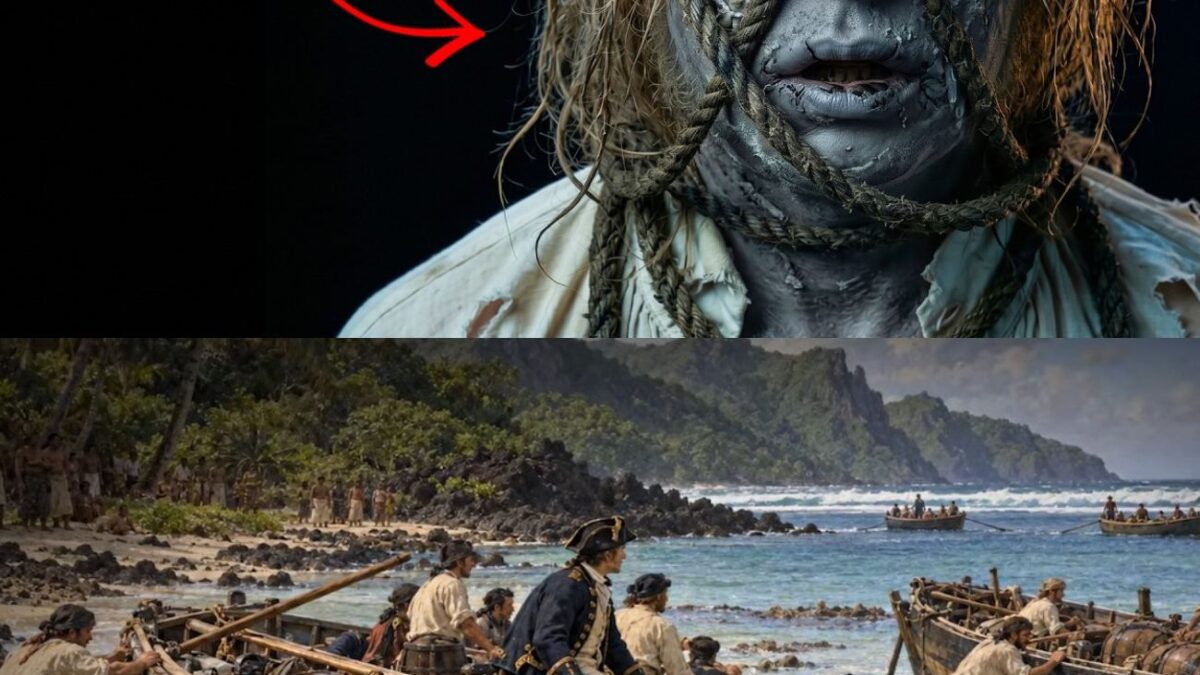
Two wooden vessels shattered against the sharp coral of an isolated Pacific reef over two centuries ago, yet the enduring riddle has never been the splintered timber. The true enigma lies with the sailors who pulled themselves from the pounding surf, bloodied and gasping, onto an unfamiliar shore. Their vanishing act transformed a proud national venture into one of the most haunting maritime ghost stories ever recorded in human history.
This was not a band of hapless merchants or careless adventurers who wandered blindly into danger across uncharted waters. This was the grand French scientific expedition commanded by Jean-François de Galaup, comte de Lapérouse, launched with immense imperial fanfare in the year 1785. King Louis the Sixteenth had personally scrutinized, annotated, and financed the enterprise as the Bourbon monarchy’s definitive answer to the legendary Pacific voyages of Captain James Cook.
Every detail of the royal mission was engineered to ensure that absolute disaster would remain entirely out of reach. Two formidable former merchant freighters, the Boussole and the Astrolabe, were refitted with heavy oak hulls and provisioned to act as mirrored counterparts. If one vessel ran aground, succumbed to hull rot, or foundered in a gale, the sister ship stood ready to absorb her complement and complete the royal mandate.
Aboard those two ships was a floating community of two hundred and twenty souls handpicked from the intellectual elite of the Enlightenment. Along with hardened blue-water sailors and aristocratic naval officers, there were natural philosophers, mapmakers, celestial astronomers, landscape painters, botanists, and a master gardener. They operated as a self-sustaining Enlightenment machine, sent to measure, illustrate, catalog, and chart the final blank expanses of the global maritime map.
For three remarkable years, the complex clockwork of the royal expedition performed its duties with brilliant, methodical precision. Enormous crates of dried pressed plants, bottled sea creatures, celestial tables, and intricate coastal soundings flowed steadily back to Paris via friendly ports of call. The officers were men who could calculate longitude by lunar distances, repair complex brass quadrants, and reconstruct their landing boats from raw lumber.
Yet beneath that formidable veneer of intellectual mastery, the expedition had been bleeding men and morale long before it ever sighted its fatal reef. The ocean possesses a cruel habit of puncturing human arrogance, and the first devastating wound struck along the misty, forbidding fjords of Alaska. A surveying party sent in small rowboats to sound the entrance of a treacherous bay was drawn into the swirling rapids of a ferocious tidal surge.
Twenty-one officers and seamen were dragged down into the freezing breakers within sight of their terrified shipmates, leaving no bodies to bury. Lapérouse searched the rocky shoreline for agonizing days, openly weeping before his assembled men as the magnitude of the disaster settled over the fleet. Before weighing anchor, the survivors buried an inscribed glass bottle upon the lonely beach, naming each lost soul and dedicating the headland to their memory.
The second catastrophic blow fell in the tropical warmth of the Samoan archipelago, carrying a darker and more chaotic kind of horror. A shore party led by the commander of the Astrolabe, Captain de Langle, took several longboats into a shallow cove to refill their depleted water barrels. As the tide steadily retreated, the heavy wooden boats scraped against the seabed, leaving the Frenchmen utterly immobilized in the murky shallows.
A vast crowd of local islanders gathered along the tree line, watching the stranded strangers with growing agitation as negotiations deteriorated into shouting. Stones whistled through the humid air, cracking wooden gunwales and striking flesh, prompting the terrified sailors to discharge their heavy muskets directly into the mass. In the vicious, hand-to-hand melee that followed, Captain de Langle and eleven of his companions, including brilliant naturalist Robert de Paul Lamanon, were bludgeoned to death.
The remaining men barely escaped by swimming out toward the safety of the rolling breakers, leaving their commander’s battered body in the surf. This deadly encounter was later painted in European histories as a simple act of native treachery, but the reality was far more nuanced and tragic. It was a chaotic clash born of cultural incomprehension, grounded boats, defensive panic, and lethal gunfire erupting between men who possessed no shared language.
When the two bruised ships finally cleared the islands, they carried a shattered company that was running desperately short of irreplaceable talent. Yet despite the grief and paranoia taking root among the crews, the expedition retained its legendary capacity for physical survival and adaptation. Their remarkable resilience was demonstrated once more when both battered ships arrived on the sunbaked coast of Australia in early 1788.
By an astonishing coincidence of history, the French vessels entered Botany Bay just as the British First Fleet was establishing the penal colony at Port Jackson. The British naval officers and their unexpected French visitors treated one another with the delicate, dignified courtesy customary among eighteenth-century European rivals. While resting in the bay, Lapérouse and his men turned their energies toward repairing their operational capacity with focused determination.
Having lost several vital landing crafts in the Samoan disaster, the French carpenters established a bustling timber yard along the sandy Australian shore. Using raw local lumber alongside spare ribs and planks carried deep within their cargo holds, they built brand-new replacement boats from the keel up. They proved beyond any doubt that they were craftsmen who could reconstruct an amphibious fleet in the middle of a wilderness using only their hands.
While resting in Botany Bay, Lapérouse also made a thoughtful decision that would ultimately rescue his life’s work from total oblivion. Knowing the immense perils of the route ahead, he bundled together his navigational charts, ship logs, and letters, handing them over to British captains sailing home. Those entrusted dispatches are the single reason modern history possesses an intimate, day-to-day record of the expedition’s first three extraordinary years.
Within those final written dispatches, the French commander laid out his ambitious navigational trajectory across the southwest Pacific with calm optimism. He intended to traverse the islands of New Caledonia, weave through the Santa Cruz group, chart the Solomon Islands, and reach home by late 1789. With their holds replenished, the Boussole and the Astrolabe weighed anchor, cleared the sandstone heads of Botany Bay, and dissolved into the horizon.
That parting view from the decks of the British transports was the last time any European observer ever laid eyes upon the expedition. Days bled into months, the seasons shifted, and the expected date of their triumphant arrival in French ports quietly passed without a whisper. A scientific armada that had faithfully reported from the far corners of the earth had suddenly fallen completely and profoundly silent.
Back home in Paris, the French nation was rapidly tumbling into the violent, transformative chaos of the French Revolution. Yet even as the ancien régime cracked and the guillotine was erected, the missing explorers were never entirely forgotten by their anxious countrymen. In 1791, the Revolutionary National Assembly commissioned a well-armed relief expedition under the command of Antoine d’Entrecasteaux to retrace Lapérouse’s proposed course.
The subsequent search became one of maritime history’s most tragic near-misses, marked by bad weather, scurvy, and the vast, deceptive emptiness of the ocean. In May 1793, d’Entrecasteaux’s ships sailed within forty miles of a remote, jungle-choked volcanic island fringed by a wicked barrier of coral. The French rescuers scanned the mist, noted the jagged terrain, named the speck of land Île de la Recherche, and kept their course, completely oblivious.
Over the decades, a dramatic myth arose claiming the rescue fleet had spotted smoke rising from the island but callously sailed away. That tale is an unfortunate distortion that carelessly blends two entirely separate maritime encounters spanning several years of Pacific seafaring. One passing merchant vessel had indeed noted distant smoke without spotting distress signals, while d’Entrecasteaux never came close enough to read the beach at all.
The genuine truth is infinitely sadder than deliberate abandonment; the rescue ships came within a single day’s sail and simply missed the target. The ocean was too immense, the coordinates too vague, and the tiny island remained shrouded in its veil of impenetrable silence. For nearly four decades, the fate of Lapérouse, his ships, and his two hundred and twenty men remained a blank expanse upon the map.
The first physical thread of the unraveling mystery was pulled not by a naval armada, but by an eccentric Irish merchant named Peter Dillon. In 1826, while trading aboard his vessel, the St. Patrick, Dillon put ashore at the small Polynesian island of Tikopia. There, in the hands of an old Prussian castaway living among the islanders, Dillon spotted an ornate silver sword guard engraved in the unmistakable French style.
When pressed, the islanders explained that the sword hilt was part of a great store of metal salvaged from an island far to the west. They spoke of a place called Vanikoro, where two massive foreign ships had crashed upon the surrounding barrier reef during an ancient, howling midnight tempest. Dillon immediately recognized the historical gravity of the relic, purchased the silver guard, and embarked on an obsessive quest to locate the graveyard.
In 1827, Dillon navigated his ship through the jagged passages of Vanikoro’s barrier reef, gazing upon the emerald slopes of the very island d’Entrecasteaux had missed. What he discovered in the shallow waters inside the reef was absolute, unambiguous proof of the great expedition’s violent and catastrophic end. Lying amid the coral garden were rusted iron anchors, heavy bronze cannons, ship fasteners, and shattered porcelain plates bearing the insignia of the French navy.
Dillon transported the salvaged treasures back to Europe, where elderly relatives and surviving contemporaries wept as they identified items belonging to their long-lost kin. The mystery of where the ships had vanished had finally been solved, yet Dillon’s discovery instantly spawned an even deeper, more urgent question. What had become of the men who clawed their way out of the raging surf and onto the shores of Vanikoro?
The island’s oral tradition, recounted by tribal elders who were children during the catastrophe, told a story that was unexpected and deeply human. They did not speak of two hundred corpses washing up along the sand, but of living castaways who had gathered themselves together on the beach. According to these island testimonies, a determined group of white men had established a fortified encampment, living along the forested shoreline for many moons.
For over a century, those native accounts remained compelling oral literature, revered by maritime historians but lacking absolute archaeological corroboration. That missing physical confirmation would have to wait for the late twentieth and early twenty-first centuries, when modern underwater and terrestrial excavations commenced. Marine archaeologists and deep divers returned to Vanikoro with modern sonar, magnetometer equipment, and archival blueprints from the French Naval Ministry.
Their underwater mapping revealed not just one jumbled debris field, but two entirely distinct wreck sites situated roughly a mile apart along the reef. Crucially, the physical condition of the two wrecks told vastly different stories about how the two sister ships had met their deaths. The first vessel had collided head-on with a deep volcanic fault in the coral shelf, torn apart instantly by the terrifying kinetic violence of the surf.
Her heavy oak timbers had been shredded like kindling, scattering cannons, ballast stones, and delicate glassware across a vertical underwater chasm. The second vessel, however, had sailed into what appeared from the open sea to be a safe, navigable passage through the outer reef. Instead, she had drifted into a deceptive dead-end channel, grounding hard against the shallow coral floor without immediately disintegrating under the ocean’s fury.
That mechanical distinction was of paramount significance to the survival of the men aboard the two doomed French exploration ships. A ship shattered against an outer reef leaves her crew to drown in the churning wash, tossed like rags against stone. A ship that wedges herself into a shallow lagoon offers her people the precious gift of time, allowing them to salvage food, tools, and weapons.
To confirm the identities of the two wrecks, researchers required something far more definitive than speculation and hull dimensions. The breakthrough came from the sediment: a brass sextant, carefully inscribed with the name of the instrument maker Merceron. A frantic cross-check of the eighteenth-century naval archives in Paris revealed that Merceron had supplied the precision navigational gear exclusively for the flagship Boussole.
With that single discovery, the pieces locked into place: the flagship had grounded in the shallows, while the Astrolabe had been obliterated at the fault. Yet archaeologists working in marine environments are always acutely aware that relics move across ocean beds over the passage of long centuries. Storms sweep loose artifacts through channels, and generations of islanders had dived the warm shallows to recover iron and brass for tools and trade.
While an artifact can reveal who manufactured or carried it, an object alone cannot tell you whose hands gripped it during its final moments. That haunting reality became painfully clear when divers working the violent fault site made a discovery that sent shockwaves through the historical community. Resting deep within the living coral, undisturbed by tides and fish for more than two centuries, lay the near-complete skeleton of an expedition member.
Here, pulled from the depths of the Pacific, was the physical embodiment of the tragedy: one of the two hundred and twenty men who had vanished. The discovery ignited an intensive scientific effort to give this forgotten maritime traveler his identity and his personal history back. French forensic pathologists, physical anthropologists, and geneticists marshaled the full diagnostic arsenal of twenty-first-century medical science to solve the puzzle.
They established that the skeleton belonged to a European male of robust build, roughly one point seven meters tall, with healthy, well-preserved teeth. Using sophisticated craniofacial reconstruction techniques, forensic artists rebuilt muscle tissue, skin, and cartilage over a resin cast of the recovered skull. For the first time in more than two hundred years, the modern world could look directly into the eyes of a Lapérouse voyager.
Yet the science also conclusively proved who the man was not, instantly dispelling hopes that they had found the commander himself. Lapérouse was an aging, battle-worn veteran who had written in his dispatches from Australia that his hair was thinning and his teeth were failing. The young, healthy bones extracted from the coral fault belonged to someone else entirely, perhaps a junior officer, a naturalist, or a midshipman.
Every subsequent high-tech method deployed to definitively identify the remains, including fragile ancient DNA extraction and genealogical tracking, ultimately yielded ambiguous results. The team was left with a poignant paradox: they held his bones, they knew his face, yet they could not speak his name. He remains an emblem of the entire expedition, an intimately known comrade who is simultaneously lost to the vast anonymity of time.
If modern science could not name the solitary physical body pulled from the reef, what could be learned about the men who survived? The answer was waiting to be uncovered not in the shifting waters of the lagoon, but beneath the thick jungle floor of Vanikoro. Guided by local traditions that pointed toward a coastal clearing near the Paiou River, archaeologists began methodically peeling back the rich volcanic soil.
What they uncovered was not a random scatter of storm-tossed driftwood, but the unmistakable footprint of an organized, military-grade encampment. In a dense, concentrated zone just beyond the high-tide line, the earth yielded hundreds of eighteenth-century artifacts deliberately transported from the wrecks. There were uniform buttons, lead musket balls, French and Spanish silver coins, carpenter chisels, hand axes, and broken fragments of fine Chinese porcelain.
Most evocative of all was a small, beautifully calibrated navigational pocket compass, stamped with the mark of its Parisian manufacturer. This was not the sort of cargo an illiterate seaman stuffed into his pockets while swimming for his life through crashing waves. This was the deliberate, salvaged equipment of a professional naval officer setting up shop on a hostile shore, determined to maintain order.
The campfire ash, the arranged lines of defensive post holes, and the concentrated debris proved beyond debate that a sizable company made it ashore. The survival question that had tormented historians for generations was finally answered: men had lived through the catastrophe and conquered the reef. Yet that victory only served to frame the ultimate, agonizing dilemma faced by those castaways in the early summer of 1788.
Vanikoro was a mountainous, rain-drenched island smothered in dense jungle, infested with malaria-carrying mosquitoes, and inhabited by wary, defensive populations. The castaways possessed salvaged firearms and carpentry tools, but they were thousands of miles from the nearest European outpost with no hope of rescue. They were brilliant, worldly navigators who knew the brutal mathematics of the Pacific better than any group of men alive on earth.
They understood that Europe had no idea they had wrecked here, and they knew the chances of a ship finding this island were negligible. Waiting on the beach meant a slow, inevitable death from fever, gangrene, starvation, or eventual conflict with the watchful indigenous tribes. Their only alternative was an undertaking so daring it bordered on absolute madness: they had to construct their own ocean-going salvation.
They possessed no dry dock, no steam saws, no seasoned naval oak, and no specialized shipwright facilities to shape structural timbers. What they did possess, however, was the indestructible institutional memory of the Enlightenment and a crew of men who knew how to build. They had already survived the murderous rip-tides of Alaska and the terrifying ambush at Samoa; they had built wooden boats in Botany Bay.
Working under the baking tropical sun and through torrential rainstorms, the survivors dragged raw timber down to their fortified encampment. They pried iron bolts, copper sheathing, and structural knees from the accessible skeleton of the grounded Boussole resting in the lagoon. Combining seasoned ship timber with felled island trees, the castaways began laying the keel of a two-masted, ocean-going pinnace.
Imagine the sound of those iron hammers echoing off the volcanic ridges of Vanikoro, day after day, week after desperate week. Astronomers helped calculate load balances; naval officers oversaw the alignment of the framing; common sailors swung adzes until their palms were raw. It was a staggering triumph of human will, an isolated community refusing to lay down and perish in the tropical mud.
When the improvised vessel was finally caulked with boiled tree sap, rigged with salvaged canvas, and launched into the sheltered water, choices were made. Some accounts preserved by the islanders suggest that a few men, broken by fever or fearful of the open ocean, elected to stay behind. But the vast majority of the survivors, perhaps thirty to fifty men, climbed aboard their handmade vessel, pushed out through the reef, and sailed west.
This is the precise moment where the historical narrative should reach a soaring, triumphant climax, celebrating the indomitable genius of the human spirit. The resourceful castaways, having stared into the abyss of total oblivion, had fashioned their own salvation and conquered the merciless Pacific. Yet it is here, where the boat clears the breaking white foam of the outer reef, that the historical trail turns utterly cold.
No recognizable wreckage of that small, handmade escape vessel has ever been located on any coral reef or atoll in Oceania. No written logbook survived to tell the story of their ocean voyage; no skeletal remains were ever matched to the fleeing crew. The men who had surveyed the far corners of the earth sailed over the edge of the blue horizon and vanished into absolute nothingness.
Over the centuries, tantalizing whispers and historical ghosts have drifted across the western Pacific, offering fleeting hints of their ultimate fate. In 1818, an English merchant vessel anchored in the Torres Strait, that treacherous passage of water separating northern Australia from New Guinea. The crew heard accounts of European artifacts held by islanders and a tale of a foreign boat that had arrived decades prior.
The story spoke of a desperate battle on the beach, of white men who had been slain, and of a solitary young boy who escaped into the mangroves. Chronologically, the date aligned; geographically, the Torres Strait sat directly along the logical escape trajectory toward the Dutch colonies in the East Indies. It is desperately tempting to seize upon that fragmentary story and declare that the mystery of the Lapérouse expedition has finally found its conclusion.
Yet responsible historical science demands that we refrain from treating an intriguing possibility as if it were an established, documented fact. Not a single artifact recovered from the Torres Strait has ever been tied definitively to the French expedition or its missing ships. The tale could easily describe the forgotten massacre of some unnamed Dutch trading schooner or an unrecorded English whaler lost in the passage.
The Torres Strait encounter remains what it has always been: a tragic, evocative shadow that mirrors the shape of the mystery without solving it. The last place where we can anchor the living survivors of the expedition with undeniable material certainty remains that beach at Vanikoro. Beyond the breaking waves of that jagged barrier reef, all certainty disintegrates into the swirling, indifferent currents of the deep open ocean.
There is one final cultural artifact belonging to this saga, though it exists within the fragile realm of national memory rather than physical evidence. In January 1793, King Louis the Sixteenth mounted the wooden scaffold in the center of revolutionary Paris to face the cold iron guillotine. A persistent French legend insists that as the doomed monarch stood before his executioners, he asked his final question: “Is there any news of Lapérouse?”
It is an unforgettable, poetic image: a king whose empire was collapsing beneath him, his thoughts drifting toward the explorers he had sent away. Whether those famous words were truly uttered or merely invented by nostalgic royalists seeking dignity in death, they capture the expedition’s enduring hold. Lapérouse and his company were the radiant champions of an optimistic age, swallowed whole by the darkness of the sea and history.
When we strip away the romantic myths and examine the cold, unyielding physical evidence, we are left with a profoundly humbling picture. Out of two hundred and twenty men who ventured out to measure the globe, modern science has physically recovered precisely one solitary human being. We restored the flesh to his reconstructed face, we measured his limbs, we analyzed his teeth, yet he remains entirely nameless.
That unidentified sailor was eventually transported back across the world to France, laid to rest in a military crypt beneath an honoring marble slab. He rests as a permanent representative of his vanished shipmates: a known member of the king’s great expedition, an eternally unknown man. His silent tomb reflects the overarching truth of everything recovered from the reefs and jungles of that remote Pacific graveyard.
Archaeologists found the shattered ships, deciphered their identities from the coral, and proved beyond doubt that men fought their way onto the beach. We know they established an orderly camp, that they refused to surrender to despair, and that they built an escape boat with their hands. We can track their desperate footsteps across the sand right to the outer edge of the coral reef where the deep water begins.
There, where the barrier ends and the vast ocean opens its jaws to the sky, they sailed out into the great silence. They stepped beyond the limits of human knowledge, leaving behind a handful of brass instruments, some iron cannons, and an enduring mystery. The map of their final voyage remains as blank and unreadable today as the wild Pacific waters they set out to tame.

