They Called His Gunner Position the “Suicide Seat” — Until He Downed 14 Bombers
On September 6, 1943, at twenty-five thousand feet above Stuttgart, Germany, the thin air inside the B-17 Flying Fortress known as Tandelio was bitter, violent, and unrelenting.
Staff Sergeant Michael Louis Arouth hunched low inside the plexiglass bubble at the absolute tail of the aircraft, feeling the freezing crosswinds rattle against the aluminum skin.
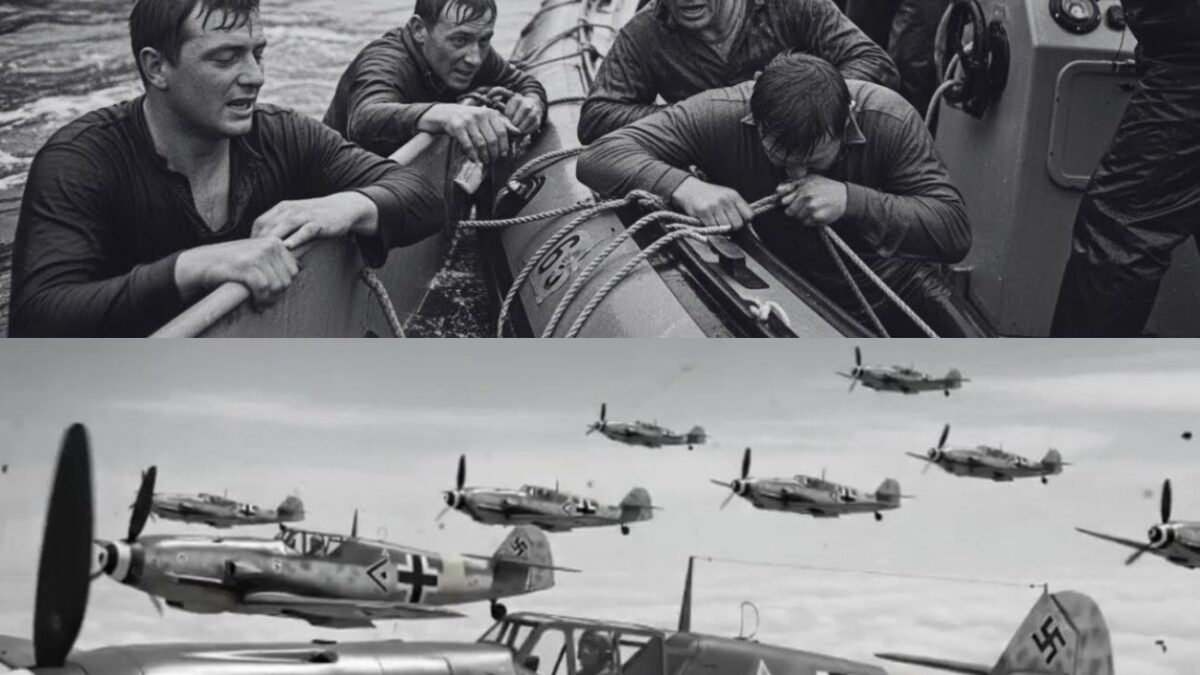
Behind the American formation, eighteen Messerschmitt Bf 109 fighters swung into an organized line, their silhouettes stark against the cold glare of the high-altitude sun.
The nineteen-year-old sergeant knew with terrifying certainty what those eighteen gathering machines represented.
During the sixty-three days since the 379th Bombardment Group had begun operational flights, forty-two tail gunners had perished in that very same compartment.
Out of the ten airmen assigned to a standard heavy bomber crew, the tail gunner faced the highest mortality rate in the European theater of operations.
The position had earned a grim, inescapable moniker among the airmen of the Eighth Air Force: the suicide seat.
Arouth grasped the spade grips of his twin Browning .50-caliber machine guns, his mittens stiff against the cold steel handles.
His breath froze into white sheets of frost on the curved plexiglass, obscuring his vision until he reached up to clear the condensation with a gloved thumb.
Three thousand yards away, the German fighters formed an immaculate line abreast, staging their impending assault without a single sign of haste.
Standard Eighth Air Force gunnery doctrine was deeply ingrained in Arouth’s mind, drilled into him through months of lectures and practical exams.
Hold your fire until the enemy closes within four hundred yards; conserve ammunition; engage only in controlled, three-second bursts.
Instructors from the hot sandbars of Tyndall Field in Florida to the soggy airfields of East Anglia repeated the identical axiom to every cadet.
Long-range shooting wastes valuable ammunition that cannot be replaced once the bombers cross deep into hostile airspace.
The brass claimed ballistics proved that hitting an evasive target beyond four hundred yards with flexible machine guns was statistically impossible.
Yet Arouth had spent the last two months watching bombers disintegrate into flaming wreckage across the German sky.
He observed that German fighter pilots understood the four-hundred-yard doctrine just as thoroughly as the Allied flight instructors who drafted it.
The Luftwaffe utilized the space between one thousand and five hundred yards as an unmolested staging ground to calculate speed, angle, and deflection.
By the time a Messerschmitt tipped its nose down and entered the designated four-hundred-yard engagement zone, the outcome was practically decided.
The German pilot had already aligned his flight path, corrected for wind drift, and settled his illuminated sight upon the bomber’s broad wings.
The fighter’s heavy twenty-millimeter cannons possessed superior range and striking power compared to the defensive machine guns arrayed against them.
Inside four hundred yards, explosive cannon rounds tore through aluminum airframes, setting fuel tanks ablaze before defensive gunners could establish lead.
Sitting curled upon the tiny metal bicycle seat with his knees tucked high against his chest, Arouth decided to discard the rulebook.
As the lead Messerschmitt began its descent at nine hundred yards, the young gunner leaned his shoulder into the mount and pulled the twin triggers.
The heavy Brownings hammered back with an ear-splitting roar, the concussive percussion reverberating directly through his breastbone.
Brilliant arcs of tracer rounds traced bright crimson lines across the blue void, smoking as they tore across the wide expanse of sky.
Hot, spent brass casings clattered into the collection bins beneath his feet, filling the freezing compartment with the pungent smell of burned cordite.
Arouth was firing at more than double the maximum range authorized by the Eighth Air Force Bomber Command.
Under strict military regulations, discharging defensive weapons at such an extreme distance constituted an unauthorized waste of combat stores, a court-martial offense.
Yet the nineteen-year-old enlistee from Massachusetts kept his thumbs clamped firmly onto the butterfly triggers as the tracers reached toward the German lead.
Those tracers tore through the open air, arcing over the engine cowl of the lead Messerschmitt and forcing the pilot into an immediate evasive roll.
What appeared to any observing officer as a reckless expenditure of ordnance would soon dismantle the foundational tactics of the entire air war.
Before Tandelio limped back to its base in England that afternoon, Arouth would claim three enemy fighters shot down using a technique doctrine deemed impossible.
The summer of 1943 was the bloodiest period the American strategic bombing forces would ever endure over the European continent.
The Eighth Air Force suffered loss rates so severe that mission planners openly questioned whether unescorted daylight bombing could survive the autumn.
During the twin strikes against Regensburg and Schweinfurt on August 17, sixty Flying Fortresses were blown out of the sky in a single afternoon.
Six hundred experienced crewmen were killed, wounded, or taken prisoner across several chaotic hours of running air combat.
The mathematical formula governing crew survival in late 1943 offered no comfort to the young men climbing into their aircraft each morning.
A heavy bomber crew was required to complete twenty-five combat sorties before earning the right to rotate back to the United States.
Yet the statistical life expectancy of an Eighth Air Force bomber in that desperate season hovered at roughly eleven operational missions.
More than half of the airmen who unpacked their flight bags in British barracks were destined to disappear over continental Europe before completing their tours.
For the tail gunners, wedged alone into the extreme end of the fuselage behind the tailwheel, the survival figure sank toward forty percent.
Six out of every ten men who occupied that freezing, isolated position were killed, crippled, or captured before their tours concluded.
The problem did not stem from an absence of firepower, for the B-17 carried up to thirteen heavy machine guns throughout its fuselage.
Nor did the crisis originate from inadequate courage, as the young gunners fought with exceptional gallantry across every mission flown deep into Germany.
The failure lay in the fundamental tactical doctrine governing how those defensive weapons were deployed against intercepting fighters.
Air Corps tactical analysts, relying on prewar ballistics tables and controlled testing range data, concluded that machine gun fire lacked precision past four hundred yards.
They argued that firing into the distance simply exposed the bomber’s position, wasted irreplaceable ammunition, and accomplished nothing of defensive value.
Official training publications explicitly commanded gunners to hold their fire until an approaching enemy fighter fully committed to its final dive.
Luftwaffe fighter groups quickly developed tactical maneuvers designed specifically to capitalize on the predictable discipline of the American crews.
German pilots approached American formations from the rear at approximately one thousand yards, comfortably outside the range of defensive fire.
They held their positions in that safe buffer zone, coordinating their attack vectors and establishing precise firing solutions without taking fire.
Once satisfied with their approach angles, they dived inward, traveling at combined closing speeds that exceeded four hundred miles per hour.
A tail gunner waiting for the enemy to reach four hundred yards had only two to three seconds of engagement time before cannon shells struck.
The tactical consensus throughout the Allied command was unanimous: long-range defensive fire was an inefficient use of resources and mechanically useless.
The mathematics appeared bulletproof, the ballistics calculations seemed ironclad, and the horrifying casualty lists were accepted as the unavoidable friction of war.
Commanders insisted that the only viable solution was the development of long-range escort fighters capable of protecting the bombers all the way to target.
Those capable escort fighters, including long-range Mustangs equipped with drop tanks, would not arrive in meaningful operational quantities until early 1944.
Until those escorts arrived, thousands of airmen were expected to climb into the sky and execute missions under operational guidelines that proved catastrophic.
The strategic stakes could not have been higher for the Allied nations preparing for the eventual amphibious invasion of occupied Europe.
The entire American daylight bombing campaign rested upon the premise that bombers could destroy key industrial facilities with visual precision.
Unlike the Royal Air Force, which struck German cities under the cover of night, the Americans exposed themselves to daylight fighter swarms.
If the Eighth Air Force could not stem the loss of aircraft, the daylight campaign would collapse, leaving the invasion beaches without air cover.
General Dwight D. Eisenhower stated unequivocally that without complete control of the skies, an amphibious assault across the English Channel was impossible.
Twenty thousand American airmen were already dead, missing, or languishing in German prisoner-of-war camps across the continent.
Factories in the United States worked around the clock, producing airframes as quickly as possible, yet German interceptors shot them down even faster.
The necessary tactical breakthrough did not emerge from a high-level conference of generals or the testing laboratories of military contractors.
It originated in the freezing tail compartment of Tandelio, conceived by an enlisted nineteen-year-old sergeant from the state of Massachusetts.
Staff Sergeant Michael Louis Arouth was never groomed to become a military theorist or a pioneer of aerial combat strategy.
He held no engineering degree, had never studied advanced mathematics, and possessed no family background in the military officer corps.
Born in 1924, Arouth grew up in a modest working-class neighborhood where his father earned a living through long hours of factory labor.
He attended public schools, earned average grades, and worked various manual jobs as an adolescent to help his family pay their household expenses.
When he reached the age of eighteen in 1942, Arouth enlisted in the Army Air Forces, eager to do his part in the global conflict.
His entrance test scores and educational background did not qualify him for pilot training, nor did they open doors to navigation or bomb-aiming schools.
Those assignments were reserved primarily for cadets who possessed college degrees or specialized technical backgrounds before entering the military.
The Air Forces assigned him to the enlisted specialty of flexible gunnery, a role that demanded steady nerves, physical endurance, and rapid reflexes.
Arouth completed his primary gunnery schooling at Tyndall Field in Florida, where instructors repeated the standard doctrine day after day.
Conserve your ammunition, fire only in tight three-second bursts, and never waste belts on targets flying outside four hundred yards.
Arouth qualified without distinction, demonstrating reliable mechanics and steady emotional composure without attracting special notice from his instructors.
In May 1943, he sailed across the North Atlantic to England, joining the 527th Bomb Squadron of the 379th Bombardment Group at Kimbolton.
He was assigned as the regular tail gunner aboard a Flying Fortress piloted by Lieutenant Bowen Fox, taking his place at the rear.
His combat education did not arrive from textbook diagrams; it was forged through the raw sensory terror of early combat sorties.
From his narrow plexiglass bubble, Arouth watched the same tragic tactical sequence unfold across mission after mission over the continent.
German interceptors consistently hung back in the clear air beyond one thousand yards, untouched, leisurely choosing the best moments to strike.
During a raid against Kassel on July 30, 1943, Arouth watched an enemy fighter maneuver calmly one thousand yards astern of their formation.
The German pilot gently rocked his wings, signaling several nearby Messerschmitts to close ranks and prepare for a synchronized mass attack.
American tail gunners throughout the formation held their fire, fingers resting obediently on their triggers as the enemy took his time organizing.
Arouth stared through the frozen glass and asked himself a straightforward question: why are we allowing them to assemble undisturbed?
The inquiry contradicted the foundational logic of the manual, which evaluated defensive fire purely by its ability to register direct kills.
Arouth realized that an effective burst of defensive fire did not necessarily have to shatter an enemy airframe to be tactically successful.
What if the primary function of long-range fire was not to destroy the fighter, but to wreck the pilot’s concentration and flight path?
If an interceptor was forced to maneuver defensively at nine hundred yards, the pilot could never settle into an optimal firing posture.
During the debriefing following the Kassel raid, Arouth tentatively raised his tactical observation with his aircraft commander, Lieutenant Fox.
Fox listened carefully to his young gunner, understanding the frustration, but reminded him that command expected strict adherence to official doctrine.
For the moment, the lieutenant instructed him to follow standard procedures, though he told the sergeant to keep thinking about defensive solutions.
By the first week of September, as losses continued to climb, Arouth decided that thinking was no longer enough; he had to act.
Implementing his plan required overcoming a significant mechanical obstacle that standard gunnery training never addressed: aiming at long distances.
The standard Sperry K-4 computing gunsight in the B-17 tail position was calibrated strictly for engagements at four hundred yards or closer.
At nine hundred yards, bullet drop was substantial, target silhouettes appeared minute, and the required deflection angles changed entirely.
Because he could not alter the mechanical gunsight without risking discovery and disciplinary action, Arouth spent his off-duty hours practicing manual compensation.
He paced out distances across the muddy perimeter track at Kimbolton Air Base, memorizing the relative sizes of distant trees and parked vehicles.
He calculated lead angles in his head, estimating how far ahead of a diving fighter he would need to place his fire.
His crewmates noticed the sergeant’s unusual behavior as he spent long maintenance afternoons sitting alone in the cold tail of Tandelio.
The crew’s navigator, Lieutenant Elmer Bendiner, observed Arouth sweeping his twin gun barrels across empty horizons, muttering mental calculations to himself.
When Bendiner asked what he was working on, Arouth quietly replied that he was studying the practical mechanics of long-distance gunnery.
The bombardier, Lieutenant Bob Hedglin, was more skeptical, asking Arouth if he planned to waste the crew’s limited ammunition during combat.
Arouth looked at his crewmate and replied that his only objective was to make sure they all returned alive from their assigned targets.
When Arouth raised the subject of long-range suppressive fire with squadron gunnery officers, their responses were uniformly dismissive and stern.
Officers reminded him that tail gunners carried a finite load of ammunition, typically between three hundred and five hundred rounds per gun.
Emptying those ammunition belts at extreme ranges where hit probabilities were low would leave the bomber entirely defenseless during the flight home.
Arouth weighed their theoretical logic against the physical realities he observed through his gunsight on every mission into the Reich.
On the morning of September 6, 1943, the target briefed for the 379th Bombardment Group was the industrial center of Stuttgart, Germany.
Intelligence officers warned all crews that fighter opposition would be fierce, with multiple Luftwaffe wings positioned to intercept the American stream.
As Tandelio reached twenty-five thousand feet and crossed into hostile airspace, Arouth checked his heated suit, cleared his guns, and waited.
When the first flight of Messerschmitts materialized three thousand yards astern, Arouth watched them begin their customary approach.
Instead of waiting for the fighters to close within four hundred yards, Arouth adjusted his elevation, compensated for bullet drop, and fired.
The twin machine guns hammered violently in their mounts, sending a stream of armor-piercing and incendiary ammunition out toward nine hundred yards.
His first burst fell low, kicking up tiny puffs of vapor in the thin air, and his second burst drifted slightly wide.
With his third burst, Arouth walked the tracers directly across the nose of the lead German fighter, illuminating the space before its cockpit.
The German pilot, utterly unprepared to encounter defensive fire at such a distance, banked his aircraft sharply away from the formation.
Arouth was not attempting to score a clean kill at that distance; he was actively destroying the pilot’s confidence and focus.
Over the aircraft intercom system, the sharp voice of the flight engineer, Sergeant Lawrence Reedman, cut through the noise of the engines.
Reedman demanded that the tail gunner cease firing immediately, warning him that wasting ammunition would leave the crew vulnerable to slaughter.
Arouth ignored the command, keeping his gaze locked on the approaching enemy and firing another heavy burst as the range fell to seven hundred.
The German flight pattern, typically rigid and methodical, dissolved into an uncoordinated scramble as individual pilots maneuvered to avoid the incoming fire.
Lieutenant Fox’s voice crackled through Arouth’s leather flying helmet, demanding an immediate explanation for why the tail guns were firing outside procedure.
Arouth shouted back into his microphone that he was keeping the enemy off balance, preventing them from establishing a stable firing solution.
A German fighter attempting to maneuver through the stream of tracers misjudged its separation and nearly collided with an adjacent wingman.
Both enemy aircraft were forced to break away without firing a single cannon round, abandoning their attack run before it even began.
The German pilots regrouped at one thousand yards, visibly confused by the unprecedented volume of fire originating from the American bomber’s tail.
When they initiated a second pass, Arouth opened fire immediately, blanketing their approach lanes with another unbroken sheet of .50-caliber tracers.
The psychological dynamic of the engagement shifted entirely, stripping the attacking pilots of their sense of security during the approach.
Forced to take evasive measures while still far out, the German pilots could not stabilize their gunsights or synchronize their cannon fire.
At six hundred yards, one Messerschmitt pressed through the defensive fire, attempting to hold its dive toward Tandelio’s empennage.
Arouth shifted his aim slightly, leading the approaching engine cowl, and walked an extended burst directly into the fighter’s nose assembly.
A dense cloud of black smoke exploded from the Messerschmitt’s damaged engine cowling as the propeller shuddered and seized in midair.
The stricken fighter rolled inverted, fell out of control, and plummeted into a steep, spinning descent toward the German countryside below.
The crew’s first kill of the mission was registered, but there was no time to celebrate as fresh waves closed in.
For seventeen exhausting minutes, German fighters made repeated runs against Tandelio and the surrounding bombers of the 379th Bomb Group.
Arouth fired continuously, his gun barrels smoking and darkening under the extreme heat generated by the uninterrupted streams of ammunition.
Empty cartridge cases piled up around his boots, threatening to jam his foot controls as he kicked them aside in the narrow space.
Two more Messerschmitts fell beneath his guns as their pilots attempted to press through his long-range defensive screen.
Several other enemy fighters broke off their attacks with damaged wings and smoking engines, unable to penetrate the wall of lead.
Despite Arouth’s aggressive defense, the sheer weight of the German assault inflicted severe damage upon Tandelio’s airframe and systems.
Twenty-millimeter cannon shells struck the waist section of the fuselage, wounding a crewman and severing main hydraulic control lines.
The number-three engine lost oil pressure and was feathered, followed shortly by the failure of the number-one engine on the opposite wing.
Crippled and unable to maintain cruising airspeed, Tandelio drifted out of the defensive box, losing altitude and becoming an isolated straggler.
A solitary, damaged bomber separated from its group was typically marked for immediate destruction by lurking Luftwaffe fighters.
Yet as the crippled B-17 struggled toward the coast, German fighters kept their distance, wary of the aggressive tail position.
The interceptors had learned that this particular tail gunner would engage them long before they reached their preferred firing positions.
Tandelio cleared the coastline of occupied France, but the damaged bomber could not maintain altitude across the English Channel.
Lieutenant Fox ordered the crew to prepare for an emergency water landing, executing a ditching into the frigid channel waters.
British air-sea rescue launches responded quickly to the crew’s emergency radio signals, pulling every member from their rafts without a single fatality.
Three days later, within the headquarters building of the 379th Bomb Group at Kimbolton, the post-mission debriefing descended into an argument.
The squadron gunnery officer, Captain William Morrison, reviewed the ammunition expenditure report from Tandelio and struck the wooden table in anger.
Morrison pointed out that Sergeant Arouth had discharged four hundred and eighty-five rounds during the mission, far exceeding authorized allocations.
The captain argued that violating engagement protocols had placed the entire crew at risk of being left without defensive ammunition.
The squadron intelligence officer, Major Thomas Brennan, intervened, noting that Arouth had been credited with three confirmed aerial victories that day.
Three confirmed kills represented the highest single-mission total achieved by any tail gunner within the group since combat operations began.
Morrison countered that the kills were an anomaly, insisting that ballistics tables clearly demonstrated long-range fire was statistically ineffective.
Lieutenant Elmer Bendiner, the navigator, stepped forward to describe what he had personally observed from the bomber’s astrodome during the raid.
Bendiner stated that Arouth’s early fire completely shattered the German flight discipline, forcing the fighters to abort their synchronized runs.
Morrison dismissed the observation as subjective, asking Arouth precisely how many rounds of ammunition he had expended per confirmed kill.
Arouth answered honestly that he had fired approximately one hundred and sixty rounds for each confirmed victory during the engagement.
Morrison noted that standard doctrine calculated that an engagement at four hundred yards required an average of only twenty-five rounds.
The officers in the room divided into opposing factions, some demanding formal disciplinary action while others defended the tactical outcome.
The group commander, Colonel Maurice Preston, stepped into the center of the briefing room and commanded immediate silence from his staff.
Preston observed that the Eighth Air Force was losing aircraft and crews far faster than factory production lines could replace them.
The colonel stated bluntly that if an enlisted gunner had discovered an effective tactic, formal doctrine was completely irrelevant to him.
Preston instructed Arouth that he would fly the upcoming mission and employ the identical long-range engagement strategy from his tail compartment.
The commander ordered every crew member to observe and document how the German fighters reacted when engaged at long range.
Captain Morrison registered an official objection, warning that authorizing such tactics directly violated established Eighth Air Force operational doctrine.
Colonel Preston cut him off, replying that if current doctrine produced unsustainable losses, then current doctrine was fundamentally incorrect.
The commander declared that the squadron would test the method in real combat to determine whether it worked or failed.
The experimental trial took place on September 15, 1943, during a large-scale strike against heavily defended targets across northern France.
Arouth was no longer the sole airman employing the aggressive technique during the run toward the target area.
Three other experienced tail gunners within the group were briefed to engage incoming fighters at ranges approaching one thousand yards.
The remaining gunners in the formation were ordered to follow standard doctrine, acting as an informal control group for observers.
Post-mission intelligence reports revealed that the experimental gunners caused German fighters to break formation two hundred yards earlier than usual.
Fighter attacks required noticeably longer intervals to organize, and several German pilots abandoned their runs after taking long-range fire.
Ammunition usage among the experimental gunners was substantially higher, averaging nearly four hundred rounds per sortie compared to the normal two hundred.
However, driving enemy fighters away before they could establish their firing solutions resulted in fewer losses within those specific elements.
Subsequent interviews with captured Luftwaffe pilots confirmed the tactical mechanism that made Arouth’s unconventional approach so remarkably successful.
A captured German fighter officer admitted that interceptors were trained to assemble their attack waves at approximately one thousand meters.
That distance had always provided them with ample time and safety to arrange their formations and coordinate their dives.
When American gunners began firing at extreme ranges, the fire rarely destroyed their fighters, but it forced them to take evasive action.
Maneuvering to avoid the tracers broke their cohesion, transforming coordinated group attacks into disorganized individual passes that were far less dangerous.
This operational reality validated Arouth’s central insight: disruption, not physical destruction, was the true measure of defensive effectiveness.
A fighter pilot occupied with avoiding incoming machine gun fire could not steady his reticle on a bomber’s vulnerable fuel tanks.
By October 1943, tactical analysts at Eighth Air Force headquarters were compiling detailed data on long-range suppressive gunnery.
Senior officers debated the logistical ramifications, noting that higher ammunition consumption placed additional strain on ordnance supply lines.
Yet the operational statistics gathered from combat units across England were impossible for command to ignore or explain away.
Formations that utilized aggressive, long-range defensive fire suffered roughly eighteen percent fewer combat losses during fighter interceptions.
In an air war where hundreds of heavy bombers were lost each month, an eighteen percent reduction represented hundreds of saved lives.
On October 14, 1943, the Eighth Air Force endured its second costly raid on the ball-bearing factories at Schweinfurt.
While sixty bombers were lost during the mission, the elements employing long-range defensive fire registered distinctly lower loss percentages.
The hard combat data gathered over Schweinfurt finally pushed Allied commanders to institutionalize the tactical changes Arouth had initiated.
In November 1943, Eighth Air Force headquarters formally distributed Technical Order 43-27-1, officially amending its defensive gunnery doctrine.
The directive authorized tail gunners to engage incoming enemy fighters with harassing fire at distances extending out to one thousand yards.
The order explained that the primary purpose was the systematic disruption of enemy attack formations rather than the immediate destruction of aircraft.
To support the revised operational approach, standard ammunition allocations for tail positions were increased from three hundred to five hundred rounds.
A nineteen-year-old enlisted airman from Massachusetts had successfully rewritten the combat manual of the world’s most powerful air force.
Arouth continued flying combat missions from Kimbolton, steadily adding to his personal tally of aerial victories through the autumn months.
By the time Tandelio ditched in the English Channel a second time on November 29, 1943, Arouth had achieved seventeen confirmed kills.
He became the highest-scoring heavy bomber gunner in the operational history of the United States Army Air Forces.
On one mission, Arouth destroyed four enemy interceptors while maintaining his defensive sector despite heavy battle damage to his aircraft.
Beyond his personal score, the tactical principles he pioneered transformed combat across the entire European theater of operations.
German intelligence reports from late 1943 reflected the growing difficulty their fighter wings experienced when intercepting American formations.
An internal Luftwaffe summary noted that American tail gunners had grown exceptionally aggressive, forcing interceptors to alter their tactical approaches.
Attacking pilots were forced to approach from greater distances and at higher speeds, drastically reducing their firing opportunities against the bombers.
The strategic loss ratios began to tilt in favor of the American bomber formations through the winter of 1943 and 1944.
In August 1943, American gunners recorded an average of 1.2 confirmed fighter kills for every one hundred bomber sorties flown.
By January 1944, following the widespread adoption of long-range suppressive fire, that figure rose to 1.9 kills per one hundred sorties.
Overall heavy bomber losses began a steady decline across the theater as defensive tactics and escort capabilities matured together.
The Eighth Air Force lost one hundred and seventy-six heavy bombers during the bloody operational weeks of August 1943.
By February 1944, that monthly loss figure dropped to sixty-four, despite the bombers flying deeper into the heart of Germany.
While the introduction of long-range Mustang escorts played a decisive role, tactical analysts credited improved gunnery with twenty percent of the reduction.
That twenty percent improvement accounted for dozens of bombers preserved and hundreds of trained airmen spared death or capture each month.
In March 1944, Lieutenant James O’Brien recorded in his after-action report that his tail gunner’s long-range fire kept enemy fighters completely disorganized.
O’Brien noted that while the aircraft took scattered fire, the German pilots were never able to coordinate their attacks effectively.
The human cost of the daylight offensive remained immense, yet the tactical shift provided crews with a realistic chance of completing their tours.
In a prolonged war of attrition, small mathematical adjustments in survival rates preserved the combat strength of entire bomb groups.
By April 1944, Staff Sergeant Michael Arouth completed his required combat tour and received orders rotating him back to the United States.
His official record of seventeen confirmed aerial victories stood as an unmatched achievement among American bomber gunners in the war.
Yet the personal victory tally represented only a small part of his true contribution to the Allied war effort.
Thousands of gunners across dozens of operational bomb groups were alive because they were using the tactics Arouth had tested over Stuttgart.
German fighter squadrons were forced to abandon their favored approach vectors, making defensive operations far more complex for their shrinking pilot corps.
Decades later, in 1987, Arouth attended a quiet reunion of the 379th Bombardment Group, sitting among the aging veterans of the air war.
An elderly man approached Arouth’s table, extending his hand and introducing himself as a former pilot with the 524th Bomb Squadron.
The former pilot explained that his tail gunner had adopted Arouth’s long-range techniques before a dangerous mission over Berlin in early 1944.
The pilot told Arouth that suppressive fire had driven off three Messerschmitts, allowing his crew to return home and raise families after the war.
Following the conclusion of World War II, Michael Arouth returned home to Massachusetts and stepped into a quiet civilian existence.
He secured employment as a factory worker, married, raised children, and never sought public attention for his wartime accomplishments.
He declined to author memoirs, refused television appearances, and rarely spoke about his combat experiences to anyone outside his immediate family.
When the United States Air Force was established as an independent military branch in 1947, historical records confirmed his status.
Archival files documented Arouth as the most successful bomber gunner in the nation’s military history, yet the public remained unaware.
Celebrated fighter aces who scored victories in sleek single-engine aircraft received parades, while enlisted bomber gunners faded into the background.
When military historians began interviewing surviving members of the 379th Bomb Group during the 1970s, Arouth’s name surfaced constantly.
In his published memoir, The Fall of Fortresses, former navigator Elmer Bendiner recalled Arouth’s extraordinary combat performance over the continent.
Bendiner wrote that Arouth never ceased firing until the aircraft hit the water, keeping the crew alive long enough to reach rescue craft.
When a persistent researcher finally reached Arouth by telephone in 1985 to ask about his tactical breakthrough, his answer was humble.
Arouth explained that he simply did what seemed practical when he realized the existing instructions were getting his fellow airmen killed.
He noted that the book ordered gunners to wait until four hundred yards, but at that distance, the German fighters were already lethal.
In 1997, historical research into World War II doctrine formally analyzed Arouth’s combat logs and after-action reports in the National Archives.
The resulting academic publications brought long-overdue scholarly recognition to the tactical contributions made by enlisted aircrew members during the war.
By that time, Arouth was seventy-three years old, content with his quiet life and indifferent to historical recognition or personal fame.
The fundamental concepts that Arouth proved over Stuttgart remain integrated into modern aerial warfare and tactical combat doctrine today.
The idea that defensive fire achieves its goal through suppression, distraction, and disruption rather than pure destruction is widely accepted.
Modern defensive countermeasures, from chaff corridors and thermal flares to sophisticated radar-jamming pods, operate on that precise principle.
A defensive system does not require the physical obliteration of an approaching adversary to protect the aircraft and preserve the crew.
The United States Air Force Weapons School continues to review Arouth’s actions as a case study in tactical combat innovation.
The historical lesson emphasizes that junior personnel engaged in actual combat frequently identify tactical realities that planning officers overlook.
Michael Louis Arouth passed away in 2007 at the age of eighty-three, leaving behind children, grandchildren, and a quiet personal legacy.
His local newspaper published a brief obituary that noted his wartime military service in a single, modest sentence.
No monuments were erected, no military installations bear his name, and no Hollywood films were produced to dramatize his service.
His true monument exists in the generations of families whose fathers, grandfathers, and great-grandfathers returned home alive from the skies of Europe.
His legacy is written into every operational manual that respects the practical observations of the soldier over the theories of the strategist.
A nineteen-year-old factory worker’s son, squeezed into the tail of a damaged bomber, looked at official policy and recognized its fatal flaw.
He backed his judgment with discipline and courage, demonstrating that wars are ultimately decided by those who face the reality of combat.
His willingness to challenge established rules saved hundreds of aircraft and preserved thousands of lives over the embattled continent of Europe.
He proved that clear thinking under pressure is often the most formidable weapon an airman can bring into battle.

