They Called Her The HOUSEKEEPER — Not Knowing She Owned The Whole House
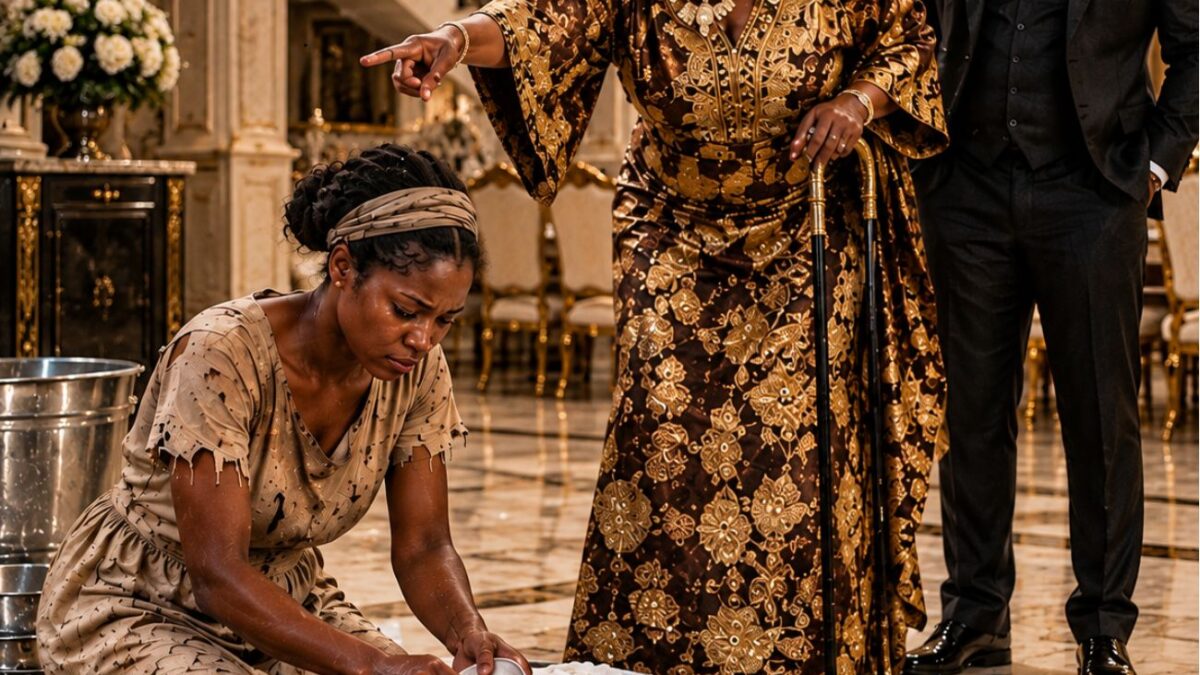
The humid evening breeze drifted from the Lagos lagoon, brushing against the heavy damask curtains of the Ikoyi mansion. Kadir stood before the gilded hall mirror, fastening his cufflinks with cold precision while watching the shadow of his wife move quietly across the marble floor. “Sleep, Naya. Sleep well,” he murmured under his breath, his knuckles whitening as he adjusted his tailored collar. “Tomorrow I find out exactly who I have been married to for eleven long years.”
From the top of the grand spiral staircase, the sharp click of stiletto heels announced the arrival of the family matriarch. Malaika swept down the stairs in voluminous, imported silk, her amber necklace clattering against a chest that puffed with perpetual indignation. “In sixty seconds our guests will arrive, yet you stand in my son’s house dressed like the housekeeper we dismissed last month,” she snapped, pointing a manicured finger at Naya’s faded cotton gown.
Naya did not flinch, smoothing the modest hemline of her dress without an ounce of shame or hurry. “I chose this dress myself, Mother,” she answered softly, meeting the older woman’s scorn with steady, unflinching dark eyes. “I have lived under this roof for over a decade, and I have never once asked you or your son for a single naira.”
“That is exactly the problem with you, Naya,” Malaika retorted, her voice dripping with venomous pity. “You never ask, so nobody ever gives, leaving you looking like an orphan beside my accomplished son. Tonight, the whole of Lagos society walks through those double doors, and they will see you standing right beside him.”
“Then Lagos will finally see the truth,” Naya whispered, her quiet composure cutting deeper than any raised voice ever could. “Both of you are far more terrified of my simple dress than you are of what my dress has never done to you. You fear the appearance of poverty far more than the stench of your own vanity.”
A sudden burst of laughter echoed from the open doorway as Kadir’s cousin, Bahati, strolled into the foyer holding a half-empty glass of champagne. “Another family meeting before the champagne even pops?” Bahati asked with an easy, mocking grin that did not reach his calculating eyes. “Naya, you look beautiful. Do not let this house tell you otherwise, because this house lies for a living.”
“Thank you, Bahati,” Naya replied, tilting her head slightly with an irony that only she fully understood. “A man is not measured by his tailoring, though my husband should know that better than anyone standing in this room. Now, if you will excuse me, I have something urgent to attend to upstairs.”
She turned toward the staircase, her movements graceful and calm, entirely unbothered by the heavy tension suffocating the foyer below. “Enjoy your distinguished guests,” she added over her shoulder, pausing on the third step. “And do enjoy the mirrors tonight, Mother. This house is full of them, yet neither of you ever dares to look inside.”
“Naya, stop right where you are,” Kadir commanded, stepping forward with his jaw locked in deep irritation. “You will go upstairs and change into something appropriate before the first Mercedes pulls up to the gate. Do not make me ask you twice in front of Bahati and the staff.”
Naya did not turn around; she merely continued her steady climb toward the dark corridor above. “A decision takes seven days, Kadir,” she murmured, loud enough for the quiet hallway to carry her parting words. “And some clocks do not care how loudly a proud family shouts into the dark.”
Behind the closed doors of her private study, the noise of the gathering gala vanished completely. The room smelled faintly of old parchment, dry tea leaves, and the cold metal of an unbreached electronic safe. An older man stood near the corner window, clutching an encrypted tablet securely against his chest.
“The shelf is sealed, Madam,” the man whispered, bowing his head in profound reverence. “Nobody downstairs heard the latch close, and Mr. Bekele is already waiting inside the private anteroom. Seven days remain, Nima. On the seventh day, the executive board gathers to cast their final vote.”
He took a step forward, the dim lamplight reflecting off his spectacles as his voice grew urgent. “Either you reveal yourself and become the public face of the empire you built, or the company goes public completely nameless. The international underwriters will not wait past next Friday for your identity.”
“Then let it go public without a face, Nima,” she answered, leaning her palms against the dark mahogany desk. “I did not spend eleven agonizing years erasing my own name just so an arrogant boardroom could hand it back to me. Anonymity was the only sanctuary I had left after the vultures came.”
“This is no longer about wealth, and you know that better than anyone,” Nima argued softly, adjusting his papers. “This is about reclaiming your dignity and your birthright. The very second you step forward, the entire continent will learn who has been sleeping under Kadir’s roof.”
Naya looked out the window, watching the luxury sedans fill the driveway like sleek, predatory beetles. “When the first billion arrived, people completely stopped hearing what I was saying,” she recalled, her voice thick with old sorrow. “My cousins called only for school fees, cabinet ministers called about contracts, and everyone spoke to a bank balance instead of a woman.”
“So you will quietly endure your husband’s insults in your own home for seven more days?” Nima asked, frowning deeply. “Are you so terrified of being known that you would let his family treat you like a stray beggar?” “Not afraid,” she countered softly. “I simply wanted one honest room in this world where nobody loved me for what I owned.”
She reached across the desk, pulled a single sheet of paper toward her, and picked up a heavy black fountain pen. “Sign the instruction to hold the vote,” she instructed without looking up. “Give them their seven days.” “And what do I tell the press when they demand to know where the founder has gone?” Nima asked quietly.
“Say nothing at all,” Naya said, signing her real initials with a firm, unbroken stroke. “Process the Yaba vocational grant tomorrow morning under the charitable foundation’s name, not mine. The young women in that workshop must learn to stand on their own feet, never knowing whose hand feeds them.”
Downstairs, the grand ballroom was alive with the clinking of crystal glasses, polite laughter, and the hum of high finance. Malaika stood at the center of the room, holding court before bankers, shipping magnates, and several members of the state assembly. Seeing Naya slip quietly into the back of the room, Malaika raised her voice to draw every eye.
“Ladies and gentlemen, forgive my daughter-in-law’s plain appearance,” Malaika announced with an exaggerated, patronizing sigh. “She insists she is a humble working woman, entirely unbothered by high society. Perhaps she can explain the complicated numbers the rest of us actually live by, if her domestic chores permit.”
Malaika turned toward Thabo, a senior investment director, gesturing dramatically with her champagne flute. “Her late father spoke endlessly of trusts, hoping to transfer some grand legacy to the first child of the family. Yet here we are, carrying the burden of real commercial progress while she observes quietly from the back.”
Naya paused by the archway, her expression as calm and still as deep water. “You are referring to the Adiri Corridor infrastructure package,” Naya said clearly, her soft voice instantly cutting through the chatter. “The ninety-year concession with a two-year grace period, where debt repayment is tied directly to port throughput rather than sovereign guarantees.”
Silence swept across the room like a sudden cold draft, causing several senior executives to freeze mid-drink. Thabo lowered his glass, his eyes widening in utter disbelief as he stared at the woman in the market dress. “That is not public gossip, Madam,” Thabo whispered. “That is the exact confidential term sheet we signed behind closed doors in Accra.”
“Where on earth did you read that?” Kadir demanded, stepping between his wife and the stunned financiers. His forehead was slick with nervous sweat as he forced a hollow, dismissive chuckle to mask his mounting dread. “Forgive the interruption, gentlemen; the traffic on the Third Mainland Bridge has clearly frayed everyone’s nerves tonight.”
“She simply heard it somewhere,” Kadir continued, looking around the room with forced, desperate levity. “My wife has an odd habit of collecting fragments she overhears at parties and repeating them later with unearned confidence. It is a harmless domestic parlor trick, nothing more.”
Malaika stepped forward, her face taut with fury that a girl in cheap cotton had silenced her wealthy guests. “A wife who listens at keyholes is certainly not the same as a wife who understands enterprise,” the older woman mocked. “Do not encourage her wild imagination, gentlemen, or the poor girl will confuse herself completely.”
Naya looked at her husband, her gaze stripping away every ounce of his tailored vanity until he shifted uncomfortably. “Kadir,” Naya said quietly, “perhaps you should tell our distinguished guests the exact interest rate on your Equiano maritime debt. You spent three hours complaining about the predatory terms last Sunday afternoon.”
Kadir’s face drained of color as several bank directors in the circle glanced at one another with sudden suspicion. “Business is hardly appropriate dinner conversation, darling,” he stammered, frantically waving a hand toward his business partner. “Zuberi, please tell them about the refinery expansion; Naya is clearly exhausted and should retire upstairs.”
Later that night, the mansion fell dead silent, the guests long departed into the humid coastal darkness. Kadir sat alone in his private study, the glow of his computer monitor illuminating his hollow, haunted face. He pressed his palms against his temples, the memory of her calm eyes in the ballroom burning behind his eyelids.
“Those eyes,” he whispered into the empty room, his voice trembling with an unsettling, creeping realization. “Eleven years ago, I sat in that legendary tech summit and watched those exact same eyes dominate a room of venture capitalists. It cannot possibly be her; she has lived in my house without an allowance, buying soap and shea butter from street hawkers.”
He began tearing through the drawers of the mahogany desk, hunting for anything that did not make sense. “Every wife who keeps a massive secret hides it somewhere stupid,” he muttered frantically. “A letter, a bank receipt, a forgotten slip.” His fingers caught the corner of an old leather-bound ledger hidden beneath a stack of unpaid household invoices.
Inside lay a single, unlaminated corporate access card, faded by time but pristine along its magnetic strip. It read: Adiri Systems — Employee Number 001 — Founder. Beneath the title was a name his mother had spent eleven years ridiculing: Adetoun, the middle name printed on her passport.
Kadir dropped into his chair, the room spinning around him as the horrifying arithmetic began to assemble itself. “Adiri Systems,” he breathed, staring at the card as if it were burning through his trembling fingers. “Founded in a cramped, humid room in Yaba, now valued higher than every commercial bank on Victoria Island combined.”
Nine billion dollars in assets, software infrastructure powering half the continent, and she had stood quietly in his mother’s foyer. She had worn a three-thousand-naira market gown and allowed them to call her an unemployable burden. A floorboard creaked in the darkness behind him, and he whipped around to see Naya standing silently in the doorway.
“You are awake,” Kadir said hoarsely, hurriedly shoving the plastic card beneath a stack of papers. “Go back to sleep, Naya. I was only reading some boring financial filings.” She looked at his trembling hands, said nothing, and turned back toward the shadows of the master bedroom.
The following morning, Malaika sat in the glass-walled breakfast conservatory, violently stirring sugar into her black tea. Her daughter Asha sat across from her, anxiously scrolling through family bank notifications on her phone. “I want your brother to divorce that girl before the year ends,” Malaika declared, slapping her silver spoon onto the porcelain saucer.
“I will personally arrange the divorce lawyers, the financial settlement, and the exact story we tell the church council,” Malaika continued. “We cannot have a penniless woman dragging down this family’s standing while Kadir attempts to refinance his corporate debts. She is a stone tied around his neck, and she must be cast off.”
Asha lowered her phone, looking at her mother with wide, frightened eyes that held none of the usual family arrogance. “Mama, before you spend a single naira on high-priced lawyers, there is something you have never explained to me,” Asha whispered. “That massive credit alert in your personal account every month—where does it actually come from?”
Malaika paused, her aristocratic composure faltering for a fraction of a second before her cold mask settled back into place. “It comes from a private development foundation,” Malaika said dismissively, waving her hand. “A philanthropic grant.” “Six million naira on the ninth of every single month for seven straight years,” Asha pressed, her voice trembling.
“You have never seen a director’s name, a formal face, or an official letter,” Asha said, leaning across the marble table. “All you receive is the bank alert, yet you have never once inquired who funds your lifestyle, Mama. Seven years of unquestioning silence is not privacy; it is raw terror that asking will make the money vanish.”
“Watch your tongue, Asha,” Malaika snapped, though her hand shook slightly as she lifted her delicate teacup. “That money keeps the Ikoyi estate fully staffed, pays the gardeners, and clears your brother’s foreign school debts. Whoever provides it understands that an elite family requires considerable resources to maintain its proper standing.”
“Who gives away six million naira every month to an arrogant woman without ever demanding thanks?” Asha asked bluntly. Malaika set her cup down hard, splashing dark liquid over the white lace tablecloth. “It does not matter who feeds me,” Malaika hissed. “That girl upstairs remains lazy, and I intend to throw her out.”
Across town in the dusty heart of Yaba, far removed from the manicured lawns of Ikoyi, an industrial building hummed with life. Rows of industrial sewing machines whirred steadily inside a brightly lit hall filled with dozens of determined young women. Naya walked between the cutting tables, her fingers grazing bright rolls of indigenous textiles with deep, quiet pride.
“Madam Naya, you came on the wrong week,” the center’s director, Mekdes, said with a warm, exhausted smile. “The girls will not care, though; they have been begging me to invite you back since Monday morning.” “I came on the wrong week on purpose, Mekdes,” Naya replied, inspecting the clean stitching on a finished jacket.
“Tell me the truth about the operations,” Naya said, pulling Mekdes aside near the quiet logistics bay. “Are the backup diesel generators working? Are the training stipends reaching the trainees’ bank accounts on time?” “Sixty-four women in this cohort,” Mekdes reported proudly. “Eighteen have already registered independent small businesses with the state.”
“Three of them now employ their own husbands,” Mekdes added, her voice dropping into a conspiratorial whisper. “And the foundation grant remains entirely anonymous, exactly as you ordered, though the girls ask about their benefactor every day. They desperately want a face to thank, Madam. Why do you continue to hide from them?”
Naya looked out over the crowded floor, watching a young woman carefully line up the seam of a patterned dress. “Tell them the hand that feeds them does not need to be seen to be real,” Naya said gently. “Tell them to master their craft and build their own independence; that is the only gratitude I will ever accept.”
A young woman in an apron approached shyly, holding out a beautifully tailored shoulder bag made of recycled canvas and leather. “I made this for my mother’s small provisions shop,” the girl whispered, beaming with pride. “One day I will own a production workshop of my own with twenty girls working under me; that will be my thank you.”
Naya smiled, gently touching the girl’s shoulder before Mekdes handed over an updated quarterly expense ledger. “The next operational budget is short by eleven million naira due to rising equipment import tariffs,” Mekdes sighed. “Do I reduce the incoming training cohort, or do I submit an emergency request to the parent trust?”
“Double the budget,” Naya commanded without a single second of hesitation, handing the paper back to the director. “My marriage at home is crumbling to dust, Mekdes, but that is no excuse to take bread out of these women’s hands. Fund every single applicant on the waiting list, and make sure the emergency reserves are fully replenished.”
When Naya returned to the Ikoyi estate later that afternoon, Kadir was waiting for her by the fountain terrace. His tailored jacket was discarded over a stone bench, his tie loosened, and his face pale beneath the heavy afternoon sun. “My mother has spent the day telling the neighbors that her son is finally free,” Kadir said, his voice flat and strained.
“Should I congratulate you on your impending freedom?” Naya asked, stopping several feet away with her hands folded. “Do not mock me, Naya,” he whispered, stepping closer, his eyes searching hers with frantic desperation. “You have vanished for hours every afternoon, carrying private phones and locking doors that were once open.”
He reached out, his hand trembling as he gestured toward the grand estate that his mother claimed as their dynasty. “My mother calls you lazy; she tells everyone you have produced nothing in eleven years—no child, no business, nothing useful. Yet every time I mention your real name in financial circles, powerful men look at me like I am a walking ghost.”
“Look at me, Kadir,” Naya replied, her voice steady, piercing the humid air like a sharpened blade. “Did you ever actually know the woman you took as your wife, or did you only see the background of your own ambition?” “I thought I knew you,” he choked out. “A quiet girl with an old laptop working out of a rented flat.”
“You fell in love with an illusion of your own superiority,” she said, turning her back on him to look at the garden. “You needed a dependent wife so you could feel like a patriarch, while your mother needed a servant to despise. I gave both of you exactly what you craved, and neither of you ever bothered to look past the surface.”
Later that evening, Kadir tracked down Leah, a veteran corporate attorney who had overseen his family’s earliest business contracts. They sat in the dim corner of an exclusive Victoria Island lounge, surrounded by high-ranking executives talking in hushed tones. “Tell me who my wife was before she married me,” Kadir demanded, slamming his palm onto the polished glass table.
Leah took a slow, measured sip of her tonic water, looking at him with deep, unvarnished pity. “Some questions cannot be unasked, Kadir,” the lawyer said quietly, leaning forward into the ambient amber light. “I am offering you one final chance to walk away from this inquiry while your ignorance is still cheap and manageable.”
“I do not want cheap ignorance,” Kadir snarled, his voice cracking with exhaustion. “She recited the exact terms of an offshore port concession at my mother’s party without glancing at a single note. Explain to me how a woman who cleans her own shoes understands institutional underwriting better than my board.”
“Then go home, Kadir,” Leah replied coldly, setting her glass down with deliberate finality. “Turn your wife’s face toward the light and look directly into her eyes without your usual arrogance blinding you. Those were once the most photographed eyes in African technology finance, even if the rest of her remained hidden.”
Kadir drove back through the empty streets of the island, his mind racing through years of forgotten conversations and discarded memories. He rushed into his study, booted his laptop, and bypassed every domestic server to access deep international business archives from a decade prior. He typed the search parameters with trembling fingers: Adiri Systems, Initial Genesis, The Anonymous Architect.
A single digitized cover of an international business quarterly from eleven years ago appeared on the glowing screen. The headline read: The Ghost of Yaba: The Female Mind Behind the Continent’s Fastest Growing Infrastructure. The portrait had been intentionally darkened by the art director, obscuring the facial contours, but the piercing eyes were unmistakable.
“I have woken up beside those eyes every single morning for eleven years,” Kadir gasped, clutching the desk edge. As he reached out to save the image, the screen suddenly flickered violently and refreshed into a stark, white error page. Record Purged by Enterprise Security Protocol. The file had vanished from the cloud archive before his very eyes.
He spun around in horror, realizing that the network activity was being tracked in real time. He stormed into the master bedroom, where Naya lay quietly beneath the linen sheets, her eyes open, staring at the ceiling. “Kadir,” she said before he could speak, “whatever you are hunting for at two in the morning will not be kinder when you find it.”
“Did you delete it?” Kadir demanded, standing over the bed, his chest heaving with wild, frantic breaths. “A magazine feature from eleven years ago vanished from an encrypted server the moment I opened it on my screen. You are lying here pretending to be asleep while your systems scrub your history right in front of me.”
“Not everything that disappears does so because of me,” Naya answered softly, sitting up slowly against the pillows. “Some people spend their entire lives frantically guarding things that were never theirs to begin with. You have spent eleven days pacing this floor like a caged animal; speak plainly if you have something to ask.”
Kadir pulled the faded access card from his robe pocket and threw it onto the white sheets between them. “Founder. Employee Number One,” he whispered, his voice breaking into a jagged sob. “Tell me what you are actually worth, Naya. Stop the riddles and tell me what you have been hiding from me.”
“I am wealthy, Kadir,” she said, her voice dropping into a tone of absolute, chilling certainty. “I am wealthier than your mother, your cousins, your business partners, and every bank that holds your debts combined. I will not give you a number, because numbers are the very sickness that rotted your family from the inside out.”
“Eleven years,” Kadir cried out, gripping his hair in despair as he collapsed onto the edge of the mattress. “Eleven years of me parading around Lagos, pretending to be your provider, while you sat on billions in assets! You watched my mother insult your family and call you a worthless stray, and you never said a single word!”
“I married you before the money became an uncontrollable weapon,” Naya said, her eyes glistening with unshed tears. “When we met, you were an idealistic young man working out of a dusty shared office, passionate about building something real. I fell in love with a man who possessed nothing, only to watch him slowly trade his soul for luxury leases and social approval.”
“Answer me honestly, Kadir,” she whispered, leaning toward him until their faces were inches apart in the moonlight. “If I had handed you a portfolio worth billions on our wedding day, would you have loved me for a single day? Or would I have simply become your most valuable commercial asset, paraded before the island to secure your bank loans?”
Kadir buried his face in his hands, his broad shoulders shaking uncontrollably in the suffocating quiet of the room. “I do not know,” he wept, the admission tearing through his chest like broken glass. “God forgive me, Naya, I truly do not know, and that is the most terrifying truth I have ever had to speak aloud.”
The next morning, Kadir summoned his corporate comptroller and demanded an unredacted audit of Adiri Systems’ public filings. He sat in his executive office on the marina, reading the confidential corporate restructuring history with growing awe and terror. Nine years ago, Naya had transferred fifty-one percent of her company’s voting shares into an employee-controlled trust.
She had legally handed over the primary engine of a multi-billion-dollar enterprise to the programmers, janitors, and logistics staff. The filing documented two agonizing years of operational losses, three hostile board coup attempts, and predatory takeover bids. The hostile buyouts had failed solely because the ordinary workers had refused to sell their shares back to private equity vultures.
Kadir stared out at the harbor, whispering to the empty room, “My mother called her an unproductive beggar in a cotton gown. And all this time, my wife was the only person in this entire country who was actually, genuinely free.” He did not realize that true freedom was a weight his own fragile ego had never been strong enough to carry.
Two days later, Malaika hosted her annual Midsummer Charity Gala in the sprawling gardens of the Ikoyi estate. Over three hundred elite guests gathered under strings of imported fairy lights, sipping vintage champagne on the manicured lawn. Malaika stood on the raised terrace platform, holding a microphone as she beamed before the city’s highest social circle.
“Before we begin our formal pledges, forgive my daughter-in-law’s presence in her plain domestic dress,” Malaika announced smoothly. A ripple of polite, condescending laughter passed through the crowd as Malaika gestured toward Naya standing near the perimeter. “Some people simply carry poverty in their bones, no matter how much generosity my son showers upon them.”
Naya set down her untouched glass of water, smoothed her simple cotton skirt, and stepped deliberately toward the central stage. “This is your charity evening, Mother,” Naya said, her clear voice carrying effortlessly through the quieted garden. “Thirty guests have contributed so far; perhaps we should spend less time dissecting my dress and more time examining your accounts.”
Malaika’s eyes flashed with absolute fury as she gripped the microphone tightly. “You are lazy, Naya! Eleven years of my son’s hard-earned money, and you have produced nothing for this house!” Naya turned her gaze toward Kadir, who stood frozen near the edge of the stage, his face pale as death.
“Say one word, Kadir,” Naya said, her voice dropping into a calm, devastating command that echoed across the lawn. “Speak one single honest word in front of all these people you have spent your life trying to impress. Say who has truly funded this family, and I swear I will never bring your debts up again as long as I live.”
Kadir looked from his mother’s furious, demanding face to the hundreds of watching socialites, and his tongue failed him completely. He swallowed hard, looked down at his polished leather shoes, and remained utterly, cowardly silent. The silence stretched across the garden like a death sentence, choking the very life out of eleven years of marriage.
Naya nodded slowly, a faint, sorrowful smile touching her lips as she looked at the man she had loved in obscurity. “I could have purchased every house on this street, Kadir,” she said quietly, her words cutting through the stillness. “All I ever wanted was one room in this world where my husband loved me without calculating what I could buy for him.”
Bahati pushed his way through the stunned crowd, grabbing Kadir’s arm and hissing frantically into his ear. “Pull yourself together, brother! Do not lose your head in front of the commercial lenders; we need this family solvent by Friday!” Naya turned away from them both, walking past the frozen guests without looking back, stepping out of the estate gates forever.
Early the following morning, Kadir cornered Bahati in the marina boathouse, throwing a thick stack of loan notices onto the table. “The forensic auditors demand a consolidated financial statement by noon, Bahati, and these figures do not add up,” Kadir yelled. “1.1 billion naira in personal liability guarantees registered against my name, two of them through offshore shell corporations.”
“It is manageable, Kadir,” Bahati insisted smoothly, pouring himself a drink despite the early morning hour. “We roll the debt over, refinance through local facilities, and nobody outside this room ever learns you are overextended. I mortgaged the family estate to secure the cars your mother parades around town; we have both been performing wealth.”
“You did not protect me, Bahati; you systematically priced me out of my own life,” Kadir realized with sickening clarity. “The interest rate on these private facilities is four percentage points above the central bank’s prime commercial rate! And the repayments did not go to commercial lenders—they were routed into an anonymous private trust.”
Bahati set his glass down, his face hardening as he realized Kadir had finally penetrated the shell companies. “Who else would lend to a reckless man performing wealth on borrowed capital?” Bahati sneered. “The anonymous trust provides the liquidity, collects the premium, and asks no questions; that was our operational agreement.”
“Six million naira on the ninth of every month for seven years to my mother’s account,” Kadir whispered, stumbling backward. “The very same trust that has been funding my mother’s arrogance has been slowly feeding on my corporate debt.” He collapsed against the boathouse railing, realizing that the unseen hand holding the debt had belonged to his wife all along.
Later that afternoon, the entire family gathered in the grand drawing room of the Ikoyi mansion under formal summons. Malaika sat stiffly on the velvet sofa, Asha sat beside her clutching a handkerchief, and Kadir stood near the cold fireplace. Naya entered precisely at four o’clock, dressed in a simple, immaculate dark linen suit, accompanied by two senior attorneys.
“Four o’clock,” Malaika scoffed bitterly. “She summons us like a magistrate in our own living room. Absolutely typical.” “Good afternoon,” Naya said, taking a seat at the head of the long dining table as her counsel laid out several folders. “I asked for four o’clock because I wanted the bright daylight of truth to illuminate this conversation once and for all.”
“So the cheap cotton gown was pure theater,” Malaika spat, crossing her arms defensively. “You have been playing the martyr in my home for eleven years simply to make fools of my son and me!” Naya reached down, deliberately slid her platinum wedding ring from her left finger, and placed it gently on the table.
“I have removed my wedding ring, Mother,” Naya said evenly. “That is the only detail of this meeting that concerns you personally. The remainder of this afternoon is strictly commercial business. My full legal name is Nia Adetoun Oyelaran; I am the founder of Adiri Systems, currently valued at 9.4 billion dollars.”
Malaika choked on her breath, her face turning an ashen gray as she stared at the official corporate seals on the documents. “You did not discover that I was secretly rich,” Naya continued, her voice cutting through the room with surgical clarity. “You merely discovered that you were horribly cruel when you were entirely convinced I was defenseless and poor.”
Kadir stepped toward the table, his voice trembling with a mixture of profound grief and lingering disbelief. “Why marry me at all, Naya? You had everything to lose and nothing to gain from tying yourself to my modest name.” “Because for eleven years, Kadir, you were the only person on earth who did not know,” she replied with devastating softness.
“That absolute ignorance was worth more to me than the entire enterprise,” she added, her eyes welling with finality. She pushed the thick settlement agreement across the polished mahogany surface toward Kadir’s trembling hands. “Here is the restructuring framework: your core logistics company survives, and every employee retains their job, salary, and pension.”
Kadir flipped through the complex clauses, reading the strict corporate governance conditions laid out in black and white. “Independent management oversight,” Kadir read hoarsely. “I retain the executive title, but I lose all unilateral signing authority. You are keeping the commercial entity alive, but you are stripping the operating pen completely from my hand.”
“I am removing the pen because that pen was the weapon you used to borrow fortunes you could never repay,” Naya replied. “That is not vengeance, Kadir; that is fundamental arithmetic. A man who borrows to perform wealth cannot be trusted to manage the livelihoods of working families.”
“And the 1.1 billion naira debt?” Kadir asked, looking up at her with hollow, desperate eyes. “You could clear that personal liability before lunch today and never even notice the deduction from your capital reserves. Are you going to wipe it away for the sake of the years we spent together?”
“No,” Naya said firmly, her voice devoid of malice yet completely immovable. “I will not pay your debts. If I rescue you from your vanity now, I teach you that dishonesty always carries someone else’s cost. You will restructure your life, sell your leased luxury cars, and repay every single kobo through honest, difficult labor.”
“Then tell me what I am supposed to do,” Kadir whispered, the tears finally flowing freely down his hollow cheeks. “I have no independent credit, a broken family, and a mother who cannot survive without six million naira every single month.” “You rebuild,” Naya answered. “Slowly, uncomfortably, and honestly, remembering this table whenever you are tempted to lie.”
Later that evening, Malaika found Naya standing alone near the overgrown rear garden, looking out toward the dark water. The older woman’s pride was entirely shattered, her shoulders slumped beneath the weight of an unpayable moral debt. “I have walked this estate every evening for thirty years,” Malaika wept, “and I never once truly saw the woman beside me.”
“I called you a worthless burden; I told three hundred people you had never produced a single useful thing in your life,” Malaika sobbed. “I am so deeply sorry, Naya. Name your financial restitution, and I will spend whatever days I have left paying it back.” Naya turned slowly, looking at the weeping matriarch with profound, weary sorrow.
“You asked me to name the price, Mother,” Naya said softly. “Here it is: six million naira on the ninth of every month for seven years. Every single naira that kept this estate standing and paid your domestic staff came directly from the woman you humiliated daily.” Malaika gasped, clutching her throat as the realization crushed the final remnants of her aristocratic vanity.
“I did not know it was you,” Malaika cried, falling to her knees on the stone path. “Take the house, take the cars, take my social standing in this city; punish me completely, because I deserve every bit of it!” “Some debts can never be repaid with currency,” Naya replied, stepping past her. “Keep the money, spend it on others, and let that be your penance.”
Six months later, the early morning sun broke over the bustling commercial streets of Yaba, illuminating a modest technology workshop. Kadir stood inside the newly painted office, wiping grease from his hands as he organized rows of refurbished server equipment. He wore a simple, faded cotton sweater and worn denim trousers, his expensive watches and bespoke suits long since auctioned off.
The street door chimed softly, and he turned to see Naya standing in the doorway, dressed in a simple, elegant blouse. “You chose Yaba,” she noted with a faint, genuine smile. “The one neighborhood where your mother used to be ashamed to visit.” “I sold the last of the offshore shares and surrendered the Ikoyi lease,” Kadir said, offering her a clean wooden stool.
“And what do you want in exchange for this sudden honesty, Kadir?” she asked, looking around the modest, hard-earned space. “Nothing,” he answered immediately, looking directly into her eyes without flinching or looking down. “It took me six months of falling completely to the ground to learn how to say that sentence without an ounce of pride.”
“You left yourself no financial cushion,” she observed softly. “If this venture fails, you have nowhere left to hide.” “Good,” Kadir replied, his voice calm and grounded for the first time in his life. “I spent our entire marriage trying to prove I was worthy of your wealth, when I should have spent every day proving I was worthy of your heart.”
Naya looked at him for a long moment, seeing the honest, humble man she had once recognized beneath the layers of family vanity. “I believe you now, Kadir,” she said gently, her voice carrying a quiet, profound grace. “And I am truly proud of the man you are becoming.” He looked up with sudden, fragile hope in his eyes, but she shook her head slowly before he could speak the question.
“I am not coming back, Kadir,” she said with absolute, peaceful clarity. “That can never be the price or the reward of your redemption. Keep the humble sweater, keep the hard-earned honesty, and build something small that belongs entirely to your own effort. When the workshop officially opens its doors next month, send a photograph to my foundation office in the city.”
The following morning, the grand auditorium of the African Development Institute was packed with thousands of young entrepreneurs and journalists. Camera flashes illuminated the podium as Naya stood before the international press, her face completely uncovered for the very first time. “For eleven years, the financial press has asked one continuous question: who is the true architect of Adiri Systems?” she began.
“Today, I provide the answer,” she announced, her clear voice carrying across the silent hall and into millions of broadcast screens. “The enterprise valuation stands at 9.4 billion dollars, an asset base built quietly from a single rented room in Yaba. Effective this morning, seventy percent of my personal equity is transferred irrevocably to an independent Pan-African entrepreneurship trust.”
The auditorium erupted into stunned murmurs as she raised her hand to finish her final public address. “The fund will operate completely without my name, my portrait, or any celebratory galas,” Naya declared with a radiant smile. “I built that company so that ordinary people could build their own futures; I never built it so that other people could build me.”

