The Young Woman Who Woke Up Inside a Forbidden Portrait—and Another “Her” Took Her Place
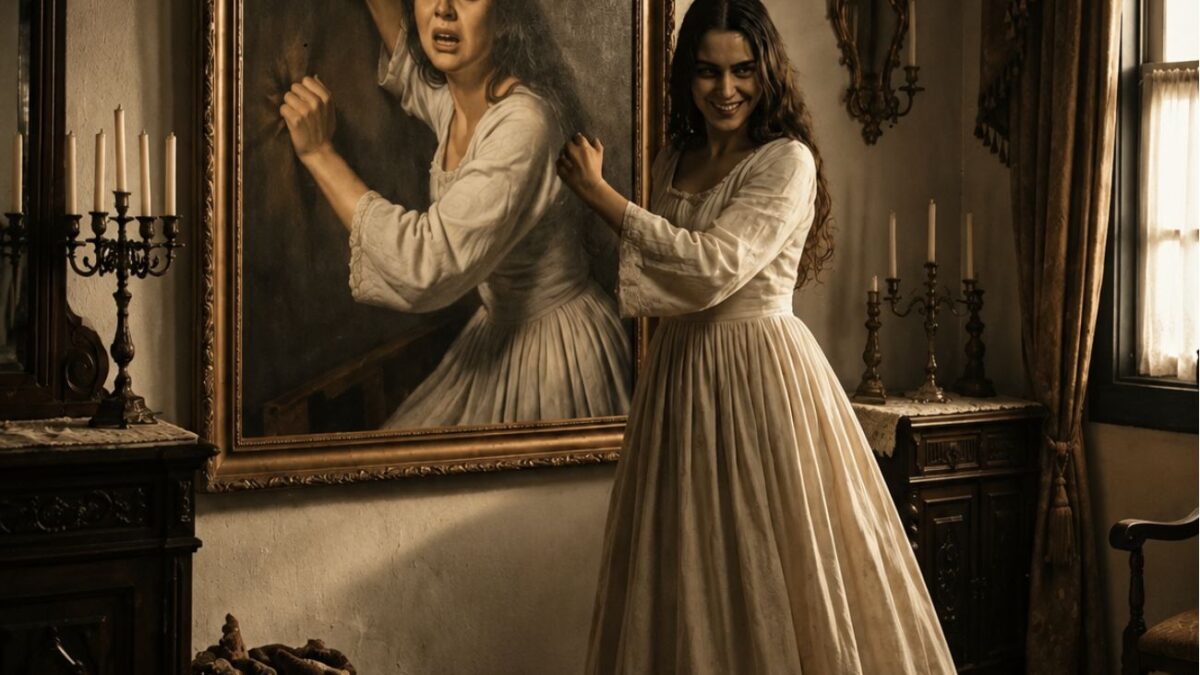
In the winter of 1947 in the town of San Miguel Regla, Hidalgo state, a respectable family began to notice something strange about their eldest daughter. Mrs. Dolores Estrada de Villarreal recorded a brief but disturbing entry in her household accounts book. Mariana no longer eats with us. He says he prefers to be in the studio. I’ve barely seen her for three days.
The town of San Miguel Regla is located forty-two kilometers north of Pachuca, nestled among rock formations and oak forests that once seemed endless. Casa Villarreal, a two-story building with volcanic stone walls and tile roofs, stood at twenty-seven Hidalgo Street, in front of the main square. It was one of the five largest residences in the town, inherited by Mr. Ernesto Villarreal Montes from his father, who had worked in the mines of Real del Monte for forty years.
The Villarreal family consisted of the married couple and their four children. Mariana Villarreal Estrada, nineteen, was the oldest. Next came Roberto, sixteen, Sofia, fourteen, and little Augusto, nine. According to the parish records of San Miguel Regla, Mariana had been baptized on March 7, 1928. Neighbors described her as a quiet, devout young woman who helped her mother with housework and embroidered tablecloths for the church.
In October of that year, the family had received a visit from an itinerant painter. The man identified himself as Leopoldo Garcés, originally from Querétaro, and arrived with letters of recommendation from wealthy families in Pachuca and Tulancingo. He offered his services as a portrait artist. According to Mr. Villarreal’s diary, found decades later among the documents of the municipal notary, the painter proposed to make a portrait of Mariana as a gift for her next birthday.
Mr. Villarreal agreed. Garcés set up his easel in the house studio, a second-floor room facing north with two narrow windows and indirect light for most of the day. The room measured approximately four meters by five meters. It had wooden floors that creaked under weight, and on the walls hung religious lithographs and an oval mirror with a carved wooden frame. The sessions began in mid-October.
Mariana posed three times a week, always in the afternoon, between three and six. Garcés worked in silence. Mrs. Estrada would occasionally come up with tea or sweet bread, but the painter preferred not to be interrupted. He said that concentration was fundamental to capturing the soul of the subject. In the first few weeks everything went smoothly.
Mariana would come down to dinner with her family on time. She didn’t talk much, but that wasn’t unusual for her. However, at the end of November, her behavior began to change. She stopped attending mass on Sundays. She refused her sisters’ invitations to go to the market. She spent hours in the studio, even when Garcés was not present.
Roberto Villarreal mentioned in a letter to a cousin who lived in Mexico City, dated November 23, 1947, that his sister seemed distracted as if she were listening to something that the rest of us could not hear. Sofía, in a personal notebook that was found years later in the attic of the house, wrote that Mariana talked to herself when she thinks no one is listening. Yesterday I saw her touching the studio mirror with her fingertips, very slowly, as if she were afraid of breaking it.
The portrait was finished on December 5th. Garcés presented it during a small family gathering. The work showed Mariana sitting in a high-backed chair, with her hands folded in her lap, dressed in a dark, high-collared suit. The background was neutral, in shades of gray and ochre, but there was something unsettling about the young woman’s expression.
Her eyes seemed to follow the viewer. Her mouth, barely curved, suggested something between a smile and a grimace. Mr. Villarreal paid the painter the agreed-upon sum, and Garcés left town the next day. Nothing more was heard of him. Years later, in 1963, a researcher from the Autonomous University of Hidalgo tried unsuccessfully to trace his whereabouts.
There were no records of a painter named Leopoldo Garcés in the State Archives of Querétaro nor in the censuses of itinerant artists of the time. After the painter’s departure, Mariana began to show more evident changes. She stopped eating regularly. She lost weight noticeably in less than three weeks. Her skin became so pale that it worried Mrs. Estrada, who consulted the town doctor, Dr. Refugio Morales.
He examined the young woman and found no signs of physical illness. He suggested it could be nervous exhaustion or melancholy, common conditions in young women her age, according to the medical theories of the time. But what most concerned the family was that Mariana began spending most of the day in the studio in front of the portrait. She would sit on the floor with her legs crossed and stare at the painting for hours.
She didn’t respond when spoken to. Sometimes she murmured incomprehensible words. Mrs. Estrada noted in her account book on December 16th that she found Mariana asleep in the studio. Her hands were cold. When I woke her, she looked at me as if she didn’t recognize me. Roberto told his father that one night, as he passed by the studio, he heard his sister talking to someone.
When he opened the door, Mariana was alone, standing in front of the portrait, one hand outstretched toward the canvas. The room was freezing, even though the rest of the house was warm. On December 22, Sofía found a folded piece of paper under the studio door. It was a note written in Mariana’s handwriting. It simply said that she is here, do you want to come out?
Sofía showed it to her mother, who decided to speak with Father Ildefonso Guzmán, parish priest of St. Michael the Archangel Church. The priest visited the house the next day. According to the parish records, Father Guzmán blessed the studio and sprinkled holy water on the portrait. He prayed for almost an hour. When he finished, he told Mrs. Estrada that he didn’t sense any evil presence, but recommended that they cover the painting.
The painting was covered with a cloth, and Mariana was told to stop spending time in that room. The family followed their advice. They placed a white sheet over the portrait and locked the studio door. For two days, Mariana seemed to improve. She came down to dinner and spoke briefly with her siblings. But in the early morning of December 26, Augusto woke up and heard footsteps in the hallway.
He looked out and saw his sister coming upstairs with a candle in her hand. He followed her silently. Mariana opened the studio door with a key she shouldn’t have had. She went in and closed it behind her. Augusto waited a few minutes and then called his parents. Mr. Villarreal went upstairs with an oil lamp, knocked on the door, and called for his daughter. There was no answer.
He forced the lock and went in. Mariana was standing in front of the portrait. The sheet that had covered it lay on the floor. The young woman stared at the painting. She didn’t blink or move. Mr. Villarreal approached and touched his daughter’s shoulder. She slowly turned her head. According to his own testimony, written in a letter to his younger brother in January 1948, Mariana looked at me, but it wasn’t her.
Her eyes were empty. She smiled at me in a way I had never seen before. She said that she is not herself anymore, Dad, and that she is here now. The family tried to get her out of the studio, but Mariana resisted with unexpected strength. She screamed and clawed. Finally, Mr. Villarreal and Roberto managed to get her into her room. They locked her in and stood guard outside the door.
At dawn, Mariana was silent. When they opened it, they found her sitting on the bed with her hands on her knees, staring at the wall. She hadn’t cried, she hadn’t tried to leave. During the next few days, Mariana barely spoke. She ate very little and moved as if in a trance. Mrs. Estrada tried to take her to the doctor again, but the young woman refused to leave the house.
Dr. Morales visited the residence and prescribed a mild sedative valerian extract. It didn’t improve her condition. On December 30, Mrs. Estrada made a decision. She went up to the studio and took the portrait down. She wrapped it in a thick blanket and carried it down to the basement of the house, a damp, dark space where the family stored canned goods, tools, and other unused items.
She placed the painting against the back wall, covered it, and the basement door was locked. That same night, Mariana came down to dinner for the first time in a week. She spoke in a low but coherent voice. She asked why everyone was looking at her strangely. She didn’t remember the last few days. She didn’t remember saying anything unusual. Her family decided not to mention what had happened.
They thought perhaps the episode was over. But the next day, January 1, 1948, something changed again. Mariana woke up early, dressed carefully, and styled her hair in an unusual way, braiding it back with a silver clip that had belonged to her grandmother. She put on light makeup, something she rarely did. When she came down to breakfast, her family noticed something different about the way she moved, spoke, and looked.
Sofia wrote in her notebook that Mariana smiles all the time now, but it’s not her smile; it’s as if someone else is using her mouth. Roberto commented to his father that his sister spoke differently, with turns of phrase that weren’t hers. She used expressions she never used before. She called things by old-fashioned names, words that Mrs. Estrada recognized as belonging to her own grandmother’s vocabulary.
On January 2, Mariana asked permission to go to the market with Sofía. She hadn’t done so for weeks. Mrs. Estrada agreed, thinking it would be good for her daughter to resume normal activities. The two young women walked along the cobblestone streets of the town. Sofía noticed that her sister greeted people she had never seen before, as if she had known them forever.
She talked to elderly women at the market about events that had occurred decades earlier, before she was born. A flower vendor, seventy-three-year-old Mrs. Eloína Ramos, approached Mariana and stared at her. According to the testimony she gave years later to a journalist from Pachuca, the elderly woman told her that she was not the Villarreal girl and that she knew those eyes because she saw them a long time ago in another face.
Mariana smiled and replied that perhaps she remembered her, Doña Eloisa, and perhaps they met in another time. Sofía took her sister back home and told her mother what had happened. Mrs. Estrada decided to consult with Father Guzmán again. The priest visited the house the next day. He spoke with Mariana privately for almost two hours. When she left the room, her face showed concern.
He told the parents that the young woman was not ill in a conventional sense, but that there was something about her that he could not explain. He suggested taking her to a sanatorium in Pachuca, where they could evaluate her in more detail. Villarreal considered the option, but before making a decision, something happened that made them hesitate. On January 5, during dinner, Mariana began to speak fluently about topics she had never studied.
She mentioned details about the history of the Real del Monte mines, specific events from the late nineteenth century that only historians or very old people would know. She accurately described the location of an old chapel that had been demolished in 1892, before she was born. Mr. Villarreal, impressed and confused, asked how she knew all that. Mariana calmly replied that she remembers because she was there.
When her father insisted, she added that she wasn’t there now, but the other woman was here, and now she has her memories. That night, Roberto decided to go down to the basement. He wanted to see the portrait. He felt a morbid curiosity. He unlocked the padlock with the key his mother kept in the kitchen. He descended the wooden stairs, which creaked under his weight.
The basement smelled of dampness and wet earth. He found the portrait covered, just as his mother had left it. He removed the blanket. The painting had changed, or at least that’s how Roberto perceived it. Mariana’s expression on the canvas was no longer the same. Now she seemed more serene, almost empty. Her eyes looked away, as if searching for something outside the frame.
Roberto felt a chill. He quickly covered the portrait again and went back upstairs. He didn’t mention what he had seen. The following days passed with an unsettling normality. Mariana helped with the housework, embroidered, read aloud to her little brother, but her family noticed that something fundamental had changed in her. She wasn’t violent or aggressive; she was simply different, as if the young woman they knew had been replaced by someone else, someone who could mimic her gestures but not her essence.
On January 14, Dr. Morales visited the house for a routine checkup. He examined Mariana and found her physical health to be excellent. She had regained weight, her pulse was steady, and her blood pressure was normal. However, when the doctor asked her how she felt, she replied that she felt whole now, as if she had been waiting a long time to be there. Dr. Morales didn’t understand the answer.
He asked her what she meant. Mariana smiled and said that before, she was trapped, but now she is free, and the other woman is where she used to be. The doctor exchanged a glance with Mr. Villarreal. He recommended that he seriously consider taking his daughter to Pachuca for a more thorough evaluation. But the family never did. They were afraid of what they might discover.
They preferred to believe that Mariana was going through a strange phase, something that would eventually pass. Besides, outwardly, the young woman was functioning normally. She posed no danger, neither for herself nor for others. She was simply different. In February of that year, Mariana began to paint. She had no prior artistic training, but suddenly showed skill with brushes and paints.
She asked her father to buy her canvases and oil paints. He agreed, thinking that perhaps art would help her. Mariana set up a small easel in her room and began working on portraits. She painted her siblings, her parents, and neighbors from the village. Her works were surprisingly good. Some said they had a particular, almost old-fashioned style, as if they were paintings from another century.
One afternoon in March, Sofia entered her sister’s room and found her painting in front of the mirror. But she wasn’t painting herself; she was painting another woman, a woman of about thirty with features similar to Mariana’s, but more aged, with lines around her eyes and mouth. Sofia asked who it was. Mariana answered without turning around that it was her, the one she used to be.
Sofia left the room without saying anything else. She told Roberto, and they both decided that they had to do something. They spoke with her parents, begging them to take Mariana to a specialist. Finally, Mr. Villarreal agreed. They scheduled a trip to Mexico City with Dr. Armando Cervantes, who had been recommended by an acquaintance from Pachuca. The trip was set for March 20th, but the night before, Mariana disappeared.
No one saw her leave. Her bed was empty, her bedroom door open. The family searched the entire house. They checked every room, every corner. Finally, Mr. Villarreal remembered the basement. He went down with a flashlight. The door was open, the lock broken. Mariana was standing there in front of the portrait. The blanket had been removed. The young woman’s hands rested on the canvas, touching her own painted face.
She wasn’t moving, her breathing wasn’t audible. When her father called her name, she didn’t respond. Mr. Villarreal approached and touched her shoulder. Mariana turned slowly. Her eyes were open, but empty, like a doll’s. She said in a strangely monotonous voice that the other woman wants to go back and says this isn’t her place, and that Mariana should be where she was.
Mr. Villarreal felt a terror he couldn’t explain. He took his daughter by the arm and led her out of the basement. He took her back to her room. This time he locked the door from the outside. The next morning he canceled the appointment with the psychiatrist. He decided the portrait had to be destroyed. He went down to the basement, retrieved the painting, and carried it to the backyard.
He built a bonfire. He was about to throw the canvas into the fire when Mariana appeared. She had managed to get out of her room. Somehow she screamed. She ran to her father. She begged him not to do it, saying that if he burns it, she will die, and she will die too. Mr. Villarreal stopped. He didn’t understand what that meant, but the terror in his daughter’s eyes was real.
He placed the portrait on the ground. Mariana picked it up carefully, as if it were something sacred. She hugged it to her chest. She wept. It was the first time she had cried since it had all started. Mr. Villarreal let her take the painting back inside the house. She didn’t know what else to do. In the following months, the family learned to live with the new Mariana.
They stopped questioning her strange statements, stopped looking for explanations. It was easier to accept that something inexplicable had happened. The young woman continued painting, continued behaving in a strange but functional way, and the portrait remained in her room hanging on the wall opposite her bed. She looked at it every night before going to sleep. She greeted it in the mornings.
Sofia wrote in her notebook in April 1948 that she no longer recognizes her sister. Sometimes when I look at her, I have the feeling that there are two people in her body. One who smiles and talks to us. Another who silently observes from within, waiting. I don’t know which one is Mariana. In June of that year, a strange event attracted the attention of the neighbors.
Mrs. Ramos, the flower vendor at the market, died. She was seventy-four years old. On her deathbed, she asked to see Mariana Villarreal. The Villarreal family took the young woman to the elderly woman’s house. There, Mrs. Ramos took Mariana’s hand and said to her, according to witnesses present, that it was her and she knew she would come back because she saw her when she was young fifty years ago with a different name, but the same eyes.
Mariana didn’t answer, she just smiled. Mrs. Ramos died that night. Her family never understood what she meant. The years passed. Mariana never married. She rejected several suitors without giving explanations. She stayed in the family home, taking care of her parents as they grew old. Roberto moved to Mexico City in 1952 to study engineering. Sofia got married in 1954 and went to live in Tulancingo.
Augusto studied in Pachuca and returned to the town in 1958 to work in the mine. But Mariana stayed, she always stayed. In 1955, Mr. Villarreal died of a heart attack. It was a hard blow for the family. In his will he left the house to his four children, but specified that Mariana could live there as long as she wished. Mrs. Estrada stayed at home with her eldest daughter.
The two women lived in an awkward silence. The mother tried not to look at Mariana too much because every time she did, she felt like she was looking at a stranger. In 1957, Sofia visited her mother and sister during the Christmas holidays. She went up to Mariana’s room, who was now almost thirty years old, but looked younger than she should have been. Her skin was smooth, her eyes bright, she moved with an energy that did not correspond to her age.
Sofia noticed that the portrait was still hanging on the same wall. She looked at it attentively for the first time in years. She froze. The image on the canvas had changed. She no longer looked like a nineteen-year-old. Now it showed a woman of about thirty with slightly darker hair, with barely visible lines around her eyes. She looked like Mariana, but she was also different.
Sofia left the room without saying anything. She had nightmares that night. She dreamed that her sister was trapped inside a frame, banging on the glass, screaming without sound. The next day, Sofia confronted Mariana. She asked her directly what was happening, what had really happened since that winter of 1947. Mariana looked at her silently for a long time. Finally she said that the other woman needed a body and Mariana wanted to see what was beyond the painting.
They made an exchange. Mariana went in, the other went out, but now neither of them can go back. Sofia didn’t understand. She asked if her sister was inside the portrait. Mariana nodded. She is there, yes, trapped like I was before. And here I am living the life that should have been hers. But I don’t know who I was before. I don’t know who she is now. I only know that we are both the same in some way.
Sofia left the village the next day. She did not visit her sister again for five years. She wrote to her mother, but the letters were brief and cold. She didn’t mention Mariana. Mrs. Estrada also didn’t talk much about her eldest daughter in her answers. She just kept saying that she was fine, that she was still painting, that she was good company.
In 1962, Mrs. Estrada died in her sleep. She was sixty-eight years old. Mariana found her in the morning, serene and cold. She called the doctor, arranged the funeral, and received condolences with a composure that unsettled her brothers. She didn’t cry, she didn’t show obvious pain, she just said that she is resting now and that’s good.
After the funeral, Roberto, Sofia, and Augusto decided to sell the house. They wanted Mariana to move in with one of them. But she refused. She said she couldn’t leave the portrait, that if she did something terrible would happen. The brothers did not insist; they allowed her to stay on the condition that she accept financial help from all three of them.
Mariana agreed. She lived alone in the house for another six years. The neighbors rarely saw her. She went to the market once a week and bought the essentials. She returned quickly. The house lights were on almost every night, even in the early hours of the morning. Sometimes those passing by the property heard voices, but when they got closer the sound stopped.
In 1968, an anthropology student from the National University named Fernando Ríos arrived in San Miguel Regla to investigate local histories and urban legends. He heard rumors about the Villarreal house and decided to visit it. He knocked on the door. Mariana opened it. She was forty years old, but looked younger. Fernando introduced himself and explained his research. Mariana invited him in.
The young man spent three afternoons at the house talking with Mariana. He took extensive notes. He recorded part of the conversations on a magnetic tape. According to their records, Mariana told him about the portrait, the painter, the exchange, and showed him the painting. Fernando was fascinated and asked if he could take photographs. Mariana agreed.
The student took several pictures of the portrait and the house. He promised to return with more questions, but Fernando Ríos never returned to San Miguel Regla. In March 1969, his body was found in a ravine near Real del Monte, eighteen kilometers from the town. He had fallen from a considerable height. The autopsy determined that the death was accidental.
However, the tapes and notes he had taken during his interviews with Mariana were never found. His family searched his student room, his university office. There was no trace of that material, only a photograph remained, a black and white image of Mariana Villarreal’s portrait. The photo was filed in the records of the anthropology department of UNAM. It remained there forgotten for decades.
The canvas can be seen clearly in the image, showing a woman of approximately forty years old with serene features, slightly squinted eyes, an expression that could be interpreted as peace or resignation. But there is a disturbing detail. If you look closely at the reflection in the mirror that appears in the background of the barely visible portrait, you can make out the silhouette of another figure, a young woman standing with her hands pressed against an invisible surface, as if trapped behind glass.
In 1969, Mariana Villarreal stopped answering her brothers’ letters. Roberto traveled to the town in July of that year to check on its condition. He found the house locked. He knocked on the door. No one answered. He forced his way in with the help of a neighbor. The house was empty. There were no signs of violence or fighting. The furniture was in its place. The kitchen is tidy.
Everything seemed normal, except for one detail. The portrait had disappeared. The wall where it used to hang was empty. Only one nail remained, along with a rectangular stain lighter than the rest of the wall, indicating that something had been there for a long time. Roberto searched the entire house. He checked the basement, the attic, every room. He found neither the portrait nor his sister.
The authorities were notified. An investigation was opened. The neighbors were questioned. Nobody had seen anything. Nobody had heard anything. Mariana had simply disappeared. The investigation was closed after six months without results. The case was filed as a voluntary disappearance. The house remained empty for two years. Roberto tried to sell it, but nobody wanted to buy it.
Rumors about the property had grown. The locals said it was cursed and that whoever entered would not leave the same. Finally, in 1971, a young married couple from Pachuca decided to take a chance. They bought the house at a very low price. They moved in August of that year. They lived there for three months. They left in November. They did not give detailed explanations.
They simply said that the house was not suitable for them, and that they preferred to live somewhere else. But the husband, in a conversation with a friend years later, mentioned that sometimes they heard footsteps on the second floor, that they saw shadows in the study, and that one night his wife swore she saw a woman standing in front of the window of the room that faced north.
When they went up to check, there was nobody there. The house was sold again in 1972 and once more in 1974. None of the occupants stayed for more than a year. Finally, in 1976, the property was abandoned. The owners stopped paying taxes. The city council recovered it. It was left empty. The windows were broken, the doors forced open, and weeds grew in the yard.
It became a haunted house in the most literal sense. In 1983, a group of teenagers from the town entered the house as part of a dare. It was an October night. They carried flashlights, went up to the second floor, and found the studio. There, on the dust-covered floor, they found something, a carved wooden frame, empty, without a canvas. The screws that were supposed to hold the fabric were rusty.
One of the young men touched the frame. He said he felt an electric shock and dropped the object immediately. The group left the house and did not return. The house was demolished in 1992. The city council decided that it was a public danger. The structure was in poor condition, the walls were cracked, and the roof was sunken in several places.
An excavator knocked down the walls. The debris was removed. A small park was built on the site. Today it is a green space with benches and trees. Children play there, families have picnics, but older locals avoid the area after dark. They say that sometimes when the sun sets and the shadows lengthen, you can see the silhouette of a woman standing where the studio used to be, just for a second, a blink, and then she disappears.
In 1996, Sofía Villarreal, already a widow and sixty-two years old, decided to write her memoirs. It included a chapter about her sister Mariana. She described the events of 1947 and 1948, just as she remembered them. She spoke of the painter’s portrait and of the change in her sister. The manuscript was never published. Sofia died in 1998. Her children found the text among her belongings.
They read it with skepticism. They thought it was fiction, a story invented by their mother in her later years. They stored the manuscript in a box in the attic. In 2002, one of Sofia’s grandsons, a university student named Miguel, found the manuscript while cleaning his grandmother’s house. He read it with curiosity and decided to investigate. He traveled to San Miguel Regla and spoke with the town’s elders.
Some remembered the Villarreal family, they vaguely remembered Mariana. One of them, an eighty-year-old man, said that that woman never aged, and when she was forty, she looked twenty, which was strange because everyone was talking about it. Miguel tried to find records at the town hall. He found Mariana’s birth certificate. He found the property records for the house, but no death certificate.
There was no record of her death or official disappearance. It was as if she had simply ceased to exist in 1969. He searched for the photograph Fernando Ríos had taken, contacted UNAM, and reviewed the archives of the anthropology department with the help of a professor. He found the image, studied it carefully, noticed the figure in the mirror in the background, and took a magnifying glass.
The silhouette was clear, showing a young woman with her hands outstretched and her face pressed against a surface. The features were difficult to distinguish, but there was something familiar about the posture. Miguel tried to trace other descendants of the Villarreal family. He found a distant cousin in Querétaro, Roberto’s son. The man was seventy years old and did not know Mariana personally, but his father had told him about her.
He said that his dad never forgave himself for leaving her alone in that house, and that he should have gotten her out of there, even if it was by force, but she didn’t want to leave and he didn’t understand why. Miguel wrote an article for a magazine about unexplained phenomena. The text was published in 2003. It received some responses from readers, but nothing conclusive.
Some suggested psychological explanations like dissociation, trauma, or schizophrenia. Others spoke of possession or change of identity, while some believed it was all fiction. Miguel didn’t have definitive answers, only questions. In 2008, during an exhibition of Mexican colonial art at the Museum of History of Pachuca, a curator noticed something strange. Among the pieces loaned by private collectors was an oil portrait of a young woman.
The label read Anonymous Portrait, circa 1940. There was no information about the artist or the subject. The curator examined the painting carefully. The woman pictured was approximately forty years old, and her eyes looked at the observer with an expression that was difficult to define, suggesting peace, resignation, and supplication. The curator asked the collector about the provenance of the work.
The man explained that he had bought it at an auction in Mexico City in 1987. It came from a private collection whose owner had passed away, and no further information was available. The curator took photographs of the portrait for the museum archives. The painting was returned to the collector after the exhibition. In 2010, the collector died.
His heirs decided to auction off his belongings. The portrait was included in the lot, but it did not attract much interest. It was acquired by an antique dealer from Toluca for a modest sum. The antique dealer displayed it in his shop for two years, and when nobody bought it, he finally sold it to an anonymous buyer in 2012. Since then, its whereabouts are unknown.
But in 2013, a blog dedicated to Mexican mysteries published a post about the case of Mariana Villarreal. It included the photograph taken by Fernando Ríos in 1968, fragments of Sofía’s manuscript, and, surprisingly, an image of the portrait auctioned in 2010. The blog’s author, who identified himself only as JL, claimed to have found connections between Mariana’s story and other unexplained disappearances in the Hidalgo region between 1950 and 1970.
According to JL, at least three young women had disappeared under similar circumstances during those years. They had all been portrayed by itinerant painters. All of them had shown personality changes before disappearing. They had all left behind portraits that were later described as disturbing or strange by those who saw them. JL suggested the existence of a pattern, although he did not offer any concrete explanations.
The blog received hundreds of comments. Some expressed skepticism, others shared similar stories from their own families or regions. One of the comments posted by an anonymous user read that their grandmother knew Mariana Villarreal and lived in San Miguel Regla until 1950, saying that Mariana was two people at the same time, one who spoke and another who watched from within, which made her grandmother afraid of her.
In 2015, an independent filmmaker from Querétaro, interested in the case, attempted to make a documentary. He traveled to San Miguel Regla. He interviewed descendants of the families who had known the Villarreals. He filmed the park where the house once stood. He tried to contact Miguel, Sofía’s grandson, but was unsuccessful. The project was never completed.
The filmmaker mentioned in a later interview that he had lost interest after experiencing strange events during filming, though he did not specify what kind of events. In 2017, during a conference on Mexican folklore at the University of Hidalgo, a researcher presented a study on urban legends of the region. He briefly mentioned the case of Mariana Villarreal as an example of a contemporary myth based on cultural anxieties about identity and change.
According to the researcher, the story reflected collective fears about loss of identity, the influence of external forces, and the instability of perceived reality, without addressing the possibility that the events were real. In 2019, a social media user posted an old photograph with a caption stating it was found in their great-grandfather’s photo box in San Miguel Regla in 1953, and asking if anyone recognized the woman.
The image showed a young woman standing in front of a stone house with her face visible but slightly blurred, wearing period clothing and smiling. Several users commented that the woman resembled descriptions of Mariana Villarreal, while others pointed out that she could be anyone. The post received hundreds of interactions, but no conclusion was reached.
In 2020, during the pandemic, when many people were spending time at home going through old belongings, a man from Pachuca found a diary in the attic of his parents’ house. The diary had belonged to his grandmother, who died in 1995. In an entry dated June 1948, the grandmother wrote that she went to the market today and saw the Villarreal’s daughter, noting that she didn’t know what happened to her, but she wasn’t the same anymore because there was something about her eyes that scared her, as if she was looking right through you rather than at you, while her mother told her that some things are better left alone.
The man scanned the pages and shared them in a local history group on social media, generating renewed interest in the case. Some people began searching for more information, while others shared fragments of manuscripts, letters, or diaries from their own families that mentioned the Villarreal family or strange events in San Miguel Regla during those years. In 2021, a visual artist from Mexico City, inspired by Mariana Villarreal’s story, created a series of paintings titled Exchange.
The works depicted women trapped in frames, women looking into mirrors that didn’t reflect their own image, and women with two superimposed faces. The series was exhibited in a gallery in Coyoacán. In the exhibition description, the artist wrote that this series explores the idea that we are multiple versions of ourselves trapped in representations that we don’t always control, asking what part of us is real and whether it is the one we show or the one we hide.
The exhibition received positive reviews, with some reviewers citing Mariana Villarreal’s story as an inspiration while others didn’t make the connection, and one of the paintings was acquired by an anonymous collector while the others stayed with the artist. In 2022, a Mexican mystery podcast dedicated an episode to the case, interviewing local historians, descendants of families from San Miguel Regla, and researchers of the phenomenon.
One of the interviewees, an anthropologist from UNAM, suggested that the story could be a case of identity transfer facilitated by psychological trauma and its cultural management, while another interviewee, a psychologist, spoke of dissociative identity disorder, though none of them offered an explanation that fully satisfied the particularities of the case.
The episode ended with a reflection from the hosts on what makes this story so unsettling, highlighting not just what supposedly happened, but the fact that we will never know the truth since Mariana Villarreal disappeared, the portrait disappeared, and all that remains are fragmented testimonies and unanswered questions.
They questioned whether the exchange was real or if it was all a construct of minds affected by fear and misunderstanding, concluding that perhaps the answer doesn’t matter and that the important thing is how the story is still alive, still unsettling, and still making us question how solid our own identity is and how sure we are of being who we believe ourselves to be.
Today in 2025, the story of Mariana Villarreal continues to be an occasional topic of discussion in circles interested in unexplained phenomena, with no new leads or significant testimonies, while the portrait has not been located, the house was demolished over three decades ago, family members have passed away, and official records remain scarce and ambiguous.
The only thing that remains is the story, which raises uncomfortable questions about what happens when we look at a representation of ourselves and that representation begins to take on a life of its own, prompting us to wonder if something within an image, painting, or photograph may contain a part of us that later claims autonomy, or if we are the ones who project so much onto those representations that we eventually confuse them with reality.
There are no answers, only echoes of a winter of 1947 when a young woman posed for a portrait and something changed, something that cannot be fully explained in words, but that can be felt in the way those who knew Mariana spoke of her, in the way her sister wrote about her, and in the way she disappeared, leaving only an empty frame and a stain on the wall.
San Miguel Regla remains a quiet town where the mines of Real del Monte no longer operate as they once did, the forest was largely cut down during the second half of the twentieth century, and the main square has been remodeled several times, yet if you ask older residents, some still remember the story of the Villarreal house, avoid the park at dusk, and look at their own portraits with distrust, wondering if what they see is really just paint, pixels, or reflected light.
In the end, the story of Mariana Villarreal is not just about a young woman who disappeared; it is about the fragility of what we call ourselves, the possibility that what we are can be replaced, duplicated, or transferred, and the fear that one day we will look in the mirror and see someone else looking back, using our face, our hands, and our voice, while confronting the silence that surrounds that fear.
This is the silence of families who prefer not to talk about what they saw, the silence of communities that bury the inexplicable under layers of routine and oblivion, and the silence of files that go missing, testimonies that are not recorded, and questions that are not asked because the answers could be too disturbing.
Somewhere, perhaps in a dusty basement, in a private collection, or in a forgotten antiques market, there is a portrait of a woman who could be twenty or fifty years old, looking at the observer with eyes that contain too much knowledge, too much experience, and too many lives.
And if you look closely enough, if you get close enough, maybe there’s something more, such as a shadow behind her, a figure in the mirror in the background, a young woman with her hands pressed against an invisible surface, her mouth open in a silent scream, her eyes pleading, leaving two women, one image, and no answer.

