The tempter in Genesis was not a snake. The Hebrew text reveals this!
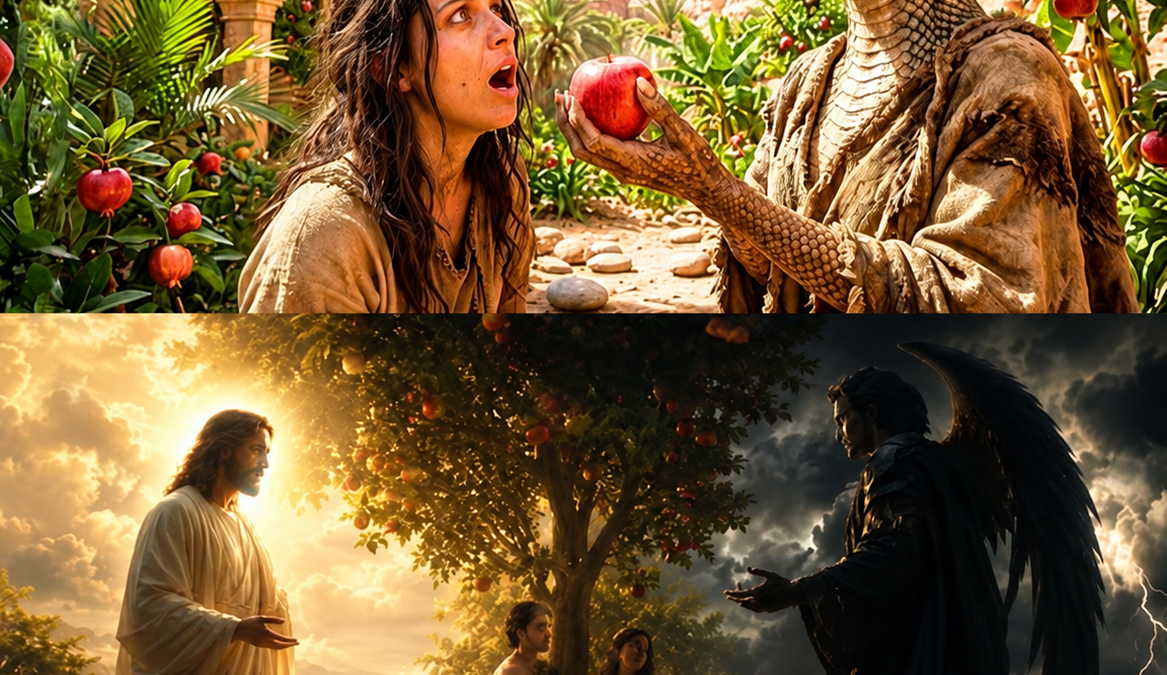
Across generations of human storytelling, few ancient narratives have gripped our collective imagination quite like the garden encounter in Genesis. Almost every child learns the basic picture early: an idyllic paradise, a woman standing beside a tree, and a sinister snake wrapping its scales around branches. Yet beneath that familiar Sunday school depiction lies a far more profound, ancient, and haunting cosmic drama waiting to be properly understood.
When the sacred scrolls of Genesis open upon the third chapter, they confront the reader with an enigmatic presence coiled in paradise. We are told that this creature was craftier than any beast of the field, possessing an extraordinary capacity for intellect, rhetoric, and spiritual malice. Generations of readers have reduced this pivotal event to an ordinary, talking reptile whispering half-truths into the ear of an unsuspecting woman.
The traditional imagery portrays an easy villain, a passive husband standing silently in the shade, and an apple plucked from forbidden boughs. According to the conventional retelling, eating this mysterious piece of fruit triggered the immediate fall of man and the sudden introduction of mortality. Because of a single bite, paradise was instantly revoked, the earth fell into ruin, and humanity was banished forever into sweat, tears, and pain.
Yet this simplified picture immediately creates an array of profound theological, linguistic, and historical questions that demand much deeper answers. Why would an Almighty God place a talking reptile in His flawless sanctuary with the deliberate capacity to subvert His newly crowned rulers? Why did Eve react to this creature without the slightest hint of terror, shock, or surprise when it engaged her in high-level theological discourse?
In any normal human setting, encountering an animal that articulates fluent speech and analyzes divine decrees would provoke immediate alarm or bewilderment. Eve, however, did not flee in terror, nor did she run to Adam in astonishment to report a miracle of animal communication. She engaged the figure as a credible peer, conversing naturally about the nature of divine authority, cosmic boundaries, and ultimate destiny.
To unpack what actually occurred in that primordial orchard, we have to look past modern English translations and examine the original Hebrew vocabulary. When modern readers encounter the English word “serpent,” they instinctively visualize a biological reptile slithering along the damp ground. In the ancient Hebrew text of Genesis chapter three, the word utilized to describe this creature is the evocative noun nahash.
The Hebrew language is profoundly multi-layered, where single consonants and root structures carry multiple intersecting streams of conceptual meaning. The root word underlying nahash contains three primary semantic domains that completely revolutionize our traditional understanding of the story. On the surface, nahash can indeed function as a noun denoting a serpent, snake, or reptilian creature that moves across the earth.
Yet the very same verbal root in ancient Northwest Semitic and biblical Hebrew conveys the distinct action of divination, whispering, and enchanting. It portrays one who communicates esoteric secrets, casting deceptive verbal spells and utilizing cunning speech to manipulate the perceptions of others. A practitioner of nahash was understood as an enchanter, a figure skilled in altering reality through whispered illusions and seductive promises.
Most remarkably of all, when used as an adjective or related noun, the word is directly tied to brightness, bronze, and radiant luminance. In this third linguistic sense, nahash can literally be translated as “the shining one” or a being possessing a blazing, luminous exterior. This extraordinary linguistic triad suggests that Moses was using a deliberate Hebrew wordplay to describe an entity of staggering celestial brilliance.
Rather than a silent, scaly garden snake slithering through the weeds, Eve was confronted by a dazzling, radiant member of the divine realm. She encountered a glorious, luminous guardian whose natural appearance conveyed heavenly authority, supernatural majesty, and astonishing divine wisdom. This single linguistic revelation instantly explains why the woman showed no apprehension or shock when the creature initiated conversation with her.
She was not standing before an ordinary garden beast, but speaking with an awe-inspiring, shining luminary of the celestial council itself. The presence of such an entity within God’s holy garden was neither out of place nor inherently alarming to the original inhabitants. Eden was not merely an earthly plantation filled with flora and fauna; it was the sacred dwelling place where heaven met earth.
In the ancient Near Eastern worldview and biblical theology, the garden of God was the cosmic mountain and throne room of Yahweh. It was the divine sanctuary where the Creator walked in fellowship with both His earthly image-bearers and His heavenly host. Within this sacred precinct, radiant spiritual beings served as divine guardians, standing watch over the throne and holy presence of God.
Centuries after Genesis was penned, the prophet Ezekiel was given a profound prophetic vision regarding this exact same primordial scene. In the twenty-eighth chapter of his book, Ezekiel delivers an extraordinary oracle that lifts the veil on the Edenic narrative. Addressing the proud power behind the Prince of Tyre, the prophet directs his spiritual gaze back toward the dawn of human history.
“You were in Eden, the garden of God,” Ezekiel declares with striking, majestic clarity regarding this fallen cosmic entity. “Every precious stone was your covering: ruby, topaz, and emerald, chrysolite, onyx, and jasper, sapphire, turquoise, and beryl.” “Your settings and mountings were made of purest gold; on the day you were created, they were meticulously prepared for you.”
Ezekiel continues with an even more explicit identification of this figure’s original celestial rank and supreme heavenly authority. “You were anointed as a guardian cherub, for so I ordained you,” the prophet writes under direct divine inspiration. “You were on the holy mountain of God; you walked back and forth among the fiery, radiant stones of heaven.”
“You were blameless in all your ways from the day you were created,” the ancient oracle solemnly records, “until unrighteousness was found in you.” “Your heart became proud on account of your beauty, and you corrupted your transcendent wisdom because of your magnificent splendor.” “So I drove you in disgrace from the mountain of God, and I expelled you, guardian cherub, from among the fiery stones.”
This breathtaking description from Ezekiel does not remotely resemble a biological reptile slithering silently through dirt and tangled vines. It depicts a magnificent, supreme cherub—a dazzling angelic guardian adorned with radiant gems and blazing with the glorious light of God’s throne. In ancient biblical thought, cherubim were not the chubby, gentle infants with tiny wings popularized by Renaissance European artwork.
Biblical cherubim were towering, majestic, and terrifying throne-guardians endowed with divine power and blazing with heavenly fire. They stood at the boundary between the holy presence of the infinite Creator and the rest of created existence. This was the exalted station held by the being who entered the sanctuary of Eden with rebellion already smoldering in his heart.
A companion portrait of this celestial tragedy is provided by the prophet Isaiah in the fourteenth chapter of his prophetic work. There, the prophet records the internal monologue of the Morning Star, historically identified as Lucifer, whose ambition shattered the peace of eternity. “How you have fallen from heaven, Morning Star, son of the dawn!” Isaiah laments as he exposes the prideful roots of evil.
“You said in your heart, ‘I will ascend to the heavens; I will raise my throne above the stars of God,'” the text reveals. “‘I will sit enthroned on the mount of assembly, on the utmost heights of Mount Zaphon, the holy heights of the north.'” “‘I will ascend above the tops of the clouds; I will make myself like the Most High, equal to the Creator.'”
Five distinct times, this glorious celestial prince declared his stubborn, self-exalting “I will” against the sovereign supremacy of the Almighty. He was no longer content to remain a guardian cherub reflecting the uncreated glory of the One who spoke him into being. He craved independent authority, desiring the worship, adoration, and sovereign dominion that belonged exclusively to the Eternal King.
Because pride and cosmic jealousy corrupted his heart, this shining prince was abruptly cast down from his exalted heavenly position. Yet his expulsion from the highest heavenly court did not immediately terminate his ability to access and manipulate the terrestrial realm. Stripped of his holy standing, he turned his cunning focus toward the newly crowned vice-regents of the earthly cosmos: mankind.
God had fashioned Adam and Eve from the dust, breathing His own breath into their lungs and crowning them with royal glory. Though lower than the celestial beings in sheer power, these frail human creatures had been granted sovereign dominion over the entire earth. To a proud, fallen cherub who sought to sit upon the cosmic throne, this human exaltation was an unbearable offense and affront.
He recognized that he could not launch a direct military assault against the omnipotent Creator and hope to achieve victory. Therefore, he chose an asymmetrical, insidious strategy of psychological seduction aimed directly at the Creator’s beloved earthly reflections. If he could deceive humanity into rejecting God’s benevolent rule, he could bring ruin upon creation and assert his own dominion.
Thus, the radiant cherub stepped into the earthly paradise, disguising his treacherous rebellion beneath the guise of benevolent illumination. This is precisely why the Apostle Paul issued his timeless warning to the Corinthian church thousands of years later. “And no wonder,” Paul wrote in second Corinthians, “for Satan himself masquerades as an angel of radiant light.”
The shining one approached Eve not with weapons of terror, but with the subtle cadence of intellectual enlightenment and spiritual liberation. He did not begin his assault with an obvious blasphemy, but with an apparently innocent question designed to plant skepticism. “Did God really say, ‘You must not eat from any tree in the garden’?” he inquired with calm, enchanting poise.
With that single leading inquiry, the deceiver subtly distorted the character of the Creator, painting Him as restrictive and stingy. God had generously granted humanity freedom to feast from every single tree of the paradise garden, withholding only one boundary marker. By exaggerating the single restriction into a total prohibition, the tempter planted the poisonous seed of resentment within the woman’s thoughts.
When Eve attempted to correct his premise, she inadvertently revealed that the doubt had already begun to alter her perspective. She stated that they were forbidden to eat or even touch the fruit of the tree in the center of the garden. Seeing her defensive uncertainty, the shining deceiver advanced his attack with a brazen, direct contradiction of the divine warning.
“You will not certainly die,” the shining one whispered, directly undermining the absolute truthfulness of the Creator’s solemn word. “For God knows that when you eat from it your eyes will be opened, and you will be like God, knowing good and evil.” Here was the very lie that had caused his own celestial downfall, now repackaged as an enlightened opportunity for human evolution.
He framed God not as a loving Father providing life, but as an insecure tyrant withholding supreme godhood from His subjects. The temptation was not fundamentally about satisfying physical hunger with sweet, ripe garden produce hanging from a leafy branch. It was about autonomy—the intoxicating desire to define good and evil for oneself without reference to the supreme moral lawgiver.
It was an invitation to overthrow divine wisdom and declare that human perception should become the ultimate standard of truth. Eve looked at the tree and saw that it was pleasing to the eye, desirable for food, and longed for its promised wisdom. Tragically, she took of the fruit and ate, handing it to her husband who was with her, and he ate as well.
In that single, catastrophic act of willful rebellion, the moral architecture of the terrestrial universe fractured along its fault lines. The transformation was instantaneous, devastating, and entirely the reverse of what the deceptive cherub had so seductively promised them. Their eyes were indeed opened, but they did not awaken to transcendent godhood or untethered, joyful cosmic freedom.
They awakened to the excruciating reality of their own moral guilt, nakedness, vulnerability, and sudden, agonizing psychological terror. For the very first time in their pristine existence, the human heart felt the foreign, crushing weight of shame. Instead of walking with heads held high into the presence of God, they desperately wove rough fig leaves to cover their exposed bodies.
When the majestic sound of the Lord God walking in the cool breeze of the day echoed through the trees, they hid. The sacred intimacy they had previously enjoyed with their Creator was instantly shattered, replaced by an instinct to flee from His gaze. When interrogated by their loving Father, the harmony between the husband and wife disintegrated into frantic blame and defensive accusations.
Adam immediately blamed the woman whom God had gifted him, while Eve placed the ultimate blame upon the deceiving serpent. Having investigated the catastrophe, the Sovereign Judge stepped forward into the ruined paradise to pronounce righteous, cosmic verdicts. He began not with the man or the woman, but directly with the fallen celestial being who had engineered the spiritual massacre.
“Because you have done this,” the Lord God declared to the shining rebel, “cursed are you above all livestock and all wild beasts.” “You will crawl on your belly, and you will eat dust all the days of your existence.” For centuries, superficial readings have viewed this divine declaration as a biological just-so story explaining why snakes lack legs.
In the ancient world and biblical symbolism, however, “eating dust” and crawling on one’s belly were universal metaphors for absolute humiliation. It signified the utter public disgrace, subjugation, and permanent debasement of a defeated, proud, and conquered cosmic enemy. The glorious, shining cherub who had aspired to ascend above the stars of heaven was hurled down into the lowest dirt.
His radiant celestial status was stripped away forever, reducing him to a despised, degraded exile whose spiritual existence was tethered to death. Then, into the bleak darkness of that fallen sanctuary, God spoke the most important prophetic words in the entire Old Testament. Known throughout Christian theological history as the Protoevangelium or the “First Gospel,” Genesis 3:15 sounded the trumpet of redemption.
“And I will put enmity between you and the woman,” the Almighty proclaimed, “and between your offspring and hers.” “He will crush your head, and you will strike his heel.” With this magnificent declaration, God announced that the human tragedy in Eden would not conclude with the ultimate victory of darkness.
A perpetual spiritual warfare was inaugurated that would reverberate across every generation, culture, and epoch of human history. The conflict would rage between the seed of the serpent—those aligned with cosmic rebellion—and the righteous seed of the woman. God promised that a singular, specific male descendant would arise from the lineage of the very woman who had been deceived.
The deceiver would manage to inflict a painful, wounding strike against the heel of this coming human champion during the fray. In sharp contrast, the promised Redeemer would deliver an absolute, annihilating deathblow directly against the head of the ancient serpent. Even as the curse fell upon the rebellious cherub, a bright, unquenchable beam of eternal hope pierced through the gloom of Eden.
The divine courtroom then proceeded to declare the painful, earthly consequences that Adam and Eve had brought upon themselves. To the woman, God declared that sorrow, deep anguish, and physical agony would intensely accompany the sacred blessing of childbirth. The very process through which the promised, victorious seed would enter the world would be forever marked by tears and labor.
To the man, God revealed that the pristine ground of the earth had become resistant, stubborn, and cursed on his account. No longer would the soil yield its abundant fruit effortlessly in response to joyful, fulfilling, and unwearied human stewardship. It would now produce biting thorns, stubborn thistles, and relentless resistance, demanding the sweat of his brow for survival.
“Dust you are,” the Creator solemnly reminded the trembling man, “and to dust you shall inevitably return.” Mortality invaded the human condition; physical degeneration and biological death became the inescapable destination of every human journey. The ultimate penalty for trusting the shining deceiver over the living God was alienation from the uncreated source of eternal life.
Yet even in their banishment, the breathtaking grace and profound mercy of the Almighty God were unmistakably revealed. Before sending them away from the holy mountain, the Lord God personally fashioned garments of skin to clothe their nakedness. To cover their shame, an innocent animal had to die; blood was shed in Eden to provide a righteous covering for their sin.
God then stationed mighty cherubim with flashing, flaming swords at the eastern gate of the garden to guard the way. This expulsion was not merely a harsh punitive eviction, but a profound act of divine protection and long-suffering mercy. Had fallen humanity eaten from the Tree of Life in their state of corruption, they would have been locked into eternal, irredeemable wickedness.
The closed gate preserved the possibility of future salvation, ensuring that human history would proceed toward a magnificent day of redemption. Adam and Eve stepped out into a wilderness marked by briars, heartache, and death, yet carrying the seed of a promised hope. Centuries rolled by, and the ancient serpent continued his deceptive reign across the fractured kingdoms of the fallen world.
He blinded the minds of the nations, erecting idolatrous pantheons and fostering violence, oppression, and moral devastation among men. The Old Testament scriptures carefully trace the unbroken genealogical thread of the woman’s seed through trials, floods, and exiles. Satan repeatedly sought to eradicate the royal line, attempting to cut off the righteous branch before the deliverer could be born.
Yet the sovereign providence of God remained utterly unshakeable, guiding human history toward its preordained fullness of time. In an obscure, quiet village in Judea, a humble virgin named Mary received an astonishing visit from a holy celestial messenger. The angel announced that she would bear a son through the miraculous power of the Holy Spirit, naming Him Jesus.
This child was the long-awaited Seed of the woman, fully human through Mary and fully divine as the eternal Word made flesh. When Jesus arrived, He immediately entered the arena of spiritual warfare to confront the ancient deceiver face to face. Led by the Spirit into the Judean wilderness, Christ fasted for forty days and forty nights amidst rock and blowing dust.
The tempter appeared once again, just as he had in the lush paradise of Eden thousands of years earlier. Where the first Adam fell into disobedience within a garden of lavish abundance, the Second Adam stood firm in a barren desert. Jesus repelled every deceptive whisper, quoting the truth of the scriptures and refusing to abandon His path of humble obedience.
Throughout His earthly ministry, Christ systematically pushed back the borders of the kingdom of darkness with authority and power. He cast out demons with a single word, healed the sick, gave sight to the blind, and raised the dead from corruption. Watching the powers of evil retreat before His disciples, Jesus boldly proclaimed, “I saw Satan fall like lightning from heaven.”
The ultimate clash of this cosmic war did not take place in an earthly imperial palace or a glamorous military arena. It unfolded upon a windswept hill called Calvary, outside the historic stone walls of Jerusalem, upon a rough wooden cross. There, the forces of darkness converged with unimaginable fury upon the innocent, suffering, and bleeding Lamb of God.
Satan believed he had finally secured his supreme, ultimate triumph as he orchestrated the unjust execution of the Messiah. Through the betrayal of Judas, the cowardice of Pilate, and the hatred of the mob, the serpent struck at the Savior’s heel. The nails were driven through His flesh, and the Son of God absorbed the full, crushing judgment for human rebellion.
Yet what appeared to the physical eye as the absolute defeat of goodness was secretly the greatest cosmic trap ever sprung. By willingly dying as a spotless substitute, Jesus paid the complete moral debt of fallen humanity, satisfying the righteous justice of God. In doing so, He totally disarmed the ancient accuser, stripping him of the legal authority he held over human souls through sin.
The Apostle Paul captures this glorious, paradoxical triumph with majestic prose in the second chapter of his letter to the Colossians. “Having disarmed the powers and authorities, He made a public spectacle of them, triumphing over them by the cross.” The very instrument of agonizing execution was transformed by Christ into the cosmic weapon that shattered the adversary’s dominion.
Three days later, the garden tomb burst open as the resurrected Christ walked out into the early dawn of a new creation. Death was completely swallowed up in victory; the power of the grave was broken, and the head of the serpent was fatally crushed. The ancient prophecy spoken in the ruins of Eden was gloriously, definitively fulfilled by the triumphant Son of the living God.
The final book of the biblical canon, the Revelation of Saint John, pulls back the cosmic curtain on the end of the serpent’s journey. In Revelation chapter twelve, the true identity of the Edenic adversary is stated with absolute, unmistakable theological precision. “The great dragon was hurled down—that ancient serpent called the devil, or Satan, who leads the whole world astray.”
The text looks forward to the final consummation of all things, when the defeated enemy will be stripped of all influence forever. He will be cast into the lake of burning fire, never again to deceive, divide, accuse, or torment the beloved children of God. Then, the sacred scriptures conclude by bringing the human story full circle, returning to a restored, glorified paradise of God.
In the final chapters of Revelation, the Tree of Life reappears beside the crystal river flowing from the eternal throne of God and the Lamb. “No longer will there be any curse,” the apostle writes with overflowing joy regarding the glorious city of the redeemed. “He will wipe every tear from their eyes; there will be no more death or mourning or crying or pain, for the old order has passed away.”
The story that began with a deceptive shining cherub in a primordial garden finds its ultimate answer in a triumphant Savior. Understanding the true identity of the serpent reveals that our everyday human struggles are rooted in a far grander spiritual reality. Temptation is not merely a psychological weakness; it is the continued echo of an ancient rebellion designed to steal our divine destiny.
Yet those who anchor their trust in Jesus Christ do not fight for victory, but live and stand from the absolute victory He has already won. The curse of Eden has been completely broken, our filthy garments of shame have been replaced by robes of pure righteousness, and the sanctuary gate is open wide. Through the cross and the empty tomb, humanity has been lovingly brought home to walk in eternal, unhindered communion with their God once again.

