The “Soup Can Trap” That Turned a Jungle Sniper Into a One-Man Army
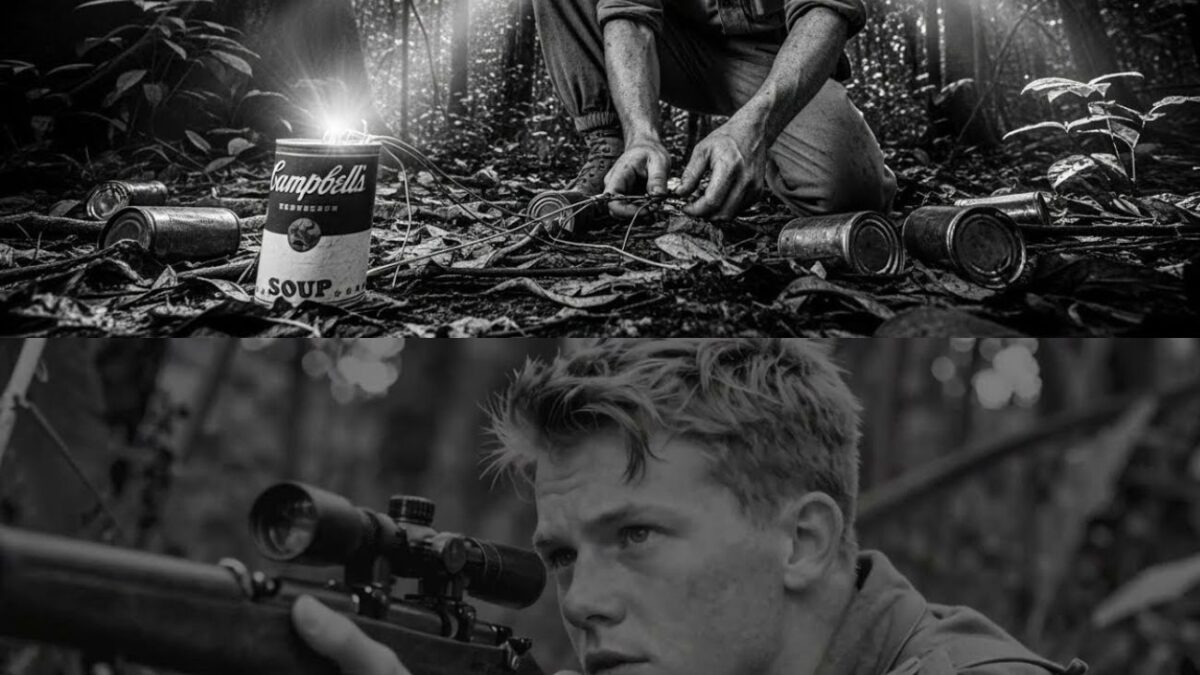
The humid air of the Philippine jungle hung thick on the morning of December 8th, 1941, as Private First Class William Henderson of the 31st Infantry Regiment settled into his foxhole outside Manila. The twenty-three-year-old farm boy from Iowa wiped condensation from his rifle scope, confident that any conflict with the forces approaching from the north would be brief. After all, conventional wisdom held that the enemy’s equipment was inferior and their military training utterly inadequate for prolonged engagement.
What Henderson could not have known, adjusting his position beneath the tangled canopy of vines and towering mahogany trees, was that a discarded soup can and his own desperate ingenuity would transform him from an anonymous rifleman into a legendary phantom. Over the next four months, this unassuming soldier would use nothing more than scavenged trash, meticulous marksmanship, and raw observation to delay an entire hostile company’s advance through the rugged Bataan Peninsula. In doing so, he would permanently demonstrate that individual human innovation could shift the tactical balance of mechanized, modern warfare.
The opening salvos of the conflict across the Philippines shattered initial American assumptions with brutal, unrelenting efficiency. Henderson’s regiment, serving as an integral component of the combined defense forces under General Douglas MacArthur, found itself pushed steadily southward from supposedly impregnable defensive positions. Wave after wave of well-coordinated opposing units advanced southward, demonstrating an unexpected mastery of jungle warfare, superior air coordination, and devastating operational momentum.
By the middle of December, Henderson’s own company had been systematically whittled down from one hundred and forty-seven men to a mere sixty-three combat effectives. Their retreat was not an orderly maneuver, but a grinding, agonizing sequence of rearguard actions through a sodden wilderness that seemed eager to swallow whole battalions. Every defensive perimeter established in the mud was abandoned within days as opposing columns outflanked their positions through unmapped trails and crocodile-infested waterways.
Technical Sergeant James Morrison, Henderson’s steadfast platoon leader, kept meticulous records in a small notebook even amid the terrifying chaos of their fighting withdrawal. His personal diary, recovered long after the eventual liberation of the islands in 1945, painted an unvarnished portrait of institutional collapse and physical degradation. Rations had been slashed to half-portions by December 20th, leaving soldiers weak and prone to malaria, while ammunition resupply dwindled to a trickle after Christmas.
By the dawn of the new year, vital medical supplies, especially sulfur tablets and quinine to combat rampant tropical fevers, had evaporated entirely from supply depots. The soldiers of the 31st Infantry were confronting the merciless mathematics of industrial warfare far from their distant homeland. Their opponents possessed not only decisive numerical superiority, but also the massive maritime logistics required to press their tactical advantage across Luzon without pause.
Henderson spoke very little during those harrowing weeks of relentless fallback toward the southern thumb of Bataan. His comrades noted his mounting quietness, watching as he stared into the oppressive green canopy with a steady concentration that bordered on absolute obsession. Where other exhausted soldiers saw only an impenetrable green wall of thorns and mud, the young Iowan began to perceive subtle structural patterns, game trails, and hidden terrain opportunities.
His childhood spent tracking white-tailed deer across the snowy river bottoms and hardwood ridges of rural Iowa translated remarkably well to this alien, equatorial theater. He observed how the thick air amplified certain frequencies of sound at dawn while dampening metal echoes during the blazing midday heat. Above all, he recognized that despite their fierce tactical discipline, the advancing patrols followed rigid operational doctrines that made their movements clockwork and predictable.
The turning point of his wartime experience occurred on January 15th, 1942, during a desperate, rain-slicked rearguard action near the small village of Abucay. Henderson’s battered squad received orders to anchor an obscure trail junction for six critical hours, allowing the main American defensive column to withdraw and dig in three kilometers to the south. The squad was down to forty-two rounds of ammunition per man, possessed zero heavy machine gun support, and held strict instructions to avoid decisive engagements.
Corporal Eddie Martinez, a seasoned regular from the peacetime army who had spent five continuous years garrisoned in the islands, was boiling muddy stream water over a tiny fire. He used an empty Campbell’s tomato soup can salvaged from an overrun quartermaster dump, balancing it carefully on three flat river stones. Henderson watched with glazed eyes as Martinez poured out the steaming brew, blew on his blistered fingers, and tossed the battered tin into the brush.
The discarded vessel rolled down a mossy embankment and landed upright in the churned red clay, its scarlet label peeling yet still starkly visible against the dark mud. What unfolded seconds later was an accidental revelation that Henderson would carry with him for the rest of his life. An enemy combat patrol, consisting of six infantrymen moving in standard staggered file, stepped silently into the clearing barely twenty meters from the Americans’ camouflaged rifle pits.
The lead scout’s heavy leather boot struck the hollow cylinder, kicking it against a hollow mahogany log with an unnatural, ringing metallic crash. The sound was sharp, alien, and impossible to mistake for anything produced by the natural inhabitants of the Philippine rainforest. The entire hostile column instantly froze mid-stride, their weapons snapping upward toward the canopy as their training took complete control of their bodies.
Henderson watched through the Lyman scope mounted on his service rifle as the enemy unit carried out their doctrine with flawless, textbook precision. They did not break ranks or scatter blindly, but dropped into prone cover, swept their assigned arcs of fire, and hand-signaled their trailing support elements to halt immediately. For eight agonizing minutes, the patrol remained frozen in the mud, fixated entirely on the harmless soup can, convinced it masked a tripwire, an unexploded shell, or an observation post.
Eight precious minutes had been bought without firing a single precious round of caliber .30-06 ammunition or compromising their squad’s concealed position. Henderson’s mind raced through the tactical possibilities of that single clattering object as he watched the sweat drip from his sergeant’s chin. If sound discipline was sacred in the jungle, then anomalous noise could be forged into a precision instrument to manipulate the enemy’s caution.
Why waste scarce bullets trying to stop an advance with firepower when you could make the enemy stop themselves through their own doctrinal thoroughness? If an empty tin can could command the undivided attention of six armed soldiers for nearly ten minutes, a network of such devices could paralyze an entire battalion. Henderson realized he did not need to destroy the opposing army; he merely needed to manufacture ghosts that their commanders could not afford to ignore.
That very evening, after his unit slipped away to link up with the new defensive perimeter, Henderson approached Sergeant Morrison with a bizarre operational concept. He requested formal authorization to detach from the regular company line, slip into the dense buffer zone between the armies, and wage an independent irregular campaign. His requested kit sounded like madness to the supply clerk: miles of discarded telephone wire, empty tins, bent nails, and every scrap of scrap metal in the company bivouac.
Morrison stared at the young marksman, recognizing both the hollow madness born of prolonged retreat and the cold, terrifying clarity of an exceptionally skilled hunter. He knew that the 31st Infantry was running out of men, time, and ammunition, and that orthodox tactics were simply failing against the relentless push down the peninsula. With a grim nod and a signed field pass, the sergeant authorized a seventy-two-hour trial period, expecting he might never see the Iowa boy alive again.
Henderson’s private war commenced on the damp morning of January 18th, deep in the untamed wilderness along the slopes of Mount Natib. He slipped into the shadows carrying his beloved M1903 Springfield bolt-action rifle, a canvas bandolier holding one hundred rounds, a canteen, a handful of dried rice, and a heavy sack of scavenged junk. His designated operations sector was a two-square-kilometer choke point where three overgrown logging trails funneled through a steep, vine-strangled valley toward the American lines.
His initial apparatus was crude, designed more as a proof of concept than an intricate weapon of war. He strung rusted tripwire between two banyan trees at ankle height, wiring several empty condensed-milk tins packed with river gravel directly to the line. Crouched seventy meters uphill within a spider hole hollowed beneath the roots of an ironwood tree, Henderson rested his rifle barrel on a padded branch and waited.
Just after dawn, an enemy platoon entered the defile, their weapons at the low ready as they navigated the slippery, muddy incline. The point scout caught his foot on the obscured wire, sending the weighted cans rattling violently against a suspended slab of corrugated roof tin Henderson had hung behind the foliage. The resulting cacophony echoed through the mist like a burst of machine-gun fire, sending the entire formation rolling into the ditch for cover.
The patrol commander immediately signaled a full defensive perimeter, deployed flanking scouts into the thick bamboo, and spent twenty-five exhausting minutes sweeping the empty jungle. Henderson watched the entire performance through his crosshairs, his finger resting lightly against the cold steel of the trigger without ever increasing pressure. The enemy had burned precious daylight, soaked their uniforms in stagnant swamp water, and expended immense nervous energy combating a handful of stones and discarded cans.
Henderson quickly realized that repeating the identical trick would breed familiarity, and familiarity would eventually lead the enemy to disregard the alarms. To keep them off balance, he transformed his rudimentary experiments into a comprehensive psychological taxonomy of confusion, paranoia, and operational delay. Some of his perimeter warnings were noisy, while others were unnervingly silent, consisting of deliberately placed American equipment positioned to simulate abandoned observation hides.
He crafted hybrid mechanisms where a tripped wire at ground level produced no immediate sound, but instead jerked a line running sixty meters away into the jungle canopy. High above the jungle floor, the wire violently shook clusters of dry palm fronds, causing opposing point men to dive for cover from non-existent tree snipers. Each encounter forced the enemy to halt their columns, dispatch cautious reconnaissance teams, and methodically sweep empty underbrush while the minutes ticked away.
Private Daniel Kowalski, one of the few couriers permitted by Morrison to run supplies to Henderson’s isolated sector, later provided vivid testimony to military investigators. Kowalski noted that Henderson had transformed his square of mountainous wilderness into a dynamic, deadly chessboard, charting every trail with mathematical precision. He had mapped out enemy patrol cadences, calculating that the opposing units cycled through specific trail networks with absolute, unwavering institutional regularity.
If a reconnaissance unit scouted Trail Dog at zero-six-hundred hours on a Tuesday, identical doctrinal procedures dictated that a relief patrol would repeat that exact patrol path seventy-two hours later. This rigid adherence to standard operating procedure became the primary vulnerability Henderson systematically exploited to sow discord. The jungle was no longer a chaotic wilderness to the solitary farmer; it had become an intricate web of invisible tripwires, sightlines, and psychological trip-traps.
By the end of January, Henderson had expanded his territory into what his field sketches designated as systematic “interrupt zones.” In these designated sectors, an advancing infantry squad could not traverse more than one hundred meters without triggering some form of calculated sensory anomaly. A sudden tin clatter here, a snapped bamboo stalk placed deliberately against the wind, or an empty American ration wrapper fluttering conspicuously beside a suspected deadfall.
Each deliberate clue seemed to promise sudden death, compelling the opposing commanders to execute time-consuming security halts and flanking maneuvers. The cumulative mental toll on the opposing infantrymen far exceeded anything Henderson’s commanders could have reasonably anticipated from a lone marksman. Soldiers advancing through the dense brush were subjected to continuous, nerve-shredding suspense that transformed every branch and leaf into a lethal threat.
Captain Yoshiro Tanaka, commanding the vanguard company assigned to sweep this mountainous corridor, left detailed impressions in his official operational logbook. Tanaka noted with escalating frustration that his seasoned units, which typically advanced five to six kilometers daily through broken terrain, were crawling forward at barely two thousand meters. His soldiers were reporting extreme psychological exhaustion, jumping at shadows and constantly reporting invisible snipers concealed within the impenetrable green canopy.
The pressure reached such a fever pitch that on three separate occasions, jittery soldiers opened fire on rustling bushes, triggering chaotic, friendly-fire skirmishes. Morale began to plummet under the relentless strain of hunting an adversary who vanished like morning fog whenever superior force was brought to bear. Tanaka’s men were fighting an enemy they could never see, hear, or pin down, yet whose presence hung over every foot of trail.
What elevated Henderson’s irregular operation from an irritating nuisance into a genuine tactical catastrophe for Tanaka’s company was his cold, calculated economy of violence. He did not engage every patrol that walked into his web; with fewer than a hundred cartridges in his pack, he could not afford a protracted firefight. Instead, he waited until an enemy unit had navigated three or four false alarms, their discipline degraded and their patience completely exhausted.
When the soldiers finally convinced themselves that the strange noises were merely harmless tricks and began to rush carelessly forward, Henderson would strike. Waiting at the extreme limits of iron-sight accuracy, often through narrow vision corridors cut through the undergrowth, he would fire a single, catastrophic round. The bullet would find its mark with surgical finality, and before the echo had finished reverberating through the hills, Henderson would be crawling away through pre-dug escape tunnels.
This brutal rhythm created an insoluble tactical dilemma for the advancing forces, paralyzing their initiative and destroying their confidence. Every tripped wire might simply be an empty can filled with pebbles, or it might be the sensory precursor to a fatal high-velocity bullet from nowhere. Because there was no conceivable way to distinguish between the phantom decoys and the real marksman, Captain Tanaka had no choice but to treat every anomaly as fatal.
As a direct consequence, the imperial company’s timeline fell apart completely under the weight of their own institutional caution. A thrust intended to shatter the secondary American lines by January 25th was still bogged down in Henderson’s forested labyrinth well into the first week of February. A single soldier, sustained by swamp water and dry rice, had managed to anchor the advance of hundreds of veteran infantrymen.
Yet the toll extracted from Henderson’s own mind and body was severe, carving away at his physical endurance and mental stability. When Corporal Martinez conducted his clandestine supply drops every fourth night, he watched his friend steadily deteriorate into an unrecognizable shell. Henderson had shed nearly twenty pounds from his tall frame, leaving his cheekbones sharp, his uniform rotted with fungus, and his hands trembling with nervous exhaustion.
He spoke only in flat, monosyllabic whispers, his bloodshot eyes darting continuously across the darkened canopy even while conferring with his trusted comrade. The crushing burden of uninterrupted solitude, coupled with the necessity of remaining alert every second of the day and night, was corroding his psyche. He was living as both hunter and prey, trapped in a relentless cycle of stalking where a single careless cough or snapped twig meant instantaneous death.
Surviving field logs indicate that between January 18th and February 10th, Henderson discharged his Springfield rifle exactly forty-seven times against hostile targets. Every single shot represented a confirmed casualty at distances ranging from one hundred and eighty to over four hundred meters through obscuring jungle foliage. Those forty-seven rounds, husbanded with astonishing discipline, effectively stalled an entire reinforced rifle company for more than three weeks.
The tactical balance had shifted so dramatically that Henderson had accomplished entirely alone what an entrenched infantry company would have struggled to achieve. He had turned the jungle’s natural oppression back upon the invaders, weaponizing their own doctrine and turning their professional discipline into a liability. But the enemy was composed of experienced military professionals, and such glaring tactical asymmetries could not remain unanswered forever.
By the second week of February, Captain Tanaka recognized that small, light reconnaissance elements were simply being dismantled in detail by the unseen phantom. Abandoning his standard scouting doctrine, Tanaka shifted to an aggressive strategy centered on overwhelming mass delivered along narrow, concentrated axes of advance. He ceased sending squads along the trails, choosing instead to push entire reinforced platoons shoulder-to-shoulder through the brush regardless of the noise they generated.
When forty armed men moved forward simultaneously, Henderson’s pebble-filled cans were swept aside as mere irritants rather than terrifying omens of ambush. The sheer volume of fire the enemy could instantly deliver into the jungle made Henderson’s close-range harassment tactics unacceptably hazardous. The lone Iowan recognized immediately that the tactical landscape had changed and that continuing his previous patterns would lead to his immediate encirclement.
On the night of February 14th, Henderson left a penciled scrap of paper at the designated drop tree for Corporal Martinez. He scribbled that the game had evolved, and that to survive and remain effective, he had to escalate his campaign against the enemy’s leadership. If the opposing force insisted on advancing in massive, concentrated columns, he would ignore the scouts entirely and sever the mind directing the body.
What ensued was the most hazardous and audacious chapter of Henderson’s solitary campaign in the wilderness of the Bataan Peninsula. He began shadowing the massive columns from parallel ridges, studying their movements through his optic for hours, sometimes trailing a unit for days. He learned to identify the company’s commissioned officers and senior sergeants by their posture, their equipment, and the deference paid by surrounding men.
He waited for the oppressive heat of the early afternoon, that deadening hour between one and three when vigilance naturally waned under the sun. When the column paused to check maps or hydrate, Henderson would steady his rifle against an embankment hundreds of meters away, select the leader, and fire. By the time the bewildered soldiers could orient their rifles toward the distant crack of the Springfield, Henderson had already slipped away through the gullies.
Lieutenant Robert Chen of the 45th Infantry Regiment, who crossed paths with the marksman at an isolated watering hole on February 20th, recorded their meeting. Chen wrote in his personal notebook that Henderson looked less like a soldier and more like a wild creature spit out from the jungle’s belly. His eyes were sunken deep into bruised sockets, his skin was scorched black beneath encrusted mud, and his uniform hung from his frame in tattered ribbons.
Yet what truly unsettled Lieutenant Chen was the eerie, detached precision in Henderson’s voice as he calmly discussed enemy movement tables and patrol intervals. The farmer spoke of tracking human beings with the dispassionate technicality of an engineer discussing bridge loads, his humanity seemingly hollowed out by the task. He had elevated the art of the solitary stalker to an absolute science, but the horrifying discipline required was slowly devouring him from within.
The operational climax arrived on the sweltering morning of February 23rd at a critical trail convergence overlooking a dry river crossing. Henderson had stalked a company-sized formation for three uninterrupted days, memorizing their rest intervals, security deployments, and communications procedures. He had identified the overall commander by his polished leather map case and the persistent presence of a communications specialist bearing a backpack transceiver.
As the formation halted in the riverbed to coordinate their route, four officers clustered tightly around an unfolded topographic map laid across a boulder. Henderson lay concealed two hundred and ninety meters away on an elevated ridge, fighting off the violent heat shimmer that made the distant figures waver. The shot was at the absolute limit of what his iron sights and iron nerves could deliver through the rising thermal currents of noon.
Controlling his racing heartbeat through shallow breaths, Henderson compensated for the cross-valley draft and gently squeezed the cold curved trigger. The rifle bucked hard against his bruised shoulder, its report echoing through the ravine as the enemy company commander collapsed into the dust. The surrounding formation dissolved into chaotic shouting, immediately deploying smoke grenades and raking the far hillside with blind bursts of light machine-gun fire.
Henderson, however, was already low-crawling through a ditch he had cleared days before, ignoring the bullets clipping the bamboo shoots overhead. He had prepared several false paths, complete with planted footprints that directed pursuit straight toward an impassable mud bog riddled with deceptive dead-end trails. By the time the hostile scouts reached the firing ridge, the lone marksman had put half a kilometer of impenetrable swamp between himself and their rifles.
The loss of their commanding officer sent shockwaves through the enemy’s regional command, bringing their tactical advance in the sector to a complete standstill. Tanaka’s emergency dispatches revealed that the offensive was temporarily suspended while high-ranking officers conducted a thorough tactical review of their movement doctrine. Higher headquarters issued immediate, urgent directives ordering the total elimination of the ghost sniper who had effectively neutralized an entire operational corridor.
Nearly six hundred frontline soldiers were diverted from the primary offensive against the main American line to comb the jungle for Henderson. The tactical irony of the situation was staggering; Henderson’s success had made him an objective of such immense value that he became a primary target. Every infantryman assigned to sweep the mountains for the lone American was one less soldier storming the beleaguered defenses protecting the southern peninsula.
Henderson had made himself an indispensable strategic asset through nothing more than patience, psychological manipulation, and an extraordinary understanding of forest craft. Yet the vast net was drawing tighter around him with every passing day, shrinking his sanctuary into a handful of jagged, inaccessible ravines. By the first week of March, the search teams had introduced trained tracking dogs into the theater, introducing a weapon Henderson could neither deceive nor terrify.
When Corporal Martinez made his final clandestine supply run on the night of March 8th, he found Henderson trembling violently in a shallow cave. The marksman had been on the run for forty-eight sleepless hours, surviving entirely on stagnant water, fern roots, and edible grubs pulled from rotting logs. He had only eleven rounds of rifle ammunition remaining in his pocket, his boots had split open, and his feet were bleeding raw.
Martinez pleaded with his comrade to abandon the sector and retreat back to the safety of the main American lines, warning him that the net was closed. Henderson flatly refused, his fevered eyes burning with an unsettling intensity that silenced the corporal’s arguments in the dark. He had spotted a structural flaw in the enemy’s sweeping pattern, an unpatrolled sector that opened every seventy-two hours during battalion relief rotations.
He intended to launch one final strike against the enemy’s concentration before exhaustion claimed him, something decisive enough to justify the terrible ordeal. Seeing that Henderson could not be dissuaded, Martinez left his own remaining rations and an extra canteen, squeezed his friend’s shoulder, and melted away. Henderson’s final combat engagement occurred on the misty morning of March 11th, 1942, against an elevated topographic feature designated on maps as Hill 227.
Allied intelligence had recently identified this commanding promontory as the forward staging base for an imminent assault against the battered Bataan defensive perimeter. Working through the thick undergrowth on hands and knees, Henderson spent thirty hours evading search patrols to reach a concealed vantage point. From his hide four hundred meters below the crest, he peered through the foliage to see an open-air planning pavilion crowded with high-ranking officers.
Radios were humming, tactical maps were pinned to timber easels, and the polished equipment clearly signaled the presence of senior general staff. Henderson rested his rifle over an exposed root, his body racking with chills from an acute bout of malaria that made his vision swim. He possessed only six rounds of ammunition, the range pushed the ballistic envelope of his rifle, and unpredictable mountain winds whipped across the clearing.
Steadying his breathing through sheer force of will, Henderson aligned the sights on the central figure at the table and pressed the trigger. He cycled the Springfield’s bolt with mechanical rhythm, firing his second, third, and fourth rounds into the clustered leadership in rapid, disciplined succession. The distance was too great to confirm precise casualties, but he observed bodies dropping instantly to the floor as the pavilion descended into frantic disarray.
Maps fluttered away in the wind, alarms blared, and armed guards threw themselves over the fallen officers while others fired blindly down the mountain. With two rounds left in his rifle, Henderson did something that baffled even himself: he stood straight up in the open, lowered his weapon, and walked away. He did not run, he did not take cover, and he did not check his back trail; he simply turned south and began to walk.
He later recounted to military interrogators that his spirit had simply reached its absolute limit; he possessed no remaining energy for fear or flight. His mission was complete, his physical reserves were entirely gone, and if the enemy was destined to cut him down, he would accept it on his feet. What followed was a journey through the heart of the jungle that defied every principle of battlefield probability and survival logic.
For six agonizing hours, Henderson trudged through enemy-held territory like an ambulatory corpse, his eyes fixed on the distant southern ridgeline. The broken ravines and choking vegetation that had served as his hunting grounds now masked his silent, stumbling retreat from view. Passing within meters of hostile patrols who were actively scouring the ridgeline for the sniper, his tattered, mud-caked frame blended seamlessly into the landscape.
At eighteen-hundred hours on March 11th, a skeletal figure emerged from the dense undergrowth near the American perimeter at the village of Bagac. The nervous outposts nearly cut him down with a heavy water-cooled machine gun before a sergeant recognized the shredded remnants of an American uniform. When medics carried him into the field hospital, they discovered that Henderson had shed forty-three pounds since the start of his solitary campaign.
He was suffering from severe malnutrition, advanced hookworm, amoebic dysentery, systemic bacterial infections from dozens of thorn cuts, and acute combat exhaustion. The remarkable saga might have ended there, lost amidst the tragic collapse of the Philippine defense and the subsequent surrender of American forces at Bataan. However, Allied military intelligence had been quietly piecing together the extraordinary effects of Henderson’s operation through captured enemy documents and prisoner interrogations.
Major Thomas Bradford, the intelligence officer tasked with analyzing the defense of the sector, documented the full scope of the marksman’s impact. Bradford’s calculations revealed that Henderson’s fifty-four-day campaign had delayed the advance of three entire enemy companies by approximately twenty-three days. Furthermore, his phantom war had compelled the diversion of nearly eight hundred frontline troops into futile counter-sniper sweeps at the height of the campaign.
The statistical data was remarkable, but it failed to capture the profound psychological disruption Henderson had inflicted upon the opposing units. Interrogations revealed that the rank-and-file soldiers had become terrified of entering the jungle, convinced that a spectral sniper battalion was tracking them. The mythology of the invisible American who could kill from nowhere had thoroughly infected the ranks, undermining their morale long after Henderson had left the field.
Henderson was evacuated to Australia aboard one of the last blockade-running transport planes in April 1942, narrowly escaping the horrors of the Death March. He spent three months in a military convalescent facility outside Brisbane, wrestling with the invisible wounds that contemporary physicians simply called combat fatigue. Lieutenant Chen, who had also escaped the fall of the islands, visited his friend during that agonizing period of recovery.
Chen noted that while Henderson rarely spoke of the violence, he spent his nights staring at the ward doors, keeping an unloaded rifle beneath his mattress. His body had returned from the Philippine mountains, but his hyper-vigilant mind remained trapped in the shadows of Mount Natib, listening for the snap of twigs. Recognizing his profound intuitive mastery of fieldcraft, the army wisely assigned Henderson to an instructor role rather than returning him to frontline combat.
For the remainder of the war, Henderson taught advanced scout-sniper doctrine to replacement troops in Australia and the dense jungles of New Guinea. Thousands of young soldiers learned to view terrain not as an obstacle, but as a dynamic tactical instrument to turn against their opponents. One of his students, Private James Wilson of the Alamo Scouts, later wrote that Henderson taught them that effectiveness in war came at a harrowing price.
Henderson constantly warned his men that surviving alone behind enemy lines required shedding one’s humanity, a psychological transformation that was brutally difficult to reverse. When the war finally concluded, Henderson returned quietly to the rolling fields of Iowa, settling down on the family farm where he had grown up. He married his high school sweetheart, raised four children, cultivated corn and soybeans, and served as a quiet, respected pillar of his local community.
To his neighbors, he was simply Bill Henderson, a modest veteran who never joined war parades and refused to boast of his overseas service. Yet the subtle habits of his ordeal never completely left him; he refused to sit with his back to doors in diners and restaurants. He walked the timber lots behind his farm alone for hours, his gaze sweeping the tree limbs with the ingrained instincts of a jungle hunter.
In 1978, during his sole public interview with a local reporter, Henderson offered a rare, candid glimpse into the mindset that had kept him alive. He explained that he felt no pride in what had transpired, having simply utilized what was at hand to solve an immediate survival problem. He remarked that the true tragedy of extreme focus was that one became indistinguishable from the violence, losing the boundary between self and the mission.
The military’s formal appreciation of Henderson’s actions continued to evolve over the decades as modern tacticians studied the Bataan campaign with fresh perspectives. In 1991, the Department of the Army formally upgraded his decorations to the Silver Star, citing his extraordinary valor and unmatched tactical resourcefulness. The citation explicitly noted that his single-handed deployment of scavenged materials stood as one of the most brilliant examples of force multiplication in modern history.
Further historical validation arrived in 2003 when Japanese historian Dr. Hiroshi Yamamoto published a groundbreaking study utilizing declassified records of the imperial forces. Yamamoto dedicated an entire chapter to the mysterious ghost sniper of Bataan, analyzing Captain Tanaka’s desperate, confused field reports from the front lines. The documents revealed that the opposing command had genuinely believed they were fighting a coordinated team of elite American marksmen with experimental silencers.
Tanaka’s final official report had even urged his superiors to adopt Henderson’s acoustic misdirection techniques for their own irregular units in future island campaigns. Henderson passed away peacefully in 2007 at the age of eighty-nine, resting in the same farmhouse where he had taken his first steps. At his funeral, few of the grieving neighbors fully grasped the complexity of the gentle, elderly farmer who had once brought an army to a standstill.
His grandson later donated his wartime artifacts to the Army Heritage Center, including a heavily rusted tomato soup can kept preserved on a workshop shelf.

