The Slave Woman Who Mixed ‘Oleander Sap’ into the Mistress’s Carmine: The Lips That Turned Black!
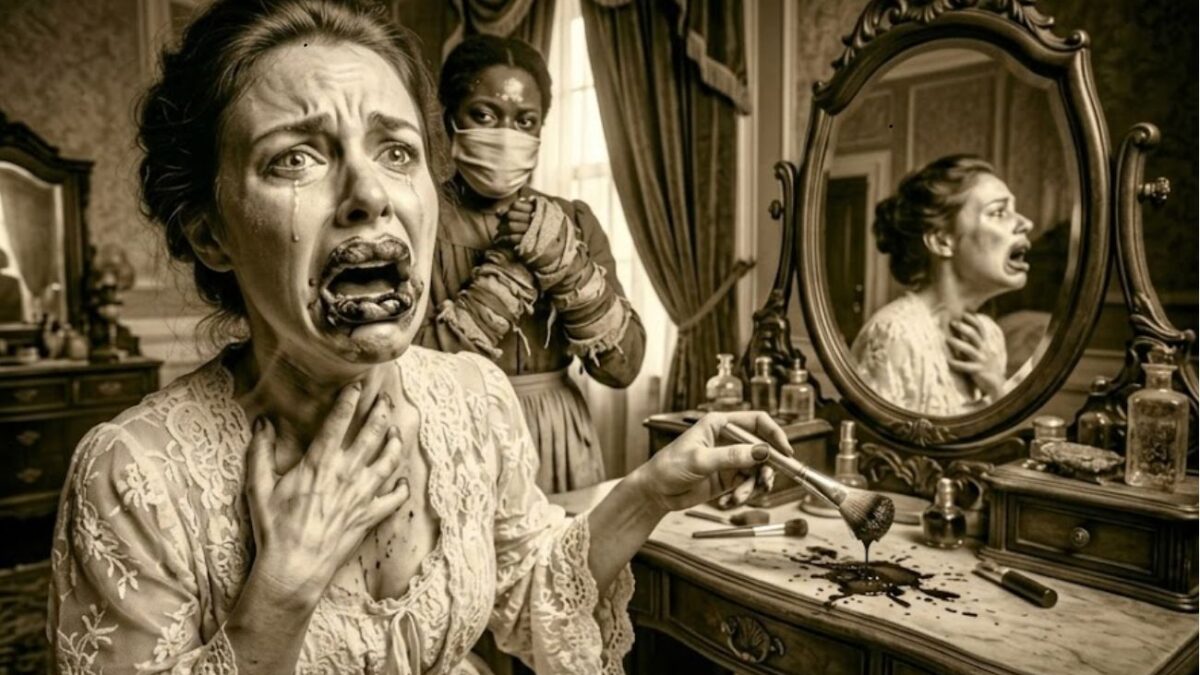
How much does the beauty of a woman who feeds on the agony of others truly cost? That unspoken reckoning hung thick in the suffocating heat of the Recanto das Sombras plantation, lingering in the shadows of the valley. It watched in silence while an imported, vibrant crimson paste slid smoothly across the delicate contours of Sinhá Constança’s pale lips.
Behind that impeccable layer of French carmine, a quiet rot was already preparing to devour far more than human flesh. It was an insidious corruption destined to shatter the absolute power of the coffee barons throughout the Paraíba Valley. On that particular morning in 1860, the sun crested the serrated mountain ridge with a heavy, languid insolence.
The golden light did little to pierce the darkness entrenched within the souls of those who possessed nothing left to lose. The morning mist settled over the sprawling estate like a shroud woven from cold iron and ancient tears. In the valley below, dawn brought no warmth, only the familiar, mechanical ache of another day spent under the lash.
Coffee was the undisputed monarch of the nineteenth century, an undisputed king hailed as the miraculous green gold of an ambitious empire. For the hundreds of men and women who broke their bodies against the red earth from dawn until dusk, it had no regal splendor. It smelled exclusively of sour sweat, felt like coarse gravel, and tasted like the sharp, bitter copper of fresh blood.
The Recanto das Sombras plantation, known far and wide as the Retreat of Shadows, lived up to its grim title with meticulous cruelty. Tucked deep within a low basin where the morning fog sank early and clung obstinately to the soil, the grand estate was a stone monument to opulence. Every polished plank of rosewood and every ornate crystal chandelier rested squarely upon a foundation of human agony.
High arched windows stood sentinel across the façade of the Big House, observing the endless rows of coffee shrubs like cold, unblinking eyes. Within those cavernous hallways, the heavy rosewood flooring groaned beneath the deliberate footsteps of an aristocracy that genuinely believed itself anointed by God. It was a secluded kingdom built on absolute subservience, preserved through terror, and protected by walls of arrogant silence.
Through those dim corridors drifted Dr. Augusto, moving like a restless ghost haunting a tomb that had not yet closed. He was not a creature of the land, nor did he share the brutal, swaggering swagger of the overseers who patrolled the red dirt paths. Augusto was a man sculpted entirely by darkness, exile, and the bitter residue of a lifetime spent in deep remorse.
Years prior, he had disembarked from a Portuguese vessel in Rio de Janeiro with high honors from the University of Coimbra. His leather luggage had carried a pristine diploma, polished silver instruments, and an innocent, fiery hope for the future. Yet the unforgiving reality of human frailty had torn his grand ambitions to pieces before they could ever truly bloom.
A catastrophic delivery in the humid alleys of the imperial capital had claimed both his beloved young wife and his newborn son. Elisa had slipped away beneath his frantic, blood-soaked hands while the child had barely drawn enough breath to let out a single wailing cry. That terrible night, Dr. Augusto had perished alongside them, leaving behind an empty vessel that merely walked and breathed.
What remained of the physician was a hollow shell, an aimless exile whose once miraculous surgical fingers now shook violently without spirits. The only medicine capable of steadying his hands was cheap, burning cachaça, purchased in clay jugs and hidden away like stolen treasure. He had become the Baron of Alencar’s indispensable fixer, an educated drunkard retained to maintain order among the damned.
Augusto occupied a damp, decaying stone room at the far rear of the estate, nestled between the stables and the kitchen garden. His meager dwelling smelled constantly of mildewed leather, rotting parchment, stale cane liquor, and the faint, sweet trace of carbolic acid. His sole purpose on the plantation was to preserve the Baron’s expensive investments, ensuring that the human property remained capable of harvesting.
He patched split skin after the whips had done their work, set broken bones, and treated the fevers that periodically swept the quarters. He witnessed unnameable cruelties, heard the muffled weeping that rose from the quarters at midnight, and scrubbed the whipping post clean of gore. Yet throughout those grueling years, he had said nothing, offering no protest and raising no hand against the tyranny that sheltered him.
His complicity was the miserable rent he paid for cheap liquor, a dry bed, and the cowardice to hide from his memories. He kept his tarnished silver surgical kit tucked inside a velvet-lined rosewood box beneath his cot, a relic of a noble life. It was a tangible testament to a time when he had believed in justice, healing, and the sacred nature of human existence.
If Augusto was the shattered, ruined ghost of the plantation, Damiana was the living, unyielding blade waiting patiently within the dark. She was a young woman of extraordinary grace, possessing delicate features and an obsidian gaze that seemed to slice straight through stone walls. She served as personal maid to the mistress of the house, a position that placed her directly inside the serpent’s nest.
Damiana’s daily labor was to function as the passive, mute mirror for Sinhá Constança’s monstrous, insatiable vanity. For endless hours each morning, she combed perfumed pomades into her mistress’s curls and powdered the woman’s sallow, venomous cheeks. She painted Constança’s thin lips with the prized, expensive French carmine paste that arrived by private courier all the way from Paris.
Sinhá Constança was a woman draped in the finest European silks, possessing pale, translucent skin that hid a profoundly deformed spirit. Despite her lavish jewels, her fine laces, and the sweet waters imported to bathe her flesh, she exuded a cold, putrid malice. She derived genuine pleasure from inflicting misery, finding solace for her own miserable marriage in the systematic torment of her enslaved servants.
Tucked discreetly into the hem of Damiana’s coarse skirt was a secret token: a sprig of dried, aromatic leaves gathered long ago. It was the sole physical legacy of her mother, Benedita, who had once been the plantation’s most gifted and revered healer. Benedita had possessed the rare gift of coaxing life from dying soil and healing wounds that baffled educated doctors like Augusto himself.
Five years earlier, Benedita had been dragged from her quarters in chains and sold down south to an unknown, brutal master. Her only offense had been curing a field hand whose slow, agonizing death Constança had personally wished to witness from her veranda. Damiana had watched her mother disappear into the dust of the slave driver’s cart, carrying an incandescent vow carved into her ribs.
Damiana understood the surrounding soil intimately, knowing that the tangled rainforest hugging the coffee terraces was not merely green foliage. It was a living, breathing apothecary that offered both gentle deliverance and catastrophic vengeance to those who understood its silent language. She knew which hidden vine could soothe a frantic heartbeat, and which pale tuber, ground fine, could stop a man’s pulse entirely.
The simmering tensions that plagued the great house reached an explosive threshold on a particularly humid, airless Tuesday afternoon. Baron de Alencar, a broad-shouldered man with sweeping silver whiskers and eyes as frigid as river stones, had returned from the capital. The master was furious, his broad brow furrowed with dark rage over financial maneuvers and mounting personal debts he could no longer manage.
Whispers traveled swiftly through the heavy damask curtains of the bedrooms, carried from ear to ear by terrified housemaids. Constança had learned through indiscreet correspondence that her aristocratic husband maintained a second, younger household in the bustling center of Rio de Janeiro. Worse still, the gold that should have purchased her emeralds and European gowns was being poured into the hands of an actress.
Constança’s fury was not a noisy tempest of flying porcelain or screamed insults directed at the imposing, tyrannical Baron. She possessed a predatory, calculated cowardice, swallowing her rage in her husband’s presence and releasing it entirely upon the defenseless. She wandered the estate looking for the slightest imperfection, eager to tear skin and draw blood to quell the humiliation burning her soul.
That afternoon, Damiana was kneeling upon the polished floorboards, pressing heavy silk sashes with an iron filled with red embers. The room was sweltering, the air thick with charcoal smoke, heavy rose water, and the oppressive, suffocating weight of Constança’s unspoken wrath. A single bead of sweat rolled from Damiana’s brow, stinging her eye and causing her hand to hesitate for a fraction of a second.
The heavy iron rested upon the delicate Parisian silk a moment too long, leaving behind a faint, golden scorch across the hem. It was the trivial pretext the mistress had been actively seeking throughout the long, agonizingly quiet hours of that humid afternoon. “You dare ruin what is mine, you insolent beast?” Constança hissed, her eyes dilating until they appeared almost entirely black with venom.
Before the young maid could move or utter an apology, the mistress lunged forward with the feral swiftness of a striking viper. She seized Damiana’s jaw with claw-like fingers, grabbed the smoking iron from the stand, and pressed the flat brass point against her cheek. The agonizing hiss of burning flesh filled the bedchamber, followed immediately by the nauseating, heavy stench of an open, searing wound.
Damiana did not cry out, refusing to grant the sadistic woman the satisfaction of hearing her scream or plead for mercy. She squeezed her eyes shut, digging her fingernails so deeply into her own palms that her blood dripped steadily upon the floorboards. As the excruciating agony radiated through her skull, her world tilted on its axis, transforming ancient sorrow into a pristine, crystalline hatred.
In that solitary, searing moment of torture, the young maid finally recognized that endurance alone would never purchase her salvation. Merely surviving the whims of monsters was an illusion; the only true path to life lay in the total annihilation of her tormentors. She bowed her head, gathered the ruined silk, and walked out into the corridor with smoke still rising from her burning cheek.
During the days that followed that savagery, Damiana walked the halls of the Big House with a rough linen rag bound around her face. She absorbed the mocking glances of the armed overseers and endured the casual cruelty of Constança, who feigned total indifference to the injury. Yet when midnight blanketed the valley in thick darkness, Damiana slipped silently into the manicured gardens that framed the manor.
There, nestled between imported white marble statues and trimmed hedges, flourished Sinhá Constança’s favorite, most prized ornamental shrubs: the oleanders. Their delicate pink blossoms opened lavishly under the moonlight, looking like innocent drops of spilled wine scattered across the dark, glossy green foliage. But Damiana possessed her mother’s profound knowledge, and she knew the terrifying, lethal secret that circulated within those woody branches.
The thick, milky sap flowing through the veins of the oleander contained cardiac glycosides capable of paralyzing nerves and causing severe tissue necrosis. If applied to raw wounds or absorbed through sensitive mucous membranes, it acted like a slow, localized rot that devoured healthy flesh. With steady fingers that did not tremble in the cool night breeze, Damiana snapped the slender green stems and gathered the poison.
Her target was sitting upon the mahogany vanity in the mistress’s bedchamber: the small, ornate porcelain jar filled with French carmine. The rich, ruby-tinted paste was Constança’s supreme treasure, an essential cosmetic she applied generously every morning to disguise the sallow hue of her skin. In the dead of night, while the house slept beneath a blanket of fog, Damiana introduced the sap into the crimson cream.
She stirred the mixture carefully with an ivory pin, measuring the dosage with the precise instinct of a master apothecary. She did not seek an immediate, quiet death that could be dismissed as sudden illness or the work of a phantom fever. She intended for Constança’s vanity to become her instrument of torture, allowing the mistress to slowly witness her own monstrous, physical decay.
Two days after the poisoned carmine was prepared, frantic shrieks of unendurable agony tore through the silent corridors of the manor. The cries shattered the quiet of the morning, echoing across the coffee terraces and penetrating the damp stone walls of the infirmary. An overseer arrived at a dead run, hammering violently upon Dr. Augusto’s door and demanding his immediate presence in the master’s quarters.
The physician, still battling the nauseating haze of a night spent drowning himself in cachaça, stumbled into the lavish bedchamber. The scene before him made the residual fog of alcohol evaporate from his mind in an instant of sheer, cold horror. Sinhá Constança was thrashing wildly across the bed, tearing at her silk nightgown while her husband stood frozen beside the hearth.
Her mouth, which had been painted with the French paste that very morning, was transforming into a grotesque, terrifying monstrosity before their eyes. What had begun as intense stinging and feverish blisters had rapidly darkened into deep, spreading areas of localized necrosis. The soft flesh of her lips was turning as black and stiff as coal, looking as if an ember were burning from within.
Augusto approached the bed, compelled by ingrained medical reflex, and leaned down to inspect the catastrophic damage inflicted upon the woman’s face. A sweet, unmistakable stench of rotting tissue struck his nostrils, mingling terribly with the artificial scent of lavender water and expensive hair pomade. His keen eyes drifted instinctively from the blistered, blackening lips to the open jar of carmine resting upon the vanity table.
Upon the gilded rim of the porcelain container, barely visible to an untrained eye, glistened a thin smear of dried, milky latex. He knew the indigenous plants of the valley; he knew the deadly oleander that grew so abundantly beneath the terrace windows. As his breath caught in his throat, he suddenly felt the oppressive weight of a steady, unwavering gaze watching him from the shadows.
In the corner of the room stood Damiana, her hands folded quietly over her apron, holding his gaze without a flicker of fear. She did not tremble, nor did she cast her eyes downward in the performative subservience required of an enslaved maid in that house. She stood tall, her posture radiating an ancient, regal defiance that Augusto had never before witnessed in any human being on that plantation.
The doctor parted his dry lips to question her, to shout for the guards, or to demand an explanation for the crime. Yet the words withered entirely within his throat as Damiana stepped forward silently and whispered words that struck his chest like a hammer. “You failed to save Dona Elisa in Coimbra because of fear, doctor,” she murmured with chilling precision. “Will you allow fear to blind you to justice now?”
Augusto felt as though all the air had been violently sucked from his lungs, leaving him gasping in the warm, perfumed air. Elisa was the sacred, agonizing name he had buried beneath miles of ocean and decades of uninterrupted, alcoholic despair. He had never spoken that name to a single living soul in Brazil, keeping it locked within the darkest chambers of his heart.
How could an enslaved girl in the isolated interior of the Paraíba Valley know the intimate details of his ruined past? How had she pierced the protective armor of his silence to find the exact wound that defined his miserable, cowardly existence? In that terrifying moment of clarity, Augusto realized he was not standing before a simple housemaid driven mad by her mistress’s cruelty.
He was standing face-to-face with a brilliant, calculating strategist who had studied his weaknesses long before striking her blow against their common enemy. The agonizing groans of Sinhá Constança faded into background noise as the doctor stood frozen between two distinctly different pathways. He could expose Damiana immediately, sending her directly to the whipping post, or he could finally choose the path of moral redemption.
Before he could speak, the bedroom door flew open with tremendous force, banging loudly against the plaster wall of the entrance. Baron de Alencar strode into the room, his face flushed purple with rage, followed closely by two armed overseers reeking of tobacco. The master took one look at his wife’s horrifying, blackened face and unleashed a guttural roar of disgust and disbelief.
“What manner of witchcraft is this, doctor?” the Baron bellowed, his fist crashing down upon the surface of the dressing table. “What has happened to my wife, and why does her face rot before my eyes like the carcass of a dog?” The Baron’s fury was the violent, unpredictable tempest that routinely preceded executions and public floggings in the center of the yard.
Augusto snapped the tarnished latches of his surgical kit shut, forcing his trembling hands to obey his desperately racing mind. “It is an acute, violent toxic reaction, Baron,” Augusto lied smoothly, feeling beads of cold perspiration trace down his trembling spine. “A rare contamination within the imported cosmetic, triggered by the intense tropical heat during its long maritime voyage from the coast.”
“I must move her to the stone infirmary immediately,” the physician insisted, maintaining a firm, authoritative tone he had not used in years. “The air in this grand house is stagnant, and I require specialized chemical preparations that cannot be transported across the grounds.” The Baron glared suspiciously at the open cosmetic jar, his cold eyes lingering for a brief, tense moment upon the silent maid.
“Take her, then,” the Baron barked, waving his hand in disgust as if dismissing a contaminated piece of damaged furniture from sight. “Save her face, Augusto, or you will answer to me with your own skin; and place that girl under guard, she was present!” With the assistance of the overseers, Constança was carried down the long staircase on a heavy linen canvas to the clinic.
Damiana was marched closely behind, an overseer’s hand resting upon the heavy leather whip coiled at his hip like a snake. As they crossed the threshold of the stone infirmary, Damiana caught Augusto’s eye and made a subtle, deliberate gesture toward her apron. She touched the hem of her skirt, signaling to the physician that the game was far larger than the poisoning of a vain woman.
Once inside the clinic, the thick scents of alcohol, sulfur, and dried mint replaced the oppressive, artificial perfumes of the main house. Augusto ordered the overseers out, claiming that the dangerous vapors of the medical tinctures required total isolation to avoid spreading contagion. Alone with the moaning, semi-conscious mistress and the young woman who had disfigured her, Augusto turned the heavy iron key in the lock.
“How do you know the name Elisa?” the doctor demanded in a harsh whisper, leaning heavily against his stained worktable for support. His hands were shaking uncontrollably now, rattling the small amber glass vials lined up neatly in their wooden storage racks. “Tell me how an enslaved girl from the Paraíba Valley knows the details of a grave dug across the Atlantic Ocean.”
Damiana approached the table with calm deliberation, showing no sign of fear despite the volatile situation they found themselves trapped within. “My mother was not merely an herbalist, Dr. Augusto,” she said softly, her dark eyes reflecting the yellow flame of the lantern. “She was a woman who could perceive the invisible burdens people carried within the quiet chambers of their broken spirits.”
“Shortly after you arrived at this estate, she found a silver medallion near the well, containing a lock of fair hair and an unsent letter.” Damiana spoke with a steady, quiet authority that completely commanded the room. “The overseer’s literate daughter taught me my letters in secret, and I read the sorrow you poured onto that yellowed paper.”
Augusto closed his eyes as a wave of profound sorrow washed over him, sweeping away the protective numbness he had cultivated with alcohol. “You are reckless,” he whispered, staring at the blackened, peeling lips of the woman writhing upon the narrow wooden cot. “You have placed your neck into the hangman’s noose; if the Baron discovers what you have done, no power can save you.”
“My neck has been inside the noose since the day I drew my first breath on this plantation, doctor,” Damiana replied without hesitation. She pointed directly to the raw, raised burn mark that disfigured her own cheek, a mirror of the violence inflicted upon her. “The only difference now is that Sinhá Constança finally wears the mark of her own rotten heart upon her face.”
“She will survive the night,” Augusto said, checking the shallow pulse fluttering at the mistress’s wrist with practiced professional detachment. “The necrosis has set in deeply; her lips will slough away, leaving behind a scarred, hideous sneer that no cosmetic can ever hide.” Her legendary beauty, the primary ornament she had wielded like a weapon against the vulnerable, was permanently annihilated.
“I did not orchestrate this merely to punish a cruel woman’s vanity,” Damiana said, reaching deep into the lining of her bodice. She produced a thick, carefully folded packet of yellowed legal documents and laid them squarely upon the table before the astonished physician. “Look at these papers, Dr. Augusto; I retrieved them from the false bottom of the Baron’s private desk while he was away.”
Augusto unfolded the parchment sheets, his eyes widening in mounting shock as he scanned the formal signatures, stamps, and legal seals. They were letters of manumission, dozens of them, bearing the names of men and women currently laboring under the whip outside. The Baron of Alencar had been intercepting and concealing legal grants of freedom to keep his labor force intact without paying compensation.
Among the names recorded upon the stamped documents, one single entry caused Augusto’s racing heart to stop entirely in his chest: Benedita de Jesus. “My mother was legally granted her freedom five years ago by the court in Rio,” Damiana said, hot tears cutting clean paths through the dust on her cheeks. “Yet that monster forged new papers and sold her south into brutal servitude to settle an old gambling debt.”
“He stole her life, he stole my life, and he stole the lives of forty others who harvest his fields under the lash,” she whispered. The scope of the Baron’s deception was staggering, representing a massive, highly illegal conspiracy involving forged notary stamps, bribed local magistrates, and human trafficking. The great wealth of the Recanto das Sombras was an elaborate lie built entirely upon stolen liberty and forged records.
Augusto leaned closer to the documents, his analytical mind piercing through the lingering fog of his past to grasp the broader picture. Alongside the hidden freedom papers lay a comprehensive ledger detailing the Baron’s private debts, revealing that the entire estate was completely mortgaged. The grandiose display of the Big House was nothing more than an opulent mask hiding imminent bankruptcy, maintained through terror and falsified documents.
“If these documents reach the capital, the Baron will not merely be disgraced,” Augusto murmured, his voice trembling with profound realization. “He will be stripped of his aristocratic titles, cast into prison, and ruined for the rest of his miserable, parasitic life.” The doctor looked down at his own hands, realizing that for seven long years, he had been this criminal’s faithful accomplice.
“What do you require of me, Damiana?” Augusto asked, his voice suddenly steady, clear, and stripped of its chronic, self-pitying cadence. He carefully folded the incriminating records and concealed them beneath the straw mattress of the rear clinic bed, out of sight. “Tell me what must be done, and I will follow your lead to the very end of this nightmare.”
“Keep that wicked woman alive, but keep her face hidden from the world,” Damiana instructed, her eyes burning with fierce tactical brilliance. “The imperial judge arrives from the capital in ten days for an official banquet, coming to audit the estate and inspect the books.” “The Baron cannot afford to show a damaged wife to his creditors; we will use his vanity against him.”
“We must smuggle these original documents off the plantation and into the hands of the abolitionist brotherhood in the village,” Damiana explained. “They have lawyers who can present the records directly to the visiting magistrate before the Baron can destroy them or buy the court.” Augusto nodded, understanding that he had crossed an invisible line; he was no longer a broken exile, but a co-conspirator in an uprising.
Before another word could be spoken, the heavy crunch of gravel outside the window shattered the fragile sanctuary of the locked room. The ominous sound of horse hooves circled the clinic, accompanied by the metallic clink of spurs striking the flagstones outside the door. Through the cracked wooden shutter, Augusto recognized the imposing, muscular silhouette of Sete Vidas, the Baron’s most ruthless and feared slave-catcher.
Sete Vidas was a man who possessed the tracking instincts of a bloodhound and the cold, unfeeling malice of a professional executioner. He did not knock; he simply leaned against the heavy timber of the door, inhaling deeply through his nose like a predatory beast. He smelled the sulfur and the alcohol, but beneath those sharp scents, he detected the unmistakable, sweet reek of decaying human flesh.
The heavy brass handle of the infirmary door began to turn with excruciating, deliberate slowness, testing the strength of the internal lock. Augusto reached into his pocket and closed his fingers around the cold, heavy handle of his silver-plated surgical scalpel. Damiana melted back into the deep shadows between the wooden shelving, her fingers gripping the dried herbal charm pinned beneath her apron.
The lock groaned under the pressure, but held fast against the weight of the man attempting to force his way inside. “Doctor,” Sete Vidas called out from the darkness, his voice low, dry, and rasping like autumn leaves dragged over stone. “The Baron demands to know if the mistress still breathes, or if we should begin digging a grave in the family plot.”
Augusto cleared his throat, forcing an authoritative calm into his chest that completely belied the terrifying pounding of his heart. “She lives, Captain,” Augusto answered firmly, keeping his back pressed against the table and his eyes locked upon the wooden door. “The infection is aggressive and highly contagious; if you value your own skin, I suggest you return to the stables.”
A heavy, suffocating silence fell between the two men, separated only by two inches of aged, iron-reinforced Brazilian oak. Sete Vidas inhaled once more through the crack, let out a dry, chilling chuckle, and turned away, his spurs jingling into the mist. Augusto exhaled slowly, knowing with terrifying certainty that they had merely bought a few precious hours before the bloodhound returned to strike.
“We cannot wait for dawn,” the doctor whispered urgently, moving across the room toward the small hearth to ignite a fresh candle. “If Sete Vidas begins searching the quarters or checking the trails, not even a mouse will leave this plantation alive.” They needed a courier who could navigate the mountain passes in total darkness without drawing the suspicion of the armed guards.
Augusto immediately thought of Old Tião, an elderly stable hand who lived in a forgotten, leaking shack behind the mule pens. Considered too frail and broken for heavy labor, Tião was largely ignored by the overseers, who viewed him as a useless mouth to feed. Yet Augusto knew that Tião had spent fifty years traversing every hidden deer trail and forgotten watercourse within the rugged valley.
More importantly, the old man was an elder in the local Brotherhood of Our Lady of the Rosary, an underground network of mutual aid. If anyone possessed the connections and moral fortitude required to deliver the forged manumissions to the village, it was Old Tião. Augusto gathered the papers, wrapped them in oilcloth to protect them from the river damp, and slipped out through the clinic’s rear window.
The doctor found Tião sitting upon an upturned crate, whittling a piece of soft cedar by the pale light of the stars. Without speaking a word of unnecessary explanation, Augusto placed the heavy parcel into the old man’s weathered, calloused hands. Tião looked at the seals, recognized the name of his own sister among the records, and simply nodded with quiet, solemn resolve.
“The cart leaves with firewood for the village baker before the first bell of dawn, doctor,” the old man murmured softly. “The papers will be hidden beneath the false bottom of the woodbox; if the wolf catches me, the wood will burn first.” Tião tucked the bundle into his shirt, his milky, cataract-clouded eyes gleaming with an ancient fire that decades of bondage had failed to snuff out.
Augusto returned to the clinic just as the gray light of dawn began to seep through the heavy fog covering the valley. Constança lay upon the cot, her breathing shallow and ragged, her blackened lips weeping a clear, foul-smelling serum that soaked the bandages. The physical rot had progressed precisely as Damiana had predicted, leaving the mistress disfigured beyond the reach of European medicine or cosmetic artifice.
At seven in the morning, the Baron returned to the clinic, his tall riding boots polished to a high, mirror-like gloss. He carried a silver-headed cane and wore a tailored frock coat, preparing to travel into the village to meet the advance party. “Is she presentable, Augusto?” the master demanded curtly, refusing to look directly at the swollen, bandaged form upon the cot.
“She will live, Baron,” Augusto replied, stepping between the cruel husband and the ruined face of his aristocratic, sadistic wife. “The skin requires total protection from sunlight and air for the next two weeks if we are to prevent fatal gangrene.” “She cannot speak, and her face must remain entirely concealed beneath a thick veil of imported black silk.”
“Tell the visiting judge that she has taken a solemn vow of silent penance and pious mourning for her deceased mother,” Augusto suggested smoothly. “The imperial court in Rio is deeply sentimental regarding displays of Catholic devotion; it will add an aura of sublime piety to her name.” The Baron stroked his thick whiskers, considering the deception with the cold calculation of an investor evaluating a risky financial venture.
“A veil of piety,” the Baron murmured, a slow, predatory smile creeping beneath his heavy mustache as he nodded in approval. “Yes, that will satisfy the judge and distract the creditors until the new loan agreements are signed and sealed.” “Ensure she does not stumble, Augusto, for if this reception fails, your life will end in the ditch behind the quarters.”
That afternoon, Augusto watched from the narrow infirmary window as Old Tião guided his creaking firewood cart through the main plantation gate. Behind the wagon, riding at a discreet distance upon a tall bay mare, followed the dark, brooding figure of Sete Vidas. The overseer carried a short carbine across his saddle pommel, watching the old man’s slow progress with the patience of a circling vulture.
Augusto’s chest tightened as the two figures disappeared around the bend of the red dirt road, swallowed entirely by the dense mist. Damiana stepped up beside the physician, her face impassive, her gaze fixed upon the empty road where the wagon had vanished. “Do not despair, doctor,” she whispered softly. “The truth is like the water of the river; you can build a dam, but it will eventually drown you.”
Over the next nine days, the tension within the Recanto das Sombras tightened like a bowstring drawn to its absolute breaking point. The Great House was swept, scrubbed with vinegar, and draped in fragrant garlands of orange blossoms to mask the lingering stench of fear. Imported French wines, smoked hams, and silver serving platters were unloaded from pack mules, preparing for the most lavish banquet the valley had ever hosted.
Augusto barely slept, spending his nights tending to the silent, agonized mistress and his days monitoring the nervous movements of the guards. Sete Vidas had returned from the village empty-handed and furious, having found nothing inside Tião’s cart except split cedar and dry firewood. The old stable hand had vanished completely into the alleys of the settlement, slipping through the slave-catcher’s fingers like morning mist.
On the tenth evening, carriages bearing the imperial crest arrived at the foot of the sweeping marble staircase of the Big House. Judge Bernardo de Castro, an austere, sharp-eyed magistrate renowned for his unbending adherence to the law, stepped out into the courtyard. The Baron welcomed him with extravagant bows, sweeping gestures, and loud declarations of loyalty to the Emperor and the prosperity of the empire.
Inside the quiet infirmary, Augusto helped Damiana drape the heavy black silk veil over the ruined head of Sinhá Constança. Beneath the opaque fabric, the mistress’s mouth was a horrific, petrified landscape of absolute blackness, the lips completely desiccated and stiffened. She could manage only wet, guttural clicks against her teeth, her eyes wide with terror, helplessness, and the unbearable, burning torment of her condition.
“It is time, Sinhá,” Damiana whispered into the woman’s ear, her voice cold and completely devoid of pity or hesitation. “Tonight, all the great gentlemen of the court will bear witness to the true, unvarnished beauty of the mistress of the shadows.” Constança tried to thrash, tried to reach for the physician’s coat, but Augusto gently yet firmly took her arm and guided her forward.
They mounted the grand stairs of the manor, stepping into the brilliant illumination of the banquet hall where dozens of chandeliers blazed. The long mahogany dining table groaned beneath porcelain tureens, crystal decanters of port, and silver platters heaped with roasted meats. At the head of the gathering sat Judge de Castro, flanked by wealthy planters, local politicians, and the Baron, who beamed with triumphant arrogance.
Constança was led to the empty seat of honor beside her husband, her veiled head bowed in an attitude of profound, solemn submission. The guests murmured approvingly, whispering among themselves about the touching devotion of a noblewoman who cloaked her great beauty in religious penance. The Baron raised his crystal goblet of imported wine, signaling for silence as he prepared to deliver his grand toast to the Empire.
Before the master could utter a single word, Sete Vidas stepped through the side doors of the hall, his boots caked with red mud. The overseer marched directly to the head of the table, leaning down to whisper urgently into the Baron’s ear while pointing at Damiana. A dark, terrifying smirk spread across the master’s aristocratic face as he set his goblet down with a sharp, resonant clatter.
“Dr. Augusto,” the Baron announced, his booming voice cutting through the polite conversation of the gathered elite with cold, mocking insolence. “My overseer informs me he intercepted a courier near the parish church, carrying curious papers that seem to have vanished from my office.” “Would you care to enlighten our distinguished guests as to why my private household ledgers were traveling toward the village in secret?”
The room fell into an immediate, breathless silence, the clatter of silver cutlery ceasing instantly as dozens of eyes turned toward Augusto. The doctor felt a violent tremor run through his limbs, his old cowardice threatening to pull him down into the familiar pit of submission. But then his eyes shifted to Damiana, who stood perfectly upright behind the mistress’s chair, her hand resting upon the silk veil.
He looked at the scar upon the young woman’s face, remembering the tragic, lonely death of his own wife in that forgotten room in Coimbra. He understood that this was the solitary moment of redemption granted to him by providence, a chance to finally pay his debt to humanity. Augusto took three deliberate steps forward, squaring his shoulders and meeting the Baron’s furious, murderous glare with total, unblinking clarity.
“Those papers did not leave your desk by theft, Baron,” Augusto said, his voice ringing out across the vast hall with steady power. “They were seized as evidence of high treason, systemic fraud, and the criminal enslavement of free imperial citizens against the laws of the realm.” A collective gasp rippled through the seated planters, several men half-rising from their chairs in shock at the physician’s treasonous accusation.
“Silence this drunken fool!” the Baron roared, gesturing violently for the armed overseers standing by the doorway to seize the physician. “Your Honor, this man is an unhinged drunkard whose medical failures drove him mad years ago; have him dragged to the quarters!” But Judge de Castro did not move, his sharp, penetrating eyes darting between the trembling Baron and the calm, resolute doctor.
“Let the physician speak, Alencar,” the magistrate commanded in a voice of cold iron that brooked no disobedience from any man present. “A courier arrived at my lodgings in the village three hours ago, bearing documents that bear your personal seal and forged judicial stamps.” “I intend to hear what Dr. Augusto has to say before another drop of wine is poured at this table tonight.”
Augusto reached into his coat and produced the second ledger, the record of illegal sales and fraudulent gambling debts he had secured from the clinic. “Baron Alencar is utterly bankrupt, Your Honor, and has sustained this plantation through the illegal sale of free men into the southern mines.” “He has forged certificates of death for dozens of men and women whose manumission papers were granted and signed years ago by imperial courts.”
“Lies! Pure slander from a disgraced vagabond!” the Baron shouted, his face darkening to a violent crimson as he reached for his carving knife. “Constança, tell this magistrate of our honor! Stand and show this court the dignity and sanctity of our ancient name!” The entire room turned toward the silent, veiled figure seated at the center of the lavish table, waiting for her defense.
“Show them your dignity, Sinhá,” Damiana said, her voice rising clear and resonant above the frightened murmurs of the gathered aristocracy. With a single, swift motion of her hand, Damiana grasped the black silk fabric and tore the veil completely away from Constança’s face. A collective, deafening shriek of pure horror erupted from the women at the table as several noblemen recoiled in absolute revulsion.
There sat Sinhá Constança in the harsh glare of a hundred candles, her monstrous, rotting vanity exposed to the society she had sought to dominate. Her lips were entirely gone, replaced by two thick, rigid bars of pitch-black necrotic tissue that exposed her yellowing teeth in a permanent sneer. The surrounding flesh of her cheeks was sunken and gray, and the overwhelming, sweet reek of gangrene washed over the dining table.
“Behold the true face of the Recanto das Sombras!” Damiana cried out, stepping forward into the light, pointing directly at the petrified monster. “She burned my skin with hot iron, but her own wickedness has blossomed upon her lips through the very poison she used to paint her vanity!” Constança tried to cover her ruined face with her silk-gloved hands, letting out wet, choked sobs that sounded like a dying beast.
The Baron lunged across the mahogany table toward Damiana, his eyes wild with the murderous fury of an absolute monarch whose kingdom had fallen. “I will kill you with my bare hands, you insolent wretch!” he screamed, knocking over decanters of wine that pooled across the white cloth like blood. But before he could round the table, the magistrate’s imperial guards drew their heavy sabers, barring his path with drawn steel.
“Restrain that man immediately!” Judge de Castro ordered, rising to his full height, his face pale with profound disgust and righteous outrage. “The feast is ended; this estate is placed under immediate imperial arrest, and every ledger on this property will be audited before the sun rises.” “Baron Alencar, you will surrender your sword and your keys, for you shall travel to the capital tonight in chains.”
Sete Vidas, recognizing with animal cunning that the empire of terror had collapsed, slipped through the pantry door to make his escape into the dark. But as he burst out into the courtyard, he found his path completely blocked by fifty field hands armed with heavy iron hoes and torches. At the front of the crowd stood Old Tião, his toothless mouth curved into a wide, triumphant grin as the overseer dropped his rifle.
The corrupt dynasty that had ruled the Recanto das Sombras for three generations dissolved into ruin in the span of a single, unforgettable hour. The Baron’s prestigious title and grand connections evaporated into thin air, leaving him an impoverished, disgraced felon awaiting a life sentence in the damp imperial dungeons. The creditors descended upon the property like locusts, seizing the land, the house, and the furniture to satisfy the mountains of unpaid debt.
Sinhá Constança was transferred under armed guard to a secluded charity ward run by the Sisters of Mercy in the outskirts of the capital. She lived out her remaining bitter years behind thick linen bandages, an object of clinical pity and a whispered legend of cruelty turned upon itself. No cosmetic ever touched her skin again, and she spent her days staring at stone walls, unable to speak a single word of defense.
Dr. Augusto did not attempt to flee the consequences of his long years of silent complicity, submitting himself willingly to the magistrate’s formal inquiry. Because his testimony and preserved documents were instrumental in dismantling the regional trafficking network, the imperial court spared him from hard labor in prison. He relinquished his medical license, leaving the grand cities behind forever to live a life of quiet, humble service among the poor.
Three weeks after the banquet that destroyed the plantation, the morning sun rose over the mountains of the Paraíba Valley with a clean, golden brilliance. The morning fog that had cloaked the Recanto das Sombras for decades seemed to lift at last, banished by a warm, fragrant wind carrying the scent of pine. The heavy iron gates of the estate stood wide open, their rusty hinges hanging broken and abandoned against the stone pillars.
Down the winding red dirt road walked Damiana, stepping with the light, unhurried grace of a woman who answered to no living master on earth. In her hand, she carried a formal document bearing the imperial seal of the court, confirming her absolute, unassailable legal freedom. Tucked inside her bodice rested her mother’s silver medallion, resting gently against the small sprig of dried healing herbs that had guided her path.
When she reached the crest of the highest hill overlooking the valley, she paused and turned to look down at the silent, empty Big House. The great manor looked small, fragile, and utterly pathetic, sitting abandoned in the morning light like the cast-off shell of a dead cicada. From her pocket, Damiana retrieved the small, cracked porcelain jar of French carmine, which she had kept as a symbol of her long struggle.
She raised the delicate porcelain vessel high above her head and hurled it violently against a jagged outcropping of gray granite beside the road. The jar shattered into a thousand tiny fragments, spraying the crimson paste across the dry soil, where the first drops of the morning rain began to fall. The red stain smeared into the dirt, quickly washed away by the cleansing water until not a single trace of the cosmetic remained.
“The earth always heals what the cruelty of man wounds,” Damiana murmured softly to herself, feeling the cool, refreshing mountain breeze brush against her scarred cheek. She turned her back on the valley of shadows forever, walking with steady purpose toward the blue ridges of the distant mountains where her people waited. There, in a free settlement carved into the forest, the only master of her life would be her own sovereign destiny.

