The shocking reason why the children of Moses were erased from history.
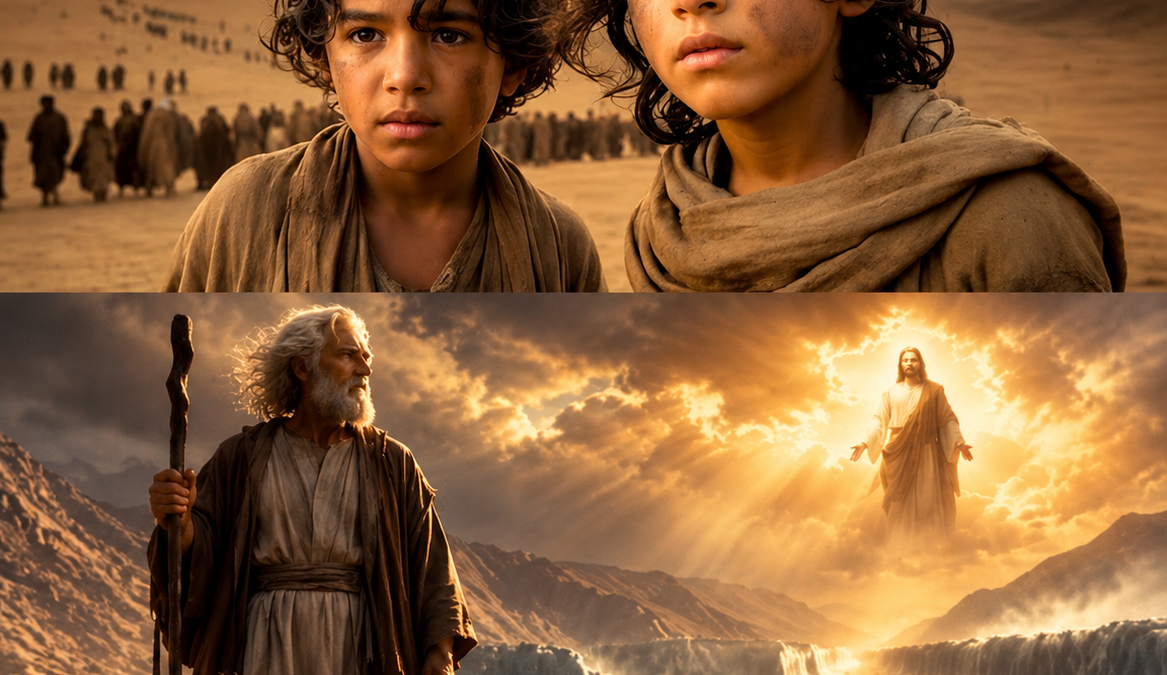
Moses stands across human history as an towering figure of faith and leadership. He defied the empire of Pharaoh, split the waters of the Red Sea, and spoke directly with the living God. His name echoes through centuries as the lawgiver, the liberator, and the humble shepherd of an entire nation.
Yet nestled deep inside his epic narrative lies an unexpected and profound mystery. Moses was not only a national prophet and leader, but he was also a husband and a father. He had two sons named Gershom and Eliezer, born far from the courts of imperial power.
While the lineage of his brother Aaron inherited the revered and eternal priesthood of Israel, the direct sons of Moses seem to vanish completely from the center stage of biblical accounts. They did not inherit his mantle of command, nor did they receive public crowns or widespread renown.
Were they set aside by divine decree, did they deliberately choose a quieter life, or does their apparent silence hide an enduring, beautiful truth meant for all generations? To discover why they faded from the headlines of history, we must travel back into the desert.
Before the thundering judgments struck the land of the Nile, Moses was a fugitive in Midian. He had fled Pharaoh’s vengeance after striking down an Egyptian overseer in defense of an enslaved Hebrew. In that remote land of silence and sunbaked dust, the former prince learned to herd humble sheep.
Midian was a solitary place where the illusions of royalty and worldly status were systematically stripped away. There, beside an ancient well, Moses encountered the seven daughters of Jethro, the priest of Midian. After protecting the sisters from aggressive shepherds, Moses was welcomed into their family tent.
He married Zipporah, Jethro’s daughter, binding his life to an unassuming pastoral existence. In that tranquil exile, before any burning bush spoke his name, their firstborn child came into the world. Moses looked down at the newborn boy and named him Gershom, an echo of his own deep sorrow.
Gershom comes from the Hebrew root word meaning a stranger, an outcast, or an alien in a foreign place. Moses declared with a heavy sigh that he had become a resident foreigner in a land not his own. The child carried the mark of a father’s exile, reflecting an identity suspended between two separated worlds.
Every time Moses spoke Gershom’s name, he remembered the palace he lost and the isolation he endured. The boy grew beneath desert skies, unaware that his father’s quiet exile was merely a season of preparation. God never intended for exile and grief to remain the only lasting memories inscribed upon Moses’ lineage.
In due time, a second son was granted to Moses and Zipporah in the tranquility of Midian. Moses named this infant Eliezer, which carries the triumphant declaration that God is my helper. Moses proclaimed that the God of his fathers had rescued him from the lethal sword of Pharaoh.
The two brothers embodied two completely opposite seasons of their father’s winding pilgrimage. Gershom was the living monument of displacement, estrangement, and the pain of lost roots. Eliezer was the bright banner of divine deliverance, sovereign protection, and renewal of hope.
Together, they formed an intimate domestic portrait nestled deep in the rugged valleys of Midian. They played among the rocks and flocks, far removed from dynastic politics and divine visitations. They knew Moses simply as a father and a shepherd, not as the earth-shattering prophet of Israel.
The biblical text introduces Gershom’s birth with brief, quiet restraint in the early verses of Exodus. Decades then pass in utter textual silence before the boys reappear in the historical record. They were children of the wilderness, shielded from the brewing confrontations that were about to engulf Egypt.
When the sovereign voice of God ignited the bush on Mount Horeb, Moses was commanded to return. He gathered his wife and his two young boys, placed them upon a donkey, and set out toward Egypt. Yet along the desolate desert road, a terrifying and intensely cryptic crisis unfolded in the dark.
At a solitary lodging place, the Lord confronted Moses because his covenant obligations had been neglected. One of his sons had not received the sacred seal of circumcision, the primordial sign of Abraham’s seed. Whether out of deference to Midianite customs or plain oversight, a spiritual rupture threatened their very lives.
In that heart-stopping moment of dire emergency, Zipporah acted with fierce, decisive courage. She took a sharp flint stone, performed the sacred covenant rite upon her son, and touched Moses’ feet. Crying out that he was a husband of blood, she averted the divine wrath through swift obedience.
This strange, blood-sealed crisis marks the only moment where the young sons are active within the journey. Immediately following this dramatic encounter, the narrative shifts, and silence descends once more. Moses would stand before Pharaoh, unleash cosmic plagues, and lead millions into the parted seabed.
During every miraculous sign that shook Egypt to its core, Gershom and Eliezer were entirely absent. They were not standing on the shores of the Red Sea when the waters divided into towering walls. They did not watch the sky rain manna, nor did they hear the mountain tremble at Sinai’s base.
The scriptures reveal why they were missing when Jethro later reappears in Exodus chapter eighteen. Moses had sent Zipporah and his two boys back to Midian for safety during the catastrophic conflicts. Jethro brought them back to the camp in the wilderness after hearing all that God had done for Moses.
Moses ran to meet his family, embracing Jethro, Zipporah, and his sons with genuine affection. He recounted the wonders, the hardships, and the miraculous deliverance the Lord had wrought. Gershom and Eliezer heard about these wonders as testimonies rather than witnessing them firsthand.
After Jethro offered sacrifices and blessed the Lord, he returned home, but the sons remained in the camp. Yet even amidst the encampment of the twelve tribes, the sons never step into the historical limelight. They do not participate in council meetings, lead military divisions, or prophesy before the elders.
Why were the flesh-and-blood sons of Israel’s supreme liberator never elevated to visible leadership? If Moses stood as the divine mediator between heaven and earth, why did his boys inherit no title? The answer does not lie in a punitive rejection, but in the profound spiritual laws of divine sovereignty.
The primary reason becomes unmistakable when observing how God established the sacred leadership of the camp. In Exodus chapter twenty-eight, God explicitly commands Moses to set apart his brother Aaron and his sons. Nadab, Abihu, Eleazar, and Ithamar were formally consecrated with holy garments, anointing oil, and sacred office.
From Aaron’s bloodline alone would proceed the high priesthood and the liturgical life of the nation. God did not distribute the high priesthood based on worldly inheritance, favoritism, or personal proximity. Aaron’s sons were chosen solely through the unmerited purpose and clear decree of the Almighty.
By excluding Moses’ own sons from the priesthood, God prevented dynastic confusion from taking root. Had Moses’ offspring inherited religious authority, Israel would have viewed leadership as a family monarchy. God demonstrated unequivocally that sacred authority and divine calling are not passed down through human blood.
Moses had performed incomparable wonders, held the law in his hands, and led the people with brilliance. If Gershom and Eliezer had immediately succeeded him, the nation would have idolized their royal blood. The Lord severed natural human succession so Israel would recognize that God alone chooses His servants.
A second reason lies in the uniquely unrepeatable nature of Moses’ own divine calling. Moses was an extraordinary instrument raised for a singular, monumental pivot in salvation history. He was designated to deliver an enslaved nation, forge their laws, and shepherd them through the wastes.
Scripture plainly affirms that no prophet ever arose in Israel like Moses, whom God knew face to face. His specific mission was so intimate, heavy, and unique that it could never be inherited as an heirloom. One cannot pass on a face-to-face communion with the Almighty like a piece of personal property.
God’s sovereign calling for a parent does not automatically duplicate itself upon their offspring. What heaven accomplishes through one generation often takes an entirely different expression in the next. The wind of the Holy Spirit blows where it wills, refusing to be bound by dynastic human assumptions.
Moses was commissioned to carve the road out of bondage, but his sons were not called to that burden. They were never meant to carry the massive legislative and prophetic weight of their father’s mantle. Their omission was not a verdict of moral failure, but a merciful boundary set by heaven’s design.
The third contributing reality was their formative absence during the foundational trials of the Exodus. Having spent those crucial years safe in Midian, they did not endure the furnace of Egyptian slave labor. They had not tasted the bitter mortar, groaned under whips, or walked through the sea on dry ground.
They had not been molded alongside the suffering multitude who learned to look to Moses for survival. A community rarely accepts leaders who have not shared their deepest sorrows and terrifying trials. Consequently, God prepared Joshua—a battle-hardened warrior who walked closely with Moses—to take command.
Yet the quiet obscurity of Gershom and Eliezer does not mean their existence was devoid of dignity. The deliberate restraint of Scripture concerning their lives presents a timeless, life-altering lesson. Not everyone called by God is summoned to stand under the blinding spotlights of public acclaim.
Some are selected to be visible heralds, while countless others are appointed to serve quietly in the shadows. The absence of the brothers from the headlines of Israel does not diminish their enduring eternal value. In the economy of God, unseen faithfulness carries identical spiritual weight to public proclamation.
God’s master design is an intricate body where diverse functions complement one another seamlessly. Some are assigned to speak with the thunder of an orator, while others labor with the patience of working hands. Every hidden corner, every quiet task, and every anonymous believer is held in honor before the throne.
Though the historical narrative of the Pentateuch seems to leave Gershom and Eliezer behind, their story continues. Hundreds of years later, tucked into the genealogical registers of the First Book of Chronicles, their names return. Far from being annihilated or erased, their lineage flourished as dedicated servants of the living God.
In the twenty-third chapter of First Chronicles, the sacred record provides a magnificent revelation. The sons of Moses, designated reverently as the man of God, were counted among the faithful tribe of Levi. They did not rule as civil kings or offer incense as high priests, but they served the tabernacle and temple.
The chronicler notes that Gershom’s lineage produced Shebuel, who served as a chief officer over the treasuries. Eliezer’s line produced Rehabiah, whose household multiplied abundantly and became remarkably numerous. This fruitful multiplication was not merely a biological statistic, but an unmistakable mark of divine favor.
Though their names were not inscribed upon military monuments, their hands tended the sacred things of God. The Levites were the unsung foundation of Israel’s worship, guarding the holy sanctuary night and day. They transported the sacred furnishings, assisted in the holy courts, and preserved the order of worship.
Without the quiet devotion of these Levitical families, public worship would have collapsed into chaos. Shebuel, descended from Gershom the alien, stood as a trusted guardian over the treasures of the sanctuary. The offspring of the man who felt like a homeless wanderer became the protector of God’s sacred house.
Likewise, the numerous descendants of Eliezer lived out the daily reality of their forefather’s name. They experienced firsthand that the Lord was indeed their helper, sustaining them across many generations. They maintained the quiet rhythms of devotion, ensuring that the flame of worship never flickered out.
This sustained, multi-generational faithfulness often escapes the notice of those skimming through Scripture. Worldly records celebrate conquerors, wealth, and political intrigue, while ignoring humble obedience. Yet the Lord, who sees in secret and searches the depths of the human heart, values unseen loyalty above applause.
The quiet journey of Moses’ sons speaks directly to anyone who has ever felt overlooked or insignificant. Living in the shadow of a monumental father could easily have provoked deep resentment or spiritual despair. They could have demanded royal titles, formed bitter factions, or rebelled against the appointment of Aaron.
Instead, the historical record contains no whisper of rivalry, rebellion, or bitter ambition from Moses’ boys. They accepted their appointed station, serving the sanctuary with quiet integrity and humble reverence. Their lives teach us that true greatness is never measured by human fame, but by unwavering submission to God.
Their story demolishes the dangerous misconception that spiritual stature is an inherited family heirloom. Gershom and Eliezer lived under the same tent as the man whose face shone with the uncreated glory of God. They heard his voice, watched him pray, and witnessed the divine cloud descending upon his tent.
Yet standing in close proximity to an anointed leader cannot substitute for personal faith in God. One cannot live spiritually on the borrowed experiences, revelations, or prayers of a holy parent. Every son and every daughter must personally seek the face of God and walk their own path of obedience.
Grace is never inherited through bloodlines, and salvation is never passed down like an ancestral ring. Moses walked his road with trembling awe, and his sons had to find their own posture of worship. They could not command the sea to divide, but they could guard the holy vessels with clean hands and pure hearts.
There is unmatched beauty in serving God simply for His glory without seeking public validation. In a modern world that equates visibility with worth, the sons of Moses stand as a refreshing corrective. The worker who cleans the sanctuary floor in secret love is as cherished by God as the preacher at the pulpit.
God does not evaluate a life by the size of its audience, but by the purity of its inner motives. He sees the late-night tears, the hidden sacrifices, and the small acts of service that go entirely unnoticed. Gershom and Eliezer show that one can be deeply loved and utilized by God without ever becoming famous.
Their legacy lived on through generations of quiet, steadfast worship that sustained the spiritual life of Israel. Centuries after Moses was buried in an unknown grave in Moab, his lineage was still faithfully serving the altar. Their enduring presence proved that quiet faithfulness outlasts the loudest shouts of worldly acclaim.
True legacy is not built upon celebrity status, viral popularity, or dynastic ambition. It is forged in steady, faithful, ordinary days of dedication to the work that God places before our hands. The God of Moses was equally the God of Gershom the stranger and Eliezer the rescued.
If you have ever felt forgotten, hidden in the wilderness, or cast aside from grand opportunities, take heart. The names forgotten by human historians are permanently engraved upon the palms of God’s hands. You do not need human approval, widespread acclaim, or center stage to fulfill a glorious divine purpose.
All that heaven requires is an obedient heart that serves with undivided loyalty wherever it is planted. The sons of Moses quietly stepped away from worldly power, embracing their sacred place among the Levites. By doing so, they revealed that serving God in the shadows is an honor of eternal, unfading splendor.

