THE MOUNTAIN DEVIL TURNED TOWARD HIS BRIDE—AND WHAT HE DID NEXT CHANGED EVERYTHING SHE FEARED C053
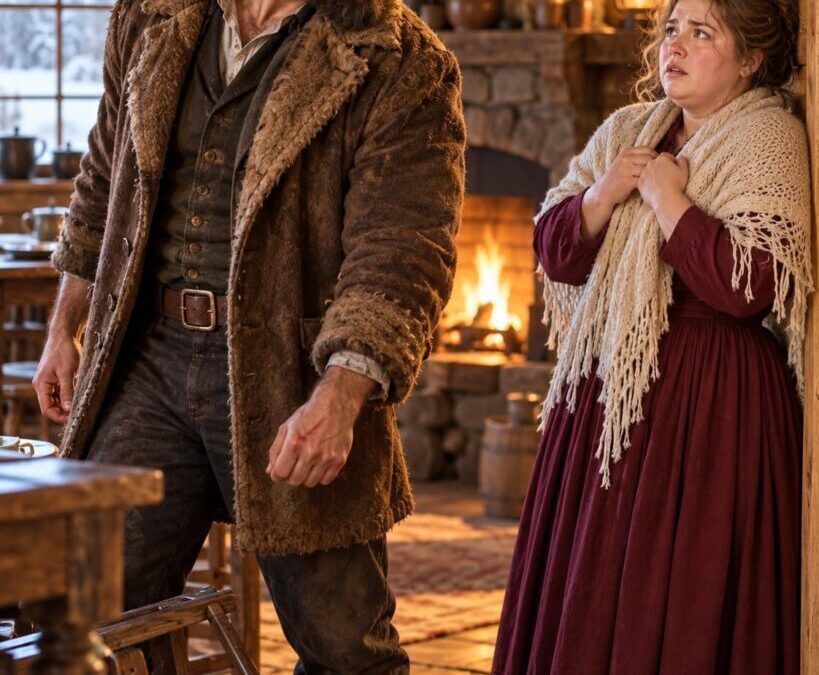
On her fourth morning in the mountains, Cora Miller watched Elias Boone shatter a cup and kick a wooden chair apart in a burst of rage.
She pressed herself into the corner, certain that the next target would be her.
But when Elias finally turned toward his new wife, the man everyone called the mountain devil was about to show her something she had never expected.
Three days earlier, Cora had stepped from the train into a freezing Wyoming outpost with one battered trunk, a carpetbag, and nowhere else to go.
She was thirty-two years old.
She was also a large woman, and she had spent most of her life being reminded of it.
Her brother had eagerly paid the twenty dollars needed to send her west.
At dances, people left her alone.
At home, she had been pushed toward the kitchen, where baking pies was apparently the only thing anyone believed she was good at.
So when she found an advertisement from a man living near the timberline—“Wanted a sturdy woman for a hard life.
No nonsense.”—Cora answered.
She was sturdy.
She was also frightened.
Two men at the depot watched her with amused expressions as she stood beside her enormous trunk.
Cora knew that look.
She had spent a lifetime learning how to recognize laughter before the words ever reached her ears.
Then a heavy wagon came down the street.
The man who climbed from the driver’s seat looked exactly like the sort of man the magistrate had warned her about.
Elias Boone was enormous, broad-shouldered and hard-built, with a thick dark beard, pale assessing eyes, and a battered Stetson pulled low over his forehead.
His buffalo coat was worn at the elbows, and he carried himself with the quiet strength of someone accustomed to surviving alone.
The town called him the devil of the ridge.
The magistrate had warned Cora plainly.
“He has a black temper, Miss Miller.
Keep your head down, do your chores, and do not cross him.”
Elias stopped in front of her.
“You, Cora?”
“I am.”
He glanced at her trunk.
“That all you brought?”
“Yes.”
He lifted the iron-bound trunk as though it weighed almost nothing and tossed it into the wagon.
“Climb up.”
Cora approached the high wagon bench, already dreading the struggle.
Her fingers slipped on the frozen handhold.
Before she could lose her balance, Elias stepped behind her.
He did not grab her waist.
Instead, he placed both hands firmly against her lower back and lifted her high enough for her to catch the bench.
Cora landed heavily on the seat, her face burning with embarrassment.
Then the stationmaster appeared.
“Looks like you got your money’s worth in bulk,” Davis called.
“Better reinforce the floorboards up at the ridge!”
Cora closed her eyes.
There it was.
The joke she had been expecting.
But Elias did not laugh.
He pulled the bullwhip from beneath the seat and cracked it sharply through the air.
Davis stumbled backward.
“Keep your mouth shut, Davis, before I come down there and wire it shut!”
Then Elias drove the horses forward.
For three hours they climbed through freezing forest without much conversation.
Cora endured every painful jolt of the wagon, refusing to complain.
Then, before they reached the cabin, Elias reached behind the seat and pulled out a heavy bear pelt.
He threw it over her lap.
“Keep it tucked under your boots,” he said without looking at her.
“Wind bites harder past the tree line.”
“Thank you.”
He only grunted.
By the time they reached the cabin, the sky had turned deep purple.
The house was not the miserable shack Cora had imagined.
It was a sturdy fortress of thick logs against the mountain, with smoke rising from a stone chimney.
Inside, everything was clean and practical.
There was one large bed.
Cora hesitated.
Elias pointed toward the loft.
“I sleep up there.
Bed’s yours.”
She stared at him.
She was his wife by proxy.
She knew what that could mean.
But Elias did not move toward her.
Instead, he explained where the stove, pantry, and water pump were, then took his hat and walked back outside.
Cora stood beside the fire after the door closed.
For the first time in a long while, she felt something dangerously close to relief.
She had a bed.
She had warmth.
And she was safe enough to breathe.
The next three days settled into a quiet routine.
Cora cooked.
Elias worked.
He left before sunrise to check traps and hunt, returning at dusk smelling of snow and the wilderness.
At supper, he ate enough for two men, sometimes clearing his plate twice.
But he never criticized her cooking.
He never commented on her size.
He never laughed at her.
Still, Cora remained cautious.
She had learned that kindness could disappear quickly.
Then came the fourth morning.
The wind hammered the cabin walls while Elias sat near the fire, trying to repair a broken harness with a stiff leather strap and a rusted awl.
Cora stood at the stove, turning hotcakes.
Then the awl slipped.
It drove into Elias’s thumb.
He roared.
The sound shook the rafters.
His chair crashed backward.
The awl flew across the room and smashed a ceramic cup.
“Useless, rotten son of a bitch!”
He kicked the fallen chair.
Wood splintered.
Cora froze.
The hotcake turner slipped from her hand.
Her heart began pounding.
She backed into the corner and pressed herself against the wall, trying to make her large body as small as possible.
She knew this moment.
She had seen it before.
She had watched her father rage.
She had watched her brother rage.
And she had learned the rule that fear had taught her:
The closest and weakest person usually became the target.
So Cora closed her eyes.
She waited for Elias’s footsteps.
She waited for the shout.
And she waited for the mountain devil to turn his anger on her.

Cora closed her eyes.
She waited for Elias’s footsteps.
She waited for the shout.
And she waited for the mountain devil to turn his anger on her.
Instead, the cabin went completely silent.
For several seconds, there was nothing but the howling wind outside.
Then Cora heard something she hadn’t expected.
A slow exhale.
When she opened her eyes, Elias wasn’t coming toward her.
He was standing beside the broken chair, staring at the splintered wood.
His hands were shaking.
Not with anger.
With shame.
He looked at the shattered cup.
Then at the chair.
Then finally at Cora.
The color drained from his face.
“Cora.”
She flinched.
Elias immediately stopped.
He didn’t take another step.
“I scared you.”
Cora said nothing.
He looked at her curled against the wall.
His jaw tightened.
“I scared you.”
Again, silence.
Then Elias slowly lowered himself onto the floor several feet away.
He sat there with his back against the opposite wall.
“I am sorry.”
Cora blinked.
No one had ever apologized to her for frightening her.
Not her father.
Not her brother.
Not the men who laughed at her.
Elias looked at the broken cup.
“I get angry at things.”
His voice was quieter now.
“Not people.”
Cora swallowed.
“People can become things when they’re angry.”
He looked at her.
“What?”
“My father used to say that.”
Elias’s expression hardened.
“Your father?”
Cora looked away.
“He believed fear made people obedient.”
Something dark moved through Elias’s eyes.
But he didn’t ask for details.
He simply said,
“I am not him.”
Cora slowly straightened.
“No.”
Elias shook his head.
“I need you to know something.”
She watched him carefully.
“I have a temper.”
His honesty surprised her.
“I won’t lie about that.
Sometimes I break things.
Sometimes I yell.
Sometimes I need to walk until my head clears.”
He pointed toward the shattered cup.
“But I will never hit you.”
Cora’s throat tightened.
“I will never threaten you.”
His voice became firmer.
“And I will never make you afraid to speak in your own home.”
Cora stared at him.
“Why?”
Elias looked toward the window.
“Because I know what it feels like.”
She didn’t understand.
He rubbed his injured thumb.
“My father was worse than yours.”
Cora said nothing.
“He used to say a man had to make his family fear him.”
Elias looked down at his hands.
“When I was twelve, my mother stood between him and my little sister.”
His voice became rough.
“She took the beating meant for her.”
Cora’s breath caught.
“She died three years later.”
Elias looked up.
“I swore I’d never become him.”
A tear slipped down Cora’s cheek.
“Then why do they call you the mountain devil?”
A faint smile touched his mouth.
“Because people fear what they don’t understand.”
He glanced at the broken chair.
“And because I don’t spend much time convincing them otherwise.”
Cora looked at him for a long moment.
Then she noticed the blood on his thumb.
“You’re bleeding.”
Elias looked down.
“So I am.”
“Let me see.”
He hesitated.
Then held out his hand.
Cora approached slowly.
She cleaned the wound.
He remained completely still.
When she wrapped the cloth around his thumb, Elias watched her.
“Thank you.”
“You’re welcome.”
She looked at the broken cup.
“I’ll clean this.”
“No.”
“I can—”
“I broke it.”
He stood.
“I’ll clean it.”
He swept up the pieces himself.
Then he carried the broken chair outside.
When he returned, he stopped beside her.
“I’ll build you another one.”
Cora smiled faintly.
“You don’t have to.”
“I know.”
He looked at her.
“I want to.”
And that was the moment Cora realized something.
The mountain devil was not afraid of his anger.
He was afraid of becoming the man who had taught him how to use it.
That evening, Elias returned from the woods carrying a rabbit and a bundle of firewood.
Cora was sitting at the table sewing a torn sleeve.
He placed the wood beside the stove.
“You should rest.”
“I’ve been resting all day.”
“You’ve been working all day.”
She looked up.
“Is there a difference?”
“Yes.”
“How?”
“You’re allowed to do neither.”
Cora laughed.
Elias stared at her.
“What?”
“Nothing.”
“What?”
“You’re strange.”
“So I’ve been told.”
She smiled.
He started preparing the rabbit.
After a while, Cora asked,
“Why did you advertise for a wife?”
His knife stopped.
“I needed someone.”
“That isn’t an answer.”
He looked at her.
“I needed a wife who could live here.”
“Because of the mountain?”
“Yes.”
“Or because you were lonely?”
His eyes narrowed slightly.
Cora immediately regretted asking.
But Elias only sighed.
“Both.”
She lowered her needle.
“I was lonely too.”
“I know.”
“How?”
“You looked lonely when you stepped off that train.”
Cora stared at him.
“I was surrounded by people.”
“That’s not the same thing.”
She looked down.
“No.”
The cabin grew quiet.
Then Elias asked,
“Why did you come?”
Cora laughed bitterly.
“Because nobody wanted me.”
His expression changed.
“That isn’t true.”
“My brother wanted me gone.”
“He wanted your labor gone.”
Cora looked at him.
“He told me I was too large to marry.”
Elias’s jaw tightened.
“Then your brother is a fool.”
“He said men don’t want women who look like me.”
Elias studied her.
“What do you look like?”
Cora blinked.
“A woman.”
He nodded.
“Exactly.”
She looked away before he could see her smile.
Winter settled over the mountain.
Snow buried the trails.
The nearest town became almost unreachable.
For the first time in her life, Cora found herself living without mirrors.
There was no one to tell her how she looked.
No dresses to make her feel too large.
No women whispering behind fans.
No family members measuring her body with their eyes.
Only the mountain.
Only the cabin.
And Elias.
She began discovering things about him.
He hated coffee without sugar.
He talked to horses when he thought nobody was listening.
He repaired everything three times before admitting something was broken.
He snored.
Loudly.
And he had a terrible habit of leaving his boots in the middle of the kitchen.
Cora began moving them.
Every morning.
He began putting them beside the door.
Every morning.
Neither mentioned it.
Then one day, Cora found something on the table.
A new pair of boots.
Her size.
Beside them was a note.
For the snow.
That was all.
Cora held the boots against her chest.
They were beautiful.
Not because they were expensive.
Because someone had noticed her feet were cold.
That night, she made Elias his favorite stew.
He took one bite.
“This is good.”
“Only good?”
He took another.
“Very good.”
She smiled.
“Better.”
He nodded.
“Better.”
It became their game.
Cora cooked.
Elias pretended not to be impressed.
She pretended to believe him.
One afternoon, while Elias was away checking traps, Cora heard horses outside.
She looked through the window.
Three men were approaching.
One was wearing a red scarf.
Cora recognized him.
Davis.
The stationmaster who had mocked her.
Her stomach tightened.
She locked the door.
The men dismounted.
Davis knocked.
“Mrs.
Boone!”
Cora didn’t answer.
“We know you’re in there.”
She stayed silent.
Davis laughed.
“Your husband isn’t home.”
Her heart pounded.
“Open the door.”
“No.”
The laughter stopped.
“Listen, woman.
We’re here for something that belongs to Elias.”
“Then come back when he is here.”
Davis kicked the door.
Cora jumped.
“Open it!”
She backed away.
Another kick.
The wood shook.
Cora looked toward the rifle hanging above the fireplace.
Elias had taught her how to use it.
She had never fired it.
She reached for it.
The door cracked.
Cora loaded the rifle with trembling hands.
The men stopped when they heard the click.
“Step away from the door.”
Davis laughed.
“You wouldn’t shoot.”
Cora raised the rifle.
“I don’t know.”
Her voice shook.
“But I know my husband taught me never to threaten unless I mean it.”
The men exchanged glances.
Then they heard something behind them.
A horse.
A heavy horse.
Elias.
He rode into the yard like a storm.
Davis turned.
Elias dismounted.
“Move away from my house.”
Davis stepped back.
“We were only—”
“I don’t care.”
His voice was terrifyingly calm.
“You touched that door.”
Davis swallowed.
“You’re threatening me?”
“No.”
Elias walked toward him.
“I’m telling you what happens next.”
The men retreated.
Elias watched until they disappeared.
Then he turned toward the cabin.
Cora was still holding the rifle.
He approached slowly.
“You all right?”
She nodded.
“You used the rifle.”
“I didn’t fire.”
“Good.”
He looked at her.
“But you were ready.”
“I was afraid.”
“I know.”
He took the rifle from her.
Then he reached for her hand.
“Thank you for protecting our home.”
Our home.
Cora felt those words settle somewhere deep inside her.
That night, Elias told her the truth.
Those men worked for a timber company.
They wanted the land.
Not because of the timber.
Because there was gold beneath the northern ridge.
“Your property sits directly over it,” Elias said.
“Why didn’t you tell me?”
“Because I wanted you to have one winter without worrying about men who think land is more important than people.”
She stared at him.
“Why did you marry me?”
He looked at the fire.
“Because I thought you would be safe here.”
“Only safe?”
His eyes lifted.
“No.”
Cora waited.
“I also wanted someone who would make this place feel like a home.”
Her heart began beating faster.
“And now?”
“Now it does.”
Neither spoke.
Elias reached across the table.
He stopped before touching her.
“May I?”
Cora looked at his hand.
Then placed hers inside it.
His fingers closed gently around hers.
“Yes.”
It was the first time they touched because they wanted to.
Not because circumstance required it.
Not because a marriage contract said so.
Because Cora chose it.
And so did he.
Spring arrived late.
When the snow finally melted, Cora discovered something strange.
She loved the mountain.
She loved the sound of the creek.
She loved watching Elias split wood.
She loved the way he smiled when he thought nobody noticed.
She loved being able to walk outside without wondering whether someone was laughing.
But she still carried one wound.
Her brother.
One afternoon, a letter arrived.
Cora recognized the handwriting immediately.
She opened it.
Come home.
That was all.
No apology.
No explanation.
Just an order.
She folded it.
Elias watched her.
“Do you want to go?”
Cora looked at him.
“No.”
“Then don’t.”
“I thought you’d tell me I should.”
“Why?”
“Because he’s my family.”
Elias’s expression softened.
“Family doesn’t mean someone gets to hurt you forever.”
Cora looked at the letter.
Then threw it into the stove.
The paper curled.
Burned.
Disappeared.
She watched until nothing remained.
Elias stood beside her.
“You all right?”
Cora nodded.
“For the first time.”
The attack came in June.
Five riders arrived at the ranch.
They were not there to negotiate.
Elias saw them from the ridge.
He sent Cora into the cabin.
“Lock the door.”
“What about you?”
“I’ll handle it.”
“No.”
He looked at her.
“I won’t hide.”
“Cora.”
“You taught me this is my home.”
He stared.
“So let me defend it.”
Elias’s jaw tightened.
Then he handed her the rifle.
“Stay behind me.”
The riders approached.
Their leader was Davis.
He smiled.
“This is your last chance, Boone.”
Elias said nothing.
“You’re sitting on enough gold to make every man in this county rich.”
“Then go find your own mountain.”
Davis drew his gun.
Everything happened at once.
A shot cracked.
Elias pushed Cora down.
The bullet struck the porch railing.
Elias returned fire.
One rider fell.
The others scattered.
Cora crawled toward the side of the cabin.
She saw Davis circling behind.
She raised the rifle.
Her hands shook.
Then she remembered Elias’s words.
Never threaten unless you mean it.
“Davis!”
He turned.
“Drop it.”
He laughed.
“You won’t shoot.”
Cora steadied the rifle.
“I’ve spent my whole life being told I couldn’t do things.”
Her finger rested near the trigger.
“I am done listening.”
Davis froze.
Elias stepped behind him.
“Put the gun down.”
Davis slowly obeyed.
The fight ended.
The sheriff arrived the next morning.
The timber company lost its claim.
The gold remained underground.
Elias didn’t care.
He had never wanted it.
Cora understood why.
Gold couldn’t buy what they had built.
A year after Cora first arrived, the mountain looked different.
The cabin had been expanded.
The porch was larger.
A new barn stood beside the creek.
And beside it was a garden.
Cora stood among rows of vegetables.
Elias approached.
He held something behind his back.
“What?”
He revealed a small wooden box.
Cora stared.
“What’s that?”
“Open it.”
Inside was a silver bracelet.
Simple.
Beautiful.
Engraved on the inside were four words.
You are safe here.
Cora’s eyes filled with tears.
“You made this?”
“I carved the box.”
“You?”
“Yes.”
She laughed.
“It looks crooked.”
“I know.”
She smiled through her tears.
“I love it.”
Elias fastened the bracelet around her wrist.
Then he hesitated.
“Cora.”
“Yes?”
“I want to ask you something.”
Her heart fluttered.
“You’re already my wife.”
“I know.”
He reached into his pocket.
There was another small box.
Cora stared.
“Elias…”
Inside was a ring.
Not expensive.
Not flashy.
But beautiful.
He took her hand.
“The first marriage happened because two men signed papers.”
He looked into her eyes.
“I want this one to happen because you choose me.”
Cora’s tears fell freely.
“You’re asking me to marry you?”
“Again.”
She laughed.
“You already married me.”
“Then I’ll ask again every year.”
She looked at him.
“Why?”
“Because I want you to keep choosing me.”
Cora wrapped her arms around his neck.
“Yes.”
His eyes closed.
For a moment, the mountain seemed completely silent.
Then he kissed her.
Not like a man claiming his wife.
Like a man grateful that she had chosen him.
Years later, people still called Elias Boone the mountain devil.
Cora found that amusing.
Because the man they feared was the man who carried her boots inside when it snowed.
The man who learned how to make her favorite pie.
The man who built her a wider chair without ever mentioning why.
The man who never once told her she needed to become smaller.
And Cora?
She became known throughout the valley as the woman who could outshoot half the men in town, bake the best bread for fifty miles, and tell a stubborn mountain man when he was being an idiot.
They built a life together.
A real one.
Messy.
Loud.
Warm.
Years passed.
One evening, Cora stood beside the fireplace.
The same fireplace where Elias had once shattered a cup and scared her half to death.
She looked at the old repaired chair.
Elias had rebuilt it.
The wood was darker now.
Smooth from years of use.
She ran her hand across the back.
Elias entered behind her.
“You remember?”
She smiled.
“The chair?”
“The morning.”
“Yes.”
He lowered his head.
“I hate that I scared you.”
Cora turned.
“You changed.”
“I should have been better.”
“You were human.”
He looked at her.
“You were frightened.”
“I was.”
“And now?”
Cora stepped closer.
“Now I know the difference between a man who loses control and a man who uses fear to control someone.”
Elias’s eyes softened.
“You taught me that.”
“No.”
She touched his cheek.
“You taught me something more important.”
“What?”
“That a woman doesn’t have to become smaller to deserve tenderness.”
He pulled her close.
Outside, snow began falling again.
The same mountain.
The same cabin.
A completely different life.
Cora rested against him.
“Elias?”
“Yes?”
“Do you still think I’m sturdy?”
He smiled.
“Very.”
She laughed.
“That’s not very romantic.”
He kissed her forehead.
“You carried this whole house when you thought you were the one who needed carrying.”
Cora went quiet.
Then she smiled.
Because she finally understood.
The mountain devil had never been the man who broke the chair.
The real devil had been the fear she had carried for years—the belief that her body made her less deserving of love, that anger always became violence, that marriage meant surrender, and that a woman’s safety depended on making herself small.
Elias had not rescued her from that fear.
He had simply shown her another way to live.
A way where she could speak.
Laugh.
Eat.
Take up space.
And still be loved.
The storm outside grew stronger.
Elias closed the shutters.
Then returned to her.
He held out his hand.
“Come sit by the fire.”
Cora took it.
She looked at the man the town still called dangerous.
Then at the repaired chair.
Then at the home they had built.
And she smiled.
Because on that fourth morning in the mountains, she had believed the worst thing that could happen was that the mountain devil would turn his rage on her.
She had been wrong.
The thing that changed everything was what he did next.
He stopped.
He saw her fear.
And instead of making her smaller, he gave her room to breathe.
That was the moment Cora’s life changed.
Not because a dangerous man became gentle.
But because a frightened woman finally discovered that she was allowed to choose what happened to her next.
And from that day forward, whenever the mountain winds howled around their cabin, Cora never feared them again.
She knew something stronger lived inside those walls.
Trust.
Choice.
And a love that never required her to disappear.

