The moment Julian looked at our two screaming six-month-old daughters and told me, “You wanted to be a mother, so act like one,” something inside me stopped begging him to understand.
The moment Julian looked at our two screaming six-month-old daughters and told me, “You wanted to be a mother, so act like one,” something inside me stopped begging him to understand.
Nora was pressed against my shoulder, trembling from exhaustion. Lily was on the living-room rug, red-faced and wailing, one tiny sock half-kicked from her foot. Three dirty bottles stood beside the sink. A plate of reheated chicken had gone cold for the second time that night.
And Julian was zipping a fishing bag.
Not a diaper bag.
Not a suitcase for a family emergency.
A fishing bag.
“You’re seriously leaving?” I asked.
He pulled the zipper shut.
“I already paid for the cabin.”
I stared at him.
Our daughters cried around us.
“You knew about this for weeks?”
His jaw tightened.
“I knew you’d turn it into a whole thing.”
“A whole thing?”
“I need a break.”
I almost laughed.
Instead, I shifted Nora higher against my shoulder.
“I haven’t slept more than two hours at a time in six months.”
“I work too.”
“So do I.”
“You’re home.”
The words landed harder than they should have.
Home.
As though home were rest.
As though six months of feeding, washing, sterilizing, rocking, changing, soothing, scheduling, and surviving counted as being home instead of working.
“Julian,” I said quietly, “I’m asking how you expect me to handle both girls alone for four days.”
He finally looked directly at me.
And said it.
“You wanted to be a mother, so act like one.”
Something went perfectly still inside me.
I didn’t scream.
I didn’t block the door.
I didn’t throw his bag into the driveway.
I simply said, “Okay.”
That seemed to irritate him more than anger would have.
Twenty minutes later, his SUV disappeared down our street.
I stood at the window holding Nora while Lily cried behind me.
And for the first time since becoming a mother, I understood that I was not simply exhausted.
I was alone inside my marriage.
Five years earlier, I would have sworn Julian wanted children even more than I did.
We had tried for years.
There had been appointments, tests, hopeful months, devastating months, and the particular silence that comes when two people want something so badly they are afraid to keep naming it.
Then came the ultrasound.
The technician smiled.
“Looks like there are two.”
Julian stared at the screen.
Then he cried.
Actually cried.
He squeezed my hand and whispered, “We got two.”
During my pregnancy, he painted the nursery himself. He spent weeks comparing car seats. He assembled two cribs, labeled storage baskets, and read reviews for bottle warmers like national security depended on it.
Every night he talked to my stomach.
“Daddy’s waiting for you.”
Sometimes one of the girls kicked beneath his palm.
His whole face would light up.
Before they were born, he promised, “I’ve been waiting my whole life to be your dad.”
I believed him.
Maybe he believed himself.
But babies are different from dreams about babies.
Dream babies sleep peacefully under knitted blankets.
Real babies spit up on clean clothes.
They cry when you finally sit down.
They wake each other.
They need bottles at 1:00, 3:00, and 5:00.
They get overtired.
They refuse naps.
They somehow sense when their mother has reached the edge of exhaustion and choose that moment to both start screaming.
At first, Julian helped.
For maybe three weeks.
Then came the excuses.
“I have work tomorrow.”
“I need sleep.”
“I’ve got an early meeting.”
“I can’t function on four hours.”
Neither could I.
But apparently, I was expected to.
Then he started going back to the gym.
“Twice a week,” he said. “I need something normal.”
Soon he stayed late at work.
“Bedtime is chaos anyway.”
Then came the questions.
When did Lily eat?
Ask Mom.
Where are the wipes?
Ask Mom.
Which pajamas does Nora wear?
Ask Mom.
What time is the appointment?
Ask Mom.
How much formula?
Ask Mom.
Julian slowly became a guest in a life we had built together.
And I protected him from noticing.
I told myself he was tired.
I told myself his job mattered.
I told myself he loved us.
I told myself this was temporary.
That Friday night, my excuses finally ran out.
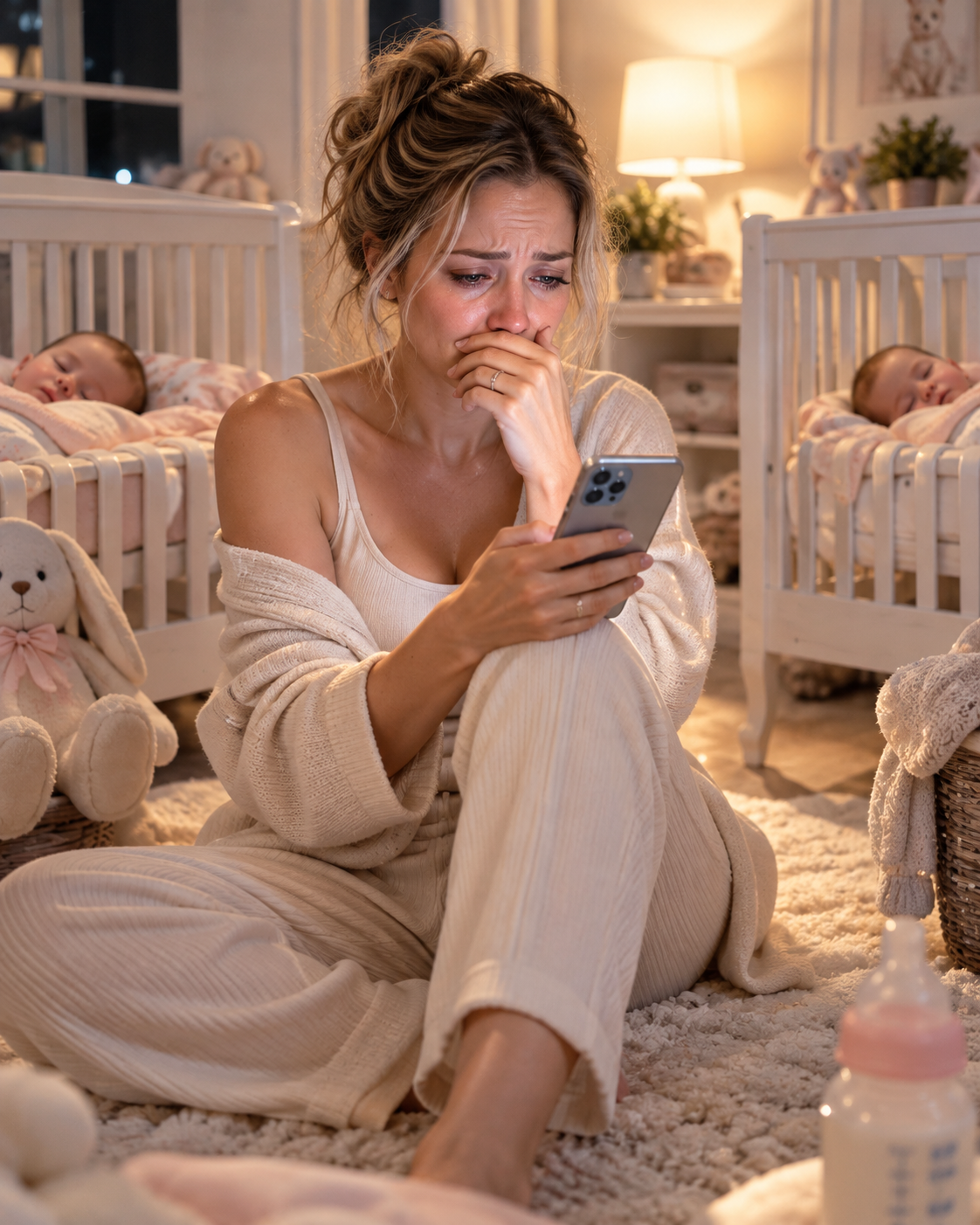
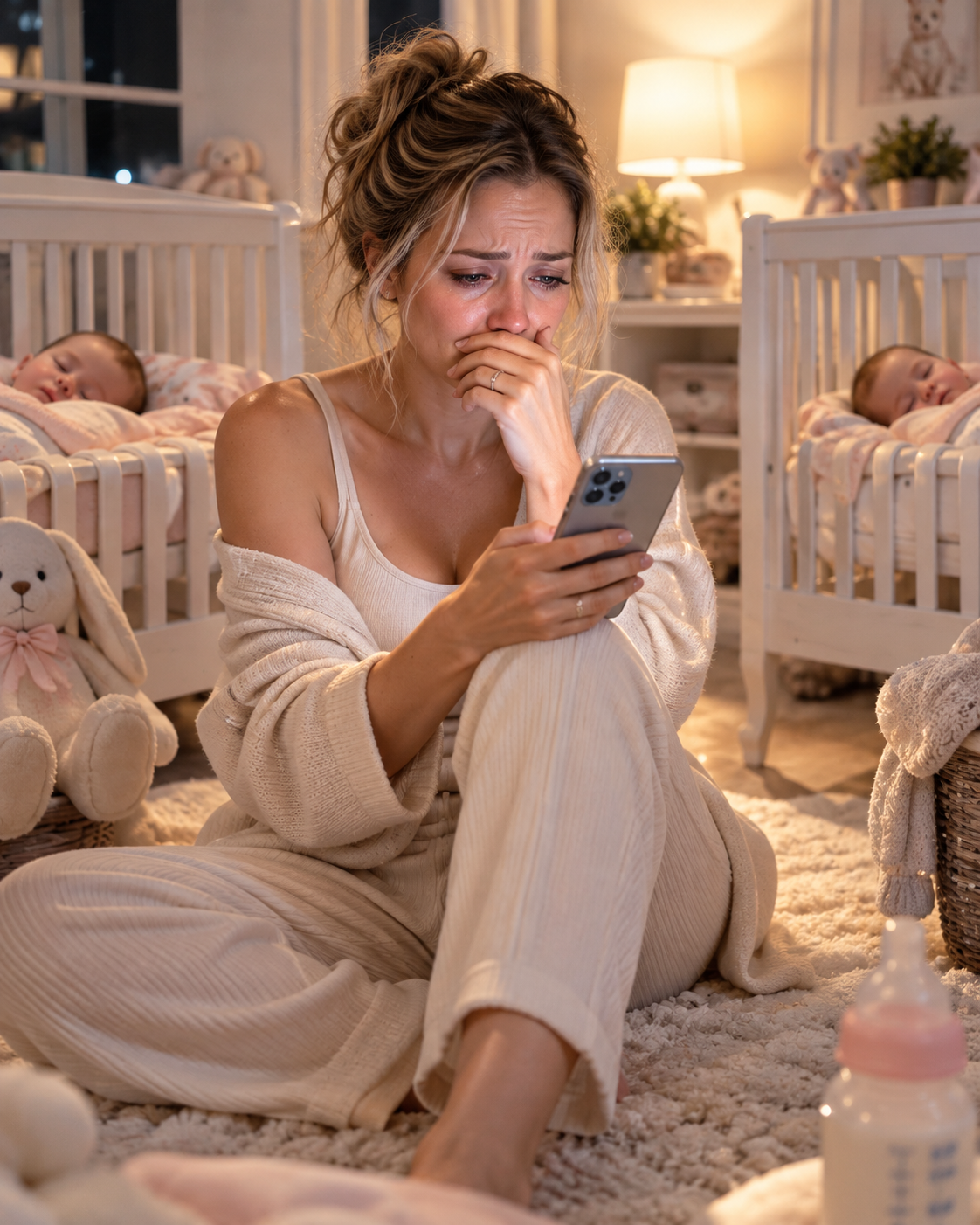
At 2:41 a.m., both girls were finally asleep.
I sat on the nursery floor between their cribs because walking to our bedroom felt impossible.
My phone buzzed.
Marcus had posted a picture from the lake.
Four men stood beside a fire, holding beers.
Julian was smiling.
Marcus had written:
FINALLY FREE.
Underneath it was Julian’s laughing emoji.
I stared at those words.
Finally free.
A strange clarity settled over me.
For six months, I had protected Julian’s sleep.
His schedule.
His career.
His workouts.
His weekends.
His confidence.
I had even protected his image of himself as a good father.
And while doing all of that, I had disappeared.
I opened my contacts and found my sister.
Megan.
My fingers shook as I typed:
I think I need help.
She called before the second ring.
“What happened?”
I covered my mouth, afraid that if I heard kindness, I would break.
“I can’t do this alone anymore.”
There was a pause.
Then Megan said, “Okay.”
That was all.
No judgment.
No lecture.
Just okay.
By sunrise, she was standing in my kitchen with coffee, groceries, clean sweatpants for me, and the expression older sisters wear when they are trying not to murder someone.
She took Lily from my arms.
“Go sleep.”
“I can’t.”
“You can.”
“What if Nora wakes?”
“I know how babies work.”
“I should wash—”
“Claire.”
Her voice softened.
“Go. Sleep.”
I slept five hours.
Five full hours.
When I woke, sunlight was pouring through the bedroom curtains.
For a moment, I panicked.
Then I heard soft music downstairs.
I found Megan sitting on the rug with both girls.
The bottles were washed.
The dishwasher was running.
There was soup on the stove.
I stood in the doorway and started crying.
Megan looked up.
“Hey.”
“I forgot what it felt like.”
“What?”
“To wake up because my body was done sleeping.”
She didn’t answer.
She just opened one arm.
I sat beside her.
That was the first moment I admitted the truth out loud.
“I think he doesn’t want this life anymore.”
Megan shook her head.
“I don’t know what Julian wants.”
Then she looked at me.
“But I know you cannot keep living like this.”
My phone started buzzing around noon.
Julian.
Why aren’t you answering?
Then:
Everything okay?
Then:
Marcus says Megan’s car is there. What’s going on?
I stared at the screen.
Megan read the messages over my shoulder.
“Don’t explain yourself.”
“He’ll be mad.”
“Claire, he left you alone with two infants for four days.”
“I know.”
“So let him wonder.”
That sentence stayed with me.
Let him wonder.
For six months, Julian had never wondered whether I needed rest.
Whether I needed help.
Whether I felt lonely.
Whether I was scared.
Maybe wondering would be good for him.
The next day, he called twice.
I didn’t answer.
He texted again.
Just checking on the girls.
I stared at it for a long time.
He hadn’t asked how I was.
On Sunday evening, another message appeared.
Heading home early. We need to talk.
My stomach tightened.
Megan read it.
Then she asked, “Are you sure you want him to come home to the same marriage he left?”
I looked around the living room.
The girls were sleeping.
The house was quiet.
And for the first time in months, I could hear myself think.
“No,” I whispered.
Megan nodded.
“Then decide what changes.”
Julian walked through the front door shortly after eight.
He expected chaos.
I could see it immediately.
He expected bottles everywhere.
Crying.
Laundry.
A desperate wife ready to punish him, forgive him, or both.
Instead, the house was calm.
Megan sat at the kitchen table.
I stood near the counter.
Both girls were asleep upstairs.
Julian stopped.
“What’s going on?”
I folded my arms.
“We’re talking.”
He looked at Megan.
“Can we do this privately?”
“She stays.”
His face hardened.
“This is our marriage.”
“Then maybe you should have stayed home for it.”
Silence.
His eyes flashed.
“I came back early.”
“That doesn’t erase why you left.”
“I needed space.”
“You had space every night you slept while I handled the girls.”
“That’s not fair.”
“No. What wasn’t fair was telling me motherhood was my job the moment it became inconvenient.”
Julian dropped his keys on the counter.
“You’re making me sound like some deadbeat.”
“I don’t have to make you sound like anything.”
He stared at me.
I took a breath.
“Here’s what changes. Night feeds are split. Bedtime is split. Appointments are shared. You get gym time, I get equal time. You don’t disappear for weekends without a conversation. And you don’t call parenting babysitting.”
Julian gave a bitter laugh.
“So now Megan runs our house?”
Megan stood.
“No. Claire does.”
He turned on her.
“Stay out of this.”
I stepped between them.
“Don’t talk to her like that.”
Julian looked at me in disbelief.
That was the moment he understood something had shifted.
For years, I had softened everything.
Translated him.
Excused him.
Protected him from consequences.
Now I wasn’t.
He exhaled sharply.
“Fine.”
“Fine what?”
“I’ll help more.”
“No.”
His eyebrows rose.
“No?”
“You won’t help me.”
I held his gaze.
“You will parent your daughters.”
For several weeks, Julian seemed to try.
He took the midnight bottle.
He handled Saturday mornings.
He learned where the wipes were without asking me.
He started putting appointments in his phone.
For a while, I wondered if the fishing trip had shocked him into growing up.
Then something strange happened.
He became secretive.
Not dramatically.
Small things.
His phone was always facedown.
He started checking messages in another room.
He took calls outside.
I told myself not to become paranoid.
Then one Tuesday afternoon, Lily developed a fever.
I called Julian.
No answer.
I called again.
Nothing.
I texted:
Need you to call me. Lily has a fever.
Twenty minutes passed.
Thirty.
Forty.
Finally, my phone rang.
But it wasn’t Julian.
It was Marcus.
“Hey.”
His voice sounded wrong.
“Is Julian with you?”
“No.”
A pause.
“Claire, I need to ask you something.”
My stomach dropped.
“What?”
“Did Julian tell you we cut the fishing trip short because of the storm?”
I frowned.
“What storm?”
There was silence.
Then Marcus swore under his breath.
“Claire…”
“What are you talking about?”
“We weren’t there four days.”
The room seemed to tilt.
“What?”
“We left the cabin Saturday morning. Weather got bad.”
I gripped the counter.
“Then where was Julian?”
Marcus didn’t answer.
I stopped breathing.
“Marcus.”
“I thought you knew.”
“Knew what?”
“He didn’t come back with us.”
Everything inside me went cold.
“Why?”
Marcus hesitated.
“He said he was going to see someone.”
The silence that followed was so complete I could hear Lily fussing upstairs.
“Who?”
“I don’t know.”
Marcus paused.
Then added, “But I think you should ask him.”
That night, Julian came home at 7:30 carrying takeout.
I was sitting at the kitchen table.
He smiled.
“How’s Lily?”
“Better.”
He put the bag down.
“Good.”
I watched him remove his jacket.
“When did the storm hit?”
His hands stopped.
“What?”
“At the cabin.”
Julian slowly turned.
I knew before he spoke.
That was the worst part.
I already knew.
“Marcus called.”
Julian closed his eyes.
“What did he say?”
“That you left the cabin Saturday.”
He pulled out a chair.
“Claire—”
“Where did you go?”
He rubbed his face.
“It’s not what you think.”
I laughed once.
“That sentence has never made anything better.”
“There’s someone I needed to see.”
I felt physically sick.
“Who?”
He stared at the table.
Then he said a name.
“Rachel.”
I knew the name.
Not well.
But I knew it.
Rachel Monroe.
Julian’s college girlfriend.
The woman he had dated for three years before we met.
I had seen her in old photographs.
“Are you having an affair?”
“No.”
“Don’t lie.”
“I’m not.”
“Then why did you leave your wife with twin babies and secretly drive to see your ex-girlfriend?”
Julian looked at me.
And what I saw on his face wasn’t guilt.
It was fear.
“I needed to ask her something.”
“What?”
He stood.
“I can’t explain this right now.”
My chair scraped against the floor as I rose.
“You don’t get to decide when I deserve the truth.”
He went silent.
Then, finally, he said, “It’s about the girls.”
Every sound in the room vanished.
“What about them?”
Julian looked sick.
“After they were born, I started thinking about something.”
“Thinking about what?”
He pressed both hands against the counter.
“My father.”
I blinked.
“What does your father have to do with this?”
Julian had rarely spoken about him.
His father, Thomas, had died when Julian was nineteen.
A heart attack.
That was all I knew.
Julian swallowed.
“My dad wasn’t my biological father.”
I stared.
“What?”
“I found out after he died.”
He opened a drawer.
From beneath a stack of receipts, he pulled out an envelope.
Inside were folded papers.
DNA results.
My heart started pounding.
“What is this?”
“My mother told me when I was twenty-one. The man who raised me wasn’t my biological father.”
I shook my head.
“I still don’t understand.”
Julian’s eyes filled.
“My biological father carried a genetic condition.”
I looked toward the ceiling.
Toward the nursery.
“No.”
“Claire—”
“No.”
“The condition can affect infants.”
My hands began shaking.
“Why didn’t you tell me?”
“I didn’t know if I had it.”
“You knew enough to be scared.”
“I got tested.”
“When?”
“Three months ago.”
I stared at him.
Three months.
Three months of secrecy.
Three months of me wondering why he was distant.
“What did it say?”
He slid another paper toward me.
“Positive.”
My knees weakened.
I sat.
Julian lowered himself into the opposite chair.
“I panicked.”
“What does Rachel have to do with any of this?”
He looked at me.
“She’s a genetic counselor.”
I froze.
Rachel wasn’t just an ex.
She was a specialist.
“She lives two hours from the cabin. I called her because I didn’t know who else to trust.”
My anger wavered, replaced by confusion.
“Why didn’t you tell me?”
“Because I was terrified.”
“That doesn’t explain abandoning us.”
“No.”
He shook his head.
“It doesn’t.”
For the first time, Julian stopped defending himself.
“I was scared that I had given our daughters something that could hurt them. I was scared you’d look at me and see the person who ruined the thing we waited five years for.”
Tears filled his eyes.
“So I did what I always do when I’m afraid.”
He looked at the floor.
“I ran.”
I wanted to feel sympathy.
Part of me did.
But another part was furious.
“You let me think I was failing.”
His face crumpled.
“I know.”
“You watched me fall apart for months.”
“I know.”
“You made me believe your absence was because I wasn’t handling motherhood well enough.”
He covered his face.
“I know.”
I stood.
“No, Julian. You were afraid. That’s real. But instead of facing fear with me, you made me carry your fear too.”
He didn’t answer.
The girls were tested the following week.
Those five days waiting for results were the longest days of my life.
Julian barely slept.
Neither did I.
But something had changed.
This time, I refused to protect him.
When Nora cried at 3:00 a.m., I woke him.
When Lily needed feeding, he fed her.
When he became overwhelmed, I did not rescue him.
He learned.
Not gracefully.
Not quickly.
But he learned.
Friday afternoon, the pediatric geneticist called.
I put the phone on speaker.
Julian sat beside me.
Megan stood across the kitchen.
The doctor spoke gently.
“Both girls are negative.”
Julian bent forward and started sobbing.
I cried too.
Megan wrapped her arms around me.
For several minutes, none of us spoke.
Then the doctor continued.
“There is something else.”
My heart stopped.
“What?”
“The girls’ samples show something unusual.”
Julian lifted his head.
The doctor paused.
“Mr. Bennett, based on the testing, you are not the biological father of either child.”
Silence.
Absolute silence.
Julian stared at the phone.
I stared at Julian.
Megan whispered, “What?”
“That’s impossible,” I said.
The doctor continued carefully.
“The probability is conclusive.”
Julian turned toward me.
His face went white.
“Claire.”
I backed away.
“No.”
He stood.
“Claire, what is this?”
“I don’t know.”
“Did you—”
“No!”
My voice cracked.
“I never cheated on you.”
Megan stepped between us.
“Everyone stop.”
I was shaking so violently I could barely breathe.
Five years of fertility treatments.
Doctors.
Procedures.
Embryos.
Then I understood.
And the realization was worse than accusation.
“The clinic.”
Julian stared at me.
“What?”
“The embryos.”
We had used IVF.
Two embryos had been transferred.
Both supposedly ours.
But if Julian wasn’t the father…
We called the fertility clinic that afternoon.
At first, they denied everything.
Then our attorney requested records.
Then records disappeared.
Then a former embryologist agreed to speak.
And the truth exploded.
There had been a labeling error.
Not once.
Not just with us.
Multiple families.
Our embryos had been mixed with another couple’s genetic material during a storage-transfer process.
The clinic had known there was a possibility of an error.
And buried it.
For months.
Julian and I sat in our attorney’s office holding hands while she explained what would happen next.
Tests.
Records.
Investigations.
Potential litigation.
The search for the biological father.
Maybe another family somewhere wondering why their child looked different.
Maybe embryos that were genetically ours had been transferred to someone else.
The room spun.
Then Julian said something I will never forget.
“What happens to Nora and Lily?”
The attorney looked at him.
“What do you mean?”
“If another biological father exists.”
Her expression softened.
“You are their legal father.”
Julian shook his head.
“That’s not what I’m asking.”
He looked at me.
Then toward the photograph of the girls on my phone.
“What happens to them?”
That question revealed the part of Julian I thought had disappeared.
Not the frightened man.
Not the selfish man.
Not the man who ran.
The father who had once whispered to my stomach.
Daddy’s waiting for you.
The investigation took months.
The clinic eventually lost its license.
Several families filed lawsuits.
One former employee testified that administrators had known about potential embryo-labeling errors and concealed them.
We learned that the biological father of Nora and Lily belonged to another couple who had undergone treatment during the same week.
His name was Daniel Ruiz.
He and his wife, Sofia, had a little boy conceived during that treatment cycle.
DNA testing revealed another impossible truth.
Their son was biologically mine and Julian’s.
For days, none of us knew how to process it.
Two families.
Two pregnancies.
Four parents.
Three children.
Genetics crossed by negligence.
We met Daniel and Sofia in a quiet conference room with two attorneys and a counselor.
Sofia cried the moment she saw photographs of the twins.
I cried when I saw their son.
He had Julian’s eyes.
The same deep brown.
The same crease near his left eyebrow.
Julian stared at the photograph for a long time.
Then he whispered, “He looks like my dad.”
Not his biological father.
The man who raised him.
The man Julian still called Dad.
That detail broke something open in all of us.
There was no dramatic custody war.
No courtroom battle over which child “belonged” to whom.
Because the moment the adults met, something became obvious.
Parenthood was already real.
Sofia was her son’s mother.
Daniel was his father.
I was Nora and Lily’s mother.
Julian was their father.
DNA explained biology.
It did not erase bedtime stories, midnight feedings, first smiles, hospital bracelets, or six months of being there.
We built something stranger and kinder.
We stayed in contact.
Birthdays became shared sometimes.
Medical histories were exchanged.
Photos were sent.
The children would eventually know the truth in age-appropriate ways.
And Julian?
He changed.
Not because a genetic test frightened him.
Not because a lawsuit forced him.
Because one evening, months after everything came out, Nora woke crying.
Julian lifted her from the crib.
I watched from the doorway.
He rocked her against his chest.
She grabbed his shirt.
He smiled.
Then he saw me.
“She has Daniel’s DNA,” he said quietly.
“Yes.”
Nora pressed her cheek against his shoulder.
Julian looked down at her.
“But she knows my heartbeat.”
I swallowed hard.
“Yes.”
He kissed the top of her head.
That was the moment I knew something important.
Forgiveness was not forgetting what happened.
I never forgot the fishing trip.
I never forgot the dirty bottles.
I never forgot sitting on the nursery floor while Julian laughed beneath a picture labeled FINALLY FREE.
But I also learned that people can become better only when they stop asking others to hide the worst parts of them.
Julian apologized without excuses.
He went to therapy.
We went together.
He learned to say, “I’m overwhelmed,” instead of disappearing.
He learned that fear did not excuse cruelty.
He learned that being a father was not measured by genetics, intentions, or promises made to an unborn child.
It was measured in what happened at 2:00 a.m.
When someone was sick.
When someone was crying.
When someone needed you and you were tired.
Years later, on a rainy Saturday morning, I walked into the kitchen and found Julian making pancakes.
Nora and Lily were perched on stools, arguing about strawberries.
The floor was covered in flour.
The sink was full of dishes.
Julian looked exhausted.
I leaned against the doorway.
“Need a break?”
He looked at me.
For half a second, neither of us spoke.
Then he laughed.
Not because the memory was funny.
Because we both understood it.
He flipped a pancake.
“Yeah.”
Then he pointed toward the coffee machine.
“But after breakfast. You’re sleeping in tomorrow.”
Lily tugged his shirt.
“Daddy, mine needs chocolate chips.”
“I thought you wanted blueberries.”
“I changed my mind.”
Nora shouted, “Mine needs both!”
Julian sighed dramatically.
“Everybody in this house is difficult.”
I smiled.
“You wanted to be a father.”
His eyes met mine.
The old sentence hung between us.
But this time, there was no cruelty in it.
Julian looked at our daughters, then back at me.
And answered softly,
“Yeah. I did.”
He lifted Lily into his arms.
“And I still do.”
For years, I had thought the worst night of my marriage was the night my husband walked out with a fishing bag.
I was wrong.
That night was the moment I stopped disappearing.
It was the moment I asked for help.
The moment I stopped mistaking endurance for love.
The moment Julian’s secrets began collapsing.
And somehow, through fear, betrayal, science, mistakes, and truths none of us could have imagined, we discovered something bigger than biology.
Families are not built by who walks away when life becomes difficult.
They are built by who learns to come back.
Who stays.
Who feeds the baby.
Who washes the bottles.
Who tells the truth.
Who says, “I was wrong.”
And who, when given another chance, finally learns how to act like a parent.

