THE MERMAID GAVE THE PRINCE A CHEST OF JEWELS THAT COULD SAVE HIS KINGDOM—BUT WARNED HIM NEVER TO OPEN THE FINAL COMPARTMENT
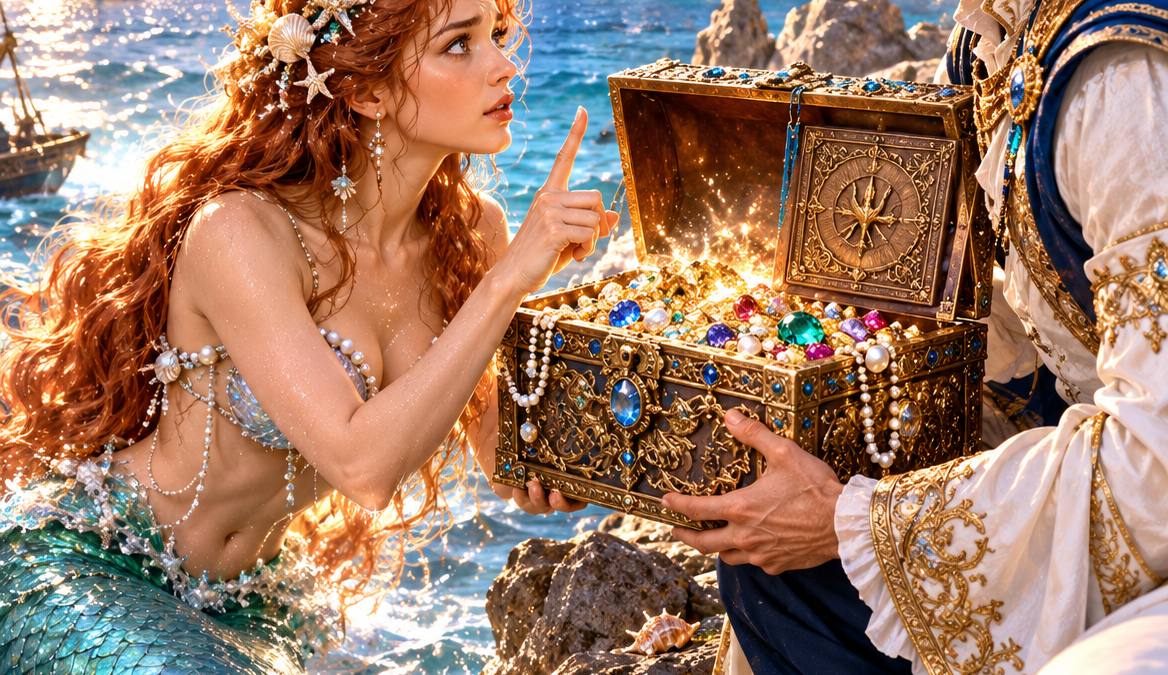
“Your Highness, open it.”
The king’s council stood in a circle around Prince Adrian while the jeweled chest rested on the table between them.
Only one compartment remained locked.
The smallest one.
And the only one the mermaid had forbidden Adrian to touch.
His father watched from the throne.
“If that creature truly wished to help us,” the king said, “she would have nothing to hide.”
Adrian looked down at the tiny silver latch.
Three weeks earlier, he had met the mermaid alone beside the eastern cliffs.
She had risen from the water just after midnight, her dark hair covered with tiny pearls, carrying a chest no larger than a traveling case.
Her name was Nerissa.
She had known Adrian’s before he told her.
“I have watched your kingdom from the sea,” she said.
Then she offered him the chest.
Inside were gemstones unlike anything found on land.
A green stone placed inside dying soil made flowers rise before sunrise.
A clear stone dropped into a polluted well left the water pure.
A blue stone set beside diseased wheat restored an entire field within days.
Adrian used them carefully.
Villages suffering from failed harvests recovered.
Wells reopened.
Families who had prepared to leave their homes stayed.
Within weeks, people began calling Adrian the prince blessed by the sea.
But Nerissa had given him one rule.
“Use every gift in the chest if you must.”
Then she touched the final compartment.
“But never open this.”
Adrian had promised.
His father had not.
The king saw something far greater than rescued villages.
He saw power.
If a handful of stones could restore crops, what might the mermaid be hiding in the final chamber?
Something that could make armies unbeatable?
Something that could extend life?
Something that could turn a small coastal kingdom into an empire?
Now Adrian stood before the entire council as his father demanded the answer.
“We are not stealing from her,” the king said calmly. “She gave you the chest.”
“Not this part.”
“A prince does not place the wishes of a sea creature above his own kingdom.”
Adrian’s hand remained beside the latch.
That sentence bothered him.
Because his father was not entirely wrong.
Beyond the palace walls, thousands of people depended on him.
If the final compartment held something capable of ending hunger forever, did he have the right to leave it closed because of one promise?
Yet he remembered Nerissa’s face.
She had not looked threatening when she warned him.
She had looked afraid.
Adrian finally asked everyone to leave.
The king refused.
So did the council.
They wanted witnesses.
Adrian understood then that if he opened the chamber, nothing inside it would ever belong only to him.
He slowly released the latch.
No explosion followed.
No flood.
No mountain of diamonds.
Inside lay a single object wrapped in pale sea silk.
Adrian lifted it carefully.
The room fell silent.
It was shaped like a human heart.
But it was made of translucent blue crystal.
And it was moving.
One slow pulse.
Then another.
Water began spreading across the polished table although nothing had spilled.
The candles flickered.
The great windows overlooking the coast suddenly fogged from the outside.
The king stepped forward.
“What is it?”
Adrian could not answer.
Then the doors of the council chamber opened.
Nerissa stood there.
Barefoot.
Dressed in a dark blue cloak.
No guards announced her.
No one had seen her enter the palace.
Her eyes were fixed on the crystal heart in Adrian’s hands.
The king immediately turned to his soldiers.
“Seize her.”
Not one man moved.
Water had begun slipping beneath every door.
Nerissa ignored the king.
She looked only at Adrian.
“You opened it.”
There was disappointment in her voice, but no anger.
Adrian tightened his grip.
“What did you give me?”
Nerissa stepped closer.
The crystal pulsed again.
This time Adrian felt the beat inside his own chest.
“The jewels were never the true gift.”
His father’s expression changed.
“Then what is that?”
Nerissa stopped across the table from Adrian.
For the first time since he had met her, she looked completely vulnerable.
“That,” she said, “is the reason I can never return to the sea.”
Adrian stared at the living crystal.
Nerissa lifted her eyes to his.
“And now that you have opened the chamber, Prince Adrian, you must decide whether I ever get my heart back.”
Adrian’s breathing changed.
Not enough for anyone else to notice.
Enough for Nerissa to notice.
His fingers loosened around the crystal.
“What do you mean, decide?”
A thin stream of seawater curled around the leg of the council table.
Then another.
Outside the fogged windows came the distant roar of the tide striking the cliffs, louder than Adrian had ever heard it from inside the palace.
Nerissa raised one trembling hand toward the heart.
She stopped before touching it.
“If I take it back,” she said, “the jewels lose their power.”
Silence.
One of the councilors inhaled sharply.
The king spoke before Adrian could.
“No.”
Nerissa did not look at him.
Adrian did.
His father’s face had gone still in that particular way Adrian remembered from childhood, the way it became still whenever something valuable seemed about to slip beyond his control.
“What happens to the fields?” Adrian asked.
“The fields remain healed.”
“The wells?”
“Clean.”
“The grain?”
“Living.”
Nerissa swallowed.
“But no stone will perform another miracle.”
The king stepped down from the throne.
“Then she does not get it back.”
Adrian turned.
“Father.”
“We have barely begun.”
“We?”
The word came out quieter than Adrian intended.
The king’s jaw tightened.
“The kingdom.”
Nerissa finally looked at him.
A strange sadness crossed her face.
Not surprise.
Recognition.
“You mean the mines,” she said.
Every head in the council chamber turned toward the king.
His expression did not move.
Adrian felt the heart pulse once between his palms.
“The mines?”
His father said nothing.
Nerissa took one step closer to the table.
“You should tell him.”
The king’s eyes narrowed.
“Be careful.”
“With what?”
Her voice stayed soft.
Water gathered around her bare feet.
“The truth?”
The oldest councilor, Lord Halden, shifted beside Adrian. His sleeve brushed the table as he looked between the king and Nerissa.
“What mines is she speaking of, Majesty?”
The king ignored him.
Adrian had seen his father command battle preparations without raising his voice. He had watched ambassadors twice his age retreat under a single look.
But now there was something else behind the king’s eyes.
Calculation.
“How does she know anything about our mines?”
Nerissa’s mouth parted in the faintest, most exhausted smile.
“Because everything you pour into the earth eventually reaches the sea.”
Adrian felt cold before he understood.
Then he remembered the eastern villages.
The first wells that had turned bitter.
The fish washing dead onto the beaches.
The fields nearest the river failing before the inland farms did.
His father had blamed poor rains.
Then blight.
Then farmers who, according to him, had grown careless after years of generous harvests.
Adrian slowly looked at the king.
“The silver works.”
His father’s eyes snapped toward him.
“The new tunnels.”
No answer.
Adrian’s heartbeat began matching the crystal one.
Slow.
Heavy.
Painful.
“Father.”
The king lifted his chin.
“The kingdom required revenue.”
Lord Halden went pale.
“You reopened the eastern shafts?”
“Expanded them.”
“You told the council they were unstable.”
“They were made stable.”
Nerissa shook her head.
“No. They were made profitable.”
The king rounded on her.
“You know nothing about governing men.”
“I know what mercury tastes like in the current.”
That silenced the room.
Nerissa’s fingers curled at her sides.
“I know what crushed ore does when the waste is washed into a river. I know what happens when black water runs beneath the reeds where freshwater meets the sea. I know what poisoned fish look like when they float over a nursery bed.”
Adrian could hear his own breathing now.
He remembered walking through Eastmere village two months earlier.
A little girl had held a dead trout by the tail and asked him why its eyes were white.
He had told her he did not know.
His father had known.
“How long?” Adrian asked.
The king looked away.
That was answer enough to make something inside Adrian break.
“How long?”
“Adrian.”
“How long have you known?”
His father’s nostrils flared.
“Do not speak to me like this in front of my council.”
“Then answer me like my father.”
The king’s face hardened.
“Since winter.”
Someone behind Adrian whispered a prayer.
Winter.
Not three weeks.
Not recently.
Months.
Adrian stared at him.
“You knew.”
“We suspected.”
“You knew the water was poisoned.”
“We knew there were risks.”
“Children were sick.”
“We needed silver.”
“People left their homes.”
“We needed soldiers.”
“Families were starving.”
“We needed leverage against kingdoms three times our size.”
Adrian’s voice cracked.
“And you let me believe the sea had cursed us.”
The king took another step toward him.
“I let you believe what allowed you to remain useful.”
The words fell into the room like a dropped blade.
No one moved.
The king seemed to realize only after speaking them that he had gone too far.
Adrian felt the crystal heart pulse.
Nerissa closed her eyes.
For one brief second, her face tightened as though the beat caused pain.
Adrian saw it.
He turned back to her.
“The heart is hurting you.”
“It has been hurting me since I removed it.”
“Why would you do that?”
Nerissa looked at the water around her feet.
“Because I could not bring it onto land.”
Adrian waited.
Her voice lowered.
“The sea does not permit my kind to abandon what we are. A mermaid may walk on shore for a night. Perhaps two. But the heart always calls the body home.”
She touched two fingers to the center of her chest.
There was no wound.
No scar visible above the dark fabric.
Still, Adrian suddenly understood the careful way she breathed.
The strange pauses between her sentences.
The way she had stood on the eastern cliff three weeks earlier with the ocean behind her and never once looked back.
“I needed to stay,” she continued.
“To help us?”
“To stop you.”
The king laughed once.
A small, humorless sound.
“Stop us?”
Nerissa looked directly at him.
“Your kingdom was not dying from drought.”
Water struck the windows.
Hard.
“The sea was dying from you.”
The king’s hand moved to the hilt of his sword.
Several soldiers shifted instinctively.
Nerissa did not.
Adrian stepped between them.
“Father.”
“Move.”
“No.”
It was the first time in Adrian’s life he had said that word to him without explanation.
The king stared at his son.
Adrian did not move.
Behind him, Nerissa whispered, “The jewels are pieces of the heart.”
He looked back.
She nodded toward the chest.
“Not pieces cut from it. Pieces of what it remembers.”
The green stones.
The clear stones.
The blue stones.
“Life,” Adrian said.
“Restoration.”
The word barely left her mouth.
Her eyes had gone glossy.
“The sea remembers what land forgets. Water carries everything. Salt. Blood. Ash. Seeds. Poison. Tears. The heart can remind damaged things what they were before they were harmed.”
Adrian looked down at the crystal.
“That is why the stones worked.”
“Yes.”
“And you gave them to me knowing they would weaken you.”
“Yes.”
“Why?”
Nerissa’s expression changed.
The smallest movement.
Her lower lip trembled once before she caught it.
“Because you knelt.”
Adrian frowned.
Nerissa continued.
“The night I first saw you, you were not standing on the cliff like a prince.”
His father’s eyes narrowed.
“You were kneeling beside a fisherman’s son.”
Adrian remembered.
A boy named Tomas.
Nine years old.
His father’s boat had come ashore with six dead fish and one living man.
The boy had been crying too hard to speak.
Adrian had knelt in the wet sand because standing above him had felt cruel.
“You took off your cloak,” Nerissa said, “and wrapped it around a child you did not know.”
Adrian looked away.
“That was nothing.”
“It was not nothing to him.”
Her eyes moved to the king.
“And it was not nothing to me.”
The king gave a contemptuous exhale.
“So this entire disaster rests on sentiment.”
“No,” Nerissa said.
Her face became still.
“It rests on greed.”
The floor jolted.
A deep sound rolled beneath the palace.
Stone grinding against stone.
Several councilors stumbled.
One of the windows cracked.
Then a bell began ringing somewhere outside.
Not a ceremonial bell.
An alarm.
A soldier ran to the window and wiped his sleeve across the fogged glass.
His face drained of color.
“Majesty.”
The king spun.
“What?”
“The harbor.”
Another bell joined the first.
Then another.
Through the cleared patch of glass, Adrian saw lanterns moving along the seawall.
People were running.
The tide had risen over the lower quay.
Nerissa’s eyes went to the heart.
“You must choose now.”
Adrian looked at her.
“What happens if I keep it?”
“You keep the stones.”
“And you?”
She did not answer.
“Nerissa.”
“I will live for a little while.”
“How long?”
Her silence cut more deeply than any number.
Adrian’s hand closed around the heart protectively.
“And if I return it?”
“The sea will take back what was separated from it.”
“The water falls?”
“Yes.”
“The stones stop working?”
“Yes.”
“And the poisoned land?”
“Whatever has already healed will remain healed. But your people will have to keep it alive themselves.”
The king stepped forward.
“You hear that?”
Adrian did not turn.
“Give her that heart and every advantage we possess disappears.”
Another violent удар of water shook the windows.
The king’s voice sharpened.
“You would trade the future of thousands for one creature?”
Adrian finally faced him.
“No.”
The king paused.
A thin smile appeared.
Adrian felt sick when he saw it.
Then he finished.
“I would trade miracles for truth.”
The smile vanished.
Adrian moved around the table toward Nerissa.
His father drew his sword.
Steel scraped through the chamber.
“Put it down.”
Every soldier froze.
Adrian turned slowly.
The point of his father’s blade was aimed directly at his chest.
Lord Halden whispered, “Majesty.”
“Silence.”
The king’s face had flushed.
“Give me the heart.”
Adrian stared at him.
“You would draw steel on your own son for it?”
“For this kingdom.”
“No.”
The king blinked.
Adrian’s voice became painfully calm.
“For what you think this kingdom owes you.”
“Do not test me.”
“I think you already tested yourself.”
The doors behind Nerissa opened again.
This time there were people beyond them.
Not guards.
Servants.
Clerks.
Two palace cooks.
A stable boy soaked to the knees.
And behind them, villagers who had been admitted through the lower gate when the harbor flooded.
Word had moved faster than any order.
Eastmere families were among them.
Adrian recognized Tomas’s mother.
She stood clutching her shawl around her shoulders, water dripping from her skirt.
The king saw them.
His face changed.
“Clear this chamber.”
No one moved.
His voice rose.
“I said clear it!”
Still no one moved.
Because Lord Halden had stepped away from the throne.
Then another councilor did the same.
Then another.
They crossed the room one by one until the king stood alone on the raised side of the table.
The king stared at them.
“You serve me.”
Lord Halden’s face looked older than it had minutes before.
“We serve the crown.”
“I am the crown.”
“No,” Adrian said.
His father looked at him.
Adrian’s hand trembled around Nerissa’s heart.
“The crown is supposed to serve them.”
He glanced toward the people in the doorway.
His father’s mouth twisted.
“You sound like a child.”
Adrian felt the insult land.
It had landed many times before.
When he had asked why taxes rose after a poor harvest.
When he had argued against forcing fishermen’s sons into military service.
When he had refused to punish a village because three families could not pay winter levies.
Too tender.
Too young.
Too easily moved.
He had spent years wondering whether compassion was simply weakness wearing a beautiful name.
Now he looked at the fear in Nerissa’s face.
The water around Tomas’s mother’s boots.
The sword in his father’s hand.
And he finally understood.
“No,” Adrian said quietly.
“I sound like the man you failed to teach me not to become.”
His father lunged.
It happened too quickly for thought.
A shout.
A flash of steel.
Adrian twisted aside.
The sword cut through the sleeve of his coat and struck the table.
Nerissa gasped.
The crystal heart slipped in Adrian’s wet hands.
The king saw it fall.
He released his sword.
And dove for it.
Adrian reached too.
Their hands struck the floor together.
The heart rolled between them.
The king seized it first.
For one instant, triumph transformed his face.
Then the crystal pulsed beneath his palms.
The entire chamber went silent.
The king screamed.
Not loudly at first.
It began as a strangled breath.
His fingers locked around the heart.
Blue light spread between them.
He tried to release it.
He could not.
Images appeared inside the crystal.
Not visions floating in the air.
Reflections.
The king saw them first.
Then the polished walls of the heart threw them outward in trembling blue light across the wet floor and white stone columns.
Men working in the eastern mine.
Barrels marked with the royal seal.
Black slurry emptying into a narrow tributary.
A mine overseer arguing with a royal officer.
A letter.
The king’s signature.
Lord Halden staggered forward.
“No.”
Another image.
The overseer kneeling in the throne room.
His voice came from the crystal, thin and distant, like sound heard underwater.
“If we continue washing ore into the river, the lower villages will lose their wells.”
The king’s own voice answered.
“Then move the waste at night.”
A woman in the doorway covered her mouth.
The next image formed.
A physician holding a bottle of cloudy water.
“Children are falling ill.”
The king again.
“Call it fever.”
Adrian stopped breathing.
His father fought the crystal.
“Stop this!”
But every attempt to crush it only made the memories brighter.
Nerissa whispered, “The heart remembers what water carries.”
The king looked at her with horror.
“You did this.”
“No.”
Her voice shook.
“You did.”
Another memory.
The king standing over a map with red marks along the eastern coast.
A minister asking if Adrian should be told.
“No. The boy would close the mines.”
The king’s fingers trembled violently.
“Enough!”
“He will see starving families and panic.”
Adrian shut his eyes.
His father’s remembered voice kept speaking.
“Let him comfort them. Let him visit villages. It keeps him loved.”
Adrian opened his eyes again.
The image shifted.
“He was never meant to fix the problem. Only survive it.”
The king’s knees hit the wet floor.
His face had lost all color.
Around him stood the people he had harmed.
No cheering came.
No one needed it.
Their silence was worse.
Tomas’s mother stared at the king with tears moving down her cheeks.
“My husband died in that water.”
The king looked up.
She stepped into the room.
“You sent grain to his funeral.”
Her voice broke.
“You sent a letter saying the crown mourned with us.”
The king’s lips moved.
Nothing came out.
“You knew.”
A fisherman entered beside her.
“My youngest cannot walk without pain anymore.”
Another voice.
“My sister lost her baby.”
Another.
“We burned our orchard because you told us the soil carried rot.”
The king tried to rise.
His feet slipped in the water.
“Guards.”
No one answered.
“Guards!”
A captain removed his helmet.
He looked at Adrian.
Then at the villagers.
Then he placed the helmet on the table.
“Majesty,” he said quietly, “my mother lives in Eastmere.”
The king stared at him as if he had been struck.
The captain lowered his eyes.
“I will not raise a sword for this.”
One by one, the other soldiers lowered their weapons.
Steel touched stone.
Soft sounds.
Irreversible sounds.
The king looked around the chamber.
At the councilors who no longer stood beside him.
At the soldiers who no longer obeyed him.
At the people who no longer feared him enough to remain silent.
At his son.
And for the first time, Adrian saw his father understand that a throne was only a chair once everyone stopped pretending otherwise.
The king’s grip finally released.
The heart rolled free.
Adrian caught it against his chest.
The blue memories disappeared.
The chamber dimmed.
The only sound left was the water.
The king remained on his knees.
His shoulders rose and fell.
Then he laughed.
Once.
Twice.
A broken, disbelieving sound.
“You think you can govern them?”
Adrian did not answer.
His father looked up.
“You think kindness feeds armies?”
Adrian’s eyes burned.
“No.”
“You think promises fill treasuries?”
“No.”
“You think they will love you when the harvest fails again?”
“No.”
The king’s smile turned ugly.
“Then what do you have?”
Adrian looked toward the villagers.
Then Nerissa.
Then the crystal heart.
“The truth.”
His father scoffed.
Adrian continued.
“And tomorrow, if the fields fail, they will know why.”
He swallowed.
“If taxes rise, they will know where the money goes.”
Another breath.
“If I make a mistake, they will be allowed to tell me.”
His father’s expression twisted.
“That is not a king.”
“Then perhaps that is why your kind of king should end.”
A murmur moved through the chamber.
Lord Halden stepped forward.
“Majesty.”
The king looked at him.
“The council has witnessed confession and evidence of deliberate poisoning of crown lands, concealment of deaths, falsified reports, and violence against the heir.”
“You cannot judge me.”
“No.”
Halden’s voice was quiet.
“But we can remove your command while the full record is heard.”
The king rose suddenly.
“You old coward.”
He reached for the sword on the table.
The captain was faster.
He stepped between the king and the weapon.
The king stopped.
Not because the captain threatened him.
Because the captain did not.
He simply stood there.
A man who had obeyed him for twenty-two years.
No longer obeying.
The king’s face collapsed in a way Adrian had never seen.
Not remorse.
Something more primitive.
The terror of being ordinary.
“Adrian.”
It was the first time he had said his son’s name without command behind it.
Adrian looked at him.
“You cannot let them do this.”
The plea was almost worse than the threats.
For one dangerous second, Adrian saw not the king but the father who had once carried him through a thunderstorm when he was six.
The father who had taught him to ride.
The father who, before power hardened every conversation between them, had once sat beside his bed until a childhood fever broke.
Adrian’s mouth trembled.
His father saw it.
Hope appeared in his eyes.
“Son.”
Adrian closed the distance between them.
The king’s shoulders lowered.
Adrian stopped an arm’s length away.
“I loved you.”
His father’s face changed.
Adrian’s voice became rough.
“I need you to know that.”
“Adrian—”
“I loved you enough to spend years thinking there had to be something I was failing to understand.”
The king stared at him.
“I thought your cruelty was wisdom I was too young to recognize.”
The room was silent.
“I thought one day I would become harder and finally understand you.”
Adrian looked down.
A tear struck the water at his boots.
He breathed once.
Then lifted his eyes.
“I am grateful that day never came.”
His father went still.
Adrian stepped back.
“Captain.”
The soldier understood.
He approached the king.
The king looked at his son one last time.
Not with rage.
Not yet.
With disbelief.
Then the captain removed the royal sword from the table and said the words no one in the kingdom had ever expected to hear.
“Your Majesty, you are no longer in command of the palace guard.”
The king’s face emptied.
Two soldiers approached.
They did not drag him.
They did not need to.
He walked between them while the villagers watched.
At the doorway, Tomas’s mother moved aside.
The king stopped when he saw her.
She did not bow.
That seemed to wound him more than anything else.
He opened his mouth.
Perhaps to defend himself.
Perhaps to apologize.
Whatever words came to him were too late.
Tomas’s mother looked directly into his eyes.
“My husband’s name was Daniel.”
The king blinked.
She waited.
He lowered his gaze.
Then the soldiers led him away.
No applause followed.
Only the slow fading of footsteps.
Adrian remained still until he could no longer hear them.
Then Nerissa staggered.
He turned.
Her hand struck the table.
“Nerissa.”
The heart in Adrian’s hands had dimmed.
He rushed to her.
She tried to stand upright.
Failed.
Adrian caught her before her knees touched the floor.
Her body was frighteningly cold.
“Nerissa.”
Her eyes found the heart.
“Now.”
He looked toward the windows.
The water had reached halfway across the chamber.
Outside, the bells were still ringing.
Adrian lifted the crystal.
“What do I do?”
“Bring it to the sea.”
“The cliffs?”
She shook her head.
“Too far.”
“The harbor.”
She nodded.
Adrian slid one arm beneath hers.
She tried to pull away.
“I can walk.”
“You can barely breathe.”
“I said I can walk.”
He looked at her.
Despite everything, he almost smiled.
“So did I when I broke my ankle at fourteen.”
A weak irritation crossed her face.
“That is not the same.”
“It is remarkably similar from here.”
For the first time since entering the chamber, Nerissa gave a breath that was almost a laugh.
It vanished quickly.
But Adrian heard it.
So did Lord Halden.
The old councilor looked away, hiding the smallest smile.
Then he spoke.
“Go.”
Adrian looked at him.
“The kingdom—”
“Will still be here when you return.”
Halden glanced at the water.
“Preferably with less ocean in the council chamber.”
Adrian nodded.
The captain opened the doors.
People moved aside.
Adrian and Nerissa passed between them.
No one touched the heart.
No one asked Adrian to keep it.
That mattered.
They descended the palace steps while storm wind tore through the courtyard.
Rain had begun.
Not from clouds.
The sky above was clear.
Water seemed to fall out of the darkness itself, blown inland from waves smashing against the seawall.
The city bells rang.
People filled the streets carrying children, ropes, lanterns, blankets.
Adrian heard his name.
Not cheered.
Called.
Questions.
Fear.
He stopped halfway across the courtyard.
Nerissa leaned heavily against him.
“What are you doing?”
He turned toward the people gathered beyond the gates.
“The heart is going back.”
Some stared.
Others did not understand.
Adrian raised his voice.
“The jewels will lose their power.”
That brought silence.
A farmer near the gate stepped forward.
“My fields?”
“What has healed will remain healed.”
“And next season?”
Adrian looked at him.
“We plant it ourselves.”
Another man called, “And the wells?”
“We close the mines.”
A woman shouted, “Tonight?”
Adrian answered without looking toward the palace.
“Tonight.”
Lord Halden, standing at the top of the steps, said loudly, “The order will be written before the prince reaches the harbor.”
The woman nodded.
That was all.
No one begged for miracles.
Adrian looked around at them.
People frightened of tomorrow.
People exhausted by today.
People who had every reason to demand that he keep the heart.
Instead, Tomas’s mother stepped forward.
“Give it back.”
Others began nodding.
A fisherman removed his cap.
“Give it back.”
A baker near the gate wiped rain from her face.
“She saved our water.”
Another voice answered.
“Our wheat.”
Then another.
“Our children.”
The words spread without becoming a chant.
Not dramatic.
Not rehearsed.
Just people saying what they knew.
Nerissa looked at Adrian.
Her eyes filled.
“They do not know me.”
“No.”
He tightened his arm around her.
“But they know what you did.”
They moved through the city together.
At the lower streets, the water reached Adrian’s ankles.
Then his calves.
People formed lines passing sandbags toward homes nearest the harbor.
The prince joined them for three bags before Nerissa caught his sleeve.
“Adrian.”
He turned.
She was shaking.
“Right.”
He placed the bag down.
A young dockworker stared at him.
Adrian pointed toward the heart.
“Mermaid.”
The dockworker looked at Nerissa.
Then at the heart.
Then back at Adrian.
“Right.”
He took the sandbag from the prince.
“Go.”
They reached the harbor as another wave struck the outer wall.
Spray rose above the towers.
Ships pulled violently against their moorings.
The sea looked black beneath the stars.
Nerissa stopped at the end of the stone pier.
Adrian supported her.
“What now?”
She looked at the heart in his hands.
“Nothing.”
He frowned.
“Nothing?”
“Give it to me.”
He stared at her fingers.
They were shaking too badly to hold anything.
“Nerissa.”
“I can hold it.”
He did not move.
She looked up.
“What?”
Adrian’s jaw tightened.
“If I give it back…”
“You save me.”
“You leave.”
Her breathing stopped for half a beat.
The waves struck stone beneath them.
“That was always the bargain.”
“There was no bargain.”
“No.”
Her mouth softened.
“There wasn’t.”
Adrian looked down at the heart.
Blue light moved through his fingers.
“I thought I was deciding whether the kingdom deserved another miracle.”
Nerissa said nothing.
“But that was never the decision.”
“No.”
He finally understood why she had been afraid when she gave him the chest.
Not afraid that he would steal the heart.
Afraid she would discover what kind of man he was when keeping it became useful.
Adrian’s eyes lifted to hers.
“You knew this would happen.”
“I knew it might.”
“You knew someone would want the final compartment.”
“Yes.”
“My father.”
“I did not know which of you.”
That hurt.
Because it was fair.
Adrian nodded slowly.
“You were testing me.”
Nerissa’s face tightened.
“No.”
“Then what?”
Her answer came almost as a whisper.
“I was trusting you.”
He looked at her.
“There is a difference.”
Her breathing trembled.
“A test expects someone to fail so it can measure them.”
She glanced at the heart.
“Trust is knowing they might fail and giving them something precious anyway.”
Adrian’s throat closed.
“I did fail.”
“You opened it.”
“I promised you I wouldn’t.”
“Yes.”
“I broke my word.”
“Yes.”
He flinched slightly.
Nerissa stepped closer.
Her knees almost gave way.
Adrian caught her elbow.
She let him.
“But you are standing here.”
Her eyes held his.
“With the choice still in your hands.”
Adrian looked at the sea.
“I wish I had not opened it.”
“I know.”
“I wish I had trusted you before I needed proof.”
“I know.”
He let out a broken laugh.
“You could say something more comforting.”
“I could.”
“But you won’t.”
“No.”
He smiled despite himself.
Then his face crumpled.
Only for a second.
He looked away.
“When you go back…”
Nerissa waited.
“Will you remember me?”
Her expression softened so completely that Adrian nearly lost control of his breathing.
“The heart remembers what water carries.”
She lifted one cold hand.
Her fingertips touched his wrist.
“Do you think the sea could forget you?”
Adrian closed his eyes.
A tear moved down his cheek.
He placed the crystal heart gently into her hands.
Nerissa inhaled.
The instant her skin touched it, the harbor went quiet.
Not calm.
Quiet.
The waves froze in motion.
Ropes stopped creaking.
Rain hung in the air like silver dust.
Adrian stared.
Nerissa pressed the crystal against her chest.
Blue light spread through her cloak.
She arched sharply, gasping.
Adrian reached for her.
Then stopped.
The heart dissolved into light.
It passed through fabric.
Through skin.
Into her.
Nerissa cried out.
One pulse shook the pier.
Then another.
Adrian felt each one in the stones beneath his boots.
The water around the harbor walls began withdrawing.
Not violently.
Like a long breath being released.
Nerissa fell forward.
Adrian caught her.
For several seconds she did not move.
“Nerissa.”
Nothing.
He dropped to his knees on the wet pier, holding her against him.
“Nerissa.”
Her face was colorless.
Her lashes rested against her cheeks.
Adrian pressed two fingers beneath her jaw.
He had no idea whether a mermaid’s pulse could be found there.
“Please.”
The word left him before he could stop it.
“Please don’t make that the last thing I gave you.”
Nerissa inhaled.
A deep, shocked breath.
Adrian nearly collapsed.
Her eyes opened.
For a moment they looked almost black.
Then blue returned.
She blinked up at him.
“You are crushing my shoulder.”
Adrian laughed.
It came out half sob.
He released her so quickly she almost fell again.
“Sorry.”
“You are terrible at rescuing people.”
“I was told I was blessed by the sea.”
“The sea exaggerates.”
He laughed again.
So did she.
Very softly.
Humanly.
Around them, the harbor water continued sinking back to its natural line.
Lanterns steadied.
The ships stopped straining at their ropes.
Along the seawall, people began to realize the danger had passed.
No celebration exploded.
First came silence.
Then crying.
Then laughter in scattered places.
People hugging the person nearest them because they had been frightened and were no longer frightened.
Adrian remained on the pier with Nerissa.
Her color slowly returned.
She looked toward the sea.
He saw the change in her face.
The call of it.
Home.
His smile faded.
“You have to go.”
“Yes.”
He stood and helped her rise.
Nerissa removed the dark blue cloak.
Beneath it, the fabric of her dress shimmered as seawater climbed around her bare feet.
Adrian looked toward the end of the pier.
“I suppose this is where I say something dignified.”
“You are a prince.”
“I have been told.”
“You should have something prepared.”
“I had a difficult evening.”
That smile again.
Small.
Private.
Nerissa stepped into the water.
It rose to her knees.
Adrian’s chest tightened.
She turned back.
“You should know something.”
“What?”
“The chest did not choose you because you were a prince.”
He frowned.
“I chose you.”
“Yes.”
“Because of the boy on the beach.”
“That is why I approached you.”
“But not why the chest opened for you.”
Adrian stared.
“What do you mean?”
Nerissa glanced toward the palace on the hill.
“The compartments only release their gifts when they are carried toward damage instead of desire.”
Adrian thought of the first green stone.
He had carried it to a dying orchard before even asking what it was worth.
The clear stone.
Straight to the poisoned well.
The blue stone.
To the diseased wheat.
His father had never touched the chest before tonight.
“What would have happened if he tried to open one?”
“Nothing.”
Adrian went still.
“All of this time…”
“He could never have used the jewels.”
Adrian stared at her.
“Then why did you warn me about the final chamber?”
Nerissa’s eyes glistened.
“Because that lock was different.”
He waited.
“It was not designed to keep your father out.”
Adrian understood slowly.
“It was designed to keep me out.”
“Yes.”
“Why?”
“Because every other compartment opened when you wanted to save someone else.”
Her voice softened.
“The last one would open only when you believed saving others gave you the right to break a promise.”
Adrian looked back toward the palace.
Toward the chamber where his father had stood beneath the illusion that power justified everything.
Then Nerissa said, “That is how men like him begin.”
The words hurt.
They were meant to.
Adrian lowered his head.
“I came close.”
“Yes.”
He looked at her again.
Nerissa stepped nearer until the water reached her waist.
“But you stopped.”
“I opened it.”
“And then?”
Adrian said nothing.
Nerissa’s smile trembled.
“You gave it back.”
For the first time since the council chamber, Adrian allowed himself to accept that both things could be true.
He had broken his promise.
And he had chosen what to do after breaking it.
The mistake mattered.
So did what came next.
Nerissa turned toward the sea.
Adrian called her name.
She looked back.
“Will I see you again?”
A long pause.
Then she smiled.
“Look in clean water.”
And stepped beneath the surface.
Blue light flashed under the harbor.
For one beautiful second, Adrian saw the silver curve of a tail beneath the dark water.
Then she was gone.
He stood alone at the end of the pier.
Not empty.
Just alone.
There was a difference.
Behind him came footsteps.
Tomas’s mother stopped several feet away.
She held Adrian’s cloak.
He had not realized he had dropped it.
She offered it to him.
“Your Highness.”
“Thank you.”
He took it.
Their hands almost touched.
She hesitated.
“Daniel used to say the sea returned everything eventually.”
Adrian looked at her.
Her eyes were red.
“My husband.”
“I remember his name.”
She nodded.
That mattered too.
Adrian put on the wet cloak.
“I’m sorry.”
She breathed in.
For a moment he feared she would bow.
Instead, she looked at him as one exhausted person looks at another.
“I know.”
Not forgiveness.
Not yet.
Something more honest.
A beginning.
They walked back from the pier together.
Near the harbor wall, families were already clearing debris.
Adrian joined them.
No decree.
No ceremony.
He picked up broken timber beside fishermen and soldiers.
Lord Halden eventually arrived carrying a sealed order.
“The eastern mines are closed.”
Adrian read it beneath a lantern.
“And the workers?”
“Paid through the month.”
“With what money?”
Halden gave him a tired look.
“The royal war reserve.”
Adrian almost smiled.
“My father will hate that.”
“I confess the thought brought me comfort.”
Adrian signed.
Halden sanded the ink.
Then held out another paper.
“What is this?”
“Temporary transfer of executive authority pending formal judgment.”
Adrian stared at it.
“The crown.”
“The work.”
Halden corrected him gently.
Adrian looked toward the city.
People sweeping water from shops.
A soldier carrying an old woman across a flooded street.
Two children stacking fallen fruit back into a merchant’s basket.
The kingdom did not look like something anyone should want to own.
It looked like something that needed care.
Adrian took the pen.
Before signing, he paused.
“Add a condition.”
Halden lifted an eyebrow.
“The mine records become public.”
“All of them?”
“All.”
“That will include council failures.”
“Yes.”
Halden’s mouth tightened.
“And yours.”
“Yes.”
The old man studied him.
Then nodded.
“Good.”
Adrian signed.
They returned to the palace as the first gray hint of dawn touched the horizon.
The council chamber smelled of salt, wet stone, and extinguished candles.
Servants had begun removing soaked rugs.
Adrian stopped at the table.
The jeweled chest still sat there.
He approached it carefully.
Every compartment stood open.
The green stones had become ordinary green glass.
The clear stones looked like river quartz.
The blue stones were pale and dull.
Lord Halden came beside him.
“Worthless?”
Adrian picked one up.
It was warm.
“No.”
Halden looked at him.
Adrian placed it back.
“Just no longer miraculous.”
Near the smallest compartment, something caught the light.
A single pearl.
Adrian frowned.
It had not been there before.
He picked it up.
Beneath it lay a narrow strip of pale sea silk.
His breath stopped.
Wrapped inside was a tiny green shoot.
Alive.
Two leaves.
No gem.
No magic light.
Just a fragile plant with wet roots.
Halden leaned closer.
“What is it?”
Adrian smiled.
“I think it’s an answer.”
“To what?”
Adrian looked toward the window.
The storm was gone.
Far below, the harbor reflected the first gold of morning.
Weeks of fear had taught the kingdom to wait for rescue from a chest.
His father had wanted miracles because miracles required no confession, no reform, no patience.
But the green shoot needed soil.
Water.
Time.
Hands.
“Whether we can keep anything alive without being saved.”
Halden let out a quiet breath.
“And?”
Adrian cupped the seedling carefully.
“We’re about to find out.”
Tomas’s mother was still in the courtyard when Adrian descended with it.
She stood beside her son.
Tomas looked older than nine beneath the dirt and exhaustion on his face.
Adrian knelt.
The same way he had that night on the beach.
The boy looked at the small plant.
“What is it?”
“I don’t know.”
“Is it magic?”
Adrian considered the question.
Then shook his head.
“I hope not.”
Tomas frowned.
Adrian held the shoot toward him.
“Do you know somewhere it can grow?”
The boy thought seriously.
Then pointed toward the eastern gate.
“My father’s garden.”
His mother’s face changed.
Tomas looked up at her.
“We didn’t plant it this year.”
She pressed her lips together.
“No.”
“Can we?”
Her eyes filled.
She placed one hand on the back of his head.
“Yes.”
The word trembled.
“Yes, we can.”
Adrian handed Tomas the plant.
The boy held it as if it were made of glass.
His mother looked at Adrian.
He saw grief.
Anger.
Weariness.
And beneath all three, the smallest space where life might someday return.
“Come with us,” she said.
Adrian glanced toward the palace.
Lord Halden stood on the steps holding three documents and looking profoundly inconvenienced.
Adrian almost laughed.
“I have work.”
“So do we.”
Tomas’s mother nodded toward the seedling.
Adrian looked at Halden.
The councilor closed his eyes.
Then waved one hand.
“Go.”
They walked east as the sun rose.
Not as a prince, a widow, and a fisherman’s son.
Just three people carrying something alive.
By the time they reached Daniel’s garden, neighbors had noticed them.
A few followed.
Then more.
Someone brought a shovel.
Someone else carried a bucket of clean water from the reopened well.
The earth was dark and soft from the night’s flooding.
Tomas chose a place beside the stone wall.
Adrian dug.
The boy lowered the roots.
His mother covered them with soil.
No blue light came.
No flowers burst from the ground.
Nothing miraculous happened.
Tomas looked disappointed for half a second.
Then Adrian handed him the water.
“Slowly.”
The boy poured.
A little mud formed around the roots.
The two leaves trembled in the morning breeze.
Tomas stared at them.
“Is that it?”
Adrian sat back on his heels.
“That’s it.”
“How long before it grows?”
“I have no idea.”
Tomas’s mother smiled through tears.
“That’s how growing works.”
The boy considered this terrible news.
Around them, several people laughed.
Softly.
Adrian looked toward the sea.
The morning light had turned the water silver.
For an instant, something moved near the horizon.
A flash.
Blue.
Then gone.
He did not call attention to it.
He only smiled.
Tomas’s mother noticed.
“What?”
“Nothing.”
She looked toward the sea anyway.
Adrian stood.
Behind them, the kingdom waited.
There would be hearings.
Repairs.
Angry families.
Empty treasuries.
Fields that required ordinary rain.
Wells that required testing.
A father Adrian would have to face again not as a frightened son seeking approval, but as a man demanding accountability.
There would be no jeweled chest to solve those things.
No miracle stone.
No easy answer.
And strangely, for the first time, Adrian was not afraid of that.
Tomas tugged his sleeve.
“Your Highness.”
Adrian looked down.
The boy pointed to the tiny plant.
One leaf had caught a drop of water.
Sunlight filled it.
Not magic.
Only morning.
Still, it shone like a jewel.
Adrian knelt beside him.
Tomas leaned closer.
His mother stood behind them with one hand resting lightly on her son’s shoulder.
No one spoke.
Far beyond the garden wall, the tide moved gently against the shore.
And when Adrian looked into the bright drop trembling on that small green leaf, he could have sworn he saw dark hair beneath blue water and a familiar face smiling back at him.
Then Tomas touched the soil around the roots with both hands.
Adrian placed his hand beside the boy’s.
And together, beneath the warm rising sun, they held the earth steady while something living learned how to grow.

