The Maid’s Midnight Call Exposed a Traitor Inside the Mafia Boss’s Own House
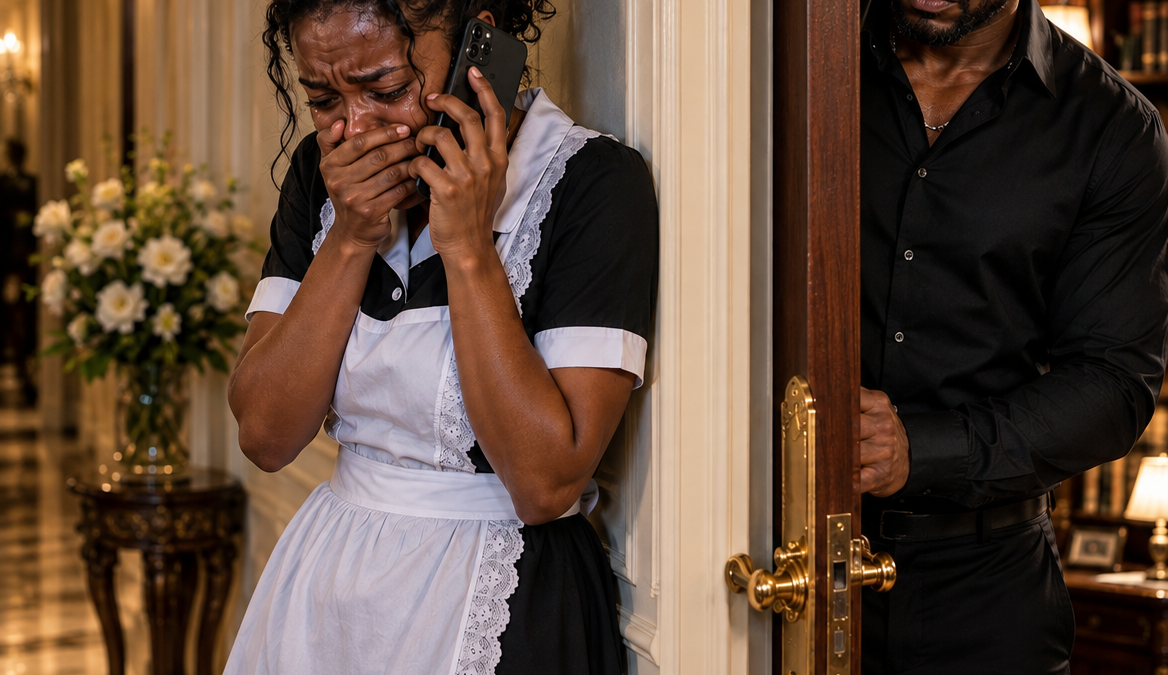
The cold marble floor of the upper corridor seemed to sap whatever warmth remained in Lua’s trembling body. She pressed her shoulder blades hard against the wall just outside the study, praying the darkness would swallow her whole. Every breath she dragged into her lungs burned like crushed glass, catching roughly against the back of her throat.
One hand clamped over her mouth to muffle the desperate, ragged sobs that threatened to tear free from her chest. Her black-and-white maid’s uniform remained meticulously pressed and pinned, a stark contrast to the sheer terror unraveling her mind. “Please, I am begging you,” she whispered into the receiver, her voice cracking beneath the unbearable weight of her reality. “Leave my mother alone.”
Inside the half-open doorway only a few paces away, Oceano had stopped turning the crisp pages of the financial ledgers. The feared syndicate head sat entirely motionless behind his sprawling mahogany desk, his sharp gray eyes fixed on the sliver of hall. He listened in absolute, predatory silence as the metallic voice on the phone demanded confidential details from that evening’s council assembly.
Lua never suspected that the man who held the city’s underworld in his clenched fist was hearing every broken plea. Six months earlier, her entire universe had shrunk down to the sterile, disinfectant-tinged air of St. Jude’s intensive care ward. She had sat beside her mother’s narrow bed, watching the slow, rhythmic rise and fall of Amara’s paper-thin chest beneath the sheets.
A senior doctor had called Lua into the corridor that afternoon, his clipboard held like a barricade between them. He explained with detached clinical efficiency that Amara’s aggressive pulmonary therapy could not continue past Friday without substantial funds. The immediate deposit required exceeded thousands of dollars, an impossible fortune for a twenty-four-year-old earning standard household wages.
Amara had tried to muster a fragile smile when Lua returned to the bedside, but the raw terror in her mother’s eyes was undeniable. With no personal savings, no remaining relatives to call upon, and every bank door slammed shut, Lua felt the walls closing in. She spent two sleepless nights wandering the city streets, weeping until her eyes swelled, completely paralyzed by the certainty of impending loss.
The trap closed on a drizzling Tuesday evening directly outside the hospital’s revolving glass doors. A man in a charcoal wool coat stepped into her path, his posture polished, polite, and thoroughly unnatural. He carried no weapon, but he spoke with a terrifying intimacy, naming the exact floor where Amara lay dying.
He knew precisely how much the hospital demanded to keep the oxygen flowing and the specialized medications running. Worse, he knew Lua had recently secured employment as a domestic maid inside the fortified coastal estate of Don Oceano. He produced a neat leather envelope, offering to settle every overdue medical invoice directly with the hospital administration that very hour.
In return, the stranger asked for what he insisted was nothing more than an insignificant, harmless favor. He reached into his tailored coat and revealed a matte black cylinder no larger than a common brass coat button. The stranger referred to the miniature audio transmitter as a simple verification tool, claiming his associates merely needed commercial confirmation.
“Our firms are negotiating shipping rights,” the smooth voice had assured her beneath the humming yellow streetlights. “We only wish to verify his terms before signing. It harms no one, costs nothing, and saves your mother’s life tonight.” He promised the arrangement would end the instant the recording device was planted and the initial frequency confirmed by his engineers.
Desperate people possess a tragic talent for manufacturing excuses to silence their screaming consciences. Lua stared at the small black device, telling herself that eavesdropping on a powerful man’s business was not equivalent to murder. She convinced herself that Oceano was wealthy beyond measure and completely immune to the minor fallout of stolen words.
Her mother, by contrast, had only hours left before the hospital machines would be switched off and wheeled away. Two days later, while polishing the sprawling library shelves in Oceano’s private study, her trembling fingers slipped beneath the heavy oak display. She pressed the adhesive side of the listening device against the unfinished pine backing near the floorboards, completely hidden from view.
That same evening, a notification chimed on her battered mobile phone while she was rinsing glasses in the mansion’s scullery. A verified wire transfer had cleared the hospital’s accounting department, guaranteeing Amara sixty full days of advanced respiratory care. Lua had collapsed onto the cold tiles of the pantry, weeping tears of dizzying relief, believing the nightmare had reached its conclusion.
The illusion of safety shattered three weeks later with a single anonymous text message arriving at three o’clock in the morning. The stranger did not want shipping confirmations; he demanded exact arrival times for Oceano’s regional commanders. He ordered Lua to photograph handwritten manifests left upon the mahogany desk and log the license plates of every late-night visitor.
When Lua panicked and sent back a trembling refusal, the caller dropped all pretense of corporate gentility. Within minutes, her phone received a high-resolution photograph taken from inside the hospital corridor, showing Amara asleep through the glass window. The accompanying voice note was chilled and precise, describing the exact nurse’s station and the vulnerability of Amara’s life-support line.
Lua realized with sickening certainty that she had handed her soul over to Oceano’s most ruthless blood rivals. The blackmailers had never intended to let her go; they had purchased an expendable pawn inside the fortress walls. If she confessed to Oceano, his security team would likely execute her on the spot for corporate espionage and treason.
If she defied the rivals, her defenseless mother would suffer a sudden, fatal complication before dawn arrived. Every morning became a suffocating exercise in psychological torture as Lua moved through the mansion with a dusting cloth and downcast eyes. Whenever she entered the private study, the hidden microphone beneath the display cabinet seemed to emit a deafening, phantom hum.
She hated the rivals with every fiber of her being, yet she was forced to serve as their ears inside the stronghold. Now, past midnight, the nightmare had reached its absolute breaking point in the drafty stone corridor. The anonymous voice on the call was demanding the alternate transport routes Oceano had finalized during an emergency council meeting hours ago.
“I can’t get close to the files, they locked the credenza,” Lua wept quietly, her nails digging deep into the flesh of her palm. “You must find another way, girl,” the voice snarled, stripping away the last shreds of patience. “Your mother’s oxygen supply is very fragile.” “Please, have mercy,” she whispered, her forehead resting against the cold molding of the wall. “I cannot do this anymore.”
A tall, dark silhouette detached itself from the gloom of the study doorway, moving with the soundless grace of a phantom. Oceano stepped into the hall, his tailored black shirt open at the throat, his presence commanding and entirely terrifying. “Who is it you fear so much?” his deep voice cut through the stillness like a newly honed blade.
Lua gasped, her heart leaping into her throat as she violently disconnected the call and shoved the device beneath her apron. She spun around, flattening herself against the wall, her chest heaving as though she had just run through a winter storm. “It was… it is nothing, Don Oceano,” she stammered, blood draining from her cheeks. “Just my brother. A private family trouble.”
Oceano’s gaze remained unblinking, heavy with the experience of a man who survived by reading the finest micro-expressions of deceit. “Family trouble does not typically demand details regarding my private logistics meetings,” he remarked with deadly calm. Lua opened her mouth to construct another lie, but the words withered on her tongue; her knees shook violently beneath her skirt.
He did not shout, nor did he signal the armed guards standing watch at the end of the grand gallery. Instead, he stepped aside, opening the heavy timber door to his private office and gesturing toward the warm interior. “Step inside,” he commanded softly, the restraint in his voice far more terrifying than a roar of fury. “Where the walls are thick.”
Refusing him was impossible; running was an illusion that would end at the wrought-iron perimeter gates. Lua stepped across the threshold, feeling as though she were walking the final steps toward her own execution block. She halted near the center of the Persian rug, clutching her hands together until the knuckles turned white as marble.
Oceano closed the heavy door, turning the deadbolt with a soft, decisive click that sounded like a chambering round. He remained several paces away, giving her room to breathe, yet his presence dominated every cubic inch of the shadowed room. “Give me the telephone,” he said simply, holding out a large, calloused palm lined with old scars.
Lua hesitated for a single heartbeat, but the phone began buzzing violently in her pocket once more, shattering the heavy silence. The caller was persistent, ringing again immediately after being dismissed, the harsh vibrations rattling against the silver buttons of her apron. Defeated, Lua reached into her apron pocket and placed the trembling plastic casing into the syndicate boss’s outstretched hand.
Oceano tapped the speaker icon and set the device flat on the center of his blotter. “Listen to me, you stupid girl,” the caller hissed through the tiny speaker, his voice dripping with venomous irritation. “We know the transport route was altered after Marcus Vale arrived tonight. Give us the highway numbers or your mother won’t see morning.”
The blackmailer continued, casually mentioning an internal dispute between Oceano and Marcus that had transpired behind closed doors. Lua broke down, sobbing openly into her trembling hands. “I never wanted to hurt anyone! Please, don’t touch her!” The voice on the speaker laughed, a dry, rattling sound. “Your regrets ceased to matter the second you placed our bug under the cabinet.”
Oceano did not react to the insult; instead, his gray eyes shifted slowly from the glowing screen to Lua’s devastated expression. In that singular moment of revelation, the complex pieces of a dangerous puzzle locked into place inside the Don’s calculating mind. The girl had committed a treasonous act, but she had done so under the ultimate duress, manipulated through a mother’s failing lungs.
Far more alarming, however, was the caller’s casual reference to the bitter disagreement between himself and Marcus Vale. That argument had taken place in the inner courtyard, miles away from the study’s listening device, with only three men present. Someone seated at his own table, someone trusted with his life, was selling intelligence directly to the rival syndicate.
The conspiracy was rotting his house from the inside, and this terrified domestic maid was merely the visible tip of the spear. Oceano reached out with a single finger and tapped the red disconnect button, severing the blackmailer’s voice mid-threat. The silence that followed was suffocating, broken only by Lua’s ragged, shuddering breaths as she waited for the inevitable bullet.
“Tell me everything,” Oceano instructed, his tone devoid of rage, carrying instead an unsettling, icy clarity. “From the very first day outside the clinic, until the words you just spoke in the hall. Leave nothing out.” Lua sank onto her knees on the rug, unable to support her own weight, and poured out the entire poisoned truth.
She spoke of the hospital’s financial deadlines, the stranger in the wool coat, the wire transfers, and the miniature microphone. She explained how the blackmailers escalated from minor curiosity to stalking her mother’s hospital room with cameras and veiled murder threats. When the confession was exhausted, she bowed her head toward the floor, waiting for the guards to drag her into the basement.
Oceano stood over her, his hands resting casually inside his trouser pockets as he weighed her broken spirit. He had executed hardened soldiers for far lesser transgressions, yet he recognized the fundamental difference between malicious betrayal and helpless desperation. “You committed a grave, reckless error,” he said finally, his baritone resonating through the wood-paneled room. “One that could have cost dozens of lives.”
Lua did not look up; she merely nodded, accepting whatever punishment the syndicate saw fit to impose upon her. “However,” Oceano continued, “the vermin who leverage a dying mother against her child are the true enemies of this household.” Lua lifted her tear-streaked face in pure astonishment, unable to comprehend the absolute absence of vengeance in his steady eyes.
“Starting tonight, your mother’s care is financed directly through my private accounts,” Oceano stated without theatricality. “My personal physician will oversee her ward, and armed men will secure her corridor under strict, non-negotiable orders.” The sudden removal of the terrifying lever that had crushed her for half a year made Lua feel completely weightless, almost faint.
“I ask one thing in exchange,” the Don said, leaning forward slightly as his gaze pinned her in place. “You will help me expose the traitor who sits at my right hand, feeding information to the men who threatened your mother.” He picked up her battered mobile phone and slid it back across the leather blotter toward her trembling fingers.
Returning the instrument was an act of profound psychology; he was not chaining her into a new form of servitude. He was handing her back her agency, demanding that she stand as an ally rather than cower as a captive. “The device beneath the cabinet remains active for now,” Oceano decided, nodding toward the shadow beneath the shelving. “They must believe you remain trapped.”
Before the sky over the bay began to purple with the approach of dawn, Oceano’s covert apparatus went to work with lethal efficiency. Private couriers transferred full hospital endowments directly to the clinic’s board, securing private suites and specialized round-the-clock nursing for Amara. Two plainclothes security operatives took up posts disguised as maintenance staff outside Amara’s room, authorized to eliminate any unauthorized visitors.
When Lua dialed the hospital at six in the morning, the head nurse confirmed that the advanced therapies were fully funded for a year. For the first time in six agonizing months, the tears that spilled over Lua’s eyelashes were born of sheer, unadulterated relief. She spoke briefly to her mother, keeping her voice light and cheerful, promising that her employment was secure and she would visit Sunday.
Later that afternoon, Lua brought a tray of black coffee into the study, locking the heavy door behind her as instructed. She laid out her phone, showing Oceano the established transmission patterns, the encrypted numbers, and the subtle flicker on the listening device. The Don knelt beside the antique display cabinet, shining a penlight onto the tiny black transmitter nestled against the baseboard.
“I can leave the estate tonight if my presence brings danger to your men,” Lua offered, her voice steadying. “If you vanish now, their suspicions will flare, and our inside traitor will scurry back into the woodwork,” Oceano replied, standing up. “I will not force you into this fire, Lua. Standing against these people requires courage. The choice must be entirely your own.”
Lua looked at the man the city called a monster, recognizing a strange, unwavering nobility beneath his fearsome exterior. “I want to help you catch them,” she answered without hesitation, meeting his intense gray eyes squarely. “They will not hurt anyone else.” Together, they drafted the opening move of a counter-intelligence maneuver designed to smoke out the household informant.
Oceano devised a leak test involving three distinct, contradictory versions of an upcoming high-value securities transfer from the docks. To his chief of logistics, he whispered a false destination point at the old rail yard near the eastern industrial canal. To his financial director, he provided a fabricated departure time, suggesting the convoy would roll at three in the morning.
To his oldest advisor, Marcus Vale, he detailed an entirely fictitious decoy method utilizing reinforced armored ambulances. Each man was briefed in quiet corners of the estate, close enough to the study for the planted listening device to register fragments. The strategy seemed elegant, tightly controlled, and practically foolproof in its design to isolate the single corrupt voice.
The following night, however, brought immediate, chaotic disaster to the Don’s carefully constructed chessboard. The rival faction struck back through encrypted channels, demonstrating knowledge that completely shattered the test’s controlled parameters. One intercept referenced the fictitious rail yard, while an urgent text sent to Lua demanded confirmation of the armored ambulance strategy.
Oceano sat behind his desk in the dead of night, staring down at the handwritten tracking logs spread across the mahogany surface. His jaw was set in rigid fury; the experiment had not narrowed the suspect list—it had inexplicably implicated everyone. Either three separate senior lieutenants had simultaneously betrayed him, or the listening device had cross-contaminated every single briefing.
The bitter taste of failure altered the atmosphere within the sprawling mansion, turning the air cold, suspicious, and suffocating. Oceano withdrew behind locked doors, his legendary patience eroding as he contemplated locking down the compound and interrogating every guard. Into this simmering paranoia stepped Marcus Vale, a man who had served at Oceano’s side for nearly fifteen blood-soaked years.
Marcus was an elegant, silver-haired strategist whose measured advice had guided the syndicate through two major territorial wars. He entered the study with grave steps, pouring two fingers of amber bourbon before leaning over the Don’s cluttered desk. “You are letting your judgment be clouded by sentiment, Oceano,” Marcus urged, his tone carrying the deep, paternal authority of an uncle.
“The girl must be removed and silenced immediately,” the older man insisted, his brown eyes cold with practical ruthlessness. “Mercy to a traitor inside your domestic staff is an open invitation for our enemies to cut your throat while you sleep.” Marcus laid out an articulate argument, claiming Lua had already proven her capacity for deceit by harboring the transmitter for half a year.
“Fear is the only currency these scavengers understand,” Marcus said softly, tapping the mahogany wood. “Crush the girl, and the leaks will wither.” Lua, who was quietly wiping the leaded glass windows across the room, froze as the advisor spoke those specific, cadence-heavy words. Crush the girl, and the leaks will wither. It was an unusual, archaic phrasing—the exact metaphor the blackmailer had snarled over the speakerphone.
She kept her gaze fixed on the glass, her heart hammering against her ribs, carefully memorizing every inflection of the advisor’s voice. When Marcus finally departed the study, leaving behind the faint scent of clove tobacco, Lua approached the desk with deliberate slowness. “Don Oceano,” she began cautiously, waiting until he lifted his weary gaze from the compromised ledgers. “I must tell you something.”
She recounted the advisor’s specific turn of phrase, explaining how the blackmailer had utilized the exact same idiom two nights prior. Yet even as she presented the startling revelation, Lua maintained remarkable poise and restraint, refusing to jump to emotional conclusions. “It may be a coincidence of speech,” she admitted honestly. “Men who run these organizations often read the same texts and use identical sayings.”
Oceano studied her face, profoundly impressed by the young woman’s refusal to weaponize the accusation to save her own skin. “Suspicion without undeniable certainty,” the Don murmured, quoting his own long-standing creed, “destroys loyalty as thoroughly as open treason.” Marcus had pulled him from a burning limousine twelve years ago; his past service made the prospect of betrayal deeply, personally agonizing.
Yet history was not immunity, and Oceano knew that long-standing loyalty could curdle into bitter resentment when power shifted. Instead of challenging Marcus directly, Oceano began observing the elder advisor through a new, sharply critical lens. He noted how Marcus subtly redirected every inquiry toward domestic staff, always steering the conversation away from the executive inner circle.
Over the next four days, the rhythm of the conspiracy accelerated as the rival syndicate grew bolder and more demanding. The blackmailer shifted his contact windows, ringing Lua’s mobile at irregular hours to test her availability and compliance. Lua never hesitated; each time the phone began its sinister buzz, she signaled Oceano immediately before answering the line.
With the Don listening quietly at her shoulder, Lua delivered precisely measured snippets of misinformation, her tone flawless in its terrified submission. When the caller threatened to have Amara’s intravenous lines poisoned, Lua’s hands shook violently, yet she never deviated from Oceano’s script. She showed a breathtaking interior resilience, transforming from a helpless victim into a cool, calculating double agent under extreme pressure.
Late on a rainy Thursday evening, a logistical lapse by the estate guards left the eastern service gate unlocked and entirely unmonitored. Lua stood near the open delivery bay, looking out into the rain-slicked forest path that led directly toward the public highway. She had cash in her pocket, her passport was tucked into her uniform, and the dark woods offered an immediate, permanent escape.
For five long minutes, she stared into the mist, the primal urge to run screaming through every nerve ending in her body. Yet she turned her back on freedom and walked back inside, securing the heavy iron latch with a firm, deliberate push. To vanish into the night would be to alert the rivals, collapse Oceano’s counter-operation, and leave her mother’s protection exposed to retribution.
When she mentioned the open gate to Oceano the following morning, the Don understood that their alliance had transcended fear and debt. The young woman was no longer acting out of intimidation or financial obligation; she was fighting beside him out of genuine, reciprocal honor. Oceano, in turn, proved the true caliber of the authority he wielded across the territories.
He never raised his hand against the domestic staff, never used Amara’s safety as a bargaining chip, and refused to perform arbitrary executions. The underworld whispered of his brutality, yet Lua discovered a profound, rigorous morality beneath his imposing, stoic exterior. His authority was rooted in absolute self-discipline rather than sadistic impulse; he was a sovereign who valued truth above terror.
Standing on the sheltered stone terrace overlooking the gray ocean, Lua confessed her earlier impressions of his character. “I believed you were a monster who cared for nothing except fear and absolute compliance,” she said, watching the waves break. Oceano leaned against the balustrade, his dark hair ruffled by the salty sea wind. “Mercy without firm judgment is mere weakness,” he replied.
“However,” he added, looking at her with quiet intensity, “punishment dealt without absolute truth is monstrous savagery. I am no butcher.” Those words echoed deep within Lua’s heart, stripping away the lingering remnants of dread that had plagued her since the first phone call. In a world governed by violence, this terrifying man had treated her with more fairness and dignity than any law-abiding institution she had known.
Their tactical meetings inside the study grew increasingly collaborative and calm as they worked out the technical obstacles. Lua recalled that while polishing the brass fittings around the display case, the signal on her phone frequently vanished near the chimney flue. She remembered that a dense lead-and-copper decorative shield sat behind the wainscoting, installed decades ago to insulate an old dumbwaiter shaft.
Working side by side in the dead of night, the mob boss and the domestic maid dismantled the lower wooden baseboard. By carefully adjusting the heavy metallic plating behind the cabinet, they discovered they could create a localized Faraday shield. The metal completely blocked the microphone’s wireless transmission without requiring them to physically extract the transmitter from its hiding place.
Lua reached into the dark recess and withdrew the miniature listening device, holding the tiny plastic cylinder in her open palm. For half a year, this microscopic fragment of circuitry had functioned as her personal executioner, dictating her every waking thought. Now, she handed it to Oceano, watching with profound satisfaction as he inspected the dead electronics under the green desk lamp.
They repositioned the metallic shield, grounding the connection so that the rival receiver would register only dead, ambient white noise. To the listeners across town, the bug would appear operational yet temporarily hindered by atmospheric interference or poor interior acoustics. With the room finally secured against unintended ears, Oceano was ready to execute his final, decisive masterstroke against the real traitor.
He would craft a single, unique, entirely fabricated piece of high-level intelligence and deliver it exclusively to Marcus Vale. Taking aim at a brother-in-arms who had stood beside him for fifteen years felt like amputating a vital limb without anesthesia. Yet the safety of his entire empire, and the lives of those under his direct protection, demanded absolute, unblinking clarity.
The following afternoon, Oceano summoned Marcus into the private office, closing the heavy doors and pouring their customary drinks. “An urgent courier is arriving tomorrow night at eleven o’clock,” Oceano confided in a lowered, conspiratorial tone. “He is delivering the master encryption keys to the offshore accounts, bypassing our standard maritime logistics entirely.”
Oceano provided an unrepeatable, highly specific operational detail that could only originate from this single, private conversation. “The courier will enter through the subterranean service bunker behind the north estate wall,” the Don explained, watching his advisor’s eyes. “He will carry a brushed silver briefcase marked clearly with an engraved black hawk upon the clasp. Only you and I know this.”
Marcus nodded solemnly, his weathered face reflecting deep, paternal concern for the safety of the household assets. “I will personally ensure the outer perimeter cameras are looped for his arrival,” Marcus promised, placing a reassuring hand on Oceano’s shoulder. “We must be vigilant, my boy. Our enemies are watching every shadow, waiting for a single slip in our defenses.”
When Marcus stepped out into the corridor, his demeanor was that of an impeccably loyal lieutenant guarding his commander’s back. Oceano remained seated behind his desk, his expression carved from gray granite, though Lua noticed the subtle tension in his jawline. Testing a trusted friend was an excruciating burden, a painful reminder of the solitary isolation that accompanied supreme criminal command.
Four hours later, precisely as night fell over the estate, the blackmailer’s ringtone buzzed through Lua’s mobile phone. She answered on speaker, holding the receiver steady between herself and Oceano, whose face was illuminated by the green desk lamp. “Listen carefully, girl,” the metallic voice commanded, crackling with an arrogant, predatory satisfaction that made Lua’s skin crawl.
“Stay clear of the north service building tomorrow night at eleven,” the voice ordered with chilling specificity. “The silver case with the black hawk belongs to our organization now. Do your job, look the other way, and your mother lives.” Lua kept her voice steady, feigning breathless submission. “I understand. I won’t go near the service entrance. Please don’t hurt her.”
She terminated the call and looked up into Oceano’s eyes; the heavy silence in the study was thicker than funeral shroud linen. No words were necessary between them. The lead-shielded microphone had transmitted nothing but static for the past twenty-four hours. The false detail regarding the silver briefcase and the black hawk had been spoken to one man, and one man alone.
The betrayal was total, absolute, and utterly undeniable; the oldest pillar of the house had sold its foundations to its enemies. The following evening, the rain fell in driving sheets against the corrugated steel roof of the secured service outbuilding. Oceano stood inside the cavernous, dimly lit storage floor, his heavy wool overcoat draped loosely over his broad shoulders.
Positioned quietly in the damp shadows along the perimeter walls were six of his most lethal, long-standing security enforcers. Lua stood several paces behind the Don, her presence requested by Oceano himself to witness the final unraveling of the deception. She had been the tool chosen to absorb the blame; it was only just that she be present when the true architect was unmasked.
At five minutes to eleven, the heavy security door creaked open, admitting Marcus Vale, who was shaking the rain from his dark umbrella. Marcus entered with the confident stride of an executive overseeing a critical transfer, expecting to find an empty outpost or a terrified courier. Instead, he halted abruptly as his eyes adjusted to the dim incandescent bulbs hanging from the high industrial rafters.
Oceano stood beside a solitary wooden table in the center of the concrete floor, illuminated by a single hanging work lamp. Resting upon the bare timber was Lua’s mobile phone, the disabled listening device, and a handwritten index card reading: Black Hawk. Marcus’s eyes darted between the three objects, his practiced, aristocratic calm fracturing for a brief, revealing fraction of a second.
“What is the meaning of this theater, Oceano?” Marcus asked, attempting a paternal chuckle that sounded hollow in the vast concrete room. “The courier will be here in five minutes. Why is the domestic girl standing in an operational tactical area?” Oceano did not smile; his voice dropped to an icy register that made the surrounding guards grip their submachine guns tighter.
“The recording device under my cabinet was neutralized yesterday morning, Marcus,” Oceano said, his words echoing off the damp concrete. “The detail concerning the silver case and the black hawk was heard by only two pairs of ears in this entire world.” Marcus’s expression hardened instantly, the benevolent uncle facade melting away to reveal the venomous, trapped wolf beneath.
He raised an accusatory finger, pointing violently at Lua. “She found another way! She is playing you for a fool, Oceano!” “Take her out into the woods and put a bullet through her skull!” Marcus roared, turning toward the perimeter guards. “That is an order!” Not a single operative moved; the armed men stood like stone statues, their expressions cold and their weapons trained forward.
Marcus stepped toward the nearest guard, his face flushed with desperate fury. “Did you hear me? I am the second-in-command of this territory!” “You no longer hold command over a single soul in this house,” Oceano stated with quiet, devastating finality from behind the table. The words stripped away fifteen years of accumulated status, immunity, and authority in a single, surgical sentence.
Marcus’s shoulders slumped slightly, his breath coming in shallow gasps as the terrifying reality of his isolation took hold. His posture shifted from arrogant outrage to a bitter, sneering cynicism as he realized the trap had closed permanently around his neck. “Your empire is decaying, Oceano,” Marcus spat, dropping all pretense of innocence and stepping closer to the solitary light.
“Your rivals offered me a thirty percent equity stake in the consolidated shipping corridors,” he admitted without a shred of remorse. “I built this syndicate with your father! I was not going to sink to the bottom of the bay when your rigid morality finally destroyed us!” He turned his venomous gaze toward Lua, his lips curling in disgust. “The girl was an ideal scapegoat. A terrified, penniless little servant.”
“Her mother was already half in the grave,” Marcus sneered, his voice echoing through the silent rafters. “She was cheap, pliable, and expendable.” Oceano stepped around the table, closing the distance between himself and his former mentor until their faces were inches apart. “I gave you my family’s trust, Marcus. I gave you our table, our secrets, and absolute authority over thousands of men,” Oceano whispered.
“Lua betrayed me under the threat of her mother’s murder, and yet she possessed the courage to confess when it could have cost her life.” Oceano reached out, grasping Marcus’s left hand, his fingers tightening with bone-crushing strength around the older man’s wrist. “You betrayed me out of sheer, unadulterated greed while enjoying the sanctuary of my home,” the Don said with chilling detachment.
With a swift, methodical motion, Oceano twisted the heavy signet ring from Marcus’s finger—the silver seal granting master administrative clearance. He tossed the ring onto the table beside the disabled bug, turning his back on the man he had once considered a second father. “Strip him of his credentials, seize his private accounts, and remove him from my territory,” Oceano commanded his waiting security team.
“Let him live in the gutters of the city he tried to sell, stripped of the power he valued above his honor,” the Don added coldly. Two burly operatives moved forward, securing Marcus’s arms with heavy nylon zip-ties and marching him out into the lashing rainstorm. The entire estate transformed into a mobilization zone within minutes of the advisor’s unmasking and subsequent removal.
Oceano’s technical teams purged every digital portal, changed every biometric perimeter code, and replaced the compromised logistics personnel. Safe houses across the maritime district were relocated, and the rival syndicate found their entire network of informants severed overnight. Lua and her mother were assigned encrypted, high-security communication channels monitored continuously by Oceano’s personal tech specialists.
Sitting alone in the study at two in the morning, Oceano picked up Marcus’s burner phone from the mahogany desk. He dialed the blackmailer’s private frequency, listening as the arrogant rival answered on the very first ring. “Is the Black Hawk package secure?” the metallic voice demanded with eager, predatory anticipation.
“Marcus Vale is broken, the listening post is dead, and Lua is under my personal protection,” Oceano stated with absolute authority. “Every route you bought has been salted, every warehouse you targeted has been cleared, and your reach into this house is finished.” The voice sputtered in sudden, disbelieving panic, attempting to muster a final threat against Amara’s clinic in the city.
“Send a single man toward St. Jude’s,” Oceano warned softly, “and I will bring the full force of my syndicates to your front door.” He hung up the phone, crushed the burner device beneath the heel of his leather boot, and kicked the fragments aside. The two objects remaining on his desk—Marcus’s signet ring and the black bug—were now harmless relics of a shattered conspiracy.
The following morning broke clear and brilliant over the coastal cliffs, washing the stone terraces in pale autumn gold. Oceano requested Lua’s presence in the study, where a thick manila envelope rested upon the polished desk beside her old maid’s key. “Your debt is non-existent, your salary is paid in full for the year, and your mother’s medical trust is fully capitalized,” the Don said.
“A vehicle is waiting at the main gate to take you anywhere in the territory,” he continued, holding out her transit papers. “You are entirely free, Lua. You have earned your life back a hundred times over.” Lua looked at the plane tickets and the bank drafts, feeling the strange, unfamiliar weight of absolute, uncoerced autonomy.
“Do you require me to leave?” she asked softly, looking past the desk into the eyes of the man who had redeemed her world. “Freedom with strings attached is merely another cage,” Oceano answered honestly. “The choice of your path belongs solely to you.” Lua took the papers, left the estate, and spent the entire afternoon sitting in the warm sunshine beside her mother’s hospital bed.
She held Amara’s frail hand and recounted the whole harrowing journey—the extortion, the blackmailer’s device, and the Don’s unexpected mercy. Amara did not romanticize the terrible error her daughter had made, but she kissed Lua’s forehead with profound, weeping gratitude. “Fear made your choices for six months, my darling,” Amara whispered through her oxygen cannula. “Never let fear hold the reins again.”
That evening, Lua returned to the seaside fortress, carrying a small travel bag and a resolute peace in her eyes. She entered the private study, where Oceano sat reviewing legitimate shipping manifests beneath the warm library light. “I wish to remain employed on your staff,” she declared, stepping up to the desk with her head held high.
“Not as a servant bound by fear or debt, but as an employee who respects the dignity she found in this house.” Oceano set down his fountain pen, studying her with an expression that bordered on genuine, hard-won respect. “You may stay,” he agreed softly, “but you will no longer work in this office. True trust does not require us to erase history.”
He picked up her old maid’s key, holding it in his open palm rather than locking it inside the desk drawer. “Is this truly your will, Lua?” he asked, ensuring no lingering shadows of intimidation influenced her answer. “Yes,” she replied, taking the key into her own hand. “This choice belongs entirely to me.”
Four weeks later, the coastal winter had set in, coating the mansion’s sprawling gardens in sparkling white frost. Amara’s health had improved dramatically; the specialized treatments had successfully arrested the pulmonary decline, allowing her to sit up and paint. Shortly after midnight, Lua walked through the grand marble corridor on the upper floor, carrying a stack of fresh guest linens.
Her mobile phone rang loudly from the pocket of her apron, its cheerful chime bouncing off the wood-paneled walls. She did not freeze, she did not hide behind the heavy velvet curtains, and her breath did not catch in her throat. She drew the phone out openly and answered with a bright, luminous smile as her mother’s voice filled the line.
“I finished the watercolor of the bay, Lua,” Amara said proudly from her warm, fully staffed convalescent room. “I am coming to see you tomorrow morning at ten,” Lua promised, laughing softly into the receiver. “Rest now, Mama. We are entirely safe.” As she disconnected, she looked up to find Don Oceano standing once again in the open doorway of his private office.
Warm, golden light spilled out from behind him, casting long, peaceful shadows across the polished parquet floor. Lua did not flinch or lower her gaze; she met his eyes with the tranquil clarity of someone whose conscience was finally clean. “Is your mother regaining her strength?” the syndicate head inquired, his voice carrying the deep warmth of genuine camaraderie.
“She is painting again,” Lua replied, offering a bow of her head that was born of mutual respect rather than submission. “Thank you, Don Oceano. For everything you protected.” “You saved this house from its own blindness, Lua,” he answered quietly. “We are even. Sleep well tonight.”
Oceano stepped back inside his study, leaving the heavy timber door wide open to the illuminated corridor. Lua continued down the hallway, her steps light, confident, and unburdened by secrets, threats, or unpaid debts. The midnight hallway that had once been her chamber of terror was now simply a quiet path through a secure and honest home.

