THE MAID DESTROYED THE PRINCESS’S BEAUTY, LET THE KINGDOM CALL IT A CURSE, AND TOOK THE THRONE FOR HERSELF—YEARS LATER, THE REAL PRINCESS WALKED INTO HER COURT
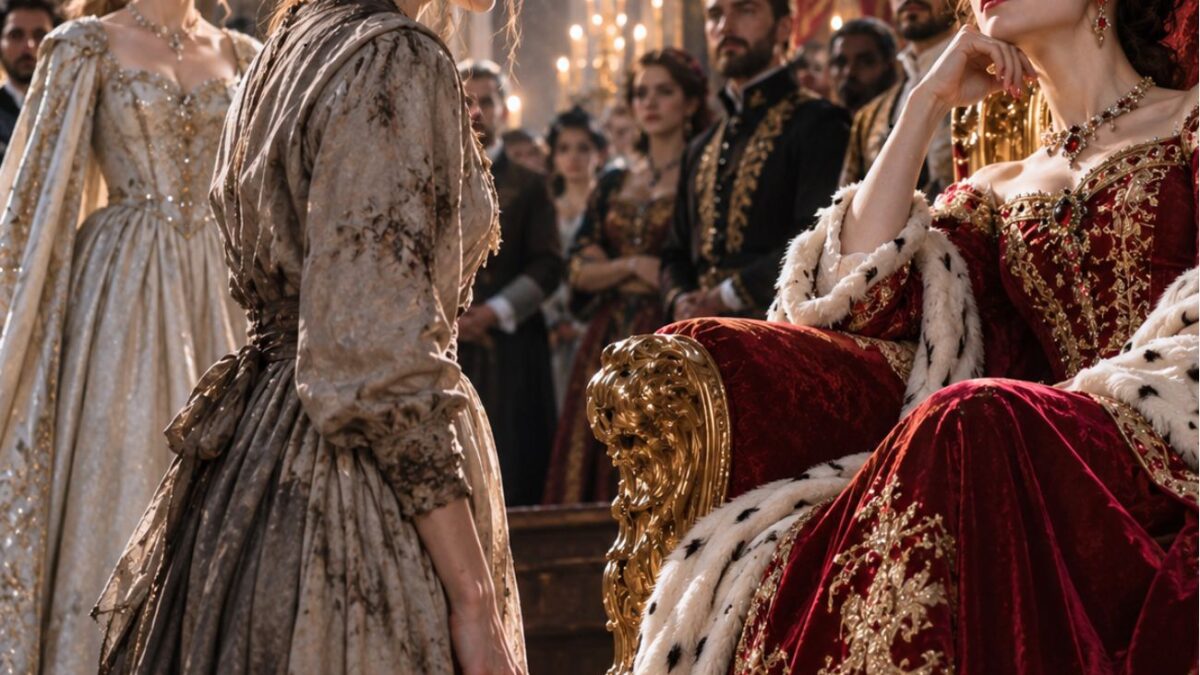
Queen Selene stopped speaking the moment the stranger lifted her veil.
The woman standing at the far end of the throne room was not beautiful.
Not anymore.
Time and a strange illness had changed the face once painted across coins, tapestries, and cathedral windows.
Most of the court did not recognize her.
Selene did.
Immediately.
“Elara.”
The name escaped before she could stop it.
Every noble in the chamber turned toward the throne.
The stranger smiled faintly.
“Interesting.”
Selene’s fingers tightened around the golden armrest.
Princess Elara had once been called the Rose of Valeria.
She was the king’s only acknowledged daughter.
Beloved.
Educated.
Beautiful enough that foreign courts sent painters merely to capture her likeness.
Selene had stood behind her for most of their childhood.
Brushing her hair.
Fastening her gowns.
Watching people praise Elara for qualities Selene had never been given the chance to possess.
Elara trusted her completely.
That made everything easier.
Months before Elara’s coronation, Selene discovered an old cosmetic tincture stored among abandoned royal medicines.
Used in tiny amounts, it caused gradual changes in complexion and features.
Nothing immediate.
Nothing obvious.
Selene began adding traces to Elara’s nightly tonic.
Soon the princess stopped appearing in public.
Court physicians could not explain why her appearance was changing.
Whispers began.
Then Selene quietly gave those whispers a direction.
A curse.
The gods had rejected the heir.
The kingdom, already frightened by poor harvests and political unrest, believed what it feared.
Elara became isolated.
Selene became indispensable.
She answered letters.
Spoke with ministers.
Carried messages between the king and his daughter.
When the king grew gravely ill, Selene controlled nearly everything that reached him.
Then Elara disappeared.
The palace announced that the princess had fled voluntarily.
Selene produced a document naming her temporary regent.
People protested at first.
Then Selene did something no one expected.
She governed well.
She reopened grain stores.
Reduced several hated taxes.
Settled a dispute with the northern provinces without war.
The temporary regent became popular.
The popular regent became permanent.
And after the king died, Selene was crowned queen.
Years passed.
Elara lived far from the capital under another name.
No one believed the quiet woman with altered features when she said she had once been a princess.
Eventually she stopped trying to convince them.
Until she learned Selene intended to found a dynasty.
That changed everything.
Now Elara stood before the woman who had taken her place.
Selene recovered quickly.
She leaned back on the throne.
“This woman is confused.”
Elara almost laughed.
“You recognized me before anyone told you my name.”
A murmur moved through the court.
Selene’s expression tightened.
“We grew up together. Of course I recognize you.”
That answer created an even more dangerous question.
If this really was Elara, why had the kingdom been told she vanished willingly?
Selene stepped down from the throne.
“You abandoned your father.”
“No.”
“You abandoned your people.”
“No.”
“You disappeared.”
Elara looked directly at her.
“I was made to disappear.”
The chamber went silent.
Elara did not demand the crown.
That unsettled Selene more than anger would have.
Instead she asked for one thing.
The king’s private genealogical book.
Selene’s face changed.
Barely.
But Elara saw it.
So did several councilors.
The book was brought from the royal archive.
Selene immediately objected.
“That has nothing to do with her accusation.”
“It has everything to do with you.”
Elara opened it near the final pages.
For years she had wondered why Selene had risked everything for a throne she had no legal right to claim.
The answer had been hidden before either of them was born.
Elara placed one finger beneath a sealed entry written in the late king’s own hand.
Then she looked at the woman wearing her crown.
“You spent your whole life believing my father kept you beside me because your mother was a palace servant.”
Selene went pale.
Elara turned the book so the council could see the royal seal.
“That was only half the truth.”
One elderly minister leaned closer.
His eyes widened.
Selene moved toward the book.
“Elara.”
For the first time, there was fear in her voice.
Elara began reading.
“Selene, daughter of King Aldric and—”
“Stop.”
The command cracked through the throne room.
And every person present turned toward the queen.
Nobody breathed normally after that.
The great chamber seemed suddenly too large and too quiet, the vaulted ceiling swallowing the last vibration of Selene’s voice while pale afternoon light fell through the high windows in long silver bars.
Elara kept one hand on the book.
Her thumb trembled against the edge of the page.
Not from fear.
From the effort of remaining still.
Selene saw it.
For one brief moment, they were not queen and claimant.
They were two girls again.
One sitting before a mirror while the other stood behind her with a silver brush.
Then the moment vanished.
Elara lowered her eyes to the page.
“Amara Vey,” she finished.
Selene closed her eyes.
Only for a second.
But that second told the room more than any denial could have.
Elara continued.
“Former attendant to Queen Helena’s household. Child acknowledged privately by the father and entered into the blood register under royal seal.”
A sound came from somewhere among the nobles.
Not quite a gasp.
Not quite a word.
Selene opened her eyes.
“Enough.”
Elara did not stop.
“Born Selene Amara Aldricsson, daughter of the Crown.”
One of the councilors slowly sat down.
Another crossed himself.
Selene remained standing beneath the throne dais, her face almost colorless.
Elara looked at her.
“You were his daughter.”
Selene’s mouth moved.
Nothing came out.
“You were my sister.”
That word struck harder.
Sister.
Selene flinched as if Elara had slapped her.
“No.”
Elara stared at her.
“It is written in his hand.”
“I said no.”
Selene took another step.
Her skirts whispered across the polished stone.
“My mother was a servant.”
“Yes.”
“He never claimed me.”
“He entered you into the royal blood register.”
“In secret.”
The last two words came out broken.
The court shifted uneasily.
Selene looked around and seemed to realize, perhaps for the first time, that there were hundreds of eyes on her and not one belonged to a person she trusted.
Her breathing changed.
She faced Elara again.
“In secret.”
Elara did not soften the truth.
“Yes.”
Something flickered across Selene’s face.
Pain first.
Then rage rushing in to cover it.
“So what exactly have you come here to prove?” Selene asked. “That the great King Aldric slept with a servant and hid the child? That he allowed that child to polish the shoes of her own sister?”
Elara’s jaw tightened.
“You never polished my shoes.”
“I fastened them.”
“Because you refused to let anyone else do it.”
“I stood behind your chair.”
“You sat beside me when the doors were closed.”
“When the doors were closed.”
Selene’s voice rose.
“There it is.”
She looked toward the council.
“There is your beloved King Aldric. A father in private. A coward in public.”
No one answered.
Even Elara did not.
Because there was truth inside Selene’s bitterness.
And truth did not become false merely because it came from someone guilty.
Elara looked down at the book again.
“There is more.”
Selene froze.
Elara turned one page.
The parchment crackled.
Selene’s eyes followed the movement.
Near the bottom was another royal notation, written several years later.
Elara read it more slowly.
“Upon the coronation of my daughter Elara, Selene is to be acknowledged before the full court as my natural daughter and granted the rank, protection, education, and estate proper to the blood of the Crown.”
Selene stared at her.
The room blurred around her.
Elara could see it in the way her eyes stopped focusing.
“No,” Selene whispered.
The old minister nearest the book leaned over it.
His lips moved silently as he read the line for himself.
Then he turned the page toward two other councilors.
The seal was there.
Unbroken.
The king’s signature beneath it.
Selene shook her head.
“No.”
“He intended to acknowledge you after my coronation,” Elara said.
“Convenient.”
“It was written twelve years before he died.”
“He could have done it at any time.”
“Yes.”
“Then why didn’t he?”
Elara’s voice dropped.
“I don’t know.”
Selene laughed once.
There was no humor in it.
“Of course you don’t.”
Her eyes shone.
“You never had to ask why a door was closed to you.”
Elara absorbed that without looking away.
“No.”
“You never had to wonder why your blood was good enough for private rooms but not for daylight.”
“No.”
“You never had to watch him kiss your forehead while I stood three feet away.”
Elara’s face changed then.
A small movement.
A tightening around the eyes.
“I watched you leave the room every time he did.”
Selene went still.
“I thought you hated affection.”
Selene’s lips parted.
“I thought you hated me touching you. I thought you hated every gown I gave you, every book I asked you to read with me, every time I tried to pull you into a dance when nobody else was there.”
Elara swallowed.
“I never knew why.”
Selene stared at her.
For an instant, something exposed and terribly young appeared beneath the queen’s composure.
Then she buried it.
“You knew enough.”
“No.”
“You had everything.”
“That does not mean I knew everything.”
“You had a father.”
“So did you.”
“He was never mine.”
“He was afraid.”
Selene’s face hardened.
“Do not defend him.”
“I’m not.”
Elara’s voice sharpened.
“I am telling you that what he did to you was wrong.”
The chamber became even quieter.
Selene had not expected that.
Neither had the court.
Elara’s fingers curled around the edge of the genealogical book.
“He should have acknowledged you.”
Selene blinked.
“He should have told me.”
Another breath.
“He should never have allowed you to believe you were less than you were.”
Selene’s chin trembled once.
Elara continued.
“But he did not pour poison into my cup.”
The tenderness vanished from Selene’s face.
There it was.
The line between wound and choice.
Elara stepped around the table.
“You did.”
Selene’s expression became unreadable.
A councilor near the eastern columns whispered something.
Selene snapped her head toward him.
“Silence.”
Elara reached into the worn leather satchel hanging at her side.
Several guards shifted.
Selene noticed.
“Take her.”
No one moved.
Selene stared at the nearest guard.
“I gave an order.”
The captain of the royal guard, a broad-shouldered man with gray at his temples, lowered his eyes for a moment.
Then lifted them.
“Your Majesty, the woman before us has presented a sealed entry of royal blood.”
“She is an impostor.”
“You called her Elara.”
Selene’s breath stopped.
The captain’s voice remained quiet.
“You called her by name before she identified herself.”
Selene looked at him as though she had never seen him before.
“You serve me.”
“I serve the Crown.”
“I am the Crown.”
Nobody moved.
The distinction had suddenly become dangerous.
Elara withdrew a narrow linen-wrapped object from her satchel and placed it on the table.
The cloth was stained with age.
She unfolded it.
Inside lay a small green-glass vial.
Selene’s eyes dropped to it.
That was all.
One glance.
But Elara saw recognition.
“So you remember this too.”
“I remember hundreds of bottles from the old medicine rooms.”
Elara lifted the vial.
“The woman who cared for me after I disappeared found this sewn into the lining of the night case that was sent with me.”
Selene said nothing.
“I didn’t understand why it was there.”
Elara turned the glass between her fingers.
“But I remembered the smell.”
A court physician who had been standing near the rear of the chamber moved forward.
He was old now.
His back slightly bent.
Elara looked at him.
His eyes widened.
“Master Orren.”
The old man’s face collapsed.
“Princess.”
He said it without hesitation.
Several nobles turned sharply.
Orren came closer.
He studied her face.
Then her eyes.
His own filled.
“We failed you.”
Elara’s breath caught.
Orren bowed his head.
“We examined your blood. Your skin. Your food. We changed your soaps, your linens, your chambers. We prayed over you like fools.”
His mouth tightened.
“We never tested the tonic.”
Selene interrupted.
“This proves nothing.”
Orren reached for the bottle, but stopped before touching it.
“May I?”
Elara handed it to him.
He removed the stopper.
Held it beneath his nose.
And immediately recoiled.
His gaze lifted to Selene.
“Belladren tincture.”
The name seemed to move through the room like cold air.
Orren stared at the liquid.
“This preparation was used decades ago in cosmetic treatments. Improper doses cause swelling, discoloration, tissue changes, nerve damage.”
Elara touched the side of her altered face without realizing she was doing it.
Orren saw.
His eyes dropped.
Selene spoke quickly.
“Then anyone could have used it.”
“Yes,” Elara said.
Selene turned on her.
“Anyone.”
“Except only three people had access to my nightly tonic.”
Selene’s pupils widened.
“My physician.”
Elara looked at Orren.
“My chamber attendant.”
Then back at Selene.
“And you.”
Selene laughed.
“You expect them to condemn me because I was near a cup?”
“No.”
Elara reached into the satchel again.
This time she removed a folded sheet of yellowed paper.
“I expect them to listen to the palace medicine ledger.”
Selene stopped moving.
Elara unfolded it.
“Belladren tincture. Removed from abandoned inventory. Two bottles.”
She looked at the signature at the bottom.
“Authorized by Selene Vey, personal attendant to Princess Elara.”
Selene’s nostrils flared.
“That signature could have been copied.”
Orren took the paper.
He studied the notation.
Then the seal beside it.
“No.”
Selene turned toward him.
“You were always weak.”
Orren looked up.
“Perhaps.”
His voice shook.
“But not blind.”
He pointed to a correction at the bottom of the ledger.
“The original apothecary questioned why a cosmetic tincture was being removed from medical storage. The authorization was countersigned.”
He looked toward the council.
“By Selene herself.”
Something shifted inside the room.
Not noise.
Allegiance.
Selene felt it.
Elara saw her feel it.
People who had spent years angling their bodies toward the throne were no longer doing so.
They were looking at Elara.
Selene’s hands curled.
“You think this makes you innocent?”
Elara stared at her.
“I have not been accused.”
“You left them.”
“No.”
“You let the kingdom believe you were dead.”
“I woke in a locked carriage.”
The words cut through the chamber.
Selene went utterly still.
Elara stepped closer.
“My wrists were bound.”
Another step.
“I was sick enough that I could barely lift my head.”
Selene’s breathing became shallow.
“There was a hood over my face.”
Elara’s voice remained controlled, but her fingers shook.
“I remember asking where my father was.”
Silence.
“I remember asking where you were.”
Selene blinked.
Elara looked at her with something worse than hatred.
Grief.
“I thought you would come for me.”
The queen’s face twitched.
“I waited for you.”
“Elara—”
“I defended you.”
Selene stared.
“To the men who took me.”
Elara gave a broken, disbelieving laugh.
“I told them there had been some mistake because Selene would notice I was gone.”
Her eyes filled.
“I told them you knew every dress I owned, every route I walked, every hour I slept. I said you would know.”
Selene took one step back.
“And then one of them laughed.”
Elara’s voice nearly failed.
“He said, ‘She is the reason you are here.’”
Selene looked away.
That was the first time she did.
The throne room disappeared from Elara’s attention.
There was only Selene.
The girl behind the mirror.
The hands in her hair.
The person she had trusted enough to drink anything she placed beside the bed.
Elara’s breathing became uneven.
“For years I wanted that man to have lied.”
Selene’s eyes closed.
“I wanted to believe you had only hated me later.”
A tear slid down Elara’s cheek.
She did not wipe it away.
“I wanted one piece of my childhood to survive you.”
Selene’s face cracked.
Just slightly.
“You don’t understand.”
“Then explain it.”
Selene opened her eyes.
“Explain what?”
“The carriage.”
Selene said nothing.
“The locked house.”
Nothing.
“The false name.”
Nothing.
“My father being told I had run away.”
Selene’s eyes shifted toward the council.
Elara saw it.
“Look at me.”
Selene’s jaw tightened.
“Look at me.”
Slowly, she did.
“Tell me you did not do it.”
A long pause.
Rain began tapping against the tall windows.
Softly at first.
Then harder.
The sound filled every silence Selene refused to fill.
Elara waited.
So did the court.
Selene’s shoulders rose with one breath.
Then another.
Finally she whispered, “I governed better than you ever would have.”
Elara’s face went still.
A councilor inhaled sharply.
Selene heard it.
And something inside her broke loose.
“Yes.”
Her voice rose.
“Yes, I took the tincture.”
Nobody moved.
“Yes, I put it in the tonic.”
Orren lowered his head.
Selene turned toward the nobles.
“You want honesty? Have it.”
She pointed at Elara.
“She was loved for breathing.”
Her voice rang against the stone.
“She entered a room and men stood. She smiled and poets wrote about it. She wore a blue dress and half the capital wore blue the next week.”
Elara did not move.
“I studied everything,” Selene said. “Tax records. Grain shipments. Border treaties. Harvest reports. I listened outside council doors while she was being painted.”
Elara flinched.
Selene’s voice sharpened.
“And when the kingdom began to break, who fixed it?”
Nobody answered.
“I did.”
She struck her own chest with one hand.
“I opened the grain stores.”
“Yes,” Elara said.
“I reduced the taxes.”
“Yes.”
“I prevented a war.”
“Yes.”
Selene stared at her.
Elara’s voice remained steady.
“You did those things.”
The admission seemed to hurt Selene more than denial would have.
Elara stepped closer.
“You were good at ruling.”
Selene’s eyes filled.
“And you still poisoned me.”
The room seemed to contract around them.
“You were good at ruling,” Elara repeated. “And you still had me dragged from my home.”
Selene’s lips trembled.
“You were intelligent.”
Another step.
“And cruel.”
Selene’s face twisted.
“You don’t get to separate those things.”
Elara shook her head.
“You did good things after doing something monstrous. The good things remain good.”
Her voice fell.
“They do not make the monstrous thing disappear.”
Selene stared at her.
For years, she had built her identity around one defense.
That Valeria needed her.
Elara had just taken that defense apart without stealing a single worthy thing from her.
Selene’s knees seemed to weaken.
She caught herself against the edge of the council table.
Then one of the ministers spoke.
“Your Majesty.”
Selene turned.
The elderly minister who had first examined the genealogical entry stood with both hands resting on his cane.
His eyes were wet.
“You told this council the princess abandoned the king.”
Selene said nothing.
“You told us she refused to return.”
Silence.
“You showed us letters.”
Elara’s head turned.
Selene’s face changed.
The minister’s voice trembled.
“Were those letters false?”
Selene looked at him.
He had served her for years.
Defended her during riots.
Stood behind her coronation.
Selene whispered, “Lord Carrow.”
“Were they false?”
She could not answer.
That was enough.
Lord Carrow closed his eyes.
His hand tightened around the cane.
“My son died defending your coronation.”
Selene recoiled.
“He believed rebels were trying to destroy the rightful government.”
Carrow’s breathing broke.
“He died believing Princess Elara had deserted us.”
“I saved this kingdom.”
“My son believed you.”
The words were quiet.
They hit harder than shouting.
Selene’s mouth opened.
Nothing came.
Carrow looked toward the captain of the guard.
“Captain.”
The captain stepped forward.
Selene straightened.
“No.”
The captain stopped.
Selene backed toward the throne.
“No.”
Her hand reached for the golden armrest.
For years that gesture had ended arguments.
Now it looked like a frightened woman clutching furniture.
“You will not touch me.”
The captain’s face was strained.
“Selene.”
Her eyes flashed.
“You address your queen.”
Elara looked at the throne.
Then at Selene.
“No.”
Selene turned.
Elara’s expression held no triumph.
Only exhaustion.
“You were never crowned by truth.”
Selene’s hand tightened around the throne.
“It is mine.”
“You built your right to it on my disappearance.”
“I earned it.”
“You earned respect for what you did as regent.”
Selene stared at her.
“You did not earn me.”
Selene’s breathing fractured.
“You did not earn my face.”
Elara touched her cheek.
“You did not earn my name.”
Her voice shook now.
“You did not earn my father’s last years.”
Selene’s eyes filled.
“And you did not earn the right to turn my suffering into the staircase you climbed.”
The captain approached.
Selene pulled the crown from her head.
For one terrible instant, everyone thought she meant to surrender it.
Instead she raised it as though she might hurl it across the chamber.
Her arm shook.
Gold flashed beneath the torchlight.
Then she stopped.
She looked at the crown in her own hands.
The object she had wanted before she understood why she wanted it.
The proof.
The answer.
The thing that was supposed to make every locked door, every lowered voice, every moment behind Elara’s chair finally mean nothing.
A small sound escaped her.
Almost a laugh.
Almost a sob.
“My father was the king.”
Elara’s face crumpled.
“Yes.”
Selene looked at the throne.
Then the genealogical book.
Then Elara.
“All this time.”
“Yes.”
Selene’s fingers loosened.
The crown fell.
It struck the stone with a hard metallic crack.
One of its red stones broke free.
The jewel rolled across the floor.
No one moved to retrieve it.
Selene watched it stop at Elara’s feet.
The captain reached her.
This time she did not resist when he removed the royal seal from her belt.
But when he touched her arm, she whispered, “Wait.”
He hesitated.
Selene looked at Elara.
There was no queen in her face anymore.
Only the woman who had once brushed Elara’s hair by candlelight.
“Did you ever know?”
Elara understood the question.
“No.”
“Did you ever suspect?”
“No.”
Selene swallowed.
“If you had known I was your sister…”
Her voice failed.
She tried again.
“Would you have wanted me there?”
Elara looked at her for a long time.
Then answered the only way she could.
“You were already there.”
Selene’s eyes closed.
The captain led her away.
No cheering followed.
No applause.
Only footsteps.
The sound of wet boots from guards entering through the rain.
The faint scrape of Selene’s gown over stone.
And the broken jewel lying near Elara’s shoe.
At the doors, Selene stopped.
She did not turn fully.
“Elara.”
Elara lifted her eyes.
Selene’s voice was almost too quiet to hear.
“I am sorry you waited for me.”
Elara’s throat tightened.
Selene lowered her head.
Then she was gone.
The throne room remained silent.
Elara stared at the empty doorway long after it closed.
Lord Carrow approached.
He stopped several feet away.
No one seemed to know how to address her.
Princess.
Queen.
Ghost.
Carrow slowly sank to one knee.
Elara stepped forward immediately.
“Please don’t.”
He looked up.
“My lady—”
“Stand.”
His face tightened.
“I helped crown her.”
“You believed what you were shown.”
“I should have questioned it.”
“So should many people.”
Carrow looked toward the floor.
“My son…”
Elara’s expression softened.
“What was his name?”
The old man’s eyes lifted.
“Thomas.”
Elara nodded.
“Then the royal record will say Thomas Carrow died serving Valeria under false information given by the regent.”
Carrow’s lips trembled.
“He should not be remembered as a fool.”
“He won’t be.”
The old man bowed his head.
Elara touched his shoulder once.
A small human gesture.
Nothing ceremonial.
Carrow covered her hand with his.
For two breaths.
Then released it.
Master Orren came next.
He could barely meet her eyes.
“I should have found the tincture.”
Elara looked at him.
“You tried to save me.”
“I failed.”
“You failed to solve what someone was deliberately hiding.”
His mouth tightened.
“I called your condition divine when medicine failed.”
Elara’s eyes lowered.
“That hurt.”
Orren nodded.
“I know.”
“No.”
She looked at him again.
“You know now.”
He accepted that.
“Yes.”
Elara’s face softened slightly.
“That is enough for today.”
Orren bowed.
The council gathered around the table.
Questions came.
Succession.
Authority.
The seal.
The army.
The provinces.
The court.
Elara listened until the words blurred.
Then Lord Carrow asked the question everyone had been avoiding.
“Will you take the throne?”
Elara looked at the empty chair.
Rainwater streamed down the windows behind it.
For years she had imagined returning.
Sometimes in anger.
Sometimes in dreams.
Sometimes only to walk into the room and force Selene to look at her.
But she had never imagined the throne would look so ordinary.
Wood.
Gold.
Velvet.
A chair beneath too much history.
“I don’t know.”
Several councilors exchanged glances.
Carrow did not press her.
Elara walked toward the dais.
She stopped where Selene had dropped the crown.
The loose red jewel remained on the floor.
Elara bent and picked it up.
It was warm from the torches.
She turned it between her fingers.
“I spent years wanting my face back.”
No one spoke.
“I thought if I could look like myself again, I would become myself again.”
She smiled faintly.
“That never happened.”
Her thumb moved over the jewel.
“Then I wanted my name back.”
She looked around the chamber.
“And now you are all saying it.”
A pause.
“It feels stranger than I expected.”
Carrow’s eyes softened.
Elara looked at the throne.
“But the kingdom cannot spend another season wondering who rules it.”
She climbed the first step.
Then the second.
She did not sit.
“I will accept the Crown.”
A breath moved through the room.
“Not because I believe blood makes me wiser.”
She looked toward the doors through which Selene had been taken.
“I have seen what happens when a person believes pain gives them permission.”
Then toward the council.
“And I have seen what happens when a kingdom confuses beauty, blood, and divine favor with worth.”
Her hand rose to her altered face.
“That ends with me.”
No one applauded.
It did not feel like a moment for applause.
Lord Carrow bowed.
This time Elara allowed it.
The others followed.
Not to the Rose of Valeria.
Not to the face from the old coins.
To the woman standing before them.
Months later, the first new coins appeared in the markets.
People gathered around moneychangers to see them.
Many expected the royal artists to restore Elara’s old face.
To smooth the damaged skin.
Straighten what illness had changed.
Recreate the beautiful princess people remembered.
Elara refused.
The coins bore the face she had now.
For several weeks, the capital talked about little else.
Then the harvest began.
And life, as it always did, found more urgent matters.
Selene stood trial before the High Council.
The evidence was read publicly.
The medicine ledger.
The false letters.
The transport orders.
The payments made to the isolated house where Elara had been kept under another name.
Most damning of all was Selene’s own confession in the throne room, heard by ministers, physicians, guards, ambassadors, and nobles.
She was stripped of the crown permanently.
The regency was declared fraudulent.
Her royal blood was entered into public record exactly as King Aldric had written it.
Elara insisted on that.
Some objected.
“She betrayed the Crown,” Carrow warned.
Elara looked at him.
“She betrayed me.”
Carrow waited.
“I will not answer one lie by creating another.”
So the official record carried both truths.
Selene, daughter of King Aldric.
Selene, convicted of poisoning the heir, falsifying royal documents, unlawful confinement, and seizure of the throne.
Not servant.
Not queen.
Not monster.
Not victim.
All of it.
Human.
And responsible.
She was sentenced to lifelong confinement in a small royal residence beyond the western cliffs, guarded but not hidden.
Elara never visited her.
Not because she hated her.
Because forgiveness, she learned, did not always require reunion.
Sometimes healing meant allowing a closed door to remain closed without spending every night standing outside it.
The palace changed slowly.
Elara removed the old portraits of herself from the private corridors but left the public ones where they were.
History did not need to be repainted merely because it hurt.
She reopened several rooms that had been sealed during her illness.
One evening, near the end of winter, she entered her childhood chamber alone.
Dust floated in the sunset.
The old mirror still stood against the wall.
Elara stopped when she saw it.
For a long time she did not approach.
Then she crossed the room.
Her reflection appeared.
Older.
Changed.
Real.
She touched the wooden table beneath the glass.
A drawer resisted when she pulled it.
She tried again.
It opened with a dry scrape.
Inside were ribbons.
A broken comb.
Three dried flowers.
And a folded scrap of paper in King Aldric’s handwriting.
Elara’s breath caught.
She sat down.
The note was small.
Old.
Written hastily.
She unfolded it.
The first lines concerned household expenses.
Nothing important.
Then, at the bottom, her father had written something else.
A memory.
Elara read it once.
Then again.
Her hand began to shake.
Carrow found her there an hour later.
He stopped in the doorway.
“Your Majesty?”
Elara did not answer.
He came closer.
Her eyes were wet.
She handed him the paper.
Carrow read.
Then looked at her.
“When was this written?”
Elara swallowed.
“I was seven.”
Carrow looked down again.
The king had written:
Elara asked today why Selene must stand behind her chair when the girls share the same lessons, the same books, and nearly every meal. I told her there are matters she is too young to understand. She became angry and dragged another chair beside her own. When I ordered it removed, she cried until supper.
Beneath it, one final sentence.
I fear the child already understands more courage than her father does.
Carrow slowly lowered the note.
Elara covered her mouth.
For years, one question had survived everything.
Had she truly been blind?
Had Selene spent their childhood only serving her while Elara smiled and accepted it?
Had she been part of the humiliation without realizing it?
The note answered nothing about Selene’s pain.
It erased none of Aldric’s cowardice.
It excused nothing that came later.
But it gave Elara back one small piece of herself.
She had seen.
Even as a child.
She had wanted Selene beside her.
Elara laughed through her tears.
A quiet, broken sound.
Carrow glanced at the old mirror.
“What will you do with it?”
Elara looked at the note.
Then folded it carefully.
“Keep it.”
“For the royal archive?”
She shook her head.
“For me.”
Spring reached Valeria slowly that year.
The first flowers appeared along the palace walls beneath patches of melting frost.
Elara ordered no festival for them.
No proclamation.
She simply walked outside one morning without attendants.
Children were playing near the lower fountain.
Two girls were arguing over a wooden hoop.
One noticed Elara.
The child froze.
The other followed her gaze.
Both bowed badly.
Elara smiled.
The smaller girl stared at her face.
Her mother, standing nearby, went pale.
“Forgive her, Your Majesty.”
Elara crouched slightly.
“It’s all right.”
The girl hesitated.
“Did the curse hurt?”
The courtyard became quiet.
Elara thought about the answer.
“There wasn’t a curse.”
The girl frowned.
“Then what happened?”
Elara glanced at the mother.
The woman looked terrified.
Elara returned her attention to the child.
“Someone hurt me.”
The girl considered this.
“And you got better?”
Elara looked toward the palace.
Toward the windows of the room where she had once hidden from mirrors.
Toward the tower where her father had died believing his daughter had abandoned him.
Toward the throne room where Selene had finally let the crown fall from her hands.
Then back at the child.
“I’m getting better.”
The girl smiled as though that were perfectly sufficient.
She held out the wooden hoop.
“Do you want to play?”
Her mother nearly fainted.
Elara laughed.
A real laugh.
The sound surprised even her.
She stood.
“I have council.”
The child looked disappointed.
Elara considered the palace doors.
Then the hoop.
“Five minutes.”
The girl brightened.
It became twenty.
Lord Carrow eventually came looking for her.
He found the Queen of Valeria beneath the first warm light of spring, running badly across the courtyard while two children shouted instructions at her.
He stopped beneath the archway.
He did not interrupt.
Elara’s hair had come loose.
Her breathing was uneven.
Her cheeks were flushed.
She missed the hoop entirely and laughed so hard she had to bend forward with both hands on her knees.
For the first time in many years, nobody watching her was thinking about whether she was beautiful.
Nobody was wondering whether the gods approved of her face.
Nobody was whispering about curses.
She was simply there.
Alive.
When Elara finally straightened, the smaller girl reached for her hand.
Elara looked down.
The child’s fingers slipped easily between hers.
Warm.
Trusting.
Without hesitation.
Elara closed her hand gently around them.
And together they walked beneath the flowering trees, while behind them the old palace windows caught the morning sun and turned, for one quiet moment, entirely to gold.

