The “Chewing Gum Fix” That Saved 42 B-24 Bombers From Crashing — Luftwaffe Never Knew Why
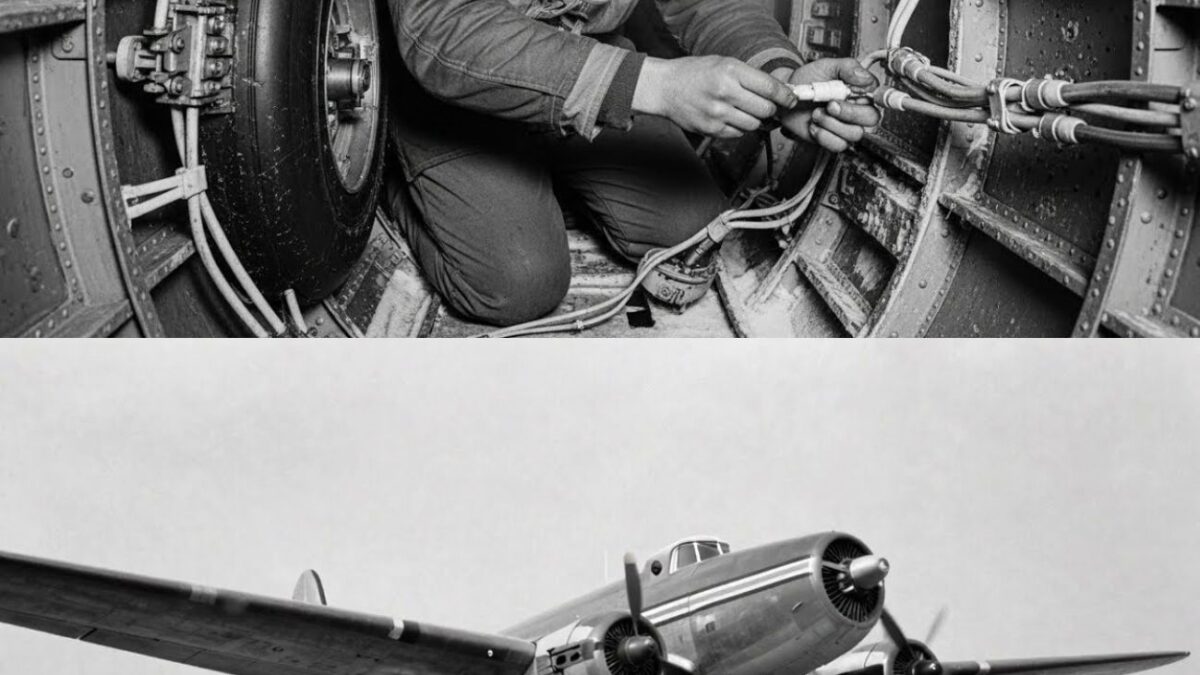
On December 19, 1944, twenty-three thousand feet above the frozen, snow-swept expanse of Eastern Germany, forty-two Consolidated B-24 Liberator heavy bombers droned steadily westward. The slipstream clawing across their olive-drab aluminum skins registered a punishing forty degrees below zero, freezing any trace of exhaled moisture into brittle ice crystals within fractions of a second. Each vibrating airframe carried ten utterly exhausted young men who believed their day’s ordeal was behind them, longing only for the black coffee, steaming mess rations, and dry cots awaiting them across the North Sea.
They had successfully dropped their high-explosive ordnance over synthetic oil refineries near Leipzig, dodging thick blankets of flak that shook their airframes down to every last structural rivet. Now cruising homeward, the men had no inkling that within the next ninety minutes, an issue so quiet and mechanical it bordered on the surreal would threaten their lives. The margin between triumph and oblivion over wartime Europe rarely hinged purely on aerial tactics, but often came down to ordinary men staring down impossible odds with whatever happened to be in their pockets.
Technical Sergeant Robert Chen, serving as flight engineer with the 392nd Bombardment Group, sat stationed behind the pilots, constantly scanning the instrument banks with practiced, bloodshot eyes. At twenty-three years old, Chen had already survived twenty-eight combat sorties over occupied Europe, possessing an intuitive grasp of every hydraulic line, control cable, and circuit breaker. Consolidated Aircraft had crafted the B-24 Liberator for devastating payload and extreme operational range, but certainly not for crew comfort or mechanical forgiveness.
Its narrow Davis wing provided magnificent aerodynamic efficiency, but that high-aspect design rendered the four-engine giant remarkably temperamental in turbulent air, demanding uninterrupted physical effort at the controls. Chen monitored the four Pratt & Whitney R-1830 Twin Wasp radial engines, which churned together to produce forty-eight hundred mechanical horsepower against the thin, biting atmosphere. Each fourteen-cylinder engine was breathing through whining turbosuperchargers that kept them alive where ordinary engines would choke, but it was not the engines that suddenly seized Chen’s undivided attention.
His gaze locked onto the hydraulic pressure panel, where a single needle trembled and began an agonizing, unprompted descent. First Lieutenant James Kosciusko, a third-generation Polish-American from Milwaukee who had spent his youth dusting crops over rolling Wisconsin farmland, noticed the sudden shift in Chen’s posture. Kosciusko flew bombers with the fluid intuition of a natural pilot, sensing the condition of an airplane through subtle vibrations in the control yoke rather than relying solely on instruments.
“What do you have back there, Chen?” Kosciusko asked, his voice crackling through the throat microphone over the steady drone of the slipstream. “Hydraulics are bleeding off on the number three system, Lieutenant,” Chen replied, his knuckle tapping against the glass dial in a futile effort to coax the needle backward. “Started five minutes ago. Operating pressure has slid from three thousand down to twenty-two hundred pounds per square inch, and it’s continuing to bleed.”
The B-24’s hydraulic architecture was not built with fully duplicated systems, but instead relied on isolated circuits assigned to distinct mechanical duties. System Three commanded the main landing gear extension actuators, the very components responsible for lowering tons of steel and vulcanized rubber into place. Without adequate hydraulic line pressure, the heavy landing gear would remain stuck in the wing recesses, leaving the heavy bomber facing the lethal prospect of a high-speed belly landing.
A forty-ton aircraft skidding along a frozen grass strip with volatile fuel vapors sitting in its wing tanks was an invitation to a fatal fireball. “Can you isolate the leak, or crossfeed from the secondary circuit?” Kosciusko asked, mentally running through the aircraft’s emergency flight manual checklists. Chen was already manipulating selector valves on the bulkhead with rapid precision, but the metal linkages fought back with an ominous, unyielding rigidity.
“I’m attempting to route auxiliary pressure from System Two, but the crossover valve is frozen solid in its seat,” Chen reported, his voice tight. “We don’t have a structural rupture, sir. We have ice forming inside the hydraulic lines.” The brutal physics of winter flight at high altitude were catching up with the formation as ambient air chilled the aluminum airframes.
The Liberator was cruising through an environment where ambient moisture, combined with temperatures lower than forty below zero, sought out any contaminant in the aircraft’s arteries. While technical specifications mandated specialized fluid capable of remaining fluid down to minus sixty-five degrees, real-world conditions rarely mirrored the neat parameters of military test laboratories. Rushed turnarounds at English airfields meant fluid barrels often sat exposed to damp morning mogs, absorbing water that went straight into the bomber’s lines.
Inside the lead Liberator of the formation, Captain Harold Zimmerman, riding as group maintenance officer, monitored his own radio set with mounting apprehension. “All aircraft, this is Group Lead,” Zimmerman transmitted across the operational command frequency. “Report hydraulic status on System Three landing gear circuits immediately.”
The replies crackled back in a relentless, sickening cascade as pilot after pilot reported identical drops in hydraulic line pressure. Within ten agonizing minutes, Zimmerman’s navigation log showed that thirty-nine of the forty-two bombers in the formation were experiencing progressive hydraulic failure. The only exceptions were three bombers that had undergone depot-level overhauls earlier that week, their systems filled with virgin fluid stored in climate-controlled hangars.
Zimmerman felt a cold chill settle deep in his gut, far colder than the frigid air seeping around his cockpit canopy. He had led young men through flak barrages that turned the morning sky into a nightmare of shrapnel and high-explosive cordite. He had witnessed Messerschmitts dive out of the sun with cannons blazing, nursing shredded, three-engine bombers back toward England on sheer will.
Yet this enemy was entirely devoid of malice, governed strictly by the immutable laws of fluid dynamics and thermal transfer. The formation was roughly ninety minutes from their home station at Wendling in Norfolk, and the rate of pressure drop promised total failure long before they crossed the coast. Belly landing a single bomber was a hazardous emergency; attempting thirty-nine concurrent belly landings at one airfield was an absolute guarantee of catastrophe.
Emergency response crews across East Anglia would be overwhelmed within minutes, their foam trucks, ambulances, and surgical beds stretched beyond breaking point. Based on historical accident data from previous forced gear-up landings, at least fifteen bombers would likely flip, cartwheel, or rupture their fuel tanks. With an average survival rate of thirty percent in high-speed aircraft fires, Zimmerman was looking at the imminent loss of over one hundred men.
These were airmen who had survived the horrors of Schweinfurt, Ploesti, and Berlin, only to face death on their own runway because of frozen oil. “All aircraft, this is Group Lead,” Zimmerman said, keying his microphone with steady resolve. “We need ideas, and we need them right now. Every crew chief and engineer, look around your stations and tell me how we restore heat to those lines.”
Aboard Zimmerman’s lead Liberator, Master Sergeant Frank Kowalski, a veteran mechanic from the automotive assembly lines of Detroit, was already unfastening the interior inspection panels. Kowalski possessed a lifetime of mechanical experience, understanding that heat transfer was fundamentally a simple matter of surface contact, conductive area, and thermal mass. “The real trouble is physical location,” Kowalski called out over the engine roar to his assistant.
“The primary actuator lines run straight through the unheated wheel wells, right where the minus-forty-degree slipstream hits them continuously,” Kowalski muttered, shining a flashlight into the dark structural recesses. “Even if we had kerosene heaters up here, we couldn’t position them close enough to make a difference without torching the cables.” Second Lieutenant David Rosenbaum, the bombardier, squeezed through the forward bulkhead opening, having monitored the exchange through his headset.
Rosenbaum had completed three years of chemical engineering studies at MIT before the draft interrupted his degree, and his mind naturally analyzed the mechanical problem. “What if we stop trying to heat the entire run of exposed tubing?” Rosenbaum proposed, tapping his pencil against a metal strut. “What if we introduce thermal energy directly into the fluid upstream, before it reaches the frozen junctions?”
Kowalski paused, considering the suggestion. “The hydraulic pumps are engine-driven, mounted directly to the engine accessory cases inside the cowlings. They pick up some engine block heat, but the fluid cools off instantly the moment it enters the long, exposed pipe runs.” “What’s our operating flow rate through that circuit?” Rosenbaum pressed, flipping open his logbook.
“Around six gallons per minute under nominal system pressure,” Kowalski answered without hesitation. “Main trunk lines are three-eighths of an inch, and the distribution branches down to a quarter-inch.” Rosenbaum was already scrawling quick fluid-dynamic calculations across the margins of his navigation log, his pencil lead snapping under the frantic pressure of his hand.
“If we can introduce even a twenty-degree bump in thermal energy right at the pump bodies, that heat will carry down the fluid column,” the bombardier said. “It could prevent the ice from bridging across the narrow restrictor orifices. But what heat source do we have inside a cold airplane?” They rapidly inventoried everything on board: flare guns, silk parachutes, first-aid kits, and emergency ration boxes.
None of those offered a safe, sustained heat source that could be applied to pressurized lines containing flammable mineral-based oil. It was Staff Sergeant Raymond Tucker, the tail gunner who had spent his childhood repairing tractors on an Alabama dirt farm, who broke in over the intercom. “What about our own bodies?” Tucker asked plainly, his southern accent cutting through the drone of the aircraft.
“Our skin is sitting right at ninety-eight point six degrees, isn’t it? What if we get men right up against those pump housings?” The silence on the interphone was absolute as the mechanical truth of the idea sank into the minds of the veteran crew. Kowalski’s eyes widened. “Damn it, that might actually do it. The engine crawlways are cramped and freeze your tail off, but a man can squeeze up in there.”
Zimmerman seized the initiative without a second thought, his voice crackling out over the formation frequency with urgent clarity. “All aircraft, this is Group Lead. Send volunteer crewmen into the wing crawlways to make direct physical contact with the hydraulic pump casings. Use body heat to warm those pumps, and rotate your men every ten minutes to prevent frostbite.”
Across several miles of frigid European sky, young American airmen stripped off bulky sheepskin jackets and wriggled into dark crawlways never meant for humans in flight. They squeezed their torsos past structural bulkheads, pressing their bare forearms and palms against the chilled aluminum surfaces of the hydraulic pumps. They gritted their teeth against the freezing metal, willingly giving their own body heat to the machinery in a desperate attempt to save their planes.
The effort yielded immediate results, as sensor readings showed the pump housings warming slightly, but the brutal cold outside remained overwhelming. The distance from the engines back to the landing gear mechanisms was too great, and the fluid chilled again as it passed through the frozen wheel wells. Chen stared down at the dials on his panel; the pressure drop had slowed, but the needle remained stuck far below operational safety limits.
“The lines are cooling down as fast as we warm the fluid,” Chen reported to Kosciusko, rubbing his numb cheeks. “We need something with real insulation, something we can mold directly around the metal lines in the unheated areas.” Back in the waist position, Sergeant Michael O’Brien was working his jaw vigorously, chewing away on a massive wad of gum.
O’Brien chewed constantly on combat operations, a nervous habit he picked up over the flak-filled skies of northern France to keep his throat from closing with panic. He bought spearmint gum by the box from the base exchange, burning through three or four packs every time his Liberator climbed into combat airspace. Watching the crew chief struggle to wrap loose canvas scraps around a frosty hydraulic tube, O’Brien suddenly became aware of the warm mass in his mouth.
He had been chewing that exact wad for the better part of an hour, keeping it pliable, soft, and heated to his own internal body temperature. Moving on pure impulse, O’Brien reached into his mouth, pulled out the warm lump of gum, and smashed it directly against a frozen line fitting. The sticky mass adhered instantly to the frosted metal, spreading out and molding over the joint like an improvised thermal jacket.
O’Brien hovered his bare hand over the spot and felt the faint heat radiating from the gum, trapped against the frozen tube. “Hey, Chief!” O’Brien shouted over the roar of the waist gun wind. “Look at this! I think I’ve got something that works!” Within two minutes, the waist gunners, radio operator, and flight engineer were emptying their pockets of every stick of gum and ration candy they possessed.
Men chewed with frantic determination, working fresh sticks into warm, cohesive lumps before slapping them onto the cold aluminum tubes. The gum served a dual purpose: its moisture and mass held warmth, while the rubber base created an insulating barrier against the slipstream. Zimmerman immediately recognized the brilliance of the improvisation and keyed his radio to broadcast the technique to the thirty-eight other crippled bombers.
“All aircraft, this is Group Lead,” Zimmerman commanded. “Have every man in your crew chew all available gum and hard candy immediately. Once warm, press it onto the hydraulic lines in the wheel wells and gear actuators. Focus on the main gear extension lines.” In forty-two bombers, four hundred and twenty airmen began chewing with mechanical fury, turning their mouths into improvised thermal factories.
Pilots and copilots kept their formations tight with one hand while unwrapping sticks of spearmint and peppermint with the other, jaws working relentlessly. The cockpits, usually smelling of high-octane aviation fuel, stale sweat, and hydraulic fluid, filled with the pungent scent of wintergreen and peppermint. Men chewed until their jaw muscles burned with exhaustion, passing warm handfuls of gum to crewmen who crawled into the freezing wheel wells.
Technical Sergeant William Jackson, an experienced hydraulic technician riding in one of the middle elements, shouted instructions over his interphone to guide the effort. “Concentrate that gum right around the mechanical actuator bodies!” Jackson yelled, wiping sweat from his forehead despite the bitter cold inside the fuselage. “Those tolerances are microscopic. If ice crystals lock the internal pistons, that gear stays up no matter how much pressure we have.”
Young men peeled off their heavy flight gloves, braving frostbite to mold layer after layer of warm gum around the vital metal connections. They worked in tight rotations, one man chewing frantically to generate fresh thermal material while another pressed it into place along the frosted lines. Slowly, the frantic effort began to show on the flight engineer’s instrument panel back in Kosciusko’s cockpit.
Chen watched the bouncing needle on the System Three gauge shudder, stop its downward slide, and hold firm at eighteen hundred pounds per square inch. It was still dangerously low, but the catastrophic drop had halted; the improvised thermal jackets were preventing the ice from locking the lines entirely. Yet human endurance had its limits, and within twenty minutes, the crews had exhausted their supplies of gum, their mouths dry and jaws aching.
Kosciusko checked the fuel gauges and glanced down at his wrist watch, doing the rough mental arithmetic of speed, distance, and remaining time. “We’re still forty minutes away from the coast, Chen,” the pilot said grimly. “We’ve bought ourselves some time, but we need more temperature if this gear is going to swing down.”
Rosenbaum, who had been studying the atmospheric gradient charts in his navigation case, leaned back through the cockpit passage with an urgent suggestion. “Lieutenant, we need to drop this formation down right now,” the bombardier said, pointing out the frost-covered cockpit side glass. “The lapse rate gives us roughly three and a half degrees of warming for every thousand feet of altitude we shed.”
“If we drop from twenty-three thousand down to ten thousand feet, the ambient temperature outside will jump from forty below up to near freezing,” Rosenbaum explained. “That forty-degree swing, combined with the gum insulation, will melt out those frozen lines.” Zimmerman agreed instantly, weighing the risk of lower altitude against the absolute certainty of disaster if the landing gear failed to extend.
“All aircraft, this is Group Lead,” the radio crackled. “Initiate an immediate formation descent to ten thousand feet. Keep your eyes peeled for stray fighters and watch your wingtips as we hit the lower soup.” The forty-two heavy bombers tipped their noses down together, sliding through the grey cloud decks in a controlled, majestic descent toward warmer air.
As the bombers descended through fifteen thousand feet, condensation began to run down the interior bulkheads as the deep freeze of the high altitude began to break. The outside temperature gauge crept upward, passing through twenty below, then zero, until it settled at two degrees above freezing at ten thousand feet. It was still bitter winter air, but compared to the sub-zero conditions of the stratosphere, it was warm enough to begin thawing the aircraft.
Inside the dark, cramped wheel wells, the thick layers of chewed gum continued to protect the fragile hydraulic lines from the rushing slipstream. Slowly, the heat from the gum and the warmer surrounding air began to break down the ice blockages choking the steel tubing. Chen sat glued to his instrument station, his heart pounding in his chest as he watched the System Three needle begin a slow, hesitant crawl upward.
Two thousand pounds. Twenty-two hundred. Twenty-four hundred. The pressure climbed steadily as the melted ice cleared through the return lines into the reservoirs. Ahead, through breaks in the winter overcast, the gray expanse of the English Channel appeared, marking the boundary between occupied Europe and the safety of home.
The formation crossed the English coastline near Felixstowe, banking northwest toward the familiar expanse of runways at the Wendling airfield. Radio operators were already in contact with the control tower, outlining the situation and requesting full emergency preparations along the active runway. On the ground at Wendling, sirens wailed as fire engines, foam trucks, and ambulances rushed out to take up positions along the concrete.
Medical officers and crash crews prepared for the worst, their grim faces set as the familiar drone of four-engine bombers filled the cold afternoon sky. Kosciusko brought his Liberator into the traffic pattern, hands steady on the control yoke as he trimmed the aircraft for final approach. “Gear extension, Lieutenant,” Chen said, his hand hovering over the hydraulic bypass selector, ready to intervene if the lines failed under load.
Kosciusko pulled the landing gear handle down into the extension detent, holding his breath as the mechanical linkages engaged. For five agonizing seconds, nothing seemed to happen, save for the rush of wind outside the heavy green cockpit glass. Then, a heavy mechanical thud reverberated through the fuselage as the main gear uplocks released, followed by the deep groan of hydraulic fluid moving under pressure.
Down in the dark recesses of the wings, the heavy steel landing struts swung downward through the slipstream, guided by lines coated in spearmint gum. The crew held their breath until three distinct green lights illuminated on the main instrument panel, indicating the gear was down and locked. “Three green lights, Captain!” Chen yelled over the intercom, a broad grin breaking across his soot-streaked face.
Kosciusko let out a long breath, keying his radio. “Wendling Tower, this is Red Three. Gear down and locked. We are coming on home.” One by one, the bombers of the 392nd entered the landing pattern, their hydraulic systems functioning as designed under their makeshift repairs.
All forty-two Liberators touched down safely on the concrete runways of Wendling that gray December afternoon, taxied off the active strip, and cut their engines. When ground crews opened the inspection panels to begin routine maintenance, they stopped in disbelief at the multicolored masses of hardened gum coating the hydraulic lines. The debriefing that evening was unlike any other in the history of the Eighth Air Force, focusing not on bomb hits, but on thermal insulation.
Chief Warrant Officer Stanley Kowaltic led a thorough technical investigation to understand exactly how the improvised fix had kept the bombers in the air. His tests revealed that the gum, warmed to mouth temperature and containing moisture and natural rubbers, had acted as a surprisingly capable insulator. The improvised coating had protected the thin metal lines from the freezing slipstream just long enough for the bombers to descend into warmer air.
Kowaltic’s formal technical report quickly circulated through the commands of the Eighth Air Force, prompting maintenance crews everywhere to add chewing gum to their kits. When Lieutenant General James Doolittle read the report at his headquarters, he immediately commended the 392nd for their initiative and ordered an investigation into depot fuel storage. Technicians discovered that hydraulic fluid drums at forward bases had been improperly stored, allowing winter rain and snow to contaminate the supplies.
New regulations were drafted requiring heated storage facilities, sealed pump systems, and mandatory fluid flushes for all combat aircraft across the theater. These procedural improvements saved countless crews from similar mechanical failures during the remaining months of the war in Europe. For the four hundred and twenty airmen who flew that mission, the memory of that flight remained indelibly etched into their lives.
Technical Sergeant Robert Chen kept a hardened, foil-wrapped stick of spearmint gum in his flight suit pocket for the remainder of his combat tour. After the war, Chen earned an engineering degree and joined the Lockheed Aircraft Corporation, contributing to the development of the C-130 Hercules transport. When his team faced cold-weather hydraulic challenges years later, Chen shared the story of the gum, reminding them that basic ingenuity was as vital as complex mathematics.
Lieutenant Kosciusko returned home to Wisconsin, building a successful agricultural aviation company that operated across the Midwest for decades. In his office, a photograph of his Liberator crew hung proudly, and he occasionally shared the true story of how chewing gum saved their lives. Captain Zimmerman went on to teach at the Air Force Institute of Technology, using the incident to demonstrate the importance of flexible thinking under pressure.
Today, in the preservation facilities of the National Museum of the United States Air Force, rests a small section of vintage hydraulic line. Still clinging to the metal are the faint, fossilized traces of spearmint gum applied on a freezing afternoon over Germany in 1944. It serves as a quiet reminder that even the most complex mechanical marvels of modern warfare can ultimately be saved by simple human resourcefulness.

