The bride left Vizir at the altar because he couldn’t walk… but another woman changed everything…
The dawn over Istanbul broke in deliberate, ceremonial splendor, brushing the waters of the Golden Horn with liquid bronze. From the heights of the Topkapi terraces down to the cobbled alleys of the Grand Bazaar, the city had been swept clean by daybreak. Streets lay cloaked under thick ribbons of crimson rose petals, crushed softly beneath the sandals of arriving emissaries and early guards.
The scent of burning sandalwood incense rose lazily through the humid summer breeze, coiling around arched marble galleries and grand porticos. It blended with the intoxicating, sharp perfume of damask roses and the rich aroma of fresh flatbreads baking in the vast palace kitchens. By midday, the southern breeze had picked up, swaying the heavy bronze lanterns that hung suspended from iron chains along the palace walls.
Their yellow flames cast flickering, warm reflections across the glazed Iznik tiles that adorned the perimeter of the great imperial courtyard. This was not an ordinary morning, nor was it a common celebration whispered among clerks behind closed administrative doors. It was the wedding day of Karim Al-Rashid, Grand Vizier to Sultan Murad and the second most powerful man in the entire Ottoman Empire.
Murmurs rippled across the outer colonnades, running like swift mountain water over smooth river stones as the court assembled. Nobles and foreign ambassadors remarked that Istanbul had not prepared for a union of such immense diplomatic and social weight in twenty years. The bride was Leila Bint Yusuf, daughter of the empire’s supreme silk magnate, renowned as the most captivating jewel of the capital.
Poets compared her eyes to the green depths of the Sea of Marmara, striking and turbulent under the light of noon. Her raven hair was legendary, reported to cascade down to her slender waist like an unspooled bolt of midnight Damascus silk. Yet behind the songs, the congratulations, and the polished veneer of polite court smiles, there lingered an unyielding, bitter shadow.
It was an undeniable reality that hovered over the banquet tables, careful lips refusing to voice what every courtier noted in silence. Karim Al-Rashid, master of imperial finances, chief strategist of the sultanate, and architect of enduring international peace, could not walk. Seven years prior, while riding as supreme general at the battlefront of Mohács, an enemy arrow had pierced his lower spine with terrible precision.
He had survived the searing fever, had crawled back from the brink of the grave, and had risen to become the empire’s greatest mind. His council had salvaged thousands of lives that steel and cavalry could never preserve across the empire’s troubled, shifting frontiers. His intellect was a vast, unerring map of known trade passages, intricate treaties, secret provincial treaties, and multi-layered civic laws.
Yet his legs remained dead beneath his torso, withered and immobile, refusing to obey the fierce commands of his lucid, burning will. In an empire that measured male nobility by physical stature, military prowess, and visible dominance, that missing strength was everything. Karim possessed unmatched titles, ancestral lineage, and the Sultan’s unshakeable ear, but the physical intimidation of a warrior was forever lost.
He had abandoned that vigor on a blood-soaked field alongside a piece of his youth, never to reclaim it again. Now, the grand central courtyard of the palace swelled with dignitaries, magistrates, and courtiers eager to witness his formal triumph. Hundreds of guests in shimmering satin, tailored damask, and gold-fringed kaftans crowded every mosaic archway, craning their necks to watch.
Pasha counselors in heavy wool robes stood shoulder-to-shoulder with wealthy Venetian merchants and royal women enveloped in diaphanous gold-threaded veils. Armored Janissaries lined the balustrades like polished statues, their ceremonial spearheads glinting sharply beneath the bright Anatolian sky. Every guest was upright, expectant, watching the elevated center where a wide, carved wooden platform held a singular golden chair.
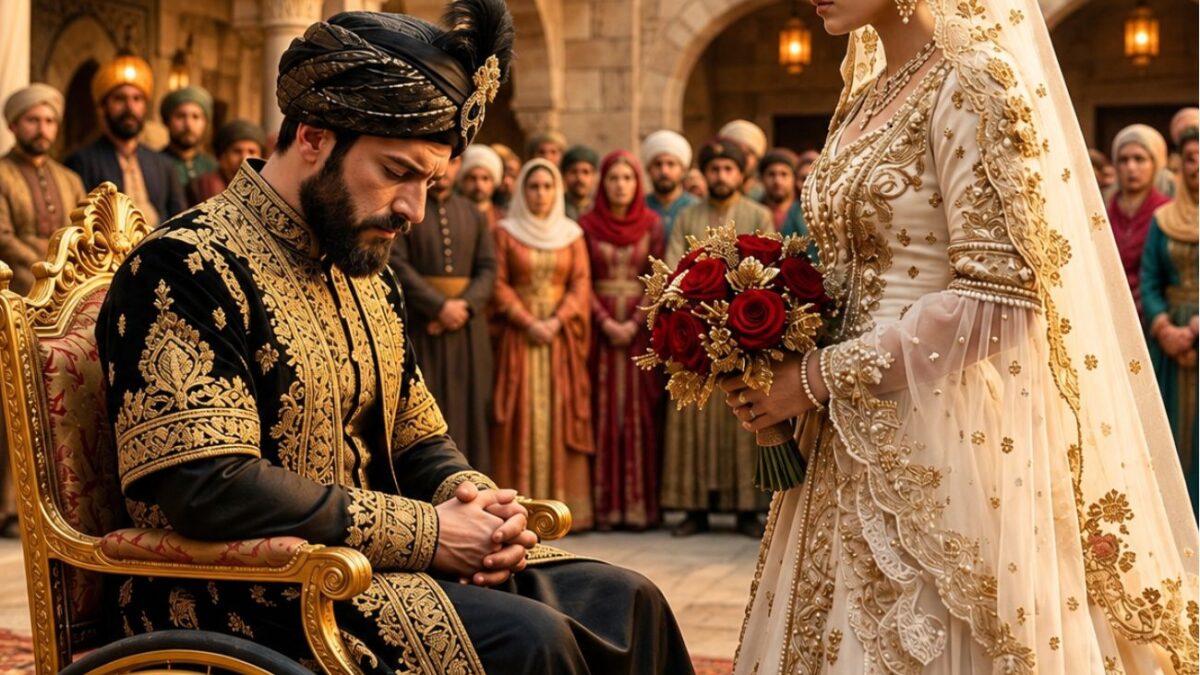
It was not an imperial throne, but a magnificent seat adorned with gilded arabesques and cushioned in deep crimson velvet. There sat Karim Al-Rashid, cloaked in an ink-black silk kaftan stitched with heavy gold embroidery across the lapels and broad shoulders. Upon his head rested a dark turban pinned with an obsidian jewel that cradled the plume of a single, dark imperial osprey feather.
His hands remained calmly clasped over his motionless knees, his chiseled face settled into an expression of stoic, immovable peace. Yet an observer looking closely would have detected the subtle clenching of his jaw and a rigid stiffness in his broad shoulders. It was not the joyous nervousness of a groom awaiting his bride, but the braced, watchful posture of a soldier anticipating an ambush.
Sultan Murad sat nearby beneath the shaded arch of the imperial loggia, resting upon an elevated bench draped in gold lamé. The Sultan’s dark eyes swept the gathering with a sovereign’s measured exhaustion, surrounded by whispering viziers and nervous junior aides. Among the secondary counselors stood Rahim Al-Faruk, a young nobleman whose quick smile and restless gaze were well-known across the Divan.
Rahim was a man whose pleasant countenance concealed an insatiable ambition, constantly shifting his position along the perimeter of influence. The grand imperial imam had already taken his position beside the ceremonial dais, unrolling the sacred marriage parchment with careful solemnity. The opening verses of the Quran had already been recited, lingering over the quieted courtyard like smoke from an unhurried pyre.
All that was required to seal the alliance before heaven and the state was the arrival of the silk merchant’s daughter. A low brass horn sounded from the southern colonnade, and the heavy cedar doors swung backward to reveal the radiant bride. Leila Bint Yusuf glided beneath the high arch, wearing an ivory gown spun from pure Bursa silk and stitched with thousands of seed pearls.
A luminous, flowing veil of gold-spun tulle cascaded behind her, anchored to her crown by a heavy circlet of polished rubies. Her physical beauty was undeniable, seeming to draw the courtyard’s light toward her as she advanced along the rose-scattered stone. Every step she took was measured, accompanied by the gentle chime of jeweled anklets hidden beneath the sweeping hemlines of her skirt.
Yet as she reached the middle of the carpeted aisle, mere paces from Karim’s gilded chair, she stopped with chilling suddenness. It was not a stumble of bridal shyness, nor the hesitation of a modest daughter entering an overwhelming, life-altering commitment. It was an absolute, deliberate, and icy halt, planting her heels firmly into the marble as the festive air froze around her.
Leila turned her chin slowly, deliberately ignoring the man in the chair, and directed her emerald gaze toward Rahim Al-Faruk. The entire courtyard witnessed the alignment of their eyes, though few instantly comprehended the catastrophic treason taking place before them. It was a look that contained an entire secret history: clandestine midnight meetings, calculated arrangements, and an unspoken, long-nurtured disdain.
Leila had never intended to be bound to a man whose legs could not carry him across his own bedchamber. She refused to spend her youth tending to an invalid, regardless of how many provinces knelt before his sharp, strategic mind. In that singular, frozen instant, before the supreme Sultan, the imperial council, and her intended husband, she committed the unthinkable.
She turned her back on the dais, gathered the ivory folds of her heavy skirts, and walked swiftly toward the western palace gates. At the exact same moment, Rahim Al-Faruk slipped through the gaps in the stunned crowd, vanishing like smoke into the adjacent corridors. The silence that dropped over the courtyard was not a tranquil quiet, but a violent, concussive hush that struck every chest present.
It was the breathless second between lightning hitting the earth and the thunder rattling the windows, an unbearable, tearing pause. Nobody moved, nobody shouted for the palace guards, and nobody dared utter a single syllable of judgment or alarm. In the center of the ruin, seated upon his gilded chair amidst wilting flowers and dying incense, Karim Al-Rashid watched the empty archway.
His features did not collapse into weeping, nor did his lips tremble with the humiliation burning through the assembled nobility. He did not shout her name, nor did he grip the arms of his chair in a futile, desperate attempt to rise. He merely stared at the vacant space with the sorrowful, empty gaze of a man who had already known this abandonment was coming.
Somewhere in the quiet recesses of his soul, a place he had refused to inspect during the courtship, he had anticipated this rejection. A noblewoman in the front rank raised her silk veil to muffle a gasp, while an elder pasha quickly turned his head away. Looking upon Karim at that moment felt like a violation, like intruding into a sanctuary where a warrior received a mortal wound.
The imam held the marriage scroll in trembling, paralyzed hands, his eyes darting toward the shaded loggia of the ruler. Sultan Murad remained motionless upon his throne, his jaw locked like granite, his dark eyes narrowing with cold, dangerous fury. The wedding had transformed into an utter catastrophe, the imperial prestige dragged through the dust before the eyes of foreign ambassadors.
Yet before the guards could be ordered to hunt down the runaways, a soft sound of footsteps broke the crushing silence. The figure did not enter through the grand ceremonial arches where dignitaries, ambassadors, and silk-clad nobles had processed that morning. She came from the narrow side passage, the low stone corridor utilized only by the groundskeepers, water carriers, and kitchen drudges.
That humble corridor was the only path Sirin Bint Tariq had walked throughout her six quiet years inside the imperial palace. She was twenty-two years of age, dressed in a simple, faded tunic of undyed linen with a terracotta cotton scarf covering her hair. Her hands were calloused and stained with the rich, damp loam of the palace rose beds she had tended since her adolescence.
Her father, Tariq, was a common farmer who worked the terraced hills beyond the Golden Gate, obtaining this post through an old servant’s debt. Sirin possessed no fine silks, no pearl-encrusted tiaras, and none of the grand vanity that captured the attention of court poets. Yet she possessed remarkable, deep-set eyes that saw the reality of the world rather than the illusions people wore like cloaks.
For years, pruning hedges and cultivating orange trees beneath the colonnades, she had observed the secret machinery of the court. She had seen the false smiles, the bribed eunuchs, the poisoned wine cups, and the treacherous alliances masked as pious courtesy. That very morning, while watering the climbing jasmine, she had observed Leila’s cold eyes seeking Rahim Al-Faruk near the stables.
When Leila turned her back upon the dais, Sirin had already felt a surge of unyielding resolve deep within her spirit. There was no hesitation, no calculation of personal advancement, and no fear of the palace executioner’s swift, curved blade. There was only an ancient, quiet conviction that stepped forward to prevent an honorable man from being trampled in the dirt.
She stepped out into the bright open courtyard, her simple leather slippers making soft, scraping sounds against the marble tiles. A pasha’s wife caught sight of the common peasant girl and gasped, pointing a gem-ringed finger in sheer disbelief. A Janissary officer stepped forward to block her path with the shaft of his spear, but Sirin did not flinch or break stride.
She moved with the calm, focused certainty of someone walking into a burning house to rescue the family heirlooms. She passed through the frozen sea of emeralds, velvets, and gold thread, tracing the very aisle Leila had just desecrated. Without a word, she arrived at the foot of the dais and stopped directly before the great vizier’s gilded chair.
A low murmur arose from the hundreds of onlookers, swelling from a confused whisper into a wave of genuine astonishment. Courtiers leaned against the marble columns, murmuring frantically to their neighbors while trying to comprehend the bizarre spectacle. Who was this girl from the gardens, and how had she crossed the rigid boundaries of protocol that governed their lives?
Sultan Murad leaned forward from his throne, resting his forearms upon his knees as he fixed his sharp gaze upon her. He was a sovereign who had witnessed bloody rebellions, shifting borders, and sudden deaths, yet this audacity caught him entirely unprepared. Karim looked down at her, and for the first time that morning, the rigid mask upon his face showed a visible crack.
It was not anger, nor was it wounded pride, but the profound, disoriented surprise of an intellect confronted with the inexplicable. Sirin looked into his weary, sorrowful eyes, inhaled the scent of crushed petals, and quietly dropped to her knees before him. She did not kneel to the supreme Sultan, nor to the state, nor to the imam; she knelt directly to Karim.
In the strict, hierarchical architecture of the Ottoman court, a peasant did not approach a grand vizier without explicit imperial command. To speak uninvited during a state ceremony was an offense punishable by imprisonment or immediate banishment beyond the walls. Sirin had broken every written and unwritten rule of the court within the span of thirty paces across the marble stones.
The courtyard’s murmur intensified, and the Janissary guard looked toward the Sultan’s loggia, waiting for the execution order. Murad raised a single, ringed finger into the air, an absolute command that silenced the courtyard in an instant. Karim stared down at the young woman kneeling on the flagstones, his voice emerging low, clear, and steady through the quiet.
“Rise,” he commanded gently, his tone devoid of cruelty. “I do not know you, and no one owes me their humility today.” Sirin did not look down at the stone; she raised her head and met his gaze with unshrinking, absolute clarity. In that brief communion of eyes, Karim felt an unfamiliar warmth strike the cold, defensive armor around his wounded heart.
She did not look at him with pity, nor did she see the empty authority of his title or the tragedy of his legs. She looked at the man himself, stripped of gold and status, seeing the lonely soul enduring an ocean of public malice. She stood up slowly, her spine straight, her hands clasped loosely before her worn linen apron in a posture of simple dignity.
“My name is Sirin Bint Tariq,” she announced, her voice ringing clearly against the high marble arches of the colonnade. “I am the daughter of a peasant from the hills, and I have tended the roses of this palace for six years. I possess no wealth, no family lineage to offer, no golden dowry, and no silks to rival the noble ladies here.”
She paused, the light wind tugging gently at the rough terracotta cotton scarf that framed her sun-browned cheeks. “Yet I have eyes that have worked in the shadows of these gardens, watching the great lords come and go through the seasons. And what those six years taught me is the difference between a man who possesses power and a man who possesses honor.”
A shocked ripple ran through the assembly, several counselors shifting uncomfortably beneath the direct truth of her words. Karim did not speak, but his gaze narrowed, listening to her with the total, piercing focus he usually reserved for imperial affairs. “I saw you decline public honors for military victories so that younger, insecure captains could claim the Sultan’s reward,” Sirin continued.
“I saw you study treaties by candlelight through the bitter winter nights while the other viziers feasted in their private estates. I saw you speak to the oldest gardener with the exact same courtesy you offer to the grand ambassadors of Persia. And that, my lord, is a noble virtue that all the treasury’s gold and jewels cannot purchase for a single day.”
She paused again, drawing a deep, steady breath that seemed to pull all the tension of the vast courtyard into her chest. “The woman who ran away did not leave because you cannot walk upon your feet across these marble floors,” she said softly. “She fled because her small, vain heart was entirely blind to the immense greatness of the man seated before her.
Her departure is her eternal ruin, my lord, not yours. The shame belongs to her blindness alone.” The entire courtyard seemed to cease breathing, the courtiers paralyzed by the raw, unpolished truth ringing across the imperial stones. Sultan Murad rose slowly from his throne, his ornate brocade robes whispering softly as he stood at the edge of his dais.
There was no anger in the monarch’s dark eyes; instead, there gleamed a sudden, sharp respect rarely offered to commoners. Sirin turned half-toward the royal loggia, bowing her head with instinctive, unforced reverence toward the supreme ruler of the empire. “My Sultan,” she spoke with clear resolve, “I know my voice has no recognized standing within these gilded walls today.
I know my words may seem like madness, foolishness, or unpardonable insolence to the great council assembled here in state robes. Yet if there is no noblewoman in this city willing to stand beside Grand Vizier Karim Al-Rashid, then I will marry him.” The silence that descended now was unlike the violent hush that had followed the treacherous departure of Leila Bint Yusuf.
That earlier silence had been the horror of sudden fracture, the ugly, hollow shock of a public, calculated betrayal. This silence was the stunned, breathless contemplation of an empire suddenly halted in its tracks by pure, uncalculated courage. A wealthy merchant stood with his mouth slightly ajar, while an elder pasha stared at the girl as if she were an apparition.
Sultan Murad descended the three shallow marble steps of his platform, moving with the measured weight of absolute imperial power. His heavy velvet robes swept the red rose petals as he walked directly toward the girl in the terracotta scarf. He stopped three paces away, studying her sun-darkened skin, her simple clothes, and the fearless, quiet calm within her eyes.
“What did you say your name was, girl?” the Sultan inquired, his voice deep and rumbling like distant thunder over hills. “Sirin Bint Tariq, my Sultan,” she answered steadily, maintaining her gaze without a trace of trembling or servile evasion. “Tariq the orchardist from the western hills?” Murad questioned, his brow furrowing as he retrieved the distant memory of an old petition.
“The very same, my sovereign,” Sirin responded, her hands resting quietly against the rough cotton of her simple apron. The Sultan remained silent for several long moments, the entire court leaning forward to catch the slightest hint of his judgment. “Do you understand what you are asking of this court?” Murad asked, his voice hardening with the gravity of the imperial throne.
“Do you know the burdens of the man who sits in that chair, and the enemies who circle him like hungry wolves? Do you know the sacrifices, the sleepless nights, and the bitter hatred of those whose corrupt schemes his mind destroys daily?” “I do not claim to understand all the empire’s secrets,” Sirin answered with disarming, crystalline simplicity.
“Yet I know that an honest heart can learn whatever duty demands, and I am prepared to learn everything he requires.” Murad turned his gaze toward the golden chair, where Karim sat watching the exchange in profound, unbroken silence. The two men, sovereign and servant, locked eyes across the short space, sharing a bond forged through years of shared peril.
“Karim,” Sultan Murad spoke, his tone softening with genuine warmth. “What does your own heart say to this petition?” Karim Al-Rashid looked upon Sirin, searching her face with the profound analytical depth that had dismantled conspiracies for a decade. He looked for hidden ambition, for fear, for the secret calculations of a peasant hoping to escape a life of hard labor.
He found nothing in her clear, dark eyes except an unyielding well of compassion, sincerity, and fearless, quiet truth. For the first time in seven bitter years, the defensive iron wall around Karim’s soul cracked wide open beneath the summer sun. He inhaled deeply, letting the long, suffocating tension drain from his broad shoulders, and looked up toward his sovereign.
“I accept her offer, my Sultan,” Karim answered, his deep voice carrying clearly to the farthest perimeter of the colonnade. A collective, shuddering sigh escaped the hundreds of assembled courtiers, releasing the breathless tension that had gripped them. A young maidservant standing behind a pillar wiped a tear from her cheek, while an old guard nodded slowly in quiet approval.
Sultan Murad looked at the unlikely pair, and then a rare, genuine smile broke across his stern, weathered countenance. It was not the polite, formal smile he displayed during diplomatic receptions, but the fierce grin of a ruler witnessing true greatness. “Imam,” the Sultan commanded, turning toward the dais with an authoritative sweep of his heavy, gold-trimmed sleeve.
“Step forward and read the sacred verses. This marriage shall be concluded today, before this court and before the Almighty.” The elderly imam hurried forward, his trembling hands now steady as he smoothed the parchment across the small ceremonial table. There were no gold-threaded veils for Sirin, only her simple terracotta cotton scarf, which shone with an honesty no silk could match.
The sacred words were spoken, the formal consent was witnessed, and the seals were pressed into the soft red wax upon the registry. When the final prayer concluded and the union was proclaimed, no brass trumpets blasted, and no court musicians struck their lutes. There was only a holy, reverent hush that settled over the courtyard, sealing a bond born from the ruins of humiliation.
Karim reached out his hand, and Sirin placed her earth-worn, calloused fingers into his warm, broad palm without a moment’s hesitation. “Why did you do this?” Karim whispered quietly, leaning closer so that only she could hear the question over the rose petals. “Truly, Sirin. Why would you chain your youth to a broken man who cannot even walk across his own garden?”
Sirin met his questioning eyes, a faint, gentle smile touching the corners of her lips as she looked down at their joined hands. “Because three years ago, on an autumn afternoon, I watched you stop your chair beside the southern rose bushes,” she whispered. “You sat there alone for an hour, simply watching the wind move through the blossoms, admiring their quiet, fragile beauty.
A man who can still see beauty in a simple flower after enduring such betrayal and war still possesses an intact soul. And a man with a soul like that is the only man I could ever honor as my husband.” Karim looked at her, his voice failing him, for there were no words in any language adequate to answer such grace.
After the stunned guests had dispersed to spread the astonishing news across the markets of Istanbul, Sultan Murad summoned his inner council. The sovereign took his seat upon the Great Divan, waiting until the heavy carved doors were sealed and absolute silence fell. “What took place in that courtyard today was not an act of madness,” Murad proclaimed, his eyes sweeping the assembled pashas.
“It was a demonstration of supreme courage, the likes of which this empire has rarely witnessed across its long history. It was the courage of the spirit, which defends the honor of the realm just as fiercely as any regiment of cavalry. Therefore, by imperial decree, Sirin Bint Tariq is hereby appointed Imperial Counselor for the Welfare of the Palace Families.”
A gasp of astonishment echoed from the back of the council chamber, but the Sultan held up a hand to cut short any objection. “She shall answer only to the Grand Vizier and to myself,” Murad stated with finality, his voice brooking no dispute. “And if any man among you wishes to question her worthiness, he may explain to Karim why courage should be measured by birth or gender.”
The silence that followed was heavy with reverence, marking the dawn of an unprecedented era within the administrative halls of Topkapi. Sirin, standing near the entrance of the Divan, bowed her head with solemn dignity, fully aware of the immense labor ahead. She did not celebrate or boast, understanding that a title granted by imperial favor was a burden that must be justified through toil.
Years passed over the imperial city, carrying away the old scandals and washing the palace corridors in the rhythms of ordinary life. Istanbul remained as it had always been: noisy, magnificent, crowded with spice merchants, sea captains, and scholars from every continent. Yet within the private residence of Grand Vizier Karim Al-Rashid, life had taken on a joyful warmth he had never thought possible.
The quiet, sterile halls that had once felt like an administrative prison were now filled with the sweet sounds of running children. There were small footsteps pattering across the Anatolian carpets, sudden laughter behind heavy oak doors, and the peaceful chaos of family life. Sirin bore three healthy children who grew up knowing the palace not as a den of intrigue, but as a home filled with devotion.
Omar, the eldest son, inherited his mother’s observant, dark eyes and his father’s precise, mathematical intellect for statecraft. He spent his youth moving easily between the grand library of the Divan and the terraced orchards beyond the city walls. Fatima, the daughter, inherited Sirin’s extraordinary moral authority, possessing the rare ability to calm angry ministers with a single word.
Yusuf, the youngest, was born on a golden autumn morning while the scent of damask roses drifted through the open chamber windows. He grew up with the serene, unshakeable confidence of a child who had never seen his parents exchange a single bitter glance. Sirin fulfilled her imperial appointment with brilliant dedication, learning classical Arabic, administrative law, and state history with astonishing speed.
She established sanctuaries for widowed mothers, reformed the palace orphanages, and became an unshakeable shield for the humble workers of Istanbul. The common people did not revere her because she was the Vizier’s wife, but because she remained the gardener who remembered their names. Often, Karim would sit by his office window, watching Sirin walk through the courtyard with a sheaf of petitions under her arm.
He would feel a sudden, profound ache of gratitude in his chest, an emotion so vast that it humbled his powerful mind. It was the gratitude of a traveler who had stumbled through a desolate wasteland only to be given an endless, fertile oasis. One warm summer evening, when the children were asleep and the palace guards had lit the perimeter lanterns, they sat together.
Karim sat in his chair on the flagstones of the private garden, while Sirin sat on a low bench beside him, resting her hands. The damask roses she still tended with her own hands filled the cool night breeze with their rich, familiar fragrance. The stars hung suspended above the dark silhouette of the minarets, turning the Golden Horn into a mirror of liquid silver.
“I committed an injustice against you on the day we wed,” Karim murmured softly, breaking the peaceful silence between them. Sirin turned her face toward him, her dark eyes reflecting the flickering yellow flame of the nearby lantern. “When I accepted your offer before the court,” he explained, his voice thick with emotion, “I believed fate was offering me a consolation.
I thought I was taking whatever was left of life after everything had been torn away from me by war and betrayal. It took me years of watching your grace, your wisdom, and your love to realize the truth of what heaven had done. Fate did not give me what was left, Sirin; it spared me from vanity so that I could receive the greatest treasure of my life.”
Sirin looked at him for a long, quiet moment, her eyes shining with quiet tears that held no sorrow or regret. Without speaking, she leaned her head against his broad shoulder, their fingers intertwining naturally as the night deepened around them. The bronze lanterns swayed gently in the summer breeze, casting their faithful light across the stone paths and the blooming roses.
In the years that followed, when the elders of Istanbul told the tale to their grandchildren, they did not speak of the Vizier’s abandonment. They recounted the legend of the peasant girl with the terracotta scarf who stepped into a courtyard of gold and altered imperial history. They told how true nobility has no lineage, how courage requires no title, and how fate sometimes empties our hands only to fill them with grace.
And Karim Al-Rashid, who had mastered every treaty and law under heaven, understood at last the true meaning of peace. The name of his peace, and the author of his enduring happiness, was Sirin.

