The Billionaire Chose the Poor Girl Over His Billion-Dollar Inheritance
The boardroom of Nwoku Holdings hung in absolute, suffocating silence, smelling faintly of old leather and polished brass. Outside the floor-to-ceiling glass, the skyline of Victoria Island stretched toward the Atlantic, smothered beneath the midday Lagos heat. Between Chika Nwoku and the mahogany table lay three crisp, typed pages capable of undoing three decades of calculated ambition.
“Chika, before you sign anything, I need you to understand exactly what this means,” Mr. Emeka murmured, adjusting his gold spectacles. The senior family attorney kept his fingertips pressed firmly against the edge of the leather folder, as if holding back a catastrophe. His eyes flicked toward the matriarch sitting across the polished expanse, seeking an ally who had already begun to unravel.
“I already understand, Mr. Emeka,” Chika said evenly, his voice barely louder than the low hum of the air conditioner. He sat upright, his custom charcoal jacket unbuttoned, his hand resting beside a heavy fountain pen that looked unusually dark against the paper. His pulse remained steady, though he could hear his mother’s sharp, ragged breathing filling every quiet corner of the expansive room.
“No, sir, I honestly do not think you do,” Mr. Emeka insisted, leaning across the table with genuine urgency. “If you sign this document tonight, you are formally rejecting your claim to the family trust and every asset attached to it.” The lawyer glanced at the heavy brass seal resting nearby, a physical symbol of the empire Chief Nwoku had spent forty years carving out.
“Chika, please just stop for one minute and think about what you are doing,” his mother pleaded, her rings clinking softly against the table. Chief Mrs. Nwoku looked regal even in distress, draped in rich lilac silk, but her composed exterior was cracking under the weight of his resolve. She reached out, her manicured fingers hesitating over his wrist, desperate to pull his hand away from the waiting parchment.
“I have been thinking about it for months, Mom,” Chika replied gently, not pulling away, yet offering no concession in his posture. He had spent countless sleepless nights in his penthouse, watching cargo ships drift into the harbor, wondering when his life had stopped being his own. The question had haunted him through board meetings, shareholder audits, and lavish galas where every smile felt rehearsed and every handshake felt transactional.
“Months?” his father’s voice echoed in his memory, though the empty leather chair at the head of the table spoke the loudest today. “Months, Chika?” his mother repeated, her voice rising with an edge of utter disbelief that cut through the cool, sterile room. “And after thinking about it for months, you have decided to simply throw away everything your father built with his bare hands?”
“I never said I was throwing away what he built, Mom,” Chika countered, maintaining a steady, respectful gaze that gave away nothing. “He built an empire to secure our future, but somewhere along the line, the empire began demanding our souls as collateral.” He looked at the neat legal clauses, the numbers containing too many zeros to feel real, and felt utterly disconnected from all of it.
“Then what exactly are you doing if you are not destroying this family?” she demanded, gesturing wildly toward the towering windows. “I am choosing my life,” Chika answered softly, the words dropping like smooth stones into deep water, undisturbed by the room’s mounting tension. He had said it aloud for the first time, and the strange lightness that followed surprised even him, loosening a knot behind his ribs.
“Your life? This is your life!” she cried out, her palm striking the table with a sharp slap that made the paralegal jump. “Your father’s estate includes controlling shares in multiple conglomerates, prime commercial properties across Nigeria and abroad, massive foreign portfolios, and untouched private assets.” She leaned forward, her eyes bright with tears she refused to shed. “Your inheritance is estimated at several billions, Chika. Billions of naira.”
“Do you have any idea how many people would give anything to sit where you are sitting right now?” Mr. Emeka added quietly. The attorney’s voice was softer now, colored by the weary perspective of an old friend who had watched the young man grow up. He tapped the thick stack of deeds and stock certificates, wondering how any sane man could walk away from such unprecedented power.
“I know,” Chika whispered, looking down at his own polished shoes, remembering how heavy the Nwoku name had felt since he was a boy. “I know how many people would sacrifice their families, their sleep, and their sanity just to sign their name at the bottom of these pages.” He had watched his father do precisely that, working through illnesses, missing dinners, and living in perpetual suspicion until his final, exhausted heartbeat.
“Then why?” his mother asked, her tone softening into an agonizing, broken whisper that stripped away her usual formidable social armor. “Why, my son? You do not always have to solve everything immediately. Sometimes you can just pause. Sometimes you can just breathe.” She looked at him as if searching for the boy who used to play in the sprawling garden of their Ikoyi compound, oblivious to balance sheets.
“Because there is something money cannot give me, Mom,” Chika said, picking up the fountain pen with deliberate, unhurried slowness. The metal barrel felt cool against his skin, heavy with the permanence of the choice he had arrived at after endless internal warfare. He looked up into her bewildered face, wishing she could understand the quiet desperation that had been suffocating him for the past five years.
“And what exactly is that?” she demanded, exasperation returning to mask the vulnerability she could no longer bear to show in front of counsel. “What could possibly be out there that an empire of this magnitude cannot buy for you twice over?” She scanned his face, desperate for an answer that fit into the tidy, predictable framework of the world they occupied.
“Peace,” Chika said simply, the single syllable lingering in the air between them like a fragrance that didn’t belong in a legal office. “Just simple peace.” He rested the nib against the paper, paused for a heartbeat, and allowed his memory to pull him back to the beginning of it all.
“Sir, should I bring anything else for you?” the steward had asked three months earlier, hovering near the mahogany breakfast table. The dining room of the Ikoyi mansion had been cavernous, echoing with the soft clatter of silver against bone china and utter stillness. Sunlight had cut through the heavy damask curtains, illuminating floating motes of dust in the vast, empty space where laughter rarely lived.
“No, thank you, Joseph. You can clear the table,” Chika had replied, barely touching the poached eggs and fresh fruit set before him. His tablet had been glowing beside his plate, flashing unread messages from Singapore and London, demanding decisions he had no heart to make. He had rubbed his temples, already exhausted at seven in the morning, feeling the familiar, grinding weight settling firmly on his shoulders.
“Yes, sir,” the steward murmured, bowing slightly as he gathered the dishes with the practiced, invisible efficiency common to elite domestic staff. Before the kitchen door swung shut, Chika’s phone began to vibrate violently against the glass tabletop, buzzing with unrelenting insistence. The caller ID flashed with his mother’s private line, prompting a long, silent sigh before he finally slid his thumb across the screen.
“Good morning, Mom,” he said, trying to inject an energy into his tone that he did not possess, failing to convince himself. “Chika, I have been calling you since yesterday afternoon!” she began without greeting, her voice brisk with motherly indignation and social momentum. “You barely answer your phone these days. I had to ask your secretary whether you were still in the country or flying to Abuja.”
“I have been busy, Mom. There is a lot going on at the company,” he said, standing up and buttoning his jacket out of reflex. “The expansion into the free trade zone requires daily sign-offs, and the auditors have been camping in the boardroom since Tuesday morning.” He walked toward the foyer where his driver was already waiting beside the armored SUV, engine idling in the cool morning air.
“Business is always going on, Chika! You cannot spend your entire youth hiding inside that office,” she scolded, her tone softening with genuine concern. “Your father and I did not raise you to have all this wealth and still live like an abandoned hermit in this city.” She paused, letting the silence accuse him across the cellular towers before delivering her usual, pointed assessment of his solitary lifestyle.
“I am not alone, Mom,” Chika replied quietly, stepping into the back seat of the vehicle as the driver shut the door behind him. “I have you. I have Dad’s legacy. I have the entire board, hundreds of managers, and dozens of business partners across West Africa.” He leaned his head against the tinted glass, watching the sprawling wrought-iron gates of the family estate swing open to let him pass.
“That is exactly what worries me,” she countered instantly, her words striking him with unexpected accuracy through the speaker of the phone. “Having everything is not the same thing as having someone, my son. An empire will not sit across from you when you are old.” He closed his eyes, hearing the truth in her voice, but having no defense that did not sound hollow, defensive, or childishly evasive.
“I have to go, Mom. I am already running late for the regional directors’ briefing,” he lied smoothly, eager to escape the heavy conversation. “Fine, but do not dare forget the dinner tonight,” she warned, shifting gears immediately into the logistics of their elite social calendar. “What dinner?” he asked, genuine dread creeping into his voice as he stared at his crowded calendar on the glowing screen.
“The charity gala your father’s foundation is hosting at the Aurelia tonight! Do not tell me you have forgotten again, Chika!” “I haven’t forgotten, Mom. I’ll be there,” he promised, though the prospect felt like swimming against a relentless current in lead shoes. “Good. And try to smile tonight, please. You are beginning to look like a man carrying the weight of the entire world on his head.”
The evening gala at the Aurelia Hotel was an exercise in glittering, suffocating excess, filled with Lagos’s wealthiest elite and political powerhouses. Crystal chandeliers hung from vaulted ceilings, casting brilliant white light over designer evening gowns, tailored tuxedos, and endless flutes of vintage champagne. Every conversation felt like a negotiation wrapped in velvet laughter, every compliment a carefully measured deposit into a bank of future favors.
“Good evening, Chika,” voices called out from every corner as he moved through the crowded ballroom, smiling automatically until his face ached. “Ah, Nwoku! Congratulations on the new deep-water logistics project! Welcome to the Aurelia, my friends, enjoy the night!” Men twice his age clapped his back, their eyes sharp with calculation, trying to gauge how much of his father’s legendary ruthlessness he possessed.
“Chika, my man! We need to talk about that Lekki development phase two,” a prominent real estate mogul barked, catching his elbow firmly. “I have been trying to get five minutes with your office for two weeks! Let us finalize the equity split before the quarter closes.” “Send the formal proposal to my office, Senator,” Chika managed, disengaging politely. “I will have my investment team review the risk profile.”
“Ah, that is why you are the man! Always business, always sharp!” the man laughed, turning back toward a tray of fresh caviar. Chika stepped out onto the balcony, looking past the manicured gardens toward the chaotic city beyond the private security gates of the hotel. He felt hollowed out, entirely disconnected from the applause, the champagne, and the wealthy socialites his mother kept steering into his path.
The following afternoon, an overwhelming urge to escape drove him away from his security detail and into the bustling streets of Yaba. He left his phone in the glove compartment of a nondescript sedan, dressed in an ordinary polo shirt and jeans that hid his status completely. The humid air smelled of diesel exhaust, fried plantains, and damp earth, alive with an unfiltered energy he had never experienced up close.
“CMS! Yaba! Enter with your exact change! How much is your fare? Two hundred naira only!” conductors yelled over the roar of yellow buses. People brushed past him without a second glance, rushing to catch transport, laughing with market vendors, carrying goods, and living entirely in the moment. No one bowed. No one smiled to secure an oil contract. No one cared who had fathered him or what his surname represented.
He walked until his throat felt dry, eventually ducking under the canvas awning of a modest roadside cafe tucked between two fabric shops. The space was small, smelling delightfully of freshly brewed local coffee, fried dough, and warm pastries, cooled only by two spinning ceiling fans. A group of university students sat near the door, sharing an order of meat pies and laughing so hard that one nearly choked on his soda.
“Seriously, you need to see this,” one of the students shouted, shoving a phone into his friend’s face while another reached for food. “Wait, let me see that!” the other protested, grinning widely as they wrestled playfully over the cracked screen of an inexpensive device. Chika stood near the counter, watching them with an intense, quiet envy that caught him completely off guard; they seemed so remarkably light.
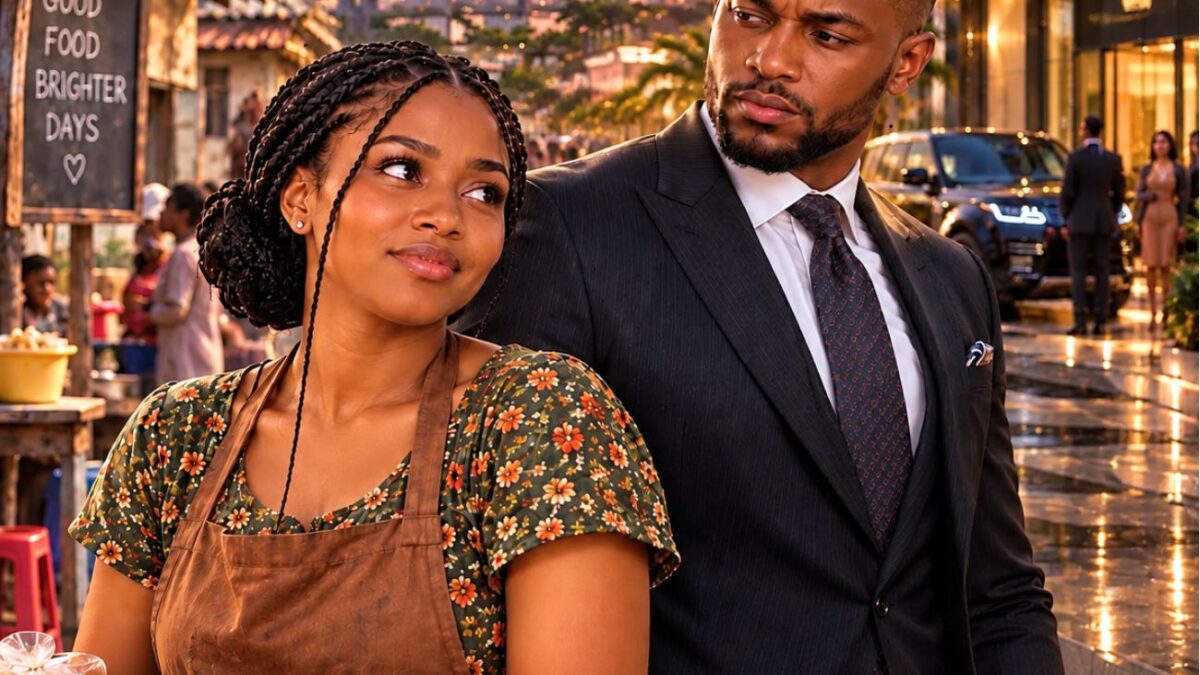
“Good afternoon, sir. What would you like to have today?” a clear, melodic voice asked, snapping him out of his quiet, brooding trance. He turned to find a young woman standing behind the display counter, wearing a simple apron over a faded shirt, her hair tied neatly back. Her face was scrubbed clean of heavy makeup, her dark eyes observant and steady, carrying an easy warmth that felt entirely foreign to him.
“Just black coffee and a meat pie, please,” Chika said, reaching into his pocket for cash and realizing he looked noticeably out of place. He took a seat by the window, staring down at the laminate table, his mind still spinning with quarterly revenue targets and unread shareholder memos. He rubbed his forehead, the phantom headache that had followed him from the boardroom returning with a slow, dull throb behind his temples.
A few minutes later, the ceramic mug clattered gently onto the table, accompanied by a warm pastry resting on a paper napkin. Instead of walking away immediately, the woman lingered, tilting her head slightly as she observed the deep lines etched across his forehead. “Excuse me,” she said softly, her voice cutting cleanly through the ambient chatter of the busy afternoon crowd behind them.
“Yes?” Chika looked up, startled by the directness of her gaze, unaccustomed to people looking at him without deferential caution or covert ambition. “Are you okay?” she asked, her expression free of pretense, asking the question simply because she saw another human being visibly struggling under strain. Chika blinked, momentarily struck dumb by the utter simplicity of the inquiry, his defense mechanisms failing to find an appropriate corporate reply.
“I am fine,” he managed, offering the standard, reflexive shield he handed out to board members and inquisitive cousins alike every single day. “You don’t look fine,” she replied bluntly, crossing her arms over her apron and offering a faint, knowing half-smile that challenged his lie. “You look like somebody who forgot how to breathe about three hours ago and hasn’t noticed yet.”
“You know, most people don’t usually ask strangers that question,” Chika said, leaning back, intrigued despite himself by her total lack of hesitation. “Maybe they should,” she answered without missing a beat, wiping the edge of the adjacent empty table with a clean white cloth. “Maybe the world wouldn’t be quite so angry if people checked in before folks completely lost their minds on the road.”
“Are you always this direct with complete strangers?” he asked, feeling the corner of his own mouth twitch upward in genuine amusement. “No,” she admitted, pausing to look him in the eye with a disarming candor that struck him squarely in the chest. “Only the ones who look like they desperately need somebody to ask.”
Chika let out a short, quiet laugh, the first authentic sound of amusement that had escaped his throat in more weeks than he could count. “I am okay, really. But thank you,” he said, taking a sip of the bitter, piping-hot coffee, feeling it warm his tired chest. He noticed a small spiral notebook resting beside the cash register near her, filled with handwritten lists of suppliers, grain prices, and packaging costs.
“You’re starting a business?” he asked, nodding toward the notebook that sat covered in calculated margins and scribbled contact numbers. She glanced back at the counter, her eyes lighting up with an unmistakable spark of pride that transformed her entire, tired face. “I’m trying to,” she confessed, leaning against the counter edge. “I don’t have much capital, so I’m starting with whatever I have saved up.”
“It’s not much yet, but one day I want to build something solid that belongs entirely to me,” she continued, her voice gaining steady conviction. There was no vanity in her voice, only the raw, beautiful hunger of someone willing to work from dawn until dusk to carve out independence. Chika, who managed billions that were merely handed to him like a family heirloom, felt a sudden, profound respect take root inside him.
“What kind of business are you building?” he asked, setting down his cup, suddenly far more interested in her plans than his own multimillion-dollar contracts. “Food processing,” she answered, her hands gesturing slightly as the vision took shape in her mind. “Packaged local spices and preserved grains.” “I want to start small, learn the supply chains properly, avoid foolish debt, and then slowly scale it up into regional distribution.”
“I know it sounds overly ambitious for someone working an afternoon shift at a cafe,” she added, checking herself with a self-effacing shrug. “But I don’t want to spend my whole life waiting for somebody to come and rescue me from poverty. That’s a fool’s strategy.” Her independence was not an act; it was forged in the reality of living in a city that gave nothing away for free.
“It doesn’t sound overly ambitious at all,” Chika said with utter sincerity, recognizing the true entrepreneurial instinct his father used to speak of with reverence. “It sounds like you already know exactly where you are going. Most men with ten times your resources don’t possess half that clarity.” She looked at him curiously, struck by the gravity in his voice, sensing that his compliment came from an unusual depth of understanding.
“Well, I am still figuring it out,” she said, blushing faintly before nodding toward his plate. “At least eat something, mister.” “You’ve been staring at that meat pie and the wall menu for almost ten minutes without taking a single bite.” “You were watching me?” Chika asked, raising an eyebrow with a playful smirk that felt strangely natural on his face.
“Unfortunately, yes,” she teased back, turning toward the kitchen as the bell above the stove pinged softly. “Breakfast service runs on a schedule.” She disappeared behind the partition, leaving him alone with his lukewarm coffee, a simple pastry, and a mind that suddenly felt surprisingly uncluttered. He ate slowly, listening to the clatter of pots, the rhythmic chopping of onions, and the cheerful banter passing between the kitchen staff and customers.
Why did he feel so profoundly peaceful here, in a noisy, cheap cafe on an ordinary Tuesday afternoon in an overcrowded corner of Yaba? At home, he had vaulted ceilings, Italian marble, private security, a temperature-controlled wine cellar, and manicured lawns that rolled down to the lagoon. He had everything a human being could reasonably desire, yet that modest cafe felt infinitely warmer and more alive than his silent mansion.
Was it the physical space? No, it was the people who inhabited it, moving through life without the poisonous burden of perpetual performance. Or maybe it was because nobody in this room knew who he was, what his bank balance contained, or who his father had conquered. They didn’t care about his surname, they didn’t care about Nwoku Holdings, and they didn’t care what brand of car he drove.
They simply spoke to him as a fellow traveler on the road, offering warmth without demanding equity in return for their attention. “What exactly am I missing?” he whispered to himself, staring out through the glass at the chaotic, beautiful tapestry of ordinary life outside. And why did he feel, with unsettling certainty, that this stranger had seen right through the armor he had worn for thirty-two long years?
Maybe he should pay his bill, get into his car, return to the glass towers of Victoria Island, and forget this strange encounter ever happened. “No,” he muttered under his breath, leaving a crisp note on the table that covered twice the cost of the meal. “I need to understand.” He stepped out into the humid afternoon air, feeling a strange, unfamiliar anticipation fluttering in his chest for the first time in a decade.
The following Friday, Chika returned to the cafe, dressed again in worn denim and a plain t-shirt, blending seamlessly into the working crowd. When the door opened, Amanda looked up from behind the counter, pausing mid-wipe with her cloth, a surprised smile tugging at her lips. “You came back,” she said, her voice carrying a light lilt of teasing recognition as she set down the spray bottle.
“I wanted to understand something,” Chika said, walking directly to the counter, hands tucked into his pockets with genuine, unforced ease. “Understand what?” she asked, leaning forward against the display counter, her eyes bright with curiosity as she looked into his face. “Why I felt so remarkably comfortable sitting in that corner chair yesterday,” he confessed, gesturing toward the small table near the street window.
“Maybe because nobody here is trying to impress anybody,” Amanda suggested, tilting her head as she considered his serious expression with amusement. “Here, people just come, eat what they can afford, talk about their day, laugh about their troubles, and go home to their families.” “Nobody here cares about what car you arrived in, or how much you paid for the cloth on your back. We are all just working.”
“Maybe that is exactly what I have been missing my entire adult life,” he murmured, half to her and half to the ceiling fan spinning above. Amanda studied him for a long moment, sensing the genuine sorrow beneath his quiet demeanor, her expression softening into pure, unvarnished kindness. “Well, if you’re truly looking for a little peace, mister, you are always welcome here,” she said, sliding a fresh cup toward him.
Over the next few weeks, the cafe became Chika’s secret refuge, an oasis of sanity carved out from the relentless demands of his family empire. On a bright Saturday morning, Amanda invited him to walk through the bustling open-air market where she sourced raw spices and dried peppers. “Fresh roasted corn! Buy your hot roasted corn here!” women called out from beside charcoal grills, the sweet, smoky aroma drifting through the humid air.
“Happy weekend, Mama Blessing!” Amanda called out cheerfully, waving to a woman sitting beneath a colorful, patched umbrella piled high with produce. “Same to you, my beautiful daughter!” the older woman shouted back, flashing a wide, toothy grin that crinkled the deep corners of her eyes. “Welcome to my side of Lagos, Chika,” Amanda laughed, guiding him past handcarts. “Don’t mind the noise around here; everybody knows everybody.”
“These are the finest tomatoes in the entire market, young man!” another vendor shouted, thrusting a woven basket of red fruit toward Chika’s chest. “Don’t listen to her, Chika! Those ones are too soft at the bottom!” Amanda warned playfully, nudging the basket away with practiced market expertise. “I can see that,” Chika chuckled, stepping around a puddle. “And apparently, everybody around here also knows everybody else’s private business.”
“Of course they do,” Amanda replied, weaving through the crowded alleyways with absolute confidence, her shoulder brushing his with comfortable familiarity. “Privacy is a luxury only rich people can afford in this town. But when trouble comes, you won’t even have to ask twice for help.” “Neighbors will show up with food, with prayers, and with their own hands before you even realize you are drowning in your sorrow.”
“That is very different from where I come from,” Chika observed quietly, thinking of the high walls, electric fences, and armed security of Ikoyi. “There, everybody has private guards, personal assistants, and private drivers, but somehow people manage to be completely, utterly alone inside those mansions.” Amanda stopped walking, turning to look up at him amidst the swirling current of shoppers, her brown eyes soft with deep, intuitive empathy.
“Maybe that’s why you keep coming all the way down here,” she said gently, voicing the truth he had avoided putting into precise words. “Maybe you’re right,” he admitted softly, pointing toward a vendor sitting beside a wooden pyramid of bright, sun-ripened oranges. “How much for those oranges? I’ll pay for them,” he offered, reaching into his pocket for a wad of notes to speed the transaction.
“Hey! No, no, no! Stop right there,” Amanda scolded, catching his wrist and pushing his money back into his pocket with a firm, scolding tap. “That is not how we do things in an open market, Chika! You have to bargain, or they will swallow your pockets whole!” “Bargain?” Chika blinked, looking utterly lost. “I don’t even know where to begin. My driver usually handles purchases, or I use a company card.”
“Uh-huh! So this is the big man who said he wanted to understand my world,” she teased, crossing her arms with theatrical disappointment. “Okay, vendor, how much for six oranges?” Chika attempted, clearing his throat and trying to sound authoritative in the crowded alley. “Two thousand naira, fine boy,” the woman answered instantly, sensing an easy mark with soft hands and expensive shoes.
“One thousand five hundred,” Chika offered proudly, looking back at Amanda as if he had just executed a masterful corporate takeover bid. Amanda burst out laughing, slapping her forehead in mock despair while the orange seller grinned broadly at his pitiful attempt at negotiation. “Chika, that is not bargaining! You are still paying almost the full price she asked for! You’re just giving away money!”
“Then you do it,” he said, laughing along with her, completely unbothered by his failure. “Clearly, I need intensive remedial training.” “Watch and learn how a professional does it,” she commanded, stepping forward, leaning in, and speaking in rapid, animated pidgin to the vendor. Within two minutes of exaggerated hand gestures, feigned outrage, and shared laughter, Amanda secured ten oranges for twelve hundred naira flat.
“Lesson one,” Amanda announced, handing him the black plastic bag with the triumph of an Olympic medalist standing atop the podium. “Never look like you are ready to pay whatever number comes out of their mouth first. Show a little hesitation, a little drama.” “Noted,” Chika said, peeling one of the fruits with his thumb, juice running over his knuckles. “You are an extremely dangerous teacher.”
Later that evening, after the market stalls had closed, they sat together on low plastic chairs outside her small, rented apartment block. The neighborhood had settled into a gentle, communal rhythm; children kicked an empty plastic bottle across the dusty lane under the streetlamp. Older men sat around a small wooden draughts board, slapping bottle caps down as pieces while women gossiped over trays of roasted groundnuts.
“This is usually how our evenings go around here,” Amanda explained softly, resting her chin in her hands as she watched the neighbors. “Once people finish their daily hustle, everybody comes outside to catch the breeze. Sometimes we just sit down and talk until midnight.” “I honestly cannot remember the last time I sat outside like this without having somewhere urgent to rush to,” Chika admitted, looking at the stars.
“Then maybe you should stop rushing all the time, Chika,” she said, her voice dropping into a quiet, tender cadence that matched the darkness. “For once in your life, let the world wait for you instead of running yourself ragged trying to keep up with its demands.” “Careful, Amanda,” he whispered, turning his head to meet her gaze in the amber glow of the porch light. “I might actually start enjoying a normal life.”
“I think you already are,” she replied with a soft, knowing smile that made his heart beat with an entirely new, terrifying rhythm. He stayed until late, forgetting his appointments, his family’s expectations, and the golden cage that waited for his return on the other side of town.
When Chika finally walked through the towering double doors of the Ikoyi mansion near midnight, the sprawling foyer was ablaze with light. His mother was sitting on the high-backed velvet sofa in the grand parlor, an unread interior design magazine resting open across her lap. She looked up sharply as his footsteps echoed against the imported marble, her eyes narrowing as she took in his relaxed, unburdened posture.
“You are late,” she noted, setting the magazine down with deliberate slowness. “And surprisingly, you are smiling like an innocent schoolboy.” “Must I have a formal board resolution to smile, Mom?” he asked, loosening the collar of his shirt as he approached her. “No,” she said, rising to her feet, circling him with the sharp, predatory intuition that had made her a feared society matron for decades.
“No, but you have been distinctly different lately, Chika. You are spending less time at the head office, you are ignoring non-essential calls.” “And suddenly, for the first time since your father became ill, you actually look happy. It does not fit your regular schedule.” She paused, stepping directly into his path, her eyes searching his face with intense, motherly scrutiny. “Is there someone, Chika?”
“Good night, Mom,” he said simply, kissing her gently on the cheek before turning toward the sweeping staircase that led to his private quarters. Behind him, Chief Mrs. Nwoku remained motionless in the center of the vast, quiet parlor, her expression tightening with protective resolve. The moment she heard his bedroom door click shut on the upper landing, she pulled a small, gold-trimmed smartphone from her designer handbag.
“My son is seeing someone,” she said into the receiver without waiting for an acknowledgment on the other end of the line. “I want to know who she is, where she comes from, and what she wants. Call your people and bring me a full profile by tomorrow.” Within forty-eight hours, the family’s discreet private investigator sat in her private sitting room, laying out a thin, plain manila folder.
“Her name is Amanda Adeleke,” the investigator reported, his voice flat, professional, and devoid of any emotional color or personal judgment. “She is twenty-seven years old, resides in an older, modest flat in Yaba, and has no family wealth, political connections, or influential backing.” “What does she do for a living?” Mrs. Nwoku asked, flipping through photographs of Amanda walking through markets and serving cafe patrons.
“She has been developing a small-scale food packaging concept, sourcing local agricultural goods,” the investigator continued smoothly, pointing to financial summaries. “From everything our inquiries uncovered, she is clean, debt-free, and simply trying to build a legitimate, self-sustaining livelihood through hard work.” “And Chika is happy around her?” the mother asked, staring at a candid photo of her son laughing uncontrollably beside a street-side fruit cart.
“From what our operatives observed, Chief Mrs., yes. Remarkably happy. That is the most unusual aspect of the entire surveillance operation.” Mrs. Nwoku closed the folder with a soft, final snap, her painted lips pursing into a thin line of complicated, aristocratic calculation. “Then arrange it,” she instructed quietly, staring at the closed folder. “I want to meet this girl who makes my son forget his own kingdom.”
The storm broke on a rainy Thursday afternoon when Amanda discovered the truth that Chika had spent weeks desperately keeping hidden behind ordinary clothes. She had been sitting in the cafe during an inventory break when a prominent business daily was left behind on a customer’s table. The front page carried a crisp, full-color photograph of Chika wearing a bespoke navy suit, standing between federal ministers at an oil terminal ribbon-cutting.
The headline blazed in bold, unmistakable print: CHIKA NWOKU ASSUMES INTERIM CHAIR OF NWOKU HOLDINGS FOLLOWING CHIEF’S ESTATE RESTRUCTURING. Amanda had stared at the image for five full minutes, her breath catching in her throat, the humble man she knew suddenly dissolving into a national figurehead. When Chika arrived that evening, rushing in to escape the downpour, he found her sitting alone at the back table, the newspaper spread open between them.
“Amanda, I have been calling your phone for three hours,” he began, shaking water from his jacket, his smile faltering as he saw her face. “I know,” she said quietly, her voice entirely flat, stripped of the playful warmth that usually greeted him whenever he pushed through the door. “Then what is wrong? You didn’t reply to my messages, and the staff said you refused to speak to anyone all afternoon.”
“You told me you worked with a family business,” she said, tapping the printed photograph with a trembling finger, her eyes wide with hurt. “You didn’t tell me that your family literally owns one of the largest corporate conglomerates on the entire West African coast.” “You didn’t tell me you are that Chika Nwoku, the heir to billions of dollars, private jets, and political dynasties in this country.”
“I didn’t lie about what truly matters, Amanda,” Chika pleaded, stepping closer, reaching across the table to try and take her cold hand. “I just… I didn’t tell you everything right away. I wanted you to see me first, before you saw the circus that surrounds my family.” “Chika, leaving out ninety percent of who you are isn’t protecting me; that is hiding something fundamental,” she said, pulling her hands back into her lap.
“I knew what would happen if you found out on day one!” he argued, his voice rising with desperate, raw honesty that surprised them both. “Everything would have changed! The way you spoke to me, the way you laughed, the way you looked at me, even allowing me to sit beside you!” “You would have seen a balance sheet, not a man! You would have treated me like everyone else does, with careful, calculating politeness!”
“You don’t know me nearly well enough to make that judgment for me!” she fired back, tears of frustration shining in the corners of her dark eyes. “Maybe I would have treated you exactly the same! Maybe I would have been cautious, but that should have been my choice to make, not your secret to keep!” “You took away my ability to decide how to approach you because you assumed I would turn into another greedy hanger-on hunting for a handout!”
“You’re right,” Chika whispered, hanging his head as the brutal accuracy of her words tore through his defenses, leaving him completely exposed. “I was terrified, Amanda. I was a coward, and I was deeply afraid.” “Afraid of what?” she demanded, wiping a rogue tear from her cheek with the back of her wrist. “That I would start asking you for business capital?”
“No,” Chika said, looking up, his voice cracking with a vulnerability he had never shown to a living soul, not even his own parents. “I was afraid you would stop seeing me as just Chika. I was afraid the only authentic thing in my entire life would vanish the moment the truth came out.” Amanda looked at him, seeing the profound, desperate loneliness behind his wealth, but her pride and sense of self-worth remained stubbornly unyielding.
“Then you should have trusted me enough to tell me yourself,” she said, rising from the table, gathering her worn canvas tote bag. “I need some time alone to think about all of this, Chika. Please do not follow me home tonight.” “I understand,” he murmured, standing helplessly as she moved toward the exit, looking smaller than usual beneath the dim cafe lights.
At the doorway, she stopped, turning back to deliver a final, quiet truth that resonated deep within the walls of his troubled conscience. “If you really want me to know you, Chika, don’t ever hand me an edited version of yourself. I deserve the whole truth, or nothing at all.”
The stress of the revelation, combined with weeks of skipping meals to pour every kobo into her packaging business, took a catastrophic toll on Amanda. Two days after their argument, she stood in her small kitchen, packing samples of ground ginger into clear pouches, her head spinning with intense vertigo. Her phone rang from the counter—her mother calling from the village—and she fumbled to swipe the screen, leaning heavily against the sink.
“Hello, Mommy,” Amanda managed, trying to keep the breathless exhaustion out of her voice as black spots danced across her field of vision. “Amanda, my child, have you eaten today?” her mother asked instantly, that supernatural maternal radar detecting weakness across hundreds of miles. “Yes, Mommy, don’t worry about me. I had rice an hour ago,” Amanda lied weakly, gripping the edge of the laminate counter until her knuckles turned white.
“You always say that, but your health is your only real capital, my daughter,” her mother insisted, her voice crackling over the rural network connection. “That packaging business you are running can wait if your body is begging for rest. Do not kill yourself trying to build Rome in a single afternoon.” “I know, Mommy. I’ll rest properly tonight, I promise,” Amanda whispered, her knees suddenly trembling, the room tilting violently on an unseen axis.
The phone slipped from her fingers, clattering onto the linoleum floor as the sounds of the neighborhood dissolved into a high-pitched, ringing hum. “Everything is blurring,” she gasped out loud to the empty room, reaching for the wall, but her hands found only thin air as darkness rushed in. She collapsed hard against the floor, knocking over a display stand of dried spices, lying motionless as the rain began to patter against the windowpane.
A neighbor delivering laundry found her ten minutes later, crying out in terror: “Somebody help her! Please, call a car! Call an ambulance!” When Chika received the frantic phone call from the cafe owner who had been contacted by the neighbors, his driver broke every traffic law in Lagos. He arrived at the private clinic in Surulere with his shirt half-unbuttoned, his security detail struggling to keep pace as he stormed the ward.
“What happened to her? Where is she?” Chika demanded, cornering the attending physician in the sterile, brightly lit corridor outside the emergency unit. “Mr. Nwoku, please calm down,” the doctor said, recognizing him immediately from the national news, his tone instantly professional and measured. “She came in unconscious, extremely dehydrated, and severely fatigued. But some of her preliminary blood panels are deeply concerning to our medical team.”
“Concerning how? What are you talking about?” Chika pressed, his heart pounding against his ribs with a ferocity that made him dizzy with dread. “Has she ever disclosed an existing chronic condition to you? Kidney issues, perhaps?” the physician asked, looking over a clip-board of lab values. “No, she never mentioned anything like that. She just said she was tired from working long hours,” Chika answered, his breath catching painfully.
“Then she requires immediate, specialized nephrology testing,” the doctor stated gravely, looking him directly in the eyes. “These markers indicate that her kidneys are functioning at a dangerously reduced capacity. We must halt the progression before acute failure sets in.” “Her kidneys…” Chika repeated, the words feeling heavy and foreign, a cold wave of pure terror washing over his entire consciousness.
“We cannot make a definitive prognosis without comprehensive scans, but you cannot afford to ignore this,” the doctor warned, tapping the file. “She needs admission, immediate stabilization, and a dedicated specialist monitoring her around the clock. The costs will escalate rapidly.” “Spare nothing,” Chika ordered without a single second of hesitation. “I don’t care what it costs, bring in the finest specialists in the country.”
When he entered the small private room an hour later, Amanda was awake, propped up against thin pillows, an IV drip running clear fluids into her arm. Her face was pale, dark circles bruising the skin beneath her eyes, but her gaze remained as sharp and unyielding as ever when she saw him enter. “Why are you here, Chika?” she whispered, her voice rough, turning her head slightly toward the drawn window blinds.
“Because you collapsed, Amanda,” he said softly, pulling a plastic chair close to the edge of the high hospital bed and sitting down. “What on earth did you expect me to do when I heard? Sit in an office and pretend the only person who matters to me isn’t lying in a clinic?” “I didn’t want you to worry about me,” she murmured, looking down at the clear tubing taped securely to the back of her bruised hand.
“You have been having dizzy spells for weeks,” he said, his voice trembling with a mixture of immense relief and profound, simmering frustration. “You’ve been secretly taking medication, skipping meals, working sixteen-hour days, and now you collapsed on your kitchen floor.” “How long have you been dealing with this, Amanda? Please, stop protecting my feelings and don’t hide this from me anymore.”
“I didn’t want my medical problems to become your financial responsibility, Chika,” she answered, a tear finally escaping and tracing her cheek. “You are not a financial problem, Amanda! You are a human being, and I love you!” he burst out, the admission slipping out raw, unpolished, and completely true. The room fell dead silent, the rhythmic beep of the cardiac monitor the only sound bridging the vast, emotional chasm between their two different worlds.
“I have been managing it for nearly two years,” she finally confessed, her voice barely audible over the hum of the air conditioner in the wall. “Managing what, Amanda? Tell me the truth.” “My kidneys haven’t been functioning properly since a bad infection two years ago. The doctors in the public hospital told me it would slowly decline without care.”
The specialist arrived twenty minutes later, confirming what Amanda had carried alone as a crushing secret beneath her cheerful market banter. “Miss Adeleke, your filtration rates have dropped significantly,” the nephrologist explained, pulling up digital scans on a portable tablet screen. “It is serious, but it is not a death sentence if managed aggressively with specialized drug protocols, strict dietary changes, and regular clinical monitoring.”
“Doctor, what is the estimated cost for this entire phase of intervention?” Amanda asked immediately, her practical mind fighting through her exhaustion. “The initial stabilization, imported medications, and specialized therapies will run around two million naira for the first six months,” the doctor replied. Amanda closed her eyes, the sum completely insurmountable for an independent girl who counted profits in five-hundred-naira increments every weekend.
“We will handle everything immediately,” Chika said without missing a beat, pulling out a black titanium credit card to settle the admission deposit. “No, Chika! Absolutely not,” Amanda interjected forcefully, attempting to push herself upright despite the sharp pull of the IV line in her arm. “Why not, Amanda? This is your life we are talking about! This isn’t a business negotiation or a pride contest!” he cried, exasperated.
“Because I refuse to let your money become the foundation of our relationship!” she argued, her chest heaving with fierce, indomitable dignity. “Today you pay my medical bills because you care about me. Tomorrow, when we disagree, I will feel like an indebted servant who owes you her life!” “I will never be able to look you in the eye as an equal if I become a charity case that you bought back from the brink of organ failure!”
“You will never owe me anything, Amanda!” Chika insisted, leaning over the bed rail, taking her cold, trembling face between his warm hands. “I am not doing this because you are poor, and I am not doing this to buy your affection or control your choices!” “I am doing this because you are Amanda. Because you saw me when I was completely invisible, and I cannot live in a world where you are not here.”
“You don’t even know how bad this could become,” she whispered, her resolve beginning to crack beneath the sheer, overwhelming sincerity in his eyes. “What happens if the treatments fail? What happens when your high-society family finds out you are spending fortunes on a sick girl from Yaba?” “Then we will find out together,” Chika answered, his forehead resting gently against hers, letting his tears mingle with the dampness on her cheeks.
“Why would my family have any say over who I choose to care for?” he added, his voice steadying into an unbreakable iron resolve. “Because you are not just Chika,” she murmured against his neck. “You are Chika Nwoku. Everything you do belongs to a dynasty.” “Then let them know exactly who I am,” he declared fiercely. “Let them strip away every title, but do not use your sickness to push me away from you.”
A week after Amanda was discharged and resting comfortably in a quiet, fully staffed serviced apartment he had secured, the family summons arrived. The executive boardroom of Nwoku Holdings was prepared for a solemn assembly; the primary trustees, senior partners, and his mother sat around the table. Thick folders bound in dark blue leather rested before each seat, carrying the final execution stamps of the probate registry and the federal high court.
“Chief Nwoku’s estate has now formally entered the final stage of executive distribution,” Mr. Emeka announced, clearing his throat with ceremonial weight. “The primary holding shares, international investment trusts, land registries, and controlling seats will now pass according to the founder’s explicit directives.” Chika sat at the foot of the table, listening calmly, having spent the last seven days watching Amanda regain her color, completely detached from this grandeur.
“So, I am assuming direct control of the conglomerate, as outlined in the general succession charter?” Chika asked, keeping his tone carefully neutral. “Eventually, yes, Chika,” Mr. Emeka replied, looking over his spectacles with visible discomfort. “However, there are specific conditions precedent.” “What kind of conditions?” Chika’s eyes narrowed, sensing the familiar, controlling hand of his deceased father reaching out from the grave.
“Your father believed that steering a business empire of this magnitude requires more than sharp intellect and executive competence,” his mother spoke up. Her voice was measured, carrying the rehearsed authority of a woman who had helped construct the very clauses now being introduced into the room. “He wanted the individual leading Nwoku Holdings to anchor the family’s social continuity and preserve our established aristocratic structure for generations.”
“Mom, what exactly are both of you trying to say without using corporate euphemisms?” Chika demanded, leaning forward against the mahogany. “The controlling shares are not unconditional, Chika,” Mr. Emeka stated plainly, turning to section fourteen of the primary trust deed. “The charter mandates that you establish an approved, recognized family succession structure before the ultimate executive voting rights are released to you.”
“You mean marriage,” Chika said flatly, the cold absurdity of the clause washing over him like ice water from a fractured glass. “Your father did not phrase it quite so crudely in the legal text,” Mr. Emeka countered gently. “He used the term ‘social stability and recognized continuity.'” “But practically speaking, yes. An approved union with a family of commensurate social and economic standing is a prerequisite for executive control.”
“So, after thirty-two years of dedication, after expanding our revenue by forty percent, after sacrificing my youth for this firm, this is the verdict?” Chika laughed bitterly, shaking his head as he looked around the circle of elderly men who had watched him labor over balance sheets for years. “I am being told that I must take an approved wife like an 18th-century monarch before I am permitted to manage what my father left behind?”
“I am merely interpreting the governing trust documents, sir,” Mr. Emeka said softly, setting his gold fountain pen down on the blue leather folder. “Your father was not trying to punish you, Chika,” his mother insisted, her hand reaching across the space between them in an urgent appeal for reason. “He spent forty brutal years building an empire, and he wanted to guarantee that the family name would remain impenetrable long after we are all dust.”
“I understand perfectly what he wanted, Mom,” Chika replied, his voice deadly quiet as he stared at the corporate seal of Nwoku Holdings. “The real tragedy is that he spent his entire life building a fortress, but he never stopped to ask whether anyone inside actually wanted to live in it.” He stood up from the executive chair, leaving the legal files untouched on the table, walking out of the boardroom without requesting an adjournment.
That evening, the confrontation moved from the sterile boardroom to the cavernous, quiet dining hall of the family mansion in Ikoyi. A feast of peppered lamb, fresh seafood, and jollof rice sat cooling between them, completely untouched by both mother and son as the clock ticked. “You haven’t eaten a single bite, Chika,” his mother said, her voice strained with an exhaustion that mirrored his own internal weariness.
“I am not hungry, Mom,” he replied, staring out into the manicured courtyard where armed private guards stood watch under the floodlights. “This is not about the food, and you know it,” she countered, pushing her plate away with a sharp clatter that broke the oppressive silence. “Your father spent decades sweating blood for this company. He did not leave you a modest trading shop; he left you a continental empire with thousands of workers!”
“I know the precise valuation of what I am inheriting, Mom,” Chika answered, turning his gaze back to her tired, aristocratic face. “Then you must also realize the monumental stupidity of what you are risking over foolish pride!” she yelled, losing her customary social restraint. “I am not risking anything yet, Mother. I am simply deciding what my life is worth,” he stated with chilling, immovable clarity.
“Your father wanted you settled, Chika! He wanted a suitable woman standing beside you who understands the heavy responsibilities of this family!” “Settled?” Chika mocked, his voice rising with passionate disgust. “I have spent years being introduced to women who wanted my surname, Mother!” “Women who lusted after the diplomatic passports, the private jets, the society weddings, and the lifestyle of being the celebrated Mrs. Nwoku!”
“I have met dozens of women who knew down to the last penny what my inheritance could buy them in London, Paris, and Dubai!” He leaned across the dining table, his eyes blazing with an authentic fire she had never witnessed in him before. “But in thirty-two years, I never met a single human being who made me feel like I could actually breathe until I walked into that cafe!”
Mrs. Nwoku closed her eyes, a deep, shuddering sigh escaping her lips as the reality of the situation settled permanently between them. “It is that girl, then,” she whispered, opening her eyes to look at him with a mixture of fear and profound sorrow. “Amanda.” “Yes,” Chika said without a trace of hesitation. “Amanda.”
“What does her family do, Chika? Who are her people in this country?” the mother asked, making one final, desperate appeal to tradition. “She comes from an ordinary, hardworking family from the east,” Chika replied softly. “No oil blocs, no chieftaincy titles, and no foreign bank accounts.” “And you are truly serious about this girl? Serious enough to shatter everything your father prepared for your future?”
“I don’t know where the road will lead with her, Mom,” he admitted, his voice softening into raw, unfiltered honesty. “I don’t know what tomorrow looks like, but I know with complete certainty how I feel when I am sitting beside her in an ordinary room.” “For the first time in my entire existence, I feel like a human being instead of an executive asset belonging to an institutional trust.”
“Then understand this with absolute clarity, Chika,” his mother warned, her voice dropping into a solemn, prophetic cadence that chilled the room. “Your father’s legal trust does not possess a heart, and it does not care about your personal feelings or romantic ideals.” “You will be forced to choose, my son. Choose between the life your father built for you, or the life you are trying to invent for yourself.”
The following morning, Chika found Amanda sitting on the small balcony of the serviced apartment, her sketchbook resting open across her knees. She had regained her strength, her skin glowing with renewed vitality, but the newspaper clipping still lay beside her tea mug on the iron table. “Amanda, I called you three times from the car,” he said, stepping onto the terrace, the morning sun warming the concrete balustrade between them.
“I know,” she answered softly, not looking up from her sketches of packaging labels. “I heard the phone ringing inside.” “Then why didn’t you pick up? Are you feeling dizzy again? Did the doctor adjust the dosage?” he asked, panic instantly creeping into his voice. “I am completely fine physically, Chika,” she said, finally turning to face him, her dark eyes carrying an ancient, sorrowful understanding. “I didn’t answer because I needed to think about us. About your family. About that monstrous inheritance waiting for your signature.”
Chika froze, his brow furrowing in confusion. “Who told you about the inheritance terms? Did my mother send someone to speak with you?” “Nobody had to send anyone, Chika,” she replied with a weary, knowing half-smile. “I have eyes, and I have learned how to read you.” “You walk in here carrying the weight of a ten-story building on your neck. Your family built an empire, and now they are putting a price on your freedom.”
“Amanda, please do not try to make this decision for me,” he pleaded, dropping into the chair beside her, reaching out to grasp her hand. “I am not making any decision for you, Chika!” she said, her voice cracking with fierce, protective emotion as she held his fingers tightly. “I am asking you to wake up and truly consider what you are about to throw away into the ocean because of a romantic feeling!”
“I am not throwing anything away because of you!” he argued, his chest tightening with desperate conviction. “Maybe you are too blind to see it right now, Chika, but your real life is over there in those corporate boardrooms!” she cried out. “Your father’s monumental legacy, your family’s honorable name, thousands of innocent employees whose daily bread depends on that business!” “And you want to walk away from all of that power and history just to sit on a plastic chair in Yaba and watch me dry pepper?”
“That is exactly why I am choosing this!” he shouted, standing up and pacing the small balcony like a caged animal seeking an exit. “Because over there, I am nothing more than a custodian of dead money! Here, with you, I am finally a living, breathing man!” “Amanda, I don’t care about the billions! Let them take every single share, let them give it to the trustees, let them burn the company to the ground!”
“Listen to me, Chika Nwoku!” Amanda stood up, confronting him with a blazing, tearful authority that commanded his complete, stunned silence. “I will not become the woman that the entire country points at and blames because Chief Nwoku’s brilliant heir lost his mind and walked away from an empire!” “If claiming that inheritance is what your soul truly requires, then go back to that boardroom tonight and take what belongs to you!”
“Build your father’s company! Expand the factories! Marry whichever high-society daughter your mother has selected to protect your family’s precious name!” Her voice broke, tears spilling freely over her cheeks, but she did not drop her gaze for a single fraction of a second. “It will tear my heart into pieces, Chika, but I will survive, and I will understand that you did what an honorable son was born to do.”
“And what do you actually want me to do, Amanda?” he asked, his voice reduced to a broken, desperate whisper in the morning wind. Amanda reached up, resting her palm gently against his cheek, her touch wiping away the phantom armor he had carried for thirty-two years. “I want you to choose whatever life you can bear to look at in the mirror when the money is gone,” she whispered with heartbreaking tenderness.
“Because money can always be earned again with two capable hands, Chika,” she said, tapping his broad chest right over his racing heart. “But if you butcher your own soul just to keep an inheritance, tell me, my love, how will you ever buy yourself back from the devil?” Chika stood motionless, her words striking the absolute bedrock of his spirit, shattering the final lingering doubts that had chained him to his father’s will.
Which brought him back to this quiet, suffocating boardroom, smelling of old leather, polished brass, and final, irreversible destinies. The clock on the wall chimed eight in the evening, the deep, mechanical tones marking the absolute deadline for the trust execution. Mr. Emeka sat across from him, pen ready, eyes heavy with the sadness of an old guardian watching an ancient lineage voluntarily abdicate its throne.
“For thirty-two years, I truly believed this corporate machine was what I was created to become,” Chika murmured, breaking the long silence. He looked across the wide mahogany table at his mother, whose face was pale, her fingers clutching a lace handkerchief in silent agony. “Are you completely certain about this, Chika?” she asked, her voice cracking beneath the immense weight of the historic moment.
“For the very first time in my entire existence, Mother, yes,” he answered, meeting her tearful eyes with a calm, peaceful smile. “Mr. Emeka, once I sign this renunciation of executive succession, the controlling trust will pass to the designated institutional board, correct?” “Yes, Chika,” the lawyer confirmed, his hands trembling slightly as he turned to the signature page of the massive legal instrument. “Your executive titles will be revoked, the primary residential deeds will revert to the estate, and your status will change permanently under the law.”
“There is no legal mechanism to reverse this decision once the registry stamp is applied tonight,” Mr. Emeka warned one final time. “I know,” Chika said softly. “My father spent his entire life building this towering monument, and I will always honor the sacrifices he made.” “He gave me an extraordinary education, he gave me world-class training, and he provided every material comfort a child could ever dream of having.”
“But he also gave me something far more dangerous, Mr. Emeka,” Chika continued, unscrewing the heavy cap of the family fountain pen. “He gave me the stubborn, unyielding will to decide for myself what kind of man I intend to be before I face God.” “Chika, please…” his mother sobbed quietly, lowering her head into her hands as the finality of the moment overwhelmed her spirit.
“Mom, I spent years drowning in rooms filled with thousands of smiling people who only wanted something from my pockets,” he said gently. “Then, in a noisy, cheap cafe in Yaba, I met an ordinary girl who didn’t care about a single kobo attached to the Nwoku name.” “She looked at me and reminded me that I was a living human being long before I was ever an heir to an industrial conglomerate.”
“And you honestly believe that choosing her means you are choosing to betray your father?” she asked through her handkerchief. “No, Mother,” Chika smiled, placing the gold nib against the signature line of the irrevocable renunciation deed. “I believe choosing her is the only way I can truly honor the life he gave me.”
With three swift, deliberate strokes of dark black ink, Chika Nwoku signed his name, relinquished a multi-billion-naira empire, and set himself entirely free. He set the pen down with a quiet, satisfying click, sliding the thick leather folder across the polished mahogany table toward the silent attorney. “It is finished,” he said, rising from his chair, feeling twenty pounds of invisible lead lift instantly from his broad shoulders.
“Money can always be made again with hard work and determination,” he added, buttoning his jacket for the final time in that executive tower. “But a soul like Amanda’s… a man only finds something that pure once in a thousand lifetimes.” He bowed respectfully to his weeping mother, walked past the silent trustees, and exited the boardroom without looking back a single time.
Six months later, the early morning sun rose over a clean, bustling commercial warehouse located on the mainland side of the city. The rhythmic clanking of a motorized sealing machine echoed off the corrugated roof, accompanied by the rich, warm scent of toasted spices. Neat stacks of cardboard cartons lined the loading bay, each bearing a colorful, professionally designed brand label: AMANDA’S HARVEST FOODS.
“Make sure those product labels are applied completely straight before they reach the dispatch pallets!” a commanding female voice called out. Amanda walked the packing line, wearing a clean white work coat and a hairnet, inspecting jars of dried ginger and ground locust beans with an eagle eye. “We have our first major retail supermarket delivery arriving at noon, and I will not have our shipment looking substandard, do you hear me?”
“Yes, Boss!” the four young packing assistants shouted back cheerfully, working with double their speed as the sealing machine hummed rhythmically. A shadow fell across the concrete threshold of the open loading bay, revealing Chika dressed in simple work trousers and a fitted black polo shirt. He carried a clipboard of freight manifests in one hand and a thermal flask of fresh coffee in the other, smiling warmly across the busy floor.
“You’re early, Mr. Operations Manager,” Amanda teased, hands on her hips, her eyes glowing with radiant health and absolute, joyful purpose. “I was reliably informed by the managing director that this company operates on absolute punctuality,” he replied, walking up to her. “Uh-huh,” she smirked, accepting the coffee flask from his hand with an affectionate nudge of her shoulder against his arm.
“So now you are attempting to flatter the boss to secure an executive promotion?” she asked, taking a grateful sip of the steaming brew. “I am still trying to master the fine art of negotiating with you, Madam Adeleke,” he laughed, leaning down to press a kiss against her temple. “Good morning, Chika,” a deep, familiar voice interrupted from the sunny driveway outside the loading bay, stopping both of them in their tracks.
They turned to see Mr. Emeka stepping out of an ordinary sedan, holding a sealed, heavy manila envelope bearing old, red wax seals. “Mr. Emeka?” Chika asked, his brow furrowing as he stepped forward to greet the elderly attorney with a respectful, warm handshake. “What happened? Has my mother fallen ill? Is there an issue with the foundation filings?” concern instantly tightened his relaxed expression.
“Nothing has happened, Chika. Your mother is in excellent health and actually playing tennis this morning,” Mr. Emeka reassured him with a wide smile. He held out the thick envelope, its wax seal bearing the distinctive, private crest of the late Chief Nwoku himself. “Your father left this private dispatch for you over two years ago, long before his passing,” the lawyer explained, his eyes twinkling behind his glasses.
“Why on earth are you delivering this to me now, six months after I signed the renunciation?” Chika asked, staring at his father’s familiar handwriting. “Because your father’s instructions to me were extraordinarily specific and legally binding,” Mr. Emeka replied, his tone growing solemn and reverent. “This envelope was to be delivered to your hands only after you had fully executed your final decision regarding the inheritance trust, and not a day before.”
Chika exchanged a bewildered look with Amanda, who stepped up beside him, resting her hand reassuringly against his forearm as he broke the wax seal. Inside lay a single sheet of heavy parchment, covered in the bold, sprawling strokes of his father’s vintage fountain pen, written with ferocious conviction. Chika cleared his throat, reading the words aloud so Amanda could hear every syllable of the dead patriarch’s final, hidden message:
“My son, if you are reading these words today, then you have already made the precise decision I spent your entire life praying you would make.” “For most of your youth, you believed I was merely teaching you how to conquer markets, crush competitors, and manage an industrial empire.” “But the terrifying truth is, Chika, I spent your entire youth watching anxiously to see whether you would allow the empire to consume your humanity.”
Amanda gasped softly, her fingers tightening around Chika’s sleeve as he paused, his voice trembling with an emotion that caught him by the throat. “Keep reading, Chika,” Mr. Emeka encouraged softly, stepping back to give the young couple space to absorb the revelation. Chika swallowed the lump in his throat, his eyes scanning down the crisp, yellowed page as the morning sun illuminated the dusty air around them:
“I intentionally designed the absurd, restrictive conditions attached to the trust because I knew they would force you to make an impossible choice.” “If you chose the money simply because it was comfortable, then you would have proven that all my labor had produced nothing more than a wealthy coward.” “You would have become another hollow custodian of dead assets, suspicious of every smile, dying alone in a gilded mansion just as I nearly did.”
“Your mother and I were terrified that our enormous wealth would turn you into a paranoid recluse who could never recognize authentic love.” “So I watched your movements carefully through Emeka long before I closed my eyes for the final time.” Chika stopped, looking up at the lawyer with wide, incredulous eyes. “You knew? Both of you knew about Amanda all along?”
“Keep reading your father’s letter, my boy,” Mr. Emeka said gently, nodding toward the parchment with a warm, knowing chuckle. Chika looked back down, his heart racing as his father’s voice seemed to rise directly from the inked page, speaking across the veil of eternity: “I knew about the girl in Yaba. I knew about her humble background, her fierce work ethic, and her total refusal to bow before your fortune.”
“I knew that she loved you for your clumsy market bargaining, not your balance sheets, because she threw you out when she discovered who you were.” “I never wanted you to choose a woman simply because her family name could protect our social standing at high-society dinner parties.” “I wanted you to find a partner who could make you forget that the cursed Nwoku empire even existed, a woman who would teach you how to live.”
“If that extraordinary woman is standing beside you as you read this, then you have already claimed an inheritance infinitely greater than my billions.” “You have inherited the rare, incorruptible courage to live your own life, to build with your own hands, and to love without fear.” “The commercial properties and investment shares you renounced have not been liquidated; they have been transferred into a private, unconditional trust.”
“The capital is entirely yours to command whenever you choose to expand your own enterprise, free from all family boards, conditions, and oversight.” “Go and build your own world with the woman you chose, my son. Make me proud, not as an heir to my past, but as the master of your own future.” The letter ended with the bold, sweeping signature of Chief Nwoku, followed by a postscript that brought a wet, joyful laugh to Chika’s throat:
“P.S. Learn how to bargain properly in the market, Chika. Paying fifteen hundred naira for six oranges is an absolute embarrassment to this family.” Amanda burst into tears and laughter simultaneously, burying her face into Chika’s shoulder as he folded the heavy parchment with trembling hands. He wrapped his arms around her waist, lifting her off her feet right there on the concrete loading dock, swinging her around as the factory staff cheered.
“You know what my father never truly understood, Amanda?” Chika asked, setting her down gently, looking deeply into her tear-streaked, beautiful face. “What didn’t he understand, Mr. Nwoku?” she asked, wiping her eyes with the sleeve of her white coat, smiling with pure, unadulterated joy. “I didn’t need his elaborate psychological test to find you,” he whispered, cupping her cheek with his hand. “My soul would have found you in any lifetime.”
“Maybe not,” Amanda teased back, rising on her tiptoes to kiss his lips with deep, unhurried passion in the warm morning light. “But you definitely needed an extraordinary amount of help learning how to actually live an ordinary life, my love.” “Fair enough,” Chika chuckled, resting his forehead against hers as the packaging machinery hummed its steady, productive rhythm in the background.
“I believe my professional legal duties here are formally concluded,” Mr. Emeka announced, adjusting his spectacles and preparing to take his leave. The old lawyer paused at the edge of the driveway, looking back at the modest warehouse with genuine warmth crinkling the corners of his eyes. “You know, Chika, this bustling little spice factory isn’t exactly the grand executive palace your father maintained on Victoria Island.”
“Thank God for that, Mr. Emeka,” Chika answered, tightening his arm around Amanda’s waist as they watched the morning delivery trucks pull into the yard. He looked out over the simple loading bay, hearing the laughter of their workers, feeling Amanda’s steady heartbeat beside his own, completely at rest. “This feels infinitely better,” he whispered, taking a deep, clean breath of the humid Lagos morning air.
“Peace,” Amanda murmured softly against his side, resting her head on his shoulder as the bright sun climbed above the horizon. “Simple, beautiful peace,” Chika agreed, turning back toward their warehouse to build a kingdom that belonged entirely to them.

