The Alpha King Found An Omega Stuck In a Branch — He Fell In Love Trying To Help Her Out
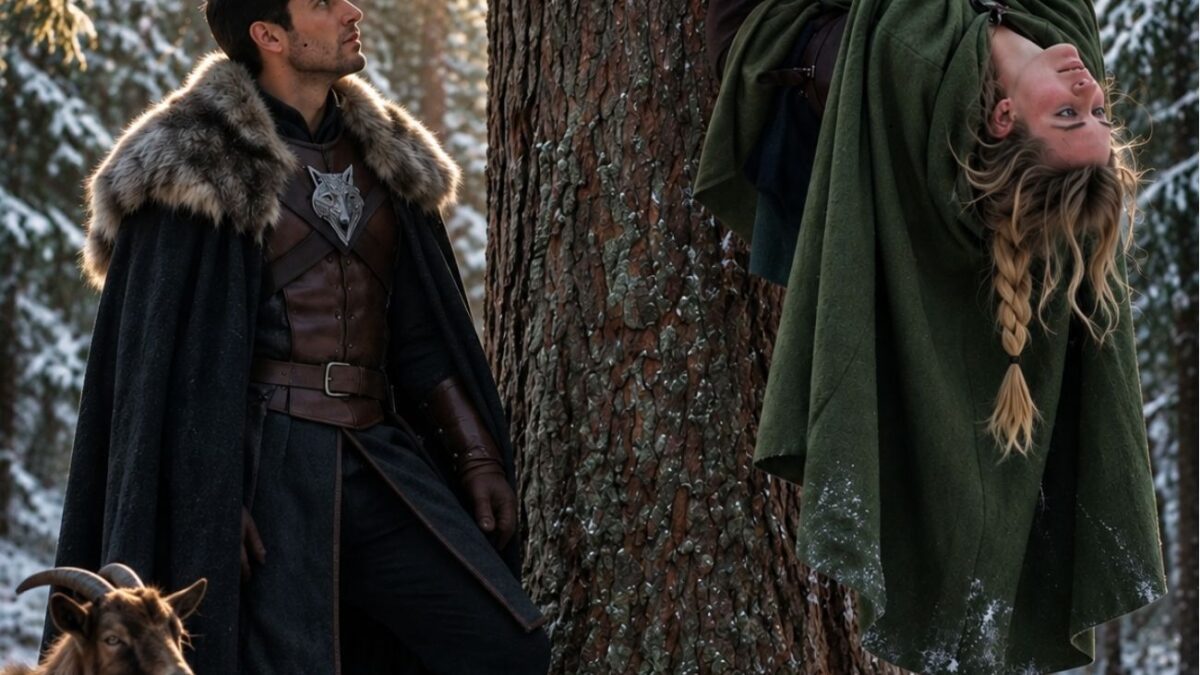
The branch had given her absolutely no warning. That was the detail Alara kept returning to as she hung upside down 20 ft above the forest floor, her left boot wedged between two thick pine limbs with the cheerful permanence of a well-driven nail.
It had cracked one sharp, treacherous complaint before the wood shifted beneath her weight with what she could only describe as deliberate malice. The boot caught on the way down, the rest of her did not, and now she dangled, cloak fallen across her face, blonde braid swinging like a pendulum.
That had lost its argument. Pine needles raining slowly past her nose as though the forest itself was making a point. She had been so close to the apples. The morning had started reasonably.
She had decided this while lacing her boots before dawn, while her breath fogged against the cold dark of her small healer’s cottage, while she listened to the unmistakable sound of the pen latch clicking open for the fourth time this month.
That latch. She had reinforced it with wire, then rope, then a length of chain she was fairly certain could have held a bear, and still Moss found a way because Moss had been sent into this world specifically to test her patience or her iron work or both.
She had followed him east into the older forest where the pines crowded close and the ground softened into dark silence underfoot through thorn patches that caught her green cloak in small deliberate grips, across a shallow stream that left her boots soaked and her dignity questionable.
An hour of tracking his particular brand of destruction, chewed bark, overturned stones, hoof prints pressed deep into the mud along the bank until she found him standing in a quiet clearing beneath a low-hanging apple branch eating something that was not his and wearing the expression of an animal entirely at peace with its own decisions.
She had made the calculation quickly, climb the tree, retrieve the fruit before he destroyed it, return to Greypine before her morning patients arrived. Simple, practical. She was, by every reasonable self-assessment, a practical woman.
The branch disagreed. Now she reached upward with both hands for the limb above her, stretched, missed, swung slightly, tried from a different angle. The boot held firm.
The world stayed upside down with the blinding difference of something that had already decided. She shoved her cloak off her face with a forearm and received a mouthful of pine sap for the effort.
She looked down at Moss. He had stopped eating. He was watching her with the ancient unreadable expression particular to goats, flat-faced, unhurried, comprehensively unimpressed, and the absurdity of the entire situation struck Alara so fully and without warning that she simply stopped fighting and laughed.
It came like something released rather than chosen, a sound that started as a small, helpless exhale and became something else entirely, breathless, full, echoing upward through the canopy in bright, unstoppable waves.
She laughed at the boot. She laughed at the apple she had not gotten. She laughed at Moss’s expression, which had not changed at all, which somehow made everything significantly worse.
She laughed until her ribs ached and her eyes blurred and she could not have explained the joke to anyone in the world. “You started this,” she informed him.
Moss blinked once, resumed chewing unapologetically. Her name was Alara Thorne. She was 24 years old, the only healer assigned to the Greypine Settlement, and 5 months into a posting that had seemed, on paper, like exactly the opportunity she had trained for.
She treated wolf pack injuries with steady hands and steadier nerves. She kept her herb stores precise, her patient records meticulous, her cottage as warm as the settlement’s drafty timber construction allowed.
She was, by every external measure, competent. She was also hanging upside down in a pine tree arguing with a goat. The northern wilds made no room for softness, and she had known that before she accepted the placement.
The council administrator who reviewed her file had looked at her once with a particular expression of a man watching someone underestimate difficult terrain, but Elara had requested the north deliberately.
The territory sat at the cold edge of the five alpha lands where winters arrived without ceremony, where the pines grew so dense they blocked the midday sun, and where the wolves who had built their lives here had been shaped by that hardship into something leaner and quieter and harder to read than their southern counterparts.
They were not unwelcoming, but their trust was a slow thing, earned in small doses over long stretches of time. She was almost certain she was making progress.
Old Garrick had told her last week that she wasn’t entirely useless. She had accepted this as high praise and moved on. She tried once more to reach the branch above her, failed, accepted with the particular calm of someone who had exhausted their options that she was staying here until something changed.
Then the forest went quiet, not the easy natural quiet of morning settling, the other kind, sudden and complete, as though the woods had drawn a breath and held it.
The birds stopped mid-song, the wind dropped, the trees stilled, even the light seemed to hesitate. Moss raised his head, Elara stopped laughing.
She looked down through the gap her cloak had made, through the tangle of pine limbs and morning shadow, and found a man standing at the edge of the clearing, tall, broad-shouldered, wrapped in dark wool and a fur-collared mantle that held the pale winter light along its edges without softening it.
He was looking at the goat. Then his gaze traveled upward, deliberate, unhurried, past the bark, past the lowest branches, to her.
Elara recognized the silver wolf emblem on his chest before her mind had fully processed what she was seeing. The mark of the five territories, worn only by one man in all the northern wilds, Alpha King Rowan Blackthorn.
He studied her for a moment that lasted considerably longer than it should have. Then he looked at Moss. Then with the careful, measured patience of a man who had faced a great deal and been surprised by very little.
He looked back up. His expression remained perfectly controlled for approximately 4 seconds. Then something shifted at the corner of his mouth. Not a smile, the shadow of one.
The kind a man fought with everything he had and was very nearly losing. “Oh, no.” Elara said.
The Alpha King looked up. “Oh, no. You saw me.” A silence fell between them. “Waited particular.”
“Unfortunately,” he said, “and Elara Thorn hanging upside down in a pine tree in the northern wilds with pine sap on her chin and her dignity some significant distance below.”
Her burst into laughter so completely that the birds scattered from the branches a second time. Rowan Blackthorn stood at the edge of the clearing and watched her.
He had not expected this. He had not, in the considerable span of his years ruling five territories, expected any of this. He climbed the tree.
He freed her boot. He caught her when she fell. Those were the facts, clean, sequential, and entirely unremarkable.
Rowan had cataloged them during the ride back to the capital the way he cataloged everything, systematically, without sentiment, filing them beneath the heading of resolved and moving on.
He was still trying to move on 3 days later. The morning report sat open on the table before him. Its columns of patrol routes and supply figures as precise as they always were.
Adviser Cael was speaking. He was almost certainly saying something important. Rowan was nodding at intervals he hoped were appropriate and thinking, with no forewarning whatsoever, about the specific sound laughter made when it rose through a pine canopy at dawn.
He stopped the thought, returned to the report. Cael paused mid-sentence. Rowan looked up.
His senior adviser was watching him with the expression of a man who had served the Alpha King for 11 years and had never once seen him smile at a supply ledger.
The Eastern inventory, Kael said carefully, did you find something amusing? No, you were reviewing the figures. A silence that was considerably more communicative than it had any right to be.
Of course, Kael said and wrote something in the margin of his own notes that Rowan chose not to ask about. The meeting ended.
The next one began. Rowan sat through two hours of border assessments with the discipline he had spent the better part of his adult life building.
And it held, mostly, except for one moment during the close of the afternoon session when someone mentioned Greypine settlement in passing. And Rowan’s attention sharpened with an immediacy that had absolutely nothing to do with border assessments.
He did not ask about it. He thought about asking about it. He did not.
Elara told no one. This was not a difficult decision. Greypine was a small settlement and small settlements ran on conversation the way machinery ran on oil, continuously and with enthusiasm for any new material that presented itself.
She had no particular desire to become material. She treated three sprained ankles, a deep cut along a patrol wolf’s forearm, and one case of suspected frostbite by mid-morning.
She restocked her herb shelf. She wrote two patient notes in her careful compact script. She moved through her work with the practiced efficiency of someone who had learned early that steady hands and a clear head were more useful than almost anything else she could offer.
She did not think about the clearing. She thought about the clearing constantly. Not the embarrassing part. She had made a reasonable peace with the embarrassing part.
It was the other things that kept surfacing without invitation. His voice, quieter than she’d expected from a man who held five territories in his hands, asking are you injured with what seemed like genuine concern rather than obligation.
The way he had assessed the situation and simply solved it. No drama, no commentary, just calm efficiency applied to the problem of an upside-down healer, as though this were a perfectly ordinary thing to encounter on a morning patrol.
And the corner of his mouth. She kept returning to that detail against her better judgment. The way he had fought the smile and nearly lost.
The way it had made him seem, for just a moment, less like the weight of an entire kingdom and more like a man who found the world occasionally, reluctantly funny.
She was being ridiculous. She filed the thought under ridiculous and went to check on Garrick. The old wolf was sitting up in his cot with a particular expression of someone who considered bed rest an insult to his character.
He was 81 years old, had survived three border conflicts, and was currently losing his longest standing battle against a knee that had stopped cooperating two winters ago.
He greeted Alora the way he always did, by informing her that he felt fine, that she worried too much, and that the compress she’d left was too cold.
“It’s supposed to be cold,” Alora said. “Then it’s supposed to be unpleasant.” “Those are often the same thing.”
Garrick squinted at her. “You’re in a strange mood.” “I’m in my normal mood.” “Your normal mood doesn’t have that look.”
She checked his knee with careful, practiced fingers and did not ask what look he meant. He told her anyway, because Garrick had never in his life required an invitation to offer an observation.
“Distracted,” he said. “Something happen?” “Moss got loose again.” “That goat,” Garrick said with the weary gravity of a man you’re saying someone is going to outlast us all.
As if on cue, a sound rose from the direction of the supply house. Petra’s voice, sharp and carrying, deploying the specific vocabulary she reserved for Moss-related incidents.
Alora closed her kit, offered Garrick a dry look that he received with satisfaction, and went to manage the situation. Moss was standing on a crate of winter herbs, eating something that was not winter herbs, and wearing the expression of an animal who had never once experienced remorse.
“Get down.” Elara said. He looked at her.
She thought, with no intention of doing so, about the clearing, about hanging upside down, about a man at the tree line who had looked from the goat to the tree to her and kept his expression perfectly controlled for almost 4 seconds. Almost.
She removed moss from the crate. She swept the herbs. She told herself firmly that it had been a strange morning and nothing more, and that was the end of it.
Three days after the encounter, Rowan reviewed the territorial roster. His finger moved down the eastern postings. Patrol captains, supply officers, medical per Graypine Settlement, healer assigned E. He stopped.
Elara Thorne. He read it once, then set the roster down. He remembered her name. He had known, without examining the fact too closely, that he would.
The first visit was legitimate. Rowan would defend this point without qualification. The eastern supply routes required review. Graypine Settlement was on the eastern supply route.
The timing, 9 days after the incident with the tree, which he was no longer calling the incident with the tree, was coincidental. He had a full itinerary. Three other settlements on the same circuit.
He arrived at Graypine fourth on a gray Tuesday morning, with Cale and two patrol captains and an entirely reasonable list of inspection items. Elara was treating a wolf with a dislocated shoulder in the open doorway of her cottage when they rode in.
She had the man’s arm at a precise angle. Her expression focused and calm, and she didn’t look up until the bone had been returned to where it belonged.
The wolf swore once, comprehensively. She told him to stop moving and handed him a compress, then turned to find the Alpha King of five territories standing in her settlement square.
She looked at him. He looked at her. Neither of them said oh no this time, which Rowan considered progress.
The supply inspection took 40 minutes. He asked three questions that needed asking and two that did not, and at some point Elara answered a question about herb procurement with a level of detail that he had no professional use for whatsoever.
And he found himself listening carefully anyway. She spoke about plants the way engineers spoke about structures, with precision and a kind of quiet affection for the subject.
She knew which roots lost potency after the first frost and which required it. She had opinions about willow bark that were both specific and firmly held.
Rowan, who had sat through 11 years of council meetings without losing focus once, was entirely attentive. He returned to the capital and filed a standard inspection report.
The second visit, two weeks later, was a boundary review. The third was a patrol assessment. The fourth, and even Rowan recognized somewhere around this point that the visits were accumulating at a pace that exceeded any reasonable administrative explanation, was an herb survey.
He had requested, with a straight face, a formal assessment of medicinal plant availability in the Eastern Territories. Kale had written it into the schedule without comment. His expression had said many things.
The survey required Elara to walk him through the forest edge behind the settlement for the better part of an afternoon, identifying what grew where and in what quantities and why it mattered.
She moved through the trees with a particular ease of someone who had learned a landscape by spending real time in it, not inspecting it, but actually inhabiting it.
She crouched in the pine duff to show him a cluster of something small and gray-green and important. She talked about soil drainage.
She corrected a misidentification he made with the brisk patience of a woman who had corrected the same mistake in new students before and saw no reason to be delicate about it.
He was not accustomed to being corrected. He found it remarkably not unpleasant. What struck him, across these visits, was not any single thing, but the accumulation of them.
The way she greeted every patient with the same focused attention regardless of rank. The old and the young, the high standing and the low.
The way she accepted no credit for outcomes that had clearly required significant skill and effort on her part, redirecting praise toward the patient’s own recovery with a deflection so practiced it had become instinct.
The way she ran herself quietly and without complaint to a level of exhaustion that no one seemed to notice except him because he had begun, without meaning to, paying attention to the details of her.
The shadows beneath her eyes on days she’d been called out before dawn. The ink that appeared on her left hand when she’d been writing patient notes.
The specific quality of her focus when something was wrong that she hadn’t yet solved. A stillness around her eyes while the rest of her face continued normally.
He noticed these things, then noticed that he was noticing them, then found the entire situation’s considerably more unsettling than he would have preferred.
Elara noticed other things. She noticed that the Alpha King of the five territories always arrived personally when any of these inspections could have been delegated to a territorial officer without comment.
She noticed that he returned details she had mentioned in passing weeks prior, a patient name and herb shortage, an opinion she had barely formed aloud before the conversation moved on.
With the ease of someone who had actually been listening rather than waiting for his turn to speak. It was a small thing. It should not have been as disarming as it was.
She mentioned it to no one, not Petra, who noticed everything, not Garrick, who would immediately develop opinions, not the patrol wolves who were starting to recognize the Alpha King’s banner in the road and straighten their posture with an enthusiasm that suggested they found his visit significantly more exciting than she was willing to admit she did.
She was professional. She was appropriate. She answered his questions and showed him her supply records and explained the Eastern herb distribution with the same composure she brought to everything.
She was, she decided handling it very well. On the fifth visit, a water source assessment, which was the thinnest pretext yet, and both of them understood this perfectly.
They walked the stream path east of the settlement in companionable, quiet. Then Alara noticed something at the edge of the bank and stopped.
Moss was standing in the stream, knee-deep, eating a plant she had specifically transplanted to that location 3 weeks ago because it required particular moisture conditions and was extremely difficult to cultivate and had taken her most of the autumn to establish.
She said nothing for a full 3 seconds. Rowan looked at the goat, then at her expression. That looks valuable, he said.
It was, was he. He knows exactly what he’s doing. Her voice was perfectly level. He always knows exactly what he’s doing.
Moss pulled a second mouthful free with visible satisfaction. Something broke loose in Rowan’s chest.
He laughed a real one, unguarded and sudden, the kind that arrived before a man had any chance to decide whether to allow it. Alara turned the sound.
He was looking at Moss, still laughing, and he looked entirely unlike a king. She smiled before she could stop herself. It became something larger.
Then they were both laughing at the goat standing in the stream eating her medicinal herbs, and the sound rose through the winter trees in a way that felt to both of them like something irrevocable.
Rowan was still thinking about it on the ride home. He had, he finally and fully admitted to himself, been looking for reasons. He was going to need ones.
It happened gradually and then all at once. The way most things did, Alara was beginning to understand where Rowan Blackthorn was concerned.
There was no single moment she could point to, no conversation that functioned as a door swinging open. It was quieter than that, an accumulation of small, unremarkable details that added up over the span of several weeks to something she hadn’t anticipated and wasn’t entirely sure what to to with.
The discovery that he walked slowly through the forest, not from lack of purpose, but because he was actually looking at it. The way he asked questions that suggested he had considered the subject before raising it.
The particular patience he showed with Garrick, who was suspicious of everyone and made no effort to conceal this, and who had nevertheless, by the third visit, begun saving observations specifically to deliver to the Alpha King.
She stopped seeing the silver emblem first, then the authority, then the legend five territories like weather arriving before a storm.
What remained was a man who drank his tea without comment when it was too strong, remembered the name of every patient she mentioned, and had she discovered on a Tuesday afternoon walk along the forest boundary an entirely unexpected opinion about the organizational failures of northern herb trade.
It was of all things the herb trade that started it. She had been explaining the supply problem. How the eastern settlements received whatever the central depot deemed sufficient, rather than what the local healers had actually requested.
A system designed by people who had never treated a patient in cold weather and showed it. And she had expected polite attention.
The kind of man offered when he was listening to something he considered minor, but wanted to appear interested in. Instead, Rowan said, “The requisition structure hasn’t been reviewed since my father’s administration.”
With the tone of a man making a note about something that genuinely required fixing. She looked at him. “That’s 20 years of accumulated assumption.” he added.
“Yes.” She said exactly that. A small silence. “Tell me what you actually need.” he said, “not what the form allows. What you need.”
She told him. He listened without interrupting, which was rarer than it should have been, and when she finished, he asked two precise follow-up questions that confirmed he had understood all of it.
She walked back to the settlement feeling faintly unbalanced in a way she could not immediately diagnose. That was when it started to shift.
She learned about his mother by accident. They were walking the ridge path above the settlement, a sixth visit, the pretext for which had been so thin neither of them acknowledged it.
When they passed a stand of pale birch trees and Elara mentioned offhandedly that her mother had loved birch forests, had called them winter trees because they were brightest when everything else was bare.
Rowan was quiet for a moment. “Mine, too,” he said. She looked The past tense had not escaped her.
“She died when I was nine,” he said. Not with grief, exactly. The grief had been processed long enough ago that what remained was something quieter, fact worn smooth by time.
“My father ruled for six more years before the border conflict.” She knew the history, everyone did.
The border conflict that had left the kingship to a 15-year-old with no preparation and no margin for error, surrounded by advisers who were testing the edges of him before he had fully grown into his own name.
“That’s very young,” she said carefully. It was. A pause. “You learn to appear certain before you are.”
She thought about this. “And after a while you’re not sure which one you’re doing anymore.” He looked at her sideways.
Something shifted in his expression. Recognition, she thought. The particular kind that arrived when someone named a thing you had never said aloud.
“Yes,” he said quietly, “that.” They walked in silence for a while and it was the comfortable kind.
She told him about her brothers later, not planning to, not building toward it, simply because the conversation arrived there naturally, in the way conversations did when both people had stopped performing for each other.
Two older brothers lost to a fever the winter she was 16, her parents the spring after. The way grief had required a purpose to survive and how she had found one in the training she’d always wanted but never had sufficient reason to pursue until then.
“I chose it because it helped,” she said, “which sounds obvious.” “It doesn’t,” Rowan said. “People assumed I went into healing because I had nothing else. People often assume the practical choice was the only option.
She glanced at him. Did you study me before these visits? The corner of his mouth moved. I reviewed the roster.
That’s not the same thing. He agreed. It isn’t. The storm came in fast, the way northern storms always did, without the courtesy of extended warning, and with evident enthusiasm for the inconvenience it was causing.
They had walked further from the settlement than intended. They discovered this when the light changed and the sky took on the particular greenish white that preceded serious weather.
The abandoned ranger cabin sat at the edge of the ridge path, half hidden by overgrown pine. Its roof intact and its door swollen shut in the way of doors that hadn’t been opened in several seasons.
Rowan opened it with his shoulder. They got inside before the rain became something worse. The cabin was small.
There was a fireplace that worked, a stack of old timber beside it, and two stools of questionable structural integrity. Nothing else of significance.
Rowan built the fire with the same unhurried competence he brought to everything. Elara found two relatively intact blankets in a cedar chest and distributed them without comment.
They sat. Outside, the storm made its argument loudly against the shuttered windows. Inside, they talked about the territories, about medicine, about the things they had each gotten wrong, and what those mistakes had cost them, and what they had learned from the price.
The fire narrowed the cabin down to amber and shadow, and the hours moved without either of them tracking them. At some point the conversation lapsed into comfortable quiet.
The storm eventually softened to rain. Neither of them pointed this out. The rumors started, as most things did in the capital, with someone who had noticed something and told one person in confidence.
The confidence lasted approximately two days. By the third day it was a conversation. By the end of the week, it had become the particular kind of knowledge that circulated through council halls and advisor offices and formal dining rooms with the quiet persistence of smoke finding gaps in old stone.
Present everywhere, sourced nowhere, and impossible to clear without acknowledging it existed. The Alpha King has visited Gray Pine six times in seven weeks.
No one said it plainly. That was not how these things worked. It arrived instead in the form of observations offered sideways.
A comment about the Eastern route schedule. A question about patrol assessment frequency. A remark about the unusual thoroughness of this season’s medical supply reviews.
The words themselves were innocent. The intent beneath them was not. Kale brought it to Rowan’s attention on a Wednesday morning in the careful, precise manner of a man delivering information he expected to be unwelcome.
“The council has noticed the pattern,” he said. Rowan looked at the document in front of him.
“The Eastern settlements require regular oversight.” “They do,” Kale agreed. “As do the northern, western, and central settlements which have received a combined total of one visit in the same period.”
A silence. “I’ll schedule broader coverage,” Rowan said. Kale wrote something down.
His expression remained entirely neutral, which meant it was communicating a great deal. “There are also questions being raised about the Gray Pine healer.”
Rowan looked up. “Her background, her placement history, her suitability.” Kale chose the last word with the delicacy of a man setting down something fragile.
“Councilor Varek has been particularly thorough in his interest.” Varek had been on the territorial council for 19 years. He was not unintelligent.
This was, in certain ways, what made him dangerous. A man of limited principle and considerable capability who had spent two decades accumulating influence the way careful men did, through patience and favors and an exceptional memory for other people’s vulnerabilities.
He believed, with the sincere and unexamined conviction of someone who had never been required to question it. That rank was not merely a social convenience, but a true measure of a person’s worth.
That the ordering of the pack was not tradition, but taxonomy. That each tier existed for reasons that were natural and correct, and did not benefit from disruption.
A low-ranking healer from a border settlement occupying the Alpha King’s attention occupied, in Varic’s view, a category of problem that required resolution.
He had been quiet about it at first, watching, collecting. The visits were documented in the official schedule. He had read each one with the focused attention of a man building an argument.
Medical supply inspection, boundary review, patrol assessment, herb survey, water source assessment. He had set them beside each other and studied what they added up to.
Then he had begun asking questions about Elara Thorne, her training record, her family background, her placement history, the circumstances of her assignment to the Eastern Territory, whether anyone had reviewed her qualifications personally, or simply processed the council placement form.
He asked these questions of people who would carry them forward in the understanding that a question, once released into the right ears, did its own work without requiring him to repeat himself.
What he wanted was a picture. What he was building was a case. Her family was unremarkable. Her training was solid, but unspectacular by capital standards.
She had no political connections, no high-ranking patron, no lineage that placed her in any tier that would make her proximity to the Alpha King legible to anyone who believed such things needed to be legible.
She was, by every formal measure that Varic considered relevant, exactly what she appeared to be. Which meant, in his estimation, that she was either naive or calculated.
Naive women did not concern him. Calculated ones required managing. He settled, after 2 weeks of quiet inquiry, on a conclusion.
A public demonstration of her unsuitability was preferable to a private one. The council chamber offered the appropriate venue, the appropriate audience, the appropriate gravity.
He drafted his request for a formal Eastern settlement review on a Thursday afternoon, submitted it through proper channels, and said nothing about his reasons to anyone.
The summons arrived on a grey Friday morning. Elara was writing patient notes when Petra knocked on the cottage door with the expression she reserved for things she found suspicious, which was a reasonably broad category, but which had a specific quality when the suspicion was serious.
She held out a folded document sealed with the territorial council’s mark. Elara looked at it.
“Patrol rider brought it an hour ago,” Petra said. “Official.” She opened it.
The language was formal and unremarkable, a request for a settlement representative to attend a council gathering in the capital to address Eastern territory medical provisions and resource allocation.
Standard administrative procedure, the kind that happened in distant offices and produced documents that trickled down to border settlements with the slow, impersonal weight of bureaucracy.
Elara read it twice. “Well,” she Petra was watching her with the focused attention of someone who reads subtext professionally.
“Will you go?” “I’ve been summoned.” “That’s not generally optional.”
“No,” Petra said, “but you could send a written report. Standard practice for remote healers.”
Elara folded the document and set it on the table. A settlement representative. The phrasing was careful, neutral.
It said nothing about why a routine resource review required personal attendance from a border healer who had never been summoned to the capital in eight months of posting.
It said nothing about why the summons had arrived the week after Rowan Blackthorn’s seventh visit to Greypine. It didn’t need to.
She looked at the seal again. “I’ll go,” she said. Petra’s expression shifted into something that looked quietly and unmistakably like concern.
The council chamber was designed, Elara suspected, specifically to make people feel small. It was not accidental.
The ceilings were high and the windows narrow, which kept the light spare and directional, falling in pale columns that illuminated the long table and left the edges of the room in shadow.
The chairs were arranged in a configuration that placed the council members along three sides of the table and the presenting party at the fourth, standing, facing all of them at once.
There was no chair at that end. She had noticed this immediately. She stood at it anyway.
With her notes in one hand and her satchel over her shoulder and the composed expression she used when a patient was frightened and needed someone in the room to appear certain.
The chamber held 14 council members, three territorial advisers, two scribes, Council of Varic, who sat at the center of the long side opposite her and who had the particular stillness of a man who had arranged something and was waiting for it to unfold, and Rowan Blackthorn, who sat at the head of the table and who had, when she entered, looked at her once with an expression she couldn’t fully read before returning to the document in front of him.
She had not known he would be present. She filed this information away and focused. Varic opened the formal proceedings with the tone of a man conducting something routine.
He was good at this, she noted, the bureaucratic register, polite, precise, entirely without warmth, that framed what was happening as administrative necessity rather than what it actually was.
He walked through the formal introduction of the session’s purpose, a review of Eastern Settlement medical provisions and resource allocation.
He noted pleasantly that Gray Pines healer had been good enough to attend personally. He thanked her for the journey. Then he began.
The first questions were structural, supply quantities, patient volumes, treatment categories broken down by type and frequency.
She answered them directly, citing figures she had prepared and others she carried from memory because she reviewed her records every week and had done so for eight months without interruption.
Varek listened, made notes, nodded occasionally. Then he shifted. “Your training was completed at the Arnfield Institute,” he said.
“Yes, a regional institution.” The modifier was gentle. “It did considerable work. One of 12 accredited healing institutes in the territories,” Elara said in the same tone she had used for the supply figures.
“The Arnfield program has a 5-year completion requirement and a clinical placement record that ranks third in graduate outcomes among all accredited institutions.”
A brief pause at the table. Varek moved on. “Your placement to Gray Pine was through the standard Council lottery.”
“It was.” “You had no prior experience in northern territory conditions.”
“I had no prior posting in the north,” she said. “The preparation for cold climate, trauma management, and frost-related injuries is covered in the third year of the Arnfield curriculum. I supplemented it with independent study before the placement began.”
She paused. “I can provide the reading list if it’s relevant.” Something shifted in the room, small, perceptible.
Varek did not alter his expression. “The eastern territories have historically been served by healers with more established backgrounds.”
He considered his next words. “One wonders whether a settlement at the edge of the known pack lands, dealing with the particular demands of border wolves, requires a more senior appointment.”
“One might wonder that,” Elara said. “The outcomes data suggests otherwise.” She opened her notes.
What followed was not a performance. She had not prepared it as one. She had prepared it the way she prepared everything, methodically, because the work deserved precision and the patients it represented deserved accuracy.
She walked through eight months of Gray Pine’s medical record, injury response times, treatment success rates, reduction in complications from untreated wounds since her arrival compared with the 2 years prior under the previous part-time posting.
The herb supply reform she had with the Alpha Kings’ administrative support, which had reduced critical shortages by 60% and eliminated three incidents of treatment failure that the records from the previous year documented plainly.
She cited figures. She explained clinical decisions. She answered every follow-up question from the table with the specific evidence-grounded patience of a woman who had spent eight months keeping difficult wolves alive and had the documentation to demonstrate it.
The room was very quiet by the time she finished. Not the strained quiet of an audience enduring something. The other kind.
The kind that followed something that had been said clearly and landed fully. Counselor Maron, who sat three seats from Varic and had said nothing until this moment, asked a question about cold weather fever treatment.
A genuine one. Ilara answered it. Two other council members followed with questions of their own.
Practical, specific. The kind people asked when they were actually interested in the answers. The conversation moved away from Varic’s architecture entirely and became something else.
He attempted once more near the close of the session to redirect it. A remark about the administrative irregularity of frequent Alpha King visits to a single border settlement.
Implication neat and plausible and clearly placed. The Alpha King’s visits resulted in a supply reform that directly improved patient outcomes, Ilara said.
I’ve documented those outcomes in the report I’ve submitted to this chamber. She looked at Varic calmly.
If there are concerns about the administrative process, the records are available for full review. The silence that followed had a different quality than the others.
Maron made a note. Two advisers exchanged a look. Varic said nothing further.
The session closed. Rowan did not speak to her until the chamber had emptied. He stood when the last adviser filed out and looked at her across the length of the table.
She was organizing her notes with the composed efficiency of someone finishing a task, and he watched her for a moment before she looked up.
He had not been proud of her performance. That was not quite the word. Pride implied she had done something unexpected.
What she had done was precisely what he had known she would do. Had known from the first visit and the second and the sixth.
Had known since the herb survey and the rain cabin and every conversation in between. She had simply shown them what she already was.
The distinction mattered to him. The supply reform documentation was thorough, he said. Alora looked at him steadily.
I thought it might be useful. It paused. Varick won’t stop, she said. Not a question.
No, Rowan said honestly. She nodded once with the particular composure of a woman who had expected this answer and was deciding what to do with it.
The political attacks, when they resumed, were more precise than before. Varick had recalibrated.
The council chamber approach had not produced the result he intended and he was not a man who repeated unsuccessful methods. What followed instead was quieter and considerably more targeted.
Questions raised in closed advisor sessions about decision making transparency, about the appearance of favoritism in territorial resource allocation, about the protocol implications of a ruling alpha’s repeated personal involvement with a single border posting.
None of it named Alora directly. It didn’t need to. The shape of what it was saying was clear enough.
Rowan received three formal written inquiries in the fortnight following the council session. Each one carefully worded and technically legitimate and transparently to create a record of concern.
He answered each with equal care and equal transparency and felt with growing clarity that he was tired of the performance.
He had been performing in one form or another since he was 15 years old. He was 31 now.
He rode to Graypine on a Tuesday without scheduling it. No inspection pretext. No survey requirement.
No entry in the official itinerary that K L managed with the resigned thoroughness of a man who stopped asking questions and started simply documenting.
He arrived mid-morning. The settlement was quiet in the particular way of cold clear days when the frost had come in overnight and the world had a sharp bright quality that made everything look freshly made.
Alara was at the edge of the eastern tree line collecting something from a low shrub with a small knife and the focused attention she brought to tasks that required care.
She heard him and turned. They looked at each other for a moment without the intermediary of pretexts.
There’s no official reason for this visit, he said. She waited. I’m aware of that, he added.
Alara looked at him for a long moment with the expression she used when she was deciding how honest to be.
He had come to know this expression well, the slight stillness around her eyes while the rest of her face remained neutral.
I know, she said. I’ve known for several visits. Yes, the water source assessment was not about the water, she said.
A pause. I know what water looks like. Something loosened in Rowan’s chest, not suddenly, the way ice loosened in early spring, gradually inevitably, as though it had always been going to and had simply been waiting for the conditions.
I’ve been looking for reasons, he said. I no longer want to look for reasons.
She set the knife carefully into her satchel. She didn’t speak immediately and he had learned to read her silences the way he read difficult terrain, with patience, without projection.
I replay our conversations, she said finally, not looking at him. Then, with the precision of someone choosing accuracy over comfort, all of them, in detail, at inconvenient times.
A beat. Petra has noticed my distraction. She hasn’t said anything because she is merciful.
Garrick has said several things because he isn’t. Rowan looked at her profile.
The frost cold air had put color in her face and she was looking at the middle distance with the expression of a woman stating facts she had arrived at through careful consideration and was now delivering without embellishment.
I think about you constantly, he said. She looked at him then.
I have since the tree, he said. Before the tree? Possibly, but I was less clear on the timeline.
The corner of her mouth moved, not quite a smile, the beginning of one. He reached out and took her hand.
It was not a dramatic gesture. There was nothing theatrical about it. He simply closed his fingers around hers where they hung at her side.
And she looked down at their joined hands with an expression he couldn’t fully name, something between recognition and relief, as though a tension she had been maintaining for a long time had been given permission to release.
She turned her hand and held his back. They stood at the edge of the tree line in the cold, clear morning, and neither of them spoke for a while, and it was the most uncomplicated Rowan had felt in longer than he could accurately calculate.
The letter from Varick arrived three days later. It was addressed to Rowan directly, which was unusual.
Most of Varick’s communications moved through formal channels, acquiring official weight through institutional distance. A direct letter was a different kind of statement.
The language was measured and courteous and entirely without ambiguity. It outlined in precise terms the council’s growing concern about the implications of the Alpha King’s personal involvement with a low-ranking border healer.
It cited three precedents from territorial history in which romantic associations between ruling Alphas and unsuitably ranked partners had produced political instability, council fragmentation, and in one case a succession dispute that had taken 11 years to resolve.
It noted that the council’s responsibility was the stability of the five territories and that this responsibility required them, with respect, to formally advise against the continuation of any attachment that could not withstand public scrutiny without political consequence.
At the bottom, in Varick’s careful script, a final line. The council stands ready to intervene formally if circumstances require it.
Rowan read the letter twice. Then he set it down on the desk and looked out the window at the pale winter sky over the capital for a long quiet moment.
He thought about 15-year-old boys learning to appear certain. About the weight of a crown accepted before the grief beneath it had finished its work.
About 11 years of choosing duty so consistently and completely that the choosing had become invisible. Had become simply the texture of his life, indistinguishable from who he was.
He thought about a woman standing in a forest clearing, hanging upside down in a pine tree laughing. He thought about a hand closing around his.
He picked up his pen. He wrote a reply to Varic that was two sentences long.
The first sentence acknowledged receipt of the letter. The second sentence made his position clear.
He sealed it and called for a rider. Then he began drafting a letter to Alara instead.
The formal session had been called on 7 days’ notice. This was, Kal explained with careful neutrality, within council procedural rights.
A full territorial gathering, all 14 members present, all three senior advisers in attendance. The agenda had been filed correctly.
The documentation was in order. There was nothing technically to object to. Rowan read the agenda.
The language was familiar. Eastern territory governance review. Resource allocation concerns.
Questions of administrative propriety. But the structure was new.
It was not a review. It was a removal process drafted in the vocabulary of administration. And moving with the quiet bureaucratic momentum of something Varic had been building toward for weeks.
He wants a formal record, Rowan said. Yes, Kal said.
A council vote on record creates precedent. That is the intention. Rowan set the agenda down.
Notify Alara. She should know what’s coming. Kal paused.
Should she attend? That’s her decision, Rowan said. Not mine.
She attended. She arrived in the chamber before most of the council members, which Rowan suspected was deliberate, a small practical act of refusal to enter after the room had already formed its expectations around her absence.
She wore her good green cloak and her composed expression and sat in the open chairs along the wall with the other settlement representatives who had been summoned for the broader governance portion of the session.
She looked, he thought, entirely steady. He knew her well enough now to see the ink stain on her left hand.
That meant she’d been writing patient notes before dawn. He knew she had slept poorly.
He knew the steadiness was real and also chosen, which made it mean considerably more. Varick opened the session with a polished ease of a man on familiar ground.
The first portion was administrative, routine, designed, Rowan understood, to establish the register of the meeting before the argument it was actually making arrived.
Supply allocations, patrol scheduling, three other border settlements reviewed and found adequate. Then Varick turned to Graypine.
The argument, when it came, was more sophisticated than the previous one. He had refined it.
He cited the precedents from his letter, the historical cases, the succession dispute, the 11-year fragmentation. He raised questions about judgment and priority and the appearance of impartiality and resource distribution.
He was measured and calm and built each point on the one before it with the precision of a man who had prepared extensively and intended to finish what he had started.
The room was quiet. Then Councilor Marren set down her pen.
“My son was posted at Graypine’s eastern boundary last winter,” she said. “Frostbite, severe. He would have lost two fingers, possibly the hand, under the previous treatment protocol.”
She looked at Varick steadily. Healer Thorn was called out at 4:00 in the morning in a snowstorm. The fingers were saved.
A pause. “I am aware of who she is.” A silence.
From the far end of the table, senior advisor Brennan cleared his throat. “My niece was stationed at the northern boundary of the Grey Pine circuit 18 months ago. Riding injury.
She was treated at Grey Pine because it was closer than the capital hall and the healer was available. He paused. She is still riding.
Another silence, different in quality from the first. A third council member spoke, then a fourth.
Not speeches, brief, factual, personal. The specific grammar of people who had been waiting for an opening and had found one.
Each account was different. All of them arrived at the same place. The room was changing.
Varick felt it. Rowan could see him recalibrating, looking for the thread he had lost, preparing to redirect.
He was good enough that he might have found it. Rowan stood.
The room went quiet in the way it always did when he stood. He had learned to use this and had generally used it in service of resolution, ending disputes, redirecting energy, closing matters that required closing.
“I want to address the council directly,” he said. Varick’s expression remained controlled.
“The political concern being raised,” Rowan said, “is whether my personal regard for Elara Thorn represents a failure of judgment.”
He looked along the table. “I want to be precise about what my judgment actually is.”
He did not use the careful register, not the administrative language, not the diplomatic construction that distributed accountability across institutional process.
He spoke plainly, which was rare enough in this room that the plainness itself held attention. He told them what he had seen.
Not the visits, the pattern the visits had revealed. A woman who treated every patient as though their recovery was a personal matter between her and the outcome, who had reformed a supply system that had failed the Eastern territories for 20 years, not because she had been asked to, but because it needed doing, and she was the person at present, who had stood in this chamber 7 weeks ago and answered every question put to her with more precision and more genuine knowledge than half the people asking them could have managed.
“The question of whether she belongs in proximity to this territory’s governance, he said, was answered by this room seven weeks ago. The answer was yes.
He let that sit. Then I intend to court her formally. I’m informing the council as a matter of record, not as a request for approval.
Varrick said very carefully, “The council’s formal position has been heard,” Rowan said, “and considered.”
Another silence. Varrick looked along the table for support. He did not find it.
Maron had returned to her notes. Brennan was expressionless. The three members who had spoken looked at Varrick with the polite immovable faces of people who had made their positions clear and were not interested in revising them.
Varrick said nothing further. Afterward in the corridor outside the chamber, Ilara stood very still.
Rowan came to stand beside her. He didn’t speak immediately. “You didn’t ask me first,” she said.
“No,” he said, “I should have.” She was quiet for a moment. He waited.
“You said you intended to court me formally,” she said. “Yes.”
She looked at him with a particular expression that preceded her most considered statements. “Then do it properly.”
He turned to face her fully. Around them the corridor was emptying, advisers and scribes moving toward other obligations.
The formal machinery of the hall continuing without them. “Ilara Thorn,” he said, “will you permit me to court you?”
Not a performance, quiet and direct and entirely serious. She looked at him for a moment.
“Yes,” she said, simple, certain, the way she said most true things. Spring came to the northern wilds the way it always did, without ceremony and then all at once.
The snow retreated first from the south-facing slopes, leaving behind a dark saturated earth that smelled of cold water and pine resin and something older underneath, something that had been waiting under the frost since autumn and was now, with the particular patience of things that understood seasons, returning.
The birch trees caught the light differently. The creek ran higher and faster.
The mornings arrived earlier and with them a quality of air that was less like enduring something and more like beginning it.
Ilara noticed all of this from the window of what had been for 3 months now, her office in the eastern wing of the Alpha Hall.
It was a good office, south-facing, sufficient light for reading patient notes without straining, a shelf that ran the full length of one wall and which she had organized with a precision that Rowan had observed once with the expression of a man recognizing a kindred tendency.
She had a full herb cabinet now, properly stocked, supplied through the reformed eastern requisition system that had quietly become a model for the northern and western circuits as well.
She had not sought that particular outcome. It had happened anyway, in the way outcomes tended to when the underlying work was sound.
He came to find her on a Tuesday morning in the third week of the spring thaw. She knew by his expression that he had something specific in mind.
There was a quality to his focus when he was moving toward a decision that she had learned to read the way she read weather, accurately and with appropriate preparation.
“Come somewhere with me,” he said. “Where?”
He looked at her steadily. “You’ll know when we get there.” She knew before they arrived.
The forest was different in spring, the same pines but altered, the light reaching further, the ground softer, small green things appearing at the base of the trees with the quiet determination of things that had always intended to be there.
She recognized the path first, then the slope of the land, then the particular way the clearing opened between the trees.
The branch was still there. It hung above the clearing at the same angle, thick and certain, entirely unchanged, 20 ft above the forest floor, the same gap between limbs where a boot could catch if a person were unwise enough to climb the tree in the first place.
Ilara stood beneath it and looked up. “You brought me back here,” she said.
“Yes, to the specific tree.” “Yes.”
She looked at the branch for a long moment, then back at him. “Rowan, you fell in love with me because I got stuck in a tree.
He looked at the branch. Then, “No,” he said.
She raised an eyebrow. “I fell in love with you because you were hanging upside down in a tree and laughing.”
She opened her mouth. He continued, and his voice had the quality it carried when he was being precise about something that mattered to him.
“Most people,” he said, “when something goes wrong, when they’re embarrassed or stuck or caught in a situation they can’t control, they contract. They manage the appearance of it. They make themselves smaller and for it to be over.”
He looked at her steadily. “You laughed.” She was quiet.
“Not at me. Not for me. You laughed because life had put you somewhere ridiculous, and you found that genuinely funny. The goat was watching you with judgment. You were 20 ft in the air, upside down, with pine sap on your face.”
Something shifted in his expression, “and you laughed anyway.” He took a step toward her.
“I had not seen that in a very long time. I’m not certain I had ever seen it quite like that. Joy without performance, honesty without calculation. You weren’t trying to be anything.”
He paused. “You were just completely, entirely yourself.” Alara looked at him.
“I fell in love with you before I reached the tree,” he said, “before I knew your name, before you knew mine properly, I mean. Not the emblem me.”
The clearing was very quiet. The light came through the pines in long, pale angles, and the branch hung overhead where it had always hung, and Alara felt something settle inside her with the permanence of things that had been true for some time and had simply been waiting to be said.
“Plainly, you were trying very hard not to laugh,” she said, “very hard. You almost didn’t manage it.”
“I didn’t manage it at all,” he said. “You were just too far away to hear it.”
She laughed. It rose through the clearing the way it had the first time, bright and unguarded.
And when it faded, she found him very close and looking at her with an expression that had nothing managed about it at all.
He kissed her beneath the branch that had started everything. It was unhurried and entirely certain, the way he did most things, without drama, without performance, with the quality of something that had been decided and was now simply finally being done.
The forest held its quiet around them. The months that followed accumulated into something neither of them had designed but both recognized as right.
Elara’s work expanded from the eastern territories outward, her reforms moving through the supply system with the patient efficiency of change been made by someone who understood the problem from the ground.
She attended council sessions. She contributed when she had something to contribute and declined when she didn’t, a practice that turned out to be rarer and more valued than she had expected.
The pack learned who she was the way packs learned most things, through direct experience repeated across seasons.
Garrick wrote her a letter from Graypine that contained three sentences. The third sentence said she was adequate, which she accepted as the highest compliment available.
Graypine flourished under a new posting healer trained under Elara’s protocols. Rowan ruled as he had always ruled, with care and without waste, and the difference was a quality of presence that Kael documented as improved, focus in his administrative notes, and that Rowan himself understood as something considerably simpler.
He was, for the first time in a long time, not only certain but content. Moss arrived at the Alpha Hall on a Wednesday in late autumn.
No one fully understood the mechanism. The enclosure at Graypine was reviewed and found theoretically secure.
The distance was not short. The route was not obvious.
Nevertheless, he was discovered in the eastern courtyard on a gray morning eating something from the Alpha Hall’s herb garden with the serene focus of an animal who had made a decision and executed it and found the outcome satisfactory.
Elara stood in the courtyard doorway and looked at him. Rowan stood beside her.
Moss raised his head, regarded them both with his flat, ancient, comprehensively unimpressed expression and returned to the herbs. “He found us,” Alora said.
“He did. He came all this way to judge us, apparently.” A pause.
“He was there at the beginning,” she said. Rowan looked at the goat, then at her.
“He was.” Moss chewed unapologetically.
The branch had trapped her. The laughter had freed her. And love, as it turned out, had found her before she ever touched the ground.

