Spain’s Doomed Young Queen Who Died At 26
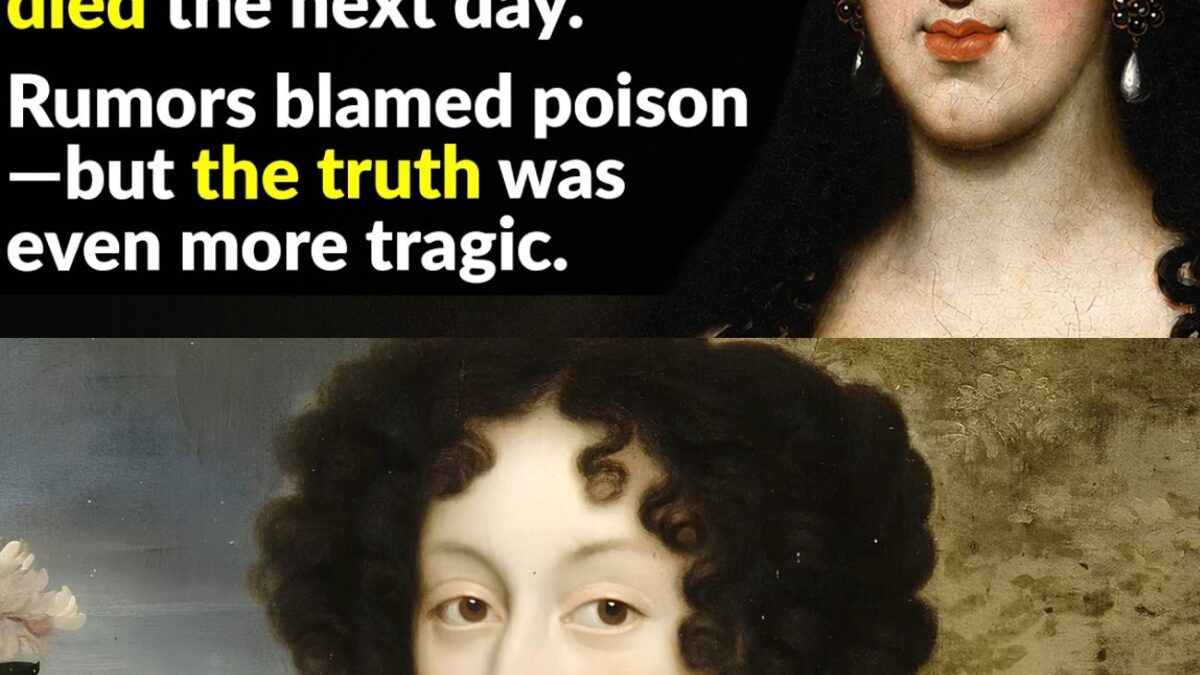
When she was only twenty-six years old, Queen Marie Louise of Spain collapsed under the weight of sudden and violent agony. Violent abdominal cramps, feverish convulsions, and relentless bouts of vomiting seized her body without warning inside the cold walls of the Alcázar. By the following nightfall she drew her final breath, leaving behind a bewildered court and a tragedy that would echo through royal history.
Rumors of poison raced through the corridors of Madrid and across the Pyrenees back to the glittering salons of Versailles. Yet beneath the poisonous whispers and political intrigue lay a truth far more heartbreaking than deliberate court treachery. Marie Louise d’Orléans was born a vibrant French princess destined for glory, only to be cast into an unforgiving Spanish exile.
Her life began amidst breathtaking grandeur on March 26th, 1662, inside the opulent halls of the Palais Royal in Paris. As the eldest daughter of Philippe I, Duke of Orléans, and Princess Henrietta of England, she represented the pinnacle of European nobility. Yet her extraordinary pedigree was burdened from birth by centuries of deeply concentrated and dangerous royal inbreeding.
Philippe’s father, King Louis XIII of France, and Henrietta’s mother, Queen Henrietta Maria, had been brother and sister. This made her parents first cousins, entangling her lineage in a web of shared blood that dominated seventeenth-century dynasties. Marie Louise was marked from the cradle by this imperial heritage, inheriting both supreme prestige and the inescapable shadows of dynastic duty.
As the legitimate granddaughter of Louis XIII, she bore the exalted title of Petite-Fille de France, commanding immense reverence wherever she walked. Across the French realm, however, courtiers and commoners fondly knew her by the simpler style of Mademoiselle d’Orléans. She possessed the famed charm, expressive wit, and beauty of her English mother, captivating everyone who entered her childhood presence.
Her early years were marked by a tender mixture of sweet privilege and sudden, devastating personal grief. Her younger brother, Philippe Charles, Duke of Valois, perished tragically before he could reach his third birthday. His untimely passing left Marie Louise as the sole surviving light in her parents’ gilded household for several difficult years.
Solace eventually arrived in 1669 when her mother gave birth to another healthy baby girl named Anne Marie. This cherished younger sister would later survive the turbulent currents of European statecraft to become Queen of Sardinia. Marie Louise, by contrast, would find no such long-lived peace or fortune in the royal destiny awaiting her.
Philippe of Orléans, known simply as Monsieur at court, utterly adored his eldest daughter beyond all measure. To anyone visiting the Palais Royal or Saint-Cloud, it was unmistakably clear that Marie Louise remained his favorite child. He showered her with affection, fine silks, and laughter, though his protection would prove powerless against the demands of the French Crown.
The princess spent her youth moving between the bustling center of Paris and the idyllic parklands of Château de Saint-Cloud. She flourished among manicured hedgerows, flowing fountains, singing attendants, and the gentle comforts of an expansive, indulgent family. Between her adoring father and her paternal grandmother, Queen Mother Anne of Austria, Marie Louise never knew deprivation or neglect.
The young girl spent countless precious afternoons sitting beside Anne of Austria, absorbing royal manners and familial tales. The dowager queen completely doted upon the child, eventually leaving the greater portion of her vast personal fortune to Marie Louise. When Anne passed away in 1666, it dealt the four-year-old princess her very first profound wound of grief.
Far worse devastation struck four years later, in the warm early summer days of June 1670. The eight-year-old Marie Louise looked on in horror as her radiant mother, Henrietta, suddenly collapsed after sipping a glass of chicory water. Within a matter of agonizing hours, Henrietta died writhing in torment, tearing away the central maternal anchor of the child’s existence.
Before Henrietta’s corpse had even grown cold, frantic whispers of deliberate poison rippled through every chamber of the palace. Suspicious courtiers pointed fingers at Monsieur’s favorites, while foreign courts speculated openly on the unnatural speed of her demise. Centuries later, forensic historians would determine that she died of a ruptured gastric ulcer, but the trauma haunted young Marie Louise forever.
The bereaved Duke of Orléans did not endure his bachelorhood for long, remarrying barely a year after Henrietta’s death. His second wife was Elizabeth Charlotte of the Palatinate, affectionately called Liselotte by family and recognized for her earthy candor. Many feared the little princesses would suffer under the cold hand of a traditional stepmother, but Liselotte surprised them all.
Liselotte possessed a robust heart, a sharp wit, and an enormous capacity for genuine, unpretentious warmth. Rather than sidelining Henrietta’s daughters, she embraced young Marie Louise and little Anne Marie as though they were her own flesh. A deep, reciprocal affection blossomed between the German princess and her stepdaughters, built on honesty, mutual respect, and long country strolls.
For Marie Louise, Liselotte became the steadfast maternal guardian she desperately required in a world dictated by cold power. Liselotte nurtured her, shared her laughter, comforted her tears, and offered wise counsel for the monumental trials gathering on the horizon. That safe sanctuary, however, began to fracture as the political ambitions of Louis XIV turned once again toward the Iberian Peninsula.
In 1678, King Louis XIV successfully brought the grueling Franco-Dutch War to a close through the Peace of Nijmegen. Yet every treaty between France and the Habsburg monarchy in Spain was fragile, requiring a living, breathing bond of flesh and blood. The Sun King cast his sweeping gaze upon his own household and selected his sixteen-year-old niece as the necessary sacrifice.
To cement the fragile truce between the two historic rivals, Louis XIV decreed that Marie Louise would marry King Charles II of Spain. At just sixteen, when her soul desired nothing more than the bright gardens of Saint-Cloud, her fate was irrevocably sealed. She was no longer merely a beloved daughter and sister; she was transformed into an instrument of state diplomacy.
In July 1679, Philippe of Orléans and King Louis XIV formally summoned the young princess into the royal apartments. With grave solemnity, her uncle announced the royal directive: she was chosen to assume the crown as Queen Consort of Spain. The proclamation fell like a funeral sentence upon the vibrant girl, shattering any illusions she held about choosing her own life.
Marie Louise made no effort to conceal the overwhelming grief and revulsion that swept through her heart. She wept openly before her family, pleading against the arrangement while witnesses watched her collapse into despair. Her resistance, however, was born of more than just natural fear of a distant, foreign realm.
Since early adolescence, Marie Louise had harbored a quiet, profound devotion for her handsome first cousin, Louis, the Grand Dauphin. The handsome Dauphin was heir to the French throne, and their shared court life had fostered an affectionate bond between them. Everyone at court knew that Marie Louise had longed to remain in Paris as the future Queen of France.
Driven by desperation, the young princess gathered her courage and confronted the intimidating Sun King in private audience. She threw herself into a passionate plea, weeping openly as she begged her imperial uncle to reconsider her matrimonial exile. Louis XIV, unmoved by tears that threatened his grand geopolitical strategy, met her supplication with chilling, dismissive logic.
He pointedly asked her whether an earthly king was not an honorable enough match for an obedient daughter of France. Her spirited answer revealed the fierce grief and sharp intellect burning beneath her aristocratic breeding. “No, Sire,” she replied through her tears, “but you could certainly have found a far better marriage for your niece.”
The man awaiting her across the Pyrenees was indeed a king, but rumors painted him more like a grotesque figure from a grim fable. Charles II, the final Habsburg ruler of Spain, was an individual broken by the devastating toll of dynastic intermarriage. Generations of unceasing cousin-marriages and uncle-niece unions had culminated in a young monarch plagued by severe congenital deformities.
The French ambassador dispatched to Madrid had sent back brutally honest appraisals that circulated among the Paris nobility. The envoy reported with dismay that Charles II appeared so sickly and misshapen as to cause genuine fear in those who beheld him. He suffered from a monstrously pronounced Habsburg jaw, an oversized tongue that hindered speech, and limbs too frail for normal exertion.
In his frail youth, Charles had barely survived consecutive bouts of smallpox, measles, and debilitating rickets. He was unable to walk without supportive leg braces until he was five years old, and he remained perpetually sickly. The French court understood well that the Spanish king could barely chew food without choking, living on soft foods and broths.
The true cruelty lay in the calculated political calculation harbored deep within the mind of Louis XIV. The Sun King did not dispatch his niece out of fraternal goodwill, nor did he believe Charles II possessed vigor or capability. He recognized that the Spanish Habsburg line was crumbling, viewing this marriage as a prime opportunity to plant French influence at Madrid’s core.
Marie Louise was expected to serve as the eyes, ears, and subtle guiding hand of Versailles inside the Spanish court. She was instructed to manipulate her frail groom, steer Spanish foreign policy toward French interests, and guarantee the peace. It was an impossible burden to place upon the slender shoulders of a sheltered, grieving sixteen-year-old girl.
For a brief season, Marie Louise was granted a temporary respite from looking upon the face of her husband. On August 30th, 1679, a magnificent proxy wedding was celebrated at the royal chapel of Fontainebleau. Her distant cousin, the Prince of Conti, stepped forward to represent the absent Spanish monarch before the altar.
Marie Louise moved through the lavish rituals like a condemned prisoner marching toward the scaffold, her face pale and drawn. She spoke the solemn vows to a stand-in bridegroom, knowing each spoken word cut the ties anchoring her to France. The moment the religious rites concluded, the newly minted Queen of Spain collapsed in private, inconsolable in her grief.
Before the mandatory journey to the Spanish frontier began, the French court staged weeks of opulent feasts and theatrical divertissements. Yet the dazzling spectacles, overflowing banquets, and glittering fireworks seemed to Marie Louise like a cruel mockery of her heart. She spent her waking hours memorizing the sight of every terrace, room, and beloved fountain she would never behold again.
On her final afternoon in Paris, she paid a somber, emotional visit to the convent of Val-de-Grâce. There, kept within a silver urn, rested the preserved heart of her beloved late mother, Henrietta of England. Kneeling upon the cold stone, Marie Louise wept bitterly, praying for strength to survive the unknown foreign land awaiting her.
Her royal uncle showed neither softening nor sympathy as the moment of her permanent departure finally arrived. Remembering how their cousin, Marguerite Louise, had once abandoned a wretched Tuscan marriage to flee back home, Louis was merciless. As Marie Louise bowed to take her leave, the Sun King issued a chilling parting command: “Farewell, Madame, and forever.”
Those three words stamped her departure as an absolute, unconditional exile from the only home she had ever known. Thankfully, she did not have to undertake the grueling journey toward the southern mountains entirely alone. Her devoted stepmother, Liselotte, insisted on accompanying Marie Louise across the breadth of France to soften the blow.
Day after day, their carriage rumbled toward the Pyrenees, with Liselotte offering tender affection and constant encouragement. When the time finally arrived to part at the border, both women wept openly, clinging tightly to one another. From that painful parting onward, the regular exchange of intimate letters would become Marie Louise’s emotional lifeline to sanity.
In November 1679, at the humble village of Quintanapalla near Burgos, Marie Louise finally came face-to-face with Charles II. There, in a hastily prepared setting, the formal Spanish wedding vows were spoken before church prelates and grandees. The vibrant Parisian girl found herself legally, physically, and spiritually bound to the fragile, stuttering young king.
Their initial union, however, was crippled by an immediate, insurmountable barrier: Marie Louise could not speak a word of Spanish. The young King of Spain, similarly, possessed no knowledge whatsoever of the French language spoken by his bride. They sat together as crowned monarchs, sharing an empire and a marriage bed, yet incapable of exchanging a single spontaneous thought.
Throughout the long, stilted ceremonies, they were entirely dependent on the Marquis and Marquise de Villars to translate every syllable. The French ambassador and his wife stood nearby, translating clumsy greetings, formal blessings, and whispered acknowledgments back and forth. It was an awkward, unromantic start to a life together that was destined to be scrutinized by the entire continent.
Upon her formal entry into Madrid, Marie Louise discovered that her royal existence had become an ornate, suffocating prison. The etiquette of the Spanish Habsburg court was vastly more rigid, formal, and austere than anything practiced at Versailles. Centuries of strict tradition dictated every glance, gesture, and minute of a royal queen’s daily routine.
Under the uncompromising rules of the court, the physical person of the Queen of Spain was considered sacred and unapproachable. No male subject, regardless of noble lineage, was permitted to touch even the hem of her gown on pain of dishonor. Her chamberlains enforced these archaic customs with severe vigilance, isolating Marie Louise from human warmth and casual companionship.
She was subjected to rules so stifling that she was forbidden from gazing out of the palace windows at the streets. The grandees decreed that it was improper for the face of the Queen to be witnessed by common eyes in Madrid. Shut away inside dim rooms hung with heavy tapestries, she felt the vibrant world outside slipping away forever.
Even more horrifying to her sensibilities were the religious duties expected of the royal family in seventeenth-century Spain. Unlike the artistic, philosophical piety she had known in Paris, the Spanish court demanded participation in public spectacles of the Inquisition. To her absolute horror, Marie Louise was obliged to attend grand autos-da-fé, watching terrified prisoners paraded and executed.
The Spanish nobility and the common populace regarded their new French queen with deep-seated suspicion and hostility. Antagonism between Spain and France had simmered for decades, making the French presence an unwelcome intrusion in the Alcázar. Courtiers whispered maliciously that Marie Louise and her small retinue of French maids were plotting betrayal against the crown.
Yet amidst this ocean of cold intrigue, Marie Louise discovered a solitary, astonishing ally within the palace walls. That ally was none other than the young king himself, Charles II, who fell desperately in love with her. From the instant he first gazed upon her miniature portrait, Charles had been captivated by her delicate features and grace.
When she arrived in the flesh, his admiration blossomed into an absolute, unwavering devotion that defied the court’s frigidity. He sought her company constantly, bringing her small gifts, listening patiently to her requests, and protecting her from hostile grandees. Charles proved to be gentle, remarkably patient, and completely enchanted by the young woman France had forced upon him.
In a remarkable turn of fate, the marriage that Marie Louise had dreaded with every fiber of her being softened. Though she could never experience the fiery, youthful passion she had once envisioned, she developed a deep, protective tenderness for him. She recognized his profound physical suffering, his childlike simplicity, and his earnest desire to make her happy.
A genuine friendship took root between the lonely French princess and the misshapen, heavily burdened Spanish king. They spent long afternoons together, laughing gently as Charles taught her Spanish while she introduced him to French phrases. She learned to accommodate his physical weaknesses, offering him patience while he shielded her from the cruelest court factions.
Yet, despite their surprising harmony as companions, their union was hollowed out by one catastrophic, unyielding failure. Month after month, year after year, the royal marriage failed to produce the one thing Spain desperately required: an heir. The entire kingdom waited in anxious anticipation for an announcement of pregnancy, but the royal cradle remained perpetually empty.
For ten long years, the couple endured religious pilgrimages, bizarre medical treatments, and endless intercessory prayers without success. Eventually, a heartbroken Marie Louise quietly confided the tragic reality to the French ambassador in private audience. She confessed that she had surrendered all hope of ever conceiving a child, recognizing that motherhood would forever elude her.
The tragedy was amplified by the fact that the failure did not lie within her own youthful, healthy body. She possessed the vitality to bear children, but her husband’s severely compromised constitution rendered him incapable of fathering offspring. Later medical assessments and his post-mortem examination confirmed that Charles suffered from severe congenital endocrine failure and testicular atrophy.
The dynastic dead end of the Spanish Habsburg dynasty was the undeniable, physical consequence of centuries of familial inbreeding. Yet in the deeply superstitious and fiercely proud atmosphere of seventeenth-century Madrid, no one dared lay blame upon the king. To suggest that the sacred monarch was sterile or deficient was unthinkable treason against God and the empire.
Consequently, the entire crushing weight of the dynasty’s infertility fell directly upon the shoulders of Marie Louise. Priests questioned her piety, ministers glared at her with accusation, and commoners penned cruel, mocking broadsheets across the capital. The Queen Mother, Mariana of Austria, who had long resented French influence, treated her daughter-in-law with increasing coldness.
The endless blame, the whisper campaigns, and the sorrow of her childless existence gradually wore away Marie Louise’s bright spirit. She watched the political factions at court begin to circle like vultures, debating who would claim the Spanish throne upon Charles’s death. Feeling utterly abandoned by the world, the queen retreated deeper into the privacy of her royal chambers.
To cope with the mounting isolation and unrelenting grief, Marie Louise sought comfort in the only indulgence available to her: food. She longed for the sweet confections, delicate pastries, and festive culinary traditions of her childhood at the Palais Royal. Depression turned into compulsive emotional eating as she attempted to quiet the dull ache of her existence with sugar.
She developed an insatiable appetite for heavy pastries, rich roasted treats, and excessively sweetened beverages imported at great cost. Her favorite daily indulgence was a spiced drink made of cold lemon and cinnamon syrup that required staggering quantities of sugar. Court ledgers recorded that over thirty pounds of refined sugar were consumed regularly to supply her private kitchens with these concoctions.
The consequences of this rich, unceasing diet upon her once-slender frame soon became impossible for the court to ignore. The queen gained a significant amount of weight, which only fueled further mockery from the critical courtiers of Madrid. Her physical health grew sluggish, and her emotional melancholy deepened as her youth slipped away inside the heavy tapestries.
On the chilly morning of February 11th, 1689, Marie Louise sought a brief escape from the stifling atmosphere of the Alcázar. She ordered her horses readied and set out for a brisk ride across the royal hunting grounds outside the city. She had always loved the freedom of horses, finding in the open wind a fleeting reminder of the fields of Saint-Cloud.
Shortly after returning to the palace, however, she was struck by an agonizing, sharp pain low in her abdomen. She dismissed it initially as a passing colic, retiring to her bedchamber in hopes that rest would soothe the discomfort. Yet as twilight descended over Madrid, the agony intensified into a violent, burning fire that left her gasping for breath.
By midnight, her condition had deteriorated into a horrific ordeal of uncontrolled shivering, violent convulsions, and relentless vomiting. The royal physicians were summoned in haste, crowding around her ornate bed with their useless remedies, tonics, and lancets. They applied hot compresses and bled her repeatedly, but every archaic medical intervention only sapped the dying queen’s remaining strength.
As the morning of February 12th dawned, the doctors recognized with quiet dread that she was slipping beyond their reach. The internal infection raged unabated, leaving her skin clammy and her pulse fluttering with alarming irregularity. Seeing that science could offer no salvation, the grand chamberlain dispatched couriers to summon the priests for the last rites.
A solemn procession of clergymen carrying holy oils and crucifixes entered the dim bedchamber as the king knelt weeping at her side. Charles II was completely shattered, sobbing openly and refusing to leave the woman who had brought light into his broken existence. He held her sweating hand, watching the only true companion he had ever known prepare to depart the earth.
Gathering her remaining strength, Marie Louise opened her eyes and looked upon the devastated face of her grief-stricken husband. In those final, precious moments of lucidity, she spoke words that surprised every courtier and confessor standing in the room. “Many women may yet share your majesty’s throne,” she whispered softly to Charles, “but none will ever love you more than I have.”
It was a breathtaking testament to the unexpected compassion and loyalty that had blossomed between them over ten lonely years. She did not curse him for the crown that had imprisoned her, nor for the barrenness that had earned her a nation’s scorn. She recognized his fragile humanity, offering him a final gift of comfort as her breath grew shallow and cold.
A few hours later, on the night of February 12th, 1689, Queen Marie Louise of Spain passed away inside the Royal Alcázar. She was only twenty-six years old, cut down in the very flower of her youth after a reign defined by loneliness. Her passing plunged the Spanish court into immediate, chaotic turmoil and left King Charles II inconsolable in his grief.
The young king locked himself within his private apartments, refusing to eat and weeping for days over the loss of his wife. Outside his closed doors, however, the corridors erupted into wild accusations, venomous rumors, and bitter international outrage. The sudden, violent nature of her death immediately convinced many observers that she had been murdered by poison.
Given the intense political rivalries dominating the Spanish court, everyone began searching for a culprit behind the tragedy. Fingers pointed immediately toward the Dowager Queen, Mariana of Austria, who was known to desire an Austrian bride for Charles. Rumors claimed that Mariana had arranged for poisoned food to be delivered to the queen to clear the way for an heir.
In Paris, the news of Marie Louise’s sudden demise ignited explosive fury within the halls of Versailles and Saint-Cloud. Her father, Philippe of Orléans, and her stepmother, Liselotte, were completely devastated by the loss of their cherished child. Liselotte wrote scorching letters across Europe, openly declaring her conviction that her stepdaughter had been murdered by Spanish enemies.
Yet beneath all the sensational accusations of dynastic murder lay a far more mundane, tragic medical reality. Modern pathologists and medical historians examining the detailed accounts of her symptoms have reached a unanimous conclusion. Marie Louise did not perish from a poisoned cup, but from acute appendicitis that ruptured into fatal, septic peritonitis.
The sharp right-sided abdominal pain, the fever, the relentless vomiting, and the final convulsions match the exact progression of a ruptured appendix. In the seventeenth century, before the development of antiseptic surgery, an internal infection of that magnitude was an absolute death sentence. What modern medicine resolves with a routine, simple procedure cut short the life of a queen who had everything to live for.
To address the swirling international scandals, the Spanish authorities conducted an official autopsy upon her embalmed remains. The examining physicians found no chemical burns, unusual discolorations, or evidence of toxic substances within her digestive organs. Yet in an age suspicious of all sudden royal deaths, official declarations did little to extinguish the romantic legend of poison.
Following solemn funeral rites, Marie Louise was transported to the grim, sprawling monastery palace of San Lorenzo de El Escorial. There, deep beneath the granite arches, she was laid to rest within the marble chambers of the Pantheon of the Infantes. This solemn crypt was reserved specifically for royal children and those queens consort who failed to bear an heir to Spain.
Her final resting place stood as a permanent, sorrowful symbol of the impossible expectations that had governed her life. She was denied burial among the reigning mothers of Spanish kings simply because biology and inbreeding had denied her a son. She took her place among the silent dead, forever defined by the child she could never bring into the world.
Marie Louise d’Orléans had entered the stage of European history as a radiant, laughing princess dancing through the halls of Saint-Cloud. She departed it as an exiled queen whose youth was bartered away for a peace treaty that barely survived her death. Her memory endures not as a political conqueror, but as an emblem of enduring dignity, tenderness, and sacrifice within the gilded cages of power.

