She Thought She Had Inherited Our Life. My Husband Had Left One Final Truth Behind.
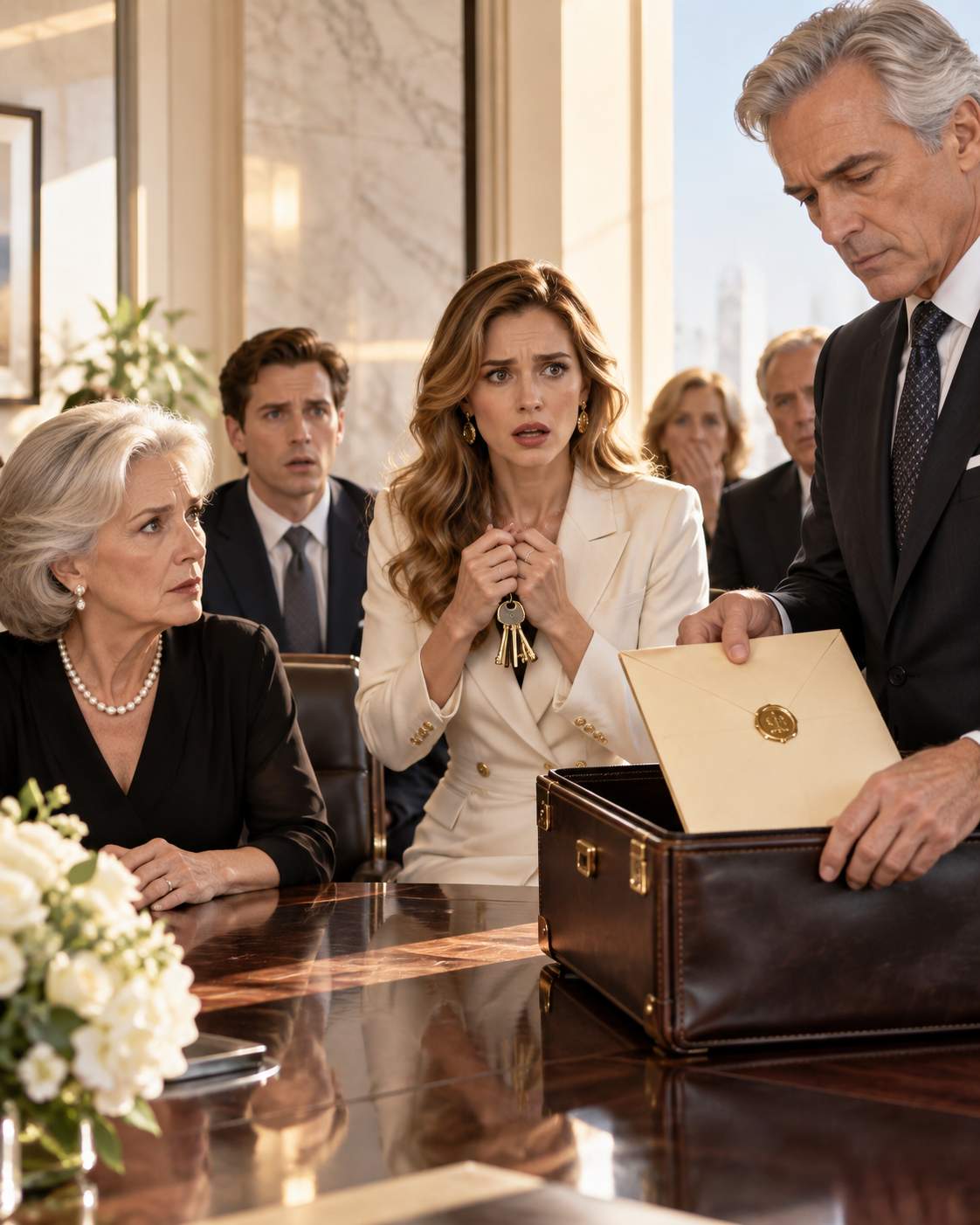
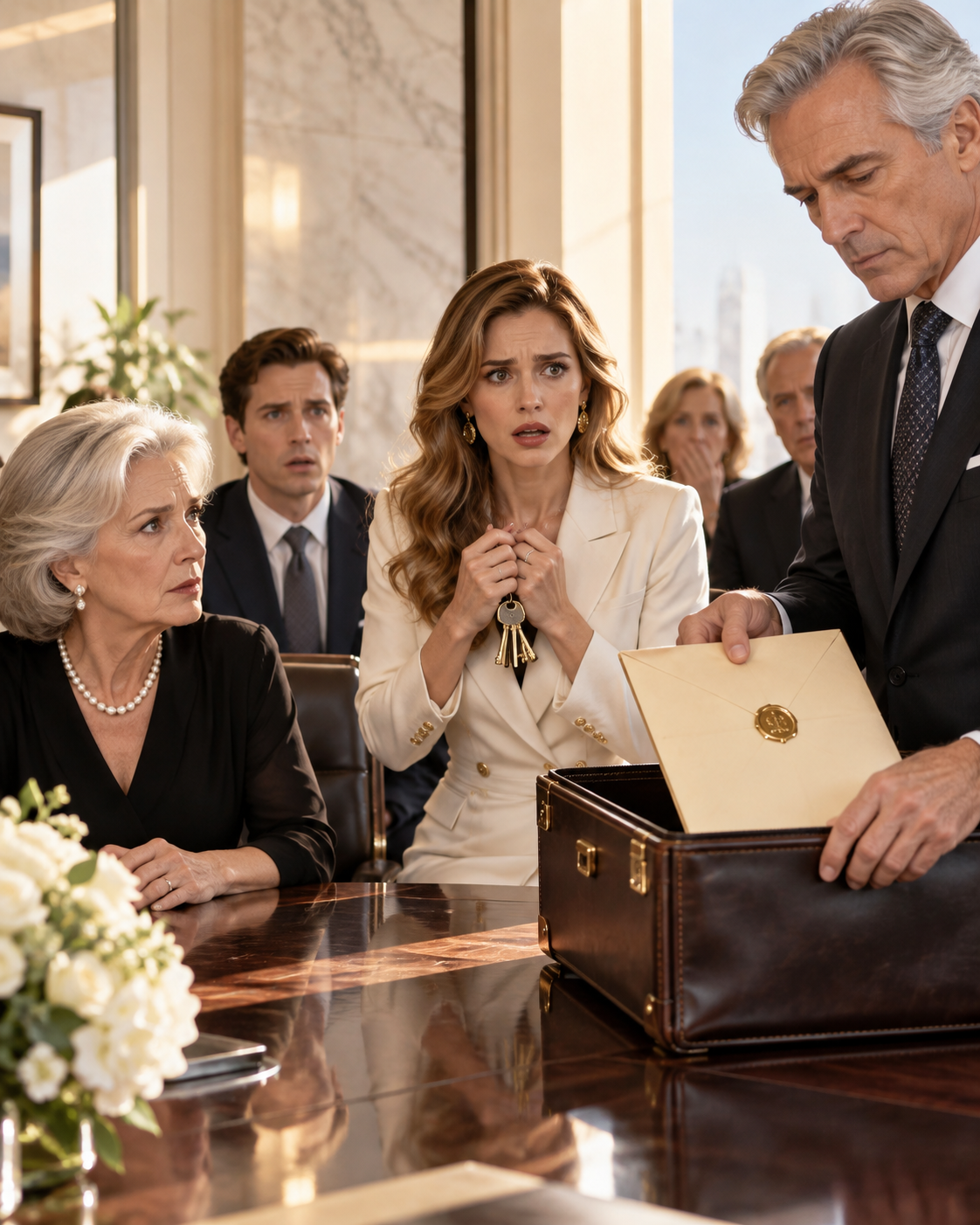
The keys struck the mahogany conference table with a sharp metallic clink.
My daughter-in-law grabbed them before Attorney James Morrison had even finished speaking.
“The Miami mansion is ours!” Elanie cried, raising the keys like a trophy.
Then she turned toward me.
“You might as well accept that you lost, you useless old woman.”
A few nervous laughs escaped from relatives who didn’t know where to look.
My son, Michael, said nothing.
That silence hurt more than Elanie’s words.
I stared at the keys in her hand—the keys to the house my husband and I had spent decades dreaming about, saving for, fighting for, and filling with memories.
Then I smiled.
“Actually,” I said softly, “there’s someone you need to meet first.”
Elanie’s smile disappeared.
Minutes later, the conference-room door opened, and a silver-haired man in a charcoal suit stepped inside carrying a leather briefcase.
No one recognized him.
Except me.
Not because we had known each other for long.
We hadn’t.
But because three hours earlier, that man had introduced himself in the lobby of the very building where Henry’s supposed will was about to be read.
“Mrs. Crawford?” he had asked.
“Yes?”
“My name is David Thompson.”
Then he had handed me a cream-colored envelope with my husband’s handwriting across the front.
JOANNE. OPEN THIS ONLY IF MORRISON READS THE OTHER WILL.
My knees had nearly given out.
Henry had been dead three weeks.
And somehow, he was still protecting me.
Now David Thompson stood before my family and placed his briefcase on the table.
“I apologize for the interruption,” he said evenly. “I’m David Thompson of Thompson Hartwell and Associates. Mrs. Crawford is expecting me.”
Every face turned toward me.
Elanie stared as if she had just discovered I could speak another language.
Morrison looked even more confused.
“What is the meaning of this?” he asked.
Thompson opened the briefcase.
“I believe there has been some confusion regarding Mr. Henry Crawford’s final wishes.”
“There is no confusion,” Elanie snapped. “You just heard the will.”
Thompson looked at her.
“You heard a will.”
A cold silence settled over the room.
Then he removed a sealed folder.
“But you did not hear Henry Crawford’s final will.”
Michael’s chair scraped backward.
“What?”
Three weeks before Henry died, Thompson explained, Henry had contacted him privately.
Henry had become convinced that the will he had signed eight months earlier—the one Morrison had just read—had been created under pressure.
Elanie immediately scoffed.
“He had memory problems.”
“Yes,” Thompson said. “Which is why Mr. Crawford voluntarily underwent a full capacity evaluation with Dr. Sarah Chen, a geriatric psychiatrist.”
He placed a medical report on the table.
“Dr. Chen concluded that Mr. Crawford had mild memory impairment, but he retained full testamentary capacity. He understood his assets, his family, the consequences of his decisions, and exactly how he wished to distribute his estate.”
Elanie’s jaw tightened.
“That proves nothing.”
“It proves quite a lot.”
Then Thompson broke the seal.
My hands trembled under the table.
For forty-two years, Henry and I had built our lives together.
He worked double shifts at the steel mill when Michael was small. I stretched groceries, cared for Henry’s aging parents, cleaned offices at night for extra money, and saved every dollar we could.
Our first rental house had peeling paint and a furnace that failed every February.
Our second property had a roof so bad Henry and I spent one summer replacing shingles ourselves.
By the time we bought the Miami Beach house, we had both cried in the empty living room.
That house had never been about showing off.
It had been proof that sacrifice could eventually turn into sunlight.
Henry used to stand on the balcony every morning with his coffee and say, “Jo, someday we’ll stay here for good.”
We never got that someday.
And now Elanie had been ready to remodel our memories before my husband was cold in the ground.
Thompson unfolded the new document.
“To my wife, Joanne Crawford,” he began, “I leave full ownership of the Miami Beach residence, the Cleveland family home, all three rental properties, and the remainder of my personal estate.”
The room froze.
I heard someone inhale sharply.
Michael stared at Thompson.
Elanie stared at me.
Thompson continued.
“To my son, Michael Crawford, I leave twenty-five thousand dollars, provided that he accepts this distribution without contest.”
Michael blinked.
“Twenty-five thousand?”
“Yes.”
“That can’t be right.”
Thompson didn’t look up.
“To my daughter-in-law, Elanie Crawford, I leave nothing.”
The keys slipped from Elanie’s fingers.
They struck the table.
Once.
Twice.
Then stopped.
Her face went white.
“This is fraudulent.”
“No,” Thompson replied.
“Joanne did this.”
“No.”
“She manipulated him!”
“No.”
Her voice rose.
“He barely knew what day it was!”
Thompson finally looked directly at her.
“Mr. Crawford anticipated that accusation.”
Then he reached inside his briefcase again.
“Which is why he documented everything.”
That was when Michael slowly turned toward his wife.
“What does that mean?”
Elanie glanced at him.
“It means nothing.”
Thompson slid another envelope across the table.
“These were provided to my office directly by Henry Crawford.”
Michael reached for it.
Elanie lunged.
“No!”
The word cracked through the room.
Everyone stared.
She stopped herself, straightened her jacket, and forced a laugh.
“I mean… this is ridiculous. We don’t even know what’s inside.”
Michael’s expression changed.
For the first time all afternoon, he was really looking at her.
“What’s inside, Elanie?”
“I don’t know.”
“Then why did you try to stop me?”
She opened her mouth.
Nothing came out.
Michael tore open the envelope.
Inside were printed copies of text messages.
At first his face was confused.
Then shocked.
Then sick.
I watched him read.
ELANIE: He keeps forgetting what we talked about. Ask again when Joanne isn’t there.
UNKNOWN NUMBER: He said the Miami house goes to Joanne.
ELANIE: Then keep pushing. Tell him she can’t maintain it.
Another message.
ELANIE: If he signs while he’s lucid enough, it will hold. We only need the signature.
Michael’s hands began shaking.
“What the hell is this?”
Elanie stood.
“Those are taken out of context.”
“Who were you texting?”
“Michael—”
“Who?”
Thompson answered.
“Attorney Richard Vale.”
Morrison’s eyebrows shot upward.
Vale was the attorney who had drafted the earlier will.
The same attorney Elanie had insisted Henry needed.
Michael looked at her.
“You told me Dad asked for Vale.”
“He did.”
Thompson quietly placed another document down.
“No. He did not.”
It was Vale’s billing record.
The client contact listed at the top was not Henry Crawford.
It was Elanie Crawford.
My son looked as if someone had punched him.
“You hired him?”
She crossed her arms.
“Someone had to take control. Your father’s estate was becoming a mess.”
“Dad’s estate?”
“Michael, stop acting naive.”
Her mask began to crack.
“All of this would eventually have become yours anyway.”
Mine.
His.
Hers.
Everyone had apparently thought of Henry’s life in terms of what would remain after he was gone.
Everyone except Henry.
And perhaps me.
Michael looked down at the messages again.
Then he whispered, “You told me Mom was trying to steal everything.”
Elanie stared at him.
“You said she was manipulating Dad.”
Silence.
“You said she was hiding his condition.”
“Michael—”
“You told me not to believe her.”
She stepped closer.
“Because she was controlling him!”
“That isn’t what these messages say.”
His voice broke slightly.
I felt my anger soften just enough for grief to enter.
Michael was my only child.
And for eight months, he had barely called me without Elanie beside him.
I had hated him for that.
Some nights I had sat alone at the kitchen table wondering how the little boy who once climbed into my bed during thunderstorms could grow into a man who let his wife call me useless.
But now I saw something I hadn’t wanted to see.
Michael looked less like an accomplice than a man waking up inside a burning house.
Elanie pointed toward me.
“She turned your father against us.”
I stood.
“No, Elanie.”
My voice surprised even me.
It was calm.
“Henry turned against being controlled.”
Her eyes narrowed.
“You always hated me.”
“No.”
That was the truth.
When Michael first brought Elanie home twelve years earlier, I had liked her.
She was funny then.
Ambitious.
Beautiful.
She brought me lilies on Mother’s Day and insisted on washing dishes after dinner.
But slowly, compliments became corrections.
“Joanne, that dress ages you.”
“Joanne, you shouldn’t handle online banking at your age.”
“Joanne, why don’t you let us make the decisions?”
By the time Henry became forgetful, Elanie no longer suggested.
She directed.
The tragedy was that Michael had mistaken confidence for competence.
And authority for love.
Thompson cleared his throat.
“There is more.”
Elanie laughed bitterly.
“Of course there is.”
He removed a small digital recorder.
My heart skipped.
“I have instructions from Mr. Crawford to play this only if the validity of the new will is challenged.”
Elanie went still.
Thompson pressed a button.
Static filled the room.
Then Henry’s voice.
Weak.
Older than I remembered.
But unmistakably his.
“My name is Henry William Crawford. Today is February seventeenth.”
I gripped the edge of the table.
Hearing him was like losing him again.
Henry continued.
“I’m making this recording because I need my family to understand something.”
A pause.
“I know my memory isn’t what it used to be. Sometimes I forget names. Sometimes I walk into a room and can’t remember why.”
Someone sniffed behind me.
“But I know my wife.”
My eyes burned.
“I know my son.”
Michael covered his mouth.
“And I know when I’m being pressured.”
Elanie’s face hardened.
Henry described Vale’s visits.
The repeated questions.
The suggestion that I was incapable of handling property.
The insistence that Michael and Elanie “needed security.”
Then his voice changed.
Lower.
Steadier.
“One afternoon I pretended to be more confused than I was.”
Everyone looked up.
My breath caught.
Henry continued.
“Elanie was talking in the kitchen. She thought I couldn’t hear.”
A pause.
“She said, ‘Once the houses are in our names, Michael won’t need to know everything.’”
Michael slowly lowered his hand.
Elanie whispered, “No.”
Then Henry said something no one expected.
“Michael, if you are hearing this, I need you to understand that you were not the person I was most worried about.”
My son looked toward the recorder.
“I believe you were manipulated too.”
Elanie’s eyes flashed.
“Turn that off.”
Thompson ignored her.
Henry’s voice continued.
“But you made choices, son. You chose not to ask questions. You chose convenience over courage. That is why I left you twenty-five thousand dollars.”
Michael began to cry.
Quietly.
Not dramatically.
Just tears slipping down his face while his father spoke from beyond the grave.
“The money isn’t punishment. It’s a question.”
A long pause.
“What kind of man will you become when no inheritance is coming to save you?”
No one spoke.
Then the recording ended.
For several seconds, the only sound in the room was the air conditioner.
Elanie grabbed her purse.
“This is insane. I’m leaving.”
Thompson stepped aside.
“You are free to leave.”
She headed for the door.
Then he added:
“Although you may want to stay for the final matter.”
She stopped.
“What final matter?”
He glanced at me.
This was the part I knew nothing about.
I frowned.
Thompson reached into his briefcase one last time.
“Mr. Crawford left an additional instruction concerning the Miami property.”
Elanie turned.
Despite everything, I felt a flicker of fear.
Henry had always loved surprises.
Usually flowers.
Sometimes plane tickets.
Once, on our thirtieth anniversary, he had secretly learned enough ballroom dancing to make it through one whole song without stepping on my feet.
But this wasn’t Henry the romantic.
This was Henry preparing for war.
Thompson handed me a deed.
“The Miami house was removed from Mr. Crawford’s individual estate four months before his death.”
I stared at him.
“What?”
“It belongs to the Crawford Family Trust.”
Michael frowned.
“What trust?”
Thompson smiled slightly.
“A trust created jointly by Henry and Joanne Crawford in 1998.”
My mouth fell open.
Then I remembered.
A lawyer.
A stack of paperwork.
A rainy afternoon nearly thirty years earlier.
Henry and I had created something when we purchased our second rental house.
I had forgotten about it completely.
“The trust went dormant for many years,” Thompson explained, “but it was never dissolved.”
He looked at me.
“And under its original terms, Mrs. Crawford was always the surviving trustee.”
Elanie laughed once.
“So? The new will could still transfer the house.”
“No.”
Thompson slid the deed toward Morrison.
“Henry never owned the Miami residence individually.”
Morrison studied it.
Then his face changed.
“Oh.”
Elanie stared at him.
“What?”
He looked up.
“The earlier will couldn’t have legally transferred the Miami property to you.”
The room erupted.
“What do you mean couldn’t?”
“It wasn’t Henry’s personal asset.”
Elanie slapped both hands on the table.
“Then why were there keys?”
Thompson looked toward the keys lying between us.
“Because Mr. Crawford wanted to know what you would do if you believed they were yours.”
A chill passed through me.
Michael whispered, “Dad set a trap.”
“Yes.”
Elanie stared at the keys.
Henry had known her.
Far better than I had.
Far better than Michael had.
He knew she would celebrate too quickly.
Talk too much.
Reveal too much.
And she had.
“The original set of trust documents,” Thompson continued, “also contains an unusual provision.”
I looked at him.
“What provision?”
“Any beneficiary who attempts through coercion, fraud, or undue influence to obtain control of trust property permanently forfeits any future beneficial interest in that trust.”
Michael stared at his wife.
Elanie said nothing.
Thompson continued.
“The evidence Henry collected was enough for him to invoke that provision.”
I thought that was the end.
I thought the surprise was that Elanie would never touch the Miami house.
I was wrong.
Thompson turned to Michael.
“Your father also amended the successor-beneficiary clause.”
Michael wiped his face.
“To who?”
Thompson looked at me.
“Mrs. Crawford has lifetime control.”
Then he looked back at Michael.
“After her death, the trust does not pass to you.”
My son stiffened.
Elanie looked almost hopeful.
“Then who gets it?”
Thompson slid one final sheet of paper across the table.
On it was a name.
Emma Crawford.
My heart stopped.
Michael went completely still.
Elanie looked confused.
“Who the hell is Emma?”
But I knew.
Or rather, I knew the name.
I had seen it once.
Years ago.
On a Christmas card hidden in Henry’s desk.
Michael whispered, “Dad knew?”
I turned toward him.
“Knew what?”
He closed his eyes.
And suddenly, the entire inheritance fight became insignificant.
Michael began to shake.
“Mom…”
“What?”
“There’s something I never told you.”
Elanie stepped back.
“No.”
Michael looked at her.
And whatever passed between them made my stomach drop.
“Eight years ago,” he said, “Elanie and I separated for six months.”
“I know that.”
He swallowed.
“What you don’t know is why.”
Elanie hissed, “Michael, don’t.”
He ignored her.
“There was someone else.”
I felt cold.
“For you?”
He shook his head.
“For Elanie.”
She closed her eyes.
Michael continued.
“She got pregnant.”
A murmur swept through the room.
I gripped the table.
“She had a baby?”
“Yes.”
I stared at my son.
“Where is she?”
His face crumpled.
“Her name is Emma.”
For several seconds, I couldn’t understand the words.
Then I looked down at the paper.
Emma Crawford.
“No.”
Michael nodded.
“Elanie wanted to place her for adoption. I… I couldn’t.”
Elanie’s voice turned sharp.
“She wasn’t his child!”
Michael spun toward her.
“She was six weeks old!”
Then he looked at me.
“I arranged for her to live with a family in North Carolina. Friends of Dad’s cousin. I paid support privately.”
My chest tightened.
“You had a child in your life for eight years and never told me?”
“I was ashamed.”
“Ashamed of what?”
“That my marriage was falling apart. That she wasn’t biologically mine. That I stayed.”
I looked at Elanie.
Her face had become stone.
“You stayed with her,” I whispered.
Michael gave a broken laugh.
“Dad found out two years ago.”
That explained the Christmas card.
Emma, age six.
A little girl in a red sweater.
I had thought she belonged to one of Henry’s old steel-mill friends.
Tears filled my eyes.
Henry hadn’t forgotten the child.
He had protected her.
Thompson spoke softly.
“Mr. Crawford established a separate educational and housing trust for Emma.”
Michael covered his face.
“And he named Mrs. Crawford as co-trustee.”
I could barely breathe.
Elanie suddenly laughed.
Not with amusement.
With disbelief.
“This is unbelievable.”
We all looked at her.
“You’re all acting like Henry was some saint.”
Her voice shook now.
“He was controlling all of you too.”
Michael stared at her.
“He protected Emma.”
“He interfered!”
“She’s your daughter.”
“She was a mistake!”
The words exploded through the room.
Silence followed.
A terrible silence.
Michael’s face changed.
Something inside him finally broke.
“No,” he said.
Elanie blinked.
“What?”
“No.”
He removed his wedding ring.
For twelve years, I had watched my son surrender one small piece of himself after another to keep peace in his marriage.
Now he placed the ring on the table.
“I kept telling myself you were difficult because you were strong. That you pushed because you cared. That Dad was confused. That Mom was emotional.”
He looked at me.
“I’m sorry.”
My throat closed.
Then he turned back to Elanie.
“But I heard you.”
She crossed her arms.
“You’ll regret this.”
“Maybe.”
He pushed the ring toward her.
“But I won’t regret Emma.”
For the first time, Elanie looked afraid.
She grabbed her purse and walked out.
No one stopped her.
The door slammed.
And just like that, the woman who had entered believing she owned everything left with nothing but her handbag.
But there was no celebration.
Only exhaustion.
Only grief.
Only the strange emptiness that follows a storm.
People slowly began leaving.
Henry’s brother hugged me.
His sister cried.
Morrison apologized three times even though none of it had been his fault.
Eventually, only Michael, Thompson, and I remained.
The Miami keys sat in the middle of the table.
I picked them up.
They felt heavier than before.
Michael stood several feet away.
“I don’t expect you to forgive me.”
I looked at him.
He suddenly looked five years old.
Then fifteen.
Then forty-one.
Every version of my son seemed to exist at once.
“I don’t know if I forgive you yet.”
He nodded.
“I understand.”
“But I want to meet Emma.”
His head lifted.
“Really?”
“She’s Henry’s granddaughter in every way that mattered to him.”
Michael started crying again.
“So she can be mine too.”
Six weeks later, a car pulled into the driveway of the Miami house.
I stood on the porch.
The ocean breeze lifted my hair.
Michael got out first.
Then a little girl climbed out of the passenger side.
Eight years old.
Brown hair.
Green eyes.
Nervous smile.
She held a small cardboard box against her chest.
Michael walked beside her but did not touch her until she reached for his hand.
“Grandma Joanne,” he said, his voice unsteady, “this is Emma.”
The girl looked up at me.
“Hi.”
One word.
That was all.
But my heart broke open.
“Hi, sweetheart.”
She held out the box.
“Grandpa Henry said this belonged to you.”
My breath caught.
“You met Henry?”
She nodded.
“Three times.”
Michael looked surprised.
Apparently, Henry had kept secrets from all of us.
Inside the box was an old Polaroid camera.
Mine.
The camera Henry had bought me on our tenth anniversary.
I had thought we lost it decades ago.
Beneath it was one photograph.
Henry and me on Miami Beach.
Young.
Barefoot.
Laughing.
On the back, Henry had written:
Jo—houses are walls. Money is paper. Family is who you choose to protect when no one is watching. Don’t spend the rest of your life guarding what we built. Fill it with people worth sharing it with. Love, H.
I pressed the photograph to my chest.
For weeks, I had thought Henry’s final act was about defeating Elanie.
It wasn’t.
It was about rescuing the rest of us from becoming like her.
That evening, Emma sat in Henry’s old reading nook drinking hot chocolate.
Michael fixed a loose cabinet hinge in the kitchen.
And I stood on the balcony watching the sun lower itself into the Atlantic.
For the first time since Henry died, the house didn’t feel haunted.
It felt alive.
Months passed.
Michael filed for divorce.
He began therapy.
He visited Emma every other weekend and called me every Sunday—not because I demanded it, but because he finally remembered that love required showing up.
As for Elanie, she challenged the will.
The challenge failed.
Vale surrendered his law license after disciplinary investigators discovered similar conduct involving another elderly client.
Elanie was never charged criminally; the evidence established pressure and unethical estate maneuvering, but not enough to prove a criminal case beyond a reasonable doubt.
I learned not every wrong ends with handcuffs.
Sometimes consequences look quieter.
A lost marriage.
A lost inheritance.
A daughter who grows up knowing exactly who chose her and who didn’t.
Two years later, on what would have been Henry’s seventy-second birthday, I returned to the beach with Michael and Emma.
We brought no flowers.
Henry hated cut flowers.
“Dead things pretending to decorate a room,” he used to say.
Instead, Emma brought a kite.
A ridiculous purple kite shaped like a dragon.
The wind caught it immediately.
She ran along the sand laughing while Michael chased after her.
I sat beneath an umbrella holding the old Polaroid.
When they finally collapsed beside me, exhausted and sandy, I raised the camera.
“Smile.”
Michael groaned.
“Mom, does that thing even work?”
“I guess we’re about to find out.”
I pressed the button.
The camera clicked.
A square photograph slid out.
Emma watched impatiently as the image slowly appeared.
Three people on the sand.
Michael laughing.
Emma leaning against him.
Me beside them.
And behind us, the Miami house glowing in the late-afternoon light.
Emma studied it.
“Grandpa Henry should be in it.”
I looked toward the ocean.
The sun had begun to sink.
For one irrational second, I almost expected to see Henry walking toward us, shoes in hand, complaining about sand between his toes.
Instead, there was only wind.
Water.
Light.
And memory.
“He is,” I said.
Emma looked at the picture again.
“Where?”
I touched the photograph.
“In everything that brought us here.”
She seemed satisfied with that.
Then she ran back toward the water.
Michael stayed beside me.
After a while, he said, “Dad really planned all of this, didn’t he?”
I shook my head.
“No.”
He looked surprised.
“No?”
“Your father planned documents. Trusts. Evidence.”
I watched Emma jump over a wave.
“But this?”
I smiled.
“This is what happened after we finally started making better choices.”
Michael looked down.
“I wasted a lot of time.”
“Yes.”
He laughed softly.
“You really aren’t going to make this easy for me.”
“No.”
Then I took his hand.
“But I’m not going to waste the time we have left either.”
His fingers tightened around mine.
The wind shifted.
Somewhere behind us, the purple kite rose higher into the sky.
And I finally understood why Henry had left me only twenty-five thousand dollars in the false will.
He knew Elanie would look at the number and see humiliation.
He knew I would look at it and remember something else.
Twenty-five thousand dollars had been the exact amount Henry and I had saved before buying our first rental property.
The number had never meant defeat.
It meant the beginning.
I started laughing.
Michael frowned.
“What?”
“Nothing.”
But it wasn’t nothing.
My husband had hidden one final private joke inside the trap.
Even in death, Henry had managed to remind me who we had once been.
Two ordinary people.
No mansion.
No rentals.
No inheritance.
Just twenty-five thousand dollars, a terrifying mortgage, one stubborn dream, and each other.
I watched Emma running along the shoreline.
And for the first time in a very long time, I didn’t feel like a widow protecting a dead man’s estate.
I felt like Joanne Crawford.
A woman with a family still unfinished.
A home still full of rooms.
And enough life left to fill them.

