Rancher Said, ‘My Room Only Has One Bed’ — The Black Widow Smiled, ‘That’s Perfect… I’m Not Afraid’
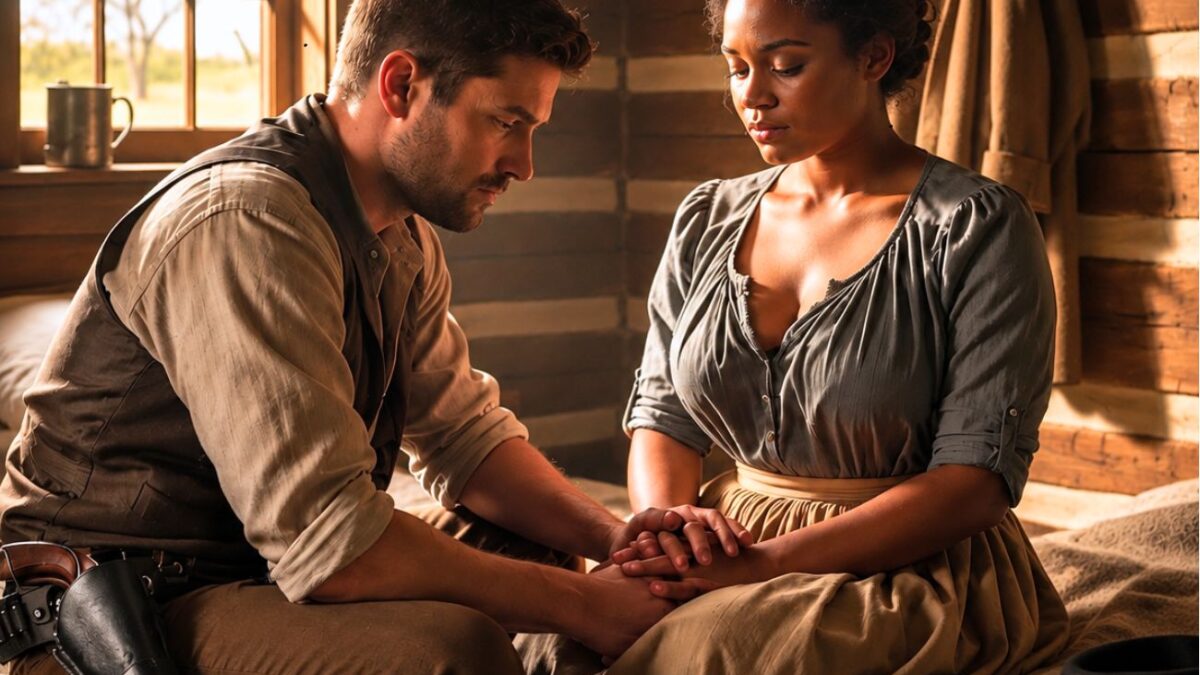
The desert wind howled across the empty plains, carrying dust and rain in furious waves.
Thunder rumbled heavily over the darkened horizon, vibrating through the rocky earth like a war drum.
James Callaway pulled his soaked hat lower against his brow, blinking through the stinging deluge.
He was a quiet rancher with a rough beard and hands scarred by decades of solitary toil.
His coat was heavy with water, clinging cold and damp to his broad, exhausted shoulders.
He had spent the better part of the morning in town trading dried goods, completely misjudging the weather.
As his gelding crested the limestone ridge, a jagged fork of lightning illuminated the valley floor.
Down by the washed-out trail stood a broken wagon, tilted sharply into a ditch of rushing mud.
Next to the ruined wheel, wrapped in a dark woolen shawl, stood a solitary, drenched figure.
“Hold up!” James shouted against the roaring squall, urging his shivering horse down the slippery slope.
The woman turned sharply at the sound of hooves splashing violently through the newly formed creek.
Her face was framed by soaking curls that clung tightly to her pale, defined cheekbones.
“Ma’am, you can’t stay out here!” he called, his gravelly voice fighting the wind.
Her gaze was remarkably calm, showing none of the wild panic he expected to see in a traveler stranded alone.
“The wheel snapped clean off the axle,” she replied, raising her voice without losing her composure.
“I was heading west toward the valley before the clouds opened up and swallowed the road.”
James swung down from his saddle, boots sinking several inches into the soft, treacherous loam.
He grabbed a canvas tarp from his pack and moved swiftly toward her exposed wooden trunks.
“You’ll freeze to death if you remain out here in this downpour,” he said bluntly.
His voice carried the rough authority of a man accustomed to giving orders only to cattle.
“My homestead sits just two miles north behind the bluffs; come with me now.”
She studied his weathered face for a long second, taking in his tired eyes and steadfast stance.
A sharp crack of lightning split the purple clouds above them, yet she didn’t flinch.
“I suppose I don’t have much choice, do I?” she said, offering a curt nod.
“My name is Clara Reed,” she added as he hoisted her battered travel bag onto his saddlehorn.
“James Callaway,” he grunted, reaching out a leather-gloved hand to help her mount behind him.
She climbed up with surprising agility, grasping the rough wool of his jacket without hesitation.
The ride toward the bluffs was brutal, the gale whipping rain sideways into their faces like needles.
James felt the slight, steady rhythm of her breath against his back as the horse navigated the mud.
Most women he had known in the frontier towns would have wept or trembled under such misery.
Clara merely tightened her grip, leaning into the storm with an unyielding, quiet endurance.
Her resilience stirred something dormant inside him, a long-buried spark of quiet admiration.
For three long years, the only voice that had accompanied him across these plains was the wind.
Finally, the squat, stone outline of his low-roofed log cabin emerged through the gloom.
He led the shivering mare straight into the small barn, rubbing the beast dry with burlap.
Clara helped him uncinch the saddle, working in practiced silence as if she knew barn chores by heart.
When they entered the cabin, the heavy cedar door shut out the storm’s deafening scream.
The room was dark and chilled, smelling faintly of seasoned pine, dried sage, and old smoke.
James knelt immediately at the hearth, blowing carefully on the banked embers until orange flames caught.
Dry cedar kindling snapped into bright, leaping light, casting long shadows across the timber walls.
He stood up, wiping soot from his calloused palms onto his work trousers, and looked back.
Clara stood by the doorway, water dripping from the hem of her dark traveling skirt.
“It isn’t a palace,” James muttered, taking off his drenched coat and hanging it near the fire.
“It’s warm and dry, Mr. Callaway,” she replied softly, her teeth chattering despite herself.
“Right now, that makes it the finest home between here and the Pacific Ocean.”
He pointed toward a small curtained alcove where a single rope-strung mattress was laid.
“There’s only one bed,” he admitted, his voice stiff with cautious propriety.
“I’ll take the floor by the hearth with a bedroll; you don’t need to worry.”
Clara met his guarded eyes, and a slow, fearless smile curved the corners of her lips.
“That’s unnecessary,” she said softly, watching him with an open, piercing gaze.
“I’ve slept on rocky ground and frozen dirt; I am certainly not afraid of you.”
Her words hung quietly between them, lingering against the steady roar of thunder outside.
James held her gaze for a heartbeat longer than polite convention dictated, his pulse jumping unexpectedly.
She removed her sodden bonnet, revealing dark hair that fell in damp waves past her shoulders.
He turned back toward the iron stove, needing to occupy his hands to steady his thoughts.
He pumped water into an iron kettle, setting it over the iron plate to heat for coffee.
“Get closer to the hearth,” he commanded gently, passing her a coarse, dry linen towel.
She stepped toward the crackling cedar logs, unwrapping her shawl and wringing out the fringe.
The heat illuminated her features, revealing subtle lines of grief etched around her mouth.
Yet beneath that shadow lay an unmistakable, hardened steel that adversity had forged rather than broken.
James measured out roasted beans into a cast-iron grinder, turning the wooden crank rhythmically.
The rich, earthy scent of crushed coffee soon filled the small, warm room.
Clara sat down on a split-log bench, wrapping a dry wool blanket around her shivering shoulders.
“Thank you,” she said, her voice softened by the crackle of burning pine knots.
“Most men on that road would have left a stranger rather than risk their neck in that.”
James poured boiling water into the tin pot, watching the dark froth rise to the rim.
“The prairie doesn’t forgive fools, but it doesn’t favor cruelty either,” he replied.
“A storm out here will kill a person in an hour once the temperature drops.”
He filled two tin mugs with the steaming brew and handed one carefully across to her.
Their fingers brushed against the metal rim, a faint jolt of warmth passing between them.
Neither moved away immediately; the contact lingered just long enough to be acknowledged.
Clara took a slow sip, letting out a long, shuddering sigh of profound relief.
“You live out here all alone?” she asked, looking around at the sparse, clean room.
A pair of carved shelves held only a few worn books, some leather punch tools, and dried beans.
Everything was impeccably functional, stripped bare of any delicate or decorative touch.
“Three years now,” James answered, staring down into his black coffee.
“Lost my brother to the winter fever back in fifty-eight, and my folks before that.”
He rubbed the back of his neck, his knuckles thick and stiffened by hard outdoor labor.
“Running fifty head of cattle and keeping up the fences doesn’t leave much idle time.”
Clara looked down at her lap, her thumb tracing the frayed edge of the grey blanket.
“Fire took everything I owned,” she confessed quietly, her voice trembling slightly before steadying.
“My husband, our dry goods shop in Missouri, our savings—all went up in smoke within twenty minutes.”
She took another sip, looking straight into the leaping flames of the hearth.
“I bought a ticket on a wagon train heading west, thinking distance might dull the memory.”
James watched her closely, recognizing the deep, hollow ache in her steady voice.
It was the same hollow ache that had haunted his own chest through three bitter, silent winters.
“You don’t have to forget what you lost to find peace again,” he said quietly.
Clara offered a faint, melancholy smile that softened the hard edges of her face.
“You sound like a man who had to learn that lesson through bone and blood.”
“I reckon most folks living west of the river learn it that way,” James murmured.
Outside, the squall lashed the split-shingle roof, the cedar timbers groaning against the wind.
Inside, the stove radiated heat, turning the cabin into an island of amber light amidst the tempest.
James fetched another thick quilt from the cedar chest and spread it across the single bed.
“Take the bed, Clara,” he said, using her first name naturally for the first time.
“I’ll bank the fire so it lasts until sunrise, then turn in myself.”
She stood up, holding the blanket tight, and walked toward the small curtained alcove.
“You really don’t have to freeze on that wooden floor, James,” she said quietly.
He looked at her, seeing the utter lack of pretense or coyness in her dark eyes.
“The bed is wide enough for two people with good sense,” she added without a blush.
James hesitated, every instinct of frontier propriety warring with the honest simplicity of her offer.
He took off his heavy work boots, setting them by the hearth to dry overnight.
He blew out the kerosene lantern, leaving only the deep red glow of cedar embers.
He walked to the bed and lay down carefully on the far side, fully clothed.
Clara lay on the opposite side, the space between them cool and wide but intensely electric.
They stared up into the dark rafters as the rain continued its rhythmic, muffled drumming.
“Maybe storms aren’t always meant to destroy things,” Clara whispered into the darkness.
Her voice was barely louder than the hum of the dying wind outside the log walls.
“Sometimes they just wash the old dirt away so you can see where to step.”
James smiled faintly in the darkness, feeling his chest rise and fall with unusual ease.
“Maybe so, Clara,” he answered softly, closing his eyes against the shadows.
For the first time in years, the silence of the cabin did not feel heavy or lonely.
When morning broke, the rain had ceased entirely, leaving the western sky scrubbed clean and pale blue.
Clara awoke to the sweet, sharp scent of wet sage drifting through the half-open window.
The storm had retreated eastward, leaving only scattered puddles that mirrored the early sunlight.
She rose and straightened her dress, noting that James had already slipped out of the cabin.
Through the pane, she saw him by the woodpile, splitting cords of oak with smooth, practiced swings.
His linen shirt was dark with sweat, his muscular back moving with mechanical, effortless grace.
Watching him, she felt an unfamiliar calmness settle deep within the hollows of her chest.
It was an absence of dread, a feeling of safety she thought she had buried in Missouri.
She quickly braided her hair, tucked in her stray curls, and stepped out into the kitchen.
Finding a crock of flour and some cured bacon, she set to work building up the fire.
By the time James stepped through the door carrying an armful of split oak, biscuits were rising.
The aroma of browned pork and fresh bread filled every corner of the once-cold room.
James stopped dead in his tracks, staring at the set table and the woman standing beside it.
“You didn’t have to do that,” he said, his voice husky from morning air.
“A person who eats woodcutter’s breakfast ought to earn it,” Clara replied, smiling warmly.
They ate in a comfortable, easy silence, sharing honey and hot coffee as the sun climbed higher.
After breakfast, James hitched his team to ride down to the ditch and inspect her wagon.
Clara rode beside him, watching the vast expanse of green prairie roll out beneath the sun.
When they arrived, the damage was far more severe than either of them had anticipated.
The wagon’s iron axle was sheared clean through, and the wooden undercarriage had cracked lengthwise.
It would take weeks to forge a replacement and rebuild the carriage frame from raw timber.
“I can’t ask you to fix this,” Clara said, surveying the ruined vehicle with a sigh.
“The stagecoach stops at the trading post twenty miles south next Wednesday,” she noted.
James looked at her, his jaw tightening slightly as he considered her departure.
“The post is closed for seasonal repairs until next month,” he said, perhaps stretching the truth slightly.
“And you can’t walk twenty miles across these hills with two wooden trunks.”
Clara glanced at him from beneath her bonnet, an amused, knowing gleam in her dark eyes.
“So you’re saying I’m stuck here on this hill, Mr. Callaway?” she challenged softly.
“I’m saying the weather is uncertain and the work here is heavy,” he replied evenly.
“A hand who knows how to bake biscuits and handle horses is worth her keep.”
A faint flush colored her cheeks as she looked out across his rolling pastureland.
“Then I suppose I’ll earn my keep until the wagon can roll again,” she decided.
They spent the afternoon loading her salvageable belongings onto his buckboard and hauling them home.
Days drifted into weeks, and the austere rhythm of the ranch shifted into something rich and full.
Clara proved to be as capable with a bridle as she was with a sewing needle.
She tended the neglected vegetable patch, clearing the stubborn weeds until young greens sprouted.
She mended James’s worn shirts, her nimble fingers replacing bone buttons that had been missing for years.
In return, James taught her how to handle the heavy Colt revolver he kept above the mantel.
He showed her where the rattlesnakes nested in the limestone ledges and how to track stray yearlings.
Their evenings were no longer spent in solitary brooding over past tragedies and lost dreams.
They sat by the porch as the orange sun sank behind the jagged western mountain range.
Clara would recount stories of her childhood along the river, her laughter ringing sweet and clear.
James found himself speaking of things he had never uttered to another living soul.
He told her about the fear he felt when the blizzards buried the cattle up to their horns.
He shared the quiet pride he took in carving a life out of this unyielding, beautiful frontier.
One evening, as twilight painted the clouds in shades of copper and violet, they sat together.
James held his tin cup, watching Clara as the prairie breeze tossed loose tendrils of her hair.
“You haven’t mentioned heading west for quite some time now,” he remarked casually.
Clara leaned back against the rough cedar post of the porch, looking out across the valley.
“There’s nothing waiting for me out west except more empty dirt and strange faces,” she said.
“I thought I was running toward a future, but I was only running away from ashes.”
She turned her gaze toward him, her dark eyes reflecting the fading amber light of dusk.
“And what if I don’t want to leave this valley at all, James?” she asked softly.
James set his mug down on the weathered floorboards, his pulse hammering against his ribs.
“Then I’d say this ranch would be a whole lot better off for your staying,” he replied.
“And the man who owns it?” Clara pressed, her lips curving with that same fearless challenge.
“The man would be entirely lost without you,” James confessed, his voice thick with raw honesty.
Spring arrived across the prairie with sudden, breathtaking splendor, carpeting the earth in wild lupine.
The scent of damp black soil and sweet sagebrush drifted through the cabin’s open windows daily.
The winter storm that had thrown them together now felt like a distant, necessary miracle.
Clara stood by the wooden corral one bright morning, watching the young foals kick their heels.
Sunlight poured over her dark curls, highlighting the rich, healthy glow on her sun-kissed face.
James approached quietly from the barn, holding a leather lead rope in his calloused hand.
He stopped a few paces away, simply admiring the way she belonged against the sweeping horizon.
She had taken a lonely, hollow wooden box and turned it into a sanctuary of warmth and life.
She had broken through the stone walls he had built around his heart after his family died.
“Clara,” he called softly, his voice carrying an unusual, tentative softness.
She turned around, resting her elbows on the top rail of the cedar fence, smiling warmly.
“Have you run out of nails again, James, or are you just admiring the horses?” she teased.
“I’ve been thinking,” he began, stepping closer until only a whisper of air separated them.
“About that first night you arrived, soaked to the bone, telling me you weren’t afraid.”
Clara looked up at him, her smile softening into an expression of tender, searching curiosity.
“And have you been afraid since that night, James Callaway?” she asked in a low whisper.
He shook his head slowly, looking straight into the clear depths of her dark brown eyes.
“I wasn’t afraid of the storm, and I wasn’t afraid of the hard work,” he said honestly.
“I was only ever afraid of waking up one morning to find this house quiet again.”
He reached out with a steady hand, gently curling his rough fingers around hers on the rail.
“I don’t want you here as a traveler who lost her way, or a guest earning her bread.”
Clara held her breath, her eyes shining with sudden, bright moisture beneath the morning sun.
“Then how do you want me, James?” she whispered, her voice trembling slightly with emotion.
“I want you as my wife, my partner, and the keeper of my heart,” he answered plainly.
A tear slipped silently down her cheek, catching the golden light of the prairie sun.
A radiant, breathless laugh broke from her lips, chasing away the last lingering shadows of her grief.
“Are you certain your cabin only needs one bed?” she whispered teasingly against his chest.
James wrapped his arms around her waist, pulling her flush against his sturdy frame with deep relief.
“It only ever needed one,” he murmured, his face burying into the sweet curve of her neck.
“So long as it’s shared with you for every sunrise we have left on this earth.”
The prairie breeze swept around them, carrying the scent of sweet grass and new, untamed beginnings.
Above them, the sky stretched vast, infinite, and clear, watching over two souls who had found home.
In the heart of the wild western plains, love had taken root, unbreakable as the stone bluffs.

