Poor Waitress Defends An Old Man Being Mocked, Not Knowing His Son Is A Billionaire CEO
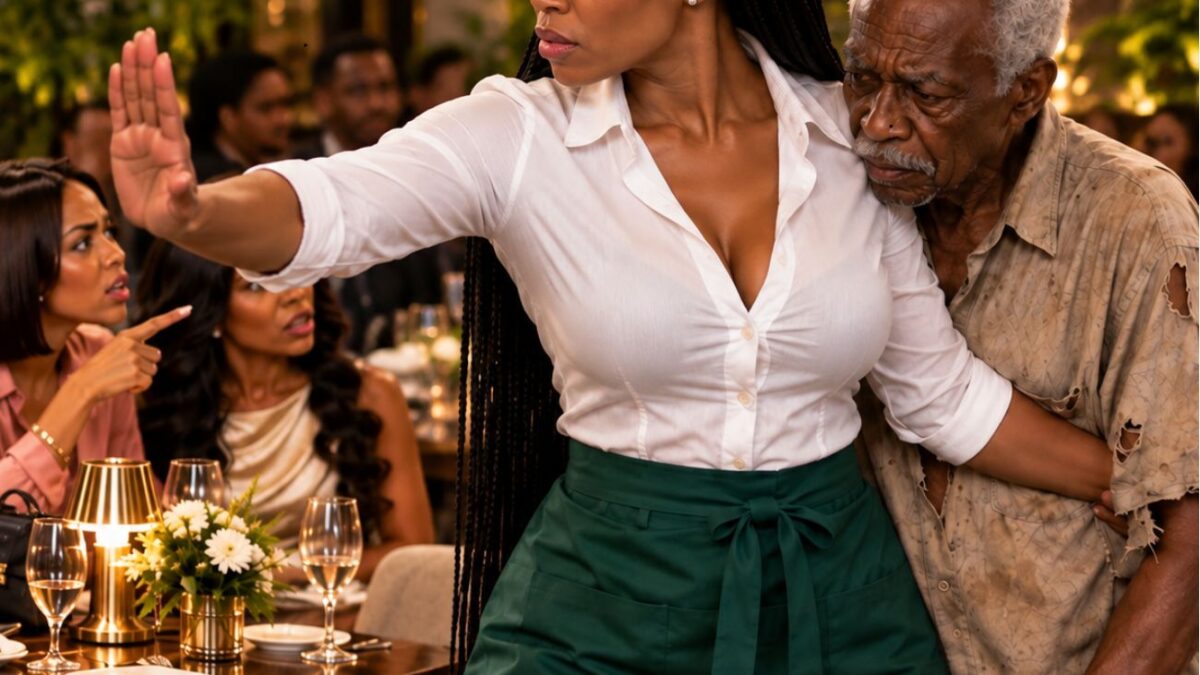
The air inside Meridian was thick with the scent of roasted garlic, charred peppers, and excessive wealth. Crystal glasses chimed against porcelain while smooth jazz played softly from speakers hidden behind discreet brass fixtures. Nkiru Eze moved across the polished parquet floor with measured grace, balancing a heavy silver tray on three fingers.
“Excuse me,” a sharp, petulant voice sliced through the ambient warmth of the dining room. “Who seated him there?”
Nkiru paused, turning smoothly toward Table 14, where Renie Balogun sat enveloped in silk and diamonds. Beside her sat three executives in tailored Italian suits, their expressions carefully neutral, though their posture radiated unmistakable condescension. Renie’s manicured finger pointed toward Table 12, where an older gentleman sat alone in an unassuming cotton shirt.
“I did, ma’am,” Nkiru said, keeping her voice even, professional, and entirely unruffled.
“Table 12 was reserved for our spillover,” Renie snapped, tapping her French-manicured nails impatiently against the dark mahogany table. “We are discussing serious corporate business here tonight. Move him somewhere else immediately.”
“I am very sorry, ma’am, but that table was vacant,” Nkiru replied, stepping forward with unwavering poise. “The gentleman arrived and ordered before your party requested additional space. Restaurant policy gives seating priority to guests who are already seated and dining.”
“Do you have any idea how much money we are spending here tonight?” Renie sneered, her eyes raking over Nkiru’s pristine apron.
The elderly man at Table 12 set down his soup spoon, wiping his mouth with a linen napkin. His demeanor was calm, possessing an uncanny stillness that seemed out of place in a crowded restaurant. He looked up at Nkiru with soft, weary eyes and offered a gentle, self-deprecating smile.
“Young lady, it’s quite all right,” he said softly, beginning to push his chair back from the table. “Please don’t trouble yourself. I can move to the bar area.”
“No, sir,” Nkiru said firmly, placing herself gently between the two tables. “You have already ordered, and your meal is served. You have every legal and moral right to remain exactly where you are.”
“Interesting,” Renie said, leaning back and letting out a sharp, cold laugh that drew the attention of neighboring diners. “So now waitresses give lectures on constitutional rights along with the pepper soup.”
“A word, Nkiru,” the shift manager hissed, suddenly appearing at her elbow like a nervous shadow. Sola’s forehead was glistening with sweat, his eyes darting frantically toward the Balogun table. “Do you have any idea who that is? That is Renie Balogun.”
“And the gentleman sitting there is a paying customer,” Nkiru whispered back, her voice level and steady.
“Her father sits on the executive committee of our parent group!” Sola hissed under his breath, his voice trembling with panic. “Do you know what that means for this establishment? She can have us both terminated before sunrise!”
“Does her father’s title change the price of that man’s soup?” Nkiru asked, looking straight into Sola’s panicked eyes. “Does money determine basic human dignity on this dining room floor?”
“Don’t get clever with me, girl,” Renie interrupted, having overheard the exchange across the small aisle. “Honestly, an establishment like this desperately needs standards. Common people shouldn’t just wander in here off the street simply because they scraped together enough cash for a bowl of soup.”
“Ma’am, I must respectfully ask that we do not insult other diners,” Nkiru said, turning to face Renie directly.
“You will ask me?” Renie gasped, rising halfway from her seat in theatrical outrage. “You dare tell me how to speak?”
“Leave it, my dear,” the elderly gentleman pleaded once more, his hand raised placatingly toward Nkiru. “It is truly not worth your job. I am finished anyway.”
“Sir, if I keep quiet simply because she is wealthy, then I am agreeing that money determines who deserves respect,” Nkiru said, her clear voice ringing through the suddenly quiet dining room. “A restaurant is a public space. A person’s dignity does not fluctuate based on the balance of their bank account.”
“Sola!” Renie barked, slamming her palm down onto the table so hard the champagne flutes rang. “Either this insolent woman leaves this floor right this second, or my entire party leaves, and I call the board!”
Sola turned white as chalk, his chest heaving under his stiff waistcoat as he looked between the billionaire’s daughter and the composed waitress.
“Remove your apron, Nkiru,” Sola choked out, his eyes refusing to meet hers. “You are suspended. Effective immediately.”
Nkiru did not blink, nor did she flinch under the collective gaze of the dining room. She reached behind her back, untied the crisp black ribbon, and folded the apron neatly over her arm. She set it carefully upon the service station counter without a single wasted movement.
“Young woman,” the elderly gentleman called out softly, rising from Table 12 and walking toward her. His voice carried a strange, heavy authority that seemed far larger than his modest attire suggested. “Tell me, what is your name?”
“Nkiru Eze,” she answered politely, meeting his penetrating gaze without fear.
“I am deeply sorry that this indignity happened to you because of me,” he said, his eyes searching her face with profound intensity.
“It didn’t happen because of you, sir,” Nkiru replied quietly, adjusting the cuffs of her white shirt. “It happened because everybody else in this room was afraid.”
She turned on her heel and walked toward the staff locker room, her head held high as whispered conversations erupted behind her like dry leaves caught in a gust of wind.
Outside in the warm Lagos night, a sleek black sedan idled quietly in the shadows near the restaurant’s rear service alley. The elderly gentleman walked past the dumpsters, pulling a simple pair of reading glasses from his pocket. A nervous driver leaped out of the vehicle, bowing deeply as he scrambled to hold the rear door open.
“Chairman, Mr. Farin has been calling your private line repeatedly,” the driver stammered anxiously, clutching a buzzing smartphone. “He said you disappeared from the security detail for nearly three hours. He was frantic, sir.”
“Let him call,” Dapo Akinwale muttered, stepping into the leather interior of the luxury vehicle. “Tell my son I am on my way home.”
Thirty minutes later, Dapo walked into the minimalist study of the Akinwale penthouse in Ikoyi, where modern marble met warm African teak. His son, Farin Akinwale, was pacing the floor in an immaculate navy suit, a glass of untouched scotch resting on the desk. Farin spun around the moment the heavy doors clicked shut.
“Dad! You vanished from the driver for three hours,” Farin said, exasperation dripping from every word. “You turned off your tracking device. We were ten minutes away from alerting the commissioner.”
“I had dinner,” Dapo said smoothly, walking over to the bar to pour himself a glass of still water. “At Meridian. Your premier subsidiary restaurant.”
“Looking like that?” Farin asked, gesturing to his father’s faded cotton shirt and worn leather sandals.
“Looking like myself,” Dapo countered, turning to face his son with a piercing look. “Looking like an ordinary man who wanted a bowl of pepper soup without an entourage clearing the room.”
Farin rubbed his temples, letting out a heavy sigh before picking up his tablet from the mahogany desk. “There is already a video circulating online. Renie Balogun filmed the entire scene, bragging about putting staff in their place, but someone else posted the waitress’s response. It’s gaining traction.”
“Good,” Dapo said, taking a measured sip of water. “Let it circulate.”
“Good?” Farin echoed incredulously. “Dad, one of our managers suspended a dedicated employee on the spot simply for protecting an innocent customer from public humiliation. It reflects terribly on our brand values.”
“And now you know precisely what your company looks like when nobody recognizes the owner,” Dapo said coldly. “When power is invisible, true culture reveals its teeth.”
“I’ll terminate the manager tomorrow morning,” Farin said, already tapping out a memo on his screen. “We will issue an apology and reinstate the girl.”
“No,” Dapo commanded, his voice slicing through the quiet room with absolute finality.
Farin froze, looking up at his father in bewilderment. “Dad, why? The manager acted cowardly.”
“If you punish one frightened manager, everybody will behave well for exactly one week,” Dapo said, walking toward the expansive floor-to-ceiling windows overlooking the glowing city. “Punishment creates compliance, not character. Find out why he was so terrified of a board member’s daughter.”
“And what about the waitress?” Farin asked, stepping closer to his father’s side. “Nkiru Eze. What do you want to do with her?”
“She didn’t know who I was,” Dapo murmured, a faint, intrigued smile playing on his lips. “She looked at a billionaire’s spoiled child and an old man in a cheap shirt, and she chose fairness over survival. That is precisely why I am interested in her.”
The following morning, the corporate headquarters of the Akinwale Group hummed with its usual predatory efficiency. In the executive suite on the thirty-second floor, Farin sat behind an expansive glass desk, reviewing an HR file that had been expedited directly to his terminal. A discreet knock sounded at the door, and his head of corporate intelligence stepped inside.
“We pulled her complete employment file,” the intelligence officer reported, placing a slim digital folder before Farin. “Nkiru Eze. Thirty years old. Married. Holds a bachelor’s degree in hospitality management with first-class honors. Three years of solid supervisory experience at a boutique hotel before joining Meridian.”
Farin frowned, scanning the credentials. “With this resume, why on earth was she waiting tables instead of running an entire department?”
“Family financial collapse,” the officer replied bluntly. “She needed immediate cash flow, tips, flexible shifts. She has been carrying her household for nearly a year.”
“Anything else?” Farin prompted, sensing the hesitation in the man’s posture. “What aren’t you saying?”
“Her husband is Tobechukwu Eze,” the officer said quietly.
Farin’s pen stopped moving across the digital pad. He looked up, his sharp eyes narrowing into slits. “Finance division? Our former finance division?”
“Yes, sir,” the officer confirmed. “The forty-two million naira unauthorized procurement fraud from eight months ago.”
Farin leaned back in his ergonomic leather chair, letting out a long, incredulous breath. The irony was suffocating. “The woman who stood up to protect my father is the wife of the man we publicly disgraced and fired for embezzling corporate funds.”
Two hours later, Nkiru stood in the center of Farin Akinwale’s expansive office, her back straight and her eyes completely calm. She had arrived dressed in her best Sunday skirt and a modest cream blouse, carrying herself not like a chastised servant, but like a diplomat visiting a foreign territory. Farin gestured toward a plush leather chair across from him.
“Please sit, Mrs. Eze,” Farin said, studying her face for any sign of nervous recognition.
“I would rather remain standing, sir, until I know whether I am currently an employee of this company,” Nkiru stated without hesitation.
Farin observed her for a moment before nodding slightly. “Your suspension has been rescinded. The disciplinary notice has been struck from your record.”
“With my two missed shifts paid in full?” she asked, her voice entirely devoid of timidity.
Farin allowed a faint smirk to touch the corners of his lips. “Yes. With your shifts fully compensated.”
“Then thank you,” she said, nodding politely. “I will report for my evening shift at five.”
“Tell me something, Mrs. Eze,” Farin leaned forward, clasping his hands together on the glass desk. “Did you know who the man at Table 12 was?”
“No,” Nkiru answered promptly. “I did not.”
“Not even after he asked for your full name?” Farin pressed, his gaze piercing. “Not even when the whole restaurant began murmuring?”
“Mr. Akinwale, if I had recognized your father, would that make what I did less decent?” she asked calmly.
“It would make it far less useful as an objective measure of your character,” Farin countered smoothly.
“I am not applying to become anybody’s moral evidence,” Nkiru said, her tone sharp and precise. “I was doing my job. An honest customer deserves a peaceful meal. That is all.”
“Fair enough,” Farin conceded. He tapped his desk terminal, pulling up a live social media feed. “However, your viral moment has complicated matters. Renie Balogun has posted another video this morning. She claims you orchestrated the encounter to manufacture internet fame. People are turning a service dispute into a class war.”
“She is claiming I planned it?” Nkiru let out a cold, dry chuckle. “The arrogance of the wealthy is that they assume poor people spend all day plotting around their existence.”
“Our internal communications team is drafting a press release,” Farin said, watching her carefully. “They will manage the narrative.”
“No,” Nkiru interrupted, her voice firm and uncompromising. “Your corporate communications team will keep my name completely out of their press releases unless I personally review and approve every single word they publish.”
Farin stared at her, genuinely surprised by her sheer audacity. He tilted his head slightly, a dark memory flickering across his mind. “You know, your husband was remarkably difficult in precisely this way.”
Nkiru went utterly rigid. The quiet confidence in her eyes was suddenly replaced by a cold, protective hostility. “You know my husband?”
“He worked here,” Farin said quietly, watching her posture shift into defensive armor. “In this very building.”
The silence in the office stretched like a drawn bowstring, neither of them willing to release the tension.
When Nkiru arrived home that evening, the tiny two-room apartment in Surulere felt smaller and more stifling than usual. The hum of an old refrigerator filled the kitchen, competing with the distant drone of street traffic outside. Tobechukwu sat at the cramped dining table, surrounded by stacks of obsolete textbooks and an aging laptop with a cracked screen.
“You went to the Akinwale headquarters today,” Toby said without looking up from his papers, his voice hollow and strained.
Nkiru paused in the doorway, setting her handbag down on a worn side chair. “Your former employer summoned me. The CEO wanted to discuss my suspension.”
“You shouldn’t have gone,” Toby muttered, finally raising his bloodshot eyes. “You should not have stepped foot inside that cursed building, Nkiru.”
“Why?” she demanded, walking into the small living space. “Give me one rational reason why I shouldn’t go to the corporate office of the company that pays our rent.”
“Because you need to stay as far away from those people as humanly possible!” Toby shouted, slamming his hand onto the table. It was rare for him to raise his voice, and the sudden explosion startled them both.
Nkiru did not flinch; she crossed her arms, her gaze hardening. “They own the restaurant where I work, Toby. Unless you have discovered a secret hoard of cash, their payroll is currently the only thing keeping food on this table.”
“Then quit the damn job!” he cried out, burying his face in his calloused hands. “Quit today. We will find another way.”
“With what money, Toby?” she asked, her voice dropping into a dangerous, searing whisper. “With what savings? We have borrowed money for rent twice this year. Your mother still believes you are working as an independent corporate consultant because you cannot bear to tell her the truth.”
Toby looked away, his jaw clenched so tightly the muscles jumped beneath his skin.
“Half of your friends stopped returning your calls the very week the embezzlement scandal hit the papers,” Nkiru continued relentlessly, stepping closer. “I work fourteen-hour double shifts on my feet, and I come home and smile so I don’t crush your pride. Do not tell me to walk away from my income without giving me a real reason.”
“They destroyed me once, Nkiru,” Toby whispered, his voice cracking with humiliation. “I cannot watch them do it to you.”
“You told me you were framed,” Nkiru said, staring down at him. “You swore on your life that you never took a single kobo from that firm.”
“I was framed!” Toby insisted, looking up with desperate, pleading eyes. “I never stole from them! Not one naira!”
“Then what on earth are you hiding from me?” she asked, her voice trembling slightly. “Because an innocent man who was unjustly ruined does not act like a terrified fugitive every time his former company is mentioned.”
Toby swallowed hard, turning his gaze back to the cracked laptop screen, retreating once more behind a wall of suffocating silence.
Nkiru didn’t sleep that night. While Toby lay restless on their squeaking mattress, her mind raced back to eight months ago—to the night Toby came home sweating, his tie undone, whispering about an audit, a discrepancy, a vendor payment gone terribly wrong. He had insisted it was an administrative glitch, an internal trap set by rivals.
By dawn, her patience had entirely evaporated. While Toby was in the bathroom, Nkiru walked to his desk and pulled open the drawer containing his old corporate laptop—the one he claimed had suffered a permanent motherboard failure during his dismissal. She plugged it into a spare adapter she had secretly bought, holding her breath.
The screen flickered to life. The hard drive buzzed, loading an unencrypted backup folder Toby had painstakingly mirrored before his corporate credentials were wiped. Nkiru’s fingers moved across the trackpad, clicking through archived PDF documents until her eyes locked onto a single file: Vendor_Disbursement_Authorization_Oct14.pdf.
She opened it. Her breath hitched in her throat.
There, bold and undeniable in the authorization box, was Tobechukwu Eze’s digital signature. Above it, the approved payment amount was clearly listed in sharp, unmistakable print: NGN 42,000,000.
The bathroom door creaked open, and Toby stepped out, a towel draped over his shoulder. He froze when he saw the glowing blue screen illuminating her devastated face.
“Where did you get that?” he asked, his voice barely audible.
“Inside the dead laptop you swore was completely broken,” Nkiru whispered, her eyes fixed on the illuminated document. “Your signature is right here, Toby. Right here on the final payment release.”
“Nkiru, listen to me—”
“You looked into my eyes,” she said, tears finally spilling over her eyelashes, hot and furious. “You let me sell my mother’s gold bangles to pay the legal retainer. You swore to God Almighty you never signed off on stolen funds.”
“I didn’t steal it!” Toby yelled, rushing forward and dropping to his knees beside her chair. “Look at the original transaction log, Nkiru! Please, look at the audit trail!”
“It says forty-two million naira, Toby!” she cried out, pointing a trembling finger at the glowing screen. “How is that not theft?”
“Because the invoice I approved was for four million two hundred thousand!” Toby shouted, grabbing the edges of the desk. “It was an urgent maintenance payment! Four point two million! Someone modified the digital record on the server after my approval and added an extra zero!”
Nkiru stared at him, trying desperately to find the lie in his frantic, desperate eyes. “Who brought you that voucher, Toby? Who asked you to approve a transaction that hadn’t cleared procurement?”
Toby lowered his head, his shoulders slumping in absolute defeat. “Temi,” he whispered into the quiet room. “Temilade Akinwale.”
Nkiru felt the floor tilt beneath her feet. “The Chairman’s daughter? The Executive Director?”
“Yes,” Toby choked out, his voice buried in his chest. “She came to my desk personally. She said procurement was backed up, the vendor was threatening to halt critical operations, and she would take full responsibility. She asked me to trust her.”
Before Nkiru could process the revelation, her phone began buzzing loudly on the kitchen counter. It was a call from the Meridian general office. She wiped her face, swallowed her tears, and answered.
“Nkiru,” Sola’s nervous voice came through the receiver. “Don’t report to the restaurant today. Corporate guest relations wants you upstairs at headquarters. Immediately.”
Thirty minutes later, Nkiru was back inside the Akinwale tower, stepping out of the high-speed elevator into the hushed luxury of the executive boardroom. Instead of Farin, the elderly gentleman from Table 12—Chairman Dapo Akinwale himself—was seated at the end of the long mahogany table, flanked by Farin and a stern woman with braided hair.
“Please sit, Mrs. Eze,” Dapo said gently, gesturing toward the leather executive chairs.
Nkiru remained standing near the doorway. “Sir, with all due respect, every time this family invites me to sit down, my life becomes dramatically more complicated.”
Dapo let out a soft, appreciative chuckle, though his eyes remained serious. “Fair observation. We are conducting an extensive structural review of the service culture across all our hospitality subsidiaries. What occurred at Meridian the other night exposed a deep, systemic rot.”
“And you want me involved?” Nkiru asked, suspicion dripping from every syllable.
“For three months,” Farin answered, stepping forward. “Observing operations, training staff on guest rights, reporting directly to corporate ethics. It comes with an executive title and an appropriate compensation package.”
“A promotion because I defended an old man?” Nkiru asked, her eyes darting between father and son. “Or hush money to ensure I don’t file a public wrongful suspension lawsuit?”
“Neither,” Dapo said firmly. “An opportunity extended because you demonstrated absolute clarity and integrity under severe pressure. Qualities that are remarkably rare in this building.”
Nkiru took a slow, deep breath, clasping her hands tightly in front of her. “And what about my husband? I will not accept a single kobo from a company that branded my husband a criminal.”
Farin exchanged a brief, heavy look with his father before turning back to Nkiru. “The two matters may no longer be entirely separate, Mrs. Eze. Two days ago, our internal audit committee quietly reopened the forensic review into the forty-two million naira disbursement.”
Nkiru’s heart skipped a beat. “Why?”
“Because your husband consistently maintained throughout his disciplinary hearing that the transaction sum was altered post-approval,” Farin explained, pulling up an encrypted ledger on the wall monitor. “And this morning, our forensic specialists uncovered definitive digital evidence that the core transaction record was indeed modified.”
“Modified from where?” Nkiru demanded, stepping closer to the illuminated screen.
“From an executive terminal,” Dapo said, his deep voice heavy with an emotion that sounded dangerously close to sorrow. “From my daughter Temilade’s private workstation.”
Nkiru stood frozen, the breath trapped in her lungs. “Tobechukwu told me last night that she brought the voucher to his desk.”
Farin’s eyes narrowed slightly as he watched her reaction. “Your husband told you that only last night? Did he tell you everything else about Temilade?”
A cold knot formed in Nkiru’s stomach. “What else could there possibly be?”
Down on the fourteenth floor, inside a private conference room with frosted glass, a tense reunion was unfolding. Tobechukwu had been summoned under the pretext of clarifying historical transaction codes. When the door opened, however, it was not an auditor who entered, but Temilade Akinwale.
She was stunning, dressed in an impeccably tailored emerald pantsuit, her hair styled with flawless precision. Yet beneath the veneer of corporate power, her eyes were shadowed with profound exhaustion.
“You shouldn’t have come here, Toby,” Temi said softly, closing the heavy wooden door behind her.
“Your brother summoned me,” Toby replied coldly, keeping his arms crossed tightly against his chest. “Your family reopened the investigation into the fraud that ruined my life.”
“I know,” Temi whispered, leaning her back against the door. “Farin has turned the entire finance wing upside down. He won’t stop until he finds every thread.”
“Then you should be terrified,” Toby spat, his voice trembling with years of suppressed rage. “Because it went too far eight months ago when you sat in your executive office and watched me get fired, escorted out by armed security like a common thief!”
“I tried to protect you!” Temi insisted, taking an urgent step toward him. “I tried to handle it internally!”
“You protected yourself!” Toby shouted, his knuckles turning white. “I was trying to protect my marriage from unnecessary history, and you used that against me!”
“History becomes necessary when someone uses it as a weapon, Toby,” she said, her voice dropping into a desperate plea.
“Did you alter that payment voucher?” Toby demanded, stepping into her space, towering over her. “Did you add that zero?”
“No!” Temi said, her eyes flashing with genuine panic. “I swear to you, Toby, I never touched that authorization sum!”
“Your terminal did!” Toby snarled. “The digital footprint came directly from your private account!”
“Then somebody accessed my terminal!” Temi cried out. “Don’t you understand how this corporate viper pit works? I lost control of my own department!”
“I lost my entire career, Temi!” Toby roared. “I nearly lost my wife! My family was pushed to the absolute brink of starvation!”
“Then tell her,” Temi said, a sudden, bitter edge hardening her voice. “Tell Nkiru the whole truth. Or does she still not know who I am to you?”
Toby flinched, stepping back as if slapped across the face. “Temi, don’t.”
“Tell your wife we were together for four long years,” Temi said, her chin lifting defiantly. “Tell her we lived together in London. Tell her that before she ever met you, we were engaged to be married.”
The heavy conference room door swung open with a quiet, sickening click.
Nkiru stood in the frame, her hand still resting on the polished chrome handle. She stood perfectly still, her face utterly devoid of color, her eyes wide as she looked between her husband and the billionaire’s daughter.
“Engaged?” Nkiru whispered, the word sounding small and brittle in the vast, quiet room.
Toby turned around, panic instantly contorting his features. “Nkiru… please. It is not what it looks like. Let me explain.”
“Don’t touch me,” Nkiru said, stepping back into the hallway, her voice dropping to a terrifying, deadly whisper. “Do not take a single step toward me, Tobechukwu.”
“Nkiru, it ended two full years before I ever met you!” Toby begged, following her into the corridor, his hands raised in desperate supplication. “It was completely over!”
“You were engaged to the woman who later became your executive director,” Nkiru said, each word landing like a hammer blow. “The woman who personally recommended you for the corporate job that ended up destroying our lives.”
“Yes,” Toby choked out, tears brimming in his eyes.
“And in five years of marriage,” Nkiru said, her voice shaking with profound betrayal, “in five years of sharing a bed, sharing meals, and sharing debts, you never found a single evening to mention her name?”
“Because there was nothing between us anymore!” Toby pleaded, grabbing his own hair in agony. “There was nothing left! I swear it!”
“Then why hide it?” she cried out, drawing the startled glances of passing junior staff. “Why bury it like a corpse?”
“Because I knew exactly how it would sound!” Toby shouted desperately.
“No,” Nkiru said, shaking her head slowly as tears tracked through her powder. “You hid it because you knew exactly how it would feel. You signed that unverified payment voucher because she asked you to. Not because it was standard procedure. Because you still trusted her.”
“I made a professional mistake!” Toby argued, his voice breaking. “I made an error in judgment, but I did not steal!”
“You didn’t just make a professional mistake, Toby,” Nkiru said, looking at him with eyes full of sorrow. “You made a marital decision every single morning you woke up and chose to lie to my face.”
Her phone chimed sharply in her hand—an encrypted text message from an unknown number. Attached was a short, grainy video file.
Nkiru tapped the screen. The footage was from a hotel corridor in Abuja, timestamped six months after her wedding day. The video showed Tobechukwu standing outside Room 408, glancing nervously down the hallway before knocking. The door opened, and Temilade Akinwale pulled him inside.
Nkiru felt all the air leave her chest. She looked up from the screen, staring at Toby with an expression of pure, unadulterated horror.
“Open it,” a voice sounded behind them. Farin had emerged from the elevator bank, his face dark and grim. “We need everyone in the boardroom. Right now.”
Ten minutes later, the Akinwale boardroom was suffocatingly tense. Seated at the head was Chairman Dapo, flanked by Farin. Across from them sat Kunle Balogun—Renie’s father and the Chief Financial Officer—sweating profusely in his pinstripe suit. Temilade, Toby, and Nkiru sat on the opposite side, the emotional wreckage between them hanging heavy in the air.
“Did you have my sister’s security token, Kunle?” Farin asked, his voice deceptively mild as he tapped a folder on the table.
Kunle adjusted his silk tie, clearing his throat nervously. “Once. Only once, Farin. She was boarding a flight to an energy summit in Abuja, and procurement needed urgent sign-off on a quarterly board pack. It was a matter of administrative convenience.”
“Once is entirely sufficient,” Farin replied coldly. “You possessed the Executive Director’s unrestricted credentials for twenty minutes. And you never reported that anomaly to the compliance desk.”
“This is becoming ridiculous!” Kunle blustered, turning to Chairman Dapo. “Dapo, are you going to let your son interrogate me like a common clerk? We have built this conglomerate together for twenty-five years!”
“The excess thirty-seven point eight million naira moved through three distinct shell vendors,” Farin said, cutting through the bluster with relentless precision. “We tracked the final disbursement route this morning. One of those shell entities wired eleven million naira directly into a fashion investment vehicle. An entity that exclusively funds your daughter Renie’s boutique business.”
Kunle’s face drained of color. “Leave my daughter out of this corporate matter!”
“Your daughter publicly humiliated my father in our restaurant while wearing a diamond-encrusted watch purchased with funds embezzled from our treasury!” Farin shouted, slamming his fist onto the table. “You framed Tobechukwu Eze because you knew his prior personal connection to Temi would make him the perfect, silent scapegoat!”
“Ask your sister why she kept quiet!” Kunle snarled, backed into a corner, his eyes wild with malice. “You people love to play the righteous saints! Ask your holy father why he begged me seven years ago never to audit Temilade when corporate money vanished the first time!”
Dapo closed his eyes, his aged shoulders dropping slightly.
“What is he talking about, Dad?” Farin asked, turning slowly toward his father.
“Seven years ago,” Dapo spoke, his voice cracked with age and sorrow, “Temilade authorized twelve million naira for an unauthorized private venture. She was young, reckless, and in over her head.”
“And you buried the internal audit,” Farin whispered, stunned by the revelation.
“She repaid every single kobo within forty-eight hours!” Dapo defended himself, his voice rising in pain. “I was protecting my daughter’s future!”
“You were teaching Kunle Balogun that our governance rules were entirely negotiable,” Nkiru said, her voice cutting through the executive arguments like a sharp blade.
Everyone in the room turned to look at the waitress.
“You should know something about powerful dynasties, Mrs. Eze,” Dapo said softly, meeting her searing gaze. “We rarely tell outright lies. We simply determine which truths other people are strong enough to survive.”
“That is still lying when you are the person buried beneath the wreckage,” Nkiru said with absolute conviction.
“Enough of this theater,” Farin interrupted, pulling out two sets of legal documents. “Kunle Balogun, your employment is terminated immediately. Security is currently clearing your office, and the Economic and Financial Crimes Commission will receive our formal petition within the hour.”
Kunle stood up, glaring at Dapo with venom. “You will regret turning this into a public spectacle, Dapo. Dynasties don’t survive when they cannibalize their own.” He turned and stormed out of the boardroom.
Farin slid the second document across the table toward Toby and Nkiru. “Temilade will step aside from all executive duties pending a comprehensive board governance review. And Tobechukwu Eze will be formally cleared of all criminal allegations.”
Toby stared at the document, a glimmer of hope breaking through his despair. “Cleared?”
“The corporate registry will reflect that you breached internal protocol by signing an unverified voucher, but the accusation of theft is permanently expunged,” Farin explained. “There is a formal settlement. Back pay, significant compensation for reputational damage, and a glowing corporate reference.”
“What is the condition?” Nkiru asked instantly, her eyes narrowing at the dense legal paragraphs.
“Confidentiality,” Farin stated simply. “A standard non-disclosure agreement. Your family receives full financial restitution to clear your debts and rebuild your lives. The Akinwale Group survives the scandal without public humiliation.”
Toby reached for the pen, his hand shaking with eager relief. “It clears our rent, Nkiru. It pays off the medical debts. It gives us our dignity back.”
“Dignity?” Nkiru repeated, placing her hand firmly over the paper, blocking his pen. “You call signing an agreement to whisper the truth ‘dignity’?”
“I am tired, Nkiru!” Toby yelled, his voice cracking in front of the executives. “I am exhausted from being the man everybody looks at with pity and suspicion! I just want our peaceful life back!”
“Peace built on enforced silence is the exact disease that brought us to this table, Toby,” Nkiru said, her voice thick with heartbreak. “If you sign a document that forbids you from speaking the truth of your own innocence, you are letting them purchase your soul.”
She pulled her hand away, grabbed her purse, and walked out of the boardroom, leaving the pen resting on the unsigned settlement.
By evening, the corporate towers of Victoria Island were bathed in a dull amber twilight. Nkiru stood on the pedestrian bridge overlooking the expressway, watching the endless stream of headlights rushing into the dark. The city moved forward, indifferent to the small tragedies unfolding inside its penthouses and tenements.
Footsteps approached behind her, slow and hesitant. Toby stood a few feet away, clutching an unsigned manila folder.
“I didn’t sign it,” he said quietly, the wind whipping through his loose shirt.
Nkiru did not turn around. “Why? It was everything you begged for. Clean debts. A full bank account.”
“Because you were right,” Toby said, coming to stand beside her at the rusted railing. “If I took their hush money, I would spend the rest of my life looking at you and knowing I bought my comfort with our integrity.”
Nkiru closed her eyes, letting out a long, shuddering breath. “Then explain Abuja, Toby.”
Toby flinched, gripping the railing until his knuckles turned white. “Six months after our wedding, Temi called my private number. She sounded hysterical. She said she had information that would shatter multiple families if we didn’t meet in private.”
“And you went to her hotel suite without telling your wife,” Nkiru said, her voice dead flat.
“She told me she had a son,” Toby confessed, tears running freely down his cheeks now. “His name is Kehinde. He was eight months old at the time. She said the timeline of her pregnancy crossed over with the final weeks of our relationship. She believed Kehinde might be my biological son.”
Nkiru felt as though the concrete beneath her feet had dissolved. The noise of the traffic below faded into a distant, muffled roar. “A child?”
“I went to Abuja to find out if I was a father,” Toby wept. “I went there terrified, confused, and sick with guilt. She asked me if there was any chance for us to fix what we had, and I told her no! I told her I loved you! I refused her completely!”
“And the child?” Nkiru whispered, her heart breaking into a thousand pieces.
“Her father, Dapo, arrived at the hotel an hour later,” Toby explained, his chest heaving. “He was furious. He arranged an immediate private DNA test that very night through a high-end concierge lab. He said he wanted the matter buried before sunrise.”
“And the result?”
“Dapo handed me the official laboratory document the following week,” Toby said. “Paternity excluded. Zero percent probability. He told me to go home, love my wife, and never speak to Temi again.”
Nkiru turned to face him, her mind connecting the fragmented pieces of a monstrous puzzle. “Who was the collection technician listed on that document, Toby?”
“I don’t know,” Toby murmured, confused. “Dapo handled the entire logistics chain. I just gave a buccal swab in the hotel suite.”
Nkiru pulled her smartphone from her pocket. Another message had arrived ten minutes prior from the mysterious anonymous sender. It contained an address: Basement Level 2, Johnson Commercial Park. Come alone.
An hour later, Nkiru stepped into the damp, echoing concrete cavern of the underground parking garage. The hum of industrial exhaust fans reverberated off the stained walls. Parked near an emergency staircase was a familiar red sports coupe.
The tinted window rolled down, revealing Renie Balogun. Her usual arrogant smirk was entirely gone, replaced by a pale, manic anxiety.
“Before you say a word,” Renie said quickly, holding up a manicured hand, “I didn’t send you that hotel video. I may be petty, but I am not an investigator.”
“Then why are we meeting in a basement?” Nkiru asked, keeping a safe distance from the vehicle.
“Because my father was arrested two hours ago,” Renie said, her voice shaking with genuine terror. “The police raided his study, but they missed his secondary cloud backup drive. I went through his private files because I wanted to find leverage to get him out on bail.”
She reached through the window and handed Nkiru a heavy, sealed manila envelope.
“Why give this to me?” Nkiru asked, staring at the thick package.
“Because your husband’s name is all over it,” Renie whispered, glancing nervously around the empty garage. “And because whatever war is happening between my father and the Akinwales, I refuse to go to prison for their sins. Open folder KA-08.”
Nkiru tore open the envelope under the harsh glare of a fluorescent tube overhead. Inside was an original, certified laboratory document bearing the embossed seal of PathCare Forensics.
Subject: Kehinde Akinwale. Alleged Father: Tobechukwu Eze.
She flipped straight to the final conclusion on the third page. Her eyes widened, the words burning into her retinas: Probability of Paternity: 99.9987%. The alleged father cannot be excluded.
Nkiru stumbled backward against a concrete pillar, the cold stone biting into her shoulder blades. “The test was positive…”
“Dapo never gave your husband the real report,” Renie said, her voice trembling. “My father intercepted the laboratory courier eight years ago and substituted a forged negative result. He kept the real document in his vault as permanent blackmail against the Chairman.”
“Eight years,” Nkiru whispered, tears blinding her vision. “He has an eight-year-old son.”
“And that is why my father had complete control over Temilade,” Renie added, putting her car into gear. “He threatened to expose Kehinde’s true parentage to the public if she ever blew the whistle on his shell company invoices. Good luck, Mrs. Eze. You are going to need it.”
The sports car sped away, tires screeching against the painted concrete, leaving Nkiru alone in the cold, cavernous silence.
The confrontation took place the following afternoon in the sunlit living room of Temilade Akinwale’s private residence in Banana Island. Dapo Akinwale sat on an ivory linen sofa, looking older and more frail than ever before. Temi stood near the grand piano, her face pale, while Toby sat in an armchair, staring blankly at the certified DNA document resting on the glass coffee table.
“He is my son,” Toby whispered, his voice completely hollow, devoid of inflection. “I have a son.”
“Toby, please,” Temi wept, covering her mouth with trembling hands. “I didn’t know Dapo gave you a forged report! I swear on my life, I believed the negative result just like you did!”
Toby slowly turned his gaze toward the patriarch of the family. “Did you alter it, sir? Did you take eight years of my child’s life away from me?”
Dapo did not look away; his jaw remained set, though his eyes were clouded with deep remorse. “Yes. I authorized the substitution.”
“You took eight years from me!” Toby roared, leaping to his feet, knocking his chair backward. “I had a son while I was begging for interviews! I had a son while my wife and I were praying for a miracle! You stole my child!”
“I prevented five prominent lives from completely disintegrating!” Dapo shouted back, rising to his feet with sudden, fierce energy. “You had just married Nkiru! Temi was married to Deji, whose family held half our infrastructure debt! If that scandal had broken, both marriages would have been annihilated, two conglomerates would have collapsed, and an innocent infant would have been dragged through the gutter of national tabloids!”
“You didn’t prevent lives from collapsing, Mr. Akinwale,” Nkiru spoke, her voice cutting through the shouting like ice water. “You simply decided whose lives were allowed to collapse.”
Dapo turned to look at her, his chest heaving under his embroidered tunic.
“You decided that my marriage was disposable,” Nkiru said, stepping forward, her eyes blazing with absolute moral authority. “You decided that my dignity, my home, and my husband’s future were acceptable collateral damage to preserve your family’s pristine social standing.”
“There is something else you must understand, Nkiru,” Dapo said quietly, pointing a finger at Toby. “Your husband did not return to the Akinwale Group by pure coincidence three years ago. He came back because of Kehinde.”
Nkiru froze. She turned slowly to look at Toby, whose face had gone completely gray.
“Is that true, Toby?” she asked, her voice dangerously calm. “Is what he saying true?”
“Not the way he is framing it, Nkiru,” Toby stammered, desperately reaching for her hand, which she instantly pulled away. “Please, let me explain.”
“Explain what?” she cried out, her composure finally shattering into raw agony. “Explain that you suspected all along? You told me you accepted the negative test!”
“I tried to accept it!” Toby yelled, tears streaming down his face. “I tried with everything in me to believe that piece of paper! But every time I saw a photograph of that boy, my soul screamed that he was mine! When Temi told me an internal finance role was open, I took it because I needed to be near him! Just near him!”
“We celebrated that job offer, Tobechukwu,” Nkiru sobbed, clutching her own chest as if trying to hold her heart together. “I went to the market and bought you that ridiculous blue silk tie with the last money in our account because you wanted to look sharp on your first day! I laid my hands on your head and prayed over your career!”
Toby fell to his knees on the Persian rug, sobbing uncontrollably. “I never approached him, Kiru! I swear to God, I never spoke to the boy! I only watched him from across the courtyard during company family days! That was all! I was terrified of losing you!”
“You keep using fear as an excuse for treachery!” Nkiru screamed, backing away from him as if he were a stranger. “You placed yourself inside this family’s toxic web, and when their corruption collapsed, you dragged me down into the mud with you!”
The heavy double doors of the living room opened smoothly, and Farin Akinwale walked inside, carrying a slim leather portfolio. He stopped, taking in the devastating tableau of broken people scattered across the opulent room.
“It is finished,” Farin announced quietly. “The board has accepted Temilade’s formal resignation from all executive roles. Kunle Balogun has been formally remanded in custody. And our corporate PR team has issued a full, unconditional retraction regarding Tobechukwu Eze.”
Nobody moved. The corporate victory felt as hollow and lifeless as a tomb.
Nkiru wiped her face, turning her back on Toby and facing Farin. She pulled her phone from her pocket and tossed it onto the glass table next to the positive DNA report.
“It was you,” Nkiru said, her voice dropping into cold, razor-sharp certainty.
Farin paused, his eyes flickering toward the phone before meeting hers. “What are you talking about?”
“The anonymous text messages,” Nkiru said, stepping toward him. “The CCTV footage of the Abuja hotel suite. The leaked internal server logs. The coordinates to Kunle’s backup files in the parking garage. It wasn’t an external hacker. It was you.”
Dapo and Temi looked at Farin in utter shock.
“Farin?” Temi whispered, her voice trembling. “You did this to us?”
Farin stood straight, his face an impenetrable mask of cool corporate calculation. He did not deny it. He looked at Nkiru with an expression that bordered on profound respect.
“You used me,” Nkiru said, her voice shaking with rage. “You used my anger, my pain, and my marriage as a battering ram to clean out your father’s corrupt empire.”
“If I had confronted my father directly with allegations of past forgery, he would have closed ranks with Temilade,” Farin explained, his voice entirely devoid of remorse. “He would have buried the evidence, paid off Kunle indefinitely, and let the rot consume the foundation of this company.”
“So instead, you detonated the bomb inside my living room!” Nkiru cried out, her fists clenched at her sides.
“Your husband should have told you the truth eight years ago,” Farin replied coldly. “I did not create his lies, Mrs. Eze. I merely exposed them.”
“Do not dare use his failure to wash your own hands clean!” Nkiru shouted, stepping directly into his face. “Why me? Out of all the people in this city, why did you drag me into your sick family war?”
“Because my father respects you,” Farin said softly, his eyes never leaving hers. “Because for the first time in thirty years, an ordinary person looked Chairman Dapo Akinwale in the eye and refused to bend the knee to his wealth. Because Temi feared your judgment far more than she feared mine. And because I knew Toby loved you enough that, under enough pressure, he would finally stop lying.”
“You studied my marriage like an efficiency spreadsheet,” Nkiru whispered, horror dawning across her face.
“I needed the absolute truth to surface,” Farin said, gesturing toward the papers on the table. “And now, the truth is out. For everyone.”
“Truth is not automatically justice simply because a billionaire decides the precise hour of its release,” Nkiru said, her voice ringing with absolute finality.
She turned around, looking down at Toby, who remained kneeling on the floor, broken, weeping, and utterly stripped of his illusions. She looked at Temi, who was clutching a framed portrait of her son, terrified of the legal and emotional battles ahead. She looked at Dapo, a powerful king sitting alone amidst the ruins of his moral compromises.
Nkiru picked up her handbag from the side table. She smoothed down the fabric of her skirt, holding her head high, her spine straight and unbreakable.
Without another word, without a single backward glance at the wealth, the power, or the men who had tried to define her worth, Nkiru Eze walked out the front door and stepped into the blinding afternoon sun, finally and completely free.

