Poor Girl Was Washing Clothes by the River — Billionaire Fell to His Knees After Seeing Her Necklace
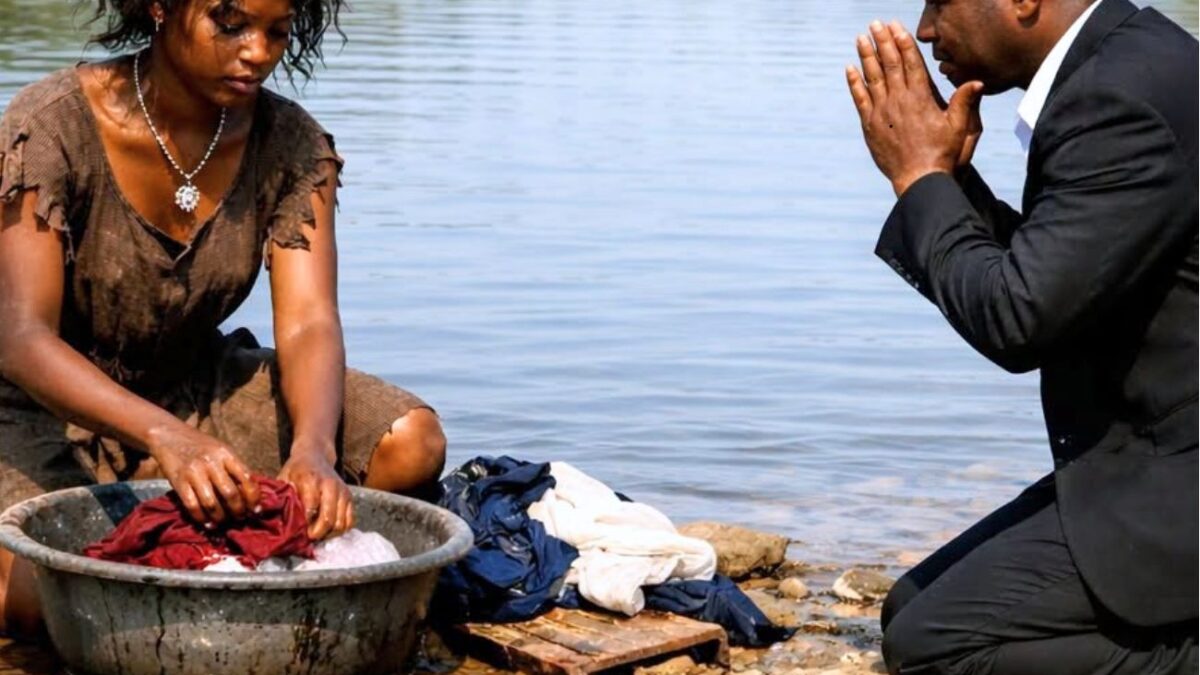
Part 1
The slap landed so hard that Zainab fell into the red mud, and the whole compound went silent except for the sound of her aunt shouting that an orphan had no right to protect a dead woman’s necklace. The clay bowl of soaked garri slipped from Zainab’s hands and broke near the outdoor kitchen. Her knees were bleeding, her faded blue wrapper was stained, and the small brass pendant on her chest swung like the last thing in the world still willing to stay with her.
Auntie Morenike stood over her with a wooden spoon in one hand, eyes burning with anger.
—Remove that useless chain before I tear it from your neck.
Zainab covered the pendant with both palms.
—It belonged to my mother.
Morenike laughed bitterly.
—Your mother died poor, coughing on a mat. What inheritance can a poor woman leave except shame?
Zainab said nothing. In Ijoba village, near the banks of the Niger, silence had become her only protection. Since her mother’s death 8 years earlier, she had lived under Morenike’s roof like unpaid help. She fetched water, scrubbed pots, washed clothes for neighbors, swept the compound, and ate only when leftovers remained. Morenike’s children wore neat uniforms to school, while Zainab washed those same uniforms by the river with cracked hands and an empty stomach.
That morning, Morenike sent her out before sunrise with 2 basins of dirty clothes balanced on her head.
—Wash everything before noon. If any woman complains, you will sleep outside tonight.
The riverbank was already misty when Zainab arrived. She knelt on a flat stone and began scrubbing. The cold water entered the small cuts on her fingers, but she did not stop. Women came and went, laughing, gossiping, pretending not to see her pain. Some called her river girl. Others said no man would marry a girl who carried misfortune like a shadow.
Only the necklace gave her strength. Her mother, Hauwa, had held it in trembling hands on the night she died.
—Never remove it, Zainab. One day, the man who forgot us will see it, and the truth will wake up.
Zainab had been 10 then.
—Which man, Mama?
Her mother had only cried and pressed the pendant to Zainab’s chest.
—When he sees it, he will know.
By midday, dizziness blurred Zainab’s eyes. She stood to rinse a wrapper and nearly fell into the water. That was when she heard footsteps behind her, slow and heavy, unlike the barefoot steps of villagers. She turned.
A tall man stood beneath a mango tree, dressed in a simple white kaftan, but everything about him carried power. His sandals were clean, his wristwatch expensive, his eyes sharp and wounded. He looked first at her face, then at her bleeding hands, then at the necklace.
The color drained from him.
—Where did you get that pendant?
Zainab stepped back.
—My mother gave it to me.
His voice became almost a whisper.
—What was her name?
—Hauwa.
The man staggered as if somebody had struck him.
—No… no, it cannot be.
Zainab’s heart began pounding.
—Did you know her?
He moved closer, eyes wet, staring at the pendant like it had dragged him out of a grave.
—I gave her that necklace.
Zainab stopped breathing.
Before she could ask another question, women at the riverbank began whispering. One ran toward the village path. The stranger noticed them, wiped his face quickly, and stepped back.
—Listen to me carefully. Do not let anyone take that necklace. I will come back.
—Who are you?
He looked at her with guilt so deep it frightened her.
—A man who should have returned 18 years ago.
Then he turned and walked away fast, leaving Zainab trembling by the river, one hand on the pendant, while the village women stared at her as if the poor orphan had suddenly become a dangerous secret.
By evening, Morenike already knew. She dragged Zainab into the compound and locked the gate.
—A rich man spoke to you because of that chain?
Zainab backed away.
—Auntie, please.
Morenike’s eyes shone with greed.
—Tonight, you will tell me everything. And if you lie, by morning, that necklace will no longer be yours.
Part 2
Morenike waited until the village slept before she attacked again. She came into the small back room where Zainab lay on a raffia mat and grabbed her by the blouse, nails digging into her shoulder. Zainab twisted away, clutching the pendant under her clothes, but Morenike was stronger. She dragged her into the courtyard, where her eldest son, Tunde, stood holding a lantern with a cruel smile. The night smelled of smoke, damp earth, and fear. Morenike hissed that poor girls did not meet powerful men by accident. She accused Zainab of planning to abandon the family after all the years of “feeding” her. Zainab finally broke. She told her aunt that starvation was not feeding, insults were not training, and beatings were not love. The words shocked even her. Tunde slapped her, and the pendant slipped out from her blouse, catching the lantern light. Morenike froze. On the back of the brass pendant was a tiny engraved mark she had never noticed before: K.A. Zainab saw it too and remembered her mother’s dying whisper about a man who forgot them. Before Morenike could snatch it, someone knocked on the gate. Not a timid knock, but the kind that belonged to people who had authority. Morenike stiffened. Outside stood the same stranger, this time with 2 elderly chiefs, a lawyer from Abuja, and Mama Sade, the only woman in the village who had ever secretly given Zainab food. The stranger introduced himself as Chief Kola Adeyemi, a billionaire construction magnate from Lagos whose name even village children knew. Morenike’s knees almost gave way. Kola did not smile. He asked to see Zainab. When she stepped forward with a swollen cheek and torn sleeve, his face hardened in a way that made Tunde step back. He told the elders that 18 years ago, he had loved Hauwa before wealth, before titles, before Lagos swallowed him whole. He had left to chase a contract, promised to return, and never did. When he finally came back years later, he was told Hauwa had died and left no child. Morenike shouted that Hauwa’s child belonged to no man and that Zainab was only a burden they had carried. Mama Sade stepped forward and revealed what she had hidden for years: Hauwa had been pregnant when Kola left, and Morenike had collected money from people claiming it was for Zainab’s school fees, but the girl never saw a classroom after age 11. The lawyer opened a brown envelope. Inside was an old photograph of Hauwa wearing the same necklace beside Kola, and a hospital record naming him as the man Hauwa had listed as Zainab’s father. Zainab felt the ground shift beneath her. Kola turned to her, voice breaking, and said that the pendant was not just proof of love. It was proof of blood. Morenike screamed that papers could be forged, that rich men could buy anything, that Zainab was cursed. Then Tunde, desperate to protect his mother, lunged toward Zainab and tried to tear the necklace away. Kola caught his wrist before he touched her. The village gate had opened by then, and neighbors had gathered outside, watching. Kola ordered the lawyer to call the police. Morenike fell to the ground, begging, but it was too late. Zainab stood in the center of the courtyard, shaking, tears running down her face, as the man she had feared was a stranger looked at her and whispered that she was his daughter.
Part 3
By sunrise, the entire village had gathered beneath the old iroko tree, not for a festival, not for a funeral, but to watch truth walk into the open. Zainab stood beside Mama Sade with the necklace visible on her chest, her cheek still swollen, her eyes red from crying. Chief Kola Adeyemi arrived in 3 black cars, but he did not walk like a proud rich man. He walked like someone carrying 18 years of shame. The elders sat in a half circle. Morenike and Tunde were brought forward, guarded by 2 local officers. Women whispered behind their hands. Men who once mocked Zainab avoided her eyes. Kola stood before everyone and told the story plainly: how he loved Hauwa, how ambition made him careless, how lies and cowardice kept him away, and how the necklace had dragged him back to the truth. He showed the photograph. He showed the hospital record. He showed letters Hauwa had written but never sent, letters Morenike had hidden inside an old wooden box because she feared that if Kola returned, her control over Zainab would end. When the elders opened the letters, Hauwa’s words silenced the square. She had begged Kola to come home. She had written that their daughter had his eyes. She had written that even if he failed her, she prayed he would not fail the child. Zainab covered her mouth and sobbed. Kola could not stand anymore. In front of the village, the billionaire dropped to his knees in the dust before his daughter. Gasps rose everywhere. —Zainab, I cannot ask you to forget what my absence cost you. I cannot buy back your childhood. But I can spend the rest of my life standing where I should have stood from the beginning. If you accept me, I will be your father publicly, legally, and with all my heart. If you reject me, I will still protect you because you owe me nothing. Zainab looked at the man kneeling before her and saw not power, but regret. She also saw her mother’s tired smile, her cracked hands, her dying hope. —Stand up, she said softly. Kola rose slowly. —I will not call you Father today just because people are watching, she said. —But I will allow the truth to begin. Kola wept openly. The elders ordered Morenike to return everything she had taken from Hauwa’s room and declared that Zainab would no longer live under her roof. The police took statements about the beatings and stolen money. Morenike begged Zainab for mercy, but Zainab only said that mercy did not mean returning to chains. That afternoon, she left Ijoba village in Kola’s car, wearing the same faded wrapper and the same necklace, but no longer carrying the same shame. Lagos overwhelmed her at first: glass buildings, loud roads, lights that did not sleep. Kola gave her space, tutors, care, and time. He did not force affection. He earned trust slowly. Months later, Zainab returned to the village, educated, steady, and dressed with quiet dignity. She opened the Hauwa Girls Foundation beside the river, paying school fees for girls who washed clothes instead of learning to read. Mama Sade became its first guardian. At the riverbank, Zainab knelt only once, not to scrub another person’s clothes, but to place white flowers where her mother used to wash pain into the water. Kola stood behind her, silent. Zainab touched the pendant and whispered that the truth had finally found its way home. The river kept flowing, but the village never looked at poor girls the same way again.

