Poor Cleaner Saved A Trapped Man At A Collapsed Building Unaware He’s A Billionaire Who Will…
Part 1
The crowd watched a man suffocating under broken concrete while a tired cleaner in torn slippers became the only person brave enough to move.
At 6:18 that evening, the old 4-storey building beside Balogun Market in Lagos gave a deep groan and collapsed like wet sand. Dust swallowed the street. Traders screamed. Buses stopped. People ran, then returned slowly with phones raised, recording the disaster from a safe distance.
Inside the rubble, a man was still alive.
—Please! Somebody! I can’t breathe!
The voice came from beneath a slab of concrete near the front entrance. People shouted, prayed, cursed the landlord, blamed the government, and called emergency services, but nobody stepped forward.
A young woman in a faded blue cleaning uniform stood at the edge of the crowd, clutching a small nylon bag that held leftover jollof rice for her younger brother. Her name was Amara Okonkwo. She had just finished cleaning offices on Victoria Island and was trying to get home to Ajegunle before nightfall.
Then the trapped man cried again.
—Please, my legs… please!
Amara looked around. Strong men stood there. Men with muscles. Men with safety boots. Men shouting instructions to nobody.
—Why is nobody helping him? she asked.
A trader beside her grabbed her arm.
—Sister, don’t try rubbish. That place can fall again.
Amara stared at the broken building. Iron rods stuck out like claws. Blocks hung dangerously. Dust still poured from cracks in the remaining wall.
Her whole body shook.
But the man’s voice was becoming weaker.
—Please… I don’t want to die here.
Amara dropped her nylon bag.
—God, hold me.
Before anyone could stop her, she stepped over the first pile of broken blocks.
—Hey! Come back! Are you mad?
She ignored them.
The closer she got, the worse the air became. Cement dust burned her throat. Her palms scraped against rough concrete as she crawled toward the voice.
—Where are you?
A hand appeared through a narrow gap, trembling, covered in grey dust.
Amara grabbed it.
—Hold me. Don’t sleep.
The man squeezed weakly.
—Water…
She turned to the crowd.
—Water! Please!
A woman threw a bottle. Amara caught it, opened it with shaking fingers, and dripped water into the man’s mouth. His face came into view when she shifted a loose block. He was well dressed, maybe around 40, in a torn charcoal suit and a wristwatch that looked more expensive than everything Amara owned.
His eyes opened halfway.
—Thank you…
Then the concrete above them cracked.
The crowd screamed.
—Come out! It is falling again!
Amara looked at his legs. A heavy slab pinned them down. She grabbed a metal rod and pushed it under the concrete. Her arms burned. Her back screamed. The slab barely moved.
—Please don’t leave me, she whispered.
She pushed again with everything she had.
The slab shifted.
The man groaned.
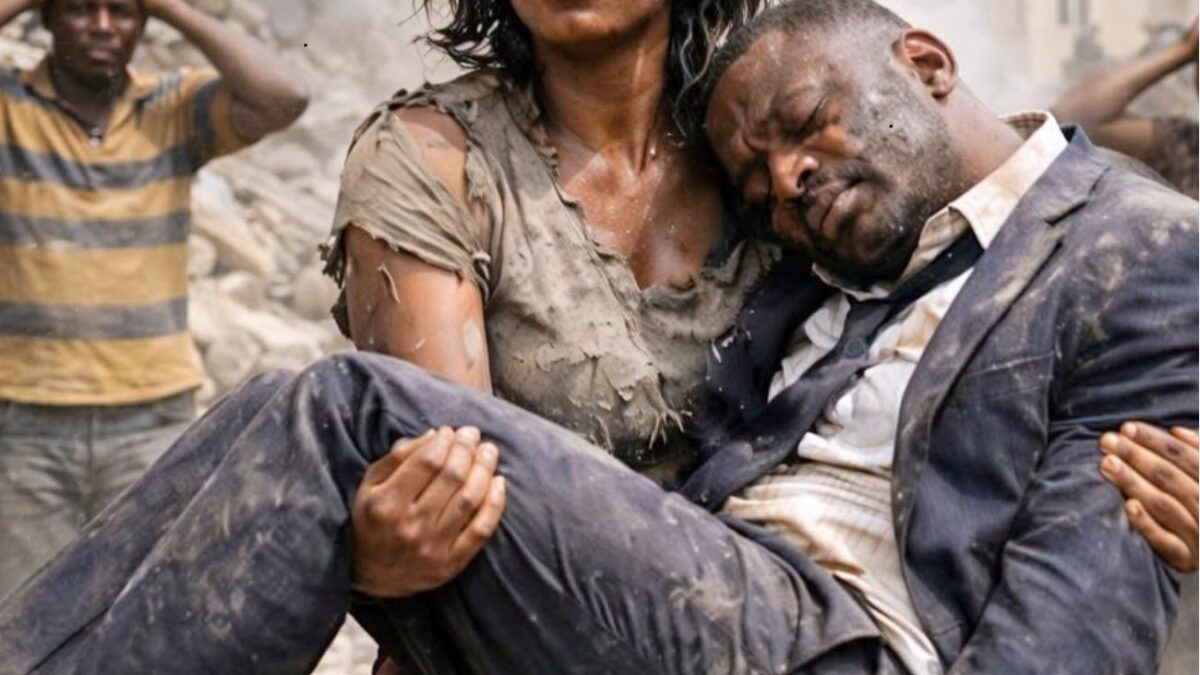
Amara dragged him by the shoulders, inch by inch, until his body rolled free. He was too heavy for her, but fear gave her strength. She pulled him against her chest and stumbled away just as the remaining wall crashed behind them with a sound like thunder.
Dust exploded across the street.
People shouted her name, though most of them had only learned it from a woman who recognized her from the cleaning company.
An ambulance finally arrived. Nurses rushed forward and lifted the unconscious man onto a stretcher.
—Who is he? a doctor asked.
Amara shook her head.
—I don’t know. I only heard him crying.
As they pushed him inside the ambulance, Amara climbed in after them.
—Madam, you cannot enter.
—Please. I pulled him out. I need to know if he lives.
The nurse hesitated, then moved aside.
Inside the ambulance, the man lay still with an oxygen mask over his face. His chest rose slowly. Amara sat frozen, her hands covered in dust and tiny cuts.
Then his fingers twitched.
His eyes opened for 1 second.
He looked straight at her and whispered:
—Amara.
Her blood went cold.
She had never met him before.
Part 2
The ambulance tore through Lagos traffic while Amara stared at the man as if he had risen from a dream she had forgotten. She had not told him her name. Nobody inside the ambulance had said it. Yet he had whispered it clearly, like someone who had been searching for her long before the building fell. At First Mercy Hospital, doctors rushed him into emergency surgery and left Amara in the hallway with dust in her hair, blood on her palms, and fear sitting heavy in her chest. She waited through the night. By morning, a doctor came out with tired eyes. —He is alive, but his spine suffered a serious impact. We cannot promise he will walk again. Amara covered her mouth. She did not know why the news hurt so deeply. He was a stranger, but she had carried his breath in her hands. On the 3rd day, a convoy of black SUVs arrived. Men in suits filled the corridor. A tall woman in gold lace nearly collapsed when she saw him through the glass. —Tunde, my brother, what have they done to you? Amara stepped back. The oldest man among them turned sharply. —Who is this girl? The doctor answered before Amara could speak. —She rescued him. Alone. The man stared at her torn slippers and dusty uniform. —Do you know who you pulled out of that building? Amara shook her head. —That is Tunde Adebayo, CEO of Adebayo Atlantic Group. Amara’s legs nearly failed. The name was everywhere in Lagos: real estate, oil logistics, hotels, politics. The woman in gold lace, his sister Morenike, thanked Amara with cold politeness, but her eyes were suspicious. When Tunde finally woke, his first request was not for his lawyers, sister, or board members. It was for Amara. —She stays. Morenike stiffened. —Tunde, she is not family. —She stays, he repeated. Weeks later, Tunde was discharged to his mansion in Ikoyi, but he returned in a wheelchair. His anger filled the house. He refused food. He broke a glass against the wall after failing to stand. Nurses resigned. His family whispered that the accident had destroyed not only his body but his mind. Amara came to return the hospital blanket he had lent her, intending to leave quietly, but Tunde saw her at the door. —Don’t go. Work here. Help me. —Sir, I am only a cleaner. —No. You are the only person here who looked at me like I was still alive. So Amara stayed. She helped him through pain, shame, and rage. She listened when he spoke about contracts. She corrected a calculation one night without thinking. Tunde froze. —Where did you learn that? —I studied accounting at Yaba College. I graduated with a 2:1, but nobody hired me. Morenike heard and later warned him privately. —Brother, poor girls don’t enter rich houses for nothing. Be careful. But the real betrayal came from inside the company. One midnight, Amara found Tunde’s chief operating officer, Bamidele, in the study, removing documents from a locked drawer. He smiled when he saw her. —Cleaner, go back to your mop. Before she could shout, he grabbed her wrist and hissed: —That collapse was not an accident. And if you love breathing, forget what you heard. Amara’s heart stopped when she saw the file in his hand. It contained photos of the same collapsed building, signed demolition warnings, and Tunde’s name forged at the bottom.
Part 3
Amara ran to Tunde’s room with the file pressed against her chest, but Morenike blocked her in the hallway. —Give me that, she said quietly. Amara stepped back. —You knew. Morenike’s face hardened. —I was protecting my brother’s empire. Tunde was becoming too soft. He wanted to cancel projects, compensate poor tenants, and expose people who helped us grow. Bamidele only did what had to be done. Amara’s stomach turned. —People died in that building. —And my brother almost died because he went there personally after receiving your petition. Amara froze. Months before the collapse, she had written a complaint about unsafe staff housing owned by a subsidiary of Adebayo Atlantic. She never knew Tunde had seen it. He had gone there to inspect the building because of her letter. That was how he knew her name. Morenike reached for the file. —Poor people should learn when to stay grateful. Amara screamed for Tunde. The door opened. Tunde stood there gripping a walking frame, his face pale with pain, but his eyes burning. —Say it again, he whispered. Morenike shook her head. —Brother, please. —Say again that my life is worth more than theirs. Silence swallowed the hallway. Security arrived. Bamidele tried to flee, but Tunde had already called the police. The documents, recordings from the study camera, and Amara’s testimony broke the entire conspiracy. Morenike wept when she was taken away, but Tunde did not stop them. —Family is not blood that hides your murder, he said. —Family is the hand that enters rubble when everyone else is watching. The scandal nearly destroyed his company, but Tunde chose truth over reputation. He paid every affected family. He rebuilt the homes. He created a foundation for unsafe housing victims and made Amara its director after she completed professional training. People mocked it at first. They called her “the cleaner who trapped a billionaire.” Tunde answered them publicly at a press conference, standing with a cane beside her. —This woman did not trap me. She saved me twice. First from concrete. Then from my own blood. Years passed. Tunde walked again, not perfectly, but proudly. Amara became known across Lagos as the woman who fought buildings before they fell. Their love grew slowly, not like a fairy tale, but like something planted in pain and watered with courage. On their wedding day, Tunde did not arrive in a wheelchair. He walked down the aisle with a cane, stopped before Amara, and whispered: —I knew your name before I knew your face because your letter carried more truth than my whole boardroom. Amara cried and held his hand. Later, when they had a son, they named him Chidi, because God had been present in the dust, in the hospital, in the betrayal, and in the quiet miracle of 2 people who refused to let each other fall.

