Oak Haven had already begun auctioning a widow’s seven children to pay her dead husband’s debt when a massive shadow crossed the square.
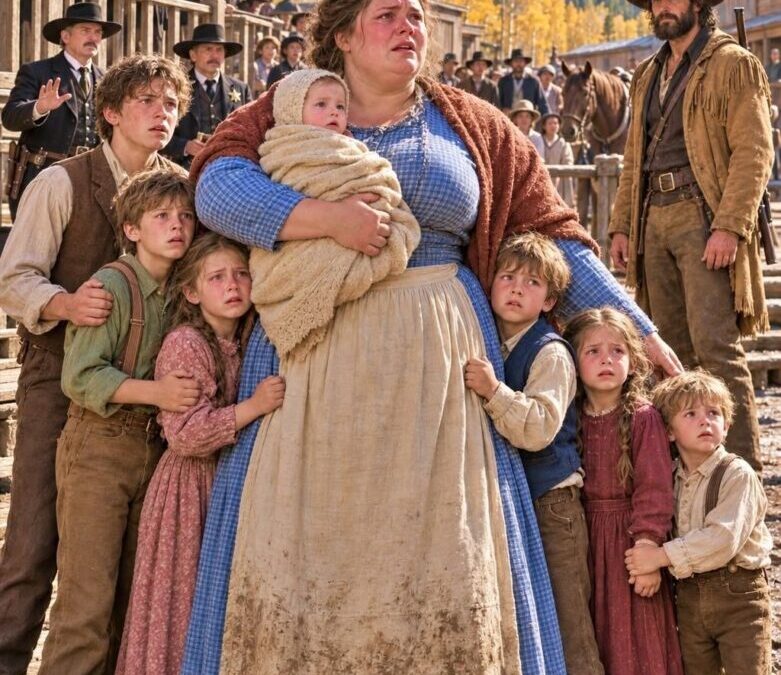
Oak Haven had already begun auctioning a widow’s seven children to pay her dead husband’s debt when a massive shadow crossed the square.
Everyone turned toward the mountain man they feared most—and what he said next stopped the bidding cold.
The gavel slammed down, echoing through the dusty streets of Oak Haven.
Seven sobbing children clung to their mother, a heavy-set, desperate widow the town had mercilessly thrown to the wolves.
They were to be split up, sold off as mere labor.
Then a massive shadow blocked the sun.
The mountain man had arrived.
The Colorado Territory in the autumn of 1878 was a place completely devoid of mercy.
The biting wind that howled down from the jagged peaks of the Rockies stripped the gold from the aspen trees and the hope from the weak.
And on this particular Tuesday morning, Oak Haven was a town that had decided to rid itself of a burden.
That burden was Josephine Dalton.
Josie, as she was known before the town turned its back on her, stood in the center of the muddy town square.
She was a woman of substantial girth, where the harsh frontier starved most women down to raw sinew and bone.
Josie was undeniably, unapologetically fat.
She had a wide, heavy frame, thick arms that had scrubbed a thousand floors, and a round, plump face, currently flushed crimson with sheer panic.
Beneath her faded gingham dress, her broad chest heaved as she struggled to catch her breath, her stout legs trembling under her own considerable weight and the crushing reality of her circumstances.
Her husband, Arthur Dalton, had been dead for exactly three weeks.
He had been swallowed whole by a collapsing shaft in the Deep Vein silver mine, leaving Josie with nothing but a mountain of gambling debt.
She knew nothing but a barren tract of rocky farmland and seven children.
They clung to her voluminous skirts like frightened ducklings.
Wyatt, the eldest at 14, stood stiffly at her side, his jaw tight, trying to look like the man of the house.
Behind him huddled Levi and Clara, twins of 12, followed by 10-year-old Amos, 8-year-old Ruth, 6-year-old Seth, and the baby, little Pearl, who was buried deep against Josie’s ample bosom.
“”Order, I will have order in this square,”” bellowed Mayor Josiah Higgins.
He stood on the wooden boardwalk outside the Assayer’s office: a ledger in one hand and a gavel in the other.
Beside the mayor stood Clement Reed.
Reed was the owner of the Oak Haven Bank, a man with a heart as cold as a minted coin.
It was Reed who had called in Arthur’s debts.
It was Reed who had foreclosed on the Dalton cabin.
And it was Reed who had invoked the archaic territorial vagrancy and orphanage act.
“”Mrs.
Dalton,”” Reed said, his voice dripping with false sympathy, cutting through the murmurs of the gathered townsfolk, “”You must understand we are doing this for the good of the children.
You are entirely destitute.
You cannot feed yourself, let alone seven growing mouths.””
“”I can work,”” Josie yelled, her voice cracking.
She squeezed little Pearl tighter, her thick arms trembling.
“”I’ll take in laundry, I’ll bake, I can clean the saloons, Mr.
Reed, just give me a month.””
A cruel scoff echoed from the crowd.
It belonged to Mrs.
Harriet Montgomery, the town’s wealthiest busybody.
“”Work?
Heavens, Josephine.
It takes you five minutes just to haul yourself up the church steps.
Who is going to pay you to clean?
You’d eat half the town’s flour supply, just trying to sustain yourself.
The bank is doing you a favor.”” Laughter rippled through the crowd.
Josie felt the heat of humiliation prickle behind her eyes.
She bit her lip, refusing to let the tears fall.
She knew she was heavy.
She had been plump her whole life, and carrying seven children had only softened and widened her further.
But her size didn’t mean she didn’t possess a mother’s fierce, desperate strength.
“”They are my flesh and blood,”” Josie roared, taking a heavy step forward.
The crowd actually took a half step back, intimidated by the sheer imposing mass of the angry mother.
“”You ain’t taking them from me.”” “”The law has already spoken, Mrs.
Dalton,”” Mayor Higgins said, banging his gavel.
“”The debt is $300.
Unless you have the gold in your apron, the property is forfeit.
And since you have no domicile, the children are hereby declared wards of Oak Haven.
We will now accept bids for their indentured placement.”” Josie’s knees buckled under her heavy frame.
Wyatt caught her arm, struggling under her weight, but managed to keep her upright.
The crowd began to murmur with sickening interest.
Local farmers needed cheap labor.
A 14-year-old boy was as good as a farmhand.
A 12-year-old girl could scrub pots.
They were going to tear her family apart piece by piece and sell them off to work in the freezing mud.
“”We will start with the eldest,”” Reed announced, stepping up to the edge of the boardwalk.
“”Wyatt Dalton, strong boy, 14 years of age, good for plowing and mucking.
Who will take his indenture for the sum of $50, payable to the bank’s debt?””
“”I’ll give 40,”” yelled a grizzled farmer from the back.
“”No!”” Josie shrieked, lurching forward.
She grabbed Wyatt by his collar, pulling him behind her broad back, shielding him with her own large body.
“”I’ll kill the first man that touches him.
I swear to God.
I’ll tear you apart!”” “”Sheriff, restrain the woman.””
Reed sighed, waving a dismissive, manicured hand.
Two deputies stepped forward, looking hesitant.
Josie was a massive, cornered bear of a woman, and the wild look in her eyes promised violence.
But they were armed and she was exhausted.
It was over.
Josie closed her eyes, the tears finally spilling over her plump cheeks, tracing paths through the dust on her face.
She prepared to throw her heavy body at the deputies, prepared to die in the dirt of Oak Haven before letting them take her babies.
Then the wind seemed to stop.
The horses tied to the hitching posts outside the saloon began to whinny and stomp in sudden, panicked agitation.
A shadow fell over the boardwalk…. .

The shadow stretched across the entire square.
For one strange second, nobody moved.
Then someone in the crowd whispered,
“Silas.”
Josie opened her eyes.
At the far end of Oak Haven’s main street stood a man so large that he seemed to have been carved from the mountain itself.
He wore a black wool coat dusted with snow, despite the fact that winter had not yet officially arrived.
A rifle was strapped across his back, and a weathered hat cast most of his face into darkness.
Silas Blackwood.
The mountain man.
Men in Oak Haven told stories about him.
They said he lived alone beyond the timberline.
They said he had killed three men who tried to steal his horses.
They said he could track a wolf through fresh snow and break a man’s wrist with one hand.
No one knew which stories were true.
No one was eager to find out.
Silas stopped beside the old water trough.
His eyes moved across the square.
The deputies.
The mayor.
Clement Reed.
The farmers.
Then finally Josie.
And the seven children hiding behind her.
His expression didn’t change.
But his jaw tightened.
Mayor Higgins raised his chin.
“Silas Blackwood.”
The mountain man’s voice was deep enough to make the boards beneath their feet seem to vibrate.
“What’s happening here?”
Nobody answered.
Silas looked at the gavel in the mayor’s hand.
Then at Wyatt.
Then at the twins.
Then at little Pearl, whose face was buried against her mother’s chest.
Finally, he looked directly at Clement Reed.
“Why are those children being sold?”
Reed swallowed.
“This is a lawful debt proceeding.”
Silas took one step forward.
“Answer the question.”
Reed cleared his throat.
“Arthur Dalton died owing the bank three hundred dollars.”
Silas glanced toward Josie.
“And?”
“She cannot pay.”
“And?”
Reed’s expression hardened.
“The children must be placed.”
Silas’s eyes narrowed.
“Placed?”
He looked at the auction block.
“You mean sold.”
A murmur swept through the crowd.
Mayor Higgins struck his gavel.
“This is none of your concern.”
Silas continued walking.
One step.
Then another.
The crowd parted without being asked.
He stopped directly in front of the boardwalk.
His height forced the mayor to tilt his head backward.
“I asked a question.”
Higgins tried to recover his authority.
“This is an official territorial proceeding.”
Silas looked at the ledger.
“Show me the law.”
“What?”
“The law you’re using to sell those children.”
The mayor’s face reddened.
“I don’t need to explain territorial statutes to some mountain hermit.”
Silas slowly removed his gloves.
“Then you won’t mind if I explain something to you.”
He tossed the gloves into the snow-dusted mud.
“I’ve been to Denver.”
A few people exchanged confused glances.
Silas reached inside his coat.
He withdrew a folded document.
“And I’ve spoken with a territorial judge.”
Reed’s face changed.
Silas held up the paper.
“This says a debtor’s children cannot be auctioned to satisfy a private gambling debt.”
Silence.
“You forged the order.”
Reed’s mouth opened.
Nothing came out.
Josie stared at Silas.
“Forged?”
Silas nodded.
“Arthur’s debt wasn’t three hundred dollars.”
Reed went pale.
Silas looked at him.
“It was sixty-seven.”
A collective gasp moved through the crowd.
Reed stepped backward.
“That is a lie.”
Silas reached into his coat again.
This time he produced several folded papers.
“Arthur paid you two hundred and thirty-three dollars over the last year.”
Reed stared at the receipts.
Silas tossed them onto the boardwalk.
“They were never credited to his account.”
Josie felt her legs go weak.
Arthur had told her something was wrong with the bank.
She had thought he was drunk.
She had thought the mine had broken him.
She had never known.
Silas looked at Josie.
“Your husband wasn’t a gambler.”
Her eyes filled.
“What?”
“He was investigating Reed.”
Reed lunged for the papers.
Silas caught his wrist.
The mountain man’s fingers closed around it.
Reed cried out.
Silas leaned closer.
“You should have left the children alone.”
Reed’s face twisted with pain.
“Let go.”
Silas released him.
Reed stumbled backward.
The crowd was completely silent now.
Mayor Higgins looked at the papers.
Then at Reed.
Then at Silas.
“What proof do you have?”
Silas turned toward him.
“Enough.”
He reached into his coat one final time.
And placed a small leather notebook on the boardwalk.
Josie’s breath caught.
She recognized it.
“That’s Arthur’s.”
Silas looked at her.
“I found it in the mine.”
She stepped closer.
“Why did you have it?”
Silas’s expression softened slightly.
“Because your husband gave it to me.”
The world seemed to disappear.
“He… knew you?”
Silas nodded.
“Arthur came to my cabin two weeks before he died.”
“Why?”
“He was afraid.”
Josie covered her mouth.
“Of what?”
Silas looked toward the bank.
“Clement Reed.”
Reed suddenly shouted.
“This is absurd!”
Silas ignored him.
“Arthur discovered Reed was falsifying debt records.”
The crowd began whispering.
Silas continued.
“He also discovered Reed had been buying up land from dead miners’ families.”
Mayor Higgins frowned.
“That would be fraud.”
“It is.”
Silas looked at the mayor.
“And you’re part of it.”
The mayor went still.
Josie looked from one man to the other.
“What happened to my husband?”
Silas’s eyes dropped.
“I don’t know.”
“What do you mean?”
“He was supposed to meet me the night he died.”
Josie’s face crumpled.
“He was coming home.”
Silas nodded.
“I know.”
“Then what happened?”
“I never saw him.”
He looked toward the mine in the distance.
“But I found his notebook after the collapse.”
Josie stepped forward.
“Why didn’t you come to me?”
Silas hesitated.
“Because I thought Reed would come after you.”
Josie’s voice broke.
“He did.”
Silas looked at the seven children.
“I see that.”
Then little Pearl lifted her head.
She stared at Silas.
The baby reached one tiny hand toward him.
Silas froze.
Pearl smiled.
“Bear.”
The crowd laughed nervously.
Silas looked genuinely confused.
“What?”
“She calls big men bears,” Josie explained softly.
Pearl reached for him again.
“Bear.”
Something changed in Silas’s face.
For the first time, the terrifying mountain man looked almost human.
He crouched.
The children stared.
“Come here, little one.”
Josie instinctively pulled Pearl closer.
Silas immediately stopped.
“I won’t touch her unless you want me to.”
That surprised Josie.
She studied him.
Then she looked at his eyes.
There was no threat there.
Only exhaustion.
“It’s all right,” she whispered.
Silas extended one finger.
Pearl grabbed it.
The mountain man smiled.
It was the smallest smile Josie had ever seen.
But it was there.
Then Wyatt stepped forward.
“You’re the man who lives at Black Ridge.”
Silas looked at him.
“Yes.”
“My father talked about you.”
Josie looked at her son.
“What did he say?”
Wyatt hesitated.
“He said Mr.
Blackwood was the only man around here who couldn’t be bought.”
Silas looked down.
For several seconds, he said nothing.
Then he looked at Reed.
“Your father was right.”
Reed’s face turned white.
The auction ended that afternoon.
Not because Mayor Higgins suddenly discovered compassion.
Not because Clement Reed developed a conscience.
But because Silas Blackwood walked into the bank with the territorial marshal behind him.
The marshal had arrived with two men from Denver.
By sunset, Clement Reed was under arrest.
Mayor Higgins resigned before anyone could arrest him.
And the ledger proving the scheme was taken into evidence.
But Josie’s problems were not over.
The Dalton cabin belonged to the bank.
At least, that was what Reed had claimed.
Silas examined the foreclosure papers.
Then he looked at Josie.
“Have you got somewhere to go?”
She shook her head.
“No.”
“Family?”
“No.”
“Friends?”
Josie laughed bitterly.
“Did you see what happened today?”
Silas’s eyes lowered.
“Yes.”
“Then you know.”
He nodded.
He was quiet for a moment.
Then he said,
“You and the children can stay at my ranch.”
Josie stared at him.
“What?”
“My ranch has room.”
“I can’t pay you.”
“I didn’t ask for payment.”
“I can’t work for free.”
“You wouldn’t be working for me.”
“Then why?”
Silas looked at the children.
“Because seven children shouldn’t sleep in a ditch because a banker stole their father’s money.”
Josie’s eyes filled.
She looked away.
“I don’t know you.”
“No.”
“You could be worse than Reed.”
Silas nodded.
“You’re right.”
She looked back at him.
He continued.
“So don’t trust me.”
That surprised her.
“Not yet.”
He picked up his hat.
“Trust what I do.”
Then he walked away.
Josie watched him disappear down the road.
Wyatt stood beside her.
“Ma?”
“Yes?”
“Can we go?”
She looked at her children.
Seven pairs of frightened eyes.
Seven little lives depending on her.
She took a deep breath.
“Yes.”
Silas’s ranch was nothing like Josie expected.
She expected a dark cabin.
A dangerous man.
Perhaps a few horses.
Instead, she found a sprawling mountain homestead tucked between pine forests and rolling hills.
There were barns.
A stable.
A smokehouse.
A vegetable garden.
Two horses.
Six cows.
And enough firewood stacked beside the cabin to survive three winters.
Silas opened the door.
“It’s not much.”
Josie stared.
“It has three bedrooms.”
“Yes.”
“We have seven children.”
“I know.”
“We’ll need more beds.”
“I can build them.”
She looked at him.
“You can build beds?”
“I built the cabin.”
That ended the conversation.
The children rushed inside.
For the first time in weeks, they laughed.
Josie stood in the doorway.
She felt something strange.
Safety.
She hadn’t felt safe since Arthur died.
Silas looked at her.
“You hungry?”
She nodded.
“Starving.”
“Good.”
He walked toward the kitchen.
“I made stew.”
Josie blinked.
“You cooked?”
“Yes.”
“What kind?”
“Deer.”
She sighed.
The children groaned.
Silas looked confused.
“What’s wrong?”
Amos raised his hand.
“We don’t like deer.”
Silas stared at him.
“Why?”
“It tastes funny.”
Silas considered this.
Then he opened a cupboard.
“I have beans.”
The children cheered.
Josie laughed.
The sound surprised her.
She hadn’t laughed since the funeral.
Silas looked at her.
She looked away.
Neither mentioned it.
The first weeks were difficult.
Silas was accustomed to silence.
The Dalton children were not.
Wyatt argued with him.
Levi broke a fence.
Clara stole biscuits.
Amos fell into the chicken coop.
Ruth cried whenever she couldn’t find her mother.
Seth followed Silas everywhere.
Pearl simply adored him.
And Josie worked from sunrise until dark.
She cooked.
She cleaned.
She mended.
She helped with the animals.
Silas watched.
One evening, he found her trying to lift a heavy sack of flour.
“Leave it.”
“I can handle it.”
“I know.”
He took the sack.
Josie frowned.
“I don’t need a man to carry everything for me.”
“I know.”
“Then why do you keep doing it?”
Silas placed the flour on the counter.
“Because you don’t have to prove you’re strong every minute.”
Josie went silent.
No one had ever said that to her.
She looked down at her hands.
“I’ve had to.”
“I know.”
“How?”
Silas looked at her.
“I watched you stand in front of seven children while armed men came toward you.”
She swallowed.
“You think that was strong?”
“Yes.”
“I was terrified.”
“So was every brave person I’ve ever known.”
Josie’s eyes filled.
Silas turned away.
“I’ll start dinner.”
She smiled faintly.
“Deer?”
He glanced over his shoulder.
“Beans.”
She laughed.
Winter arrived early.
Snow buried the mountain roads.
The children became sick one after another.
Then Josie caught pneumonia.
She tried to hide it.
Silas found her collapsed beside the stove.
He caught her before she hit the floor.
“Josie.”
She was burning with fever.
“Children.”
“They’re fine.”
“My babies.”
“They’re sleeping.”
“Pearl needs me.”
“She has me.”
Josie looked at him through half-closed eyes.
“You?”
Silas carried her to bed.
“Yes.”
For three days, he barely left her side.
He fed the children.
He cooked.
He washed clothes.
He chopped wood.
He held Pearl when she cried.
And every night, he sat beside Josie’s bed.
On the fourth morning, she woke.
Silas was asleep in a chair beside her.
His head was tilted against the wall.
One enormous hand rested near hers.
Josie smiled.
She reached over.
Her fingers touched his.
His eyes opened immediately.
“You’re awake.”
“Yes.”
“How do you feel?”
“Alive.”
He nodded.
“Good.”
She studied him.
“You stayed.”
“Yes.”
“Why?”
Silas looked away.
“Because someone should.”
Josie squeezed his hand.
“You’re a good man.”
He didn’t answer.
But his fingers closed around hers.
Spring changed everything.
The ranch prospered.
Josie planted vegetables.
She began selling bread and preserves in Oak Haven.
People who had laughed at her began buying from her.
Her cinnamon rolls became famous.
Soon farmers traveled miles to purchase them.
Josie’s weight never changed much.
Neither did her body.
But the way people looked at her did.
She wasn’t the fat widow anymore.
She was the woman who had survived.
The woman who had seven children.
The woman who rebuilt a home.
The woman who made the best bread in the territory.
And Silas?
He became less frightening.
Children began calling him Uncle Silas.
He pretended to hate it.
Nobody believed him.
One evening, Josie found him sitting on the porch.
She sat beside him.
“Silas?”
“Yes?”
“Why did you never marry?”
He stared at the mountains.
“Never found the right woman.”
She smiled.
“Maybe you never looked.”
He glanced at her.
“Maybe.”
Her heart skipped.
Neither spoke.
Then Pearl came running outside.
“Ma!”
Josie stood.
Silas smiled.
And somehow, without either of them saying it, something between them changed.
Months later, Oak Haven held another town meeting.
This time, Josie attended as a businesswoman.
The new mayor stood on the platform.
The Dalton debt had been officially erased.
The bank had been taken over.
And the town had been forced to return several properties stolen from mining families.
When Josie stepped forward, the crowd fell silent.
The new mayor handed her a document.
“Your cabin has been returned.”
Josie stared.
“Our home?”
“Yes.”
She looked toward Silas.
He nodded.
She turned back.
“We’re keeping the ranch.”
The crowd laughed.
Silas raised an eyebrow.
Josie smiled.
“It’s ours now.”
He looked at her.
“Our ranch?”
She nodded.
“If you’re agreeable.”
Silas walked toward her.
“Very.”
The crowd applauded.
Then Wyatt shouted,
“Does that mean he’s our father now?”
Silence.
Josie’s face turned crimson.
Silas looked at Wyatt.
Then at Josie.
He crouched in front of the boy.
“I’d be honored.”
Wyatt smiled.
One by one, the other children ran toward him.
Silas was buried beneath seven children.
Josie laughed.
And this time, she didn’t try to hide it.
Two years later, on a warm autumn morning, Josie stood outside the same courthouse where her children had once been auctioned.
Only now, she wore a cream-colored dress.
Silas stood beside her.
The children stood behind them.
Wyatt was sixteen.
Levi and Clara fourteen.
Amos twelve.
Ruth ten.
Seth eight.
Pearl four.
The judge looked at the papers.
“You understand this is a permanent legal adoption?”
Silas nodded.
Josie took his hand.
“We do.”
The judge smiled.
“Then congratulations.”
Pearl shouted,
“Daddy!”
Silas froze.
Everyone laughed.
Josie squeezed his hand.
He looked at her.
She whispered,
“You heard her.”
Silas smiled.
“I did.”
He bent down and picked Pearl up.
She wrapped her arms around his neck.
For the first time in his life, the mountain man who had feared no storm, no wolf, and no armed outlaw looked overwhelmed.
He kissed Pearl’s forehead.
Then he looked at Josie.
“I love you.”
Her eyes filled.
“I love you too.”
The children cheered.
And outside, the autumn wind swept golden leaves across the street.
The same wind that had once carried the sound of an auction through Oak Haven.
The same town where people had once tried to put a price on seven children.
But no one would ever do that again.
Because those children had not been sold.
They had been saved.
And the woman everyone had mocked for being too large, too poor, and too helpless had proven something the whole town would remember for generations:
A mother’s love could be heavier than any burden.
A man’s kindness could be stronger than fear.
And sometimes, the family you lose is not the end of your story.
Sometimes, it is the beginning of the family you were meant to find.
That evening, Josie stood on the porch of the ranch.
Silas came up behind her.
The children were laughing in the yard.
“Happy?” he asked.
She leaned against him.
“For the first time in a long time.”
He kissed the top of her head.
“Me too.”
Josie looked toward the mountains.
The sun was disappearing behind the peaks.
She remembered the day the shadow had crossed Oak Haven.
Back then, she had thought it meant danger.
She had been wrong.
Sometimes the biggest shadow in your life isn’t there to destroy you.
Sometimes it arrives to block the people who mean you harm.
Sometimes it stands between a mother and the world.
And sometimes…
That shadow becomes home.

