My Sister Broke My Priceless Violin Over a Dress—20 Minutes Later, She Was Begging Me for Help
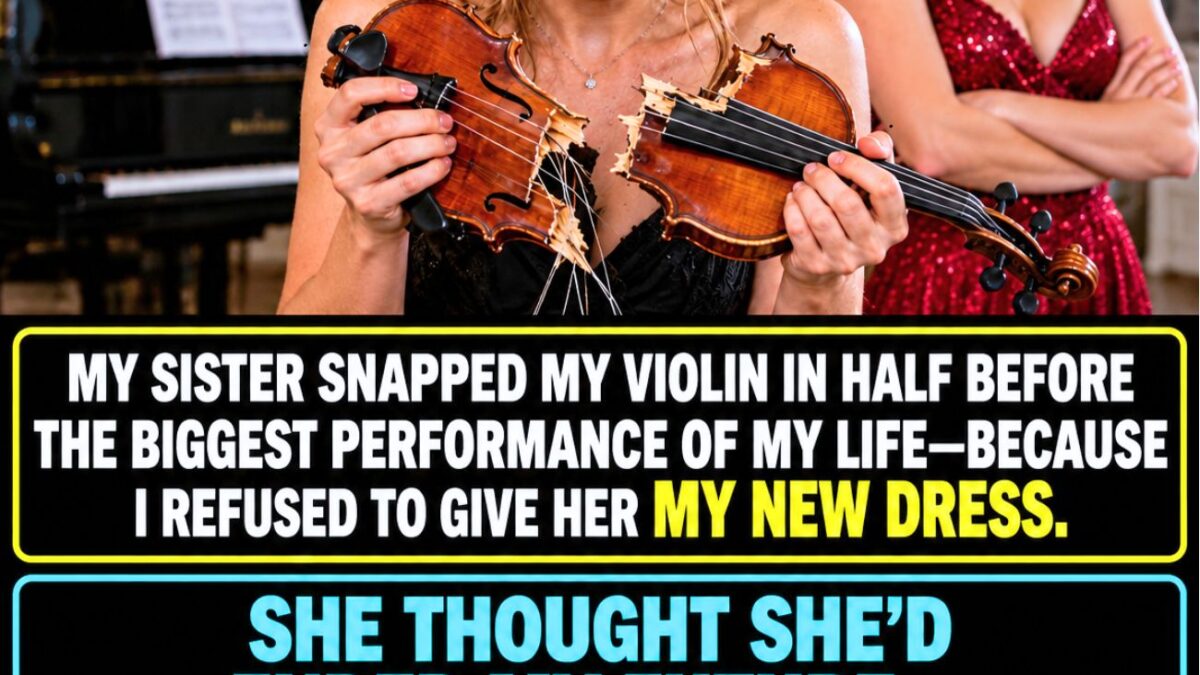
I knew that crack before I even looked down. The sickening splinter of aged spruce and maple resonated through my bones like a gunshot in a closed room. My sister had just snapped the violin my late teacher placed in my hands before he died.
It was the one thing I had promised myself I would carry onto the biggest stage of my life. Now, its neck hung limp, splintered jaggedly from the purfling, severed by a single petulant swing. I had less than an hour before my final orchestra audition, and Brielle had destroyed it simply because I refused her.
For the first time in twenty-nine years, I had stood firm and told her that what was mine belonged to me. My mother covered her mouth with trembling fingers, gasping as if the air had been pulled from the bedroom. My father went completely rigid beside the door frame, his breath hitching into absolute, horrified paralysis.
I stood there in the center of the rug, cradling the ruined instrument against my ribs while the air turned arctic. Brielle stepped back, her bare arms dropping to her sides as her mouth fell open in feigned, juvenile innocence. She whispered, “I didn’t think it would actually break,” as if the fragility of century-old wood was somehow my fault.
She genuinely thought she had ended my future right there between my mirrored dresser and the open wardrobe. She thought she had reduced my life’s ambition into an unplayable heap of twisted steel strings and snapped varnish. Yet twenty minutes later, she was crying outside my closed bedroom door, begging me to save hers from collapse.
She had no idea that behind that locked door, the quiet girl who smoothed every bump was gone forever. She had no idea she was about to hear an answer she had never once received from me in her entire life. My name is Alora Whitmore, and for nearly three decades, I was the human shock absorber of my family.
I was twenty-nine years old, and whenever a crisis erupted in our household, my phone was always the one that rang. If a bill was late, if a ride fell through, if pride or money ran thin, I was the one who quietly made up the difference. During the grueling workweeks, I taught beginner and intermediate violin to restless children across three different boroughs.
On the weekends, I squeezed my bruised fingers into performance shape for four-hour wedding gigs and corporate dinners. I played under dripping reception tents in autumn and inside drafty cathedral corners where the cold stiffened my joints. It was exhausting, repetitive, and completely unglamorous work, but music was the sole flame I refused to let blow out.
I had started playing when I was eleven years old, scraping out dissonant scales on a battered school rental. My teacher, Mr. Adrian Keller, had heard me struggling in the community center basement and had stopped in the hall. He was a severe, silver-haired man who smelled of cedar rosin and peppermint, and he saw something in me immediately.
He saw the quiet, stubborn resilience in my wrists long before I ever had the courage to see it in myself. He taught me for almost fifteen years without demanding a dime when my parents hit financial dry spells. He guided me through brutal audition rejections, family meltdowns, and every private night when I considered walking away.
Three months before pancreatic cancer took the last of his breath, he summoned me to his tiny, sunlit studio apartment. His hands were shaking, translucent veins showing through paper-thin skin as he reached beneath his bed for his case. I still remembered how reverently he placed the worn, velvet-lined leather into my grasp, his palms resting over mine.
“Don’t keep waiting until you feel completely ready, Alora,” he told me, his voice a low, gravelly rasp of certainty. “You will never feel entirely safe, but music requires your blood, so take this somewhere that scares you.” I wept openly against his shoulder that afternoon, promising him with every beat of my heart that I would.
Two years after his passing, after hundreds of lonely practice hours and rejections, the door finally cracked open. Daniel Reeves, an associate conductor who heard me lead the quartet at a charity gala, recommended me for a fellowship. It was a prestigious, two-year paid position with the metropolitan philharmonic that would completely transform my career.
Over four hundred violinists from around the country had submitted blind audition tapes for the single open chair. By that fateful Saturday morning, only six finalists remained on the call sheet, and I was among them. I was supposed to walk out beneath the blinding warmth of the main concert hall carrying Mr. Keller’s instrument.
For once in our chaotic lives, even my habitually distracted parents had unified behind my long-overdue milestone. “Alora, tonight belongs to you,” my mother had whispered that morning, setting a plate of toast before me. I had foolishly believed her, not realizing that Brielle was already calculating how to make me pay for having an evening.
The bitter truth was that Brielle had not always treated my generosity as an entitlement etched into stone. When she first gained admission to her competitive nursing program, she wept with gratitude for my smallest favors. Then, three weeks before her first clinical rotation at the county hospital, the transmission in her sedan failed completely.
She stood in the driveway in tears, panic clouding her young face, and I handed her my spare car keys instantly. “You need it more than I do,” I had told her with a smile, patting her cheek while she called me her savior. For eight months, I hauled my sheet music and Mr. Keller’s heavy case onto two separate crosstown bus transfers.
I stood beneath battered plexiglass shelters in freezing Chicago rain, shivering while water soaked through my boots. Brielle kept promising that borrowing the car was merely temporary, that her financial aid refund check would clear soon. I kept waving her apologies away, telling myself that being a good older sister meant absorbing the bitter chill for her.
Then, halfway through her second year, an administrative recalculation left her short on tuition by forty-three hundred dollars. If she didn’t clear the balance by Friday afternoon, the registrar’s office was going to revoke her student enrollment. I happened to have almost exactly that amount saved in a high-yield account, tucked away for an intensive summer masterclass.
I stared at the glowing blue balance on my laptop screen for perhaps five minutes, my throat tight with swallowed ambition. Then I clicked transfer, routing every single penny of my musical education directly into her university portal. I never told her what that money had been designated for; I simply handed her the confirmation receipt and said, “You’re covered.”
And it wasn’t only Brielle who treated my life as an auxiliary fund to pad the edges of their own mishaps. When my father’s carpentry shop suffered seasonal cutbacks, I quietly started covering the family’s weekly grocery bills. I would slip into the kitchen late at night, stocking the pantry with staples so Dad would never feel the indignity of asking.
When I found my mother weeping at the laminate kitchen table over a shutoff notice, I didn’t question the morality of it. I took the orange slip from her trembling hands, opened my banking application, and cleared the utility company’s arrears. I loved them all with an aching, desperate ferocity, and back then, sacrificing pieces of myself didn’t feel like theft.
That was the fatal flaw in the foundation of my life: everyone grew utterly accustomed to the rhythm of my surrender. My compliance became the baseline of the household, and Brielle learned that my personal boundaries were merely suggestions. Eventually, she stopped asking to borrow my car keys altogether; she would simply take them from the hallway bowl.
She stopped knocking on my door to ask if she could borrow a sweater, a necklace, or a pair of leather boots. Instead, I would receive a flippant text message three hours after she had departed, casually informing me she had taken them. Whenever money ran short for her weekend outings or lab fees, her requests were never phrased as humble inquiries.
They were always demanding imperatives: “Alora, I need two hundred dollars right now, send it via the app.” It was never, “Can you spare this?” It was always an assumption that my labor existed solely to keep her afloat. Around that same exhausting period, one of my most promising young violin students, fifteen-year-old Sadie Monroe, nearly quit.
Sadie’s mother was a night-shift caregiver who had fallen behind on the instrument rental payments at the local music shop. Sadie had sat on my piano bench with her head bowed, hot tears dropping onto the tops of her scuffed canvas sneakers. I still had my intermediate student instrument—the reliable, honey-varnished German violin I used before Mr. Keller gifted me his.
Without hesitation, I fetched the case from my hall closet, placed the leather handle in Sadie’s lap, and smiled. “An instrument shouldn’t gather dust in darkness while someone with a song in their heart has nothing to play,” I told her. She wept against my sweater, and her mother tried to offer me monthly post-dated checks, which I promptly tore in half.
I thought I was just doing what any decent teacher would do to protect a young girl’s passion from financial ruin. I had no idea that simple, quiet act of charity would become the sole anchor keeping my dreams from sinking tonight. The morning of my fellowship audition arrived crisp and golden, the early autumn sun warming the hardwood floor of my room.
My mother knocked softly and peeked inside, carrying a tailored garment bag draped reverently across both her forearms. “I know you told us not to spend unnecessary money on anything foolish,” Mom said softly, her eyes glistening. “Just open the zipper, darling.” I slid the brass runner down, revealing an emerald green evening dress crafted from heavy, luxurious bias-cut silk.
It was impossibly elegant, with long, graceful sleeves and a sweeping, floor-length skirt that caught the light like water. It was precisely the kind of dress I would linger over in high-end department store windows, only to walk past after checking the price. “Mom, you shouldn’t have,” I whispered, touching the cool fabric with trembling fingertips, completely overwhelmed.
“You spend your whole life taking care of everybody else, Alora,” she said, smoothing down the satin shoulders with pride. “Tonight, you deserve to walk out on that stage wearing something that was chosen exclusively and lovingly for you.” For once in my adulthood, I allowed myself to exhale, believing I was finally permitted to possess something beautiful of my own.
I hung the dress carefully beside the mirrored wardrobe, admiring how the deep emerald silk contrasted against the white wall. I spent the afternoon cleaning Mr. Keller’s violin, polishing the dark spruce grain with almond oil until it practically glowed. Every scratch on the bouts told a story of his seventy years of performance, a legacy I was ready to inherit.
With barely an hour remaining before I needed to load my car and head downtown, my bedroom door burst open violently. Brielle stormed in, holding up a black cocktail dress with its back zipper completely wrenched off its metal teeth. “My senior cohort dinner starts at seven, and this zipper just completely gave out!” she announced, panicking loudly.
“I can’t wear this, the entire banquet room will see my spine!” she shouted, throwing the torn garment onto my unmade bed. Then, her sharp gaze drifted across the room, locking immediately onto the emerald silk hanging beside my open closet door. “Oh, thank god,” she breathed, her face lighting up with entitled relief as she strode across the floor. “I’ll take yours.”
She reached out with manicured nails, ready to yank the silk hanger straight off the wooden rail without a second thought. Before I could rationalize my movement, my boots carried me forward, and I planted my body directly between her and the silk. “No,” I said, my voice steady, sharp, and entirely devoid of the habitual softness she had spent years exploiting.
Brielle let out a loud, mocking laugh, her hands pausing in mid-air as if waiting for the obvious punchline to land. “What?” she sneered, crossing her arms defensively over her chest. “Are you seriously going to make a scene right now?” “I said no,” I repeated, meeting her glare directly. “Mom bought this specifically for my audition tonight. You have six dresses.”
“And you have a dozen pairs of black trousers!” she snapped, her pale face tightening with venomous disbelief. “Alora, this cohort dinner matters. The head of surgical nursing is sitting at my table, and networking is everything!” “And my audition matters just as much,” I replied, standing my ground with a stillness that seemed to infuriate her further.
The bedroom grew heavy and suffocating, the grandfather clock ticking ominously from the end of the second-floor hallway. Brielle stared at me as if I had struck her across the cheek, her lips parting in utter, unadulterated outrage. “So now a stupid dress is more important than my medical career?” she hissed, leaning into my personal space.
“No,” I countered, keeping my tone level. “I am saying my career doesn’t become secondary just because you have an emergency.” Hearing the rising pitch of our voices, my mother and father appeared in the hallway, peering anxiously through the doorway. “Brielle,” Mom said, her voice filled with a weary warning, “leave that dress alone. It belongs to your sister tonight.”
Dad stepped into the room, his jaw set in a firm, rare display of parental authority that Brielle clearly wasn’t expecting. “Your sister said no,” he added, pointing toward the hall. “That should be the absolute end of the discussion. Walk away.” A bright flush of humiliation crept up Brielle’s throat, transforming within seconds into a feral, blinding temper.
Her wild eyes darted around the bedroom, looking for something—anything—to weaponize against the boundary I had drawn. They landed past my shoulder, fixating upon the velvet-lined case lying open on the middle of my patchwork quilt. Before my father could react, and before my mind could register the sheer depravity of the motion, she lunged.
Her fingers wrapped tightly around the neck of Mr. Keller’s violin, snatching it into the air like a wooden club. A cold, suffocating weight dropped through the floor of my stomach, turning my blood to absolute slush in a heartbeat. “Brielle, put that down right now,” I pleaded, my voice breaking its composed facade, terror raw and naked.
She held the instrument out at arm’s length, her knuckles white around the scroll as she backed away toward the dresser. “Maybe if your precious little music matters this much, you’ll remember who actually keeps this family moving forward!” she shouted. “Please, Brielle!” I begged, taking a slow step forward with my hands outstretched. “That was the last thing Mr. Keller gave me.”
For half a second, a flicker of hesitation registered in her eyes, a faint ripple of humanity battling her selfish spite. Then, her expression curdled into pure, unchecked vindictiveness, and she swung the instrument hard against the dresser edge. The heavy, solid maple of the antique chest caught the back of the violin neck with a sharp, sickening crack.
The sound tore through the quiet bedroom like bone snapping under a heavy boot, followed by the dull twang of tension. The strings recoiled with a metallic shriek, and the fine, hand-carved neck fractured completely off the upper bout. Mom gasped, a ragged, choking sob tearing from her throat as she collapsed against the wall, clutching her chest.
“Brielle!” Dad roared, his voice louder and more terrifying than I had ever heard it in my twenty-nine years. I couldn’t look at my father, and I couldn’t look at my mother; my entire universe had shrunk to the floorboards. I fell to my knees, gathering the splintered, weeping pieces of wood into my trembling hands as tears blinded me.
Brielle retreated two steps toward the hallway, her chest heaving, staring down at the carnage she had wrought in seconds. “I… I didn’t think it would actually break,” she whispered weakly, attempting to retract the monstrosity of her choice. Dad stepped between us, physically shielding me where I knelt on the floor, his tall frame trembling with righteous fury.
“Maybe you didn’t intend for the wood to shatter,” Dad told her, his voice shaking with contempt, “but you intended to break her.” For once in our shared history, no one in the room asked me to understand Brielle’s stress or excuse her childish temper. Dad turned his back on her, kneeling beside me on the rug, his rough, calloused carpenter’s hands hovering over my shaking shoulders.
For the next ten minutes, the bedroom was an island of stunned, desolate silence, save for my shallow, ragged breathing. Mom sat on the edge of the bed, weeping quietly, stroking my hair as I cradled the severed neck and shattered bridge. Dad bolted downstairs to his workshop, rummaging frantically through drawers, before dialing local instrument shops and music colleagues.
He was practically shouting into the receiver, begging anyone with an open line for an emergency loaner instrument of concert quality. “She’s playing for the fellowship in fifty minutes, David!” I heard him yell from the downstairs foyer. “Anything! Please!” I remained on the bedroom floor, paralyzed, staring at the white, jagged splinters of spruce poking through the dark varnish.
Then, the screen of my smartphone lit up on the bedside nightstand, emitting a persistent, repetitive calendar chime. The pop-up notification flashed brightly across the glass: “University Nursing Bursar — Payment Deadline: 9:00 PM Tonight.” I stared at the glowing numbers through my swollen, tear-stained eyes: Six thousand, seven hundred and forty dollars due.
That was the final, non-negotiable balance on Brielle’s accelerated clinical placement for the upcoming senior residency year. Three months earlier, she had wept in my kitchen, swearing she would be expelled if she couldn’t cover the tuition deficit. I had spent the entire summer skipping meals, taking double shifts, and skipping rehearsals to accumulate that exact figure.
The funds were sitting comfortably in my checking account at this very moment, ready to be cleared with three taps. My thumb hovered over the screen, the automated muscle memory of a lifelong enabler screaming at me to hit confirm. Then, my gaze shifted downward to my lap, resting on the splintered, mute remains of the violin Adrian Keller gave me.
For eight long years, every emergency, every bad decision, and every financial catastrophe in Brielle’s life had become my burden. Every time she acted recklessly, I was the one who went without sleep, without savings, and without a voice to rescue her. Not tonight. The realization didn’t come with explosive anger; it arrived with the cold, sweeping finality of an iron door.
I slowly slid my thumb across the screen, swiped the notification away into oblivion, and firmly clicked the lock button. About twenty minutes after she smashed my instrument against the furniture, soft, hurried footsteps crept back up the stairs. “Alora?” a tentative voice whispered through the slightly open door, entirely stripped of its earlier hysterical bravado.
I didn’t answer; I remained motionless on the floor, gently wrapping Mr. Keller’s severed scroll in a silk handkerchief. Brielle pushed the door open, her face completely pale, the broken black dress now replaced by an old oversized sweatshirt. “Did you send the bursar payment yet?” she asked, her voice cracking with an immediate, terrifying realization of her own.
I slowly lifted my chin, looking straight into her wide, panicked eyes with a calm that felt almost foreign to me. “No,” I answered, the single syllable falling into the quiet room like a lead weight plunging into deep water. Brielle took an involuntary step forward, her hands coming up to clutch her cheeks as her breath hitched sharply.
“Alora, the deadline is nine o’clock tonight,” she gasped, her tone swinging wildly between confusion and mounting panic. “I know what time the portal closes,” I replied, my voice steady, flat, and completely devoid of any soothing cadence. “If that payment isn’t confirmed by the registrar, they pull me from the hospital rotation tomorrow morning!” she cried out.
“I could lose the entire semester, Alora! They will make me repeat the whole clinical block from the beginning!” Big, dramatic tears began rolling down her cheeks, but for the first time in my life, they failed to move me. “Please,” she sobbed, dropping her hands to plead openly. “You can’t ruin my entire future just because you’re angry at me.”
I looked down at the severed spruce in my hands, and the final trace of hesitation in my heart simply evaporated into ash. “I am not ruining your future, Brielle,” I said, rising smoothly to my feet and meeting her terrified gaze directly. “I am simply refusing to pay for it anymore.”
Brielle stared at me as if the laws of gravity had suddenly inverted, her face twisting into sheer, uncomprehending shock. “You promised me,” she stammered, pointing an accusatory finger at my chest. “You looked at me and said you had it covered!” “I did promise you,” I replied without blinking. “And you looked at Mr. Keller’s violin before you smashed it against my dresser.”
“So you’re just going to stand there and watch me lose everything I’ve worked for?” she screamed, her entitlement resurfacing. I felt that old, toxic reflex attempt to claw its way up my throat—the desperate, pathetic urge to restore household peace. Fix the mess. Soothe the child. Make the transfer. Rebuild the savings account next year through more eighty-hour workweeks.
That was the script we had rehearsed for a decade, the comfortable domestic lie that kept everyone happy except for me. Before I could even entertain the poison of that thought, heavy footsteps echoed outside, and Dad appeared in the doorway. He had heard the entire exchange from the landing, and his expression was harder than I had ever seen it.
“Brielle,” my father said, his voice cutting through her hysterics like a razor through cotton gauze, “shut your mouth.” She turned toward him, desperate for an ally. “Dad, tell her! If I miss this deadline, the nursing board drops me!” “I understand precisely what is happening here,” Dad replied coldly, stepping fully into the room beside my shoulder.
“Your sister is an artist, not your private line of credit,” he said, each word measured, deliberate, and final. Mom stepped up beside him, her face stained with tears, but her eyes held a fierce, long-dormant maternal resolution. “You need to call the administrative office immediately,” Mom told Brielle, her voice unyielding and remarkably stern.
“You will explain that your personal finances fell through, and you will request an emergency hardship extension,” Mom continued. “You will apply for an institutional microloan, and you will pick up night shifts at the dispatch desk to pay for it.” Brielle looked back and forth between our parents, her panic escalating into wild disbelief as her safety nets vanished.
“We will help you navigate the paperwork where we reasonably can,” Dad added, “but Alora’s money stays in Alora’s account.” Brielle turned her frantic eyes back to me, whining, “But Alora already has the cash right there on her phone!” That sentence tore through me with a profound, piercing clarity, exposing the entire rotten foundation of our dynamic.
She didn’t see my savings as the product of my missed meals, my freezing bus rides, or my endless, solitary labor. To Brielle, my resources were merely an unclaimed pool of domestic wealth that I was selfishly hoarding from her needs. I carefully set the broken body of the violin inside its plush velvet case and pulled the brass zipper shut.
“I had that money because I worked seventy hours a week to earn it,” I told her, my voice dropping an octave. “I worked for that money just like I worked fifteen years to honor this instrument, and just like I worked for tonight.” Brielle aggressively swiped the mascara from under her eyes, her lips curling into an ugly sneer of pure desperation.
“So this is just petty revenge?” she spat, glaring at the dark green dress hanging pristine upon the wardrobe rail. “No,” I answered, reaching for my wool coat and draping it calmly over my shoulders without breaking eye contact. “Revenge would be calling your nursing board and explaining that you deliberately destroyed private property in a domestic rage.”
“Revenge would be ensuring they drop you for conduct unbecoming of a healthcare professional,” I continued evenly. “I am not doing any of that, Brielle. I am simply stepping out of the way of your own natural consequences.” I took a long, steady breath, feeling an extraordinary sense of lightness expand within the hollow spaces of my ribs.
“I am officially done sacrificing the things that belong to me every time your life becomes inconvenient,” I said. For the first time in our lives, nobody stepped forward to moderate my words or ask me to apologize for my tone. Dad reached down, picked up the case holding Mr. Keller’s broken instrument, and tucked it firmly beneath his broad arm.
Mom lifted the garment bag containing my emerald audition dress, zipping it securely to protect it from the chilly night air. Without speaking another word, we walked out of the bedroom, leaving Brielle standing completely alone in the center of the rug. She stood there clutching her glowing phone, finally face-to-face with an emergency that nobody was going to resolve on her behalf.
The forty-minute drive downtown through the gridlocked expressway was smothered in heavy, contemplative silence. Dad drove with both hands clamped tightly to the steering wheel, his eyes fixed grimly on the taillights ahead of us. Mom sat in the passenger seat, quietly scrolling through contacts on her phone, desperately texting every church organist she knew.
By the time Dad pulled the car into the subterranean parking structure beneath Symphony Hall, my adrenaline had crashed completely. The reality of the situation washed over me like freezing water: I was an audition finalist without a functional instrument. I had spent months preparing the complex cadenzas of the Sibelius concerto, memorizing every shift, dynamic, and bow weight.
Every micro-movement of my fingers was calibrated to the specific string height and fingerboard curve of Mr. Keller’s violin. Even if we miraculously found a spare instrument backstage, playing an unfamiliar violin at this level was career suicide. I walked through the security doors like a ghost, feeling entirely hollowed out, numb to the bustling energy of the venue.
Daniel Reeves, the associate conductor who had championed my application, was pacing near the green room corridor with a clipboard. He spotted me immediately, his face breaking into an initial smile that dissolved the moment he saw our hollow expressions. He looked down at the battered case Dad was carrying, noting the solemn, funeral-like posture of my parents behind me.
“Alora, thank goodness you’re here, we’re running fifteen minutes behind schedule,” Daniel said, his brow furrowing with concern. Then he noticed the faint tremors in my hands and the dampness lingering in my eyes. “What happened? Where is your instrument?” “My sister had an episode,” I whispered, the words tasting like lead on my tongue. “The neck was broken forty minutes ago.”
Daniel froze mid-stride, his jaw dropping as he stared at the zippered case in my father’s grip with pure horror. “Broken? As in unplayable?” he asked, running an anxious hand through his thick hair. “Can you perform at all?” “I don’t have an instrument, Daniel,” I said, a solitary tear breaking past my lashes and cutting down my cold cheek.
Daniel rubbed his temples, staring at the floor tiles as he calculated the rigid union regulations governing the audition schedule. “I can hold the committee in the hall for an extra ten minutes, Alora,” he said softly, genuine sympathy in his voice. “I can push your slot to the very end of the roster, but I cannot postpone the evaluation past tonight. It’s against committee rules.”
I nodded slowly, understanding completely that the world did not stop spinning simply because my family was broken. “Thank you for trying, Daniel,” I whispered, feeling the last remaining fragment of my musical dream slip through my fingers. I turned toward the water cooler to wash the dryness from my throat, wondering how I would ever face tomorrow morning.
“Ms. Whitmore?” a small, clear voice called out from the intersecting corridor leading toward the youth ensemble rehearsal rooms. I turned around slowly, dazed and disoriented, to see fifteen-year-old Sadie Monroe standing beside her mother near the lockers. Sadie was wearing her crisp black performance blouse, her cheeks flushed with the lingering excitement of her own youth recital.
Her mother had both arms wrapped around Sadie’s shoulders, and in Sadie’s right hand was a familiar, worn rectangular case. It was the sturdy canvas case I had given her months ago, housing my old German intermediate violin—my faithful former companion. Sadie’s dark eyes took in the devastated look on my face, then drifted to the broken case Dad held against his chest.
She didn’t need to ask what had transpired; musicians understand the gravity of a shattered instrument without requiring a single explanation. Without saying a word, Sadie stepped forward, unzipped her canvas bag, and pulled out the instrument I had given her. She extended her arms, holding the violin out toward me like a sacred offering beneath the harsh fluorescent backstage lights.
“Use mine, Ms. Whitmore,” Sadie said, her young voice ringing with an absolute, unwavering clarity that shook me to my core. I stared at the familiar, honey-colored varnish, recoiling slightly as I shook my head in instinctive, panicked refusal. “Sadie, no, I couldn’t possibly,” I stammered, my chest aching. “That is your instrument now. I gave that to you.”
The fifteen-year-old girl stepped closer, physically pressing the smooth maple ribs of the violin directly into my cold hands. “And you gave it to me because you couldn’t bear to watch me lose my chance to play,” Sadie said, her eyes watering. “You saved my music when nobody else cared, Ms. Whitmore. Please don’t let someone take yours away tonight. Please.”
That sentence nearly brought me to my knees on the linoleum floor, tearing down the last defenses of my composure. I looked at Sadie’s mother, who nodded tearfully, placing a reassuring hand over her daughter’s brave, upright shoulder. I looked down at the instrument: it was not a masterwork, and its tone lacked the deep, resonant melancholy of Mr. Keller’s.
It was bright, honest, stubborn, and resilient—an exact reflection of the girl holding it and the woman who taught her. “Ten minutes, Alora,” Daniel whispered from the doorway, his eyes wide with a sudden, unexpected glimmer of hope. I took a ragged breath, wiped the tears from my cheeks, and took Sadie’s violin into my arms with immense reverence.
Ten minutes later, dressed in the emerald silk dress my mother had bought for me, I walked onto the main stage. The vast hall was an ocean of velvet seats shrouded in dim shadow, save for the bright, surgical glare of the downlights. Behind a long wooden table seated in the seventh row, six evaluation judges sat silhouetted with clipboards and pens ready.
I walked to the brass soloist mark in the center of the polished stage, my heels clicking sharply against the maple floorboards. The silence of the hall was suffocating, magnanimous, and terrifying—a vast cavern waiting to judge my worth as an artist. I lifted Sadie’s violin to my collarbone, tucked my chin over the ebony rest, and drew my bow across the strings.
The opening measures of the Sibelius concerto were unsteadily launched; my fingers felt impossibly stiff, heavy, and alien against the board. The strings had a different tension than I was used to, and the projection lacked the effortless warmth of my late master’s instrument. For one terrifying, agonizing measure, panic seized the back of my throat, and I thought Brielle had truly succeeded in breaking me.
I thought of her sneer in my bedroom, her entitled fury, and the terrible sound of splintering wood echoing against the dresser. Then, my gaze shifted past the bright rim of the stage lights, peering into the shadows near the backstage wings. My mother was standing there with her hands clasped tightly against her mouth, tears flowing freely down her glowing face.
Beside her stood my father, holding the velvet-lined case containing Mr. Keller’s broken remains resting solemnly across his chest. Beside them was Sadie, leaning forward on her tiptoes, her young face completely illuminated with pure, unshakeable faith in her teacher. I closed my eyes for the space of a single heartbeat, shutting out the judges, the hall, and the wreckage of my morning.
In the quiet darkness behind my eyelids, I heard Adrian Keller’s gruff, peppermint-laced voice speaking to me from across the veil. “Take this somewhere that scares you, Alora,” he had commanded, his translucent hands resting warmly over my youthful knuckles. He hadn’t meant the physical box of carved wood and dried varnish; he had meant the living music dwelling within my soul.
I exhaled all the fear, all the domestic guilt, and all the suffocating compliance that had kept me small for thirty years. I stopped trying to play the concerto with polite, academic perfection, and I simply poured my raw survival into the strings. I attacked the cadenza with a fierce, burning ferocity, pulling sound from that humble student violin that defied its modest origin.
The instrument sang with a bright, biting intensity that cut through the cavernous hall like a silver wire drawn taut. Every phrase was an assertion of my right to exist, my right to have boundaries, and my right to belong to myself. When the final, soaring harmonic drifted up into the acoustic baffles and dissolved into silence, I didn’t look at the judges.
I lowered the instrument slowly, my chest heaving beneath the green silk, feeling an extraordinary stillness settle over my spirit. Before a single judge could scratch a note onto their evaluation sheet, I knew the absolute truth within my bones. My sister had broken the wood in my bedroom, but she had failed entirely to extinguish the musician standing on that stage.
The following afternoon at two o’clock, the official notification from the metropolitan philharmonic arrived in my email inbox. I had won the fellowship unanimously, securing the two-year residency and a principal substitute chair for the upcoming European tour. My mother screamed so loudly when I read the letter aloud that the neighbor’s dog began barking through the floorboards.
Dad caught me around the waist and swung me into the air, hugging me so fiercely that I could barely draw a breath. Brielle was not there to celebrate with us, nor did she attempt to intrude upon the sanctuary of our family living room. Her nursing program administration had granted her a strict, conditional forty-eight-hour extension to sort out her financial standing.
For the first time in her pampered life, she was forced to navigate the cold, unyielding reality of adulthood without my safety net. She spent her weekend selling her designer accessories online, setting up an aggressive institutional work-study contract with the bursar. She took on overnight shifts answering dispatch phones at an urgent care clinic, learning the bitter value of a single dollar.
I never sent the six thousand, seven hundred and forty dollars sitting untouched within my personal savings account. Instead, that money remained safely invested, eventually funding the exhaustive, expert restoration of Mr. Keller’s shattered instrument. Two months after that fateful Saturday evening, a soft, unannounced knock sounded at the front door of my new apartment.
I opened it to find Brielle standing in the hallway, looking noticeably thinner and carrying dark, exhausted circles beneath her eyes. She wore faded hospital scrubs, her hair pulled back into a simple, unglamorous ponytail, devoid of her former performative vanity. In her trembling right hand, she held a thick, sealed white envelope, which she extended toward me with her head bowed.
“What is this, Brielle?” I asked quietly, leaning against the door frame without stepping aside to invite her in. “It’s four hundred dollars,” she whispered, her voice rough with fatigue, keeping her gaze fixed upon the welcome mat. “It’s the first monthly installment toward repairing Mr. Keller’s violin. I set up an automatic withdrawal from my dispatch paycheck.”
I looked at the envelope, then looked closely at my sister, seeing a faint glimmer of maturity finally taking root. “I spent my whole life thinking you helped everyone because things were just naturally easier for you,” she admitted softly. “I never understood how much of yourself you were quietly slicing away just to keep the rest of us comfortable, Alora.”
“I was a monster to you that night,” she added, fresh tears spilling over her lashes as she looked up into my face. “I don’t expect you to forgive me today, and I know things will never go back to how they were, but I am so sorry.” I didn’t offer her cheap grace, nor did I rush to soothe her distress with the reflexive apologies of my past.
I reached out, took the envelope from her fingers, and nodded with a calm, grounded dignity that honored my own boundaries. “Thank you, Brielle,” I said sincerely. “I appreciate you taking responsibility for what you broke. Good luck with clinicals.” I watched her turn and walk slowly down the corridor, her shoulders straighter than they had ever been under her own burdens.
As I closed the apartment door, the autumn sun was pouring through my living room windows, warming the floorboards. On the mahogany dining table sat two violin cases side by side: Sadie’s loaned instrument, and Mr. Keller’s restored masterpiece. Brielle had broken the wood that night, but in doing so, she had shattered the cage of my lifelong compliance forever.

