“My Father Said You Wanted to Have Children,” Whispered the Apache… And I Said, “Maybe I Do.”
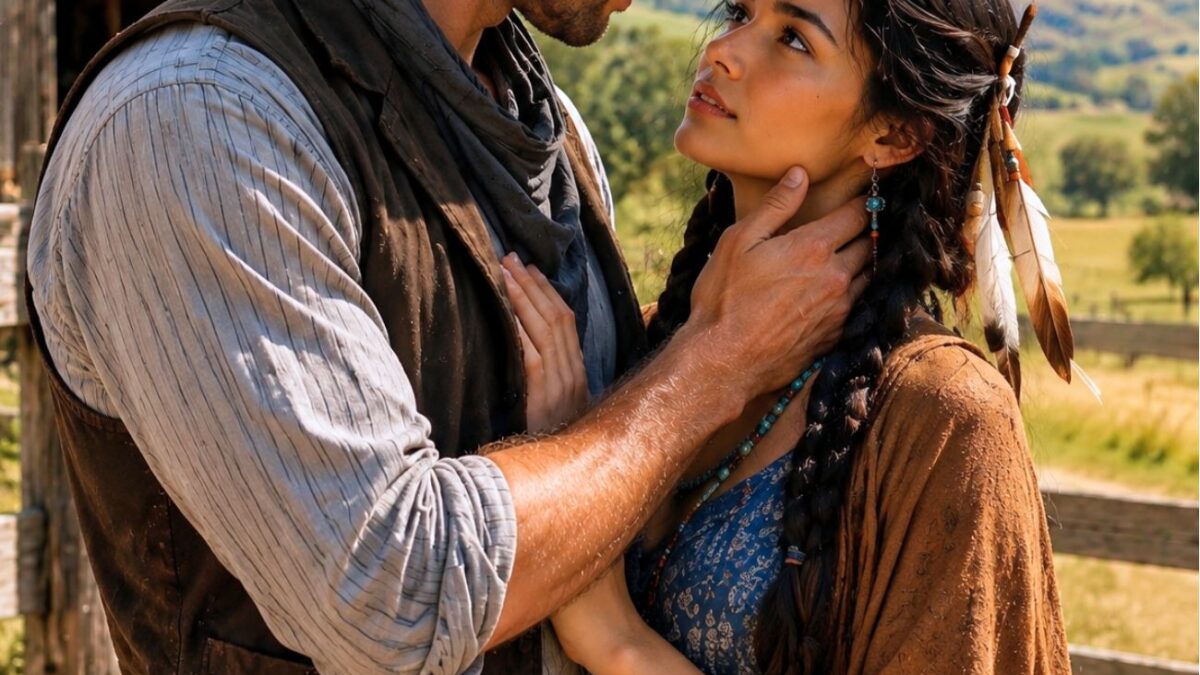
The desert does not lie. It has no use for pretty words or comfortable stories. When the sun comes down hard on the red clay of New Mexico, everything soft burns clean away. All that remains is bone, dry dust, and the solitary truth a man spends years trying to avoid.
Ethan Carter stood near the weather-beaten fence of his homestead, his eyes following the horizon. He watched the lingering stragglers of his cattle disperse behind the dry cedar ridge. He did not chase them, for he had long since abandoned the urge to run after anything in this life.
At forty-one years old, he had built a life out of quiet endurance and bare necessities. He owned a solid cedar-shingle roof, a dependable mule, and enough dried pinto beans for winter. Above all, he carried a silence so thick and heavy that it wrapped around his frame like a second skin.
There had once been a woman named Margaret whose laughter filled the quiet spaces of the house. There had once been an unshakeable dream of children running barefoot through the spring grass. A sturdy boy who would carry his name, and a bright-eyed girl who shared her mother’s gentle humor.
A whole future had seemed carved in stone, waiting only for time to catch up with its promise. Then the sickness descended through the basin like an icy whisper suddenly swelling into a scream. Margaret was gone long before the cottonwood leaves unfurled in the sudden warmth of spring.
The children who never took breath became the ghosts of a tomorrow that would never come to pass. Ethan took a spade and buried his entire life beside her in the red dirt east of the old twisted oak. Seven winters and seven dry summers had passed since the day he smoothed that earth flat with his boots.
In the years that followed, the windswept acres grew quieter and the solitary man grew harder. The people scattered through Rio Blanco County had long concluded that Ethan Carter was finished with living. They figured he was merely a ghost wandering his own boundaries, simply waiting around for his dying day.
He was drawing water from the stone well on a dry Tuesday morning when he caught the distant sound. Rhythmic hoofbeats struck the hardpan road, echoing against the weathered limestone bluffs behind the barn. He kept his gaze cast down at the wooden bucket, unwilling to give early welcome to an unbidden stranger.
Nobody ever ventured out toward these arid hills without a pressing, inconvenient purpose in mind. In Ethan’s long experience, reason was an unwelcome visitor that rarely brought good news to a threshold. Yet the rider did not pass the boundary line; the animal slowed and halted directly at his pine gate.
A quiet voice broke the stillness, low and measured, carrying an unmistakable ring of youth. “My father told me you always wanted children,” the traveler spoke across the sun-bleached rails. Ethan froze where he stood, the frayed well rope suspended tight between his calloused, sun-darkened palms.
He turned his head slowly, moving with the heavy caution of a man who distrusted all sudden occurrences. The speaker was young, perhaps nineteen or twenty, sitting upon a lean, dust-caked buckskin mare. She sat on the far side of the fence with a stillness forged not from ease, but from constant vigilance.
Her heritage was clearly written in the strong, quiet lines of her cheekbones and her dark, observant eyes. Her thick, ink-black hair hung in two neat braids, and her attire was weathered cotton mixed with deerskin. Across her shoulder rested a battered leather bag, and behind her cantle was tied an oiled woolen blanket.
Her riding boots were worn down to the welt, with split seams carefully stitched together with sinew. She studied him with steady scrutiny, the way a tracker watches an animal that might strike without warning. Ethan let go of the bucket handle, wiped his palms along his canvas trousers, and walked to the gate.
He stood on his side of the split-rail boundary, keeping his hands resting flat upon the top post. “Who was your father?” he asked, his tone gravelly from long hours of unexercised speech. “He was Cale,” she answered evenly, her accent clipped and precise. “You rode with him as Charlie.”
The name landed against Ethan’s ribs like a blunt blow, dislodging a memory buried twelve years deep. Charlie Running Horse, the quietest and steadiest man who ever sat a night guard around a herd. They had spent two hard seasons together moving longhorns across the burning plains toward northern territories.
They had shared parched trail dust, split the last grounds of bitter coffee, and kept each other alive. Yet Ethan had not heard a word of him since the day he turned south to build his home with Margaret. “Charlie is dead,” Ethan stated, knowing the reality before she could offer him any further explanation.
“Yes,” she answered without wavering. “He died three months back, when the mountain snows began to melt.” Ethan looked at the girl again, noticing the sun-bleached deerskin, the cracked boots, and her steady posture. “He sent you out across the territory to find me before he died?” Ethan asked, searching her expression.
She paused, gathering her thoughts as though she had rehearsed this exact exchange over many desert miles. “He told me you wanted children of your own once, but that you gave up after the sickness took your house.” She adjusted the reins in her hands, her knuckles scarred and weathered from a lifetime of hard trail work.
“He told me you were an honest man, but far too stubborn for your own peace,” she continued steadily. “He warned me that you would likely turn your back and tell me to ride away down the road.” “He wasn’t mistaken in that judgment,” Ethan answered, his voice devoid of anger, flat as the surrounding desert.
“He also said,” she pressed on, looking him directly in the eye, “that a man who stops wanting is already dead.” She swung her leg over the cantle, dismounting with the fluid, economical grace of someone born to the saddle. “He told me that if you turned me away, I was to remind you that you still owed him a debt.”
Ethan looked down at the dusty ground between their boots, remembering a flash flood in a swollen creek bed. “What manner of debt did Charlie think I owed him after all these silent years?” Ethan asked softly. The girl reached into the weathered satchel at her hip and produced a piece of paper, folded and worn at the edges.
“The only kind that matters in the end,” she answered, holding it out over the weathered rail. “Time.” He opened the latch, letting her lead the weary buckskin through the gate and into the bare ranch yard. They walked together toward the kitchen porch, the silence between them wide, vast, and completely uncharted.
Ethan sat at the rough-hewn pine table while she remained near the door frame, neither entering nor departing. Charlie’s handwriting across the yellowed sheet was awkward and broad, written by fingers more accustomed to ropes. Yet despite the hesitant slant of the ink, the meaning behind each carved letter remained entirely clear.
Ethan, if you are reading these lines, my girl has survived the long trail and found your homestead. Her name is Iyana, which our elders say means eternal bloom, given by her mother before she crossed over. She possesses a good heart, a sharp mind, and far too much courage for a woman living in these hard times.
The reservation agents have no patience for her independence, and her mother’s kin are scattered to the wind. She stands trapped between two worlds, too wild for the settlement parlors and too educated for the agency huts. The towns will not suffer an Indian woman without the protection of a husband or a master’s ring of chores.
Both of those paths are merely different names for the same iron cage, and she will wither behind bars. I turn to you because your word has never buckled, and because I know the heavy burden of being alone. I do not ask you to raise her as a father, nor do I ask you to offer her soft sentiment.
I ask you only to grant her a season of labor, a sturdy roof, and fair wages so she may find her own path. When the season turns to frost, if she chooses to depart, let her mount her horse and ride in peace. If she chooses to remain, let it be her own choice, made without compulsion or false promises between you.
You told me once beside the Brazos river that you wished for a family to fill your quiet spaces. I answered that life was not yet done with you, but you shook your head and claimed your time had closed. I ask you now, as an old friend who has crossed the great divide, to prove that my faith was true.
Ethan folded the paper with deliberate slowness, creasing the worn edges until they lined up perfectly square. He looked up at Iyana, who stood rooted in the doorway, the light cutting across her sharp, proud profile. “I have no right to meddle in your life, nor any claim to Charlie’s daughter,” Ethan said, his voice low.
“No, you do not,” she agreed immediately, her eyes unwavering as she met his long, searching gaze. “I am not seeking a substitute father to guide me, nor a husband to rule over my choices,” she said. “I ask only for honest labor in exchange for a bed and my meals until the autumn winds begin to blow.”
Outside, the dry wind stirred the scrub oak, making a sound against the eaves like an unanswered question. Ethan stood up from the bench, his joints popping with the familiar dull ache of forty-one weathered years. “There is an iron cot in the back room behind the pantry,” he told her, not looking directly at her face.
“I take my supper when the sun touches the ridge,” he added, moving toward the screened kitchen door. He stopped on the threshold, his hand resting against the rough cedar jamb, his back turned toward her. “One condition,” he said quietly. “I do not speak of Margaret. Not to travelers, not to hands, not to anyone.”
He waited for a beat, listening to the vast emptiness of the valley before adding, “You must know that now.” He stepped out into the blinding light, leaving her alone in the quiet kitchen with the folded letter. Iyana looked down at the paper on the table, noticing that Charlie had never once written Margaret’s name.
She understood then, with sudden clarity, the weight of the invisible ghost that haunted every corner of this house. The first two weeks passed in a steady rhythm of early mornings, shared silence, and hard physical labor. Iyana rose before the morning star had faded, lighting the woodstove without ever having been asked to do so.
She took a sledgehammer and iron wedges to the sagging post-and-rail fences running along the south boundary line. Where Ethan had merely patched the rot with scrap lumber, she dug deep, pulling the decayed wood from the soil. She tamped each new post with limestone gravel, pulling the cedar rails until the line ran straight and proud.
She quickly understood the temperamental personality of the stone well, with its heavy, fraying hemp rope. She learned how the wooden bucket had to be tilted just so against the mossy stone to fill completely. In the evenings, she prepared simple food over the hearth: boiled beans, fried cornbread, and strips of dried jerky.
Occasionally she brought wild roots and dark greens from the scrub hills, adding flavors Ethan had never tasted. He ate what she prepared in silence, finding himself surprised by the sustenance hidden in that bitter country. He watched her from beneath the brim of his hat, the way an experienced drover keeps watch on brewing weather.
He waited for the stubbornness to break, or for the quiet resentment of hard chores to show in her eyes. Yet she never complained, displaying an inner stillness that felt like the quiet center after a thunderstorm. They spoke only when the daily labor required an exchange of facts: about the cattle, the tools, the water.
On the fifteenth afternoon, Ethan climbed a tall spruce ladder to mend loose cedar shingles on the barn roof. A sudden gust caught the dry wood, shifting the base on the hard clay, and the ladder kicked out from beneath him. He grabbed a pine rafter with his right arm, slowing his fall just enough to keep from breaking his neck.
He crashed hard into the dirt on his left side, his breath leaving him in an explosive, dusty gasp. He lay staring up at the bare blue sky, waiting for the burning shock to clear so he could assess the damage. Iyana’s face suddenly appeared above him, blocking out the fierce midday sun with her dark, calm silhouette.
“Can you move your fingers and your toes?” she asked, dropping to one knee in the chaff beside him. He wiggled his dust-covered boots and flexed his right hand, gritting his teeth against the bruised ribs. “Yes,” he managed to grunt, his chest heaving as the wind slowly returned to his battered lungs.
“Then your bones are whole,” she stated, remaining right beside him without offering an unnecessary hand. “You are not as nimble on an open ladder as you believe yourself to be,” she added, her tone dry. He almost let out a laugh, the sudden impulse startling him so thoroughly that he choked on the dry air.
“I have managed this barn and this roof alone for seven long years without your counsel,” he growled out. “I have seen the crooked shingles,” she answered quietly. “That is precisely why you fell today.” She reached down, took him firmly by the wrist, and helped him haul his bruised weight up from the earth.
He pulled his hand away quickly, retreating into himself, but she simply turned back toward her chores. For the rest of that long, sun-scorched afternoon, he found his eyes tracking her every movement across the yard. That night over their plates of salt pork, neither spoke of the fall, yet the distance between them had altered.
A few nights later, Ethan built a small fire of cedar wood in the stone ring behind the kitchen garden. He sat upon an overturned wooden crate, watching the sparks drift toward the cold expanse of the desert night. He heard her moccasined footsteps approaching over the pebbles, but he did not tell her to return to her cot.
She sat on a flat limestone rock across the flickering flames, looking up into the vast canopy of stars. “My father told me the old people believed the stars were campfires left by those who walked before us,” she said. “Charlie had a way of seeing things that didn’t belong to the trail,” Ethan remarked, staring at the embers.
“He told me about you,” she said, her voice softer than usual against the crackle of burning aromatic cedar. “He said you were the only man with pale skin he would ever trust with his back in an open canyon.” “He said you were steady as an anchor, and that you never lied to yourself about how hard the world could be.”
“Charlie had a generous memory when he thought about the past,” Ethan said, shaking his head slowly. “He was not generous,” she replied with certainty. “He was precise. He looked for truth in men, not comfort.” She looked across the fire, studying his weathered features with a quiet gaze that held neither fear nor flattery.
“What will you do when the first snow arrives on these hills?” Ethan asked, breaking the silence between them. “Where does a girl like you go when the season is finished and this valley freezes over for the winter?” She remained silent for so long that he thought she would let the desert wind carry the question away.
“I do not know,” she admitted at last, her gaze drifting back to the cold constellations overhead. “I used to believe I had a home waiting somewhere across the river, but after he died, the certainty vanished.” She paused, rubbing a trace of soot from her thumb against her deerskin trousers before speaking again.
“I am looking for a piece of ground that will not pull itself away when I step onto it,” she whispered. Ethan looked away into the dark scrub, his ribs aching with an old, familiar ache that had nothing to do with falling. He let the fire burn long past its usual hour that night, sitting until the red embers turned to cold gray ash.
On the first Monday of the new month, they rode down together into Rio Blanco to purchase winter staples. The town was a dusty, sun-bleached cluster of pine false fronts, hitching posts, and watchful, suspicious eyes. Ethan had avoided the settlement for months, dreading the whispers that invariably followed his visits.
As they tied their horses before the general store, Ethan felt the cold gazes of men lounging on the porches. Near the land office, half-concealed beneath the wooden arcade, a well-dressed man watched them with calculating eyes. Ethan recognized the lean, sharp-featured countenance of someone whose trade was buying up debts and mortgages.
Inside the store, Mrs. Galvin stood behind the counter, measuring out dried beans and flour with practiced precision. She cast a long, appraising glance toward Iyana, her expression frozen in that tight, guarded neutrality of townspeople. Yet she said nothing improper, accepting Ethan’s silver coins before sliding the burlap sacks across the pine counter.
When they stepped back out into the glare of midday, a bulky teamster named Doyle was leaning against their wagon. He spat a stream of dark tobacco juice near the front wheel, his eyes fixed insolently on the young Apache woman. “Found yourself some cheap help out in the hills, did you, Carter?” Doyle sneered, his voice deliberately loud.
Ethan stopped dead in his tracks, feeling the sudden tension in the air as Iyana stiffened beside him. He set the sack of flour down upon the wagon tailboard with slow, terrifyingly deliberate care. He turned to face Doyle, his posture entirely relaxed, yet his eyes burning with a cold, unwavering intensity.
“She is the finest hand working in this territory,” Ethan said, each syllable dropping like iron upon an anvil. “And you are going to remove your boots from my wagon and step completely out of my way right now.” Doyle measured the width of Ethan’s shoulders, the calloused hands, and the lethal stillness in his gray eyes.
He muttered a coarse oath beneath his breath, backed away off the boardwalk, and disappeared into the saloon. They packed the wagon in total silence, the street watching them with a mixture of curiosity and sudden caution. As they drove the wagon back toward the foothills, the silence between them was different than before.
“You had no call to confront that man on my behalf,” Iyana said, her hands resting flat in her lap. “I know the laws of this county, and I know how these settlers look upon women of my mother’s blood.” “I didn’t do it on your behalf,” Ethan answered, keeping his eyes on the trail ahead. “I did it because it was true.”
She looked at him for a long while, her eyes searching his profile, but she offered no further words. Back in town, the sharply dressed man beneath the land office arcade stepped into the street, watching their dust fade. Six weeks into her stay, Ethan entered the main room on a Sunday afternoon to find the table covered in paper.
He had not intended to pry, but the striking images drawn across the white sheets commanded his attention. There were horses running with wild manes, rendered in dark charcoal with astonishing skill and fierce life. A red-tailed hawk soared above a deep sandstone gorge, its wings catching the invisible lift of the wind.
There was a drawing of an old man’s hands, gnnarled by rope and weather, which Ethan instantly knew were Charlie’s. And among them lay a large sheet depicting his own homestead: the repaired fence, the well, the crooked oak tree. She had captured the quiet endurance of the place, finding beauty in the dry soil and weathered cedar timber.
He turned to see her standing near the pantry door, watching him with calm, unapologetic eyes. “Charlie taught me how to hold the charcoal when the blizzards kept us inside the line shack,” she said. “He told me that if you take the time to draw a thing truly, you finally begin to understand its spirit.”
Ethan picked up the sketch of his ranch, running his rough thumb along the margin without touching the black dust. “You make this barren patch of dirt look… like it actually has a soul,” he murmured, his voice cracking. “It does have one,” she answered softly. “You simply forgot how to look at it through your own grief.”
“You are wasting your time dragging cedar posts and skinning mule hides,” he said, turning to face her. “This talent is what you ought to be giving your life to.” “A body needs both the earth and the sky,” she replied. “The fence feeds the stomach; the charcoal feeds the mind.”
He laid the paper down with extraordinary care, treating it as though it were made of spun glass. “Will you make a drawing for me?” he asked suddenly, surprised by his own unexpected boldness. She looked at him with an expression he could not quite fathom, then reached out and took a fresh stick of charcoal.
“I already know the shape of the lines I will put down,” she answered, turning back toward her small table. Three days later, she walked out to the barn before dawn and pressed a folded sheet into his calloused hands. He opened it near the lantern light and felt his breath catch in the dry hollow of his throat.
It was the stone well, but she had transformed the ordinary water source into something profound and sacred. The bucket hung suspended over the black water, catching the first pale rays of an unseen morning sun. Upon the rope rested his own weathered hands, the veins and scars drawn with an intimacy that shocked him.
And deep in the circular mirror of the water below, she had sketched two small, clear reflections standing together. A man and a woman, side by side, looking down into the same deep darkness without letting go of the edge. That evening she failed to appear at supper, leaving her wooden bowl untouched upon the clean pine table.
He walked out into the cool evening air and found her sitting on the stone coping of the well, knees pulled up tight. Her head rested against her arms, her shoulders slightly hunched against the gathering shadows of the hills. “Iyana,” he called softly, not wishing to startle her in the vast, gathering silence of the valley.
She raised her head, her face pale in the dusk, the faint traces of dried tears visible along her cheeks. “There is a truth my father kept from that letter,” she began, her voice shaking with suppressed emotion. “He knew that if he told you the whole story, you would look upon me only as an act of charity.”
Ethan sat down upon the flat stones across from her, resting his elbows on his knees, listening patiently. “A man named Aldous Rowe holds the paper on the section east of your boundary line,” she explained slowly. “He serves as an agent for the territorial commission, and he has been tracking my father’s movements for months.”
“He came to our camp before Charlie died, telling us the law had changed concerning independent native people.” “He said an unmarried Indian woman cannot hold property or live without white guardianship in this territory.” “He gave me until the end of the summer season to attach myself to an enterprise or be removed by force.”
“Removed to where?” Ethan asked, his voice deadly quiet, a cold anger beginning to stir in his chest. “To the northern agency, two hundred miles past the mountains,” she answered, looking out toward the dark hills. “They lock the gates at sundown, and they teach you how to forget the language your mother spoke to you.”
Ethan sat completely still, his fingers curling into tight fists against the worn fabric of his trousers. “Why did Charlie keep that from me?” he demanded quietly. “He knew I would never turn his girl away.” “Because he wanted you to let me stay because you saw value in me,” she said, her voice breaking slightly.
“He did not want you to take me in out of pity, like a stray dog you shelter from a passing hailstorm.” Ethan looked down at the drawing folded inside his coat pocket, feeling the warmth of the paper against his chest. He had no words left to offer her that night, but he sat beside her on the stone well until the moon rose high.
He did not sleep a single wink during the long hours that followed, pacing the small confines of his bedroom. He looked at the dusty picture frame he kept turned toward the wall, the portrait of Margaret he never touched. He realized with sudden, terrifying clarity that the grief which had ruled him for seven years was changing shape.
He was no longer just a custodian of the dead; he was a living man who dreaded the emptiness of tomorrow. He did not want to wake up to a quiet house where the stove remained cold and the well stood entirely abandoned. The next morning he hitched his best mare to the buckboard and drove thirty miles into Rio Blanco alone.
He strode directly into the county records office, demanding to see the land patents held under the name of Rowe. The clerk adjusted his spectacles, nervously flipping through the heavy leather-bound ledgers beneath the counter. “Rowe holds the territorial warrants, Mr. Carter,” the clerk stammered, intimidated by Ethan’s grim intensity.
“Under current territorial law, any unattached native can be remanded to the agency upon an agent’s affidavit.” “Is there no defense against such a writ?” Ethan asked, leaning over the wooden railing with rigid posture. “Only two things hold weight against a territorial warrant,” the clerk replied, lowering his voice cautiously.
“A registered five-year indenture bond approved by a magistrate, or… a legal territorial marriage certificate.” Ethan turned on his heel without speaking another word, striding out into the fierce heat of the dusty street. He drove the team hard on the long road home, the horses lathered white beneath their leather harness straps.
By the time the high bluffs of his homestead rose against the afternoon sky, his mind was entirely settled. He had spent seven long years hiding from the terrifying prospect of opening his closed, battered heart again. Now he was ready to step across that river, even if the current threatened to sweep away his hard-won peace.
He found Iyana working at the southern pasture fence, swinging an iron maul against a fresh cedar post. “Iyana,” he said, stepping down from the wagon and walking toward the boundary line with purposeful strides. She lowered the heavy hammer, resting its head against the red dirt, her dark eyes wide with questioning wonder.
“I do not want you to pack your belongings when this season ends,” he said, the words spilling out unbidden. She did not reply immediately, maintaining that characteristic, dignified silence that had come to define her presence. The dry grass rustled softly around their boots, and a red-tailed hawk wheeled through the amber sunlight above.
“What are you saying to me, Ethan?” she asked, her voice steady, searching for the true intent behind his eyes. “I am saying the ranch has life in it again because you walked through that front gate,” he answered honestly. “I sleep without the weight of ghosts pressing on my chest because I know you are sleeping under the same roof.”
“The sketch you gave me is the first thing that made me feel like an actual living man in seven bitter years.” He looked down at his own weathered, sun-darkened hands, then looked straight back into her deep, steady eyes. “I am saying I have lived like a dead man for too long, and I refuse to let the world take you away.”
She looked at him with an expression of profound, aching sorrow, her hands gripping the smooth handle of the maul. “I swore to myself that I would not allow this complication to take root between us,” she whispered softly. “Neither did I,” he said. “Yet here we stand, and the season is slipping away like water through our fingers.”
“I am not your daughter, Ethan,” she pointed out, her voice trembling slightly. “And I do not know what I am to you.” “Neither do I,” he answered without hesitation. “I only know that names come after a man makes his stand.” She searched his face, seeing the honesty written in the deep lines around his eyes and the firm set of his jaw.
“My father always claimed you were the most stubborn man between the Rio Grande and the Canadian border,” she murmured. “He was right about that, too,” Ethan said, the faintest ghost of a smile touching the corners of his mouth. “I need time to turn this over in my thoughts,” she said, leaning against the rail. “That is my answer for today.”
It was not the acceptance he sought, but it was not a dismissal, and for Ethan, that sliver of hope was enough. The crisis came two days later, on a sweltering Thursday when the heat hung like heavy wool across the basin. Aldous Rowe rode into the yard accompanied by two deputies, their holstered revolvers riding low upon their hips.
Ethan recognized the man from the arcade, his city-tailored coat looking entirely out of place in the desert. Rowe dismounted smoothly, ignoring Ethan completely as he strode toward the well where Iyana was drawing water. Ethan moved immediately, covering the ground between the barn and the well with swift, cold determination.
He stepped directly into Rowe’s path, his tall frame cutting the territorial agent off from the young woman. “The summer season closes tomorrow at sundown, Carter,” Rowe declared, tapping a folded document against his leg. “Her temporary labor pass expires with it, and this undocumented woman is being remanded to the agency.”
“She is not leaving this valley,” Ethan said, his voice dropping into that flat, dangerous tone he rarely used. “This is official territorial business, Carter,” Rowe snapped, his face hardening as he looked past Ethan’s shoulder. “You have no legal standing to interfere with an agent of the commission carrying out a lawful court order.”
“This is my deeded land,” Ethan stated, leaning down slightly so his eyes were level with the smaller man’s. “And this woman is my intended wife, which makes everything concerning her future entirely my business.” The yard fell into a stunned, absolute quiet, broken only by the distant call of a crow high in the rocks.
Rowe looked from Ethan to Iyana, who stood motionless by the well, her dark eyes fixed upon Ethan’s broad back. A territorial agent knew when the legal terrain had shifted beneath his boots, and Ethan’s posture offered no retreat. “A declaration of intent requires a filed bond within thirty days,” Rowe spat out, retreating toward his horse.
“You will find the paperwork properly signed and witnessed at the courthouse on Monday,” Ethan answered cold. Rowe mounted his animal, jerked the reins around with ill-concealed fury, and spurred his horse toward the road. The two deputies followed without a word, leaving a rising cloud of red dust hanging in the sweltering heat.
Ethan turned slowly to face Iyana, bracing himself for the anger he expected to find waiting in her eyes. She looked at him with an inscrutable expression, a mixture of quiet pride, amusement, and deep calculation. “Your intended wife,” she quoted softly, walking slowly toward him across the packed dirt of the yard.
“I know I took the choice from your hands in front of those men,” he confessed, lowering his head slightly. “Yes, you certainly did,” she agreed, stopping just two paces away, her head tilted up to meet his gaze. “You spoke before you asked for my consent, which is an error my father would have scolded you for severely.”
They stood together in the vast stillness of the afternoon, the sun casting their long shadows across the dust. “Ask me now, Ethan Carter,” she said, her voice clear and steady as the deep water within the stone well. He did not fall to his knees, for neither of them was built for the dramatic posturing of sentimental people.
He stood before her in his working clothes, carrying all the scars, the regrets, and the silence of forty-one years. “I cannot offer you an easy life,” he said, speaking from the very bottom of his reawakened heart. “I am a quiet man, set in my solitary habits, and I have forgotten how to make comfortable promises to anyone.”
“Yet I swear to you that I will see you every single day that I draw breath upon this earth,” he continued. “I will honor your labor, I will defend your name, and I will stand between you and the hard world forever.” She looked into his eyes for a long, quiet interval, hearing the unvarnished truth in every syllable he spoke.
“My father saw this coming from the day he wrote that letter,” she said softly, a genuine smile touching her lips. “He knew the two of us were cut from the very same piece of weathered mountain pine,” she added quietly. “He was an infuriatingly wise man,” Ethan admitted, feeling the sudden warmth spreading through his chest.
“Yes, he was,” she agreed softly, stepping forward until the distance between them disappeared entirely. “And my answer to your question is yes, Ethan. I will take this ground with you and make it our own.” They rode together into Rio Blanco six weeks later, wearing their finest clothes to the small county courthouse.
Mrs. Galvin stood as their official witness, having shut down her store counter for an entire hour to attend. The townspeople watched them walk out of the stone building side by side, their fingers intertwined without shame. The whispered judgments of the past seemed to fade like morning mist against the sheer reality of their union.
The changes that came to the homestead were not loud or sudden, but they ran deep as the roots of the oak. The fences along the south ridge stood straight and unyielding against the harshest autumn gales that blew down. The barn roof was finally laid straight, shingle by overlapping shingle, turning away the winter rains and sleet.
A garden plot east of the house was tilled and fenced, showing neat rows of winter squash and green shoots. The silence that had haunted the empty rooms for seven years was steadily replaced by the sounds of shared purpose. The scraping of charcoal upon rough paper, the clatter of iron pots, and quiet conversation by the hearthfire.
When the spring thaw arrived, turning the dry creek beds into rushing torrents of fresh, mountain-fed water. Iyana met him at the well one morning, holding a fresh bucket of clear water as the dawn sun broke the hills. “In the late autumn, Ethan,” she said simply, looking at him with eyes that held the promise of an entire future.
He stood completely still, his hands resting motionless upon the hemp rope, the realization washing over him like rain. He set the bucket down upon the stone coping, stepped across the space between them, and held her against his chest. He held her with the fierce, protective tenderness of a man who had been given back his life from the grave.
On that stubborn, sun-drenched ranch at the rugged edge of the New Mexico territory, Ethan Carter was finally home. And somewhere far beyond the distant blue mountains, Charlie Running Horse sat beside his eternal campfire and smiled.

