“In My Cabin, You’ll Be Blessed Between My Sheets.” Cowboy Told the Childless & Alone Woman
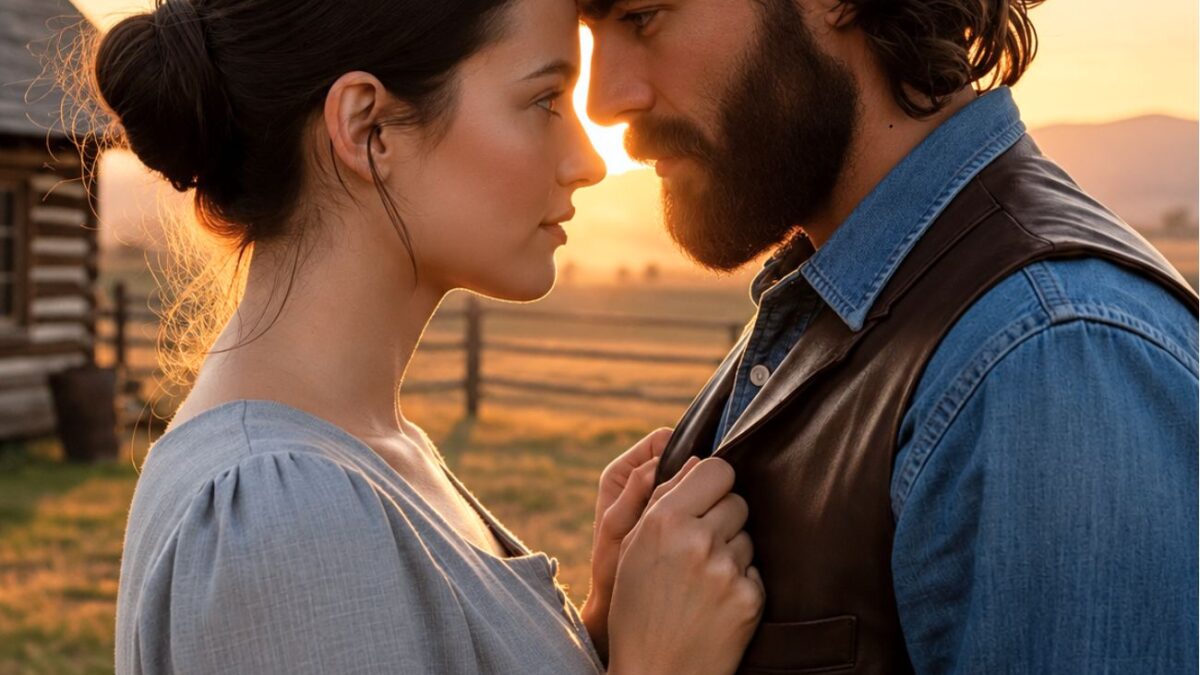
Have you ever lost everything you prayed for only to find what you truly needed waiting at the end of the world? That was how Clarice Vaughn’s journey into the rugged Colorado high country truly began. She stood beside a weathered stagecoach in the middle of nowhere, her heart far heavier than the worn suitcase in her trembling hands.
For ten agonizing years, she had begged heaven on bended knees for a child of her own flesh and blood. Ten years marked by humiliating doctor visits, whispered pity from church pews, and her former husband’s ever-deepening disgust. Now she was no wife, no mother, and possessed no home, cast aside like chaff on the biting mountain wind.
The heavy wooden wheels creaked to an abrupt halt right upon the edge of an immense, frozen mountain meadow. The driver, a gray-haired man with considerably more miles on his dusty boots than mercy in his flinty eyes, spat into the drifts. He pointed a gloved finger toward a solitary log cabin tucked securely between dark pine trees and deep drifts of snow.
“End of the line, ma’am,” he grunted, climbing down from his elevated wooden seat with an indifferent groan. “Judge Crenshaw’s strict orders from down in Cedar Falls, so don’t go blaming the messenger for your circumstance. The man up there is named Griffith Cade, and from here on out, you will be working for your room and board.”
Work was the decree, and the sharp sting of that single syllable cut deeper than the icy gale sweeping across the ridge. For all those hollow years in town, her only labor had been of the quiet, desperately lonely kind. She had kept a spotless house that never echoed with child laughter, nursing each month’s bitter reminder of unanswered prayers.
The callous driver dropped her battered leather satchel directly at her boots and merely tipped the brim of his stained hat. “You are his problem now, mistress,” he muttered before hauling his heavy frame back onto the high rig without another word. With a sharp crack of the leather whip, the coach surged forward, churning powdered snow and dirt high into the freezing air.
The rig soon vanished down the twisting alpine trail, leaving nothing behind but an overwhelming, deafening wilderness silence. There were no ringing church bells here, no peering neighbors behind lace curtains, and no sharp, cruel town gossip. There was only the primeval sigh of the wind through ancient pines and the crunch of frosted crust beneath her thin boots.
Clarice swallowed the thick lump lodged tightly in her aching throat and forced one numb foot in front of the other. Every heavy step toward that solitary cabin felt like marching deeper into an inescapable, cold exile from the civilized world. The mountain loomed above her like an unyielding gray fortress, indifferent to the woman shivering beneath its towering shadow.
When she finally reached the small timber porch, her strength was spent, her fingers completely stiffened by the frost. Before her knuckles could rap against the rough-hewn pine, the heavy door swung smoothly inward on well-greased iron hinges. Griffith Cade filled the open frame like a mountain come to life, broad-shouldered, weathered, and towering over her fragile frame.
Dark hair streaked with silver framed a face carved by years of relentless winters and unforgiving summer suns. Yet his steady brown eyes, though cautious and watchful, held none of the sneering malice she had fled in Cedar Falls. He tipped his worn hat in quiet respect, studying the shivering woman on his threshold with solemn, measured calm.
“Miss Vaughn,” he said, his voice a low, rumbling timbre that seemed to vibrate against the mountain chill. “You will want a solid roof over your head before nightfall overtakes this ridge, and supper is already hot on the stove.” There was no judgment in his posture, no prying curiosity in his tone, just plain, honest decency offered to an outcast.
It was more genuine mercy than she had witnessed in ten long years of marriage to a man who measured worth by bloodlines. She stepped across the threshold, and the sudden rush of cedar smoke and dry heat wrapped around her like an embrace. The cabin was rustic and simple, yet an undeniable sense of quiet dignity permeated every hand-hewn beam and floorboard.
A sturdy stone hearth crackled merrily at the far wall, casting amber light across a scrubbed pine dining table. Neatly organized shelves held weathered leather volumes, hand tools, dried herbs, and well-kept tins of household supplies. Here was profound order, a quiet and hard-won peace carved patiently out of the brutal wilderness by solitary hands.
“I don’t aim to be any trouble to you, sir,” she murmured softly, clutching her damp satchel against her chest. “Trouble is mostly what a man chooses to make of things, ma’am,” Griffith replied evenly, taking her wet woolen shawl. He hung his own broad hat upon a wall peg, then gestured with a scarred hand toward a small wooden door near the corner.
“That room is yours, the bed is freshly made, and we can discuss the nature of the work come morning light.” It took every ounce of Clarice’s remaining resolve not to collapse onto the floorboards and weep from sheer relief. After weeks of being paraded through courtroom benches and subjected to cold glares, being treated as human felt completely foreign.
She offered him a faint, grateful nod, slipping into the tiny room where a thick straw mattress and wool blankets waited. Later that evening, they sat opposite each other near the blazing hearth, eating bowls of thick venison stew in silence. The very first bite Clarice took nearly took her breath away, so heavily laden with black pepper it scorched her tongue.
Griffith caught her sudden gasp, his weathered face flushing a deep, embarrassed crimson beneath his graying stubble. “Lord Almighty, forgive me,” he stammered, hurriedly setting his wooden spoon aside on the edge of the rough tabletop. “I guess I got a bit heavy-handed with the spice tin, living up here so long without another soul to cook for.”
Clarice coughed once into her napkin, but then a genuine, light laugh escaped her lips before she could catch it. “It certainly has character, Mr. Cade,” she said, her green eyes brightening with the first amusement she had felt in months. A slow, quiet smile tugged at the corners of Griffith’s mouth, softening the rugged lines etched across his sun-darkened cheeks.
“Well, that is one charitable way to put it, ma’am,” he admitted, chuckling softly as he took another cautious bite himself. Hearing her own laughter sound in the room was strange, an unexpected melody rising from the ashes of her old life. When she finally blew out the tallow candle in her small quarters, sleep did not come easily, yet her mind was entirely calm.
The silence pressing against the cabin walls was vast, but it lacked the hollow cruelty of the house she had left behind. Through the thin pine partition, she could hear the comforting, rhythmic sounds of Griffith moving about the keeping room. He banked the glowing coals with a heavy iron poker, latched the heavy front door, and settled into his own bunk down the hall.
When morning light finally broke across the high peaks, it washed the frosty meadow in pale, crystalline gold. Clarice was awakened by a rhythmic, metallic thud echoing with steady precision from the hard-packed yard outside. Peering through the frosted windowpane, she watched Griffith split thick logs of cured pine with effortless, fluid strength.
His broad back and thick shoulders flexed beneath his flannel shirt, every swing of the heavy axe sure and controlled. It was a breathtaking display of patience and power, a portrait of a man completely at peace with his solitary labor. She smoothed her simple cotton dress, tightly braided her hair down her back, and stepped out into the crisp mountain air.
“Morning, Miss Vaughn,” Griffith called out without breaking his steady swing, the steel blade splitting a log cleanly in two. “Coffee is boiling on the back of the iron stove, and there is cold cornbread in the tin on the sideboard.” The coffee proved as dark as wagon grease and strong enough to rouse the dead, but it chased the mountain chill from her ribs.
She stood near the porch rail with the steaming tin cup cupped in both hands, watching the chips fly into the deep drifts. A strange, untamed serenity began to settle into the wounded corners of her spirit, a feeling she could barely understand. “What chores can I take off your hands today?” she asked, stepping down the timber stairs once he rested the axe head down.
He wiped his brow with a forearm. “You can scatter grain for the hens in the lean-to behind the small barn. The feed bin is right inside the door, but mind your skirts around them because they get cantankerous when breakfast is delayed.” Clarice nodded with determination, making her way across the crunching crust of snow toward the low-roofed poultry shed.
The dozen hens clucked loudly, flapping their wings and regarding her with the beady, disapproving eyes of town gossips. Clarice found herself smiling broadly as she scattered handfuls of cracked corn across the dry straw of the coop floor. The rhythmic clatter of their feeding, the earthy smell of grain, and the pulse of living things quieted her lingering anxieties.
Returning inside the warm cabin, she immediately rolled up her sleeves and set to work scrubbing the heavy iron woodstove. She swept every inch of the plank floor, washed the grease from the hearth stones, and aligned every jar on the pantry shelves. When Griffith returned at midday for his meal, he stopped dead in his tracks just inside the open entryway, stunned silent.
“Good Lord,” he whispered softly, gazing around the gleaming room with an expression that bordered on reverent disbelief. “I haven’t seen this place shining this clean since…” He paused abruptly, a sudden shadow crossing his warm brown eyes. He caught himself before the sentence finished, an old sorrow darting across his features before he could pull his guard back up.
“I baked fresh buttermilk biscuits with the flour from your barrel,” she offered gently, eager to ease the sudden tension. They sat together and ate in comfortable, companionable silence, the biscuits warm and flaky beneath coats of wild blackberry jam. When Griffith reached for his fifth biscuit, he caught her amused gaze across the scrubbed pine and offered an apologetic grin.
“It has been a mighty long stretch since I sat down to real home cooking, ma’am,” he confessed, wiping his fingers. “How long have you lived up here on this ridge all alone?” she asked quietly, leaning forward over her cup of tea. “Eight years now,” he replied, staring down at the wood grain of the table as his broad shoulders subtly stiffened.
“Eight years is a very long time for a man to hear only his own voice,” she observed with gentle, nonjudgmental sympathy. “Long enough to get accustomed to the quiet,” he answered softly, rising from the table to carry his empty plate to the basin. Outside, gray clouds were gathering thick and heavy over the jagged western peaks, the biting wind promising a fresh blizzard.
Inside the cabin, the stone fireplace crackled with fragrant cedar logs, pushing back the encroaching chill of the high country. For the very first time since the judge struck his gavel in Cedar Falls, Clarice did not feel like an unwanted castaway. She felt useful, she felt entirely safe, and deep down beneath her guarded heart, she began to feel quietly wanted.
As dusk settled purple over the valley, Griffith sat near the hearth mending a leather work harness with waxed thread. Clarice pulled a small stool nearby, having discovered a stack of worn flannel work shirts that were missing buttons and split along seams. The fabric of the shirt in her lap was soft and threadbare, carefully washed until the original blue had faded to dull gray.
She wondered whose hands had stitched the original seams years ago—a mother, a sister, or perhaps a beloved wife now resting beneath the pines. When Griffith looked over and noticed the garment in her lap, a complex ripple of emotion washed over his weathered countenance. Pain, an ancient memory, and then an overwhelming, humble gratitude warred in his steady gaze before he spoke.
“I didn’t realize that old shirt was falling apart so badly,” he said in a voice barely louder than the crackling hearth fire. “The tear was small, Mr. Cade, but small tears turn into ruined cloth if left unattended,” she answered, knotting her thread carefully. He held her gaze for a long moment, the warmth of the fire dancing in his brown eyes, before nodding with quiet reverence.
“Thank you, Clarice,” he said, using her Christian name for the first time without the formal barrier of her former married title. That night, the sky opened up, dumping heavy, silent blankets of downy snow that muffled every possible sound in the world. Clarice lay beneath her thick patchwork quilts, listening to the relentless mountain wind push harmlessly against the heavy squared timbers.
She did not feel broken tonight; she felt like a woman who might finally find an enduring home in this high wilderness. Yet she could not foresee that before the spring thaw arrived, an ugly evil would crawl up from the lower valleys. Nor did she know that the quiet, scarred man who had opened his hearth to her would risk his life to protect her soul.
The following dawn greeted the mountain with a breathtaking, blinding ocean of pure white that drifted high against the cabin eaves. Clarice emerged from her room to the mouthwatering aroma of sliced bacon sizzling hot in the heavy cast-iron skillet on the hearth. Griffith was already moving about the kitchen with his characteristic deliberate purpose, his movements fluid and entirely unhurried.
“Did you rest well through the blow?” he asked, lifting the iron skillet off the glowing coals to let the grease settle. “Better than I have rested in ten years, Griffith,” she replied honestly, standing beside him to slice the crusty loaf of bread. He nodded once in quiet satisfaction, turning toward the window where the wind was already beginning to kick up fresh white squalls.
“There is another front pushing hard from the north, and we need to secure the livestock before the ridge gets socked in.” “I am coming with you,” she stated plainly, reaching for her wool shawl before he could formulate any polite masculine objection. He looked as though he intended to tell her to stay by the fire, but seeing the resolve in her eyes, he simply nodded.
Side by side, they plunged out into the waist-deep drifts, their breaths blooming together like white smoke in the freezing air. They reinforced the loose timber siding on the chicken coop, hauled armfuls of cured firewood into the woodshed, and checked the cattle. The flakes fell so thick they dusted Clarice’s dark lashes and hair, yet she had never felt more invigorated by honest work.
When they finally tumbled back through the cabin door, laughing and gasping for breath, Griffith handed her a tin mug of boiling coffee. Their gloved fingers brushed against the metal rim, and a sudden, quiet charge passed between them, stopping the breath in her chest. She looked directly into his eyes, seeing a tender admiration that made her forget the howling frost rattling the window glass.
“You certainly pull your own weight on this mountain, Clarice,” he murmured, his voice dipping into an affectionate, gravelly low tone. “I never wanted an easy life, Griffith,” she answered softly, her heart fluttering. “I only ever wanted a life that held some purpose.” He held her gaze for three long seconds before clearing his throat and turning back toward the fire to poke the embers.
That evening, as the tempest shrieked against the timber walls, Griffith paused near the threshold of her small bedroom door before turning in. “If the draft gets through that north corner board, there are two thick buffalo robes inside the cedar chest near the wall.” “I will be plenty warm, but thank you,” she whispered, leaning against the doorframe, acutely aware of how close he stood.
“Rest easy, Clarice,” he said softly, lingering for a heartbeat before stepping back toward his own side of the hearth. The days slipped past like the steady turning of pages in an old book, each sunrise bringing an easier, sweeter domestic rhythm. Clarice baked, mended, washed, and tended the animals, finding deep healing in the simple necessity of every wilderness chore.
Yet it was the quiet evenings that bound her spirit irrevocably to this mountain cabin and the solitary man who built it. Griffith would sit beside the stone hearth, his long legs stretched toward the warmth, reading aloud from dog-eared books of verse and scripture. His voice, deep and gravelly from years of solitary timber cutting, seemed to wrap around the room better than any wool blanket.
Midway through the deep freeze of January, an unseasonal dry lightning storm rumbled across the high peaks with terrifying fury. Clarice jolted upright in her bed at the sudden cannon-crack of thunder, clutching the heavy patchwork quilts up to her chin. Within seconds, a series of light, polite knuckles tapped against the pine planks of her bedroom door, followed by his low voice.
“Clarice? Are you alright in there? The thunder in these high passes can shake a house hard enough to rattle your teeth.” “I am alright,” she called back, her voice trembling only slightly. “Just startled by the noise, Griffith.” “Just making sure,” he replied, and the gentle timber of his deep voice right outside her door chased every lingering terror away.
She lay down once more, listening to the heavy, reassuring thud of his stockinged feet as he returned to his chair by the dying fire. By morning, the high meadow lay completely buried beneath six feet of pristine powder, the fence lines completely swallowed by the drifts. Before they ventured out to clear the barn path, Griffith retrieved a massive, heavy sheepskin coat from the deep cedar chest.
He held it open for her, gently helping her slide her arms through sleeves that swallowed her slender hands entirely. The coat was absurdly large on her frame, but as she pulled the lapels close, the faint scent of dried lavender and woodsmoke drifted up. Clarice froze, her fingers lightly caressing the soft shearling collar as she looked up into Griffith’s suddenly pained, tightening jaw.
“This belonged to her, didn’t it?” she asked in a near-whisper, her voice filled with pure reverence rather than jealousy. He looked toward the frosted window, his throat working swallow before he spoke. “Yes. It was Martha’s winter trail coat.” “I can wear my wool shawl instead,” Clarice offered hurriedly, beginning to pull her arms from the heavy sleeves. “I don’t wish to—”
“Keep it on,” he interrupted gently, his broad, calloused hand coming to rest lightly atop her shoulder to stop her retreat. “She has been resting beneath the south pines for eight long years now, and she would want someone warm inside of it.” The quiet grief in his voice held no bitterness, only the clean, dull ache of a wound that had healed into a permanent scar.
They worked together all that morning shoveling a trench through the mountain drifts so the two milk cows could reach the trough. When a startled speckled hen flapped wildly from a drift and tangled itself directly into Clarice’s heavy skirts, she tumbled backward into the snow. Her clear, ringing laughter echoed across the pristine white slope, so full of unbridled joy that Griffith stopped his shovel mid-swing.
He stared down at her sitting in the snowbank, an expression of profound, awakened wonder washing across his weathered, handsome face. It looked as though it were the very first time in eight solitary years that the sound of real laughter had graced his frozen valley. He extended his hand, his powerful grip pulling her effortlessly up from the drift until she was standing inches from his chest.
Neither of them spoke for a long moment, their breaths mingling in the crisp air while the snowflakes melted against their cheeks. That night, with the wind settled into a low moan, Griffith sat near the hearth stone patiently cleaning and oiling his hunting rifle. Clarice sat opposite him with her basket of mending, the domestic silence between them feeling more natural than breathing itself.
“Griffith,” she began softly, breaking the quiet with a hesitant question that had lingered in her mind for weeks. “Why did you agree to let Judge Crenshaw send an outcast woman up here to your mountain without even knowing my name?” He paused his work, turning the heavy steel barrel over in his calloused palms before looking up to meet her questioning gaze.
“The judge and my late father were close friends during the territory days, and I owed his family an old debt of honor,” he said slowly. “He sent word that a good woman down in Cedar Falls was being treated with shameful cruelty by a town that called itself Christian. He thought maybe you needed a safe place far away from wagging tongues where you could finally catch your breath and heal.”
“You could have refused him,” she pointed out, her eyes shining with unshed tears. “You had your quiet life here alone.” “My mother didn’t raise a coward, Clarice, nor a man who shuts his door when someone is freezing out in the cold world.” Clarice smiled through the sudden mist in her vision. “She must have been an exceptional woman to raise a son like you.”
“She was the finest soul I ever knew,” Griffith said, his voice dropping into an affectionate murmur as he looked into the flames. “She always told me that a human being’s true worth isn’t measured by what the world takes away from them in sorrow. It is measured entirely by what they choose to keep on giving to others when they have every reason to become bitter and cold.”
Those words sank deep into the wounded bedrock of Clarice’s soul, dismantling the remaining shame she had carried from her marriage. Two mornings later, under a crisp, silver sky, Griffith strapped a pack saddle onto his mule to make the supply trek to the valley depot. As he tightened the leather cinch beneath the mule’s belly, Clarice stepped off the porch and instinctively caught hold of his forearm.
“Be careful descending the canyon trail, Griffith,” she said, the words spilling from her lips before she could check her own forwardness. He looked down at her small hand resting against his heavy canvas coat, a gentle, understanding warmth softening his brown eyes. “I am always careful, Clarice,” he promised softly, placing his gloved hand over hers for one brief, reassuring second. “I will be back by dusk.”
When he led the mule down the winding white trail, the silence left behind in the timber cabin felt sharper and far lonelier than before. It was in that quiet afternoon that Clarice fully realized how entirely his steady, noble presence had come to fill her existence. She spent the hours furiously scrubbed the cedar floors, kneading fresh loaves of sourdough bread, and keeping the stew pot simmering hot.
As the sun began to slip behind the jagged granite peaks, casting long purple shadows across the meadow, the jingle of harness bells sounded. A profound wave of relief washed through her chest as she wiped her flour-dusted hands on her apron and hurried to the door. Griffith had returned safely, but as the figures cleared the tree line, she saw he was not traveling the frozen mountain trail alone.
Riding beside him was a grizzled old prospector atop a shaggy buckskin pony, his beard as white and tangled as mountain frost. The two men stomped heavily onto the timber porch, kicking thick cakes of packed snow from their boots before entering the warmth. “Clarice, this old mountain goat is Landry Croft,” Griffith announced, relief and familiarity clear in his deep voice.
“He is half prospector, half wandering gossip, and occasionally a miracle worker when an axle breaks,” Griffith added with a rare grin. Landry chuckled, a sound like dry pine cones tumbling down a rocky chute, and swept his tattered beaver-skin hat off his balding head. “And I am entirely appetite this evening, ma’am,” Landry proclaimed, sniffing the air appreciatively. “Smells like heaven in this cabin.”
After a hearty supper of venison and warm bread, the old prospector pushed his tin plate away and leaned heavily across the table. The easy humor vanished from his wrinkled, weathered face, replaced by a grim darkness that immediately caught Griffith’s attention. “I picked up some mighty foul news down in the lower settlements yesterday, Griffith,” Landry said, keeping his voice deliberately low.
“There is talk of an ugly outfit running a hidden baby farm up in the high draws, keeping desperate women against their will. They take the newborn infants and sell them down into the territories to wealthy ranchers who can’t bear their own heirs.” Clarice felt the blood drain entirely from her face, her hands gripping the edge of the pine table until her knuckles turned white.
“Dear God in heaven,” she whispered, her voice trembling with horror. “Tell me that is only a cruel rumor, Mr. Croft.” Landry shook his gray head solemnly. “I have lived long enough in these mountains to know the stink of human wickedness, ma’am. Word is they are operating out of the abandoned silver camp tucked back into the box canyon up by Canyon Creek.”
Griffith’s brown eyes turned as cold and hard as river flint, his jaw clamping tight as he stared at the map on the wall. “That old mining camp is less than a five-hour ride across the northern ridge,” Griffith stated, his voice laced with venom. Clarice’s stomach twisted into a painful knot as memories of her own years of being valued solely for breeding flashed through her mind.
The thought of vulnerable, terrified women being treated like livestock and robbed of their children ignited a furious fire in her chest. “Someone has to stop them,” she said, her voice shaking with an intensity that surprised both men sitting at the table. Griffith turned his head slowly, studying the fierce, blazing determination in her green eyes with deep, solemn respect.
“Do you mean that, Clarice?” he asked quietly, the air between them growing thick with an unspoken, dangerous pact. “With every breath in my body,” she answered without hesitation, meeting his gaze with a courage she didn’t know she possessed. “Then we ride out tomorrow night to see the truth of it for ourselves,” Griffith declared, closing his large hands into fists.
Over the next twenty-four hours, the peaceful cabin transformed into a quiet staging ground for an act of dangerous justice. They cleaned and checked Griffith’s repeating rifle, loaded the spare revolvers, and packed saddlebags with clean bandages and food. When a moonless, star-strewn night fell over the peaks, Griffith and Landry mounted their horses, with Clarice refusing to stay behind.
They rode through the muffling snowdrifts in absolute silence, their mounts picking their way carefully along treacherous cliff edges. Canyon Creek was darker than pitch, an ominous, rotting collection of collapsed wooden shacks half-buried beneath mountain avalanches. Yet from the largest timber building near the abandoned mine shaft, the yellow glow of a kerosene lantern flickered through the cracks.
Creeping through the deep snow to the side of the weathered structure, Clarice pressed her eye against a gap between the logs. Her breath caught in her throat at the horrifying scene laid out beneath the dim, smoky lanterns inside the squalid room. Three young women, pale, hollow-eyed, and visibly trembling, sat huddled behind crude iron bars built into the back wall.
At a wooden table in the center, two rough men sat counting stacks of greenbacks and checking names in a leather ledger. Clarice’s fingers clenched into the rough wool of Griffith’s coat sleeve, a pure, blazing fury roaring through her veins. Griffith gently touched her shoulder, signaling for silence, and carefully guided her back through the drifts toward their tethered horses.
“We cannot storm this camp alone tonight,” Griffith whispered grimly once they were clear of the canyon’s acoustic bowl. “We must ride hard to the federal marshal’s outpost at dawn, bring armed deputies back up here, and end this wickedness forever.” They rode through the freezing pre-dawn dark, exhausted and shaken to their very cores, reaching the sanctuary of their cabin by daylight.
“Get some rest, Clarice,” Griffith urged gently as he built up the fire. “Landry and I will saddle fresh horses in two hours.” Yet the brutal mountain wilderness had other plans, for the blizzard that rolled in at midday brought mortal danger directly to their gate. Through the blinding wall of white, the rhythmic thud of galloping hooves broke through the howling gale outside the cabin.
Clarice looked through the front windowpane, her heart leaping into her throat as three heavily armed horsemen emerged from the storm. The lead rider sat tall in his saddle, wearing a wolf-skin coat and bearing a cruel, razor-thin sneer she recognized immediately. It was Vernick Styles, a notorious valley enforcer whose name was synonymous with violence, extortion, and cold-blooded murder.
Griffith’s face hardened into stone as he reached above the stone mantle, racking a round smoothly into his Winchester rifle. “Stay inside the back room, Clarice, and keep down,” he commanded in a tone that brooked no room for argument. He stepped out onto the heavy timber porch, holding the rifle ready across his chest as the three horses pulled up in the yard.
Clarice did not hide; instead, she crept quietly to the window, watching the steam billow furiously from the horses’ flaring nostrils. “Afternoon, Mr. Cade!” Styles called out through the whistling wind, his voice slick and smooth as snake oil on stone. “Mighty cold day for traveling, so we were wondering if you might be hospitable enough to invite three chilled men in by your hearth?”
“You can say whatever business brought you up this mountain from right where you sit, Styles,” Griffith answered with icy calm. Styles chuckled coldly, resting his gloved hand carelessly near the ivory handle of the revolver strapped low against his hip. “Word travels fast down in the valley, Cade. Folk say you and that stray woman have been snooping around places that don’t concern you. We run a respectable, private enterprise up in Canyon Creek, and we cannot abide busybodies spreading vicious slanders about our trade.”
“Respectable?” Griffith spat, his voice ringing across the frozen yard with thunderous contempt. “You call human trafficking respectable? You are stealing babies from captive women and selling them like cattle, Styles, and hanging is too gentle an end for your kind.” Styles’s arrogant smile vanished instantly, his features twisting into a vicious, feral snarl as his two men fanned out across the snow.
“That is a fatal accusation to make in these hills, mountain man,” Styles hissed, his fingers twitching above his holster. “I think this trail ends right here for both you and your little charity case inside the house. Nobody will find your bones until spring.” Inside the room, Clarice felt a cold wave of fear wash over her, but beneath the terror rose an unyielding wall of fierce resolve.
She would not allow this noble, kind man who had saved her life to be slaughtered on his own porch by cowardly cutthroats. Spotting Griffith’s heavy Colt pistol resting on the sideboard, she gripped the heavy checkered grip with both hands. Before her fear could paralyze her limbs, she kicked open the heavy front door and stepped boldly onto the porch beside Griffith.
“Nobody is dying today except the men who prey on the weak!” Clarice shouted, raising the heavy barrel and cocking the hammer back. Styles blinked in momentary shock, then burst into a mocking, ugly laugh that echoed against the towering pine trees. “Well, look here boys! The barren cast-off from Cedar Falls thinks she can play at being an outlaw! How utterly touching!”
“You can pull your gun and shoot me down where I stand, Styles,” Clarice said, her voice steady and clear despite her trembling knees. “But the truth is already out, the federal marshals will have this mountain swarming with lawmen, and your rope is already braided!” For three agonizing heartbeats, the entire world seemed to hold its breath, the only sound being the violent shriek of the wind.
Suddenly, a deafening rifle crack shattered the silence, echoing from the dense treeline along the edge of the clearing. The outlaw to Styles’s left screamed in sudden agony, his revolver dropping into the snow as he clutched a shattered shoulder. “United States Marshals! Throw down your iron or be cut down in your tracks!” roared Landry Croft’s booming, deceptive voice from the woods.
The brilliant bluff worked instantly on the second outlaw, who panicked, wheeled his terrified horse around, and fled into the blizzard. Styles snarled in rabid fury, his revolver clearing leather with lightning speed as he aimed directly at Griffith’s chest. Griffith did not flinch; his Winchester barked once, the heavy lead slug striking Styles squarely in the center of his chest.
The notorious valley outlaw tumbled backward out of his saddle, hitting the deep snowdrifts with a heavy, final thud. He gashed at the crimson stain spreading across his wolf-skin coat, staring up at Griffith with disbelieving, dying fury. “You… you will burn in hell for this, Cade,” Styles rasped through bloodied lips, his strength fading into the mountain snow.
“Perhaps I will, Styles,” Griffith replied coldly, lowering the smoking barrel. “But you are going to get there long before me.” Within moments, the clearing fell completely still, the silence broken only by the whimpering of the wounded outlaw on the ground. Clarice lowered the heavy Colt, her adrenaline crashing instantly as her knees buckled beneath the overwhelming weight of the violence.
Griffith immediately dropped his rifle and caught her in his powerful arms before she could strike the timber porch boards. “Are you hurt? Did a stray ball touch you, Clarice?” he demanded urgently, his hands gently framing her pale, tear-streaked face. “No, Griffith… I am whole,” she whispered, leaning her forehead against the rough wool of his coat as she shook violently.
“You are the bravest woman I have ever known in my life,” he breathed, pressing his cheek against her hair with fierce gratitude. It took two grueling days of travel through the snow for the true federal marshals from Denver to arrive and take custody of the prisoner. Guided by Landry and Griffith, the lawmen raided the Canyon Creek camp, tearing the vile enterprise apart beam by rotting beam.
Every captive woman was liberated, the ledger books were seized for trial, and the network of corrupt buyers was smashed across the territory. Yet the victory carried a heavy, sorrowful price that weighed heavily on Clarice’s tender, compassionate heart. Several of the younger women were gravely ill from exposure, their bodies broken by the cruel conditions of their captivity.
For nearly a week, Griffith’s cabin served as a temporary hospital, filled with the soft rustle of bandages and quiet weeping. Clarice moved tirelessly among them, bathing fevered brows, feeding them warm broth, and holding their trembling hands through dark nights. She whispered the same soothing words of comfort and dignity she had once used to whisper into the silence of her own prayers.
When the final medical wagon arrived from Denver to transport the recovering survivors down to safety, Clarice stood on the porch watching. Griffith stepped up beside her, his broad shoulder pressing warmly against hers as the wagon disappeared down the canyon road. “You gave those poor souls back their humanity, Clarice,” Griffith said softly, looking down at her with unbounded reverence.
“We gave them their lives back, Griffith,” she replied, turning to meet his steady gaze with eyes brimming with quiet tears. The weeks that followed the raid passed in a gentle, healing blur as the deep snows of mid-February began to soften under warmer breezes. The timber cabin was quiet once more, yet it was no longer an outpost of two lonely outcasts enduring the cold world alone.
A profound, sacred bond had been forged between them in the fire of shared danger, shared mercy, and shared labor. One evening, after returning from a scouting trip with fresh supplies, Landry sat near their hearth, watching them prepare the evening meal. Clarice moved gracefully around the stove while Griffith carved the roasted meat, their movements perfectly synchronized without a single spoken command.
“If you two keep dancing around what is plain as daylight, you are going to wear permanent grooves into these cedar floorboards,” Landry grunted. Clarice blushed a bright, beautiful crimson, hurriedly wiping a plate with her linen towel. “Mr. Croft, please, that is quite enough.” “Don’t you ‘Mr. Croft’ an old man who has seen enough of this hard life to know when grace is staring folks in the face,” he scolded gently.
“You love that man with every beat of your heart, Clarice, and he loves you so fierce it hurts to watch him pretend otherwise. Life is too short and these mountains are too cold to spend your years pretending you don’t need each other’s warmth.” Later that night, after Landry had turned in, Clarice stood alone on the front porch beneath an ocean of brilliant, shimmering stars.
The air was brisk, smelling faintly of melting snow and fresh pine needles, the promise of an early spring hanging on the breeze. The timber door clicked open, and Griffith stepped out into the night, coming to stand so close she could feel the heat radiating from his chest. “Landry has a terrible habit of speaking his mind without measuring his words first,” Clarice murmured softly, looking out at the meadow.
“He does,” Griffith agreed in a low, gravelly timbre that made her breath hitch in her throat. “The trouble is, he spoke the absolute truth.” Clarice turned her head slowly, her heart pounding violently against her ribs as she looked up into his handsome, earnest face. “Clarice,” he began, his voice rough with an emotion he had kept locked behind stone walls for eight long, solitary years.
“I spent eight years believing my life was over, believing that solitude and cold memories were all I ever deserved in this world. Then you stepped out of that stagecoach, and you brought light back into this dark house. You made this cabin feel like a home again. You made me want to live again, Clarice. You are my home, and I love you more than my own life.”
Tears spilled over her lashes, tracing hot silver paths down her cold cheeks as she desperately shook her head in painful protest. “Griffith, please… you don’t know what you are asking of yourself,” she whispered, her voice breaking beneath the weight of her past. “I cannot give you children. My former husband threw me out into the dirt because my body is broken and barren. I am incomplete.”
“Hush now, stop that,” Griffith commanded gently, raising both of his large, calloused hands to tenderly cup her tear-streaked face. “You are not barren, Clarice. You are the bravest, strongest, most loving woman that God ever placed upon this earth. If we live out all our years on this mountain and never hear the cry of a child, I would still consider myself the most blessed man alive.
Because I would have you beside me, and your love is more than enough for any man’s soul.” The last lingering wall of Clarice’s old shame crumbled completely to dust beneath the overwhelming tenderness of his declaration. She wept openly then, not from the familiar agony of rejection, but from the breathtaking, magnificent relief of finally being truly loved.
Griffith leaned down and pressed his lips to hers, a kiss filled with the promise of enduring shelter, sacred fidelity, and fierce passion. They were wed the very next morning on the cabin porch, with Landry Croft grinning from ear to ear as he read the vows from his pocket Bible. The remaining winter weeks melted away under the golden sun, giving way to an explosion of alpine wildflowers across the meadow.
Purple lupine and golden columbine painted the high slopes, their vibrant colors mirroring the newfound joy flourishing inside the cabin. Their marriage grew sweet and deep through shared labor, quiet laughter by the evening hearth, and the profound comfort of loving arms. Then, on a stormy night in early May, when the spring rain drummed softly against the cedar shingles, a faint sound woke them both.
It was not the wind, nor the prowling of a timber wolf, but the thin, unmistakable wail of an infant crying out in the wet dark. Griffith reached for his rifle while Clarice lit the lantern, both stepping quickly toward the heavy front door with racing pulses. Opening the door to the mist-laden porch, Clarice gasped, dropping down to her knees beside a woven willow basket resting on the boards.
Inside, swaddled tightly in layers of clean, dry wool blankets, lay a tiny baby girl with dark blue eyes and wisps of golden hair. Pinned to the front of the blanket was a damp scrap of paper, written in the hurried, trembling script of an exhausted mother. The note read simply: “Her name is Grace. She deserves a mother who is brave and pure. Please, let her be yours.”
Clarice lifted the fragile infant from the basket, pressing the warm, breathing miracle against her chest as tears poured down her face. The baby stopped crying instantly, her tiny, perfect fingers reaching up to curl tightly around Clarice’s trembling index finger. Griffith dropped to his knees beside his weeping wife, wrapping his massive arms around both Clarice and the abandoned child.
Wonder and awe shone in his brown eyes as he gently stroked the baby’s downy cheek with the tip of his work-roughened thumb. “It seems heaven heard your prayers all along, Clarice,” Griffith choked out, his own voice thick with overwhelmed tears. “It just took heaven a long journey through the wilderness to bring her home to the only mother meant to raise her.”
They never discovered which of the rescued women had made the long trek to leave the infant on their doorstep that rainy night. They only knew she was a sacred gift born out of tragedy, entrusted to their care by a mother who knew they would guard her life. Grace Cade grew up running through those high mountain meadows, her laughter echoing off the pines like music through the valley.
Years later, travelers passing through the high Colorado passes would still speak with reverence of Griffith and Clarice Cade. They told the legend of the woman who had been discarded for being barren, only to become the fierce protector of the innocent. They spoke of the lonely mountain man who taught an entire territory that family is not merely an accident of blood and bone.
Family is the sacred home you build with your own hands from the shattered pieces of what the world tried to destroy. On quiet summer evenings when the jagged mountain peaks glowed with brilliant rose and gold in the setting sun, they sat on the porch. Clarice would hold Grace upon her lap, smoothing the girl’s curls while whispering, “Let the blind world call us castaways, my sweet girl.
Inside the walls of this mountain home, we are blessed beyond measure.” Griffith, sitting beside them on the timber bench with his arm draped protectively around his wife’s shoulders, would smile with complete peace. He knew in his soul that every mile of sorrow, every cold winter night, and every drop of blood had led him to this sacred porch.
The mountain breeze carried their quiet laughter across the whispering pines, blending into the eternal music of the high country. It was a living hymn of redemption, unbroken courage, and the wild, miraculous grace that always finds a home in the faithful heart.

