“I’m Still a Man, Anna”—the Wheelchair-Bound Mafia Boss Challenged Her
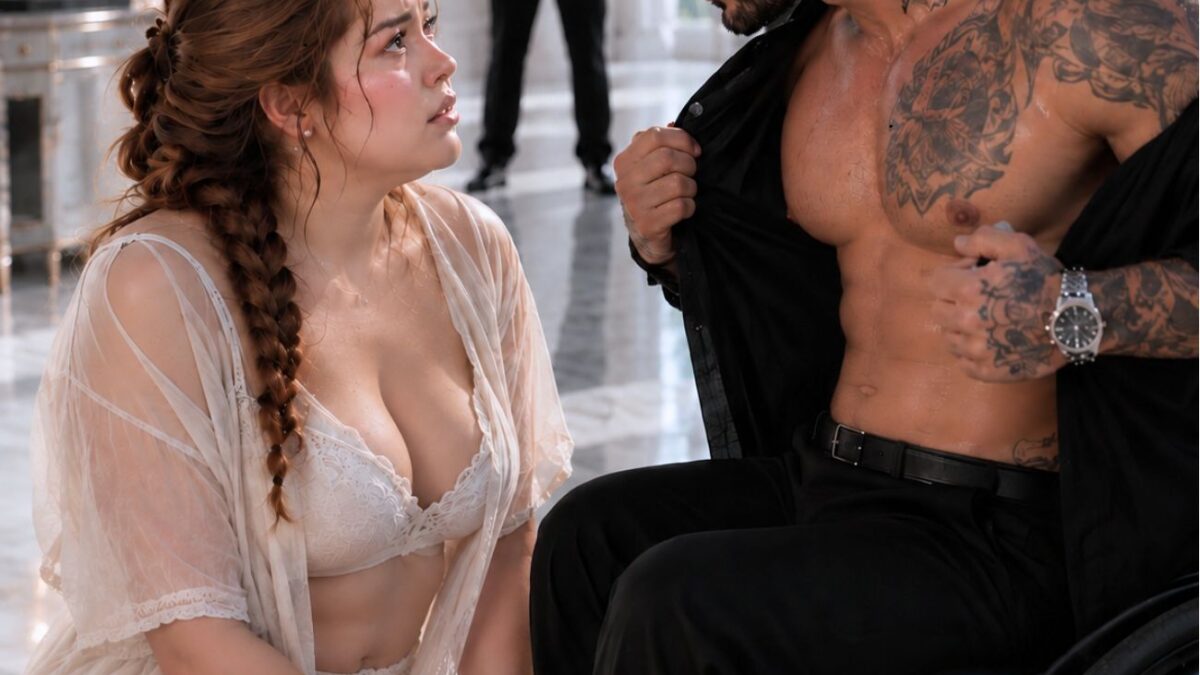
The rain had stopped an hour ago, but the ballroom window still wore it like fine lace, heavy silver beads sliding slowly down the tall glass while the city glittered somewhere far below. Inside, the annual charity gala had thinned to its last quiet hour, the hollowed-out stretch of night when the music softens, voices drop into conspiratorial murmurs, and nobody wants to be the first to walk out into the chill. Dante Moretti sat at the perimeter of the polished dance floor, one calloused hand resting on the push-rim of his wheelchair, the other loosely holding a crystal glass of scotch he had not touched in twenty minutes.
His tailored tuxedo jacket fit him the way fine wool fits powerful men, cut so sharply it seemed forged directly onto his silhouette rather than sewn around it. Yet it was his dark, unreadable eyes that commanded the massive room, cold and entirely still, currently fixed on the woman crossing the parquet toward him in a wine-red silk dress that moved like poured water. Anna Foster did not walk like an employee approaching an infamous underworld patriarch; she walked with the relaxed, unhurried posture of a woman crossing a room to meet someone she genuinely liked.
“You have been sitting here scowling at that poor string quartet for ten solid minutes,” she said, coming to a halt directly before him. She stood close enough that he caught the quiet, warm vanilla notes of her perfume rising through the ballroom’s drifting veil of beeswax candle smoke. “What did those four musicians ever do to you to deserve such lethal concentration, Dante?”
Dante’s mouth set into a grim, faintly sardonic line as he shifted his dark gaze back to the violins. “They keep playing sentimental songs designed to trick reasonable people into falling in love,” he answered, his voice a low, gravelly rasp. “I find the entire enterprise distinctly irritating.”
“Do you really?” Anna asked, tilting her head as her hazel eyes caught the warm amber light of the chandeliers. A few honey-toned curls had slipped loose from the formal braid pinned at the nape of her neck, softening her cheek. “Or do you find it irritating because you can’t get up and dance to them?”
Dante nearly laughed—a dangerous, startled rustle of amusement that died just behind his teeth. “You possess a reckless, suicidal talent for saying the exact thing nobody else in this entire ballroom would dare breathe in my presence.” “Someone has to,” Anna replied without blinking, holding out an open, bare palm.
It was not offered to shake, nor was it positioned to lever him upright or assist his balance; it was simply there, steady and waiting. “Give me your hand,” she said softly, leaving no room for negotiation. He hesitated for half a breath before lifting his fingers and resting them against her warm skin, feeling her pulse beat against his knuckles.
Anna reached out with her other arm, caught the back of an ornate gold ballroom chair, and dragged it across the polished floorboards without a care for the scraped sound it made. She swung it directly around to sit facing him, seating herself so close their knees were separated by less than an inch of evening fabric. At that distance, the sprawling, cavernous room, the murmuring elites, and the lingering security details blurred away into distant golden halos and weeping violin strings.
“We are not going to get up and dance,” she said, her voice dropping into an intimate register meant entirely for him. “We are going to sit right here, close our eyes, and pretend we are dancing, and not a single soul in this hall has to know the difference.” Then, keeping her fingers tightly woven between his, Anna began to hum the quartet’s melody beneath her breath, delightfully off-key and completely unbothered by her lack of pitch.
Dante Moretti, the most lethal figure on the Pacific seaboard, a man whose name was spoken in whispered syllables only after checking the shadows of the room twice, suddenly laughed out loud. It was a quiet, private, unguarded sound, bursting up from deep in his chest—a sound not one of his captains had heard pass his lips in six long, suffocating years. He watched the curve of her lips as she hummed, his defenses collapsing one by one like dry kindling beneath an inevitable, creeping flame.
At some point between the second refrain and the third, her warm fingers shifted, lacing deeply between his scarred ones until their palms were pressed flush. At some point, he leaned his broad shoulders forward, tipping his head until his lips brushed the soft skin of her temple, speaking so low the sound lived only in the shell of her ear. “I don’t remember the last time I felt like a man instead of a walking medical diagnosis, Anna.”
“You were always a man, Dante,” she whispered back against his cheek, not pulling away by even a fraction of an inch. “The rest of this foolish, frightened world just needed someone to remind them.” His thumb rose slowly, tracing the cool, familiar edge of the small gold locket resting against the hollow of her collarbone—a quiet, unconscious habit he had formed whenever she sat this close.
“Anna,” he murmured, the word barely surviving the distance between their mouths, laced with a vulnerability that terrified him far more than an assassin’s gun ever had. “Stay with me tonight.” She did not offer a verbal answer; she simply closed her eyes and leaned forward, resting her forehead gently against his, breathing in the cedar and smoke of his skin while the candles burned down to wax.
That was the night everything was still quiet, the fragile, golden hour before the foundation beneath their feet cracked open to show the teeth of a six-year-old betrayal. Six weeks earlier, none of this—neither the whispered confessions nor the tenderness—would have seemed even remotely possible. Anna Foster’s mornings had followed the exact same unyielding rhythm for four straight years, built upon discipline and the quiet ghost of an older tragedy.
Her alarm always sounded at five-forty in the morning, cutting through the damp Seattle darkness before the harbor horns had even begun their dawn calls. She drank her dark roast black, wore functional medical scrubs pressed crisply the evening prior, and kept her apartment stripped of unnecessary clutter. Before turning the deadbolt to leave, her fingers always paused on her bedside table, brushing against the glass frame of an old photograph showing a broad-shouldered man in turnouts.
Captain Robert Foster, twenty-two years with the Seattle Fire Department, had carried three children out of a collapsing timber warehouse the summer Anna turned nineteen. The burning structure had taken the full mechanical function of his lower legs as the price of those three young lives, pinning him beneath a blackened crossbeam. Anna had spent eleven grueling months walking the white linoleum corridors of the spinal rehabilitation ward, watching the world divide itself neatly into two distinct categories of caregivers.
There were the professionals who looked at her father and saw a broken, ruined object to be safely managed, their voices dripping with sticky, condescending pity. Then there was one solitary physical therapist—a sharp-tongued, iron-willed older woman named Ruth Callaway—who had looked at the retired captain and spoken to him like a man with work left to finish. Standing in the corner of that sterile hospital gym, holding her father’s sweat-soaked towel, nineteen-year-old Anna had decided with fierce finality which kind of person she was going to be.
Now, at twenty-seven, she was one of the lead neurological rehabilitation specialists at the Cascade Neurological Recovery Center, the premier private facility in the Northwest. The clinic was perched on a quiet, fog-draped terrace above Elliott Bay, where the mist rolling in off Puget Sound softened the jagged glass towers of downtown into gentle gray silhouettes. Her patients respected her, not because she coddled them or spoke in soft euphemisms—she rarely did either—but because she categorically refused to view a wheelchair or a brace as an ending.
To Anna, medical hardware was merely punctuation—a comma or an ellipsis in a patient’s life, but never, under any circumstances, a full stop. Every morning before entering the clinic floor, she bought a paper cup of black coffee from a corner bakery two blocks away and stood motionless on the sidewalk for sixty seconds, watching the tide churn against the piers. Her father had once told her from his wheelchair that watching the gray water slowly clear in the morning wind proved that healing was glacial, but it was never nothing.
She had carried that unyielding philosophy into every treatment room she had ever unlocked, whether working with a stroke survivor or a crushed dockworker. Anna Foster believed to the bottom of her soul that dignity, not sympathy, was the true active compound in neurological medicine. In four years of clinical practice, she had never encountered an ego or an injury capable of making her question that core conviction.
She had no reason to suspect that the rainy Tuesday her department director summoned her into the corner office would alter the course of her life forever. “We have an inquiry for a private, full-time resident placement,” her director said, sliding a thick manila folder across the mahogany desk without looking directly at her face. “The compensation is three times your clinical salary, but the environment is… specialized, and he has already dismissed four of our best therapists over the years.”
“Four?” Anna asked, resting her fingers on the edge of the closed file without opening it yet. “Four therapists in six years,” the director clarified, his lips pressing into a thin, anxious line. “The last one walked out after twelve days and refused to debrief us on what occurred; his name is Dante Moretti.” Anna knew the name, of course; anyone who had lived in the Puget Sound area for more than a month knew the name Dante Moretti.
It was a name spoken in hushed, nervous tones across the city, appearing frequently in investigative columns that leaned heavily on the adjective alleged. It was the name responsible for the sudden, uneasy quiet that settled over high-end Italian restaurants whenever a motorcade of armored black Escalades pulled up to the curb. She had read about the shootout six years ago on the industrial waterfront—a brutal ambush that had left three men dead and the young syndicate heir paralyzed from the waist down.
“I don’t care who he commands outside his front gates,” Anna said evenly, pulling the manila file across the desk and flipping it open to the initial intake scans. “I only care what his thoracic and lumbar spine look like on an MRI, and whether his nerve roots are completely severed or merely impinged.” Her supervisor stared at her for several seconds before a faint, weary smirk touched the corners of his mouth. “That is precisely what I told his legal counsel you would say.”
The Moretti estate sat atop the highest crest of Queen Anne Hill, an imposing fortress of dark stone, tinted glass, and black wrought iron overlooking the churning bay below. Two armed men in charcoal suits systematically searched Anna’s medical duffel and medical kit at the guard gate without offering an apology, checking every vial and strap. A third escort, built like an iron pillar, guided her through echoing marble hallways that smelled of expensive beeswax polish, aged leather, and something far colder beneath.
The massive house felt less like a private residence and more like a mausoleum constructed to perform ancient wealth rather than accommodate human living. Towering floor-to-ceiling windows framed the slate-gray water, sweeping toward a curved marble staircase that bore no signs of human footprints. Anna had walked into plenty of intimidating spaces in her life—including hostile hospital boardrooms full of surgeons who dismissed rehabilitation nurses—but this estate possessed a distinct, predatory stillness.
She found Dante Moretti waiting in a wood-paneled library at the back of the mansion, seated behind a desk carved from a single slab of dark mahogany the size of a boat. He was dressed in an impeccably tailored charcoal suit, looking as though he were preparing to preside over an international acquisition rather than an initial therapeutic assessment. He did not lift his chin when the heavy oak doors clicked shut behind her, his attention remaining fixed on the financial documents spread before him.
“You are the fifth,” he said, his voice deep, gravelly, and flat, carrying the cold authority of a man used to moving armies with a whisper. “I assume they warned you.” “I was informed that you fired four qualified specialists who were attempting to assist you,” Anna replied, setting her medical bag down on a leather wingback chair without waiting for an invitation. “I didn’t come here to be your fifth dismissal, Mr. Moretti; I came here to be the first person who refuses to let you throw a tantrum and quit.”
That made him look up. His eyes were a deep, obsidian black that seemed to absorb ambient light rather than reflect it, cold and assessing beneath thick, dark brows. For an involuntary second, Anna felt an ancient, animal chill dance down her spine, understanding instantly why seasoned criminals reportedly lost their composure when facing this man across a table.
Then, behind the impenetrable dark of his gaze, she caught a momentary flicker—a hairline fracture in his armor that might have been surprise, or perhaps the faint, rusty stirrings of curiosity. “You aren’t trembling,” he observed, leaning his broad chest back against the leather cushion of his wheelchair. “Most people tremble in this room.” “I’m not on your payroll to be frightened of your reputation,” Anna said, unzipping her blood-pressure cuff with crisp, businesslike efficiency.
“I’m here to find out if we can get your motor pathways firing again, and make you functionally stronger than you were yesterday,” she continued, meeting his gaze squarely. “Everything else—your businesses, your enemies, and whoever owes you money—is strictly between you and your security guards.” For the first time in longer than either of them could have calculated, Dante Moretti let out a short, startled sound—a genuine bark of amusement that escaped before he could seal it away.
What neither of them knew in that sunlit room, what was hidden in the careful alignment of the specialized equipment down the hall, was that Dante’s recovery had never been left to chance. Locked inside a subterranean filing cabinet in the estate’s secondary administrative wing lay six years of meticulously falsified neurological progress notes. It was the paper trail of a rehabilitation protocol deliberately engineered not to heal the Moretti boss, but to ensure he remained permanently confined to his chair.
The architect of that slow, administrative poisoning was standing just beyond the heavy library door at that precise moment, his ear tilted toward the wood. Marco Bellini carried Moretti blood in his veins, but none of Dante’s icy discipline or strategic patience; he was younger by four years, possessing a sharp, nervous charm that often passed for intellect until one recognized the desperate greed beneath it. For six years, while Dante had expanded the family’s shipping and real estate holdings with ruthless precision, Marco had quietly constructed a parasitic empire within the walls.
He had bought two licensed physicians, compromised a resident physical therapist, and established a steady drip of altered medical reports designed to keep his cousin believable as an invalid. Marco had never wanted Dante dead; a murdered boss becomes an eternal martyr, an untouchable symbol around which loyal captains rally to seek bloody vengeance. Marco wanted something far more lucrative: he wanted Dante alive, nominally revered, and permanently sidelined until the captains naturally grew tired of taking orders from a man who could not stand at the head of the boardroom table.
Marco had successfully eliminated the four previous physical therapists through calculated intimidation, bureaucratic frustrations, or quiet threats delivered to their families. He had fully expected this fifth candidate—a blonde rehabilitation nurse from a public clinic—to fold under the pressure within a fortnight. Stepping away from the library door, Marco slipped a burner phone from his breast pocket and tapped out a brief message to an unsaved international number: New nurse arrived. Same protocol. Handle quietly.
The reply arrived within thirty seconds: Understood. The clock is running. Marco had three months before the annual general commission meeting, where the regional capos would gather in Seattle to review operations and decide the family’s future leadership. Three months to ensure Anna Foster was either chased out of Queen Anne Hill or silenced before her fingers stumbled upon the discrepancies buried within Dante’s physical baseline.
For the first fourteen days of her contract, Anna Foster did very little direct physical intervention; instead, she observed the house. She watched the way Dante’s private bodyguards moved, noticing how they leaped forward to pull open heavy doors that he was entirely capable of reaching from his seat. She watched his personal valet place hot espresso directly into his curled fingers rather than setting the saucer on the desk where he would have to reach for it.
Every single person within the stone mansion had quietly, lovingly formed a conspiracy to treat Dante Moretti as though he were made of spun sugar. She watched Dante endure it, his strong jaw clenching in silent irritation, choosing not to fight over coffee cups because his energy was consumed by the brutal underworld politics outside his gates. She also spent hours inspecting the high-end rehabilitation gym situated in the east wing—the hydraulic lift, the parallel walking bars, the specialized harness systems.
Something about the wear patterns on the equipment struck her as fundamentally wrong; the cables were frayed in odd spots, and the tension dials showed resistance levels far too low for a man of his muscular build. A patient who had genuinely worked these machines for six years should possess far more core stability than his intake charts indicated. She kept her suspicions tightly locked behind her teeth, continuing her quiet baseline evaluations until the fifteenth morning.
That afternoon, as Dante finished a series of seated shoulder presses, his valet stepped forward to hoist him by the armpits to transfer him toward the massage table. “Step back, please,” Anna said, her voice cutting through the quiet gym with absolute, calm authority. “He is going to manage the transfer himself.” The valet blinked in shock, his hands hovering awkwardly in mid-air. “Miss Foster, Mr. Dante always requires assistance with this lateral move; it is the standard protocol.”
“I know what the previous protocol was,” Anna said, meeting the valet’s bewildered gaze without yielding an inch of ground. “We are changing the protocol today.” Dante sat frozen in his chair, his dark eyes narrowing into an expression Anna was beginning to recognize—the predatory stillness of a dangerous man deciding whether to crush an insolent subordinate. “You do not give operational commands to the staff in my house,” Dante said, his voice dropping into a dangerous, gravelly register once the valet had hurriedly vacated the room.
“I don’t care about your staff, and I don’t care about your house,” Anna countered, stepping directly into his personal space, her hazel eyes completely steady. “I care about your body while you are on these mats, and right now, your upper torso and latissimus dorsi are capable of twice the workload this household allows you to perform.” “You presume to tell me what I am capable of?” he growled, his hands gripping the armrests of his chair with enough force to turn his knuckles white.
“Yes,” Anna said simply, crossing her arms over her chest. “Show me I’m wrong.” The silence hung between them like a drawn bowstring, thick and charged with an intensity that had nothing to do with medicine. With a low, guttural curse, Dante shifted his hips forward, planted his thick, calloused palms onto the transfer board, and engaged the broad muscles of his back.
His shoulders knotted beneath his thin workout shirt, veins standing out like cords along his neck as he fought the dead weight of his legs. His arms—muscular and battle-hardened from years of compensating for his lower body—trembled violently under the strain as he suspended himself between the surfaces. Sweat broke across his brow, his teeth grinding together to suppress a ragged grunt of exertion, taking nearly three agonizing minutes to complete a lateral movement that should have taken ten seconds.
When his hips finally settled onto the padded examination mat, his chest was heaving, his breathing ragged and wild, eyes burning with sheer fury at his physical limitations. Anna did not rush forward with a towel or offer an outstretched hand to steady him. Instead, she stood back, raised her hands, and gave three slow, deliberate, unapologetic claps.
“Are you completely out of your mind?” Dante panted, glaring at her through the dark hair falling over his forehead, caught between disbelief and raw indignation. “Not at all,” Anna replied, stepping forward to hand him a clean towel. “That is simply the first time in six years someone in this mausoleum respected you enough to let you fight your own battle.”
Dante froze, his hand paused halfway to his face, his dark gaze locked onto hers as though seeing her clearly for the first time. “Say that again,” he murmured, the anger suddenly draining out of his voice, replaced by something deep, hollow, and aching. “Struggling is not the opposite of strength, Dante,” Anna said softly, her tone entirely stripped of professional detachment. “Struggling is the undeniable proof that strength exists.”
Over the following four weeks, the atmosphere inside the cavernous Queen Anne estate began, incrementally, to shift. The oppressive, tomb-like silence of the stone hallways was broken by the sound of Anna humming old jazz standards while she worked through his range-of-motion drills. She brought an unyielding, radiant warmth into rooms that had known only calculated paranoia for a decade, refusing to walk on eggshells simply because men with sidearms stood outside the doors.
Dante found himself tracking her schedule with a quiet intensity that unsettled him; he knew the exact pitch of her modest sedan’s engine as it pulled up the gravel driveway at seven in the morning. He began refusing small courtesies from his staff, wheeling himself into operational briefings and dressing himself without waiting for an attendant. When a subordinate capo attempted to speak over him during a security briefing, Dante cut him down with a cold, cutting reprimand: “My legs may be damaged, Tomas, but my hearing and my authority remain entirely intact.”
Later that same evening, while Anna was wrapping his calves in therapeutic ice bands, he confessed that dressing down his captain had felt better than any business victory he had secured that year. “They stopped looking at my face years ago, Anna,” he admitted, looking out the grand study window as the Seattle twilight turned the water purple. “Somewhere along the way, they stopped seeing Dante Moretti and started seeing a broken chair that needed to be wheeled out of the line of fire.”
“I have never once seen the chair, Dante,” Anna said, securing the Velcro strap with a firm, practiced tug before looking up to meet his gaze. “I only see the man.” “I know,” Dante replied, his voice softening until it sounded remarkably like a sacred confession. “I know you do.” Their connection deepened through a hundred unspoken moments that never found their way into her clinical charting.
There was the quiet evening she found him in his dressing suite, struggling to tie a formal silk necktie in the mirror, his fingers stiff with frustration. Instead of stepping in to take over, Anna pulled up an ottoman, sat beside him, and playfully critiqued his knotting technique until they were both laughing so hard his hands relaxed and finished the knot. There was the stormy Sunday she discovered him in the industrial kitchen trying to operate an old manual espresso machine; she talked him through the grind and the steam pressure from across the island, refusing to touch a single lever herself.
She watched him reclaim his autonomy millimeter by millimeter, realizing with a sudden jolt of panic that her heart was no longer operating within the safe boundaries of a nurse-patient dynamic. The critical turning point arrived on a brilliant, sunlit Thursday afternoon, three weeks before the Moretti Foundation’s annual gala. Anna was in his expansive dressing room, organizing the specialized garments designed to accommodate his leg braces, when she reached for a heavy charcoal jacket hanging from the valet stand.
“Here, let me hold this for you,” she said casually, lifting the wool toward his shoulders in a gesture that was entirely instinctive and meant only to save him time. Before the fabric could touch his back, Dante’s large hand shot out, his long fingers closing firmly around her wrist. The room plunged into an immediate, breathless silence, the air growing dense and fragile between them.
Anna looked down, expecting the cold anger of a mob boss whose pride had been nicked, but she found no fury in his features. Instead, his jaw was trembling with an effort at control she had never witnessed, his dark eyes shimmering with an agonizing, naked vulnerability. “I am still a man, Anna,” Dante whispered, the words ragged and raw, torn straight from the marrow of his bones. “Do you truly think I am incapable of putting on my own coat?”
The sentence struck Anna directly in the center of her chest, carrying the crushing weight of his six-year imprisonment. In that single, terrible second, she saw every well-meaning relative, every overprotective bodyguard, and every patronizing doctor who had gently, systematically stripped him of his agency. Her throat tightened with a sudden burn of tears, but she refused to let them fall, knowing that an apology would be the ultimate insult.
“Then show me,” Anna whispered back, her voice ringing with fierce, unshakeable faith as she stepped backward and dropped her hands to her sides. It took him nearly six grueling minutes to work his left arm into the heavy silk lining, his teeth bared, sweat beading at his hairline as he fought the stiff angles of his shoulders. Twice the heavy wool slipped down his back; twice he paused, dragged oxygen into his lungs, reset his posture, and attacked the movement again.
When the jacket finally settled square across his broad shoulders, smooth and perfectly aligned, Anna did not offer a polite murmur of approval. She stood straight and gave him an ovation of fierce, genuine pride—the kind of recognition a soldier receives when taking high ground. “That,” Dante breathed, leaning his head back against the leather rest, his chest rising and falling heavily, “is the first time in six years I have felt like a man doing a task instead of a patient receiving charity.”
Anna crossed the small distance between them, reached out with slow, deliberate hands, and gently smoothed the satin lapels over his chest, refusing to look away. “You were always the man, Dante; the rest of the world just needed you to show them.” Dante caught her hand against his lapel, his fingers surprisingly gentle as he brought the back of her knuckles to his mouth, pressing a slow, burning kiss against her skin.
Neither of them heard the soft click of the dressing room door settling into its frame at the end of the hall. Neither of them saw Marco Bellini standing in the carpeted corridor, lowering his smartphone from his ear, his handsome face twisted into an ugly, venomous sneer. “The situation has changed,” Marco murmured into his encrypted line, his voice shaking with suppressed rage. “She isn’t breaking; she’s making him stronger, and Dante is starting to look like a boss again.”
“Then we accelerate the schedule,” replied the gravelly voice of Hector Reyes, the syndicate head who had been funding Marco’s shadow operations. “Eliminate the woman.” “Quickly,” Marco hissed, staring at the closed door. “Before he remembers who he was before the bullet.” The campaign against Anna began with subtle, calculated incidents designed to look like accidental failures.
Two days later, during a morning gait-training session on the parallel bars, a high-tension steel cable snapped with a sound like a rifle shot. Dante went down hard onto the rubber matting, his shoulder taking the brunt of the fall as he cursed violently, slamming his fist into the floor. Anna was on her knees instantly, checking his neck and clavicle, her sharp eyes tracking the frayed end of the severed cable.
“This braided steel was inspected and logged as pristine less than two weeks ago,” she said, her voice shaking with adrenaline. “This was cut halfway through with a jeweler’s saw.” “Someone is getting careless,” Dante said, his eyes darkening to coal as his security detail rushed into the gym. Forty-eight hours later, a forged dossier of confidential financial and medical files from the Moretti estate was leaked to an investigative reporter at the city’s major daily newspaper.
The accompanying anonymous note claimed that Anna Foster was actively selling internal family security layouts to rival syndicates. Tomas, the stone-faced head of security, brought the printout directly to Dante’s study, laying the papers before his employer with a grim, noncommittal expression. “It’s a complete fabrication,” Anna stated, standing rigid before the massive desk, her voice unwavering even as her fingers knotted together. “I have never spoken to a journalist in my life.”
“I know,” Dante said instantly, cutting her off before she could mount a defense, not an ounce of hesitation in his voice. “You… believe me?” Anna asked, caught off guard by the total absence of suspicion in his dark eyes. “I have spent two months studying your character, Anna,” Dante said, leaning forward. “You are incapable of treason; someone within these walls is trying to force you out, which means we are getting close to something they fear.”
Anna felt a wave of profound relief wash through her, followed immediately by a chill of realization. “Whoever is doing this has administrative access to both your medical charts and the internal security cameras,” she noted. Dante’s expression turned lethal, the subtle warmth he possessed with her vanishing behind the mask of an apex predator: “Then we will draw them into the open.”
That night, unable to shake the image of the sawed cable, Anna locked herself in the estate’s secondary records library and pulled every physical therapy ledger dating back six full years. What began as an intuitive hunch rapidly crystallized into undeniable evidence of systemic medical treason. Across seventy-two months of rehabilitation records, the progress metrics flattened unnaturally at identical quarterly intervals, showing deliberate regression whenever Dante’s motor scores improved.
The signatures of Dr. Alfred Whitfield and a technician named Corbin Hale appeared on eleven separate authorizations ordering the reduction of electrical stimulation therapies. Every time Dante’s personal calendar showed an upcoming commission summit or an aggressive training push, Whitfield’s notes conveniently fabricated severe phantom limb spasms to justify heavy sedatives. It was not medical negligence; it was an exquisite, cold-blooded architectural plan designed to keep a powerful man physically dependent and socially neutralized.
Anna sat back in the leather chair, the fluorescent light humming above her, a sick wave of nausea washing through her stomach. She thought of Marco Bellini’s solicitous inquiries at dinner, his counterfeit displays of concern, his constant reminders to the capos that Dante needed to rest. She gathered the files, locked them in her personal medical satchel, and prepared to confront the reality of the Moretti household the following evening.
The next night, Dante insisted on attending a routine business dinner at an upscale waterfront seafood restaurant owned by the family, refusing to alter his schedule despite security warnings. Anna accompanied him, not as an armed operative, but because neither of them could bear the thought of separation in an environment that felt increasingly hostile. The private dining room overlooked the gray swells of Elliott Bay, lit by soft amber lanterns that cast long shadows across the crisp linen tablecloths.
Dante reached across the table, his fingers lightly brushing hers, the intimacy between them so heavy it seemed to push the rest of the world into obscurity. “You look exhausted, Anna,” he said gently, noting the faint purple smudges beneath her hazel eyes. “I’ve been reading,” she replied cryptically, her heart hammering against her ribs as she prepared to tell him about Marco’s six-year betrayal.
Before she could open her mouth, the panoramic front windows of the restaurant shattered inward in an explosion of flying glass and deafening automatic gunfire. The air filled instantly with the stench of cordite, screams, and the violent percussion of heavy-caliber rounds shredding mahogany paneling. Dante’s security detail reacted within seconds, drawing their weapons and returning fire, but in the initial chaos, Dante’s wheelchair caught violently against the leg of a heavy oak partition.
He was pinned in the open, broadside to the shattered streetfront, unable to lever his chair free as muzzle flashes illuminated the rainy dark outside. “Get down!” Anna screamed, her clinical composure vanishing beneath an older, primal instinct forged in the fires of her youth. She did not hesitate or cower; she launched her entire body forward across the ruined table, throwing her full weight into the frame of Dante’s wheelchair.
Using her hips, shoulders, and legs, she drove the heavy titanium frame backward, dragging both of them behind the structural safety of an overturned cast-iron serving station. Splinters of wood and chunks of plaster rained down on her hair as high-powered rounds chewed through the wall mere inches above their skulls. “Anna, stay down!” Dante roared, trying to shield her with his broad torso, but she pushed him flat against the floorboards, her hands steady as stone.
What the Moretti syndicate had failed to realize when vetting Anna Foster was that she had spent two teenage summers running triage alongside her father during eastern Washington wildfires. She understood the physics of falling timber, she knew how to drag dead weight through smoke, and she knew that terror was a luxury reserved for people who had already survived. “Quiet,” she hissed in his ear, keeping her body pressed over his as she surveyed the layout through the drifting drywall dust. “The kitchen exit is clear; we move on my mark.”
When Dante’s men temporarily suppressed the exterior shooters with a sustained volley, Anna grabbed the handles of his chair, dropped her center of gravity, and drove him through the service doors. They burst into the cold, wet alley just as the sirens began wailing in the distance, Dante’s guards swarming the perimeter to form an impenetrable wall of steel. Anna stood in the rain, blood dripping from a jagged glass laceration on her forearm, her scrubs soaked, her hands finally beginning to shake as the adrenaline crashed.
Dante stared up at her from his chair, his chest heaving, his face pale with a terrifying mixture of awe and absolute terror for her safety. “Where in God’s name did you learn to move like that?” he demanded, his voice cracking with emotion. “My father was a firefighter, Dante,” she whispered, wiping rain and plaster dust from her cheek with the back of a bloody wrist. “I learned how to pull people out of collapsing structures long before I learned how to heal them.”
Dante reached out, his powerful hands catching her hips and pulling her firmly against his chest, burying his face in the damp fabric of her uniform. “You just hauled a two-hundred-pound man and a steel frame through active gunfire,” he breathed against her neck. “It was everything,” Anna whispered back, her fingers sinking into his thick, dark hair. “I wasn’t going to let them take you from me.”
Later that midnight, in the fortified sanctuary of his private study, Anna sat on a low stool while Dante methodically cleaned the glass fragments from her arm with antiseptic. His hands, normally so decisive and lethal, were trembling with an agonizing gentleness as he wrapped the sterile gauze around her skin. “You could have died tonight because you were sitting at my table,” Dante said, his voice hollow with self-loathing.
“I could have died a hundred pointless ways in a hospital ward,” Anna answered firmly, reaching out with her uninjured hand to cup his rugged jawline. “Stop treating me like a liability you have to protect from your darkness, Dante; start treating me like a woman who chose to stand in it with you.” He didn’t speak; he simply leaned forward, caught her waist, and lifted her effortlessly onto his lap, holding her against his heart until the tremor left her limbs.
It was there, in the quiet safety of his arms, that Anna reached into her medical bag and placed the thick stack of audit reports directly onto his desk. “It wasn’t an accident that your cables broke, Dante, and it wasn’t an accident that you haven’t walked in six years,” she said softly, watching his face harden into stone. “Dr. Whitfield’s signature is on eleven forged orders; your progress was systematically halted every time your motor pathways began to reconnect.”
Dante spent twenty minutes reading the documents in absolute, terrifying silence, the air in the room dropping toward an icy, lethal zero. “Marco,” he whispered finally, the name escaping his lips not as an inquiry, but as a cold, finished verdict. “The signatures and the bank transfers point directly to his shell accounts,” Anna confirmed quietly. “He needed you weak enough to take your empire, but alive enough to prevent a war.”
The following evening, Dante Moretti summoned all twelve regional capos to the great mahogany hall, seating himself at the head of the massive table. He did not wear his usual business attire; he wore the dark tactical wool of a commander preparing for an assault, his obsidian eyes scanning the assembled men with lethal clarity. “For six years, someone at this table has been paying my physicians to keep me crippled,” Dante announced, his voice carrying like thunder across the room without him raising it an octave.
The room froze, men who had killed without remorse shifting uncomfortably beneath the terrible weight of his gaze. “I never needed functional legs to rule this family,” Dante continued, resting his palms flat on the wood. “I only needed loyalty, and my cousin Marco has proven he possesses none.” His gaze dropped to the single empty chair at the foot of the long table—Marco had failed to appear, having fled toward the industrial docks three hours prior.
“Find him,” Dante ordered his commanders, his voice cutting through the heavy air like an executioner’s blade. “Bring him to the south terminal before dawn.” The confrontation occurred at three in the morning beneath the rusted iron cranes of Pier 42, where Puget Sound lapped black and cold against the pilings. Marco Bellini had been intercepted trying to board a freighter bound for South America, surrounded by Dante’s most trusted enforcers with weapons drawn.
Anna had categorically refused to remain behind at the mansion, standing resolutely behind Dante’s armored vehicle as the rain began to fall in sheets. Dante wheeled himself forward across the wet timber of the pier, stopping five feet from his trembling, bloodied cousin, who was held down on his knees by Tomas. “Six years, Marco,” Dante said softly, the words carrying easily over the roar of the wind. “You sat at my Sunday dinners and asked about my physical therapy while paying butchers to keep me in this chair.”
“You were broken anyway, Dante!” Marco screamed, his composure completely disintegrating into hysterical fury. “I preserved this family! The men needed a leader who could walk into a room, not a cripple they had to pity!” “The only person in this city who ever pitied me was you, Marco,” Dante replied with chilling, majestic calm. “Because you were too cowardly to challenge a whole man, so you tried to manufacture a weak one.”
Dante looked up at his waiting captains, who stood in the shadows like stone sentinels, their loyalties completely and irrevocably solidified. “Strip him of every asset, take his passport, and put him on a transport south,” Dante commanded coldly. “If he ever sets foot in Washington state again, finish it.” Marco was dragged away into the rainy dark, screaming curses until the exhaust of the transport swallowed his voice entirely.
Dante sat alone at the edge of the pier for a long moment, watching the black water churn against the wood, the six-year nightmare finally lifting from his shoulders. Anna walked forward through the misty rain, dropping to her knees directly in front of his chair, exactly as she had done on her first day in his house. “You didn’t need to stand to be the strongest man on this dock tonight,” she whispered, her hazel eyes bright with unshed tears.
“I know,” Dante said, reaching out to cradle her face in his scarred palms, his thumbs brushing away the rain from her cheeks. “You taught me that, Anna.” “No,” she said, pressing her forehead against his. “You always possessed it; I just made sure the rest of the world stopped lying to you.”
He pulled her up into his arms, his mouth finding hers in the cold, wet air of the pier, tasting of salt, rain, and the fierce, unyielding promise of a new dawn. Three weeks later, the ballroom of the Fairmont Olympic was once again ablaze with crystal light for the rescheduled Moretti Foundation gala. The city’s elite filled the floor, but the predatory tension that had once haunted the room had vanished, replaced by an atmosphere of absolute, unquestioned stability.
Dante sat at the edge of the dance floor, watching Anna cross the parquet in a stunning emerald gown, her hair swept up to reveal the small gold locket at her throat. When she reached him, she did not ask questions; she simply pulled a gilded ballroom chair around to face him, their knees nearly touching as the quartet began to play. “Are you going to complain about the violinists again, Mr. Moretti?” she teased, her eyes sparkling with warmth.
“Not tonight,” he murmured, his fingers finding hers and pulling her close. “Stay with me, Anna. Not just for this gala, and not just for the recovery. Stay for the rest of it.” “I was never going anywhere,” she whispered back, resting her brow against his temple as the music swelled around them. Eight months later, a brilliant, clear autumn sun broke over the Seattle waterfront as hundreds gathered for the ribbon-cutting of the Moretti Center for Spinal Recovery.
The eight-story facility of steel and curved glass stood as a monument to functional rehabilitation, funded entirely by clean, legitimate capital Dante had separated from family operations. Sitting in the front row was Dr. Ruth Callaway, Anna’s old mentor, dabbing at her eyes with a handkerchief while Tomas stood watch at the perimeter with an uncharacteristic smile. Anna stood beside the podium, watching former stroke patients and young accident survivors moving through the state-of-the-art gymnasiums inside.
When his name was announced, Dante Moretti did not roll his chair forward to address the crowd of doctors, politicians, and loyal captains. Instead, using carbon-fiber leg braces that Anna had spent eight exhausting months training him to operate, Dante planted his hands on the armrests and pushed himself upward. A collective, stunned gasp rippled through the hundreds of gathered guests as Dante Moretti rose to his full six-foot-two height, standing tall on his own two feet.
He was not walking without effort—every muscle in his broad frame was engaged in the fierce, disciplined struggle of balance—but he was standing, proud, sovereign, and entirely unbroken. He stepped up to the microphone, his dark eyes locking instantly onto Anna where she stood just off to his right side, her hands pressed against her mouth to hold back her tears. “For six years, the world told me that the man I was had ended the night a bullet took my mobility,” Dante said, his voice echoing with absolute authority across the plaza.
“I believed them because it was easier than fighting a world that preferred me small and manageable,” he continued, his voice softening with deep emotion. “Then a woman walked into my house, looked past the metal and the diagnosis, and demanded that I show her the man who was still alive inside.” Dante reached into his breast pocket, retrieved a small velvet box, and, with slow, deliberate, hard-earned control, lowered his right knee onto the podium platform before the entire city.
“I am still a man, Anna Foster,” Dante said, the words from that sunny dressing room returning with no sorrow, only an eternity of devotion. “And I want to spend the rest of my standing and sitting days proving I am worthy of the woman who saw me when I was invisible.” Anna dropped to her knees before him, laughing through her tears as she threw her arms around his neck, whispering against his lips, “You always were, Dante. You always were.“

