I Gave My Cheating Husband Everything in Court. Then a Six-Year-Old Girl Told the Judge What He Had Really Done.
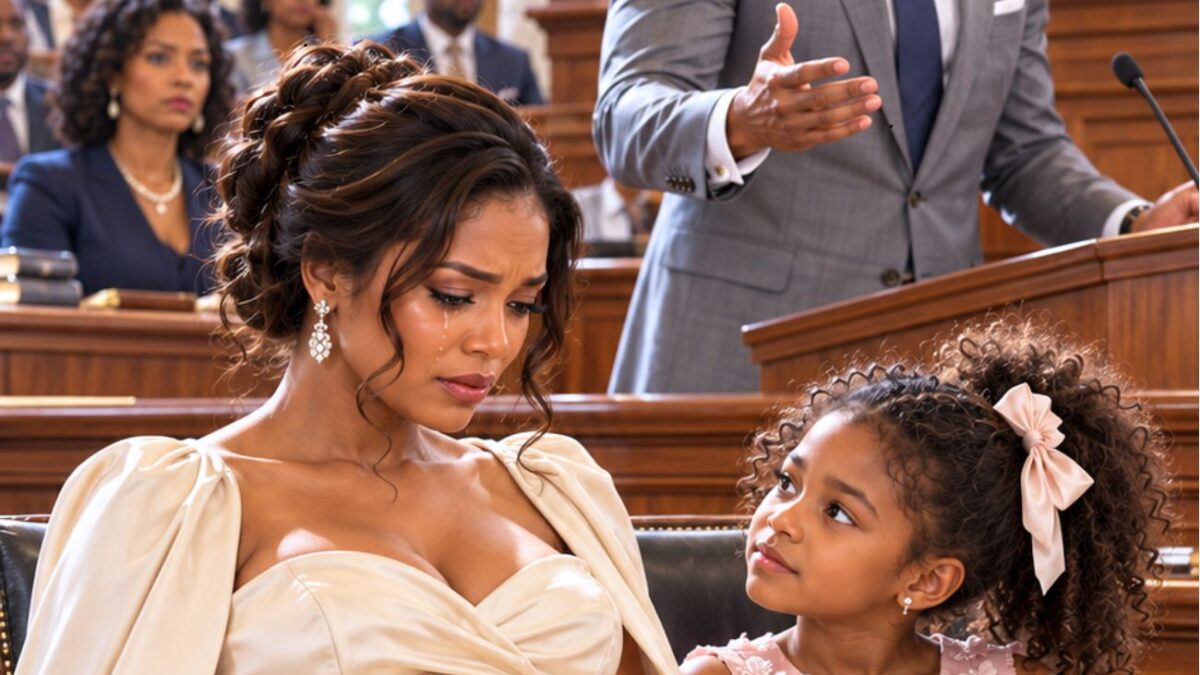
The six-year-old girl pointed one trembling finger across the courtroom and said the words that destroyed my husband’s life.
“Daddy and the mean lady put something in Penny’s drink.”
Nobody moved.
Not my attorney.
Not the bailiff.
Not the strangers sitting on the hard wooden benches behind us.
And certainly not Gabriel.
My husband’s face had already gone pale when Daisy entered the courtroom clutching her battered stuffed rabbit.
Now it seemed to lose every trace of blood.
Beside him, Bianca Shepherd sat rigid in a cream-colored dress, her lips parted slightly.
Only ten minutes earlier, she had been laughing at me.
Laughing because I had just offered Gabriel nearly everything we owned.
Our house.
Our savings.
Two cars.
My interest in his company.
Even the antique furniture my grandmother had left me.
At eight months pregnant, I had stood before Judge Rosalind Barrett and surrendered almost twelve years of financial security because Gabriel had promised me one thing in exchange.
He would not fight me for my unborn baby.
I had believed losing everything was worth that peace.
Then Daisy walked into the courtroom.
And suddenly the divorce was no longer about adultery.
It was no longer about money.
It was not even about custody.
It was about what had happened to me three weeks earlier in our garage.
And, although I did not know it yet,
it was about what had happened to another woman nearly two years before that.
Judge Barrett leaned forward.
“Daisy,” she said softly, “you’re safe here.
Nobody is angry with you.”
Daisy’s frightened brown eyes moved toward me.
I knew that expression.
I had seen it when she woke from nightmares.
I had seen it the first Christmas after her mother died.
I had seen it when Gabriel raised his voice too loudly and she instantly became very still.
I wanted to cross the courtroom and take her into my arms.
But I couldn’t move.
My daughter kicked beneath my ribs.
Or at least, at that moment, the baby growing inside me was the only child I believed was truly mine.
Daisy squeezed the rabbit against her chest.
Judge Barrett spoke again.
“What happened to Penny’s drink?”
Daisy swallowed.
“Daddy told me to go upstairs.”
Gabriel suddenly stood.
“Your Honor, this is outrageous.
She’s six years old.
She doesn’t understand what she’s saying.”
The judge’s expression changed instantly.
“Sit down.”
“But—”
“Mr.
Albright,
sit down.
”
The bailiff took one step toward him.
Gabriel lowered himself into his chair.
I had been married to that man for seven years.
I knew the tiny signs of his anger.
The muscle twitching near his jaw.
The thumb pressing repeatedly against his wedding-ring finger even though the ring was gone.
The way his shoulders became unnaturally still when he was frightened.
He was frightened now.
Terrified.
Judge Barrett turned back to Daisy.
“You said your father told you to go upstairs.”
Daisy nodded.
“But I wanted Bunny.”
She held up the stuffed rabbit.
“It was in the laundry room.”
My chest tightened.
Three weeks earlier, I had been found unconscious in our garage.
Gabriel said I must have fainted while trying to leave the house.
The engine of my SUV had been running.
The garage door had been closed.
If our neighbor hadn’t heard Daisy screaming and called emergency services, my unborn baby and I might not have survived.
I remembered almost nothing.
Only drinking raspberry tea after dinner.
A strange heaviness behind my eyes.
Then waking in a hospital with an oxygen mask over my face while Gabriel sat beside my bed telling doctors that pregnancy had made me emotionally unstable.
He had even suggested I might have tried to harm myself.
I had screamed at him.
He had cried.
And when the toxicology screen showed traces of a prescription sedative, Gabriel told doctors I must have taken one of the old sleeping pills left over from a surgery years earlier.
I had believed there had to be some explanation.
Because the alternative was impossible.
Because husbands cheated.
Husbands lied.
Husbands abandoned wives.
But husbands did not drug pregnant women and place them beside running cars.
At least, I had needed to believe that.
Daisy’s voice shook.
“I went down for Bunny.”
She looked at Gabriel.
“Daddy was carrying Penny.”
My hand flew toward my mouth.
Gabriel whispered, “No.”
Bianca turned toward him.
“Gabriel—”
“Don’t.”
Judge Barrett’s head snapped toward them.
“Neither of you speaks again unless I ask you a question.”
Daisy continued.
“Penny was sleeping weird.”
“Sleeping weird?” the judge asked.
Daisy nodded.
“Her head was hanging.”
Something cold moved down my spine.
Daisy demonstrated by letting her chin fall against her chest.
“Daddy was holding under her arms.
Miss Bianca had her feet.”
Someone behind me gasped.
I heard my attorney, Rachel Cho, whisper my name.
I couldn’t answer.
I was no longer in the courtroom.
I was seeing our garage.
Gray concrete.
Gabriel’s workbench.
The shelves filled with paint cans and gardening supplies.
My silver SUV.
I was imagining my husband carrying my unconscious body toward it.
Bianca holding my ankles.
My baby inside me.
Helpless.
“What did they do next?”
Judge Barrett asked.
Daisy started crying.
My instinct finally defeated everything else.
“Your Honor, please.”
Judge Barrett looked at me.
“May I go to her?”
She hesitated only briefly.
“Yes.”
I crossed the courtroom slowly because my legs were shaking.
Daisy ran toward me.
The moment she reached me, she pressed her face against my stomach and began sobbing.
I wrapped my arms around her.
“I’m here,” I whispered.
“I’m sorry, Penny.”
“For what?”
“I didn’t tell.”
My heart cracked.
“Oh, sweetheart.”
“He said you’d go away if I told.”
I looked over Daisy’s head.
Gabriel would not look at me.
“What exactly did he say?”
Judge Barrett asked.
Daisy’s hands tightened around my dress.
“Daddy said Penny was sick in her brain.”
My eyes closed.
“He said sometimes sick people hurt themselves.
And if I told anybody what I saw, the police would think Penny was crazy and take the baby away.”
My attorney stood.
“Your Honor—”
Judge Barrett raised one hand.
“I know, Ms.
Cho.”
Her gaze moved toward the bailiff.
“Deputy Harris, lock the rear doors and contact courthouse security.”
Gabriel shot upright again.
“You cannot detain me based on the imagination of a child.”
“I have not placed you under arrest, Mr.
Albright.”
“Then I’m leaving.”
“No, you are not.”
Bianca abruptly grabbed her purse.
Two deputies stepped into the doorway.
The smile she had worn while I surrendered my life was gone.
Judge Barrett’s voice became quiet.
“Daisy, when your father carried Penny into the garage, what happened?”
Daisy buried her face against me.
I stroked her hair.
“You don’t have to be afraid.”
“He put her in the driver seat.”
My knees weakened.
“Then?”
“Miss Bianca pushed her legs inside.”
Daisy sniffed.
“And Daddy turned the car on.”
Rachel’s hand landed against the table.
“Oh my God.”
Gabriel slammed his palm against his own table.
“She’s repeating something Penelope taught her!”
I turned toward him.
I had not felt hatred until that moment.
Not when I discovered Bianca’s earrings beneath our bed.
Not when I found the hotel receipts.
Not when he told me he had “fallen out of love.”
Not even when Bianca sent me a photograph of herself drinking coffee from my favorite cup in my own kitchen.
But standing there with Daisy clinging to me, hearing the child describe my husband placing my unconscious pregnant body inside a running vehicle, something inside me became perfectly still.
“You told me she was asleep upstairs,” I said.
Gabriel’s mouth opened.
Three weeks earlier, in the hospital, I had asked where Daisy had been during the incident.
Gabriel told me she had slept through everything.
That lie suddenly became the first solid thing beneath my feet.
Judge Barrett noticed too.
“Mr.
Albright?”
He looked at his attorney.
His attorney looked like he wished he could disappear.
“I’m invoking my client’s right not to answer further questions on anything potentially criminal.”
The courtroom became unbearably quiet.
Judge Barrett nodded once.
“That would be wise.”
Bianca whispered something to Gabriel.
He ignored her.
Then Daisy pulled away from me.
“There’s more.”
The judge’s eyes returned to her.
“What more?”
Daisy looked down at the stuffed rabbit.
For the first time, Gabriel did not merely look frightened.
He looked horrified.
“No,” he whispered.
Daisy heard him.
She hugged Bunny tighter.
Judge Barrett noticed.
“What is it, Daisy?”
Daisy touched the rabbit’s back.
“Mama said if Daddy ever did something bad again, I should give Bunny to somebody important.”
My entire body went cold.
Daisy’s biological mother had been named
Leah Shepherd
.
Bianca’s younger sister.
And Leah had been dead for twenty-one months.
Officially, she had died from an accidental overdose.
I looked at Bianca.
Bianca stared at the rabbit.
Then, very slowly, she stood.
“I need to use the restroom.”
Deputy Harris blocked her path.
“Sit down, ma’am.”
“I said I need—”
“Sit down.”
Her hands began shaking.
I looked from Bianca to Gabriel.
And for the first time that morning, I understood something far more frightening than adultery.
They both knew what was inside that rabbit.
Seven years earlier, Gabriel Albright had been the kind of man people remembered after meeting him once.
He was tall, charming, confident without seeming arrogant, with dark hair beginning to silver at the temples much earlier than it should have.
At thirty-four, he owned a growing restoration company in Indianapolis.
At thirty, I worked in financial administration for a regional hospital group.
We met at a fundraiser after he spilled wine on my dress.
He offered to pay for cleaning.
I told him the dress cost forty dollars.
He said, “Then I owe you forty dollars and dinner.”
I laughed.
That was how it began.
Gabriel loved dramatically.
Flowers arrived at work.
He remembered tiny details.
If I once mentioned liking a certain bakery, a box from that bakery appeared the following week.
When my mother underwent surgery, Gabriel sat in the waiting room for nine hours.
When my father died unexpectedly the next year, Gabriel handled everything I could not.
He made phone calls.
He cooked.
He held me while I cried.
I believed compassion revealed character.
I did not yet understand that
some people become indispensable because dependence gives them control.
We married at the Marion County courthouse because my father’s death had erased my appetite for elaborate celebrations.
I wore cream.
Gabriel wore navy.
Judge Barrett was not the judge who married us, but the courthouse lobby looked almost identical seven years later when I returned pregnant and broken.
During our second year of marriage, we began trying for a baby.
Nothing happened.
One year became two.
Two became three.
Tests.
Hormone injections.
Needles in bathroom drawers.
Calendars filled with appointments.
Then IVF.
We created four embryos.
Two were considered excellent quality.
One failed after transfer.
One clinic told us had stopped developing before it could be frozen.
The remaining two were stored.
Months later, a refrigeration malfunction affected several storage units.
We were informed that
one of our embryos had been damaged beyond viability
.
Only one remained.
I cried for three days.
Gabriel held me and promised that if children never came, I would still be enough.
It was one of the sentences I remembered when everything later fell apart.
Three years into our marriage, a woman named Leah Shepherd arrived at my office.
She looked exhausted.
She was twenty-eight, maybe twenty-nine.
Brown hair tied carelessly behind her neck.
No makeup.
Dark circles beneath her eyes.
She asked for me by name.
“Are you Penelope Albright?”
“Yes.”
She stared at me for several seconds.
Then she began crying.
I took her into an unused conference room.
She placed her phone on the table.
There was a photograph on the screen.
Gabriel.
He was holding a toddler.
The little girl had brown curls and enormous dark eyes.
“That’s his daughter,” Leah said.
My stomach dropped.
“No.”
“She’s two.”
“No.”
“I’m sorry.”
“No.”
Leah closed her eyes.
“Her name is Daisy.”
That afternoon divided my life into before and after.
Gabriel admitted sleeping with Leah.
But his version sounded different.
It had been one night.
I had been grieving my father.
Our marriage had been strained.
He had been drinking.
Leah had pursued him.
He had panicked when she became pregnant.
He had sent money privately because he feared losing me.
I wanted to leave.
I even packed.
Then I met Daisy.
Gabriel brought her to our house one Saturday.
She was tiny and suspicious, carrying the same stuffed rabbit she would eventually carry into Judge Barrett’s courtroom.
She stood in my hallway and stared at me.
Then she pointed at the framed photograph of Gabriel and me.
“Daddy.”
I nearly collapsed.
None of it was Daisy’s fault.
That mattered.
It mattered so much that it became the excuse I used for staying.
Gabriel cried.
He promised therapy.
He handed me passwords.
He transferred money into joint accounts.
He agreed that there would be no secrets.
For almost two years, I believed we had somehow survived.
Daisy began spending weekends with us.
She loved strawberry pancakes and hated socks with seams.
She called me Penny because “Penelope” was impossible for her.
When she was sick, she wanted me.
When she scraped her knee, she wanted me.
When Gabriel worked late, I read her stories.
Leah and I were never friends.
But something complicated developed between us.
We had both loved the same man.
We had both been lied to by him.
And we both loved Daisy.
One November afternoon, when Daisy was four, Leah came to collect her from our house.
Gabriel was away.
Leah stood on my porch longer than necessary.
“Can I tell you something?”
I remember drying my hands against a dish towel.
“Okay.”
“Gabriel is not what you think.”
I almost laughed.
“I think I’m fairly aware of his flaws.”
“No.”
Her expression frightened me.
“I mean you don’t know him.”
“Leah—”
“There are things about Daisy you don’t know.”
That stopped me.
“What things?”
She glanced toward the driveway as though expecting someone.
Then her phone rang.
She looked at the screen.
Her face changed.
Gabriel.
She rejected the call.
“I shouldn’t have come.”
“You just told me there are things about Daisy I don’t know.”
“I’ll explain another time.”
“When?”
“Soon.”
She took Daisy’s hand.
Before leaving, Leah looked at me and said something I would remember for years.
“If anything happens to me, don’t believe the first story you hear.”
Three months later, Leah died.
The police found her alone in her apartment.
Prescription medication.
Wine.
No obvious evidence of violence.
The coroner ruled the death accidental.
Bianca told everyone Leah had struggled emotionally.
Gabriel said the same.
I knew Leah had experienced difficult periods, so the explanation was tragically believable.
Still, I remembered her words.
Don’t believe the first story you hear.
But grief overwhelmed suspicion.
Daisy had lost her mother.
Gabriel became her custodial parent.
And I became the person waking at two in the morning when a four-year-old screamed for a woman who would never return.
For months, Daisy slept with Bunny pressed beneath her chin.
One night she asked me, “Can dead mommies hear you?”
“I don’t know.”
“If I talk, will Mama hear?”
“I think love hears things we don’t understand.”
She considered that.
Then she whispered into Bunny’s ear for nearly ten minutes.
I pretended not to listen.
After that, Daisy and I became inseparable.
Bianca visited occasionally.
She acted grateful that I cared for her niece.
She brought toys.
She took Daisy shopping.
She hugged me at Leah’s memorial.
Once, she even thanked me.
“She needs a mother,” Bianca said.
“I’m not trying to replace Leah.”
“I know.”
Then she smiled.
“That’s probably why Daisy loves you.”
I had no idea that Gabriel was already sleeping with her.
I discovered their affair when I was seven months pregnant.
Pregnant naturally.
After years of infertility.
After procedures.
After grief.
After we had nearly given up.
I stared at the positive test in our bathroom and laughed so hard that I started crying.
Gabriel cried too.
At least I thought they were real tears.
For three months, he became the husband I had fallen in love with.
He attended appointments.
Painted the nursery.
Talked to my stomach at night.
Then things changed.
He became protective of his phone.
He started showering immediately after arriving home.
He took “emergency client meetings” on Sundays.
One afternoon, while searching our shared cloud account for a nursery receipt, I found photographs automatically uploaded from his phone.
Bianca.
In lingerie.
Inside a hotel room.
Gabriel’s watch visible on the bedside table.
There were twenty-seven photographs.
The oldest was nearly eleven months old.
I threw up in the kitchen sink.
When Gabriel came home, I was waiting.
I placed his tablet on the counter.
“Tell me I’m misunderstanding.”
He saw the photograph.
His face hardened.
That frightened me more than guilt would have.
“How did you get into my account?”
That was his first question.
Not I’m sorry.
Not please let me explain.
“How long?”
“Penny.”
“How long?”
He exhaled.
“Almost a year.”
I stared at him.
A year.
Meaning the affair had begun before I became pregnant.
Meaning Bianca had smiled at me during my baby shower while sleeping with my husband.
Meaning she had helped Daisy decorate cupcakes for the celebration while deceiving me.
“Get out.”
Gabriel’s expression changed.
“This is my house too.”
“Then I’ll leave.”
He stepped between me and the hallway.
“You’re seven months pregnant.”
“Move.”
“Think about what you’re doing.”
I laughed.
“What I’m doing?”
He lowered his voice.
“I made a mistake.”
“You had sex with your dead mistress’s sister for a year.”
His face became dangerously still.
“Don’t call Leah my mistress.”
“What should I call her?”
“Daisy’s mother.”
“And what should I call Bianca?”
He said nothing.
That silence was the end of our marriage.
But Gabriel did not want an ordinary divorce.
Within days, he began building a narrative.
I was emotional.
Hormonal.
Unstable.
Obsessed with his affair.
He told mutual friends I was having “episodes.”
He secretly recorded arguments.
But only after provoking them.
One evening he followed me through the kitchen repeatedly saying, “You’re scaring Daisy,” although Daisy was at a friend’s house.
When I yelled, “Stop lying!” he lifted his phone.
He was recording.
Another time, Bianca arrived without warning.
She walked into my home using Gabriel’s key.
Pregnant and furious, I ordered her out.
She smiled.
“Maybe I’ll be living here soon.”
I moved toward her.
Gabriel stepped between us.
Later he told his attorney I had attempted to attack Bianca.
That was when Rachel Cho, my divorce attorney, warned me.
“He’s establishing a custody strategy.”
“My baby isn’t even born.”
“It doesn’t matter.”
“He cheated.”
“Adultery and parenting fitness are separate questions.”
The words terrified me.
Gabriel knew that.
He began using the baby as leverage.
“You want an ugly custody fight?” he asked one night.
“I’ll tell the court everything.”
“What everything?”
“Your anxiety.
Your sleeping medication.
Your breakdown after your father died.”
“My father died five years ago.”
“You saw a grief counselor.”
“That isn’t insanity.”
“Jurors don’t decide custody, Penny.
Judges do.
And judges look at patterns.”
I stared at him.
There was satisfaction in his eyes.
“You planned this.”
He smiled sadly, performing pity.
“You’re paranoid.”
Then came the night of the garage.
I remembered making tea.
Daisy had been staying with us because Gabriel claimed he wanted “family normalcy” during the transition.
Bianca stopped by.
I told her she wasn’t welcome.
Gabriel said she had brought paperwork concerning Leah’s estate.
I went upstairs.
Later I returned to the kitchen.
My raspberry tea was still warm.
I drank perhaps half of it.
After that, everything became fractured.
A ringing sensation.
The counter tilting.
Gabriel asking whether I felt okay.
Bianca standing near the sink.
Then nothing.
I woke in the hospital.
My blood oxygen had been dangerously low.
The baby’s heart rate had shown signs of distress.
A neighbor named Harold Beck had called emergency services after hearing Daisy screaming inside the house.
Gabriel told police he had discovered me in the garage.
He claimed the car must have started because I pressed the ignition.
He suggested I had been confused.
Bianca told officers she had left hours earlier.
The sedative complicated everything.
I had an old prescription.
The bottle was missing.
Gabriel cried beside my hospital bed.
“I’m worried about you.”
I remember staring at him.
“You think I did this.”
“I think you need help.”
“I would never hurt my baby.”
“Nobody said you meant to.”
That was when fear began replacing anger.
Two days later, Gabriel offered a bargain.
He wanted the house.
The investments.
The vehicles.
My shares in Albright Heritage Restoration.
In exchange, he would sign an agreement giving me primary custody of the baby and promising not to contest relocation within Indiana.
Rachel hated the arrangement.
“Penelope, financially, this is madness.”
“I don’t care.”
“You own thirty percent of his company.”
“I don’t care.”
“The house has nearly six hundred thousand dollars in equity.”
“I don’t care.”
She stared at me.
“Why are you so afraid of him?”
I couldn’t answer.
Because I did not yet have language for what I felt.
I only knew that when Gabriel walked into a room, my body became tense before my mind understood why.
I wanted freedom.
And I believed I had to purchase it.
Which was how I arrived at Judge Barrett’s courtroom willing to surrender everything.
And how Bianca ended up laughing at me.
Courthouse security separated Gabriel and Bianca before noon.
A child welfare investigator arrived to speak with Daisy.
Then detectives came.
Nobody opened Bunny immediately.
The rabbit was treated as potential evidence.
Daisy cried when Deputy Harris placed it inside a clear evidence bag.
“Please don’t hurt him.”
“We won’t,” he promised.
Gabriel’s attorney requested that the hearing be continued.
Rachel requested emergency protective orders.
Judge Barrett granted them.
Gabriel was ordered to have no contact with me or Daisy pending investigation.
Bianca received the same restriction.
Then two Indianapolis Metropolitan Police detectives entered the courtroom.
One spoke quietly to Gabriel.
He looked toward me.
Then he turned his wrists behind his back.
The sound of handcuffs clicking around them was shockingly small.
Bianca began shouting.
“This is ridiculous!
You don’t have evidence!”
A detective responded calmly.
“We have enough to question you.”
“You’re arresting me because of a child?”
“No, ma’am.”
He looked at Gabriel.
“We’re detaining you because Mrs.
Albright’s toxicology results were reexamined this morning after Judge Barrett contacted the prosecutor’s office.
There are also inconsistencies in the garage security logs.”
Gabriel’s eyes moved toward me.
I will never forget that look.
Not apology.
Not fear.
Hatred.
As though I had betrayed him by surviving.
They took him through the side door.
Bianca followed.
She did not laugh again.
I spent that night at Rachel’s house because police advised me not to return home.
Daisy was placed temporarily with Bianca and Leah’s mother, Margaret Shepherd, after investigators confirmed Margaret had no involvement in anything suspicious.
At two in the morning, I sat awake in Rachel’s guest bedroom.
My baby moved gently.
For the first time, I let myself understand the truth.
Gabriel had tried to kill us.
The thought should have felt impossible.
Instead, once I allowed it inside my mind, hundreds of tiny memories rearranged themselves.
The insurance policy Gabriel increased four months earlier.
The questions about whether my beneficiaries were current.
His sudden insistence that I stop sharing my location with my sister.
The new garage camera he claimed had malfunctioned that night.
Bianca joking that pregnancy had made me “forgetful.”
The missing prescription bottle.
The fact that Gabriel knew exactly which medication could cause confusion and sedation.
I vomited until there was nothing left.
Rachel found me sitting on the bathroom floor.
She lowered herself beside me.
“Penelope.”
“I almost gave him everything.”
“That hearing saved your life.”
“No.”
I looked toward her.
“Daisy did.”
Two days later, Detective Owen Morales called me.
“We found something in the rabbit.”
My heartbeat changed.
“What?”
“I’d rather show you in person.”
Rachel came with me.
At the police station, Morales placed several photographs on the table.
Bunny had a stitched patch beneath its left shoulder.
Inside was a small waterproof pouch.
The pouch contained a microSD card, a folded note, a tiny brass key and a USB drive.
“Leah put those there?”
I asked.
“We believe so.”
“What was on the drive?”
Detective Morales looked toward Rachel.
She nodded.
“Tell her.”
He turned a laptop toward me.
The first file was an audio recording.
A date appeared.
Four days before Leah died.
Morales pressed play.
For several seconds, there was static.
Then Leah’s voice.
“You lied to me from the beginning.”
Gabriel answered.
“I helped you.”
“No.
You used me.”
“Lower your voice.”
“I know what you did.”
A pause.
Then Gabriel said, “You don’t know anything.”
“I know about the signatures.”
My skin prickled.
“I know Penelope never consented.”
I looked at Rachel.
She frowned.
On the recording, Gabriel said, “You accepted the money.”
“I accepted money because you told me she knew.”
Silence.
Then Leah spoke again.
“You told me Penelope couldn’t carry a child.
You told me she begged you to find another way.”
My hands became cold.
Rachel whispered, “What is she talking about?”
I shook my head.
The recording continued.
Leah was crying now.
“I believed you.”
“You wanted Daisy.”
“Yes.”
“You love her.”
“Of course I love her.”
“Then stop asking questions.”
Something deep inside me shifted.
Daisy.
I stared at the laptop.
The next words came from Leah.
“She deserves to know Daisy is hers.”
The room disappeared.
I heard Rachel say my name.
I heard Detective Morales stop the recording.
But everything sounded far away.
“What did she say?”
Morales did not answer immediately.
“What did she say?”
Rachel touched my arm.
“Penelope.”
I pulled away.
“Play it again.”
Morales replayed the sentence.
She deserves to know Daisy is hers.
I stood so fast the chair tipped backward.
“No.”
My breathing became shallow.
“No.
Daisy is Leah’s daughter.”
Morales rose.
“Sit down.”
“She’s Gabriel’s daughter with Leah.”
“There are documents on the drive.”
“No.”
“Penelope—”
“No.”
I pressed both hands against the table.
“We did IVF.”
Detective Morales’s expression told me he already knew.
The room tilted.
“One embryo was destroyed.”
Rachel stared at me.
I continued, barely able to hear myself.
“The clinic said there was a storage malfunction.
We lost one.”
Morales opened another file.
It was a scanned laboratory report.
My name appeared at the top.
PENELOPE MARIE ALBRIGHT.
Gabriel’s name beneath it.
Embryo identification number.
Transfer records.
Then another document.
Recipient.
Leah Marie Shepherd.
I stopped breathing.
The authorization page supposedly contained my signature.
It looked like mine.
It wasn’t.
Morales spoke carefully.
“We contacted the fertility clinic.
They’re cooperating with an investigation.
Preliminary records suggest somebody submitted altered consent documents approximately seven years ago.”
“Seven…”
My knees gave way.
Rachel caught my arm.
Daisy was six years old.
“No.”
My voice broke.
“No, no, no.”
Morales continued.
“Leah apparently learned the truth when Daisy was around four.
She obtained private DNA testing.”
He opened another document.
Probability of maternity.
99.9998%.
My name.
Daisy’s sample.
I stared at the number.
I had loved that child for years.
I had brushed her hair.
Held her through fever.
Sewn Halloween costumes.
Packed lunches.
Slept beside her after nightmares.
I had spent countless nights grieving children I believed I would never have.
And all that time—
My chest broke open with a sound I did not recognize.
Rachel wrapped both arms around me.
“Oh my God.”
“She’s mine.”
Nobody answered.
“She’s my daughter.”
The baby kicked hard beneath my hands.
I began sobbing.
Not delicately.
Not quietly.
I folded against Rachel and cried until I could barely breathe.
The daughter I had believed was proof of Gabriel’s betrayal was my biological child.
And the woman I had once hated for having her had been carrying a secret that could have destroyed Gabriel.
Leah had not stolen my husband and produced his daughter.
Gabriel had stolen our embryo.
He had forged my consent.
And somehow, through lies I still did not understand, he had convinced Leah to carry it.
The investigation took months.
The story uncovered by detectives was worse than anything I could have imagined.
During our IVF treatments, Gabriel became obsessed with having a child.
I wanted one too.
But after the first failed transfer, my doctor advised waiting before another attempt.
My body needed time.
Gabriel hated waiting.
Around that period, he had already begun an affair with Leah.
She became pregnant once but miscarried early.
According to messages recovered from an old cloud backup, Gabriel then told Leah that I was medically unable to carry our remaining embryos.
He claimed we had discussed surrogacy privately.
He told Leah that our marriage was essentially over and that I had agreed to let another woman carry one of the embryos.
Leah hesitated.
Gabriel forged documents.
He paid an employee at a satellite fertility practice to process paperwork without proper verification.
That employee had died several years later, but banking records showed unexplained transfers from Gabriel’s company.
The embryo we were told had been destroyed
had never been destroyed at all
.

It became Daisy.
Leah discovered the truth years later when she contacted the main clinic seeking medical information for Daisy.
A nurse noticed discrepancies.
Leah began investigating.
She secretly obtained DNA from one of my coffee cups during a birthday gathering.
Then she had Daisy tested.
She intended to tell me.
That was what she had meant on my porch.
There are things about Daisy you don’t know.
But someone discovered what she was doing.
Investigators believed that someone was Bianca.
Bianca had known about Gabriel’s relationship with Leah.
She had also borrowed large amounts of money from him.
Financial records eventually revealed payments to Bianca beginning before Leah’s death.
Then came the second recording.
Detective Morales warned me before playing it.
“This one is difficult.”
I listened anyway.
Bianca’s voice.
“You promised nobody could trace it.”
Gabriel.
“They won’t.”
“What if they test her?”
“They’ll find exactly what they expect.”
“What about the rabbit?”
My entire body went still.
“What rabbit?”
Gabriel asked.
“The stupid toy Daisy carries.
Leah was hiding things from me.
She kept touching it.”
“Then get rid of it.”
“I tried.
Daisy screamed.”
Gabriel exhaled angrily.
“Leave it alone for now.”
Then Bianca said something that ultimately became central to the criminal case.
“You said Leah would just sleep.”
A long pause followed.
Gabriel answered.
“She did.”
The recording ended.
Leah had apparently activated a recording application whenever Gabriel or Bianca visited during the final weeks of her life.
Some files were incomplete.
Others contained ordinary conversation.
But together they painted a horrifying picture.
Gabriel and Bianca knew Leah was collecting evidence.
They knew she intended to expose the embryo theft.
They knew she intended to seek legal protection for Daisy.
And prosecutors came to believe they had drugged Leah, staged an overdose and removed documents from her apartment.
The original investigation had missed it because Leah had legitimate prescriptions and a history of anxiety.
Her death looked tragically ordinary.
Daisy’s rabbit contained the only copies of what Leah had gathered.
For almost two years,
a stuffed toy had carried the evidence of a woman’s death through birthday parties, grocery stores, bedtime stories and weekend visits to the house of the people responsible.
And somehow Gabriel had never found it.
The attempted killing in the garage was easier to prove.
Our neighbor’s doorbell camera showed Bianca’s car arriving at 7:42 p.m.
It did not leave until after midnight.
She had told police she left before nine.
Our home security company recovered deleted cloud data.
A clip from the hallway showed Gabriel carrying me toward the garage at 10:16.
Another showed Bianca following him.
The interior garage camera had been manually disabled seven minutes earlier.
Gabriel’s phone history contained searches from the previous week about carbon monoxide exposure and pregnancy.
Bianca had purchased a bottle of prescription sedatives from a coworker.
The coworker admitted it after prosecutors offered limited immunity.
They had expected my death to look like suicide.
Gabriel had spent months creating the foundation.
The arguments.
The recordings.
The comments to friends.
The questions about my mental health.
The conveniently missing medication.
The increased life insurance policy.
When I survived, Gabriel changed strategies.
He planned to use the incident as evidence that I was unstable.
Then he would frighten me into surrendering our property.
Which almost worked.
There was one problem Gabriel never anticipated.
A six-year-old girl wanted her stuffed rabbit.
I saw Daisy four days after learning she was biologically mine.
I did not tell her.
Not yet.
A child psychologist advised us to move carefully.
Daisy had already experienced enough upheaval.
Her father was in custody.
Her aunt had been arrested.
Her biological mother—the woman who had carried and raised her first four years—was dead.
Suddenly telling her that I was genetically her mother could become another loss rather than a gift.
So when she ran toward me at Margaret Shepherd’s house, I simply opened my arms.
“Penny!”
She collided with my belly.
Then immediately jumped backward.
“Did I squish the baby?”
Despite everything, I laughed.
“No.”
She put both hands on my stomach.
“Baby okay?”
“Baby’s okay.”
Her face became serious.
“Are you mad at me?”
The question destroyed me.
I crouched as much as my pregnancy allowed.
“Why would I be mad?”
“Because I told.”
“Daisy.”
I took her little face between my hands.
“You saved me.”
Her eyes filled.
“And you saved the baby.”
“Really?”
“Really.”
She started crying.
I pulled her against me.
Over her shoulder, Margaret stood in the hallway.
Her expression was complicated.
Margaret had only recently learned that Daisy was not biologically Leah’s child.
But Leah had carried her.
Given birth to her.
Fed her.
Loved her.
Motherhood was not erased by DNA.
Margaret understood that.
So did I.
Later, while Daisy colored at the kitchen table, Margaret handed me an envelope.
“Police gave me a copy.”
“What is it?”
“A letter Leah wrote.”
The original had been found folded inside Bunny’s hidden pouch.
My hands shook as I opened it.
The letter was addressed to me.
Penelope,
If you are reading this, then I failed to tell you myself.
I am sorry.
There is no sentence large enough for what Gabriel did to you.
There is also no sentence large enough for my part in it.
I believed him when he said you had agreed.
Maybe that makes me stupid.
Maybe selfish.
I wanted a child desperately, and he knew it.
When I learned the truth, Daisy was already mine in every way a child can belong in a mother’s heart.
I was terrified you would take her.
Then I met you properly.
I watched you kneel on the floor when she cried.
I watched you cut crusts off her sandwiches because she hated them.
I watched you love her when you believed she was evidence of the worst thing your husband ever did to you.
And I understood something.
You were already her mother too.
Gabriel expects women to fight each other because fighting keeps us from looking at him.
I will not do that anymore.
If something happens to me, please protect Daisy.
Do not let Bianca raise her.
Do not let Gabriel teach her that love means fear.
And please understand this:
I never wanted to steal your child.
I did not know she was yours.
By the time I learned, she was mine too.
Maybe someday Daisy can belong to both our stories without either of us being erased.
Leah
I read the letter three times.
Then I pressed it against my chest and cried for a woman I had once hated.
Margaret sat across from me.
“My daughter loved her.”
“I know.”
“She made terrible choices.”
“So did I.”
Margaret looked toward Daisy.
“She was trying to fix them.”
I followed her gaze.
Daisy was drawing three people.
A large woman.
A smaller girl.
A baby.
Above them, she had drawn a yellow circle.
“Who is that?”
I asked.
Daisy pointed.
“That’s you.”
Then herself.
“Me.”
Then the tiny figure.
“Baby sister.”
I pointed to the yellow circle.
“And that?”
Daisy smiled.
“Mama.
She’s the sun because she can see us.”
Margaret turned away and covered her mouth.
I cried again.
My divorce from Gabriel did not proceed the way he had planned.
Rachel filed motions withdrawing every concession I had offered under coercion.
Forensic accountants examined the company.
That uncovered another surprise.
Albright Heritage Restoration had not become successful solely because of Gabriel’s brilliance.
Years earlier, when my father died, I inherited approximately $430,000.
I had invested $280,000 into Gabriel’s struggling business.
In exchange, I received thirty percent ownership.
Gabriel later claimed my shares had been diluted.
They had not.
He had created false corporate records.
Worse for him, several expansion loans had been personally guaranteed using property I had inherited.
A financial examiner reconstructed the ownership structure.
By the time the fraud was corrected, Gabriel’s controlling interest was significantly smaller than he had represented.
I did not want revenge.
But I no longer wanted to disappear.
There is a difference.
For months, Gabriel had convinced me that escape required surrender.
I began to understand that survival sometimes requires standing still and saying:
No.
You move.
The house remained frozen as an asset while criminal and divorce proceedings continued.
I moved into a smaller rental near Margaret’s neighborhood.
It had three bedrooms.
One for me and the baby.
One nursery.
And one room with yellow curtains that Daisy chose herself.
She began spending increasing amounts of time with me after family court appointed an independent advocate.
Gabriel was denied contact while his criminal case proceeded.
Bianca remained jailed after prosecutors argued she was a flight risk.
Two weeks before my due date, Daisy asked me a question while we folded baby clothes.
“Can I call you Mom?”
I stopped breathing.
She stared at a tiny onesie in her hands.
“You don’t have to,” I said carefully.
“I know.”
“You can call me Penny forever.”
“I know.”
“Calling me Mom doesn’t mean you love Mama Leah less.”
“I know.”
She looked frustrated.
Six-year-olds hated when adults complicated obvious things.
“I have two.”
“Two what?”
“Moms.”
My eyes burned.
“One died.”
Her voice became quiet.
“One didn’t.”
I sat beside her.
She leaned against me.
“Then you can call me whatever feels right.”
Daisy placed the onesie on my stomach.
“Mom.”
I cried so quickly that she laughed.
“Why do grown-ups cry at everything?”
“Pregnancy.”
“You cried before the baby.”
“Then you’re probably the problem.”
She giggled.
It was the first time in months our home sounded normal.
My daughter Caroline Leah Albright was born on a stormy Tuesday morning.
I gave her Leah’s name as her middle name.
Some people later asked whether that felt strange.
It did not.
Leah had carried my first daughter when I could not.
She had died trying to return the truth to me.
Whatever mistakes existed between us, Bianca and Gabriel had depended on us remaining enemies.
Naming Caroline after Leah felt like refusing that final cruelty.
Daisy visited the hospital wearing a shirt that said BIG SISTER.
She climbed carefully onto the chair beside my bed.
The nurse placed Caroline in her arms.
Daisy stared at her.
“She’s red.”
“She just got here.”
“Was I red?”
“Probably.”
“Did you see me?”
The question came unexpectedly.
Daisy knew the truth by then.
We had told her gradually with help from her therapist.
We explained that Leah had carried her and given birth to her.
We explained that I had helped create the tiny beginning that became her.
We avoided language like real mother.
Children deserve better than adults forcing love into competitions.
Now Daisy looked at me.
“Did you see me when I was a baby?”
I swallowed.
“No.”
“Why?”
“Because I didn’t know.”
She considered that.
Then she looked down at Caroline.
“You missed it.”
“I did.”
“That’s sad.”

“Very.”
She touched Caroline’s tiny hand.
“But now you have pictures of me.”
“Hundreds.”
“And I’m here.”
I smiled through tears.
“You’re here.”
She nodded as though the problem had been solved.
Then she whispered to Caroline, “I’ll teach you everything.”
Gabriel’s criminal trial began eleven months later.
I had dreaded seeing him.
When he entered the courtroom, he looked smaller than I remembered.
His hair had grown gray.
His expensive suits were gone.
He wore a plain dark jacket.
For years I had believed Gabriel controlled every room because he was stronger than everyone inside it.
Now I understood something.
Control had only ever worked while the people around him doubted themselves.
Once we stopped doubting, there was very little left.
Prosecutors charged him in connection with the attempt on my life, conspiracy, fraud involving reproductive records, evidence tampering, and Leah’s death.
Bianca eventually accepted a plea agreement.
That was Gabriel’s final miscalculation.
He assumed she would protect him.
She did not.
Facing decades in prison, Bianca testified.
She admitted helping Gabriel drug Leah.
She claimed Gabriel insisted the dose would merely incapacitate her so they could retrieve the evidence.
When Leah stopped breathing, Gabriel refused to call an ambulance.
He arranged the apartment to suggest accidental overdose.
Bianca helped.
Months later, Gabriel began sleeping with her.
I asked myself many times how a woman could become romantically involved with a man after helping conceal her own sister’s death.
No answer ever satisfied me.
Perhaps some questions do not contain a human explanation.
At trial, Bianca described the garage plan.
Gabriel believed that if I died, he would receive a substantial life insurance payment and retain control of assets tied to our marriage.
He also feared I had begun questioning financial irregularities inside his company.
He intended to portray my death as suicide.
When I survived, he pivoted.
He would use the incident to label me unstable, threaten custody and force me to transfer assets.
Then came the most painful testimony.
Daisy.
She did not testify before the open courtroom.
A judge allowed a recorded forensic interview conducted by specialists months earlier.
I left the room while it played.
I could not listen again.
I waited in the hallway with Margaret.
Afterward, Rachel came out.
“It’s over.”
“Did she do okay?”
“She did.”
I exhaled.
Then Rachel smiled faintly.
“There’s something else.”
“What?”
“Gabriel wants to speak to you.”
“No.”
“You don’t have to.”
“Then no.”
He had spoken to me enough for one lifetime.
Three weeks later, Gabriel was convicted on nearly every major count.
The sentencing hearing drew reporters.
I attended only because I wanted to make a victim-impact statement.
When my name was called, I walked toward the lectern.
Gabriel sat behind the defense table.
I did not look at him immediately.
I looked at the judge.
“For a long time, I thought the worst thing Gabriel Albright did was cheat on me.”
My voice sounded stronger than I felt.
“I believed Bianca humiliated me by sitting beside him while I offered away my home, money and future.”
I paused.
“But humiliation was never the real weapon.”
I finally looked at Gabriel.
“Fear was.”
His expression did not change.
“You convinced me that I was weak.
You convinced Leah that she was trapped.
You convinced Bianca that loyalty to you mattered more than loyalty to her sister.
You convinced Daisy that telling the truth would destroy the people she loved.”
Gabriel looked down.
“But a six-year-old child was braver than all of us.”
Behind me, someone began crying.
“She told the truth.”
My hands tightened around the lectern.
“And because she told the truth, I am alive.”
I touched my chest.
“My younger daughter is alive.”
Then I looked directly at Gabriel.
“And your older daughter will grow up knowing that fear is not love.”
His jaw tightened.
“You took years from us.
You took Leah’s future.
You took my consent.
You took my body and treated it like paperwork you could forge.”
My voice cracked.
“But you do not get the rest.”
That was all.
I stepped away.
I never spoke to Gabriel again.
Two years after the courtroom hearing that began everything, the house finally sold.
I could have kept it.
I chose not to.
Some walls remember too much.
With my share of the proceeds and funds recovered through the business litigation, I purchased a modest brick house with a wide backyard.
Daisy wanted a treehouse.
Caroline wanted whatever Daisy touched.
Margaret lived twelve minutes away.
She became Grandma Margaret to both girls.
We kept Leah’s photograph in our hallway.
Not hidden.
Not treated like an uncomfortable chapter.
Daisy deserved every part of her story.
One spring afternoon, we planted roses beside the porch.
Daisy was eight.
Caroline had just turned two.
Daisy dug holes while Caroline mostly threw dirt at everyone.
At one point Daisy disappeared inside.
She returned carrying Bunny.
The rabbit looked terrible by then.
One eye had been replaced.
The fur had thinned.
A seam ran along its shoulder where investigators had opened it.
Daisy sat beside me on the porch steps.
“Mom?”
“Hmm?”
“Can Bunny go in my memory box now?”
“You don’t want to sleep with him anymore?”
She shook her head.
“I’m big.”
“Very big.”
She touched the repaired seam.
“Bunny saved everybody.”
“You saved everybody.”
“He helped.”
I smiled.
“He definitely helped.”
She leaned against me.
For several minutes, we watched Caroline destroy the flower bed.
Then Daisy said something strange.
“Did you ever use the little key?”
I looked at her.
“What little key?”
“The one inside Bunny.”
My skin prickled.
“The police had it.”
“I know.”
“What was it for?”
She shrugged.
“Mama used it once.”
“Where?”
“At Grandma’s old house.”
I stared at her.
“What did she open?”
“A box.”
I stood so quickly Daisy jumped.
“What kind of box?”
“A green one.”
“Did you tell the police?”
“Nobody asked.”
The tiny brass key had remained unexplained throughout the investigation.
Police assumed it belonged to an old lockbox, but no matching box had been located among Leah’s belongings.
Margaret had moved from her previous home after Leah died.
The property had belonged to Margaret’s late husband.
It was now vacant and awaiting renovation.
That evening, Margaret and I drove there.
The old house smelled of dust.
Daisy led us upstairs.
“Mama went here.”
She pointed toward a linen closet.
Margaret frowned.
“There’s nothing there.”
Daisy crouched.
“She moved this.”
At the bottom of the closet was a wooden panel.
Margaret stared at it.
“My husband built that.”
We removed two screws.
Behind the panel sat a narrow green metal cash box.
My heartbeat became deafening.
The brass key fit.
Inside were documents.
Old photographs.
A sealed envelope.
And a legal file.
The top page contained one sentence that made me sit down on the hallway floor.
PETITION FOR VOLUNTARY ESTABLISHMENT OF MATERNITY AND GUARDIANSHIP.
Leah had prepared documents before her death acknowledging the DNA results and declaring that I was Daisy’s genetic mother.
But beneath them was something stranger.
A notarized statement.
I began reading.
By the third paragraph, my hands were shaking.
Margaret leaned over my shoulder.
“What?”
I could not speak.
She took the paper.
Then she gasped.
Because Gabriel had lied about one final thing.
Something even prosecutors had never discovered.
The embryo transfer had not been his original idea.
It had been Leah’s.
Not the secret transfer.
Not the forgery.
But years earlier, before Gabriel manipulated both of us, Leah had met me.
I simply had not remembered her.
The fertility clinic had run a support group.
During my first failed transfer, I attended exactly twice.
Leah had been there.
She had been struggling with recurrent pregnancy loss.
According to her statement, we spoke after one meeting.
I had told her, crying, that I wished women could somehow carry one another’s children when their bodies failed them.
A meaningless conversation between two grieving strangers.
Leah remembered me.
Months later, she encountered Gabriel at a restaurant.
He recognized her from the clinic parking lot.
He approached her.
That was how their relationship began.
But the last page changed everything again.
Leah wrote:
Gabriel told me Penelope remembered me and had privately chosen me as a gestational carrier.
I believed him because of the conversation Penelope and I once had.
I believed the forged letter because it repeated things Penelope had actually said to me in support group.
I now understand Gabriel must have read Penelope’s journal.
He did not invent a convincing lie.
He stole one of her private wishes and weaponized it against both of us.
I lowered the page.
My journal.
I remembered it.
After the failed transfer, I had written pages about motherhood.
About surrogacy.
About adoption.
About how desperate I was.
Gabriel had read it.
That explained everything.
But there was still one envelope remaining.
My name was written across it.
I opened it.
Inside was a photograph.
Two women sat beside each other in a fertility-clinic waiting room.
One was Leah.
The other was me.
I looked exhausted.
She looked frightened.
Neither of us was smiling.
On the back, Leah had written:
We met before either of us knew he would teach us to hate each other.
Below it:
If I get the chance, I want to tell Penelope I remember what she said to me that day.
She told me:
“A child can never have too many people who truly love her.”
Maybe someday she will forgive me.
Maybe someday Daisy will know she was loved before she even had a name.
I sat on the dusty floor and cried.
Margaret sat beside me.
For years, Gabriel had rewritten our lives around himself.
He had made Leah the mistress.
Me the betrayed wife.
Bianca the secret lover.
Daisy the evidence.
Every woman had been given a role designed to keep her from looking beyond the others.
But the photograph proved something he could never rewrite.
Our lives had crossed before him.
Leah and I had once sat beside each other as strangers, both grieving motherhood.
Years later, through cruelty neither of us understood, one of us carried the other’s daughter.
And when Leah finally learned the truth, she had died trying to send that daughter home.
That night, I showed Daisy the photograph.
She sat cross-legged on my bed.
“That’s you?”
“Yes.”
“And Mama?”
“Yes.”
“You knew each other?”
“Only a little.”
She studied it carefully.
Then she smiled.
“Mama knew you first.”
I laughed softly.
“I guess she did.”
Daisy placed the photograph beside Leah’s letter.
“Can I keep this?”
“Someday.
Right now I want to make copies.”
“Okay.”
She crawled beneath the blankets.
I kissed her forehead.
As I reached for the lamp, she stopped me.
“Mom?”
“Yes?”
“Do you think Mama knew I’d find the judge?”
I smiled.
“No.”
“Then how did everything work?”
I looked toward the hallway.
Caroline was asleep in her room.
Margaret had gone home.
The house was quiet.
Two years earlier, I had entered a courtroom believing I was about to lose almost everything I had built.
I had been eight months pregnant.
Terrified.
Humiliated.
Ready to surrender.
I thought walking away empty-handed was the price of keeping one daughter safe.
Instead, a frightened six-year-old walked through the rear doors holding an old stuffed rabbit.
She told one sentence of truth.
Then another.
Then another.
And the entire architecture of Gabriel’s lies collapsed.
I brushed Daisy’s hair away from her forehead.
“I don’t know how everything worked,” I told her.
“But I know your mama wanted you safe.”
Daisy thought about that.
“And you wanted me safe.”
“Always.”
She smiled.
“So I had two moms helping me.”
My throat tightened.
“Yes.”
She closed her eyes.
I switched off the lamp.
At the doorway, I looked back at her.
For years, I had thought Gabriel’s greatest betrayal was giving another woman a child while denying me motherhood.
Then I learned the truth.
He had never given Leah my place.
He had stolen my choice.
He had stolen Leah’s trust.
He had tried to steal our lives.
But there was one thing Gabriel Albright had never understood about women he believed he had successfully divided.
Eventually, we stopped believing his versions of one another.
Leah left evidence.
Daisy found courage.
I survived.
And Bianca, when faced with spending the rest of her life protecting him, finally told the truth.
Gabriel once controlled all of us because each woman believed she stood alone.
The moment our stories connected, he lost everything.
The next morning, Daisy placed Bunny inside her memory box.
She added Leah’s photograph.
A copy of the letter.
The picture of Leah and me at the fertility clinic.
Then she closed the lid.
Caroline waddled into the room clutching a toy rabbit of her own.
Daisy laughed.
“No secrets in that one, okay?”
Caroline laughed because Daisy laughed.
I stood in the doorway watching my daughters.
My two daughters.
For most of my adult life, motherhood had felt like a locked room I might never enter.
Then one child grew beneath my heart.
And another had somehow spent years finding her way back to me.
Daisy saw me watching.
“Mom, come here.”
I walked toward them.
She made space beside her.
And as Caroline climbed into my lap and Daisy rested her head against my shoulder, I finally understood the strangest truth of all.
That morning in court, I had believed I was surrendering my house, my savings, my marriage, and my future.
I thought I was walking into that courtroom to lose everything.
Instead, because one little girl refused to keep her father’s secret—
I walked out with my life, my unborn baby, the truth about a murdered woman, and the daughter I had been mourning for six years without ever knowing she was mine.

