How One Navajo Soldier’s ‘CRAZY’ War Cry Made 52 Germans Think They Were Surrounded
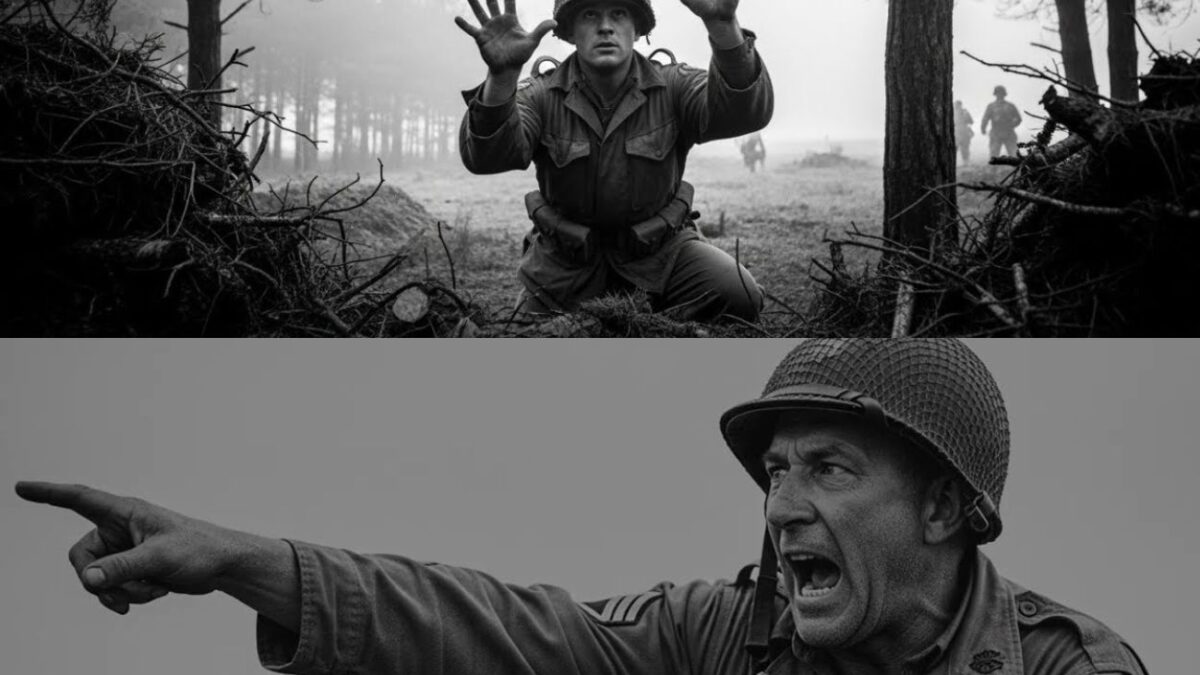
On October 15, 1944, the dense and ancient forests of the Vosges Mountains in eastern France echoed with the low, ominous rumble of distant artillery. A bone-chilling morning mist clung stubbornly to the towering pine needles, drifting across the damp forest floor like pale, spectral fingers. Private First Class Joseph Patrick Sullivan crouched low behind a hastily built revetment of fallen logs, sodden pine branches, and dark forest mud.
His combat gear was damp with morning dew, heavy against his broad shoulders, and reeking of sulfur, wet wool, and pine sap. Tucked deep inside his canvas field pack lay a heavily oiled, leather-worn baseball mitt, preserved like a holy relic against the elements. The twenty-two-year-old native of Chicago’s South Side had spent four rigorous minor league seasons crouching behind home plate for the Indianapolis Indians.
Those long, dusty Midwestern summers had forged reflexes capable of snaring a ninety-mile-per-hour fastball out of the dirt with clean, mathematical perfection. His vision was calibrated to read the seam rotations on an incoming slider, and his wrists were conditioned to react before conscious thought intervened. He could never have suspected that before the noon sun broke the fog, those diamond-honed instincts would elevate him into living legend.
Sullivan and his weary comrades from the Third Battalion, 141st Infantry Regiment of the 36th Infantry Division, were holding a jagged perimeter. Having clawed through weeks of bitter mountainous combat, the men believed they were settling into an uneventful defensive vigil along the contested line. The Allied intelligence briefings promised nothing more demanding than sporadic sniper harassment and occasional probing patrols from the German units entrenched ahead.
That assessment would soon prove to be one of the most disastrously complacent miscalculations of the late autumn campaign. A tranquil morning in the wilderness was about to shatter into a desperate crucible of smoke, shrapnel, and miraculous athletic reflexes. The art of tracking foul tips, blocking spiked runners, and firing lasers down to second base was about to save dozens of lives.
Dawn had crawled across the French ridge with the slow, grinding monotony that dictated existence on the front lines of the European theater. Sergeant William “Bill” Henderson, a hard-bitten veteran from the Nebraska plains who had survived the slaughter at Salerno, made his morning inspection. He apportioned rations, dry socks, and heavy ammunition clips with the stoic care of a squad leader who knew death lingered in small oversights.
Nearby, Private Tommy Rodriguez, a quiet young recruit hailing from the sun-bleached outskirts of El Paso, Texas, disassembled his M1 Garand. He wiped the bolt mechanism with clean patches, applying the identical reverence and mechanical patience his grandfather had taught him for farm machinery. Every click of the rifle parts settling back into place offered a tiny anchor of control amidst the unpredictable terrors of war.
A few yards down the trench line, Corporal James Mitchell from rural Alabama leaned back against a timber revetment, writing a letter home. He scribbled loving descriptions of misty European valleys to his young wife, Sarah, carefully omitting any mention of mortar barrages or frozen boots. Mitchell concealed the raw dread that kept every infantryman’s nervous system pulled tight as a steel piano wire strung to its breaking point.
Sullivan spent his downtime far differently than the other men in his company, who mostly slept, smoked stale cigarettes, or played cards. He kept five smooth, ovular riverstones nestled in his coat pocket, retrieved days earlier from the banks of a cold mountain stream. Kneeling in the damp loam, Sullivan tossed the stones high into the foliage, snatching them out of the air with blinding bare-handed speed.
Up and down the stones tumbled in complex rhythmic sequences, his calloused palms absorbing the kinetic impact with effortless, mechanical rhythm. His platoon mates had initially viewed his endless, obsessive juggling drills with quiet bewilderment, wondering if combat stress had cracked his mind. Over the grueling weeks of fighting through Italy and southern France, they had simply grown used to what they fondly called “Sully’s stone game.”
The first whisper that this autumn morning would descend into bloody chaos arrived at precisely nine forty-seven, cutting through the forest quiet. Corporal Mitchell’s field radio hissed violently to life, spitting out a frantic burst of high-priority traffic straight from battalion headquarters. Aerial reconnaissance and forward listening posts reported concentrated German movements along the ridgeline, pointing to an imminent, violent counterthrust.
The urgent transmission cautioned all forward units to bolster their perimeters, check weapon clearings, and prepare immediately for violent enemy contact. Yet static-laden tactical warnings could never capture the raw, desperate enterprise quietly organizing itself merely dozens of yards through the hemlocks. Just beyond the fog line, a battle-hardened German reconnaissance detachment was crawling forward with bayonets fixed and grenade pins loosened.
Leading the infiltrating force was Obergefreiter Hans Weber, an austere Bavarian combatant who had survived three years of butcherous fighting in the East. Weber carried the scars of Stalingrad and the Dnieper, possessing that rare, uncanny combat instinct that kept seasoned frontline soldiers alive. His assault squad was equipped with an abundant crate of Model 24 Stielhandgranaten—the infamous potato mashers packed with concussive TNT charges.
Weber’s operational orders were ruthlessly straightforward: locate the American defensive flank, unleash concentrated explosive violence, and pull back cleanly. The German squad advanced with the ghostlike efficiency that only years of brutal trench survival could cultivate in veteran infantrymen. They slipped beneath tangled blackberry brambles, bypassed fallen timber, and avoided dry leaves with the uncanny quiet of predatory mountain cats.
Through the drifting tendrils of mist, from a distance of barely forty meters, Weber peered out at the American position. He could see the exhausted GIs warming their rations, checking rifle bolts, and leaning casually against their muddy earthen ramparts. They appeared blissfully unready for sudden violence, their helmets tipped back while wisps of breakfast smoke curled harmlessly above their pits.
Weber signaled silently to his four seasoned grenadiers, who crawled forward like shadows, arranging their stick grenades quietly into the grass. The operational plan dictated a sudden, simultaneous barrage of explosives lobbed into the center of the American fortifications. The ensuing inferno of shrapnel and confusion would tear the platoon apart, allowing the German unit to withdraw safely under cover of smoke.
At precisely ten fifteen, Hans Weber tapped his point man on the shoulder and gave the hand signal to commence the attack. Five gray-clad soldiers rose from the tangled fern bed in perfect unison, their arms cocked like catapults, fuses already pulled and hissing. Seven stick grenades arced upward through the morning chill, slicing smoothly through the pale fog along mathematically lethal trajectories.
Weber launched his own grenade with the mechanical grace of a soldier who had hurled hundreds of explosive canisters across battlefields. Its wooden handle flipped methodically end-over-end through the frosty mountain air, trailing a faint, deadly streak of gray friction smoke. What was supposed to follow was the familiar concussive nightmare of bursting iron, flying earth, and shredded human flesh.
Instead, the next twenty-eight seconds would birth an impossible legend that would echo across mess halls and base camps for generations. Joseph Sullivan was kneeling beside his revetment, casually flipping a heavy riverstone, when the first cylindrical shapes breached the canopy mist. Long before his conscious mind registered the threat of German explosives, thousands of hours spent under stadium lights seized total control.
His optic nerves tracked the incoming arc, instantly calculating speed, atmospheric drop, and exact descent vectors with instantaneous clarity. To Sullivan’s finely tuned nervous system, the tumbling German stick grenade looked neither alien nor terrifying—it was simply a ball in flight. The first explosive canister cleared the timber parapet and struck the hard-packed clay six feet from where Sullivan was crouching.
The sharp metallic clink against stone sent a jolt of panic through the surrounding soldiers, but Sullivan’s body was already surging forward. His bare right hand lashed out with blistering precision, fingers opening wide into the exact pocket shape of an elite professional backstop. He scooped the heavy steel can clean off the dirt, absorbing its forward momentum with a supple, practiced give of his wrist.
Time seemed to freeze into a crystalline, hyper-focused reality where every particle of drifting smoke and flying pine needle stood still. The cold steel cylinder and smooth wooden handle settled into his palm with the familiar heft of a well-scuffed league ball. Without a single beat of hesitation, Sullivan pivoted his right foot into the clay, dropped his elbow, and snapped a violent throw.
The live grenade tore back through the mist on a flat, whistling trajectory, returning straight toward the tree line where it had originated. Before his boots even resettled into the dirt, the second German grenade landed heavily just three feet to his left side. Driven by pure athletic reaction, Sullivan threw his body sideways in a low dive, extending his arms across the rough ground.
He snapped the hissing device off the pine needles before it could settle, popping instantly up onto one knee in throwing stance. With the fluid, whip-crack motion of a catcher gunning down a runner at second base, he fired the second grenade back. The timing was so unfathomably swift that Weber, staring through the brush, saw his squad’s ordnance hurtling back toward them mid-flight.
Private Rodriguez, who was cleaning his rifle only ten yards away, sat frozen with his jaw slack, paralyzed by what he saw. He later swore to battalion interrogators that Sullivan seemed enveloped in a blur of motion, moving with fluid, uncanny grace. His hands worked with supernatural autonomy, intercepting lethal steel cylinders and redirecting them through the woods like an exhibition juggler.
The third and fourth grenades arrived in the clearing virtually together, hurtling along parallel flight paths toward the center of the foxhole. For any major league catcher, handling wild pitches on consecutive pitches with the bases loaded was the absolute ultimate test of nerve. Sullivan did not blink; his left hand snared the third grenade inches from the parapet while his right tracked the fourth.
He flung the left-handed catch with an unorthodox, lightning-fast sidearm flick that sent it tumbling forty yards back into the timber. An instant later, his dominant right hand closed tightly around the fourth wooden handle, catching it right out of the air. He twisted his hips, cocked his shoulder, and launched it back along its original trajectory before its internal fuse could detonate.
Sergeant Henderson had hit the deck behind a heavy log, his veteran instincts shouting that their position was about to be obliterated. Raising his head from the mud, he was stunned into dead silence by the surreal, impossible sight unfolding right in front of him. Sullivan was virtually playing an acrobatic game of catch with enemy explosives, fielding live ordnance as if he were back in Indianapolis.
“Get down!” Henderson finally bellowed, his voice cracking through the thunderous static. “Everybody keep your damn heads down!” Yet Sullivan was beyond hearing battlefield commands, locked entirely inside the serene, silent isolation of supreme athletic execution. The fifth grenade plummeted toward a cluster of green soldiers who were still fumbling to unholster their weapons in blind terror.
Sullivan launched into a full-length diving sprawl across the jagged shale, scraping his elbows and knees against the frozen mountain stone. His bare fingers snared the tumbling wooden stick mere inches above the dirt, right before it could bounce into the crowded foxhole. Using the kinetic energy of his slide, he rolled across his shoulder, scrambled back onto his cleats, and whipped the explosive away.
Out in the timber, Obergefreiter Weber and his seasoned grenadiers were paralyzed by an overwhelming wave of sheer, terrifying disbelief. They were watching their own lethal assault invert upon them with deadly speed, the incoming missiles humming through the canopy leaves. The first returning grenade slammed into the damp forest floor fifteen meters from Weber’s squad, erupting in a deafening concussive flash.
The blast showered the Bavarian soldiers in a hail of pulverized spruce bark, wet dirt, and jagged, whining hot fragments of shrapnel. The realization that their textbook infiltration had been violently dismantled by a single bare-handed American soldier shattered their morale. They had survived machine-gun nests and heavy artillery on the Russian steppes, but this defied every law of modern warfare they knew.
The sixth grenade came screaming in high and wide to Sullivan’s right, carrying the velocity of a foul pop-up soaring over the grandstands. Sullivan tracked the projectile through the pine boughs, coiled the powerful muscles in his thighs, and leapt straight into the air. At the apex of his vertical jump, his outstretched fingers closed firmly around the flying steel cylinder with effortless perfection.
Landing with both feet anchored firmly in the mud, Sullivan rotated his torso and launched his sixth bullet into the gray fog. By then, the paralyzed American riflemen had finally shaken off their stupor and begun pouring furious covering fire into the tree line. Rodriguez rested his Garand across the parapet, squeezing off rounds in rapid succession, while Henderson screamed for additional machine-gun support.
Mitchell was screaming into his microphone, trying to articulate the impossible situation to a bewildered staff officer back at headquarters. The staff captain on the other end repeatedly demanded clarification, convinced that Mitchell was experiencing a severe psychological episode under fire. Yet along the tree line, the reality of hot lead and exploding timber was undeniable, and Sullivan was not quite finished.
The seventh and final grenade of the initial German volley arrived along a low, wicked, knee-high trajectory through the brush. It skipped off a moss-covered boulder and took a wild, unpredictable hop that would have handcuffed almost any infielder in the country. Sullivan dropped his chest, dropped his right knee to block the hop, and snapped a lightning-fast backhand scoop inches from the mud.
Without rising from his crouch, he brought the explosive back across his ear and delivered his most powerful throw of the morning. The grenade sailed in a flat, laser-like trajectory, ripping through the foliage and landing dead center inside Weber’s hidden ditch. “Raus!” Weber shrieked, throwing his body backward into a shallow depression as the stolen explosive detonated with a deafening roar.
The blast shattered the remaining German equipment, pulverized their extra ammunition crates, and showered the detachment with burning debris. Stunned, bleeding from their ears, and thoroughly convinced they were fighting an enemy with supernatural capabilities, the Germans broke and ran. They scrambled backward through the mountain ravines in blind panic, abandoning their advance to escape the terrifying American position.
From the first grenade leaving German hands to Sullivan’s final throw detonating in the brush, precisely twenty-eight seconds had elapsed. Within that half-minute window, Sullivan had cleanly fielded seven live explosives, preserving his squad without a single Allied casualty. The air in the clearing hung thick with acrid white smoke, cordite stench, and the stunned, ringing silence of complete disbelief.
Sullivan remained kneeling in the wet grass, his chest heaving, his palms streaked with black soot, machine grease, and superficial abrasions. He glanced at his trembling hands, took a long, steadying breath of mountain air, and reached down to pick up his riverstone. Around him, his platoon mates stared in unblinking awe, looking at their quiet Chicago catcher as if he had descended from the heavens.
Miles away, Weber arrived at his regimental headquarters in an absolute daze, trembling as he gave his report to his commanding officers. He insisted under oath that the American outpost was guarded by elite commandos capable of intercepting live artillery shells out of the air. The report, drafted with absolute Bavarian earnestness, sparked immediate paranoia across the German corps regarding secret American defensive projects.
For weeks afterward, enemy commanders along the Vosges sector ordered their frontline patrols to exercise extreme caution against the 141st Infantry. They strictly warned their troops against employing grenade barrages, fearing the deadly projectiles would be intercepted and returned with interest. This psychological dread spread rapidly from trench to trench, eroding German confidence and granting the American battalion an immense tactical edge.
Meanwhile, back at Allied field headquarters, Sergeant Henderson was enduring his third contentious interrogation regarding his after-action report. His superiors returned the documentation repeatedly, demanding he remove what they viewed as outrageous exaggerations and impossible tallies. They asked if the sergeant was referring to spent casings, rifle grenades, or if the squad had utilized improvised shovels to swat the explosives.
Private Rodriguez and Corporal Mitchell were called in separately to give formal statements, both maintaining identical, unshakeable accounts. They described Sullivan’s footwork, his precise glove-free catches, and the devastating accuracy of his returns with absolute clarity. Gradually, the sheer consistency of the eyewitness accounts forced the battalion brass to consider that the impossible had actually occurred.
Three days later, Colonel Robert Mason, commander of the Third Battalion, drove his jeep out to the forward lines to see Sullivan. Mason was a stern, West Point-educated career soldier who had little patience for battlefield mythology or embellished camp stories. He stood before the unassuming young Chicagoan, his eyes traveling from Sullivan’s scarred knuckles down to his muddy combat boots.
Sullivan answered the colonel’s skeptical questions with absolute humility, downplaying the feat as simple, automatic reaction. To prove his capabilities, the training officer brought out a wooden crate of deactivated iron practice grenades for an impromptu demonstration. Standing twenty paces away, the officer hurled the heavy metal dummies at Sullivan with all the velocity he could muster.
Sullivan fielded every throw with effortless, casual elegance, his hands swallowing the iron chunks without making a sound. He snagged high flies, dug low fastballs out of the mud, and redirected them to designated targets across the bivouac. Colonel Mason watched in stunned silence, realizing that he was standing before the most extraordinary defensive phenomenon in military history.
Mason immediately initiated paperwork recommending Sullivan for the Medal of Honor, crafting a citation that read like heroic folklore. He wrote that Sullivan’s display of poise, bravery, and unmatched physical reflexes stood without equal across modern mechanized warfare. As the paperwork wound its way through the Pentagon, word of the twenty-eight-second miracle rippled across the entire Allied front.
Soldiers across Europe began referring to the Chicago native as “The Backstop of the Vosges,” their morale soaring with each retelling. Infantrymen routinely requested transfers to the 141st, genuinely convinced that Sullivan’s presence provided a divine shield against shrapnel. Every time his company rotated into a new combat sector, rumors preceded them, unnerving the German divisions entrenched opposite their lines.
Military strategists and athletic instructors descended upon the camp to analyze Sullivan’s physiology and unorthodox defensive technique. Several training commands debated implementing specialized grenade-catching regimens for incoming recruits, hoping to cultivate similar reflexes. However, initial testing quickly revealed that Sullivan’s combination of innate depth perception, calm under fire, and lifetime practice could not be replicated.
Whenever combat correspondents cornered Sullivan, asking what went through his mind as the hissing explosives tumbled down, he laughed softly. He explained that behind home plate, a catcher didn’t have time to debate whether he should block a spiked ball or duck away. “You just see the stitches, settle your feet, and make the play before it hurts somebody behind you,” he told reporters.
That unpretentious modesty only cemented his status as a national hero as stories of his exploits flooded the American home front. His photo graced the front pages of major dailies, celebrated as proof of how American sporting grit was triumphing over fascism. Major league scouts took note, and multiple team executives penned letters promising Sullivan immediate tryouts the moment the war ended.
In May 1945, Nazi Germany surrendered, and Sullivan was honorably discharged from the United States Army, returning home to Chicago. His beloved South Side welcomed him with banners, parades, and thunderous applause, but his eyes were set squarely on the diamond. He immediately reported to the Chicago White Sox training camp, his reflexes sharp and his baseball acumen deepened by wartime maturity.
Sportswriters who covered his post-war games noted that Sullivan operated behind the plate with an eerie, unbreakable calm. Fastballs that crossed the plate at nearly a hundred miles an hour never caused him to blink, flinch, or pull his glove. Opposing base runners found it almost impossible to steal on him; his release from crouch to throw was measured at lightning speed.
Sullivan climbed through the White Sox farm system, reaching Triple-A by 1947, catching doubleheaders with unwavering physical durability. Whenever fans recognized him, shouting questions about his exploits in the Vosges, he would merely tip his catcher’s cap and smile. His heart remained with the pure mechanics of the game, treating his wartime heroism as a duty completed rather than personal glory.
In the autumn of 1948, Sullivan traveled to Washington, D.C., where President Harry S. Truman awarded him the Medal of Honor. Standing in the East Room of the White House, the humble minor league catcher stood straight as the blue ribbon was draped around his neck. Truman remarked that Sullivan had demonstrated that the finest traits of American youth—discipline, bravery, and teamwork—could alter the course of history.
Far from Washington, Hans Weber was forging an entirely new destiny of his own amid the ashes of post-war Europe. Having survived the brutal final months of combat, Weber chose to leave Germany behind, emigrating to the United States in 1952. He settled on the South Side of Chicago, working tirelessly in construction and eventually founding a successful regional contracting firm.
Weber had fallen in love with American baseball, finding the discipline, tactical precision, and peaceful competition deeply therapeutic. He became a regular spectator at minor league parks, often marveling at the incredible defensive skills displayed by professional catchers. During an afternoon game in 1954, Weber glanced down at his scorecard and saw a familiar name listed behind the plate: Joseph Sullivan.
His mind immediately flashed back ten years to that foggy French morning, remembering the impossibly swift hands that had intercepted his grenades. Through mutual veterans’ associations, Weber reached out, requesting a quiet meeting with the man whose impossible reflexes had spared both their lives. Their historic reunion took place near the dugout at Comiskey Park, witnessed by several sports writers who recognized the profound moment.
The two former enemies shook hands warmly, the lingering bitterness of war completely dissolved by mutual respect and shared survival. Weber stared at Sullivan’s right hand, laughing softly as he remarked on the surreal miracle of seeing those same hands catching fastballs. Sullivan expressed his gratitude that Weber had survived the blast, welcoming the former German soldier into his city as a friend.
Their improbable bond blossomed into a lifelong friendship that lasted until Hans Weber’s death in the late nineteen-eighties. They met regularly for coffee, attended Chicago ballgames together, and frequently spoke at veterans’ halls about peace, sportsmanship, and reconciliation. Weber often told audiences that Sullivan’s athletic perfection had done more than save soldiers; it had taught him the boundless potential of the human spirit.
Sullivan’s active baseball career concluded in 1956 when a severe knee collision at home plate finally ended his playing days. Refusing to abandon the game he loved, he transitioned into education, becoming a revered physical education coach in Chicago’s public schools. For three decades, he coached thousands of urban youths, teaching them that hand-eye coordination, emotional composure, and discipline were indispensable tools for life.
He utilized the same stone-catching drills he had practiced in the French mud, urging his students to prepare constantly for unexpected challenges. His coaching philosophy was rooted in the profound conviction that preparation eliminated fear, enabling ordinary individuals to perform miracles under immense pressure. Generations of young athletes went on to collegiate and professional careers, crediting Coach Sully with teaching them true resilience.
Over the years, biometric researchers and sports scientists from several top universities studied Sullivan’s physiological data in detail. They sought to quantify the neurological wiring that had enabled his brain to track, intercept, and throw seven projectiles in twenty-eight seconds. The studies offered vital insights into motor control, peripheral vision, and high-stress decision-making, influencing modern training protocols for elite athletes.
In his golden years, Sullivan was often invited to speak at West Point and the Naval Academy, addressing future military commanders. He consistently steered their attention away from his personal fame, focusing instead on the vital connection between civilian preparation and combat survival. He insisted that the strength of a free nation lay in the everyday skills, passions, and character forged on sandlots and community playgrounds.
Today, a bronze memorial honoring Joseph Patrick Sullivan stands proudly inside the halls of his old Chicago high school. The display features his silver catcher’s mask, his tarnished minor league spikes, and his framed, faded Medal of Honor citation. Students pass the case every morning, reminded that a simple South Side kid once altered history with nothing more than quick hands, bravery, and a baseball glove.

