How One Machinist’s “Forbidden” Barrel Swap Made MG42s Fire 1,200 Rounds Per Minute
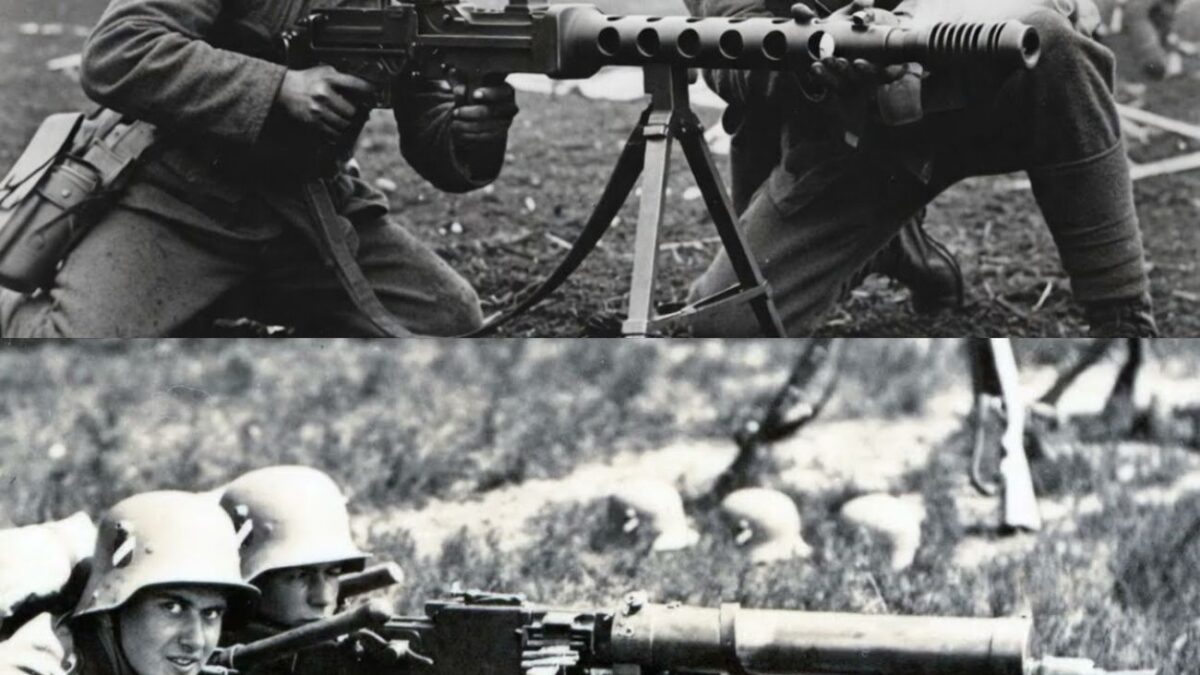
In June 1942 across the desolate expanses of the Eastern Front, Soviet forces advancing on the critical approaches to Stalingrad encountered a mechanical sound unlike anything ever documented in the history of warfare. It was not the familiar, rhythmic mechanical thumping of conventional automatic weapons that soldiers on both sides had learned to navigate across thousands of miles of hostile terrain. Instead, it tore through the trembling morning air as an unbroken, deafening shriek that seemed to shred the very atmosphere at an astonishing cyclic rate of more than one thousand two hundred rounds every minute.
The sheer velocity of the projectile stream struck attacking infantry formations with catastrophic speed before individual riflemen could even comprehend where the firing originated or scramble into defensive craters. Frontline Red Army soldiers christened the terrifying weapon the linoleum ripper because the acoustic signature resembled heavy fabric or industrial flooring being violently torn apart at supernatural speeds. When American troops later waded ashore under hostile coastal fire during the amphibious landings in North Africa six months later, they gave this monstrous engineering marvel their own enduring name: Hitler’s buzzsaw.
The MG42 discharged ammunition at such astronomical velocity that the physical reports of individual cartridges blurred seamlessly into a monolithic, uninterrupted wall of acoustic fury. What stunned Allied tactical planners even more profoundly was that this lethal device did not simply fire in brief, panicked bursts before burning out its operating mechanisms. It sustained this apocalyptic rate of suppressive fire for whole minutes at a time, continuously devastating infantry lines longer and with greater mechanical reliability than any general-purpose machine gun previously deployed in modern combat.
By developing and fielding this weapon, German ordnance engineers had achieved something that industrial ballistics specialists from every other major military power had adamantly declared physically impossible. They had built an infantry automatic weapon capable of cycling rounds at more than twice the speed of standard frontline weapons without warping its rifled steel or melting down its structural components. When Allied intelligence officers examined the earliest intact MG42 specimens captured from entrenched Axis units in Tunisia, they found themselves thoroughly baffled by the gun’s inner mechanisms.
Conventional metallurgic doctrine stated unequivocally that any standard steel barrel subjected to such violent thermal friction should begin glowing cherry-red and fatally warping after roughly two hundred and fifty rounds of continuous rapid fire. That rigid thermal limit governed the venerable American Browning M1919 air-cooled weapon, the British Bren light machine gun, and the legendary Soviet Maxim heavy machine gun. Every frontline automatic weapon in contemporary service overheated at roughly identical thresholds because the unforgiving physical laws of metallurgy could neither be ignored nor sidestepped by wishful military thinking.
If an infantry crew fired six hundred rounds through a standard twenty-two-inch steel barrel in under ninety seconds, basic thermal dynamics dictated that the component had reached the end of its operational life. The superheated steel would rapidly lose its structural temper, the sharp internal lands of the rifling would deform into smooth metal, and ballistic accuracy would instantly disintegrate. If a desperate gunner persisted in holding down the trigger past this catastrophic failure point, the swollen barrel could rupture catastrophically like an overripe fruit under pressure.
Yet the newly arrived German MG42 seemed to operate completely outside these established boundaries of physical science and battlefield mechanical doctrine. German machine gun crews were routinely observed discharging massive fifteen-hundred-round belted strings of ammunition during protracted engagements that would have utterly ruined any comparable Allied barrel assembly. Having emptied whole ammunition crates in unbroken defensive fire, the German gunners would immediately traverse to engage fresh assault waves without pausing to let their weapons cool in the freezing wind.
The brutal mathematical reality on the ground soon became a waking nightmare for company commanders attempting to orchestrate offensive infantry movements against entrenched positions. A single dug-in MG42 emplacement could throw more heavy rifle ammunition downrange inside two minutes than an entire standard American rifle squad could muster during ten minutes of deliberate aimed fire. The resulting suppressive pressure was so overwhelming that veteran Allied soldiers learned to recognize the sound instantly and threw themselves flat against the dirt, knowing that standing upright was instant death.
Back in the United States during the late summer of 1942, ordnance engineers at Aberdeen Proving Ground in Maryland received their very first intact, combat-captured specimen of the MG42. The mysterious weapon arrived packaged inside a splintered pine shipping crate covered with official Wehrmacht military inspection stamps, having been taken as a war prize by British forces at El Alamein. The investigative team assembled to evaluate the captured hardware included some of the most celebrated and experienced small-arms designers in North America.
These senior American engineers had spent their entire working careers analyzing, drafting, and refining military machine guns since the trench warfare of World War I, and they understood every known manufacturing trick for mitigating barrel heat. They began field-stripping the captured weapon with eager anticipation, expecting to uncover some sort of exotic metallurgical alloy, intricate forced-air cooling vents, or a miniaturized water jacket. Instead, as the receiver opened before them on the workbench, they encountered an astonishing mechanical simplicity that challenged every foundational premise of contemporary small-arms doctrine.
The entire barrel could be extracted and fully cleared from the weapon’s housing in less than five seconds flat, without requiring a single hand tool, wrench, or protective adjustment. The operating gunner simply had to depress an ergonomic, spring-loaded latch located flush against the right side of the steel receiver casing, smoothly rotate an internal sleeve ninety degrees, and pull the spent assembly free. A cold replacement barrel could be slid straight into the open guide path, the collar twisted back into its locked alignment, and the latch snapped secure.
The entire operational cycle took five seconds to perform under normal handling, stretching to perhaps seven seconds if the assistant gunner was operating with exceptional caution in adverse conditions. The Aberdeen engineering team methodically ran through the mechanical sequence twenty consecutive times, calculating an average swap time of precisely 5.4 seconds from the moment fire ceased to the moment it resumed. American ordnance programs had spent the prior three years attempting to develop an effective quick-change barrel retrofit for their standard Browning M1919 machine guns.
Their most promising developmental prototype still demanded thirty-five full seconds to complete, required the use of specialized tools, and forced soldiers to manipulate scalding surfaces with heavy asbestos mitts. The German weapon accomplished the identical operational task in roughly one-seventh of that duration through an internal assembly that relied on merely three moving components. The lead testing officer, Colonel Thomas Jarvis, sat down at his drafting table and drafted an internal memorandum summarizing the profound operational revelation the captured gun represented to Allied planners.
The Colonel wrote that the design represented a comprehensive philosophical departure from traditional sustained-fire thinking, completely upending how modern combat weapons ought to be conceived and deployed. While American engineers had exhausted decades trying to forge ultra-durable barrels capable of withstanding the monstrous thermal punishment of extended fire, German designers had instead recognized that barrels were disposable wear items. That straightforward conceptual pivot changed the operational reality of the modern infantry battlefield by shifting mechanical burdens entirely away from metallurgical perfection.
American doctrine of the era rigorously demanded that machine gunners deliver paced, disciplined bursts of fire to carefully protect the barrel from reaching critical temperatures during an enemy charge. The barrel was treated as a permanent structural feature of the weapon that had to be preserved at all costs, even if slowing down meant allowing enemy troops to advance. German doctrine, by stark contrast, instructed the gunner to unleash the weapon’s terrifying cyclic rate without hesitation, simply swapping out hot barrels as soon as thermal expansion threatened operational performance.
The weapon was intentionally designed to adapt to the unpredictable chaos of frontline warfare, rather than demanding that infantry tactics bend around the physical limitations of a fixed steel tube. Naturally, American and British ordnance authorities immediately sought to uncover who had conceived such a revolutionary mechanical layout and how this unknown designer had conquered the engineering barriers. The investigative trail led all the way back to 1934, inside the drafting rooms of a metalworking firm named Mauser-Werke, situated in the industrial town of Oberndorf am Neckar.
The German military procurement bureau had issued a comprehensive set of developmental requirements for a general-purpose machine gun to serve as the technological successor to their newly fielded MG34. The military command demanded an automatic weapon that was noticeably lighter, significantly less expensive to manufacture at scale, and capable of delivering an even higher sustained rate of suppressive fire. When civilian arms manufacturers examined the official specifications, the performance demands seemed to cross into the realm of absolute mechanical fantasy.
The military wanted a cyclic rate of twelve hundred rounds per minute, absolute reliability when immersed in fine desert dust or freezing Russian mud, and internal systems simple enough for conscripts to master. Most demanding of all was the requirement for uninterrupted operational endurance, dictating that a well-crewed gun should theoretically be limited only by the logistical volume of ammunition supplied to the position. The chief designer overseeing experimental automatic weapons, Heinrich Vollmer, decided to assign this seemingly insoluble heat problem to an unorthodox machinist named Carl Meyer.
Carl Meyer was a thirty-four-year-old precision technician who had cultivated a reputation across the Oberndorf workshops for completely disregarding orthodox engineering consensus and rebuilding mechanical devices from first principles. Meyer’s official personnel documentation contained pointed remarks from senior supervisors noting that he routinely refused to follow standardized engineering manuals and obsessively questioned every traditional design premise. Within the rigid, hierarchically conservative manufacturing culture of interwar German arms production, such behavioral evaluations were seldom viewed as complimentary traits.
Yet Vollmer recognized that conventional design dogmas could never produce a lightweight weapon capable of firing twenty rounds per second without burning itself out on the firing line. Every established automatic weapon designed since Hiram Maxim’s original mechanical marvel had treated the barrel as an immovable, fixed assembly that engineers were obligated to protect and insulate. Meyer was given an extraordinarily direct mandate: throw out every historical assumption regarding barrel longevity, discard traditional cooling methodologies, and build an operational mechanism from scratch.
Meyer began his engineering investigation by stripping the thermal problem down to the fundamental physics governing modern ballistics and chemical propellant reactions within rifled tubes. A standard military-grade carbon steel barrel naturally absorbs approximately thirty percent of the total thermal energy generated by every rifle cartridge ignited inside its chamber. At an operating cadence of twelve hundred rounds per minute, the mechanism detonates twenty rounds every single second, pumping brutal heat energy into the steel far faster than atmospheric convection can bleed it off.
When running the ballistic math, Meyer recognized that an uncooled barrel would breach its critical temperature threshold of six hundred degrees Celsius within ninety seconds of sustained automatic fire. At that extreme temperature, carbon steel enters a phase transition where its structural temper degrades, internal rifling softens under friction, and catastrophic metal deformation becomes inevitable. Facing these immutable laws of physics, a designer was left with precisely three theoretical paths forward if the firearm was to remain operational during sustained combat.
The first option was to significantly increase the overall thickness and mass of the barrel, providing more raw metal to absorb the heat, though this added intolerable weight. The second path was to throttle the cyclic rate of fire down to a modest, manageable rhythm, which directly violated the army’s fundamental requirement for massive bullet dispersion. That left only the third alternative: completely abandon the concept of the permanent barrel and develop a mechanism to swap out superheated steel for cool replacement tubes within seconds.
The concept of a quick-change barrel was not entirely unprecedented in the history of firearms design, but previous industrial attempts had failed disastrously in actual combat environments. Meyer understood precisely why earlier design teams had walked away from the concept, having identified three persistent engineering hurdles that consistently doomed previous quick-change mechanisms to operational failure. First, the mechanical alignment between the detachable barrel and the fixed receiver had to remain absolutely consistent, or point of impact would drift uncontrollably after every swap.
Second, the structural locking apparatus had to be profoundly robust, because any minute mechanical looseness during high-pressure automatic fire could cause the barrel to violently detach from the gun. Third, and perhaps most difficult of all, the entire mechanical interface had to remain exceptionally simple, enabling terrified soldiers to manipulate hot components amidst the terror of active combat. If an inventor could successfully resolve all three of these complex variables simultaneously, an infantry squad could theoretically maintain an uninterrupted stream of suppressive fire indefinitely.
Conversely, failing to solve even one of these engineering requirements would inevitably produce a weapon that was either unacceptably inaccurate, inherently dangerous to its crew, or far too delicate for field use. Meyer discovered his first mechanical breakthrough not by studying existing automatic rifles, but by carefully analyzing how heavy breech-loading naval and field artillery pieces managed tube alignment. Modern artillery systems frequently relied on interrupted thread systems, employing segmented cylindrical collars with complementary locking ridges that secured massive barrels against explosive combustion forces.
Meyer reasoned that if this rugged mechanical principle could be scaled down to the size of a handheld infantry weapon, it would yield a system that combined immense strength with rapid manual operation. His prototype employed a precision-turned cylindrical barrel collar fitted with three heavy locking lugs that seated directly into corresponding structural channels milled into the receiver. By rotating the barrel collar precisely ninety degrees, the lugs aligned with open exit channels, permitting the entire assembly to slide forward and clear the weapon effortlessly.
Rotating the sleeve back into position drove the heavy steel lugs into structural recesses with unmistakable mechanical rigidity, locking the assembly against the tremendous pressures of modern 7.92mm ammunition. The geometry was inherently self-aligning, meaning that the smooth cylindrical contact surfaces automatically guided the replacement barrel into dead-center alignment as it entered the receiver housing. Meyer’s second vital breakthrough tackled the practical ergonomics of field manipulation, ensuring that exhausted, terrified soldiers could operate the device without dropping crucial components into the dirt.
He devised an elegant, spring-loaded retention catch that firmly secured the locking collar during the violent vibrations of automatic fire, yet disengaged instantly under simple thumb pressure. An intuitive lever integrated directly into the side of the stamped receiver housing allowed the assistant gunner to actuate the entire release cycle using a single gloved hand. One swift push of the latch released the collar, an ergonomic turn of the handle opened the breech path, and the superheated barrel slid free in a single motion.
Crucially, the entire barrel-change assembly contained zero detachable pins, tiny retaining screws, or loose accessories that could be dropped, misplaced, or packed with mud during an assault. The mechanism remained locked during automatic cycling, easily withstanding the punishing recoil forces generated by twenty detonations every second, while retaining the ability to unlock instantly when required. The third conceptual breakthrough emerged from Meyer’s willingness to re-examine the true practical requirements of combat accuracy within the chaotic environment of frontline infantry engagements.
Traditional ordnance evaluators had long insisted that a detachable barrel system must maintain micrometer-level mechanical tolerances, fearing that any minute structural variance would ruin the weapon’s precision. Meyer recognized this demand as an obsolete holdover from the era of manual bolt-action rifles, pointing out that general-purpose machine guns served a completely different tactical objective. In high-intensity combat, effective suppressive accuracy at six hundred meters meant delivering rounds reliably within the perimeter of a human silhouette, not punching neat target holes through competition paper.
Provided that every cold replacement barrel seated reliably into the identical resting position every single time, minor variations between individual manufactured barrels were practically irrelevant in the field. Meyer proved this operational concept through a rigorous empirical testing protocol conducted inside the Oberndorf research facilities using five randomly chosen production-standard barrel assemblies. He fired a hundred deliberate rounds through each separate barrel to establish an accurate baseline zero, then swapped the barrels indiscriminately while recording shifts in point of impact.
The absolute maximum point-of-impact variation he recorded across all five swappable assemblies was less than three inches at an engagement distance of one hundred meters. For an infantry suppression weapon cycling ammunition at twenty rounds per second within an intentional cone of dispersion measured in feet, this tiny mechanical variance was completely meaningless. By the early spring of 1937, Meyer had constructed a fully operational prototype of his quick-change barrel mechanism and mounted it to an experimental receiver.
The definitive proving ground trials took place at the military testing facilities in Kummersdorf, where Wehrmacht evaluators subjected candidate weapons to extreme torture regimens designed to induce mechanical failure. Technicians methodically fed twelve-thousand-round ammunition belts through the prototype action, pausing strictly every two hundred and fifty rounds to execute a rapid barrel exchange using Meyer’s collar system. The prototype ran through the mountainous stacks of ammunition without suffering a single mechanical jam, ruptured case, or catastrophic lockup during the entire evaluation sequence.
Test personnel subsequently buried the weapon in loose sand, dragged it through thick mud pits, froze it overnight in sub-zero environmental chambers, and fired it without pre-cleaning at dawn. Through every environmental trial, the simple spring-loaded catch operated reliably, the cylindrical collar turned smoothly, and replacement barrels seated into battery with total mechanical precision. When industrial production analysts reviewed the design, they discovered that Meyer’s innovative barrel-changing assembly added only 4.5 Reichsmarks to the total manufacturing cost of each firearm.
Furthermore, field trials revealed that teaching an ordinary recruit to execute a flawless barrel change under simulated combat conditions required barely fifteen minutes of instruction. In exchange for this minimal expenditure in raw materials and training time, the newly designated MG42 gained the unprecedented capability to sustain fire rates that no other military weapon could match. The German high command formally adopted the design in May 1942, and the first mass-production units were rushed directly into the hands of frontline combat units later that summer.
The practical impact of Meyer’s mechanism on frontline tactical engagements was both instantaneous and horrifying to the opposing Allied forces who had to endure its fire. In July 1942, along the heavily contested Rzhev Salient in the Soviet Union, a dug-in German infantry platoon held a critical rail junction against overwhelming odds. A reinforced Soviet rifle company consisting of one hundred and twenty seasoned infantrymen launched a determined dawn assault across four hundred meters of unobstructed open grassland.
The German defensive perimeter relied on a single newly issued MG42 manned by a standard three-man crew: the primary gunner, an assistant gunner, and an ammunition bearer hauling spare barrels. The advancing Soviet infantry moved forward in disciplined, alternating bounds, fully expecting the German automatic position to fire in brief, measured bursts to prevent its barrel from overheating. That was how every machine gun engagement had played out across the Eastern Front for the previous year, leaving predictable intervals during which attacking troops could safely sprint forward.
Instead of the anticipated pulsing bursts, the lone MG42 opened up with a terrifying, unbroken roar that sounded to the charging soldiers like an enormous circular saw slicing through sheet metal. The gunner pinned down the trigger, traversing the weapon smoothly across the open field and laying down a lethal carpet of steel across every foot of the advance. Within twenty seconds of sustained automatic fire, the gun had digested an entire two-hundred-and-fifty-round ammunition belt, leaving the steel barrel glowing a dull cherry-red in the morning light.
Before the smoke had even cleared from the muzzle, the assistant gunner had already extracted a cool replacement barrel from its protective metal carrying tube. The primary gunner flicked the side latch with his right thumb while his left hand twisted the locking collar open, allowing the superheated barrel to slide forward. The assistant caught the smoking component with an insulated asbestos mitt, slid the fresh barrel home, and snapped the collar shut in six seconds flat.
The MG42 erupted into full automatic fire once again before the attacking Soviet infantry could even process that the suppressive stream had momentarily halted. Another belt was fed into the feed tray, another barrel change was flawlessly executed, and another brief six-second lull was instantly swallowed by an avalanche of lead. The three-man German crew methodically cycled through four interchangeable barrels over three minutes of desperate fighting, throwing more than a thousand heavy rifle rounds across the open terrain.
The Soviet assault broke apart entirely under this unprecedented concentration of fire before a single soldier could close within grenade range of the rail embankment. The surviving attackers retreated to their jump-off trenches, leaving forty dead scattered across the devastated clearing in front of the unbroken machine gun position. The Soviet regiment’s subsequent operational report described an unknown German automatic weapon possessing a supernatural rate of fire that appeared completely exempt from ordinary thermal cooling restrictions.
Red Army company commanders quickly distributed urgent advisories to their frontline units, warning infantrymen to listen intently for that distinctive, tearing acoustic signature before attempting any assault. If that continuous mechanical roar was heard echoing across the lines, it meant the opposing position was anchored by an MG42, rendering textbook bounding tactics suicidal. Several months later, in November 1942, American soldiers experienced their own baptism of fire against the new German weapon during the fighting at Kasserine Pass in Tunisia.
Elements of the US 168th Infantry Regiment were ordered to advance against what intelligence staff had confidently identified as an isolated, lightly defended mountain strongpoint. The Axis defensive line was held by just three concealed machine gun emplacements positioned to establish interlocking fields of fire across the rocky, barren defile. The American infantry advanced with textbook precision, utilizing the uneven contours of the rocky ground for cover while their own Browning M1919 teams laid down covering fire.
The German positions held their fire with disciplined patience, waiting silently until the lead American platoons had committed themselves into open ground barely three hundred meters away. When all three MG42s opened fire simultaneously, the staggering density of the incoming bullet streams shocked even experienced combat veterans who had survived the horrors of the First World War. One surviving American soldier later recounted that the opening volley sounded as though every machine gun in Europe was firing simultaneously, though it was merely three weapons.
The advancing American companies were instantly pinned to the dirt, unable to crawl forward or backward because lifting an arm or a helmet drew a concentrated burst of lead. Every attempt by American machine gun squads to suppress the German nests failed because the technological gap between the opposing weapons systems was simply too vast. The Browning M1919 was restricted to an operational cadence of roughly four hundred and fifty rounds per minute, forced into strict bursts to keep its fixed barrel alive.
The German MG42s, by comparison, poured out twelve hundred rounds per minute, cycling through fresh barrels in seconds whenever thermal limits were approached on the line. The unequal engagement cost the American attacking force fifty-four casualties in less than an hour, forcing the shattered battalion to withdraw from the valley floor. The three German crews had successfully held off an entire infantry company of one hundred and eighty men while expending eight thousand rounds across thirty-two barrel changes.
Throughout that brutal engagement, not a single one of the three MG42s suffered a mechanical stoppage, a stripped locking lug, or a catastrophic barrel failure. By the spring of 1943, Allied staff officers had drafted specialized tactical doctrines devoted exclusively to neutralizing entrenched MG42 positions without needlessly sacrificing attacking infantry. The British Eighth Army issued a specialized training bulletin that advised infantry commanders to utilize artillery bombardments, heavy mortars, and armor, warning that unsupported infantry charges were doomed.
The psychological toll inflicted by the weapon on frontline Allied troops proved every bit as devastating as the physical casualties it produced on the battlefield. Soldiers learned to dread the unmistakable sound of that ultra-high-rate fire, and hearing the distant buzzsaw echo across a valley often induced immediate panic among green recruits. The US War Department produced specialized training films containing genuine audio recordings of MG42 fire, hoping to inoculate infantrymen against freezing up when hearing the weapon in real combat.
On the German side of the lines, small-unit tactics were completely redesigned to exploit the extraordinary defensive firepower provided by Meyer’s innovative barrel-changing mechanism. Rather than treating the machine gun as a secondary support weapon attached to a rifle squad, the MG42 became the tactical centerpiece around which all squad movements revolved. Ordinary riflemen were assigned the primary mission of hauling extra ammunition belts, carrying spare barrel containers, and physically protecting the machine gun crew from being flanked.
Standard equipment regulations dictated that every frontline MG42 team carry a minimum of six spare barrels in specialized protective canisters slung across their shoulders. This provided a three-man crew with the operational capacity to expend upwards of fifteen hundred rounds of continuous rapid fire before exhausting their immediate reserve of cold barrels. Ammunition expenditure rates escalated to unprecedented levels, with a single well-supplied position frequently expending more rifle ammunition during one afternoon than a World War I squad used in weeks.
The quick-change system proved so mechanically robust and dependable under punishing conditions that it earned universal praise from the combat soldiers who relied on it. Wehrmacht training manuals stressed that an MG42 team’s survival depended entirely on the crew’s mechanical mastery of rapid, rhythmic barrel exchanges during the heat of battle. Crews drilled for weeks until the entire extraction, insertion, and locking process could be completed blindfolded amidst complete darkness, choking smoke, and falling debris.
Official Wehrmacht instructional circulars established strict timing metrics for evaluating machine gun teams during combat preparation courses across the home front. An eight-second barrel swap was classified as barely acceptable, six seconds was designated as standard proficiency, and four seconds was considered expert-level mastery. Elite combat units turned the procedure into a competitive sport, with veteran gunners obsessively drilling their assistant loaders until they could execute a complete swap in three seconds flat.
The maintenance requirements for Meyer’s mechanism proved astonishingly modest compared to the finicky, high-tolerance mechanical systems common to other contemporary German armaments of the period. Because the cylindrical collar utilized generous built-in clearances, the locking lugs rotated smoothly into place even when the receiver was heavily coated with soot and dust. On the frozen steppes outside Moscow, German machine gunners reported operating their MG42s in temperatures plunging past minus forty degrees Celsius without applying liquid lubricant to the receiver.
While frozen gun oil caused widespread stoppages in conventional firearms, the MG42’s barrel-change latch and locking sleeve continued to function without seizing up in the cold. In the scorching expanse of the Libyan desert, the mechanism demonstrated the opposite operational extreme, shrugging off fifty-degree heat and fine sand that routinely choked more complex actions. The rare instances of mechanical binding that did occur during intense fighting almost invariably traced back to undisciplined crews who had violated operational guidelines by firing past the limit.
If an inexperienced gunner fired well beyond the prescribed two-hundred-and-fifty-round threshold, the superheated steel expanded so severely that the barrel could temporarily bind inside the housing. The solution preached by instructors was simple and uncompromising: pay attention to the weapon’s cadence and follow the mechanical drill with absolute discipline under all circumstances. Experienced gunners could physically detect the onset of thermal expansion through subtle changes in recoil vibration and a slight deceleration of the weapon’s cyclic cadence.
The moment that subtle shift was felt through the spade grips, the gunner immediately cracked the release latch and let the assistant slide a fresh barrel into place. By the close of 1944, German arms factories had manufactured more than four hundred thousand MG42s, scattering the fearsome weapon across every major front in Europe. Allied intelligence assessments described it as the single most effective infantry weapon in the Axis arsenal, warning that overcoming an MG42 required overwhelming localized fire superiority.
At Springfield Armory in Massachusetts, American engineers initiated crash development programs aimed at equipping the existing Browning M1919 design with an effective quick-change barrel system. However, rather than designing a brand-new receiver from the ground up as Carl Meyer had done, American planners attempted to retrofit an existing, aging platform. The resulting compromise, designated the M1919A6, featured a cumbersome barrel-swapping arrangement that required special tools, added dead weight, and still demanded twenty-five seconds to complete under ideal conditions.
The British military also examined captured MG42s with intense technical interest, attempting to reverse-engineer the quick-change collar for a proposed replacement for their venerable Bren gun. The fundamental engineering lessons pioneered by Carl Meyer eventually found their way directly into the development of the British L7 GPMG and the American M60 machine gun. Both of these celebrated post-war weapons incorporated swappable barrel mechanisms, though neither platform ever managed to beat the five-second operational speed achieved by Meyer’s original design.
The psychological footprint of the MG42 grew increasingly pronounced as the Allied armies fought their way into Western Europe and across the Rhine during the final months of the war. Debriefing reports filed by Allied intelligence officers repeatedly noted that surviving infantrymen routinely believed they had faced dozens of machine guns, even when records revealed only one gun was present. The incredible cyclic rate of fire produced an acoustic illusion of multiple automatic weapons firing simultaneously, tricking attackers into radically overestimating the true size of the defensive force.
This massive force-multiplication capability became an invaluable tactical asset for the German military during the desperate defensive campaigns of late 1944 and early 1945. A single well-entrenched MG42 crew possessing sufficient ammunition crates and spare barrels could successfully pin down enemy forces ten times their size, buying valuable operational time. Across hundreds of obscure defensive engagements on the Eastern Front, small rear-guard detachments inflicted disproportionate losses on advancing Soviet spearheads solely through the devastating firepower of their machine gun emplacements.
When the war in Europe finally ended in May 1945, Allied technical teams swept through captured German arms factories and discovered MG42 production lines still operating. American ordnance specialists documented the manufacturing methods and uncovered another brilliant dimension of Meyer’s engineering philosophy that had previously escaped full appreciation in the West. The entire barrel-changing assembly had been specifically engineered from day one to accommodate rapid, inexpensive, mass-scale industrial stamping and turning processes.
The locking collar was a simple turned cylindrical component that could be machined rapidly on standard, non-specialized lathes by relatively inexperienced factory personnel without requiring hand-finishing. The modifications needed on the receiver consisted of three straightforward milled channels that any commercial shop equipped with basic milling equipment could execute with ease. The spring-loaded retention latch was fabricated from standard commercial steel stock, requiring none of the hand-fitted precision parts typical of traditional pre-war small-arms craftsmanship.
Meyer had intentionally designed the system to survive the harsh logistical realities of total war, anticipating that weapons would be constructed by semi-skilled laborers in factories facing constant bombardment. While American design efforts had remained wedded to high-cost machining, hand-fitted components, and tight tolerances, Meyer proved that elegant mechanical simplicity consistently outperformed expensive industrial precision on the battlefield. The post-war legacy of this humble German machinist’s innovation permanently transformed the landscape of modern military small-arms design across the entire globe for generations to follow.
By the arrival of the 1960s, nearly every modern general-purpose machine gun manufactured by major world powers incorporated a rapid quick-change barrel system based directly on Meyer’s principles. From the American M60 and the Soviet PKM to the Belgian FN MAG and the German MG3, modern automatic weapons embraced swappable barrels as an essential operational baseline. When the United States military officially adopted the M60 in 1957, it was an explicit acknowledgment that the quick-change doctrine developed at Oberndorf was the superior path forward.
The contemporary M60 allowed a gun crew to swap out a hot barrel in under ten seconds without utilizing hand tools, finally providing American soldiers with capabilities pioneered two decades earlier. Tactical doctrine across all NATO and Warsaw Pact armies shifted permanently to align with the core philosophy Carl Meyer had established during his lonely pre-war experiments: sustained automatic fire was limited only by logistical ammunition supply, never again by the thermal lifespan of an individual steel tube.
Decade after decade, modern conflict zones from the dense jungles of Vietnam to the dusty mountain passes of Afghanistan proved the timeless relevance of Meyer’s mechanical breakthrough. Modern infantry doctrine universally mandates that machine gun teams deploy with spare barrel bags and drill constantly until swapping components under enemy fire becomes pure instinct. The technological advantage Carl Meyer created in his modest Oberndorf workshop—the mechanical ability to maintain fire indefinitely through rapid component replacement—remains foundational to modern military doctrine.
The contemporary German military, the Bundeswehr, continues to field the MG3 machine gun, which is essentially an MG42 modified to fire standard 7.62x51mm NATO ammunition. The quick-change barrel mechanism on the modern MG3 is identical in its components, geometry, and operational movement to the original blueprint Meyer drew in 1937. That design has remained in frontline military service for nearly nine decades, establishing a record of operational longevity matched by very few mechanical devices in military history.
Beyond Germany’s borders, multiple sovereign nations have license-produced direct variants of the MG42 design, including Italy, Spain, Pakistan, Iran, and Turkey, serving on active frontlines across six continents. Total industrial production of firearms incorporating Meyer’s barrel-locking collar has comfortably exceeded one million individual weapons since the first prototypes were hand-fitted at Mauser-Werke. The conceptual ripple effects of his work extend far beyond direct mechanical copies of the original stamped receiver that terrified Allied infantry in 1942.
Whenever contemporary small-arms designers sit down at drafting workstations to create a new squad automatic weapon or medium machine gun, they treat quick-change barrels as an mandatory requirement. The feature that Meyer invented to solve a seemingly impossible thermal dilemma has become as standard and expected on an automatic weapon as a trigger or a front sight. In 2018, when the United States Army selected the revolutionary M250 automatic rifle to replace its aging inventory of squad automatic weapons, its specifications included a quick-change barrel.
The modern procurement documentation listed the requirement for an under-ten-second tool-less barrel swap as an ordinary, obvious feature, making no mention of the fierce historical debates that once surrounded it. Carl Meyer himself passed away quietly in 1974, living out his later years in obscurity, largely unremembered outside a tight circle of dedicated weapons historians and mechanical engineers. No international headlines marked the death of the eccentric German machinist whose unconventional technical philosophy had permanently changed the nature of infantry combat across the globe.
His original personnel records, now preserved in German historical archives, still retain those vintage notations describing him as an obstinate, difficult employee who refused to respect traditional procedures. Yet it was precisely that unyielding, stubborn refusal to bow to orthodox assumptions that empowered Meyer to crack an engineering conundrum that had baffled the world’s greatest ordnance minds. The greatest irony of Meyer’s quick-change barrel mechanism is that its structural elegance makes it seem blindingly obvious to anyone who inspects it today.
Hindsight tempts modern observers to wonder why early firearms designers did not embrace swappable barrels from the very moment Hiram Maxim first demonstrated automatic fire in London. But simple, elegant mechanical solutions only ever appear obvious after someone possesses the rare intellectual courage to disregard conventional wisdom and rebuild a system entirely from first principles. The terrified Allied soldiers who crouched in shallow foxholes across Tunisia, Normandy, and the Ardennes were not thinking about the engineering elegance of the weapon firing at them.
They were consumed entirely with the desperate, immediate business of survival while that dreadful industrial buzzsaw tore through the trees and churned the earth above their heads. Yet the underlying reason they found themselves pinned beneath that unbelievable volume of fire traces back to one stubborn machinist who refused to believe barrels were permanent fixtures. Every modern general-purpose machine gun manufactured today carries a piece of that intellectual lineage within its steel locking collar, keeping Meyer’s mechanical revolution alive on modern battlefields.
The legendary technological breakthrough that Allied intelligence officers once considered forbidden physics was never an impossible metallurgical secret hidden away in experimental laboratories. It simply required an unconventional thinker who was willing to challenge foundational assumptions, discard traditional habits, and demonstrate that five seconds was all it took to redefine fire doctrine forever.

