How One Engineer’s “Stupid” Twin-Propeller Design Turned the Spitfire Into a 470 MPH Monster
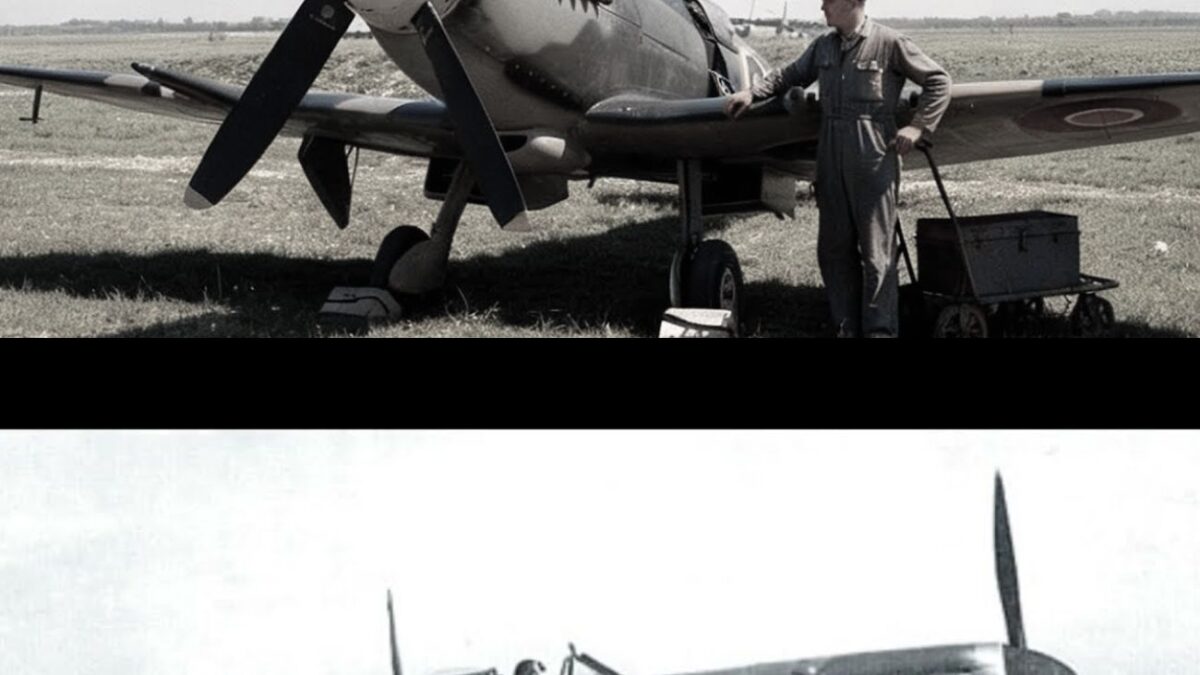
The autumn rain of 1943 drummed incessantly against the corrugated hangar roof at Supermarine Aviation Works in Southampton. Each heavy drop echoed like a ticking clock, relentlessly marking precious wartime seconds that Britain simply could not afford to squander. Under the harsh glare of industrial floodlights, tired mechanics worked around the clock on what should have been the Royal Air Force’s most devastating interceptor.
The Spitfire Mark 21 was supposed to be the ultimate refinement of Reginald Mitchell’s immortal, sweeping elliptical design. It promised terrifying speed, heavy punch, and the legendary low-altitude agility that had snatched victory from the Luftwaffe during the darkest hours of the Blitz. Instead, on the soaked tarmac outside, the newly fitted engine had turned Britain’s most graceful thoroughbred into an uncontrollable and deadly mechanical beast.
The culprit sat bolted tightly ahead of the firewall: the gargantuan Rolls-Royce Griffon 65 engine, a sixty-degree V-12 powerplant. Generating nearly two thousand horsepower at sea level, it produced roughly double the output of the venerable Merlin engine that had won the Battle of Britain. Yet all that unbridled fury twisted the sleek airframe with such violent rotational energy that seasoned aviators could barely keep the craft right-side up.
Squadron Leader James McKinnon dropped heavily from the cockpit ladder, his heavy canvas flight suit thoroughly drenched in cold sweat. His calloused hands trembled visibly as he peeled off his sheepskin flight gloves, his knuckles white and drained of blood. It was not fear that shook the veteran ace, but the sheer physical exhaustion of wrestling an enraged machine across the Hampshire sky.
Chief Engineer Malcolm Whitfield hurried across the oil-streaked concrete floor, wiping grease from his calloused palms with a dirty rag. He took one look at McKinnon’s pale, drawn face and stopped short, already knowing the bitter verdict before a single word was uttered. “How bad is she today, Jimmy?” Whitfield asked quietly, the surrounding drone of pneumatic wrenches dropping away in tense anticipation.
“At three hundred and fifty miles per hour, she wants to roll left so violently I nearly spun her into the Solent,” McKinnon spat out. His thick Scottish brogue was laced with deep exhaustion and pure, unadulterated venom directed at the shuddering machine behind him. “The torque from that monstrous engine is trying to twist the nose clear off the fuselage, and past four hundred miles per hour, forget about it.”
“No pilot alive could hold her steady in a dogfight,” McKinnon continued, running a trembling hand through his damp, matted hair. “If a Focke-Wulf dives on your tail and you fire the guns, you’ll fight the rudder just to keep the horizon level.” “You aren’t flying an interceptor up there, Malcolm; you’re sitting astride a runaway bomb that wants to snap its own neck.”
Whitfield stepped forward and laid a solemn hand on the cold aluminum skin of the massive four-bladed Rotol propeller hub. He could feel the faint, dying tremor through the metal, a ghostly vibration that lingered long after the magnetos were grounded. Sir Isaac Newton’s third law of motion had become a lethal operational wall: for every action, there is an equal and opposite reaction.
Every revolution of that enormous single propeller produced an immense aerodynamic and gyroscopic torque reaction against the airframe. At leisurely cruising speeds, a pilot with iron thighs could stomp on the right rudder pedal to keep the nose tracking straight. Yet as airspeed surged toward four hundred miles per hour, the escalating aerodynamic forces magnified the rotational rolling moment beyond human physical endurance.
“The Germans are facing the very same nightmare with their up-rated fighters,” Whitfield muttered, seeking some sliver of solace. “The Focke-Wulf 190 Dora series suffers from nasty torque roll on sudden throttle application, but their squadrons manage through strict doctrine.” “They restrict sudden throttle movement and train their pilots to anticipate the yaw before committing to high-speed dives,” he explained quietly.
McKinnon shook his head with fierce, uncompromising disdain, glaring toward the blacked-out hangar doors rattling in the rising gale. “You cannot negotiate a compromise with fundamental physics, Malcolm, and our lads shouldn’t have to fight their own airframes while dodging cannon shells.” “At the speeds required to break the Luftwaffe over Western Europe, this bird is an unguided missile, and if we can’t fix it, the project dies.”
The stakes looming over the Southampton factory floor were nothing short of catastrophic for the entire Allied air strategy. The Ministry of Aircraft Production had poured millions of pounds and thousands of man-hours into tailoring the Spitfire airframe for the Griffon engine. Assembly lines across the Midlands stood poised to turn out hundreds of Mark 21 airframes to spearhead the upcoming cross-Channel invasion.
Furthermore, the Royal Navy desperately required the naval variant, the Seafire, to protect aircraft carrier task forces in the Pacific theater. Operating from narrow, pitching wooden flight decks, a carrier-borne fighter that veered sharply on takeoff would plunge straight into the churning sea. Failure here meant a gaping chasm in Allied air power precisely as Nazi Germany readied advanced jet and rocket-propelled combat designs.
Fifteen miles away in the drafting rooms of Rotol Airscrews Limited, Joseph Smith sat hunched over a vast sea of blueprint paper. Slide rules, half-eaten sandwiches, and stone-cold cups of bitter tea crowded the edges of his mahogany drafting table. At forty-two, the unassuming design engineer possessed an intuitive grasp of aerodynamic flow that frequently baffled his more conservative contemporaries.
Smith had spent the last fortnight tearing through telemetry sheets, stress logs, and pilot debriefs from every troubled Griffon flight. The standard engineering expedients proposed by the Air Ministry committees had all crashed into dead ends of basic physics. Enlarging the vertical fin and rudder added parasite drag and tail heaviness without quelling the dynamic torque at terminal velocities.
Canting the engine mounts off the centerline weakened the forward structural trusses and introduced asymmetrical yaw during level glides. Trimming the propeller blade chord helped marginally at low speeds but introduced punishing high-frequency vibrations that cracked the cowl fasteners. Conventional wisdom dictated that an airplane should use one engine to drive one propeller in one direction; Smith saw only mathematical stubbornness.
His reputation among the aviation establishment was that of a brilliant maverick whose ideas pushed past the comfort zones of industrial planners. He had crafted variable-pitch propellers that squeezed remarkable climb rates out of earlier fighters, winning praise and sharp rebukes alike. Conservative bureaucrats frequently grumbled that his components demanded manufacturing tolerances better suited to fine Swiss watchmaking than wartime British mass production.
Now, staring intently at the swirling mathematical equations on his ledger, Smith reached for a sharp graphite drafting pencil. His breakthrough emerged not from trying to fight the Griffon’s two-thousand-horsepower rotational torque, but from daring to split it in half. If a single propeller turning clockwise violently twisted the airframe to the port side, the obvious remedy was to cancel the twist entirely.
He began drafting a system of two coaxial propellers mounted on concentric drive shafts, turning in opposite directions from a common powerplant. The forward propeller would slice through the air clockwise, while the rear propeller, spinning immediately behind it, would rotate counterclockwise. The torque created by the forward blades would be neutralized by the opposing torque of the rear set, reducing airframe twist to zero.
Beyond merely taming the beast, the contra-rotating blades would reclaim the vast helical energy normally lost in a conventional spiraling slipstream. The swirling corkscrew of turbulent air discharged by a standard propeller wasted significant energy, deflecting against the tail surfaces and degrading directional stability. A contra-rotating arrangement straightened the slipstream into a pure, clean, horizontal cylinder of accelerated thrust, boosting propulsive efficiency by fifteen percent.
The theoretical elegance was undeniable, but the mechanical penalties required to achieve it were breathtakingly severe. It demanded a dual-output planetary reduction gearbox capable of handling two thousand horsepower while dividing rotational force between two concentric, counter-spinning steel shafts. The gearbox had to be remarkably compact, completely reliable under sustained combat G-forces, and lubricated under savage extremes of high-altitude freezing temperatures.
The next morning, Smith unveiled his initial pencil schematics to the assembled senior engineering staff inside Rotol’s main conference room. The response from his closest colleagues was swift, defensive, and overwhelmingly hostile. Blueprints were pawed over with furrowed brows, skeptical grunts, and dismissive shakes of graying heads around the table.
“It is an absolute mechanical Rube Goldberg contraption, Joseph,” barked Robert Morrison, Rotol’s veteran senior mechanical specialist. “You are proposing to cram a two-stage planetary differential inside an engine nose casing that is already packed tighter than a tin of sardines.” “The gear teeth alone will demand metallurgical tolerances we cannot consistently achieve under current blackout factory conditions,” Morrison added scornfully.
Charles Henley, the weary production manager responsible for output quotas, slammed a heavy hand down onto the mahogany drafting table. “Our machine shops are already starved of trained machinists and specialized tooling, running round-the-clock shifts just to replace operational losses,” Henley argued. “You want to manufacture hollow concentric drive shafts that don’t gall, seize, or shatter when a fighter pulls six Gs in a dive?”
“And what about the weight penalty?” asked David Clark, the firm’s liaison to the naval aircraft procurement board. “That complicated gearbox and the extra hub casting will slap at least two hundred pounds of dead iron onto the nose.” “The Seafire will snap its oleo struts on the first hard carrier deck trap, dumping the whole mess into the drink,” Clark warned.
Smith stood quietly before the chalkboard, his chalk tapping a steady, confident beat against the slate as he outlined his calculations. “Yes, it adds roughly two hundred pounds ahead of the firewall,” Smith admitted evenly, his eyes sweeping across the room without flinching. “And yes, the gear cut must be precise to within five ten-thousandths of an inch to prevent excessive tooth wear and overheating.”
“However, consider what you gain in return,” Smith stated, circling the net thrust vector on the board with deliberate force. “The complete elimination of torque reaction means the pilot never has to fight the stick or stomp the rudder pedals during a full-throttle run.” “The straightened slipstream increases overall propulsive efficiency by nearly fifteen percent, easily buying back every single ounce of that gearbox weight.”
“Instead of an unmanageable flying brick that tries to execute a snap roll at four hundred miles per hour, you hand the RAF an interceptor.” “A clean machine capable of hitting four hundred and seventy miles per hour in level flight, steady as a rock when firing its cannons.” “We are not indulging in academic curiosities here, gentlemen; we are giving our pilots an airframe that can out-turn and out-run anything flying.”
Despite the compelling mathematics, the Rotol management remained deeply split, refusing to commit company funds without high-level ministry approval. Smith took his fight straight to the top, boarding a soot-stained wartime train for London on the freezing morning of November 15, 1943. The headquarters of the Ministry of Aircraft Production on Millbank felt less like an engineering bureau and more like a high military tribunal.
Around an imposing conference table sat senior officers and civil servants whose decisions dictated the survival of the nation’s war industries. Air Marshal Sir Wilfrid Freeman presided at the head of the table, flanked by stacks of operational casualty logs and factory production projections. His steely gaze fixed upon Smith with the weariness of a commander who had seen dozens of radical inventions fail under real combat conditions.
“Mr. Smith,” Freeman began, his voice flat, clipped, and devoid of bureaucratic pleasantries. “We have reviewed your proposal for this dual contra-rotating propeller system, and my technical staff remains profoundly unimpressed.” “The consensus among our engine directors is that you are introducing terrifying mechanical complexity at the very hour we need proven simplicity.”
Sir Roy Fedden, one of Britain’s most celebrated engine designers, leaned forward, his spectacles glinting coldly under the electric chandelier. “Your design calls for an inner drive shaft rotating inside an outer sleeve, separated by specialized high-load needle bearings,” Fedden pointed out. “If a single bearing overheats at twenty-five thousand feet, or a single gear tooth strips under full combat boost, both propellers seize instantly.”
“You will transform a flying fighter into a three-ton glider in less than half a second,” Fedden said, his voice brimming with engineering skepticism. “The field maintenance in muddy forward airfields in France or dusty strips in the Mediterranean will ground entire squadrons within a fortnight.” “How do you expect twenty-year-old ground crew mechanics to service a twin planetary gear system between combat sorties?” he demanded.
Smith reached into his leather portfolio, sliding a set of precisely drawn schematics across the polished tabletop toward the skeptical committee. “De Havilland proved that hydraulic variable-pitch mechanisms could be serviced reliably in the field with proper modular casing design,” Smith countered. “Our gearbox is enclosed as a single sealed cartridge unit that can be swapped out completely in under forty-five minutes using standard field wrenches.”
“The forward propeller operates at a reduction ratio of 0.77-to-one, while the rear counter-rotating unit turns at 0.62-to-one,” Smith explained calmly. “The differential gear teeth are bathed in a continuous high-pressure oil bath fed directly from the main engine sump through a scavenge pump.” “We are not guessing at these margins, Sir Roy; we have engineered the gear teeth with a structural safety factor of three.”
Group Captain Peter Thornton, representing RAF Fighter Command operations, flipped through a dossier of grim operational reports from the front. “The Mark 21s are rolling off the line at Castle Bromwich right now, Mr. Smith, and our frontline squadrons refuse to fly them in combat.” “The pilots call them widow-makers because you cannot hold an enemy fighter in your gun-sight while wrestling the torque roll.”
“If your contra-rotating airscrew can truly fix that without robbing the aircraft of its top-end dash, we need it yesterday,” Thornton declared. “Every intelligence report crossing my desk warns that the Germans are accelerating high-altitude trials of their pressurized Messerschmitt and Focke-Wulf fighters.” “We cannot afford to let them hold the vertical advantage over Normandy when the invasion fleet sets sail this coming summer,” he added grimly.
Air Commodore Ralph Sorley, whose tactical vision had helped champion the eight-gun monoplane fighter before the war, locked eyes with the designer. “Mr. Smith, your record with Rotol speaks for itself, but I must look you in the eye and ask a direct, unvarnished question.” “Are you prepared to stake your entire professional career on this contraption delivering on its promises without grounding the Mark 21 program?”
“I stake my career, my reputation, and every penny I possess on it, Sir,” Smith answered without the slightest flicker of hesitation. “The physics are absolute, the engineering is robust, and the resulting aircraft will be the most lethal piston fighter in the world.” “Grant me six weeks to manufacture the gearbox cartridge and assemble the matched blade sets, and we will prove it in the air.”
Freeman tapped his fountain pen against the table blotter, trading silent glances with the seated officers before rendering his verdict. “You have six weeks for the gearbox, Mr. Smith, and four weeks for final fabrication and static balancing,” Freeman decreed sternly. “One prototype airframe will be assigned to you at the Aeroplane and Armament Experimental Establishment at Boscombe Down for exhaustive flight trials.”
“However, understand this clearly: if your contraption fails or delays standard production by so much as a single week, the program is scrapped.” “We will cancel the contract, pull the tooling, and revert to detuned engines with conventional propellers, regardless of the performance loss.” “The fate of the Mark 21 sits squarely upon your shoulders, Joseph,” Freeman concluded, closing the folder with a sharp, final snap.
Smith returned to the Rotol workshops with an authorized development warrant and the weight of the entire RAF resting upon his shoulders. For the next forty-two days, the machine shop floor operated in an unbroken, deafening rhythm of twenty-four-hour manufacturing shifts. Skilled toolmakers machined high-tensile nickel-chromium steel gear blanks, inspecting each cut under optical comparators to guarantee microscopic accuracy down to the tenth.
The concentric drive shafts posed a terrifying metallurgical riddle, requiring boring out solid steel forgings over four feet long without introducing internal stress fractures. Each of the six duralumin propeller blades—three for the front unit, three for the rear—had to be hand-sculpted and balanced against its partners. Even a variance of half an ounce between opposing blade tips would generate punishing harmonics capable of shaking the airframe to pieces.
By the second week of February 1944, the completed assembly was crated and rushed under armed military escort to Boscombe Down in Wiltshire. There, in the cavernous expanse of Hangar Seven, engineers mounted the revolutionary mechanical nose onto Spitfire serial number RK958. The aircraft looked unlike any Spitfire that had ever left a dispersal bay, exuding a predatory, almost alien industrial menace.
Two massive three-bladed airscrews, each eleven feet across, overlapped on the nose, separated by a gleaming steel hub only inches apart. The forward blades swept clockwise; the rear blades sat angled to sweep in reverse, their counter-curved profiles defying all aeronautical convention. Ground crews and veteran pilots stopped in their tracks to stare, shaking their heads at the sheer, audacious audacity of the contraption.
The morning of February 23, 1944, arrived across Salisbury Plain with a bitter, freezing gale whistling through the gaps in the hangar doors. Twenty-four-year-old Squadron Leader Jeffrey Wellum stood beneath the wing of RK958, zipping his leather Irvin jacket against the cutting wind. Despite his youth, Wellum was an old hand, having survived the desperate scrambles of 1940 and flown over eight hundred combat hours.
His legendary analytical precision in the cockpit had made him one of the testing establishment’s most trusted and demanding evaluation pilots. “She looks like an angry dragon with a mechanical jaw, Joseph,” Wellum remarked, looking up at the towering, tiered propeller blades. “The forward unit rotates at 1,825 rpm, while the rear turns at 1,475 rpm through the internal differential,” Smith briefed him quietly.
“Between them sits one hundred and ninety-three pounds of precision planetary gearing, balanced down to the fraction of an ounce,” Smith explained. “Your flight profile calls for a clean, gradual climb to eight thousand feet, level runs at stepped power, then acceleration toward maximum boost.” “Above all, Jeffrey, pay close attention to your feet on the rudder bar during sudden changes in engine throttle settings,” Smith instructed.
Chief Test Engineer Michael Lithgow hovered nearby with a wooden clipboard clamped tightly under his arm, his brow creased with worry. “Ground-running runs showed steady oil pressure at sixty pounds per square inch, but we noted faint harmonic flutter around eighteen hundred engine rpm.” “Keep a sharp eye on that reduction gear casing thermometer, Jeffrey; if she spikes past ninety degrees, throttle back immediately and glide home.”
Wellum nodded, strapped on his leather helmet, and hoisted himself into the narrow, familiar cockpit that smelled of high-octane fuel and doped canvas. Yet the instrument panel before him featured new dials: forward pitch indicator, rear pitch differential, and an auxiliary gearbox oil pressure gauge. He adjusted his rudder pedals, locked his harness tight, and signaled the ground crewman stationed at the external trolley accumulator.
“Contact!” Wellum called out, throwing the master ignition switch and hitting the pneumatic starter button with his thumb. The Griffon engine coughed, spat twin plumes of blue-gray exhaust smoke from its twelve stub ejectors, and roared into life with a deafening boom. Yet the sound washing over the airfield was unlike anything heard in the history of British aviation.
Instead of the familiar, steady, rhythmic thrum of a single propeller, the contra-rotating blades created an eerie, overlapping acoustic resonance. It was a deep, menacing, twin-toned growl that seemed to vibrate straight through the hangar walls and into the marrow of one’s bones. Wellum glanced at his auxiliary oil gauges, noted steady needles, and waved the chocks away with a curt flick of his glove.
At precisely 9:32 AM, Boscombe Control cleared the experimental fighter for takeoff on the long bitumen runway facing into the teeth of the wind. Wellum took a deep breath, braced his right leg for the brutal, habitual leftward yaw of the Griffon engine, and smoothly advanced the throttle quadrant. The supercharger kicked in with a sharp hiss, unleashing nearly two thousand horses of raw thermodynamic fury straight into the reduction gearbox.
Then, an aeronautical miracle occurred that left Wellum wide-eyed behind his tinted flying goggles. There was no violent swing to the port side, no frantic need to stand on the right rudder pedal to save the wings from scraping the grass. The Spitfire surged down the painted white centerline as straight and true as an artillery shell fired from a rifled naval gun barrel.
The opposing rotational forces canceled each other out with mathematical precision, leaving the directional controls completely neutral and docile. At eighty-five miles per hour, Wellum gently eased the spade grip stick back, and RK958 levitated cleanly off the runway into the frosty Wiltshire sky. Inside the cockpit, the young squadron leader let out a breathless, joyful laugh into his oxygen mask; the dreaded torque beast was completely dead.
Yet, as the fighter passed through three thousand feet in a steep climb, a troubling sluggishness began to drag at the airframe’s responsiveness. Wellum glanced down at his rate-of-climb indicator and noticed the needle lagging far behind where a Griffon-powered Spitfire ought to have been. He was shoving the throttle past eighty percent boost, yet the aircraft ascended at barely eighteen hundred feet per minute, wheezing under the strain.
The additional drag and the unresolved aerodynamic slipstream patterns between the opposing blades were robbing the airframe of its anticipated vertical agility. “Boscombe Control, this is Test Twenty-Seven,” Wellum radioed, his voice straining against the roar of the slipstream whistling past the bubble canopy. “Climb rate is markedly sluggish, requiring near-maximum boost to sustain two thousand feet per minute; requesting level-off at six thousand for handling checks.”
“Test Twenty-Seven, you are cleared to level out,” Lithgow’s tense voice crackled back through the headphones from the tower. “Watch your cylinder head temps and report back on control column forces as you settle into cruise trim.” Wellum leveled the nose, reduced the engine throttle back to standard cruising revs, and allowed the aircraft to stabilize along the horizon.
Here, in straight-and-level flight, the aircraft transformed back into a masterpiece of aeronautical harmony. Freed from torque reaction, the Spitfire flew with an uncanny, glass-smooth stability that made it feel lighter and more obedient than any previous variant. He racked the machine into a sudden, vertical sixty-degree bank to the left, then snapped the control stick instantly hard over to the right.
The fighter reversed direction with breathtaking, lightning agility, carving through the cold sky without the slightest hint of adverse yaw or nose drop. It handled like the legendary early Mark Is that had saved London, but backed by twice the brute engine power beneath the cowl. Wellum checked his airspeed indicator: three hundred and twenty miles per hour, purring like a contented cat with hands off the flight stick.
Confidence surging, Wellum decided it was time to push the aircraft toward the outer boundary of its promised performance envelope. He pressed the pitch override lever forward, locked the radiator gills open, and shoved the polished throttle quadrant straight to the firewall. The Griffon engine howled, the supercharger screamed, and the airspeed needle crept rapidly past three hundred and fifty miles per hour.
Three hundred and sixty miles per hour clicked past, then three hundred and seventy. Suddenly, without the slightest aerodynamic warning, a violent, bone-rattling shudder tore through the entire length of the airframe. It was not a gentle oscillation, but a savage, high-frequency shudder that blurred the instrument panel into an unreadable smear of glass and needles.
The dual propeller assembly ahead of the nose had struck a catastrophic resonance frequency, fighting its own turbulent, supersonic tip vortices. The violent vibration slammed through the rudder pedals and control stick, nearly tearing the grip directly from Wellum’s white-knuckled fist. In the rear of the cockpit, rivets creaked and groaned under unnatural torsional stresses that threatened to rip the engine mounts clean from the firewall.
“Boscombe Control! Test Twenty-Seven! Experiencing catastrophic airframe vibration at three-seven-zero!” Wellum shouted, fighting the bucking control stick. “Controls are fluttering wildly! Backing off throttle immediately! Aborting test run and returning to circuit!” He yanked the throttle back to idle, chopped the mixture lever, and prayed the stressed aluminum airframe would hold together long enough to glide home.
As the engine rpm dropped, the terrifying vibration subsided into a dull, sullen clatter within the reduction casing. Descending back toward the airfield, Wellum discovered yet another unwelcome aerodynamic surprise born of the experimental dual airscrews. With the throttle closed, the twin sets of six stationary blades acted like an immense solid airbrake, drastically steepening his glide angle.
The aircraft dropped toward the turf threshold like a lead weight, forcing Wellum to nurse the throttle delicately to avoid undershooting the runway. He touched down hard on the tarmac, bouncing once before setting the tailwheel down and letting the rolling fighter coast to a stop near Hangar Seven. When he cut the magnetos, the silence that enveloped the cockpit was thick, suffocating, and dripping with bitter, crushing disappointment.
Ground crews and fire tenders swarmed the idling fighter, their fire extinguishers primed as the smell of scorched bearing grease drifted from the nose. Wellum sat motionless in the cockpit for a long minute, his hands trembling violently once more from pure adrenaline and physical strain. When he finally slid back the canopy and pulled off his flight helmet, his eyes found Joseph Smith standing silently by the wingtip.
Two hours later, the emergency debriefing inside the hangar office carried the grim, unforgiving atmosphere of a wartime court-martial. Air Commodore Sorley had driven down at breakneck speed from the Air Ministry in London, his leather briefcase slamming onto the scarred table. The room was packed with stony-faced officers, metallurgists, and design staff, all looking toward Smith like prosecutors eyeing a fallen defendant.
“Give us your report without embellishment, Squadron Leader Wellum,” Sorley commanded, his eyes fixed on the young combat veteran. Wellum stood tall, his flight suit still stained with sweat, his voice measured and brutally honest. “On the ground run and during takeoff, the system performed beyond our wildest hopes, Sir; directional torque is completely eliminated.”
“You can take off with your feet flat on the floor, and below three hundred and fifty miles per hour, the handling is sublime.” “It is steady, razor-sharp, and completely predictable, offering the best gun platform characteristics of any fighter aircraft I have ever flown in my life.” The assembled engineers exchanged startled, hopeful glances, but Wellum’s voice immediately hardened, dropping the hammer on their fleeting optimism.
“However, past three hundred and seventy miles per hour, the aircraft becomes an absolute deathtrap,” Wellum stated plainly. “The resonance vibration is so violent that I could not read my altimeter or airspeed indicator, and the airframe was seconds from structural disintegration.” “Furthermore, our climb rate is degraded by nearly thirty percent compared to standard single-propeller variants; the system is currently unviable for combat.”
Sir Roy Fedden leaned back in his chair, his arms crossed triumphantly over his chest, his expression one of vindicated skepticism. “Precisely what our theoretical calculations predicted from the very outset, Mr. Smith,” Fedden declared with cold, cutting finality. “The aerodynamic interaction between the two blade sets at high Mach numbers creates destructive shockwaves and wake turbulence that cannot be eliminated.”
“You have traded a known, manageable torque issue for an uncontrollable aerodynamic flutter that will snap crankshafts and tear airframes apart in midair.” “Every hour we waste pursuing this mechanical white elephant is an hour taken away from retrofitting conventional rudders to the production Mark 21s.” “The invasion of the continent is months away, and we cannot send our frontline squadrons into battle with an unproven, temperamental laboratory experiment.”
Smith stood up slowly from his seat, his hands resting flat upon his scattered sheets of flight test telemetry and balance charts. His hair was disheveled, his eyes ringed with dark circles of sheer fatigue, but his engineer’s gaze burned with absolute, unshakeable conviction. “The core concept has just been proven completely sound by Squadron Leader Wellum himself,” Smith replied, his voice calm, steady, and resolute.
“We solved the torque roll that crippled this aircraft for six months; we proved that contra-rotating propellers eliminate airframe twist.” “The vibration we encountered today is not a fatal failure of the concept; it is an acoustic and aerodynamic resonance between the two blade discs.” “Because our gear ratios spun the forward and rear blades at mismatched speeds of 1,825 and 1,475 rpm, their acoustic frequencies collided at high speed.”
“The tip vortex shed by the forward blade disc was striking the leading edges of the rear blades at their critical harmonic frequency,” Smith argued. “It acted like an air hammer slamming against the rear propeller fifty times every second, exciting the natural vibration mode of the engine mount.” “We do not need to abandon the design; we simply need to retune the harmonic frequencies away from the fighter’s combat flight envelope.”
Michael Lithgow looked up from a scratchpad of vibration frequencies, his pencil paused mid-stroke as he checked Smith’s rapid deductions. “If we adjust the planetary gear train to bring the speed differential closer together—say, seventeen hundred and fifteen hundred rpm—we alter the strike pattern.” “And if we redesign the blade twist distribution, washing out the pitch at the tips, the forward vortex will slip harmlessly past the rear hub,” Lithgow mused.
Sorley checked his pocket watch with an expression of cold, calculating military urgency, balancing operational necessity against technical promise. “How long to machine new internal planetary gears and hand-carve six completely re-profiled propeller blades, Mr. Smith?” Sorley asked quietly. “Three weeks of non-stop work in the toolroom, Sir,” Smith answered without flinching, meeting the Air Commodore’s gaze with unwavering confidence.
“Three weeks, and not a single day more,” Sorley ruled, his voice carrying the finality of an iron gavel striking stone. “This is your final chance, Joseph; if that aircraft vibrates, falters, or fails to exceed four hundred miles per hour on the next flight, the project is terminated.” “The contract will be canceled, the airframe scrapped, and we will accept whatever compromised fighter the standard factories can give us.”
For the next twenty-one days, the Rotol machine shops were transformed into an intense crucible of round-the-clock precision manufacturing. Smith lived inside the factory, sleeping on a canvas camp bed set up in the corner of the experimental design office. Every single tooth of the new planetary gear assembly was hand-lapped with diamond paste to eliminate micro-chatter under heavy torsional load.
Meanwhile, master woodworkers and aluminum shapers reworked the six duralumin blades, thinning the chord along the outer third of each blade. By washing out the blade twist near the tips, they deliberately sacrificed a fraction of static low-speed thrust to disperse the violent tip vortices. The leading edges were polished until they gleamed like surgical mirrors, guaranteeing that airflow across the dual discs remained perfectly laminar.
On the freezing morning of March 18, 1944, Spitfire RK958 was rolled out once more onto the damp tarmac of Boscombe Down. The pale morning sun broke through the gray winter overcast, glinting off the newly contoured, knife-sharp propeller blades mounted on the nose. The entire high command of the Ministry of Aircraft Production stood waiting by the perimeter grass, wrapped in thick wool greatcoats.
Air Commodore Sorley, Sir Roy Fedden, and Malcolm Whitfield watched in silence as Jeffrey Wellum climbed into the cockpit for the final verdict. At 10:15 AM, the Griffon engine sparked to life, settle into an unbroken, smooth, mechanical hum that lacked any trace of the previous flutter. The revised gear ratios hummed with a tight, high-pitched mechanical whine, like a massive turbine spinning in perfect dynamic equilibrium.
Wellum taxied out to the runway threshold, aligned the aircraft with the painted centerline, and smoothly locked his wheel brakes. He ran the engine up to zero boost, verified that all temperature and pressure needles rested squarely in the green, and released the brakes. With a deliberate, steady push, he advanced the throttle quadrant past the gate and engaged full war emergency supercharger boost.
The Spitfire surged forward down the runway with terrifying, jaw-dropping acceleration, pinning Wellum firmly back against his armored seat rest. Without an ounce of rudder deflection, the fighter tracked along the centerline as if running on greased railroad tracks across the plain. In less than two hundred yards, the tires broke contact with the bitumen, and the aircraft leapt into the sky at an astonishing climbing angle.
Where the aircraft had wheezed and wallowed on its maiden test, the re-profiled blades now bit into the cold air with voracious efficiency. The rate-of-climb needle swept smoothly past twenty-five hundred feet per minute, then crossed three thousand, climbing under only eighty percent throttle. Smith’s aerodynamic refinements had unlocked the Griffon’s dormant power, translating every foot-pound of engine torque into pure, unadulterated vertical climb.
“Boscombe Control, this is Test Twenty-Seven climbing through eight thousand feet,” Wellum’s voice sang over the operational radio frequency. “Climb performance is exceptional, completely transformed from the initial trial; cylinder head temps and gearbox pressures are stable and nominal.” “Leveling out at ten thousand feet to begin high-speed acceleration run across the measured course; standing by for speed checks.”
Wellum leveled the sleek nose, trimmed the elevators with a light touch of his fingers, and smoothly fed in full engine boost. The airspeed indicator raced past three hundred miles per hour, then three hundred and fifty, the airframe cutting cleanly through the sky. Inside the cockpit, Wellum held his breath, his eyes glued to the airframe instruments as the needle approached the dreaded three-hundred-and-seventy mark.
Three hundred and seventy miles per hour flashed past without a shudder. Three hundred and eighty, three hundred and ninety, and then the needle swung past four hundred miles per hour into uncharted aerodynamic territory. There was no vibration, no violent bucking of the flight stick, and no high-frequency flutter threatening to tear the wings from their roots.
The Spitfire flew with an iron, bullet-like stability that defied every traditional instinct Wellum had developed across hundreds of combat hours. The counter-rotating propeller discs had transformed the wild, destructive energy of the two-thousand-horsepower Griffon into pure, undistorted forward velocity. The aircraft felt lighter, more responsive, and more harmoniously balanced at four hundred and ten miles per hour than a standard Spitfire felt at half that speed.
“Boscombe Control! Test Twenty-Seven!” Wellum shouted, his voice ringing with pure, unfiltered joy through the control tower speaker. “Airspeed indicator reading four-one-five level! Repeat, four hundred and fifteen miles per hour in level flight, smooth as silk!” “Handling is magnificent! Controls are light, responsive, and completely harmonized! She is an absolute thoroughbred!”
Standing atop the observation tower, Joseph Smith lowered his binoculars, his breath catching in his throat as tears welled in his tired eyes. Far above in the cold Wiltshire blue, the Spitfire carved a sweeping, effortless vertical victory roll against the pale morning clouds. The impossible idea—the “stupid” contraption that every conservative mind in British aviation had mocked and dismissed—had just rewritten the laws of aerial combat.
For another half-hour, Wellum pushed the experimental interceptor through every punishing combat maneuver in the RAF operational handbook. He hauled the machine into a maximum-rate screaming dive from fifteen thousand feet, watching the airspeed needle rocket past four hundred and seventy miles per hour. Even as compressibility began to stiffen the ailerons at near-sonic speeds, the nose tracked with dead-center, razor-sharp gun platform precision.
He snapped the fighter into a series of punishing six-G high-speed turns, testing the structural rigidity of the concentric propeller shafts. The gearbox ran cool, the differential gears distributed the massive engine stresses without complaint, and the airframe held its line like a dream. When Wellum finally throttled back and joined the landing pattern, the aircraft settled onto the grass with the docile grace of a training glider.
He taxied RK958 straight up to the apron outside Hangar Seven, where the assembled brass and engineers stood waiting in stunned, reverent silence. Wellum cut the twin magnetos, letting the concentric propeller blades spin down until they came to a dead halt, overlapping like twin steel scythes. He pushed the canopy back, peeled off his flying helmet, and looked down from the cockpit directly into the eyes of Air Commodore Sorley.
“Gentlemen,” Wellum announced, his voice carrying the unimpeachable authority of a pilot who had just seen the future of aviation. “What Mr. Smith has built here is not merely an improved Spitfire; it is the most formidable piston-engined fighter in the world today.” “There is not an aircraft flying in the Luftwaffe or anywhere else that can match this machine for speed, climb, and rock-solid gunnery.”
Sorley stood motionless for a moment, then turned slowly toward Joseph Smith, his stern face breaking into a wide, admiring smile. He stepped forward and extended his hand, grasping the weary designer’s ink-stained fingers in a firm, resolute grip of military gratitude. “My deepest apologies for ever doubting your mathematics, Joseph,” Sorley said, his voice thick with unreserved respect and professional admiration.
“Your contra-rotating airscrews have saved this entire program, and with it, our ability to control the skies over Europe.” “Starting tomorrow morning, Rotol receives top priority for all necessary machine tooling, specialized alloys, and factory allocations.” “We are putting this propeller system into immediate mass production for every Spitfire Mark 21 and naval Seafire rolling off the lines.”
In the weeks that followed, the experimental success at Boscombe Down blossomed into an industrial triumph across Britain’s war manufacturing network. The contra-rotating Spitfire Mark 21s and their carrier-borne Seafire sisters became the ultimate expression of wartime high-performance piston fighters. Naval aviators who had once dreaded carrier landings in high-torque fighters could now grease their approaches onto pitching decks with complete directional control.
When the final variants of the Spitfire faced the ultimate challenges of the war—intercepting V-1 flying bombs and engaging enemy jets—they did so with Smith’s design. The twin, counter-spinning blades became an iconic, triumphant silhouette against the skies of liberated Europe and the vast stretches of the Pacific Ocean. They stood as an enduring monument to the power of daring engineering over conservative tradition in the furnace of total war.
Beside the silent, gleaming prototype resting inside the hangar, Joseph Smith packed his slide rules and grease-smudged drafting notes into his worn leather case. Outside, the Hampshire rain had finally stopped, replaced by a brilliant shaft of spring sunlight breaking through the clearing clouds above Southampton. An idea once branded as impossible, absurd, and foolish by an entire industry had become the definitive weapon of Allied air supremacy.

